Pruning wound protectant application timing and documentation
TL;DR
- Apply pruning wound protectants within 24 hours of cutting, ideally right after each cut or at the end of each pruning day.
- Waiting 24 to 72 hours measurably raises infection risk from Eutypa lata, Botryosphaeria, and Esca fungi.
- Every application needs a dated spray record with product name, EPA reg number, rate, and applicator ID to stay compliant with your state's pesticide use reporting rules.
Why does application timing matter so much for wound protectants?
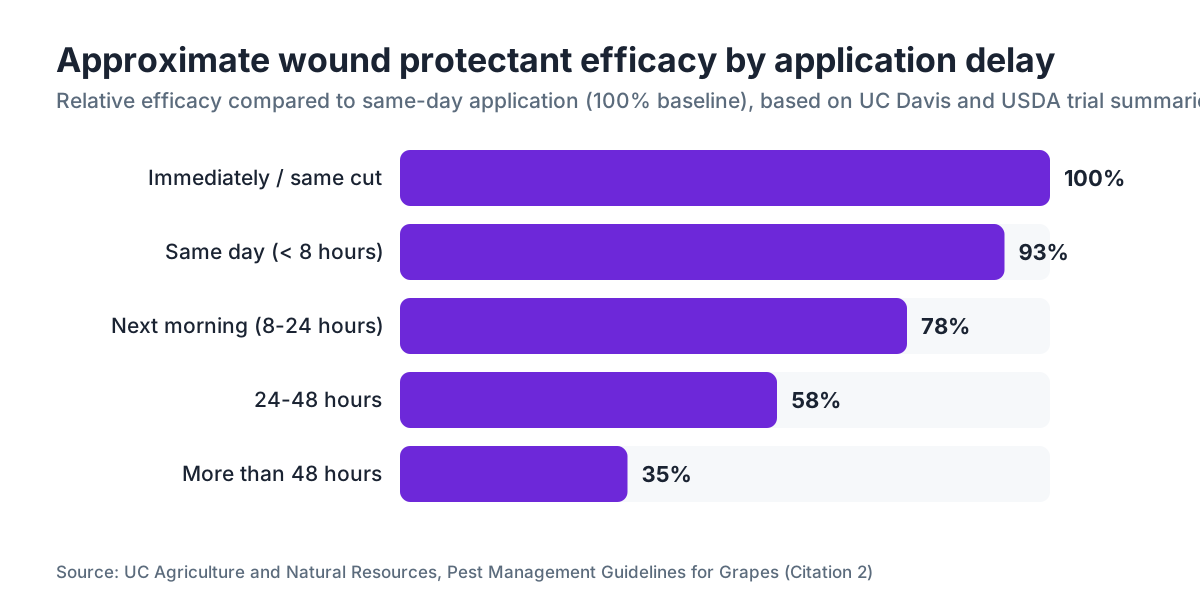
A fresh pruning cut is an open wound on a woody plant, and wood-rotting fungi like Eutypa lata don't wait around. Research from UC Davis found that Eutypa spore germination and early wood colonization can begin within hours of a cut being exposed, especially when pruning happens during wet winters when spore loads peak. [1] That window is not theoretical. Field trials measuring lesion size show that same-day protectant treatments beat applications made 24 hours later, and anything past 48 hours does almost nothing to stop spores already sitting on the cut surface. [2]
The fungi behind grapevine trunk diseases (GTDs) live in most commercial vineyards already. Botryosphaeriaceae species can infect through wounds in dry conditions, while Eutypa lata rides rain events that mobilize ascospores. The lesson is simple. If rain is forecast within 24 to 48 hours of pruning, get product on those cuts before the rain, not after.
Timing also matters legally. If your wound protectant is a registered pesticide (most commercial formulations are), the label is a federal legal document. The EPA requirement to apply at the labeled rate and timing is not a suggestion. Applying a product outside the labeled use window can void your legal protection under FIFRA and expose your operation to liability. [3]
What is the recommended application window after pruning cuts?
Immediately is always better, same-day is good, next morning is acceptable, and 48 hours is the outer edge of usefulness. That's the honest ranking.
UC Davis Cooperative Extension recommends applying wound protectants within 24 hours of pruning as standard practice, with same-cut application being ideal when labor allows. [1] Cornell's viticulture extension group says the same, noting that some products containing Trichoderma species (a biological control organism) need live tissue to colonize, so very fresh cuts give the best results. [4] Washington State University extension adds that the spore deposition from a single rain event can overwhelm a late or missed application. [5]
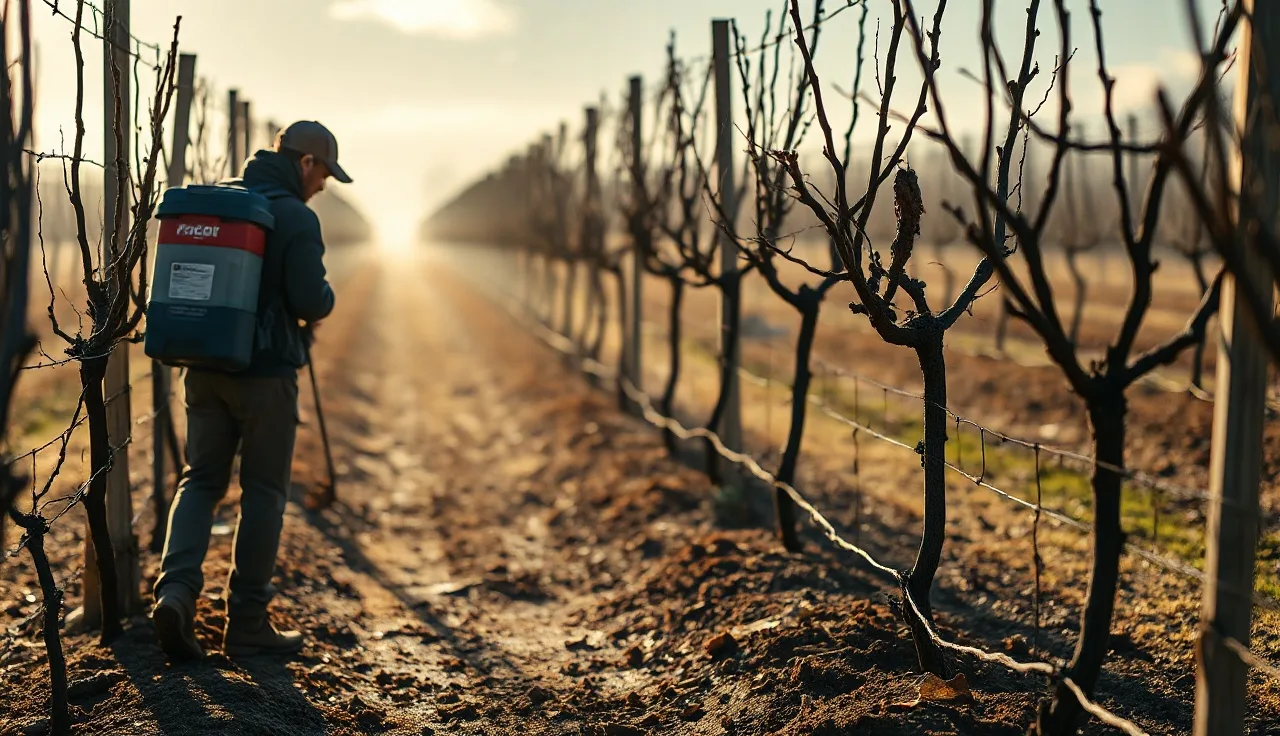
Applying to each cut the moment it's made is usually only feasible in small blocks or on grafts. Most vineyards use end-of-row or end-of-day application, where a second worker or the pruner follows with a backpack sprayer or squeeze bottle. That's a reasonable compromise as long as the same-day target holds.
A few products formulated as wound protectants, including those based on Trichoderma asperellum and T. gamsii strains, carry label language requiring application within a set number of hours. Read that section of the label for your product. The label requirement overrides any rule of thumb.
| Time after cut | Relative efficacy (vs. same-day) | Notes |
|---|---|---|
| Immediately / same cut | 100% baseline | Best for high-disease-pressure sites |
| Same day (< 8 hrs) | ~90-95% | Standard target for commercial blocks |
| Next morning (8-24 hrs) | ~70-85% | Acceptable if no rain overnight |
| 24-48 hrs | ~50-65% | Marginal; re-evaluate if spore conditions high |
| > 48 hrs | < 40% | Generally not recommended |
Note: Relative efficacy figures are approximate ranges pulled from multiple UC Davis and USDA trial summaries; no single study covers all product types and cultivars. [1][2]
Which products are registered for grapevine wound protection?
Three main categories of registered pruning wound protectants get used in California, Washington, and New York vineyards today.
First are biological fungicides based on Trichoderma species. The most widely referenced is Vintec (containing T. asperellum Strain T34), registered by Bayer. A second product, RootShield PLUS, contains both T. harzianum and T. virens and is labeled for wound treatment in some states. Biological products are popular in wineries chasing organic certification since some are OMRI-listed, but they need careful attention to water pH, UV exposure, and shelf life. [4]
Second are wound sealants that pair a physical barrier with a fungicide, like Topsin-M (thiophanate-methyl) mixed into a latex paint carrier. This is a common DIY approach in California. Thiophanate-methyl has systemic activity against Eutypa and Botryosphaeria. The mix ratio matters: typically one part Topsin-M 70WP per gallon of water-based white latex paint. This is an off-label use in many states, so verify your state pesticide regulations before using it. [2]
Third are copper-based products, broad-spectrum and OMRI-listed for organic programs. Copper hydroxide and copper sulfate wound treatments have long historical use, though the efficacy data for trunk disease prevention specifically is thinner than for biological or thiophanate-methyl approaches. [5]
EPA registration numbers for any of these appear on the label (format: EPA Reg. No. XXXXX-XXX). You need that number in your spray record. Period.
How do rain events change your timing strategy?
Rain is the main driver of Eutypa lata infection and a big driver for several Botryosphaeriaceae species. Ascospores are splash-dispersed and wind-carried. The decision rule most advisors use: if more than 0.1 inch of rain is forecast within 48 hours of pruning, get protectant on those cuts before the rain arrives. Treating cuts after a rain event that already soaked them is closing the barn door after the horse is gone.
WSU extension research found that most Eutypa infections in Pacific Northwest vineyards happen November through March, when pruning and rainy weather overlap. [5] California's Central Valley has a shorter window of concern, but coastal and foothill vineyards get real winter rainfall during the same period when dormant pruning is standard.
If you prune in dry stretches, same-day application is still the standard, though the urgency drops a notch because spore dispersal needs moisture. Growers in arid regions like eastern Washington and the San Joaquin Valley have more flexibility. Even so, Botryosphaeria species can infect through dry-weather wounds, so a dry season is no excuse to skip treatment.
Watch the forecast at the block level, more than regional weather. A block on a north-facing slope with a trunk disease history deserves more aggressive timing than an open, well-drained block with a clean record.
What records do you legally need to keep for wound protectant applications?
This is where a lot of small vineyards are genuinely under-documented. If the product carries an EPA registration number (nearly all commercial wound protectants do), you have pesticide use reporting obligations.
At the federal level, the EPA Worker Protection Standard (WPS) doesn't require a pesticide application log in a specific format, but it does require certain information be available to workers and handlers. [3] The real documentation burden comes from your state. California has among the strictest rules: under the California Department of Pesticide Regulation (CDPR), every restricted-use pesticide application requires a report to your county agricultural commissioner within 7 days, and general-use pesticide applications must also be documented. [6] Washington requires licensed commercial pesticide applicators to keep records for at least 7 years under WAC 16-228. [7] New York's DEC requires commercial application records for 3 years. [8]
Whatever your state's law, the minimum record every application needs is:
- Date and time of application
- Field or block ID and acres treated
- Product name and EPA registration number
- Active ingredient
- Amount of product applied (and water volume if diluted)
- Pest or purpose (e.g., "pruning wound treatment, trunk disease prevention")
- Applicator name and license number (if required in your state)
- REI (re-entry interval) from the label
Keeping these by hand in a field notebook is legal everywhere, but searching paper during a state inspection is slow and error-prone. Plenty of vineyard managers now use digital spray logs. VitiScribe, for example, is built for vineyard compliance recordkeeping and lets you attach product label details and block maps to each application entry, which makes audit prep much faster.
One more thing. If you're applying any WPS-covered pesticide, you must post application and REI information at a central location workers can reach. The REI for many wound protectant products is 4 hours (dry), but check your specific label. [3]
How should you document wound protectant applications in your spray records?
The best spray records hold up when a county ag commissioner walks into your office unannounced. That means complete, consistent, and legible.
For each application, record the exact product as it appears on the label, not a shorthand or brand nickname. Write "Topsin-M 70WP," not "Topsin" or "the fungicide." Copy the EPA Reg. No. straight off the label. Write the rate as the label states it (e.g., "1.5 oz per gallon") and separately note the total product used. If you're mixing into a paint carrier, document that too: the carrier product, the ratio, and the total volume mixed.
Block identification should match your ranch map. If your blocks are labeled A through F on the map, use those exact labels in your records. Vague entries like "east side of vineyard" create problems during audits.
The REI matters, especially if any workers re-enter treated areas the same day or next morning. Write the REI on the record and note what time it expires. In California, this is a specific CDPR requirement. [6]
For organic operations, add the certifier-required notation: confirm the product is on your OMRI list or has been pre-approved by your certifier. A record that says "Vintec (OMRI-listed, approved by [certifier name])" is much cleaner than one that leaves a certifier guessing.
Date and sign every entry the day you make it. Records dated days after the application are a red flag during audits. If multiple applicators work a block on the same day, note each person who applied product and the sections they covered.
Does pruning season timing affect which protectant you should choose?
Yes, and it's an underappreciated factor.
Early dormant pruning, meaning cuts made in November and December when temperatures are cold and vine tissues are dormant, carries higher Eutypa infection risk in regions with early winter rain. Trichoderma-based biological products need some moisture and moderate temperatures to establish. In very cold conditions (below 40 degrees F soil and tissue temperature), their efficacy drops. A synthetic fungicide or copper-based barrier product may be more reliable for very early-season applications in cold climates. [4]
Late dormant pruning in February and March, common in California's coastal regions and in New York where growers delay to reduce frost risk, lines up with rising temperatures that favor biological products. Trichoderma-based products tend to perform better in this window.
Double pruning, where growers make a long cane cut in fall and then return to the final spur or cane position in late winter, is an increasingly popular trunk disease strategy. The first (spur-leaving) cut in fall usually doesn't need protectant treatment since you're cutting well above the wood you want to keep. The final cuts in late winter do. UC Davis Cooperative Extension recommends double pruning combined with wound protection as the most effective trunk disease prevention program available to growers. [1]
Managers running this approach need spray records for the final-cut application, not the fall pre-pruning pass. Make sure your records clearly separate the two.
What application methods actually work in a commercial vineyard?
Three realistic methods, depending on your scale.
A backpack sprayer with a small cone nozzle is the most flexible and most common. One applicator follows the pruners row by row, making a single directed spray at each cut surface. This works well in blocks up to about 20 acres with a dedicated second person. The downside is labor cost: you add roughly one labor hour per acre on top of your pruning crew.
Squeeze bottle or paint brush application, with a wound sealant paste or paint-mixed fungicide, is slower but gives precise coverage and minimal drift. It's common in small blocks, heritage vineyards, or situations where you're treating only the largest cuts (2-inch diameter and up). Research supports treating all cuts on a trunk disease program, not only the largest, though resources sometimes push growers toward the bigger wounds.
A mist blower or low-volume air blast sprayer is an option in large contiguous blocks. You can make a calibrated pass right behind the pruners. The catch is coverage: a broad spray struggles to hit individual cuts, and drift risk climbs. Some growers use this in blocks with very high cut density and get acceptable results, but directed application is more reliable per cut. [2]
Whatever method you use, note it in your spray record. "Backpack sprayer, 15 GPA, cone nozzle" is a complete record. "Sprayed" is not.
If your vineyard operation is growing and you want to see how spray records tie into your broader compliance picture, the vineyard operations hub has more on field record systems.
Are there any EPA Worker Protection Standard requirements specific to wound protectant applications?
The EPA Worker Protection Standard (WPS), codified at 40 CFR Part 170, applies to any agricultural pesticide use, including wound protectants applied in vineyards. [3] The 2015 revised WPS strengthened several requirements that hit small vineyard operations directly.
Here's what you need to meet for wound protectant applications.
First, central posting. You must post pesticide application information, including product name, EPA Reg. No., active ingredient, and REI, at a location all workers can reach. The posting stays up throughout the REI.
Second, early entry notification. If any worker needs to enter a treated area before the REI expires, you must follow early-entry procedures. Most wound protectant REIs run 4 hours (when dry) to 24 hours (for some systemic fungicides), so this comes up during active pruning.
Third, handler training. Workers handling pesticides (including applying wound protectants) must receive WPS handler training before their first use. Training records must be kept. The WPS requires handlers receive "pesticide safety training," and those records must be available for inspection.
Fourth, PPE. Personal protective equipment requirements are on the label. Common ones for wound protectant handlers include chemical-resistant gloves, long sleeves, and eye protection. The label is the law; your spray record should note that required PPE was worn.
Fifth, the 11-worker threshold. If you have 11 or more workers or handlers on a given day, you need a designated pesticide safety representative on site. Most small operations fall below this, but know where you stand.
The EPA publishes a practical WPS compliance guide for agricultural employers worth printing and filing. [3] State ag departments often have condensed state-specific versions.
How long do you need to keep wound protectant spray records?
Federal law sets no uniform pesticide recordkeeping retention period for private commercial applicators, so state law governs. The variation is real.
California requires pesticide use records be kept for 3 years, though county ag commissioners can request records going back further during investigations. [6] Washington requires commercial pesticide applicator records for 7 years under WAC 16-228. [7] New York requires 3 years for commercial applicators under state DEC regulations. [8] Oregon is also 3 years. Most other states cluster in the 2 to 5 year range.
For organic certification, the National Organic Program requires production and handling records be kept for 5 years. [9] If your vineyard is certified organic, that 5-year floor likely tops your state's pesticide requirement and should be your default retention period.
The pragmatic answer for anyone running a small vineyard: keep 5 years of spray records as standard, regardless of your state's minimum. Trunk disease litigation, organic certification audits, and multi-year farm loans all benefit from clean, continuous records. Storage is cheap. Reconstruction is impossible.
Digital records in a cloud-based system (with backup) satisfy every state recordkeeping law this article is aware of, as long as the records can be printed or produced on demand. VitiScribe's spray log module timestamps entries at creation, which gives you an audit trail handwritten records can't match.
What mistakes do vineyard managers most commonly make with wound protectants?
Waiting too long. This is the most common and most damaging error. A pruning crew finishes a block on Friday, the manager plans to apply wound treatment Monday. Three days pass with no protection and rain falling over the weekend. By Monday the infection window has closed, in the wrong direction.
Not documenting the application at all. Many small vineyards treat wound protection as part of routine pruning and never enter it as a pesticide application. That creates a compliance gap and complicates organic certification renewals.
Using the wrong rate. Diluting a Trichoderma product too aggressively or mixing a thiophanate-methyl blend with too little fungicide cuts efficacy without cutting your legal reporting obligation. Always mix per label.
Treating only large cuts. There's intuitive logic to focusing on 2-inch-plus cuts, but research shows smaller cuts are also infection courts for trunk disease fungi. [2] A program that treats all cuts consistently beats one that treats only selected cuts.
Not recording the REI or not notifying workers. This is the WPS violation that trips up small operations most often. If your pruning crew re-enters a block within hours of treatment, you need documentation that the REI had expired or that proper early-entry procedures were followed.
Buying product without checking your state's registration. Some biological wound protectants are registered in California but not Oregon, or registered in Washington for one use pattern but not another. Check your state ag department's registered pesticide database before purchasing. Using an unregistered product is a federal and state violation even if it's legal elsewhere.
Frequently asked questions
Can I apply wound protectant the day after pruning or does it have to be the same day?
Same-day application is the standard target, but applying the morning after cuts made the previous afternoon is generally acceptable if no rain fell overnight and temperatures stayed cool. Beyond 24 hours, efficacy declines significantly. UC Davis research indicates same-day application is substantially more effective than 24-hour-delayed application, especially when spore pressure is high during wet winters.
Do I need to document wound protectant applications if the product is OMRI-listed for organic use?
Yes. OMRI listing does not exempt a product from pesticide use reporting. If the product carries an EPA registration number, you have documentation obligations under your state's pesticide use reporting law. Organic certification also requires input records for 5 years under the National Organic Program, so those records serve double duty.
What is the re-entry interval for common pruning wound protectants?
It varies by product. Biological Trichoderma-based products typically carry a 4-hour REI when dry. Thiophanate-methyl products commonly list a 12-hour REI. Copper-based products range from 24 to 48 hours depending on formulation. Always read the specific product label, because the label REI is the legal requirement, not a general guideline.
Is double pruning a good substitute for wound protectants, or do I still need to apply product?
Double pruning reduces the size and number of wounds that need protection on final cuts, but it's not a substitute for wound protectants. UC Davis extension recommends using both practices together as part of an integrated trunk disease management program. The final-cut wounds in late winter still need protectant treatment, and those applications still need to be documented.
What EPA registration number do I use for a thiophanate-methyl plus latex paint mixture?
Use the EPA Reg. No. from the thiophanate-methyl fungicide product (e.g., Topsin-M 70WP). The latex paint is a carrier, not a registered pesticide, so it doesn't have a registration number. Your spray record should list the fungicide product, its EPA Reg. No., the rate used in the mix, and note that it was mixed with white latex paint as a carrier.
How many acres or cuts justify hiring a second person just for wound protectant application?
There's no universal answer because labor costs and disease pressure vary. As a rough benchmark, most advisors consider dedicated wound treatment labor cost-effective in vineyards with any history of trunk disease, vineyards pruned during wet weather, or blocks with vines over 10 years old. The cost of replanting trunk disease-killed vines ($5 to $15 per vine plus lost production years) typically dwarfs a season of wound treatment labor.
Can I use a boom sprayer instead of a directed spray for wound protectant application?
Boom or air-blast sprayers can work in large blocks but tend to produce uneven coverage on individual cut surfaces compared to directed application. If you use broadcast equipment, calibrate for coverage at the cut surface and document the equipment type, nozzle size, pressure, and travel speed in your spray record. Directed application is generally preferred where feasible.
What information does California require in a pesticide use report for wound protectant applications?
California DPR requires: date and time, site location (county, township, range, section or GPS), commodity (grapes), acres treated, product name and EPA Reg. No., amount of product applied, applicator name and license number, and pest-control purpose. Reports for restricted-use pesticides go to the county agricultural commissioner within 7 days. General-use pesticide reports are also required under California's Pesticide Use Reporting system.
Does applying wound protectant within an hour of the cut actually make a measurable difference versus end-of-day application?
The research suggests yes, but the practical difference between a 1-hour and an 8-hour application is smaller than the difference between 8 hours and 48 hours. Most of the measurable benefit comes from getting product on within the same day. Immediate-cut application is most worthwhile in blocks with high historical trunk disease incidence or when rain is forecast within 24 hours.
Are there any wound protectants approved for use in certified organic California vineyards?
Yes. Several Trichoderma-based products (such as Vintec and some RootShield formulations) are OMRI-listed and approved for use in certified organic vineyards. Copper-based products are also approved under organic standards with volume restrictions. Always confirm with your organic certifier before using any input, and keep a copy of the certifier's approval in your records alongside the spray log entry.
How should I handle wound protectant records for blocks split across different fields or AVAs?
Record each block separately. Your spray record should use your internal block ID and enough geographic information to be unambiguous: block name or number, acreage, and GPS coordinates or legal land description if your state requires it. If an AVA matters for marketing or compliance reasons, note it as a descriptor but don't use it as the primary location identifier in a pesticide record.
What happens if I miss documenting a wound protectant application and a state inspector asks about it?
If the record doesn't exist, the application legally didn't happen from an enforcement standpoint. Penalties vary by state but can include fines, license suspension for licensed applicators, and complications for organic certification renewal. The best approach if you discover a documentation gap is to document what you can remember accurately with a note explaining the gap, rather than back-dating or reconstructing entries.
Is there a difference in timing requirements between biological and synthetic wound protectants?
Generally yes. Biological products based on Trichoderma often need live, actively metabolizing wood tissue to establish effectively, making very fresh cuts (under a few hours) more favorable. Synthetic fungicides like thiophanate-methyl work by chemical inhibition and retain efficacy slightly longer after application, though same-day application is still the standard target for both categories.
How do I record wound protectant applications when multiple workers apply the product across a large block in a single day?
Create one record for the block and date, then list each applicator's name and the section or rows they covered. If your state requires individual applicator license numbers on the record, list all of them. Note the total product used and total acreage covered. Some vineyard managers split large blocks into sub-block records if different sections were treated at different times of day.
Sources
- UC Division of Agriculture and Natural Resources: Trunk Diseases of Grapevines: UC Davis Cooperative Extension recommends applying wound protectants within 24 hours of pruning and formally recommends double pruning combined with wound protection as the most effective trunk disease prevention program available to growers.
- UC Agriculture and Natural Resources: Pest Management Guidelines for Grapes, Eutypa Dieback: Field trials measuring lesion size show that protectant treatments applied same-day outperform applications made 24 hours later; efficacy beyond 48 hours is generally insufficient; all cut sizes should be treated.
- EPA: Worker Protection Standard, 40 CFR Part 170: The EPA Worker Protection Standard requires central posting of application information, handler training records, PPE compliance, and early-entry notification procedures for all agricultural pesticide applications including wound protectants.
- Washington State University Extension: Grapevine Trunk Diseases: WSU extension research found that most Eutypa infections in Pacific Northwest vineyards occur during November through March when pruning and rainy weather overlap; Botryosphaeria species can also infect through dry-weather wounds.
- California Department of Pesticide Regulation: Pesticide Use Reporting: California requires pesticide use reports to be filed with the county agricultural commissioner within 7 days for restricted-use pesticides; general-use pesticide applications must also be documented; records must be kept for 3 years.
- Washington State Department of Agriculture: Pesticide Licensing and Recordkeeping, WAC 16-228: Washington state requires licensed commercial pesticide applicators to keep application records for a minimum of 7 years under WAC 16-228.
- New York State Department of Environmental Conservation: Pesticide Reporting Requirements: New York DEC requires commercial pesticide applicators to keep application records for a minimum of 3 years.
- USDA Agricultural Marketing Service: National Organic Program, 7 CFR Part 205: The National Organic Program requires certified operations to keep production and handling records for 5 years, which includes pesticide and approved input application records.
- EPA: Federal Insecticide, Fungicide, and Rodenticide Act (FIFRA), 7 U.S.C. 136 et seq.: Under FIFRA, a pesticide label is a federal legal document and applying a product outside the labeled rate or timing is a federal violation.
- UC Davis Plant Pathology: Eutypa Lata and Grapevine Trunk Disease Research Overview: Eutypa lata spore germination and initial wood colonization can begin within hours of a fresh pruning cut being exposed, particularly during wet winter periods with high spore loads.
Last updated 2026-07-10