How to write a corrective action plan after a harvest food safety issue

TL;DR
- A corrective action plan (CAP) documents what went wrong at harvest, why it happened, what you changed, and how you verified the fix.
- FDA's FSMA Produce Safety Rule requires growers to take corrective actions and keep records for two years.
- A solid CAP runs four to six pages and follows a root-cause structure, not a blame story.
What is a corrective action plan in vineyard food safety?
A corrective action plan answers four questions: what happened, why it happened, what you're doing about it, and how you'll know the fix worked. It's not a punishment document. It's proof you run a serious operation.
In a vineyard, a harvest food safety issue might be a worker illness tied to a sanitation failure, a water test that came back above the FSMA irrigation standard, an equipment breakdown that left harvest bins uncleaned overnight, or an auditor catching your crew skipping the posted hand-washing protocol. Any of these can trigger a CAP, either because your own food safety plan demands it or because a buyer, auditor, or regulator asks.
The FDA's Produce Safety Rule (21 CFR Part 112) says covered farms must "take corrective actions when there is a material failure of a covered activity," and records of those actions must be kept for at least two years [1]. If you're below the FSMA coverage threshold (average annual produce sales under $25,000 over the previous three years), you're technically exempt. Most winery buyers and retail chains still require CAPs as a contract term, no matter your regulatory status.
The document doesn't have to be fancy. Auditors care about specificity and honesty, not formatting. A CAP written in plain language with real dates, named people, and a verification step does more for your standing than a polished PDF that hedges every sentence.
When do you actually need a corrective action plan?
You need one any time a food safety control failed or couldn't be verified. That's the practical rule.
FSMA's Produce Safety Rule treats a material failure as a situation where an established procedure wasn't followed, a monitoring result exceeded a standard, or there's reason to believe produce may have been contaminated [1]. In a vineyard harvest, that covers:
- A generic E. coli or coliform result above the FSMA irrigation water threshold (a geometric mean above 126 CFU/100 mL or a statistical threshold value above 410 CFU/100 mL for surface water) [2]
- A worker testing positive for or showing symptoms of an illness covered by your employee health and hygiene policy
- Harvest bins or picking equipment that wasn't sanitized on your written schedule
- A pesticide residue exceedance flagged by your buyer or a third-party test
- An animal intrusion (deer, birds, rodents) into harvest equipment or a picking zone
- A documented gap in spray records that an auditor calls a Maximum Residue Limit risk
Some of these don't mean the product is unsafe. They do mean you have to investigate, document, and fix. Your food safety plan should spell out which findings require a CAP and who decides. If it doesn't say that yet, add it before your next audit.
One note on pesticide residues: if a buyer's residue test comes back with a finding, the CAP process overlaps with your Pesticide Use Report (PUR) records and your Restricted Use Pesticide (RUP) license documentation. Keep those files linked. An auditor tracing a residue issue will ask to see both.
What's the right structure for a vineyard corrective action plan?
FSMA doesn't mandate a single CAP format, but FDA inspection guidance and the major produce audit standards (PrimusGFS, SQF, USDA GAP) land on the same basic sections [3][4]. Here's the structure I'd use.
Section 1: Issue Description
Date discovered, who found it, where it happened, and what the observable finding was. Keep it factual. "On September 12, 2024, the harvest crew supervisor noted that three picking totes had not been rinsed after the previous day's use" beats "there was a sanitation lapse."
Section 2: Immediate Containment Action
What you did in the next 24 to 48 hours to stop the issue from getting worse. Quarantine the affected bins. Pull the crew for retraining. Stop the irrigation draw from the affected source. Document the time and who did each step.
Section 3: Root Cause Analysis
The hardest part, and the one most CAPs botch. The root cause is not "the worker forgot." It's whatever put the worker in a position where forgetting was possible. Use the 5 Whys method or a simple cause-and-effect diagram. For a sanitation failure, a real root cause might be "the end-of-day sanitation checklist was posted only in English for a crew that is 90% Spanish-speaking, and no supervisor verified completion before the crew left."
Section 4: Corrective Actions
The specific changes you're making to fix the root cause, not the symptom. Each action names a responsible person and a completion date. Skip vague language like "improve training." Write "translate the sanitation checklist into Spanish, laminate and post it at each bin wash station, and require supervisor sign-off by September 20, 2024."
Section 5: Verification
How you'll confirm the fix worked. A follow-up water test, a supervisor observation checklist, a re-inspection of equipment, or a review of the next cycle's records. Set a specific date for the first check.
Section 6: Effectiveness Review
A follow-up entry, made after verification, that confirms whether the corrective actions held. This is often a single paragraph added 30 to 60 days after the initial CAP.
Section 7: Signatures
The person who prepared the CAP, the farm manager or owner who approved it, and the date. If a third-party auditor or food safety consultant reviewed it, add their name too.
How do you do a root cause analysis for a harvest issue?
Root cause analysis sounds technical. In a vineyard it's really just disciplined asking of "why."
Take a real example. A harvest crew skipped the hand-washing protocol at the portable sanitation unit, and the buyer's food safety auditor wrote it up.
Why didn't the crew wash their hands? They didn't know the protocol required it at that task transition.
Why didn't they know? The training happened only at the start of the season, six weeks earlier, and only in English.
Why only in English? The supervisor assumed the crew had seen it in prior seasons.
Why was that assumption never checked? There's no pre-harvest verification step in the food safety plan that confirms crew comprehension.
That's the root cause: a gap in the food safety plan itself, not a worker failing. Now the CAP can address something fixable.
The 5 Whys method works well for human-factor issues like this one. For equipment or environmental problems, a cause-and-effect (fishbone) diagram is often better. Cornell's agricultural food safety extension materials have solid templates for both [5]. UC ANR's produce safety materials also carry harvest-specific root cause worksheets built for California growers, and while much of it points at leafy greens, the logic transfers cleanly to grape harvest [6].
The one trap to avoid: stopping at the first plausible cause. "The water test failed because the creek flooded" is not a root cause analysis. The real questions are why your food safety plan had no protocol for suspending irrigation draws after a flood, and why you weren't testing often enough to catch the problem before harvest.
What records do you need to keep and for how long?
Under FSMA's Produce Safety Rule, corrective action records must be kept for at least two years from the date they were created [1]. That's the federal floor. Some state programs and buyer contracts want longer. California's Leafy Greens Marketing Agreement (LGMA) requires three years for certain records, and several major retail supply chain contracts now specify five years for all food safety documentation.
For a vineyard CAP, the records package should include:
- The CAP document itself, signed and dated
- Any monitoring records that triggered the issue (water test results, employee illness logs, sanitation checklists)
- Training records showing the corrective training was completed, by whom, and when
- Verification records from the follow-up check
- Any lab results from re-testing after the corrective action
Store these as a single incident file. Don't scatter them across binders or digital folders. Auditors under PrimusGFS or USDA GAP want to see the full chain from finding to verification in one place [3].
On paper, keep originals in a binder labeled by year and incident date, with a simple index page. Digitally, a platform that timestamps entries and locks them from retroactive editing is worth having. VitiScribe was built for exactly this kind of vineyard compliance record-keeping, linking spray records, water test results, and corrective action logs in one timestamped system, which matters when an auditor or buyer asks for the complete paper trail on a single incident.
One practical note: the date on the CAP matters. An auditor who sees a CAP dated three days after a finding, with verification records dated two days later, will trust it. A CAP dated the day before an audit, everything wrapped up neatly, raises questions you don't want to answer.
How does FSMA's Produce Safety Rule affect what you have to write?
FSMA's Produce Safety Rule (21 CFR Part 112) is the controlling federal regulation for most commercial grape growers. It took full effect for large farms (over $500,000 in average annual produce sales) in 2018, with staggered compliance dates for smaller operations [1].
The rule doesn't prescribe a CAP format. It requires that covered farms:
- Identify and carry out procedures to address food safety problems when they occur
- Keep records documenting those corrective actions
- Retain those records for at least two years
Section 112.50 is the corrective action provision. It states: "You must take corrective actions whenever you find, or have reason to believe, that a significant deviation from the requirements of this part has occurred" [1]. The phrase "have reason to believe" is broader than it looks. You can't wait for a positive test result before writing a CAP. If you see a practice that violates your food safety plan, that's enough.
FDA's written guidance for Produce Safety Rule compliance suggests that a good corrective action record addresses the root cause, more than the symptom, and includes a plan for preventing recurrence [2]. That guidance isn't legally binding the way the rule itself is, but inspectors use it as their evaluation checklist.
For farms selling to buyers who require USDA GAP or PrimusGFS certification, the CAP requirements are similar but sometimes stricter on turnaround. PrimusGFS, for example, expects a CAP within a defined window after a non-conformance finding, often 30 days for major findings [3].
What's a realistic timeline for completing a corrective action plan?
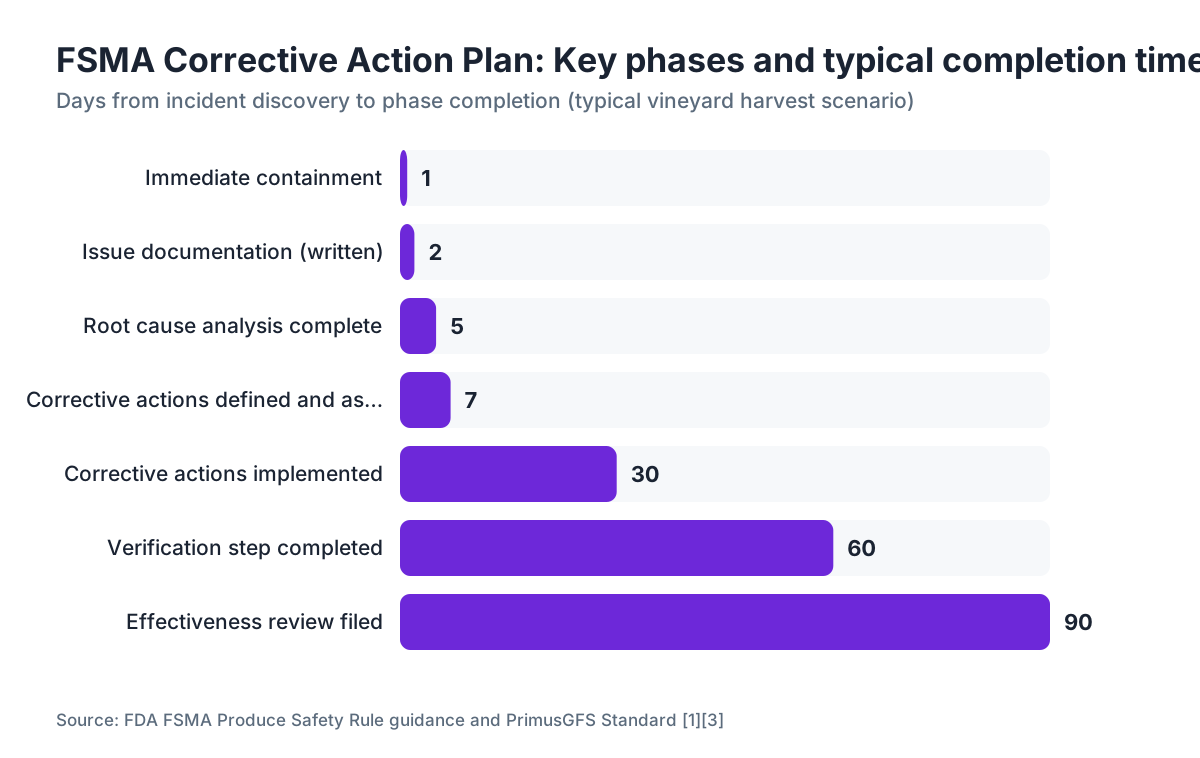
It depends on the severity of the issue and your buyer's requirements, but here's a framework that works for most vineyard situations.
| Phase | Action | Typical Timeline |
|---|---|---|
| Immediate containment | Stop the practice, quarantine affected materials | Within 24 hours |
| Issue documentation | Write the Issue Description section | Within 48 hours |
| Root cause analysis | Complete the 5 Whys or fishbone | Within 3-5 days |
| Corrective actions defined | Assign owners and deadlines | Within 5-7 days |
| Corrective actions implemented | Training, equipment changes, protocol updates | Within 14-30 days |
| Verification | Follow-up test, observation, or record review | 30-60 days after implementation |
| Effectiveness review | Final note added to CAP file | 30-60 days after verification |
For an auditor-flagged finding, many programs expect the CAP document itself (through the "corrective actions defined" phase) within 30 days of the finding, even if some actions are still in progress. Submit what you have with realistic completion dates instead of waiting until everything is done.
For an internal finding you caught yourself, the timeline is looser, but don't let root cause analysis drag past two weeks. The issue is fresh, the crew remembers what happened, and the evidence is available. Waiting three months to write a CAP for something that happened in September is exactly what makes an auditor question whether you run a real food safety program or just document after the fact.
How do worker health and hygiene violations get handled in a CAP?
Worker health and hygiene issues are among the most sensitive CAP situations, and they come up all the time at harvest. A crew member working while visibly ill. A portable toilet that wasn't serviced. A hand-washing station out of soap. An undocumented cut. Each of these is a finding that needs a corrective action record.
FSMA's Produce Safety Rule (Subpart D) covers worker health and hygiene, and EPA's Agricultural Worker Protection Standard (WPS) adds requirements around pesticide-related illness and exposure [7]. If the health issue involves a pesticide, you're inside both frameworks at once.
In a worker health CAP, the containment section should document what you did to protect the worker and whether any produce that may have been exposed got segregated or discarded. Be honest. If you don't know whether contamination occurred, say so, and record the decision you made about the produce.
The root cause for hygiene issues almost always traces back to training frequency, language barriers, or supervision gaps. WSU Extension's food safety materials for tree fruit and berry crops have specific guidance on worker hygiene programs that transfers well to vineyard harvest [8]. Their recommendation is that verbal training be paired with visual aids and that supervisors run random observation checks at least once a day during harvest.
One thing I'd push back on: some operations handle worker illness by documenting only that "the worker was sent home." That's containment, not a corrective action plan. An auditor wants to see what you changed in your system so the next sick worker feels safe coming forward instead of hiding symptoms.
What happens if a corrective action plan is inadequate or incomplete?
An inadequate CAP has three possible consequences, and they scale with severity.
The least serious is an auditor closing the finding as "not corrected" and flagging it for the next inspection. A nuisance, but manageable. You get another shot at a better CAP.
More serious is a buyer refusing product or canceling a contract pending a satisfactory CAP. This happens more often than people expect. A buyer can put your operation on hold for a full season while you prove the fix held. In California's fresh produce supply chain, several retail buyers now have explicit contract language on CAP response timelines, and missing those timelines is grounds for removal from the approved supplier list.
The worst case is an FDA warning letter or, in a confirmed illness cluster, a facility inspection that spreads beyond the original finding. FDA has escalating enforcement tools under FSMA, including administrative detention of produce, suspension of a food facility registration, and mandatory recall authority [1]. These outcomes are rare for vineyard operations, but they're not hypothetical. The Produce Safety Rule gets enforced, and the pattern shows the problem is rarely the original contamination event. It's the absence of documentation that the event was taken seriously.
An incomplete CAP usually looks like this: a description of the finding, a vague line that "staff were retrained," no root cause, no verification date, no effectiveness review. That document fails a PrimusGFS or SQF audit and gives an FDA inspector nothing to work with [3][4]. You want a document that tells a complete story, so anyone reading it a year later understands exactly what happened and how it got resolved.
Can you use a template, or does every corrective action plan need to be written from scratch?
Templates are fine. They beat starting from scratch every time, because a consistent format makes it easier to train new supervisors and easier for auditors to review.
The catch is that the content inside the template has to fit the actual incident. A template CAP where every incident gets the same generic root cause and the same generic corrective action is worse than no CAP at all. It signals the process isn't real.
Cornell Cooperative Extension has a food safety template library with CAP forms built for small and mid-size produce operations, and several adapt directly to vineyard harvest [5]. UC ANR (Agriculture and Natural Resources) publishes a Produce Safety Toolkit with similar materials aimed at California growers [6]. Both are free. Download them before you need them, not after an incident.
For vineyards that want everything linked, including spray records, water test logs, harvest records, and corrective action files, a record-keeping system like VitiScribe lets you attach a CAP directly to the monitoring record that triggered it, which keeps the audit trail clean and stops documents from living in disconnected folders.
One template decision to make upfront: whether your CAP form includes a severity rating (minor, moderate, major) and whether you tie different severity ratings to different response timelines. That kind of tiering is common in PrimusGFS programs and lets you triage findings in a busy harvest without every issue getting the same level of urgency.
What should you NOT do when writing a corrective action plan?
A few patterns come up over and over in CAPs that fail audits or make legal situations worse.
Don't write a blame narrative. A CAP that names a worker as the cause without examining the system that allowed the failure is unfair and useless. It tells auditors you haven't found the root cause, and it creates a paper record that could complicate employment decisions.
Don't backdate or alter records. This should be obvious, but document integrity failures happen when people panic after a finding. FDA inspectors are trained to spot record alteration, and a falsified CAP turns a food safety issue into a potential federal violation under 21 U.S.C. 331 [1].
Don't promise corrective actions you can't finish. If you write "all harvest equipment will be replaced" and miss your stated date, your CAP now documents a second failure. Be realistic about what you can do and when.
Don't skip the verification step. A CAP with no verification is a wish list. The verification section turns it into an actual management tool. Even a simple follow-up observation by a supervisor, documented with a date and signature, is enough for most findings.
Don't confuse a CAPA (Corrective and Preventive Action) with a plain corrective action. Some certification programs, particularly SQF Level 2 and 3, expect a full CAPA that includes a preventive component addressing whether the same issue could happen elsewhere in the operation [4]. If your certification requires CAPA, make sure your template has a separate section for preventive actions beyond the immediate incident.
How do you connect CAP records to your spray records and water test logs?
This is where good record organization pays off. A harvest food safety incident rarely touches just one record type. A pesticide residue finding pulls in spray application records, equipment calibration logs, and product labels. A water quality failure pulls in test results, irrigation maps, and weather records. An equipment sanitation failure pulls in cleaning logs and maintenance records.
The CAP should reference each supporting document by date and file location. Don't copy the documents into the CAP itself. Reference them, so the audit trail stays traceable without getting unwieldy.
For spray records, every pesticide application in California must be reported to the County Agricultural Commissioner through the Pesticide Use Report (PUR) system [9]. If a residue finding triggers a CAP, your PUR records are part of the evidence chain. Make sure your CAP references the specific application dates and products, and that the corrective action addresses any gap in your pre-harvest interval (PHI) tracking or equipment calibration.
For water test records, FSMA's Produce Safety Rule requires covered farms to keep agricultural water test results and maintain a written agricultural water assessment [2]. If a water test failure triggers your CAP, reference the test date, the lab, the parameter that failed, and what you did with any produce irrigated with that water before the failure was caught.
Keeping all of this linked, whether in a binder with a clear cross-reference index or a digital system that ties documents together by date and incident, is the difference between an audit that goes smoothly and one where you're digging through three different places while an inspector waits.
Frequently asked questions
How long does a corrective action plan need to be?
There's no required page count under FSMA or any major audit standard. A CAP for a minor sanitation finding might be one page. A CAP for a water quality failure or worker illness might run four to six pages with attachments. Length matters less than completeness: issue description, root cause, corrective actions with owners and dates, and a verification step.
Does FSMA require a corrective action plan for every finding, or only serious ones?
FSMA's Produce Safety Rule (21 CFR 112.50) requires corrective actions for any "significant deviation" from the rule's requirements or your food safety plan. The rule doesn't set a severity threshold, so in practice you should document corrective actions for any finding that touches a covered activity. Your food safety plan can define minor versus major findings and set proportionate response requirements.
What's the difference between a corrective action and a preventive action in food safety?
A corrective action addresses a failure that already happened: you fix the specific problem and stop it from recurring. A preventive action addresses a potential failure that hasn't happened yet: you spot a risk and change the system before something goes wrong. Some certification programs (SQF, BRC) require both in a formal CAPA document. FSMA's Produce Safety Rule focuses mainly on corrective actions, but your food safety plan can include both.
Can a vineyard be penalized for a food safety issue if they have a good corrective action plan on file?
A well-documented CAP doesn't erase regulatory risk, but it changes how FDA treats a situation. The agency's enforcement pattern under FSMA shows that farms with documented corrective action systems are more likely to receive warning letters with a path to compliance than aggressive enforcement. No documentation, or evidence of record falsification, consistently leads to worse outcomes.
Who should sign off on a corrective action plan at a small vineyard?
At minimum, the person who prepared the CAP and the farm manager or owner who approved it. If you have a food safety coordinator or a third-party consultant, their signature adds credibility. For a buyer-triggered CAP, some contracts require the buyer's food safety team to countersign or formally accept the document before the finding is closed.
How do you handle a corrective action plan when the issue involved a contracted labor crew?
You're still responsible for the CAP even if the workers were employed by a farm labor contractor. FSMA holds the farm owner or operator accountable for Produce Safety Rule compliance on their land [1]. The CAP should document the issue and the corrective actions, which may include specific steps the labor contractor must take. Get written confirmation from the contractor that training or procedure changes were implemented.
Do organic vineyards have different corrective action plan requirements?
Organic certification under the USDA National Organic Program (NOP) has its own corrective action requirements for organic system plan deviations, separate from FSMA food safety CAPs. A single incident may need both: an NOP-related CAP to your certifier if the issue involves a prohibited substance or practice, and a food safety CAP under FSMA if it involves a produce safety standard. Keep them as separate documents filed together.
How do you write a corrective action plan for a harvest water quality failure?
Start with the test results: lab name, date, sample location, parameter, and result versus the FSMA standard (126 CFU/100 mL geometric mean for generic E. coli in surface water [2]). Document any produce irrigated with that water and the decision made about it. The root cause should address why testing didn't catch the problem earlier. Corrective actions typically include more frequent testing, alternative water sources, and an updated agricultural water assessment.
What's the difference between a USDA GAP audit finding and an FSMA violation in terms of CAP requirements?
A USDA GAP audit is voluntary and buyer-driven. A CAP written for a GAP finding goes to your buyer and the certifying organization, not a government regulator. An FSMA violation is a regulatory matter: if FDA identifies a Produce Safety Rule violation during an inspection, your CAP may go to the agency as part of a warning letter response. The documents look similar, but their audiences and legal weight differ.
How soon after a harvest food safety incident do you need to start writing the CAP?
Immediately. Document the containment section within 24 hours of discovering the issue. Draft the full CAP, through root cause and corrective actions, within five to seven days while details are fresh. Many buyer contracts and audit programs set a 30-day deadline for the complete document. Waiting until the next season to document an issue from the previous harvest is a serious credibility problem in any audit.
How do you verify that a corrective action actually worked?
Verification depends on the issue. For a water quality failure, re-test the source after the fix. For a sanitation failure, have a supervisor run and document an unannounced observation check. For a training failure, use a short written or verbal quiz and record results. Whatever method you use, document the date, who performed the verification, and the outcome. The verification entry is what closes the CAP.
Are there free corrective action plan templates available for vineyard operations?
Yes. Cornell Cooperative Extension has CAP templates in its food safety toolkit built for produce operations [5]. UC ANR's Produce Safety Toolkit includes California-specific forms [6]. WSU Extension has materials for Pacific Northwest growers [8]. All are free. Adapt any template to your specific crops and practices instead of filling it in generically: an auditor can tell the difference.
How do I write a corrective action plan if the issue was found by a buyer, not an auditor?
The structure is the same, but the stakes feel higher. Contact the buyer's food safety team promptly, acknowledge the finding in writing, and give a timeline for the CAP. Don't get defensive. Buyers who flag an issue and get a well-structured CAP within the agreed window usually keep the relationship going. Buyers who get silence or a vague reply tend not to. The CAP is your evidence that you take the issue seriously.
Sources
- FDA, fda.gov, FSMA Produce Safety Rule (21 CFR Part 112): FSMA Produce Safety Rule requires covered farms to take corrective actions for significant deviations and retain records for at least two years; Section 112.50 is the corrective action provision
- FDA, fda.gov, FSMA Produce Safety Rule agricultural water requirements and guidance: FSMA irrigation water standards include a geometric mean of 126 CFU/100 mL and a statistical threshold value of 410 CFU/100 mL for generic E. coli in surface water; covered farms must keep water test records and a written agricultural water assessment
- PrimusGFS, primusgfs.com, PrimusGFS Standard: PrimusGFS audit standard requires corrective action plans to be submitted within defined timeframes after non-conformance findings, typically 30 days for major findings
- SQF Institute, sqfi.com, SQF Food Safety Code for Fresh Produce: SQF Level 2 and 3 certifications require a formal Corrective and Preventive Action (CAPA) system that includes both corrective and preventive components
- Cornell University, cals.cornell.edu, Cornell Cooperative Extension Food Safety Program: Cornell Cooperative Extension provides CAP templates and food safety toolkits for produce operations, including small and mid-size farms
- UC ANR, ucanr.edu, Produce Safety Toolkit for California Growers: UC ANR's Produce Safety Toolkit includes harvest-specific root cause worksheets and corrective action templates for California growers
- EPA, epa.gov, Agricultural Worker Protection Standard (WPS): EPA's Agricultural Worker Protection Standard establishes requirements for handling pesticide-related illness and exposure incidents, which overlap with FSMA food safety CAP requirements
- Washington State University Extension, extension.wsu.edu, Food Safety Program for Fresh Produce: WSU Extension food safety materials recommend supervisors conduct random worker hygiene observation checks at minimum once per day during harvest
- California Department of Pesticide Regulation, cdpr.ca.gov, Pesticide Use Reporting: Every pesticide application in California must be reported to the County Agricultural Commissioner through the Pesticide Use Report (PUR) system
- USDA Agricultural Marketing Service, ams.usda.gov, USDA Good Agricultural Practices (GAP) Audit Program: USDA GAP certification is a voluntary, buyer-driven program; CAPs written in response to GAP audit findings are submitted to the certifying organization, not a government regulator
Last updated 2026-07-11