Managed pollinator protection plan documentation for vineyard operations

TL;DR
- A Managed Pollinator Protection Plan (MP3) documents how your vineyard reduces pesticide risk to honey bees and other managed pollinators.
- Many states now require or strongly recommend one when you apply certain pesticides near apiaries.
- The plan names the applicator, identifies at-risk pollinators, lists the pesticides used, and records beekeeper communication.
- EPA sets the federal floor through FIFRA labels; state rules vary widely.
What is a managed pollinator protection plan and does my vineyard need one?
A Managed Pollinator Protection Plan, usually shortened to MP3, is a written document describing how a pesticide applicator will reduce harm to managed pollinators, mostly honey bees, when applying pesticides in or near areas where those pollinators forage or are kept. The EPA developed the framework alongside its 2016 pollinator risk assessment guidance and the BeeCheck-style notification systems many states adopted afterward [1].
Whether your vineyard needs a formal written plan depends on your state. California, Oregon, Washington, New York, and several others have codified MP3 requirements through their pesticide use reporting systems or through registration conditions on bee-toxic products. The EPA does not mandate a universal MP3 form for private applicators. But its pesticide labels increasingly carry language like "This product is highly toxic to bees exposed to direct treatment" followed by specific use restrictions, and those label restrictions are federal law under FIFRA [2].
Here's the practical version. If you manage a vineyard and you apply insecticides, certain fungicides, or tank mixes during bloom or near active hive placements, you should have a written pollinator protection plan whether or not your state legally requires it. A documented bee kill can cost you the replacement value of a commercial hive, which runs $200 to $350 per colony, plus a regulatory complaint on top [3]. Paperwork is the cheaper problem.
Small vineyards that spray only sulfur, copper, or a strictly pre-bloom program sometimes assume they're exempt. For the sulfur-only crowd, that assumption mostly holds. It breaks down the moment you add a neonicotinoid, a pyrethroid, or an organophosphate, even once.
Which pesticides used in vineyards are highest risk to pollinators?
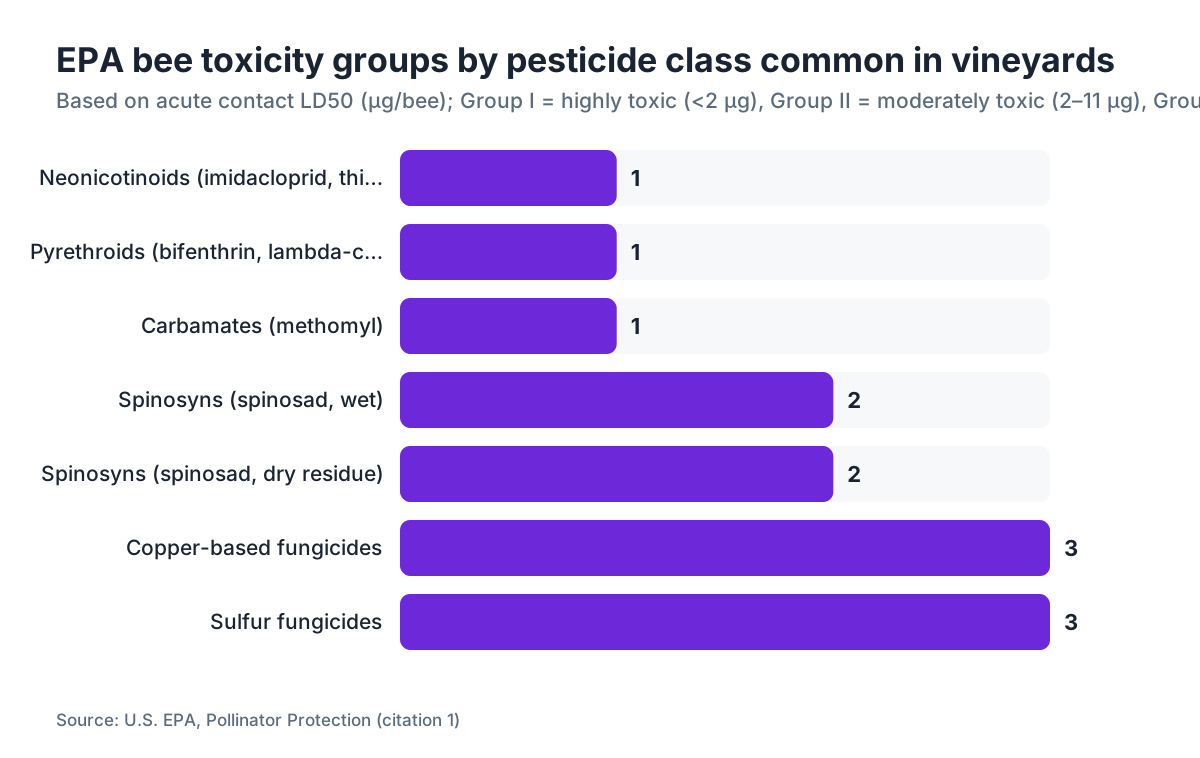
The EPA rates pesticide toxicity to honey bees using acute contact LD50 and acute oral LD50, both measured in micrograms per bee. A product with a contact LD50 below 2 micrograms per bee is Group I, highly toxic to bees, and carries the strictest label restrictions [1].
Insecticides are the problem in vineyards, not fungicides. The chemistries that trigger pollinator concerns sort into a handful of classes.
| Chemical Class | Common Vineyard Use | EPA Bee Toxicity Group | Notes |
|---|---|---|---|
| Neonicotinoids (imidacloprid, thiamethoxam) | Soil drench for glassy-winged sharpshooter, mealybug | Group I (highly toxic) | Systemic uptake; can appear in guttation fluid |
| Pyrethroids (bifenthrin, lambda-cyhalothrin) | Leafhopper, mealybug, vine mealybug | Group I (highly toxic) | Short residual on foliage; avoid bloom |
| Organophosphates (chlorpyrifos, now largely restricted) | Historical use; mostly phased out | Group I | Residual soil activity |
| Carbamates (methomyl) | Some fruit fly programs | Group I (highly toxic) | Rarely used in wine grapes |
| Spinosyns (spinosad) | Leafhopper suppression | Group II (moderately toxic, dry) | Toxic when wet; safer after drying |
| Sulfur | Powdery mildew | Group III or exempt | Not a significant bee toxin at label rates |
| Copper-based fungicides | Downy mildew | Minimal acute bee toxicity | Label compliance still required |
The single most useful habit you can build is reading the "Directions for Use" and "Environmental Hazards" sections of every label for the phrase "Do not apply while bees are actively foraging" or any specific timing window [2]. Those phrases are enforceable federal law, not suggestions.
UC Cooperative Extension points out that bloom timing in wine grapes shifts by variety and region, and the period when cover crops are flowering is often more hazardous to foraging bees than the vines themselves [4]. A Chardonnay block with a blooming clover cover crop in May is a real foraging site even before the vines flower. That cover crop timing belongs in your plan.
What does a vineyard pollinator protection plan actually have to contain?
There is no single federally mandated MP3 template. The EPA issued guidance and supported state-level BeeCheck and ApiaryWatch registries, and those state programs set their own documentation standards [1]. Most state-compliant plans, along with the templates from Washington State University Extension and Cornell Cooperative Extension, share the same core elements [5][6].
A complete plan has eight parts.
Applicator identification. Legal name, license number if you're a licensed PCA or certified applicator, and contact information. This is the person responsible for the application decisions.
Operation identification. APN or parcel number, vineyard name, physical address, and approximate acreage. If you farm multiple blocks on different spray schedules, list each block or management unit.
Pollinator and apiary inventory. A map or written description of known hive placements on your property and, ideally, within a quarter mile. Many states run voluntary pollinator registries (Washington's BeeConnected, California's DPR notification requirements), and cross-referencing them is good practice [7].
Pesticide use schedule. Every product you expect to apply during the season, with active ingredient, EPA registration number, application timing (calendar window and crop stage), and application method (ground, aerial, chemigation). You don't have to forecast every spray. You do have to list every product in the program.
Bloom and foraging window identification. Dates or growth stages when vines are in bloom and when cover crops are actively flowering. This is where most plans fall short. If your plan says "vines bloom in May" but never mentions the Crimson clover cover crop flowering from April 15 through June, you've missed the real risk window.
Beekeeper notification procedures. How and when you'll notify any beekeeper with hives inside a defined radius (usually a quarter mile to one mile, depending on state rules) before applying Group I or Group II pesticides. Washington's BeeConnected program sets this as email notification at least 48 hours before a planned application [7].
Mitigation measures. Specific steps to cut exposure: avoiding applications during bee flight hours (roughly dawn to dusk when temperatures top 50 degrees F), mowing or crimping cover crops before spraying, running ground rigs instead of aerial, and picking lower-toxicity products where they exist.
Record of communications. A log of every notification sent to beekeepers, with date, method, and acknowledgment if you got one. This is your paper trail if a kill event is ever disputed.
Cornell's Integrated Pest Management program recommends updating plans at least once a year, and after any bee kill incident no matter the suspected cause [6].
How do state MP3 requirements differ from the federal EPA baseline?
The EPA sets the floor. Pesticide labels are federal law under FIFRA, so any label language about bee protection applies everywhere in the country [2]. States can go stricter, and several have.
California requires licensed pest control advisers (PCAs) and growers to file a Pesticide Use Report (PUR) for every restricted-use pesticide application, covering site, product, rate, and acreage treated. The California Department of Pesticide Regulation has also set notification requirements for certain highly bee-toxic pesticides in counties with dense hive populations [7]. Written MP3s aren't universally mandated for private applicators in California yet, but the DPR endorses them as a best practice.
Washington State requires growers applying certain pesticides near registered apiaries to notify beekeepers through BeeConnected or an equivalent. WSU Extension guidance sets that notification at least 48 hours before application for Group I bee-toxic products [5].
New York's Department of Agriculture and Markets recommends MP3 development for any operation using neonicotinoids or other bee-toxic chemistries. Cornell Extension provides a model template [6].
Oregon lost an estimated 50,000 bumble bees in a Wilsonville parking lot in 2013 after a linden tree got treated with dinotefuran, and that incident accelerated the state's rulemaking. The Oregon Department of Agriculture now runs some of the most specific notification rules in the country for certain active ingredients.
The table below is not exhaustive. State rules change, so check your state lead agency directly. It shows the range.
| State | Written MP3 Required? | Beekeeper Notification Required? | Registry System |
|---|---|---|---|
| California | Recommended, not universally mandated | Yes, for certain products in high-density counties | DPR PUR system |
| Washington | Effectively yes via BeeConnected requirements | Yes, 48 hrs before Group I application | BeeConnected |
| Oregon | Yes for certain product/use combinations | Yes | ODA notification system |
| New York | Recommended (Cornell template available) | Voluntary but advised | None statewide |
| Other states | Varies widely | Varies | Check state lead agency |
If you don't know where your state stands, the National Pesticide Information Center (NPIC) at Oregon State University keeps a directory for finding your state lead pesticide agency [8].
How do you document beekeeper communication in your plan?
Beekeeper notification trips up more vineyard operators than any other piece of the plan. The requirement shows up in different forms across states, and even where it's voluntary, a documented notification protects you legally if a bee kill ever gets disputed.
The log itself is simple. For each planned application of a Group I or Group II pesticide during a likely foraging period, record the beekeeper's name and contact information, the date and method of notification (phone, email, BeeConnected), the product you planned to apply, the planned application date, and whether you got an acknowledgment.
If a beekeeper asks you to delay an application or switch products, log that conversation too, even if you don't change your plan. The paper trail shows good faith.
Finding local beekeepers is the harder part. Start with your state's BeeConnected or equivalent apiary registry if one exists. Your county agricultural commissioner's office is next; in California, apiaries must be registered with the county ag commissioner. Local beekeeping clubs and state associations know who's placing hives where. USDA APHIS maintains federal apiary inspection records for some states.
The EPA's 2016 pollinator guidance states plainly that voluntary communication between growers and beekeepers is a core protective strategy [1]. That framing matters. Regulators are watching whether growers make real outreach efforts, more than whether a box got checked.
What records do you need to keep and for how long?
Record retention for agricultural pesticide applications runs through a mix of the EPA Worker Protection Standard, FIFRA requirements, and state pesticide laws [9]. Here's the practical breakdown for vineyard operators.
Under the EPA Worker Protection Standard (WPS), revised in 2015, agricultural employers must keep pesticide application records for at least two years after the application date. Those records include the product name, EPA registration number, active ingredient, location and description of the treated area, date and time of application, and applicator name [9].
Keep your MP3 for at least that same two-year window. If your state wants longer (California's PUR system effectively builds a permanent record through the DPR database), follow the longer rule.
Beyond the legal minimum, hold your beekeeper communication logs for at least three years. That's closer to the typical statute of limitations for civil disputes in most states.
Organize by season. Each year, the MP3 document plus the beekeeper notification log plus the spray records for every application make up the full compliance file. Keep them together, in a physical binder or a digital folder, and a regulatory inspection or a neighbor complaint gets a lot less stressful. Software built for vineyard record-keeping, like VitiScribe, can hold spray records, application timing, and notification logs in one place, which genuinely helps when you're running multiple blocks across different spray windows.
The USDA National Agricultural Statistics Service does not require private grower records, but its data on pesticide use in viticulture is worth knowing as a benchmark for what regulators treat as typical application rates [10].
What should the map or site diagram in your plan show?
A site map is not always legally required, but every good MP3 has one. It's the document that proves you knew where the pollinators were and planned your applications around them.
At minimum, the map shows your spray blocks or management units (ideally with block IDs matching your spray records), any known apiary locations on or within a quarter mile of the property, permanent cover crops or wildflower strips, water sources bees use (ponds, irrigation standpipes), neighboring crops that might bloom during your spray windows, and any buffer areas you've set as no-spray zones around apiaries.
Nothing fancy required. A satellite image printed from Google Maps or your county assessor's GIS portal, with hand-drawn block boundaries and apiary pins, is plenty for a state inspection. Regulators want evidence that you looked.
If you farm in a county thick with hives, like Napa or Sonoma in California or the Yakima Valley in Washington, the quarter-mile search might turn up several registered apiaries. That's normal. It just means your notification list is longer.
WSU Extension's pollinator guidance suggests using the USDA Web Soil Survey or your state's GIS resources to spot neighboring operations that might flower alongside your spray windows [5]. Most small vineyards skip that step. Commercial operations should think about it.
How do cover crops change your pollinator risk and documentation obligations?
Cover crops are the most underrated pollinator risk in vineyard management. Vines have small, wind-pollinated flowers that barely interest honey bees. Your blooming phacelia, clover, or mustard cover crop is a bee magnet.
This reshapes your MP3 directly. In many blocks, the bloom timing of your cover crop defines the high-risk window more than vine bloom does. Apply a pyrethroid for vine mealybug in May while your Crimson clover is in full bloom, and you've made a Group I application during active foraging no matter where the vines sit in their phenological cycle.
UC Cooperative Extension's IPM materials for wine grapes are direct on this. They recommend mowing cover crops to end bloom before applying any bee-toxic pesticide, and logging that mowing in your spray records [4]. The documentation note matters. "Cover crop mowed 5/12, application made 5/14" is a record of a mitigation step, and it reads like one to an inspector.
Species selection matters for your plan too. Buckwheat, borage, and phacelia draw bees hard and bloom for long stretches. Grasses and cereal rye barely register. If your cover crop program leans on highly attractive species and you also run a regular insecticide program, your MP3 should name that tension and describe how you manage it.
The UC Davis Viticulture and Enology program and affiliated UC Cooperative Extension offices have published cover crop guidance for California wine grapes that addresses this interaction [4].
What happens if there is a bee kill incident at your vineyard?
A bee kill changes your entire documentation posture. Find dead bees at or near your vineyard after a pesticide application, or get a call from a beekeeper claiming losses, and the first move is to document what you see right away: date and time, location, approximate number of dead bees, any field conditions you notice.
Don't admit liability. Don't destroy records. Both make a bad situation worse.
Contact your state lead pesticide regulatory agency. In California that's the county agricultural commissioner. In Washington it's the WSDA Pesticide Management Division. In most states the county extension office can point you to the right contact. Many states run protocols for sampling dead bees to determine cause of death [8].
Your MP3 and spray records are your primary defense. A complete plan showing you identified the pollinator risk, notified the relevant beekeepers, chose sensible timing and methods, and kept records all season is strong evidence of good-faith compliance. Missing documentation, or records clearly created after the fact, signals the opposite.
EPA guidance treats label language as federally enforceable conditions of use, and failing to follow bee protection label language can trigger FIFRA Section 12 civil penalties. The current schedule reaches up to $19,176 per violation per day for commercial applicators, and the EPA adjusts that figure for inflation, so verify the current amount [2].
Civil liability to the beekeeper sits separate from regulatory penalties. Commercial honey bee colonies replace at $200 to $350 each, and a single incident can hit dozens to hundreds of hives [3]. That's a real number.
How do you build a vineyard MP3 from scratch, step by step?
Building a plan from scratch takes two to four hours the first time. Updating it in later years takes thirty minutes if your program hasn't changed much.
Step one: gather your inputs. Pull every pesticide label you plan to use this season. Note each product's bee toxicity group from the Environmental Hazards section. Flag any that say "highly toxic to bees" or carry specific foraging restrictions.
Step two: map your operation. Create or print a site map showing your blocks, any apiary locations you know about, and your cover crop areas. Check your county agricultural commissioner's registry for registered apiaries nearby.
Step three: build your contact list. Write down every beekeeper with hives within at least a quarter mile of your spray blocks. Get phone and email for each.
Step four: write the plan document. Most state extension programs publish a template. Cornell's template [6] and WSU's template [5] are both solid starting points no matter which state you're in. Fill in the applicator information, the operation details, the pesticide program, the bloom and foraging risk windows, and the mitigation measures you'll follow.
Step five: create your notification log template. A simple spreadsheet with columns for beekeeper name, contact method, notification date, product name, planned application date, and beekeeper response covers everything you need.
Step six: review and sign the plan. Date it. Keep the signed copy as your master record.
Step seven: notify beekeepers before any Group I or Group II application during a foraging risk window. Log each notification.
Step eight: at season's end, file the plan and all notification logs with your spray records. Retain for at least two years, longer if your state requires it [9].
For vineyards running multiple blocks with different spray crews or PCAs, VitiScribe centralizes spray records and application timing so pulling the documentation together for a plan (or a regulatory inspection) hurts a lot less.
If your operation is big enough to work with a licensed PCA, have them review your plan every year. A PCA's signature on the MP3 carries real weight in a dispute.
Where can you find official templates and training resources?
The resources worth bookmarking are specific and free. Here's where to go.
USDA Agricultural Research Service publishes national pollinator research and protection guidance that explains the science behind federal policy [11]. It's not a template. It's the reasoning behind the regulatory thresholds.
EPA's Pollinator Protection page links to the 2016 pollinator risk assessment guidance and to pesticide label requirements [1]. Start here to understand the federal framework.
WSU Extension's Pesticide Safety Education Program has a pollinator protection module for growers, including a documentation checklist [5]. It's tuned to the Pacific Northwest, but the core elements travel.
Cornell Cooperative Extension's Integrated Pest Management program has a model MP3 template that's widely referenced for eastern vineyards [6]. It's built around New York's program and works as a general starting point.
UC Cooperative Extension, through the UC IPM program at UC Davis, publishes pest management guidelines for wine grapes that include pollinator protection guidance specific to California viticulture [4]. Their cover crop and bloom timing recommendations are the strongest part.
National Pesticide Information Center (NPIC) at Oregon State University keeps a state-by-state directory of lead pesticide agencies, which you need to find your state's specific MP3 requirements [8].
Your state's lead pesticide regulatory agency is the definitive source for state-specific rules. Don't rely on secondary sources for compliance-critical requirements.
If you farm the Paso Robles wineries area or the South Coast wine region of California, the San Luis Obispo or Ventura county agricultural commissioner's offices have county-specific guidance on apiary registration and notification that's worth requesting directly.
Frequently asked questions
Is a written pollinator protection plan legally required for all vineyards?
Not universally. The EPA does not mandate a single federal MP3 form for all private applicators. But pesticide label language requiring bee protection is federally enforceable under FIFRA everywhere in the US. Several states, including Washington and Oregon, have codified written MP3 or notification requirements for certain pesticide uses. Check your state lead pesticide agency for the specific requirement where you farm.
Do I need to notify beekeepers before every pesticide application in my vineyard?
No, not every application. Notification requirements typically apply to Group I and Group II bee-toxic pesticides applied while pollinators are actively foraging, generally when cover crops or other forage plants are blooming. Sulfur and copper applications usually don't trigger notification. Washington's BeeConnected system requires at least 48 hours advance notice for applicable products. Check your state's rules and each product's label language.
How long do I need to keep my vineyard's pollinator protection plan records?
The EPA Worker Protection Standard requires pesticide application records to be kept for at least two years after the application date. Keep your MP3 plan and beekeeper communication logs for at least that same period. For civil liability protection, three years is a safer practical minimum. California's PUR system creates an effectively permanent regulatory record through the DPR database regardless of what you retain personally.
What is the BeeConnected program and does it apply to my vineyard?
BeeConnected is Washington State's online registry where beekeepers register hive locations and growers commit to notifying them before applying bee-toxic pesticides. Washington growers applying Group I bee-toxic products near registered apiaries are expected to use BeeConnected or an equivalent notification method. Other states run similar registries. If you're in Washington, register through the WSDA BeeConnected portal and check for nearby hive registrations before each spray season.
Are cover crop bloom periods really part of the pollinator protection plan?
Yes, and this is one of the most commonly missed pieces. Honey bees forage cover crops like clover, phacelia, and mustard far more than vine flowers. A Group I insecticide application during cover crop bloom is a real pollinator risk even when the vines aren't flowering. Your plan should identify your cover crop species, their typical bloom windows, and your protocol for mowing or crimping before any bee-toxic spray.
What is the penalty for violating pesticide label bee protection language at a vineyard?
Pesticide label violations fall under FIFRA Section 12. For commercial applicators, civil penalties can reach $19,176 per violation per day under current EPA penalty schedules, and the EPA adjusts this figure for inflation, so verify the current amount. State penalties vary. Beyond regulatory fines, civil liability to beekeepers for colony replacement, at $200 to $350 per hive, can add up fast depending on the number of hives affected.
What EPA toxicity group are neonicotinoids in, and are they used in wine grape production?
Neonicotinoids like imidacloprid and thiamethoxam are Group I, highly toxic to bees, with contact LD50 values well below the 2 microgram per bee threshold. They appear in some wine grape programs, mostly as soil drenches targeting glassy-winged sharpshooter or mealybug. Systemic uptake means the active ingredient can show up in plant tissue and guttation fluid, stretching the potential exposure window beyond the application date.
Do I need a separate pollinator protection plan for each vineyard block I manage?
Not necessarily a separate plan per block, but your plan should identify each management unit separately, especially if blocks have different spray programs or sit at different distances from apiaries. A single plan covering the whole operation is fine as long as the block-level details, including pesticide programs and foraging risk windows, are addressed for each unit. Lumping everything under one vague description is not adequate.
What should I do immediately after a suspected bee kill at my vineyard?
Document what you observe right away: date, time, location, approximate number of dead bees, field conditions. Do not destroy records or admit liability. Contact your state lead pesticide regulatory agency, usually the county agricultural commissioner in California. Request laboratory sampling of dead bees if possible. Present your MP3, spray records, and beekeeper notification logs as evidence of your protective measures. Contact a licensed pesticide attorney if the incident is large or involves regulatory action.
Can a PCA (pest control adviser) sign and own the pollinator protection plan for a vineyard?
Yes, and it's a good practice. A licensed PCA who designs the pesticide program and signs the MP3 takes on professional responsibility for the plan's accuracy. Their license number on the document tells regulators a qualified professional reviewed the pollinator risk. It doesn't relieve the grower of compliance obligations, but it strengthens the documentation and shows a trained expert was in the decision-making.
Where can I find a free MP3 template for a California wine grape operation?
UC Cooperative Extension through the UC IPM program at UC Davis publishes pest management guidelines for wine grapes that include pollinator protection elements. Cornell Cooperative Extension's model MP3 template also adapts well for California use. The California DPR website links to pollinator protection resources. Your county agricultural commissioner's office may have county-specific templates, especially in high-hive-density counties like Napa, Sonoma, or San Luis Obispo.
Does the EPA Worker Protection Standard cover pollinator protection requirements?
The WPS, revised in 2015, primarily protects agricultural workers and handlers from pesticide exposure. It mandates two-year record retention for application records and requires posting of pesticide application information. It does not specifically mandate MP3 documentation, but the application records it requires overlap heavily with what an MP3 needs. Pollinator protection requirements come mostly from pesticide label language under FIFRA and state programs layered on top.
How does vineyard size affect what my pollinator protection plan needs to cover?
Size affects complexity more than core requirements. A 5-acre vineyard with one beekeeper neighbor needs a simpler plan than a 500-acre estate with multiple spray contractors and a dozen registered apiaries within half a mile. The legal duties, following label language and notifying known beekeepers before bee-toxic applications, apply at any size. Larger operations gain more from formal templates and digital record-keeping to manage documentation and communication across many blocks and crews.
Sources
- U.S. EPA, Pollinator Protection: EPA bee toxicity classification framework (Group I below 2 µg/bee LD50), 2016 Pollinator Risk Assessment Guidance, and policy on managed pollinator protection plans
- U.S. EPA, Pesticide Registration: Pesticide labels constitute federally enforceable conditions of use under FIFRA; label bee protection language is federal law; FIFRA Section 12 civil penalty authority
- USDA National Agricultural Statistics Service, Honey: Commercial honey bee colony replacement costs in the range of $200 to $350 per colony
- UC IPM, UC Davis, Pest Management Guidelines: Grapes: UC Cooperative Extension guidance on cover crop bloom timing as a pollinator risk window in wine grapes, and mowing recommendations before bee-toxic pesticide applications
- Washington State University Extension: WSU Extension pollinator protection guidance for growers including 48-hour advance notification requirement for Group I bee-toxic products and BeeConnected system reference
- Cornell Cooperative Extension, Integrated Pest Management Program: Cornell's model MP3 template for eastern growers and annual update recommendation after any bee kill incident
- California Department of Pesticide Regulation: California DPR notification requirements for highly bee-toxic pesticides in high-hive-density counties and PUR reporting requirements for restricted-use pesticides
- National Pesticide Information Center, Oregon State University: State-by-state directory of lead pesticide regulatory agencies and state protocols for sampling dead bees after a kill incident
- U.S. EPA, Agricultural Worker Protection Standard: EPA WPS revised 2015: agricultural employers must retain pesticide application records for at least two years after application date, including product name, EPA registration number, location, date, and applicator name
- USDA National Agricultural Statistics Service, Chemical Use: NASS data on pesticide application rates in viticulture as a benchmark for typical commercial use patterns
- USDA Agricultural Research Service: USDA ARS national pollinator research and protection guidance providing scientific context for federal regulatory thresholds
Last updated 2026-07-10