NAP coverage documentation for small vineyard natural disaster losses

TL;DR
- USDA's Noninsured Crop Disaster Assistance Program (NAP) pays small vineyards for natural disaster losses when yield drops more than 50% below their average.
- To collect, file a Notice of Loss within 15 calendar days of the loss, hold an active NAP application before the disaster hits, and keep production records going back at least 5 years.
- Miss any deadline and the claim is dead.
What is NAP and does my small vineyard qualify?
NAP, the Noninsured Crop Disaster Assistance Program, is USDA's safety net for crops that can't get federal crop insurance or where insurance isn't sold in your county. Grapes fall into that bucket across a lot of smaller wine regions, especially for varieties or training systems private insurers won't touch. You run everything through your local USDA Farm Service Agency (FSA) office. [1]
Three conditions decide whether you qualify. Grapes have to be an eligible crop in your county, which FSA sets each year. You need an active NAP application (Form FSA-840) on file before the disaster happens. That second one trips up more small growers than anything else: there's no applying after the fact. And the loss has to come from an eligible cause, which FSA defines as natural disasters. Drought, freeze, excessive moisture, excessive heat, flood, hail, lightning, and a short list of others. [1]
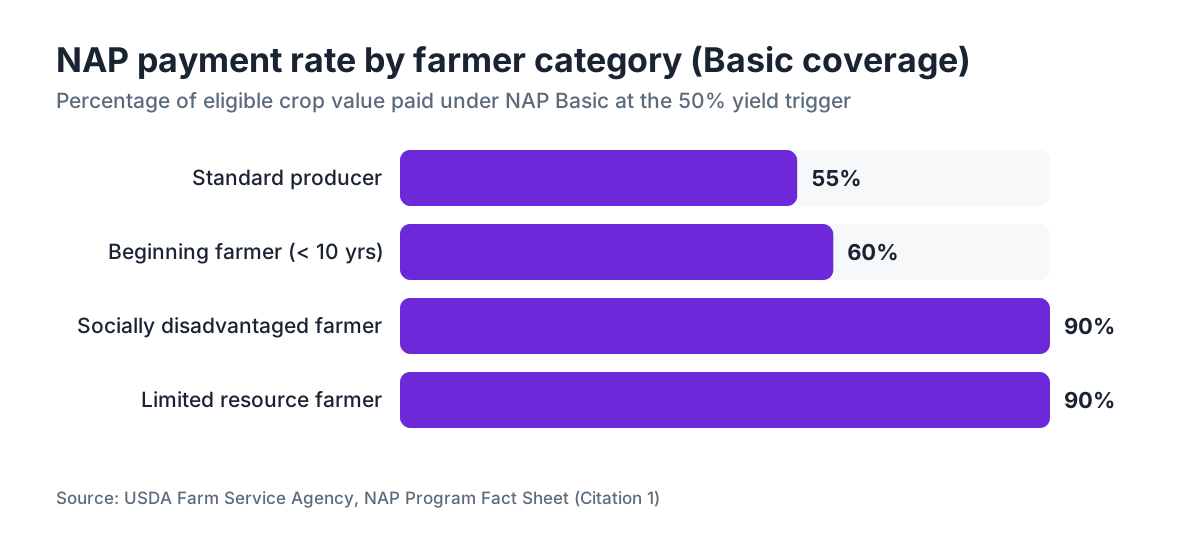
There's a payment trigger too. Your actual yield has to drop below 50% of your approved yield (the average of your best 5 of 10 consecutive crop years, or a county average if you don't have records). NAP then covers 55% of the value of the lost production above that 50% floor, unless you bought up to a higher level. Basic coverage costs a $325 service fee per crop per county as of 2024. That's cheap for what it does. [1]
Run fewer than 10 acres, or farm as a socially disadvantaged, limited resource, or beginning farmer? You may qualify for a service fee waiver and a payment rate as high as 90% of crop value. Ask your FSA office about these by name. They don't always bring them up on their own.
What disasters are covered under NAP for vineyards?
NAP covers natural causes only. The statute, 7 U.S.C. 7333, lists qualifying disasters as drought, freeze, excessive moisture, excessive heat, flooding, hail, insect infestation (when the infestation itself is declared a natural disaster), lightning, and tornado, among others. [2] It does not cover losses from poor management, a market price drop, or most disease, unless a weather event caused the disease.
For vineyards, four events generate most claims. Spring frost and freeze that kill primary buds or young shoots. Drought that cuts yield through poor cluster set or small berries. Wildfire smoke damage, which is harder to document and where FSA's position has moved around by state and year. And flood or excessive rain that rots fruit before harvest.
Smoke taint gets its own note. FSA has covered smoke-associated losses in some California and Pacific Northwest declarations, but it isn't automatic. If smoke from a declared wildfire disaster area hit your fruit, file right away and get a written assessment from a certified crop consultant or enologist documenting the affected fruit. WSU Extension has published smoke taint assessment guidance that FSA field offices in Washington have accepted as supporting documentation. [3]
Hail is fully covered and one of the easiest claims to prove, because the damage is visible and immediate. Photograph every row within hours of the storm. Freeze is trickier. The full extent sometimes doesn't show for days or weeks after the event, so keep documenting as it develops.
What are the NAP filing deadlines for vineyard losses?
This is where claims die. The deadlines are strict and FSA enforces them.
Notice of Loss: file Form FSA-576 within 15 calendar days of the date the loss first became apparent. For a frost, that's 15 days from the morning it hit. For a drought loss, FSA generally reads it as 15 days from final harvest if the loss built up over time rather than in a single event, but don't bank on that read. See damage, file. Same day if you can. [1]
Application for Payment: once the loss is quantified, you file Form FSA-840A to request payment. It's due by the later of 60 calendar days after the end of the insurance period, or the date FSA finishes its appraisal. In practice FSA sets a county-level application closing date, and you need to know yours.
Coverage has to already be in place. Your NAP application (Form FSA-840) for the crop year is due by the application closing date, which FSA sets before the planting season. For perennials like grapes, that date usually repeats year after year, often in the fall. Miss it and you have no coverage, no matter how bad the disaster gets.
The 15-day rule is so unforgiving that the advice worth tattooing on your arm is simple: file first, assess later. You can always withdraw a notice if the damage turns out minor. You cannot file one after the window closes.
What records do you need to document a vineyard NAP claim?
FSA asks for several categories of records. Miss any and your claim slows down or your payment shrinks.
Production records (at least 5 years, ideally 10). FSA builds your Approved Yield from the average of your actual production history. Fewer than 5 years of records and FSA drops in a county transitional yield (T-Yield), usually lower than what a well-run vineyard actually produces. That cuts your payment directly. Keep every harvest weight ticket, winery receiving record, and custom crush settlement sheet from every vintage. Cornell Cooperative Extension's farm record guides recommend keeping these in both paper and digital form for at least 10 years. [4]
Acreage reports (Form FSA-578). You have to report your planted acreage every crop year. No acreage report, no baseline for coverage. File FSA-578 every year, even the good ones.
Disaster documentation. Weather station data proving the freeze, flood, or drought actually happened. NOAA climate data from the nearest Cooperative Observer station is the gold standard. Download and print the daily summary for the week of the event. A screenshot works as backup, but get the official NOAA printout. [5]
Loss appraisal records. For standing crop losses, FSA sends an appraiser to count clusters or judge canopy damage. For harvested losses, you supply actual production weights against your approved yield. If the appraiser skips rows or uses a bad count method, you can request a second appraisal. Bring your own count from a block-by-block walk.
Input cost records. NAP doesn't need these for the payment calculation, but they document economic harm if you're also filing for disaster loans or state relief. Keep them.
A solid claim kit: printed NOAA weather data, your FSA-578 acreage report copy, harvest weight records for the past 5 to 10 years, timestamped and GPS-tagged photos, your FSA-840 application confirmation, and any third-party damage assessment from a certified crop consultant or viticulture advisor.
How do you actually calculate your potential NAP payment?
NAP math has three moving parts: your approved yield, the price election, and your actual production.
Here's the formula FSA uses. Payment equals (Approved Yield x Coverage Level x Acres x Price Election) minus (Actual Production x Price Election). At Basic coverage, the 55% payment factor and 50% yield trigger mean FSA pays 55% of the difference between 50% of your approved yield and your actual production, times the price election per ton. [1]
The price election is the NAP established price for grapes in your county and variety category, set every year by FSA. For wine grapes it usually sits well below actual market prices, which drives growers up the wall. It's meant to cover part of production costs, not market value.
A simplified example with round numbers. Say your approved yield is 3 tons per acre, you farm 5 acres, the price election is $400 per ton, and your actual yield after the frost is 0.5 tons per acre.
- 50% trigger: 3 tons x 0.50 = 1.5 tons per acre
- Loss above trigger: 1.5 - 0.5 = 1.0 ton per acre
- Payment: 1.0 ton x 5 acres x $400 x 0.55 = $1,100
That's a modest payout next to the real economic damage, which is exactly why NAP is a partial safety net and not a revenue replacement. Pay the premium for a higher coverage level (NAP allows 50%, 55%, 60%, 65%, and higher for some crops) and your payment factor climbs.
Watch the T-Yield. If FSA swaps in the county T-Yield for missing production history, your approved yield can land 30% to 50% below what a decent vineyard actually produces in your region. That drags down every payment. Good records are worth real money.
What photographs and field evidence does FSA actually want to see?
FSA appraisers are not viticulture specialists. They follow an appraisal method, and your job is to make their job easier while protecting your own interest in an accurate count.
Photograph right after the event. For frost, shoot within 24 to 48 hours while the burned tissue still shows. For flood, photograph standing water and the waterline on trellis posts. For hail, catch cluster damage before the leaves recover. Every photo should include a row identifier marker (a stake with a block letter does the trick), and your phone's automatic timestamp and GPS are enough for legal purposes.
Document by block, not by vineyard. If Block A is Pinot Noir on VSP and Block B is Zinfandel on head-trained vines, photograph and note them separately. Frost damage swings hard by variety, training, and microsite. An undifferentiated vineyard-wide photo misses that, and FSA's appraisal will flatten it.
Count your own damage. Walk every block and run a sample: 10 vines per block, count total shoot positions, count dead primary buds or damaged clusters, note the percentage. Write it down with the date and your signature. That gives you a contemporaneous record to hold against FSA's appraisal. If their count is off, you have ammunition.
If you already track spray applications and field observations in a digital system, those timestamped entries work as supporting evidence. Tools like VitiScribe generate date-stamped field logs you can export for FSA submission, which saves real time mid-claim.
Get a third-party assessment when the loss is large. A certified crop consultant (CCA) or certified professional agronomist (CPAg) can write a damage assessment that carries weight in FSA appeals. UC Cooperative Extension refers growers to viticulture advisors through its Farm Advisors network. [6]
How does the FSA appraisal process work for grapes?
Once you file the Notice of Loss (FSA-576), your local FSA office schedules an appraisal visit. For perennial crops, FSA follows a Loss Adjustment procedure built for grapes that accounts for variety, training system, and regional production norms. [1]
The appraiser walks the vineyard with you or a representative, counts damaged clusters or buds per vine on a sample basis, and compares that to expected production on your NAP application. Be there. Do not let this visit happen without you or someone who knows the vineyard.
If the appraiser's loss percentage looks low against what you're seeing, ask for a second appraisal on the spot. You have the right to a re-examination. Put your disagreement in writing before you leave that day. Verbal objections evaporate.
For pre-harvest losses like spring frost, FSA appraises while the damage is still visible. For post-harvest losses, you submit actual production records and FSA calculates the shortfall against your approved yield. Post-harvest claims are simpler on paper, but you need clean weight records to make them work.
After the appraisal, FSA calculates the payment and mails you a notice. You have 30 days to request an agency review if you disagree. Next level up is the FSA State Committee appeal, then the USDA National Appeals Division. Keep every piece of paper through the whole thing.
Can NAP be combined with other disaster assistance programs?
Yes, within limits. You can't collect duplicate payments for the same loss from multiple programs.
NAP stacks with FSA Emergency Loans (EM loans), which are low-interest credit to cover operating costs after a disaster. You apply for those separately through your FSA office. [7] NAP payments count as income for EM loan purposes, so the loan officer will ask about any pending NAP claims.
The Emergency Relief Program (ERP), which USDA ran in 2022 and 2023 for crop losses from 2020 and 2021 disasters, let NAP participants receive ERP payments based partly on their NAP indemnity. Growers who carried NAP coverage and filed claims got automatic ERP consideration in Phase 1. USDA may run similar programs again. Having NAP coverage in place is effectively a ticket to being considered under any follow-on disaster legislation. [8]
Some states layer their own disaster assistance on top of the federal programs. California's CDFA has periodically offered supplemental relief for frost and drought losses. Check with your state department of agriculture after any real disaster declaration.
NAP does interact with federal crop insurance. Where crop insurance is available and actuarially sound for your crop and county, you generally can't buy NAP for the same crop in the same county too. But for specialty wine grape varieties in a lot of counties, insurance simply isn't sold at a meaningful coverage level. That gap is precisely why NAP exists.
What mistakes do small vineyard operators make that kill NAP claims?
The single most common one is missing the Notice of Loss deadline. Fifteen days feels like plenty until you're neck-deep in a disaster and doing vineyard triage. Set a phone reminder the same day you see damage.
Second most common: no NAP application on file. You cannot buy coverage after the disaster. That's a structural trap for growers who find the program only when they go looking for help after a loss. Get FSA-840 filed before your county's application closing date for every crop year you want covered.
Third: incomplete acreage reports. If your FSA-578 doesn't show planted acreage for the crop year, FSA has no basis for coverage. File it every year, even when you're sure nothing will go wrong.
Fourth: no production history. Growers who can't show yield records for at least 5 years get the T-Yield, almost always lower than their actual average. Start keeping records now, even if you never file a claim this year.
Fifth: assuming FSA knows your variety breakdown. Grow multiple varieties, watch one get wiped out while another sails through, and FSA needs your application to carry that variety-level detail. A single pooled acreage report for "wine grapes" lumps your recovery together and shrinks your loss percentage.
Sixth: not appealing a low appraisal. FSA appraisers make mistakes, especially in vineyards where their variety-specific expertise is thin. A polite, documented request for re-examination or a formal appeal costs nothing and sometimes recovers serious money.
How do you build a documentation system before disaster strikes?
Pre-disaster prep is the whole game with NAP. Once frost or flood hits, you have 15 days to file and no time to reconstruct years of records.
Keep a permanent vineyard file, current at all times. Your most recent FSA-578 acreage report. Your FSA-840 NAP application confirmation for the current crop year. Your production records for the past 10 years (winery receipts, weight tags, settlement sheets). And your block map showing variety, acreage, and trellis system by block.
Run a field observation log year-round. Notes on bud break date, shoot length at thinning, cluster counts at veraison, and harvest dates build a baseline that can support a claim if something goes sideways mid-season. These don't need to be fancy. A dated note in a field notebook works fine. Digital logs with timestamps hold up better for storage and retrieval.
For vineyards spread across multiple sites, or with a complicated variety mix, keeping this in a digital field management platform makes retrieval much faster during a crisis. VitiScribe's field log and spray record features generate exportable, date-stamped reports that translate straight into FSA-compatible documentation without reformatting.
Build a relationship with your FSA office before you need it. Learn the name of your local FSA farm loan and program specialist. Show up to a county FSA outreach meeting at least once. Growers who've met their FSA contact in a calm moment consistently report faster claim processing when things go bad.
For more on setting up a vineyard record system with NAP in mind, UC Cooperative Extension publishes farm record guides for California viticulture operations. [6] Cornell Cooperative Extension has parallel resources for the Northeast. [4]
What are the NAP payment limits and income caps?
NAP payments carry per-person payment limits and an adjusted gross income (AGI) cap. These shift with each Farm Bill reauthorization, so confirm current figures with your FSA office.
Under the 2018 Farm Bill (still governing policy as of this writing), the NAP payment limit is $125,000 per person, per crop year, across all crops. [9] For most small vineyards this cap never bites, because NAP payments run off the price election rather than market value, and the price election usually sits well below market.
The AGI cap is more likely to matter. If your average adjusted gross income over the preceding 3 tax years tops $900,000, you're not eligible for NAP payments. That threshold applies to the person or entity receiving the payment. [9] For a small family vineyard it almost never comes up, but partnership structures and corporate entities should check their eligibility.
Limited resource and socially disadvantaged farmers get a service fee waiver and qualify for a payment rate of 90% of crop value, instead of the standard 55%. Beginning farmers (fewer than 10 years operating a farm) get a 50% service fee waiver and a 60% payment rate at Basic coverage. For smaller operations these provisions add up.
Payments arrive as a check or ACH deposit to the individual or entity on record with FSA. Timing after a claim runs roughly 60 to 90 days from approval, longer in years with widespread disaster declarations when FSA offices are buried in claims.
Where do you go for help with a NAP claim?
Your local FSA office is the front door. Find your county office through the USDA service center locator. [10] Come prepared with your acreage information and the staff can walk you through FSA-840, FSA-578, and FSA-576 in one appointment.
Extension programs earn their keep here. UC Cooperative Extension Farm Advisors in California have helped growers document frost and smoke damage for FSA. [6] Cornell's viticulture extension team in the Finger Lakes and Hudson Valley keeps NAP-related resources for Northeast growers. [4] Washington State University Extension's viticulture and small farm programs cover the Pacific Northwest, including guidance on drought and smoke taint documentation. [3]
If your claim is large or tangled, hire a farm management consultant or an agricultural attorney who knows FSA procedure. State grape grower associations often keep referral lists. Your state Farm Bureau may offer member help with FSA claims too.
For appeals, the USDA National Appeals Division (NAD) handles FSA disputes. You can request an informal review within 30 days of an FSA determination and move to a formal hearing if you need to. NAD decisions are published and searchable online, so you can look up how earlier grape loss cases came out. [11]
Don't skip your local grape grower association. Groups like the California Association of Winegrape Growers, the Washington Winegrowers Association, and the New York Wine and Grape Foundation push out FSA program updates and usually know the practical wrinkles of how NAP is being run in your region that year.
Frequently asked questions
Do I need to file a NAP application every year, or does it carry over?
File a new NAP application (Form FSA-840) for each crop year. Coverage does not renew on its own. FSA sets an application closing date, usually before the growing season starts, and missing it means no coverage that year. For perennials like grapes, the closing date typically falls in the fall for the following year's coverage. Confirm the exact date with your county FSA office annually.
Can I file a NAP notice of loss after the 15-day window if I didn't know about the damage right away?
Generally no. The 15-day clock runs from the date the loss was first apparent, not from the date you discovered NAP exists or realized the damage was serious. FSA has limited authority to waive this and rarely grants it. If you think you had a legitimate reason for missing it, you can request a waiver in writing and document why the loss wasn't apparent in time, but plan on the waiver being denied.
How many years of production records do I need for a NAP claim?
FSA uses your best 5 of 10 consecutive crop years to set your approved yield. With fewer than 5 years of records, FSA fills the gaps with a county transitional yield (T-Yield), usually lower than actual well-managed vineyard production. At least 5 years of documented history normally produces a better approved yield and a higher payment. Ten years is ideal.
What's the difference between NAP basic and higher-level coverage?
NAP Basic covers 55% of the value of the loss that runs more than 50% below your approved yield. Higher-level coverage lets you raise the payment factor, and for some crops the yield trigger, in exchange for a premium. The maximum available varies by crop and county. For most small vineyards, Basic is the practical starting point, because the premium for higher levels often isn't favorable given the low price elections FSA uses for grapes.
Does NAP cover smoke taint damage to wine grapes from wildfires?
It can, but it isn't guaranteed. FSA has approved smoke-related grape losses in California and Washington under certain wildfire disaster declarations, but coverage depends on whether the loss meets NAP's natural disaster causation standard. You'll need a written agronomic or enological assessment documenting smoke exposure and its effect on fruit quality. File a Notice of Loss immediately regardless, and get third-party documentation from a certified crop consultant or extension viticulture advisor.
Is the $325 NAP service fee per vineyard or per crop?
The $325 service fee (as of 2024) applies per crop, per county. Grow multiple grape varieties that FSA treats as separate crops and you may owe separate fees. The total service fee cap across all crops is $825 per producer per year. Limited resource, socially disadvantaged, and beginning farmers may qualify for waivers. Confirm current fee amounts with your FSA office, since they can adjust.
Can I receive NAP payments and also apply for an FSA Emergency Loan after the same disaster?
Yes. NAP and FSA Emergency Loans (EM loans) are separate programs and both can address the same disaster. NAP replaces a portion of lost production value; EM loans provide low-interest operating credit for recovery costs. The EM loan officer counts your NAP payment as income, which can affect loan sizing. Apply for both at once if the loss is large enough to warrant it.
What if FSA's appraiser underestimates my vineyard damage?
Request a second appraisal in writing before you leave the appraisal site. Document your disagreement with the count or methodology the same day. If the second appraisal still looks wrong, you have 30 days from the FSA determination notice to request an informal agency review, then a formal appeal to the FSA State Committee, followed by the USDA National Appeals Division. Your own contemporaneous cluster counts and photos are your strongest evidence.
What does the NAP price election for wine grapes typically look like?
FSA price elections for wine grapes vary by state and county and reset annually. They usually land well below market prices, often in the $200 to $600 per ton range for generic wine grape categories, while contracted grape prices in premium regions can run several times that. The election is meant to cover part of production costs, not replace market revenue. Check the current year's election with your FSA office before assuming your coverage level.
How long does it take to receive a NAP payment after a claim is approved?
Typically 60 to 90 days from approval, though in years with widespread disaster declarations FSA offices get backlogged and it can take longer. The clock starts after FSA finishes the appraisal and you submit all required documentation. Incomplete submissions reset it. Payments come as a check or ACH deposit to the name and account on file with FSA.
Do I need to report my NAP payment on my federal taxes?
Yes. NAP payments are taxable income and reported to you on IRS Form 1099-G. They're generally ordinary farm income for federal tax purposes. Some growers elect to defer reporting in the year of a weather-related crop loss under IRS rules for deferring crop insurance proceeds, but talk to a tax advisor before doing so. IRS Publication 225 (Farmer's Tax Guide) covers this treatment.
Can a vineyard without a crop history yet get NAP coverage?
Yes, though your approved yield rides on the county T-Yield, not your own production history, until you have enough years of records to build a personal average. A new planting can get NAP coverage from the first year you file FSA-840 before the application deadline. Keep every production record from the first harvest forward so you can work toward a personal approved yield that may beat the county average.
Is there a minimum acreage or production threshold to be eligible for NAP?
The NAP statute sets no explicit minimum acreage, but coverage only means something if your production history and acreage generate a payment above the service fee cost. Very small plots under an acre may produce de minimis payments. The practical floor is whatever acreage makes the $325 service fee worth it against your risk. There's no maximum acreage, though payment limits cap total payments at $125,000 per person per year.
Sources
- U.S. Code, 7 U.S.C. 7333, Noninsured Crop Disaster Assistance Program: NAP statutory authority listing qualifying natural disasters including drought, freeze, excessive moisture, flooding, hail, lightning, and tornado
- Washington State University Extension: WSU Extension guidance on filing Notice of Loss immediately and smoke taint assessment protocols for FSA documentation
- Cornell Cooperative Extension, Farm Record Keeping resources: Cornell Extension recommendation that growers retain harvest records in both paper and digital form for at least 10 years
- NOAA National Centers for Environmental Information: NOAA Cooperative Observer station daily summaries serve as primary weather documentation for FSA disaster loss verification
- University of California Agriculture and Natural Resources (UC Cooperative Extension): UC Cooperative Extension Farm Advisors help growers document frost and smoke damage for FSA purposes and publish farm record guides for California viticulture
- USDA Farm Service Agency, Farm Loan Programs: FSA Emergency Loans provide low-interest credit to cover operating costs after a disaster and can be combined with NAP payments for the same event
- USDA Service Center Locator: Find your local FSA office for NAP applications and claim filing
- IRS Publication 225, Farmer's Tax Guide: NAP payments are taxable income reported on Form 1099-G and may qualify for crop insurance proceeds deferral election under IRS rules
Last updated 2026-07-10