Whole farm revenue protection record requirements for wine grape growers

TL;DR
- Whole Farm Revenue Protection (WFRP) requires wine grape growers to provide at least five years of Schedule F (or equivalent) tax records, a completed Annual Summary of Commodities form, itemized revenue records per commodity, and an approved farm operation report before coverage attaches.
- Missing or incomplete records are the most common reason WFRP applications get delayed or denied.
What is Whole Farm Revenue Protection and who qualifies?
Whole Farm Revenue Protection is a federal crop insurance product run by USDA's Risk Management Agency (RMA). It insures the total revenue of a farm operation instead of any single crop. That structure is one of the few insurance options that actually fits a diversified wine grape operation growing multiple varieties, selling bulk fruit, taking custom crush revenue, and maybe running a few cover-crop commodities on the side. [1]
To qualify, your operation has to meet RMA's definition of an eligible farm. The farm's Allowable Revenue, calculated from your historic Schedule F data, has to land within the program's revenue cap. For 2024, the maximum insurable revenue is $8.5 million. [1] Small diversified operations are squarely the target market. A Paso Robles grower with $600,000 in grape sales and a little direct-to-consumer revenue is a much better WFRP candidate than a single-commodity row-crop farmer.
Here's what people miss. WFRP is sold through private agents approved by RMA, not directly through USDA. Your agent submits everything to a reinsured company, which means the record requirements are non-negotiable. The agent can't waive them. Neither can the company. If your records don't meet RMA standards, the policy won't bind.
How many years of tax records does WFRP actually require?
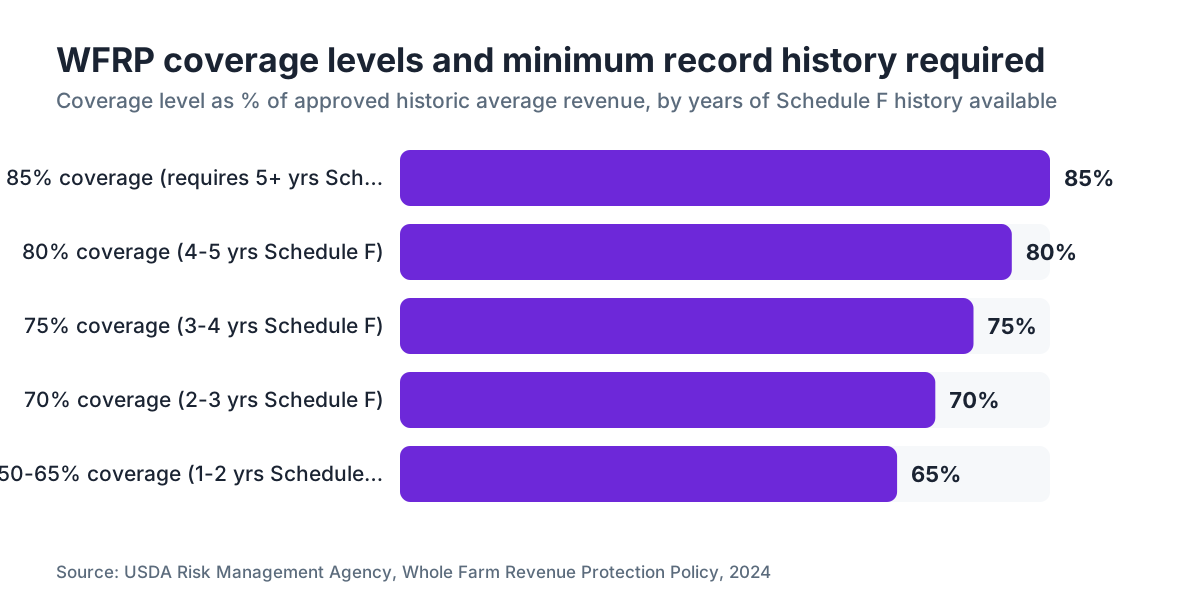
Five consecutive years of Schedule F (Profit or Loss From Farming) data, or the equivalent if your operation files as a corporation or partnership. [1] Farmed for fewer than five years? You can use the years you have, subject to adjustments RMA makes to fill the gap, but those adjustments usually lower your approved revenue and therefore your coverage. Getting your fifth year of actual returns on file is worth waiting for.
For wine grape operations, the Schedule F has to show gross income by category. Line 2 (sales of livestock, produce, grains, and other products you raised) is where grape sales land. [9] Any custom harvest income, equipment rental income, or other farm-related revenue needs to break out too, because RMA's underwriters reconcile your Annual Summary of Commodities against those Schedule F lines. [2]
If you operate under a single Social Security Number or EIN but farm multiple parcels or AVAs, all revenue under that tax ID rolls into one Schedule F. That's usually fine. The trouble starts when revenue flows through two or more separate entities (say, an LLC that owns the vineyard and a sole proprietorship that sells the fruit). RMA has specific rules for consolidating or excluding revenue across entities, and getting that wrong at the tax return stage causes headaches at application time. Talk to your tax preparer and your crop insurance agent before you file, not after.
Schedules have to be copies of returns actually filed with the IRS. Drafts, worksheets, and QuickBooks reports don't count. [1]
What is the Annual Summary of Commodities and how do you fill it out correctly?
The Annual Summary of Commodities is the form where you list every commodity your farm produced or will produce in the insured year, along with its expected revenue. For a wine grape grower, each variety you sell separately counts as its own commodity line if it has a separate price. Sell Cabernet Sauvignon and Chardonnay at different prices per ton and those are two commodities. Sell everything as "mixed red" at one flat price and that may consolidate to one. [1]
The form also asks you to flag whether each commodity is "purchased" (inputs you buy and resell, like custom crush services you market under your own label) or "produced" (fruit you grow). This matters because purchased commodities are subject to a 50% cap on how much of your total allowable revenue they can represent. Wine grape growers who also run a small custom crush business need to track this closely. [1]
Here's a real pitfall. If you grow a commodity in the insurance year that wasn't in your historical record period, RMA allows it but assigns a beginning-farmer revenue estimate, which usually runs lower than your actual projection. The fix is to list any new varieties or revenue streams openly and let the agent document them fully.
Get the form from your agent or directly from RMA's website. [1] Don't reuse a form from a prior policy year. RMA updates them.
What farm operation records must you keep throughout the policy year?
Signing a WFRP policy isn't the end of the paperwork. The policy requires you to keep records during the crop year that can substantiate your actual revenue if you file a claim. [1] For wine grape growers, that means five things.
Sales receipts or contracts for every lot of fruit sold, showing the commodity (variety), quantity in tons, price per ton, buyer, and date. Crush receipts from the winery or custom crush facility work if they show all of this.
Inventory records for any grapes held at year end. If you custom crush your own fruit and hold wine inventory, RMA counts the value of unsold wine as part of your farm revenue in some circumstances, a nuance many growers and agents overlook. [2]
Expense records tied to each commodity. WFRP doesn't insure expenses directly, but expenses feed the net farm revenue calculation, and RMA reconciles gross against net on a claim.
Any government payments received (ARC, PLC, conservation payments) documented too, because they count in allowable revenue under the policy. [1]
A practical point: the records RMA wants are largely the same ones you'd keep anyway for good vineyard management and tax prep. The difference is organization. You need them sorted by commodity and by policy year, not dumped in a shoebox or a single QuickBooks account. Block time in September or October, before harvest closes, to reconcile your records against your Annual Summary projections. That's when you still have room to fix errors.
What is the farm operation report and when do you submit it?
Before WFRP coverage can attach, you submit a Farm Operation Report through your agent. It's a snapshot of your operation: what you grow, where (county and FSA farm number), approximate acreage per commodity, and your revenue history. [1]
For wine grape growers in multi-county appellations, this takes care. Farm in two counties and each parcel needs its correct county FSA farm number. Errors here cause delays when a claim crosses county lines. Your FSA office can print your current farm records. Get a fresh copy at the start of each policy year rather than relying on last year's form.
The sales closing date for WFRP is January 31 of the crop year in most states, though RMA can adjust it. [1] Your Schedule F records and completed farm operation report have to be in front of your agent before that date. It sounds like plenty of time. It isn't, because January is exactly when CPAs are buried. The growers who get this right hand their records to their agent in November or December.
How does WFRP handle the specific revenue timing of wine grapes?
Wine grapes have a timing problem most row crops don't. You pick in August through October, but you may not get paid until January or February of the following year, depending on your contract. WFRP counts revenue in the year it's received (or constructively received), the same way Schedule F cash-basis accounting works. [2]
That creates a mismatch risk. Harvest 200 tons in October and the winery pays in February, and that revenue shows up on next year's Schedule F, not this year's. It affects both your historical average revenue calculation and your actual revenue in any claim year.
Accrual-basis filers have a different set of adjustments. If your operation files on an accrual basis, work with your agent and accountant to understand how RMA treats your income-recognition method. The RMA Actuarial Data Master and your policy's Basic Provisions both address this, but the plain-English explanation from your agent matters more in practice. [9]
WSU Extension has published guidance on Schedule F record-keeping for tree fruit and specialty crop growers that translates well to wine grapes, even though it isn't WFRP-specific. [3] UC Davis farm management resources cover cash vs. accrual issues for California growers. [4]
What records do you need to file a WFRP claim?
If your actual whole-farm revenue drops below your guaranteed revenue (the coverage level times your approved historic average), you can file a claim. At that point, RMA's loss adjusters ask for a specific set of records.
All sales receipts and settlement sheets for the policy year, by commodity.
Your completed Schedule F for the loss year (or a signed statement if the return hasn't been filed yet, with the final return to follow).
A completed Actual Revenue Report, RMA's form for capturing what you actually received versus what you projected on the Annual Summary.
Any records supporting offsets: crop insurance indemnities from other policies, disaster payments, or marketing loan benefits, because these count in actual revenue and can reduce or wipe out a claim. [1]
Proof of expenses if RMA requests it for a reasonableness review.
Loss adjustment for WFRP runs longer than single-crop policies because adjusters reconcile total farm revenue, not one commodity's yield. Budget for a two-to-four month process from claim filing to indemnity payment, based on RMA's published adjustment procedures. [1]
One thing speeds claims up: keep your WFRP records in the same folder structure you use for Schedule F prep. If your accountant can hand the loss adjuster a clean revenue-by-commodity summary in ten minutes, you're ahead of most claimants.
How do spray and field operation records interact with WFRP compliance?
WFRP doesn't directly require spray records or field operation logs. But those records matter indirectly, in two ways.
First, if RMA or your agent questions whether a revenue shortfall came from an insured event (weather, price decline, whole-farm revenue loss) versus a management failure, your field records are your defense. A grower who can show a frost event on a specific date, the blocked yield by block, and the spray and cultural response has a much cleaner claim than one who can only point to a low Schedule F number.
Second, EPA's Worker Protection Standard (WPS) requires pesticide application records be kept for two years and made available to workers, handlers, and inspectors on request. [5] Many state departments of agriculture require longer. California requires three years for restricted-use pesticide records. [6] These records don't go to RMA, but an operation that keeps them organized tends to have the record discipline that makes WFRP paperwork manageable.
If you want field and financial records in one place, vineyard management software like VitiScribe can tie spray records, harvest data, and revenue summaries together so they're ready when the insurance agent calls. That saves real time during the pre-closing rush in January.
For Paso Robles or South Coast growers managing AVA-straddling blocks, the operational notes in our Paso Robles wineries and South Coast Winery coverage cover region-specific wrinkles.
What record-keeping mistakes cost wine grape growers WFRP coverage or claims?
These are the errors that actually show up in practice, based on RMA's published compliance guidance and common agent experience.
Mixing entities without documentation. Running grape sales through a personal account one year and an LLC the next breaks the continuity of your Schedule F history. RMA needs a clear explanation and may require an entity certification.
Missing a commodity on the Annual Summary. Forget to list a small lot of Grenache you sold and that revenue isn't covered. Period. Review the Summary against every sales receipt before the closing date.
Late Schedule F filing. WFRP requires the prior year's return to be filed (or a signed extension) before coverage can attach. If your accountant files late and you haven't documented an extension, your agent may not be able to bind your policy.
Not reconciling purchased vs. produced revenue. If purchased commodity revenue tops 50% of total, RMA reduces your insurable revenue accordingly. [1] Growers who buy and resell fruit need to watch this ratio.
Failing to report all revenue. Government payments, crop insurance indemnities from other policies, and custom farming income are all part of farm revenue under WFRP. Leaving them off your Actual Revenue Report is a misrepresentation, intentional or not.
Keeping records on paper only. If your barn floods or your filing cabinet sits in a fire path, you lose your five-year history. Digital backups of Schedule F copies, sales receipts, and Annual Summaries are not optional.
How does WFRP compare to other specialty crop insurance options for wine grape growers?
Every policy type below insures something different and asks for a different pile of records. Here's how they stack up for a wine grape operation.
| Policy Type | What it covers | Record burden | Revenue cap | Best fit |
|---|---|---|---|---|
| WFRP | Whole-farm revenue decline | High (5-yr Schedule F + commodity records) | $8.5M insurable revenue [1] | Diversified operations, multiple varieties |
| Actual Production History (APH) | Per-crop yield loss | Moderate (yield records by practice) | None (per-crop) | Single-variety or dominant-crop operations |
| Revenue Protection (RP) | Per-crop revenue loss | Moderate (yield + price) | None (per-crop) | Growers with established APH history |
| Rainfall Index | Rainfall shortfall proxy | Low | Varies by coverage | Dryland or non-irrigated blocks |
| NAP (Noninsured Crop Disaster) | Catastrophic yield loss, uninsurable crops | Low | 65% of value [7] | Varieties not covered by APH |
For a wine grape grower with four or more varieties and some custom crush revenue, WFRP often delivers the highest total coverage because it captures revenue across all of them in a single guarantee. The record burden is real. So is the payout potential, and it scales up with it. A grower with APH-only coverage on Cabernet Sauvignon collects nothing if their Syrah crop fails and the Cab holds. WFRP covers the combined shortfall.
Cornell's agricultural economics group has published comparisons of specialty crop insurance options worth reading before you commit to a policy type. [8]
Where do you get help with WFRP applications and records?
Your first stop is an RMA-approved crop insurance agent who specializes in specialty crops. Not every agent writes WFRP. It's more complex than APH policies, and some agents steer around it. Ask directly whether the agent has written WFRP for wine grapes before.
RMA's regional offices have outreach staff who answer questions about record requirements without selling you a policy. The RMA website lists regional contacts by state. [1]
University extension programs are genuinely useful. UC Cooperative Extension has farm advisors in most California wine grape counties who understand both the production side and the insurance record requirements. [4] WSU Extension covers Washington and Oregon growers. [3] Cornell Cooperative Extension supports New York's Finger Lakes and Hudson Valley operations. [8]
Your local FSA office is a free resource for farm number verification, historical yield data, and clarification of how your operation maps in the USDA system. Go there before your agent submits your farm operation report, not after.
And your CPA or farm accountant needs to know you're enrolled in WFRP before they prepare your Schedule F. The way they categorize and label income lines can simplify or complicate your application. A one-hour conversation before tax season is cheaper than a contested claim.
If you want a single place to track harvest records, sales receipts, and spray logs so they're organized when your agent asks, VitiScribe offers a free trial built for vineyard operations.
Frequently asked questions
Can I use WFRP if I only have three years of Schedule F returns?
Yes, you can apply with fewer than five years of returns. RMA uses the years you have and fills the gap with an approved substitute, which usually produces a lower calculated allowable revenue and less coverage. The policy's Basic Provisions describe the adjustment method. Most agents recommend waiting until you have five actual years if the coverage difference matters to your operation.
Do I have to list every wine grape variety separately on the Annual Summary of Commodities?
You list each commodity that has a distinct market price. Sell Cabernet Sauvignon and Chardonnay at different prices per ton and they are separate commodities. Blend varieties and sell under one price and they may consolidate. RMA's definition is price-based, not varietal. Your agent makes the final call, but erring toward more line items is safer than consolidating and missing a coverage category.
Does custom crush revenue count as farm revenue under WFRP?
It depends on who owns the fruit. If you grow grapes and pay for custom crushing to make your own wine, the grape sale to yourself isn't a Schedule F revenue event; the eventual wine sale is. If you perform custom crush services for others and charge a fee, that fee may count as farm revenue. RMA separates purchased and produced commodities, and purchased commodity revenue is capped at 50% of total allowable revenue.
What happens if I sell grapes in January after an October harvest, splitting revenue across two Schedule F years?
WFRP follows Schedule F cash-basis accounting: revenue counts in the year it's received. If payment arrives in January, it goes on the following year's Schedule F. This can create a mismatch between your crop year activity and your revenue record. Plan for it when projecting your Annual Summary and discuss it with your agent before closing. Accrual-basis filers have different but equally specific rules.
Are government program payments like ARC or conservation payments included in WFRP revenue?
Yes. Government payments that appear on Schedule F count in your allowable revenue calculation. That includes ARC, PLC, conservation reserve payments, and most USDA disaster payments. It also means those payments count as actual revenue in a loss year, which can offset or eliminate a claim. Document them the same way you document grape sales.
How long do I have to keep WFRP-related records after the policy year ends?
RMA's policy provisions typically require you to retain records for three years after the end of the insurance period, but since WFRP also uses five years of historical returns, you should effectively keep Schedule F records for at least seven years. Match that with EPA's two-year pesticide application record requirement and California's three-year restricted-use pesticide record requirement, and a seven-year standard covers all bases.
Can a vineyard that also has a tasting room or wine club include those revenues in WFRP?
Generally no. Direct-to-consumer wine sales, tasting room revenue, and wine club income are typically not farm revenue for Schedule F purposes if they come from wine you produced rather than farm commodities you sold. WFRP covers farm production revenue, not retail or hospitality revenue. Check with your agent and accountant, because the line between farm and non-farm income is where mistakes happen.
What is the sales closing date for WFRP and can it be extended?
The standard sales closing date for WFRP is January 31 for most states. RMA occasionally adjusts it by state or crop year, so confirm with your agent each year. Extensions are not routinely granted for individual farms. Miss the closing date and you cannot buy WFRP for that crop year. Submit your records to your agent in November to leave room for corrections.
How does WFRP interact with other crop insurance policies I already have on individual grape varieties?
You can hold both WFRP and a per-crop policy like APH or Revenue Protection on the same crop, but RMA requires you to include those per-crop indemnities in your WFRP actual revenue report. A payout from an APH policy reduces your WFRP claim dollar for dollar, because the program covers the gap left by other insurance rather than stacking on top of it.
Do I need to have an FSA farm number to enroll in WFRP?
Yes. Each parcel in your operation must have a valid FSA farm number, and those numbers must appear on your Farm Operation Report. If you farm land that isn't registered with FSA, or if your numbers are outdated, visit your local FSA service center before your WFRP application deadline. Getting FSA records corrected can take two to three weeks.
What coverage levels are available under WFRP?
WFRP offers coverage levels from 50% to 85% of your approved historic average revenue, in 5-percentage-point steps. The 85% level is only available to farms with five or more years of Schedule F history. Higher coverage levels cost more in premium. Most agents recommend 80% or 85% for wine grape operations because both the revenue per ton and the production risk run high compared to commodity crops.
Can a new wine grape operation in its first or second year qualify for WFRP?
Yes, with limited coverage. RMA lets beginning farmers with fewer than five years of Schedule F history enroll, using the available years plus an approved substitute revenue figure for the missing ones. Beginning farmer status may also qualify you for premium discounts. The coverage amount runs lower than for an established operation, but it isn't zero, and building your Schedule F history now matters for future years.
How do I handle a year where I had an unusual revenue spike (like selling a block of vines) that inflates my Schedule F?
Sale of farm assets like vine stock or land usually appears on Form 4797, not Schedule F, so it typically doesn't inflate your WFRP allowable revenue. Proceeds from selling inventory (fruit you grew and held) do appear on Schedule F and do count. If you have an unusual year for any reason, document it clearly in your Farm Operation Report and discuss how RMA's underwriting treats it with your agent before submitting.
Sources
- USDA Risk Management Agency, Whole Farm Revenue Protection Policy: WFRP requires five consecutive years of Schedule F records, has a $8.5 million maximum insurable revenue cap, a January 31 sales closing date, and a 50% cap on purchased commodity revenue
- USDA RMA, Whole Farm Revenue Protection Basic Provisions: WFRP revenue recognition follows Schedule F cash-basis accounting; inventory of farm commodities at year end is included in revenue calculations
- Washington State University Extension: WSU Extension publishes Schedule F record-keeping and farm management guidance for tree fruit and specialty crop growers
- UC Agriculture and Natural Resources, Farm Management: UC Cooperative Extension provides farm management and tax record guidance for California specialty crop and wine grape producers
- EPA, Agricultural Worker Protection Standard (WPS): EPA WPS requires pesticide application records be kept for two years and made available to workers, handlers, and inspectors
- California Department of Pesticide Regulation: California requires three-year retention of restricted-use pesticide application records
- USDA Farm Service Agency, Noninsured Crop Disaster Assistance Program (NAP): NAP provides coverage at 65% of expected value for uninsurable crops and catastrophic yield losses
- Cornell University Cooperative Extension: Cornell Cooperative Extension publishes specialty crop insurance comparisons for New York wine grape and other producers
- USDA RMA, Actuarial Data Master: RMA Actuarial Data Master contains WFRP rate and historical program data by state and commodity
- IRS, About Schedule F (Form 1040), Profit or Loss From Farming: Schedule F Line 2 captures sales of livestock, produce, grains and other products raised; Schedule F is the tax document required by WFRP underwriting
Last updated 2026-07-10