Gearmore vineyard sprayer: what growers actually need to know

TL;DR
- Gearmore makes PTO-driven air-blast vineyard sprayers aimed at small to mid-size wine grape operations.
- They're known for adjustable air heads and entry pricing below most European brands.
- Before buying, weigh canopy coverage testing, calibration needs, and EPA WPS recordkeeping against machine cost, row spacing, and whether a local tech can actually service the thing.
What is a Gearmore vineyard sprayer and who makes it?
Gearmore is a California-based agricultural equipment maker that has built a catalog of vineyard spray equipment over several decades. The sprayer line is all air-blast, which is the design type that dominates wine grape work across California, Washington, and Oregon. The machines sell mostly through western U.S. dealers and have a following among smaller family operations that can't justify a $60,000-plus self-propelled unit from a European brand.
The core of the lineup is PTO-powered air-blast sprayers that attach to a standard compact or utility tractor. Tank sizes in their vineyard units run from around 50 gallons up to 200 gallons, which puts them in the useful range for vineyards under roughly 100 acres when you pair them with sane refill logistics [1]. Some variants add adjustable vertical air towers, so you can redirect airflow for either bilateral (both sides of the row) or unilateral passes.
Gearmore is not the only player here, and it's not the largest. You'll also find Gregoire, Durand-Wayland, Ghedini, and a number of Italian imports doing similar work. What sets Gearmore apart for many buyers is domestic manufacturing, parts stocked in California warehouses, and prices below most European alternatives.
What spray technology does Gearmore use, and is air-blast the right choice for vineyards?
Air-blast sprayers throw a high-velocity air stream that carries atomized droplets into the canopy. The fan pulls air through an intake and pushes it out past a series of nozzle jets. On a Gearmore unit the fan is typically axial (a large spinning impeller behind the tank), driven through the tractor's PTO at 540 RPM. That air moves at roughly 80 to 120 mph at the outlet, enough to punch through a dense Cabernet canopy if your travel speed and nozzle placement are dialed in [2].
For wine grapes, air-blast has a long record of adequate coverage when calibration is right. The UC Davis Cooperative Extension guidance on vineyard spray application makes the point that "deposition efficiency and coverage uniformity depend more heavily on calibration and canopy characteristics than on sprayer brand," which is worth remembering when you're comparing machines [2]. A Gearmore sprayer set up sloppily will lose to a cheaper machine set up with care.
The real question is whether air-blast fits your vineyard's architecture. Narrow rows under 7 feet, tall trellises, or high-density European-style planting may need more precise delivery than a standard radial air-blast gives you. For those sites, tunnel sprayers and recycling sprayers (which capture overspray) are worth comparing. Gearmore doesn't currently sell a recycling sprayer in its vineyard line, so if drift or off-target deposition is a serious concern for your block, that's a real gap.
Most western U.S. vineyards sit at 8- to 10-foot row spacing with bilateral VSP training. For those, an air-blast machine in the Gearmore range is a workable, proven fit.
How much does a Gearmore vineyard sprayer cost?
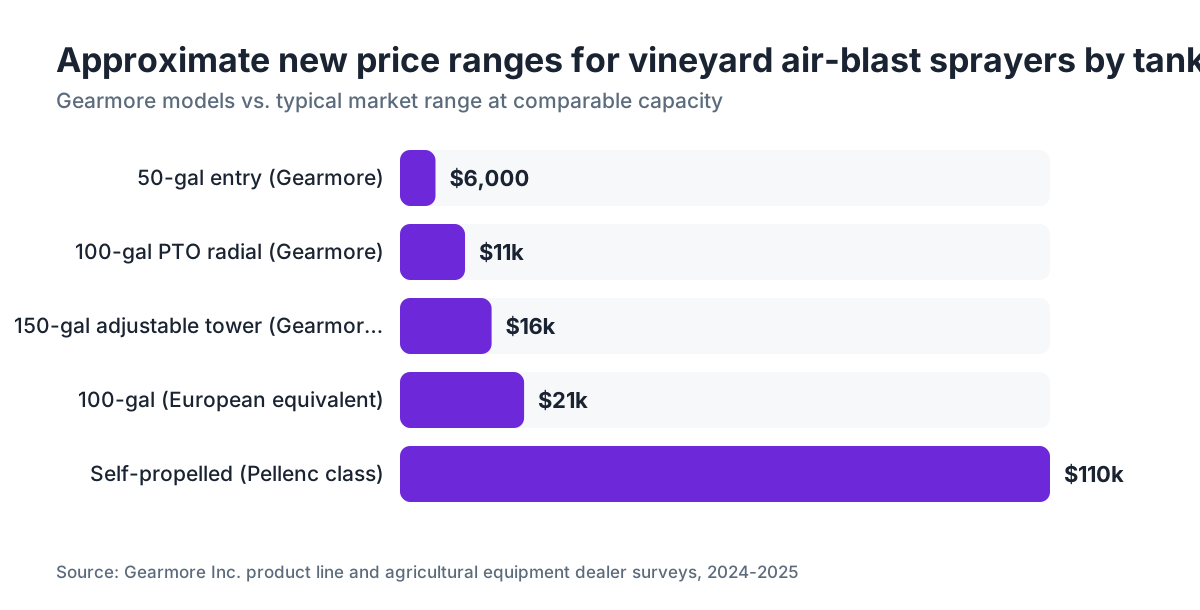
Price depends on configuration, tank size, and new versus used. As of 2024 to 2025, new Gearmore vineyard sprayers in the 100- to 150-gallon range land somewhere between $8,000 and $18,000 depending on options. Smaller 50-gallon trailer models come in under $7,000. Larger units with hydraulic tower adjustment can push past $20,000 [3].
Used Gearmore units show up regularly at auction and through farm equipment dealers in California's Central Valley and North Coast. A five- to ten-year-old 100-gallon unit in decent mechanical shape typically sells for $3,500 to $7,000 at auction. The pump, the fan bearings, and the nozzle manifold are what make or break the deal. Get a mechanic on any used unit before you pay.
| Configuration | Approximate New Price | Notes |
|---|---|---|
| 50-gal trailer, fixed head | $5,500 - $7,000 | Entry level, small vineyards |
| 100-gal PTO, radial | $9,000 - $13,000 | Most common vineyard model |
| 150-gal PTO, adjustable tower | $13,000 - $18,000 | Bilateral, better canopy control |
| 200-gal PTO, full-featured | $17,000 - $22,000+ | Larger operations, longer refill intervals |
Treat those figures as ballpark. Dealer markups, freight from California, and local service fees add cost. Always get a written quote and confirm what's included. Some dealers bundle nozzle sets, hose kits, or the first service visit. Some don't.
For comparison, a European air-blast unit (Gregoire, Nobili) at similar tank capacity usually runs $15,000 to $30,000 new. The Gearmore price advantage is real for a 20-40 acre operation.
How do you calibrate a Gearmore vineyard sprayer correctly?
Calibration is the single most important thing you can do with any sprayer, and it's where most spray applications go wrong. The goal is to put down a set volume of spray mix per acre at a consistent pressure and forward speed. On a Gearmore air-blast unit, calibration has three parts: nozzle output, forward speed, and canopy volume adjustment.
Start with nozzle output. Collect from each nozzle individually for 30 seconds using a graduated cup. Any nozzle that deviates more than 10% from the manufacturer's rated output at your target pressure should be replaced. Wear is usually invisible to the eye but produces real over- and under-application [4].
Forward speed is the variable most growers get wrong. Measure your actual travel speed in the vineyard under real conditions: uphill, downhill, on your actual row surfaces. A GPS speedometer beats the tractor's gauge, which is set for road conditions. WSU Extension lays out a clean method: mark 100 feet in the row, time a run with a stopwatch, then work backward to MPH from the seconds it took [5].
Once you have nozzle output and speed, calculate gallons per acre (GPA) with the standard formula. Cornell Cooperative Extension's sprayer calibration resources (on their Integrated Pest Management site) walk through the math step by step and include reference tables for various nozzle types [6].
Canopy volume matters too. A dense, wide canopy needs more total spray material than a light, narrow one at the same linear row footage. The Tree Row Volume (TRV) method, documented in UC Davis extension literature, gives you a multiplier based on canopy height, width, and row spacing. For many VSP-trained vineyards, 30 to 60 GPA is a reasonable starting point for fungicide applications, but that number shifts with product label requirements and canopy density [2].
Recalibrate at least once per season, and after any nozzle replacement or pump service.
What are the EPA Worker Protection Standard requirements when operating a vineyard sprayer?
The EPA's Worker Protection Standard (WPS) applies to all pesticide applications in agricultural settings, vineyard spray operations included. It was revised in 2015, with the revised rule taking full effect by January 2017 [7]. If you run a Gearmore or any commercial vineyard sprayer and you have employees (including family members who aren't owners), WPS compliance is not optional.
The requirements that touch sprayer operation are these: restricted entry intervals (REIs) that must be observed after each application, personal protective equipment (PPE) for the applicator and anyone entering a treated area, training for all agricultural workers and pesticide handlers, and posting at a central location and at treated field entry points.
The WPS rule at 40 CFR Part 170 defines a "pesticide handler" as someone who applies pesticides, which covers operating a sprayer. Handlers must complete WPS handler training, wear the PPE named on the label, and have access to emergency medical information and decontamination supplies at the application site [7].
For recordkeeping, you have to keep application records with the product name, EPA registration number, active ingredient, target pest, location treated, total amount applied, and applicator information. Keep them for two years. The federal rule states: "The establishment must retain records of each pesticide application for 2 years following the date of each application" [7].
California growers carry extra state duties under the Department of Pesticide Regulation (CDPR) Pesticide Use Reporting system, which requires monthly reporting of all applications to the county agricultural commissioner. Washington and Oregon layer their own requirements on top of federal WPS [8].
WPS paperwork is one area where a field operations platform like VitiScribe genuinely saves time. Keeping digital spray records that satisfy both state reporting and federal WPS retention in one place takes a real administrative load off a small operation.
What spray coverage and drift problems should you watch for?
Air-blast sprayers throw droplets across many sizes, and the small ones are the main drift risk. The EPA defines spray drift as "the physical movement of a pesticide through air at the time of application or shortly after to any site other than the area intended" [9]. For vineyards near homes, riparian zones, or neighboring crops, drift is both a compliance problem and a neighbor problem.
Water-sensitive paper cards (under $20 per pack from most ag suppliers) are the cheapest and most useful tool for checking actual canopy coverage from your Gearmore setup. Clip cards at several heights in the vine canopy, run a pass at your working speed and pressure, then read the stain patterns. Cornell's IPM program recommends a minimum of 50 spots per square centimeter on coverage cards as a baseline for fungicide efficacy [6].
The common coverage failures on air-blast vineyard sprayers are three: too little penetration into the dense interior canopy, too much outer-canopy deposition that runs off before it dries, and uneven bilateral coverage when the machine isn't set up symmetrically. On a Gearmore adjustable-tower unit you can angle airflow to hit specific canopy zones. Do that work early in the season rather than trusting the factory setting to match your trellis.
Drift comes down with speed and pressure. Slowing forward speed cuts total drift by giving droplets more time to reach the canopy. Cutting air volume (if your machine allows fan speed adjustment) also cuts drift but can hurt interior penetration. That tradeoff is real and site-specific. There's no universal setting. You dial it in for each block.
How does a Gearmore sprayer compare to other vineyard sprayer brands?
Comparing sprayer brands honestly means separating what matters (actual canopy coverage at your site, parts availability, total cost of ownership) from what doesn't (brand reputation in general farming, horsepower ratings that exceed what most vineyard tractors deliver anyway).
Gearmore's main competition in the western U.S. for this price segment includes Rears Manufacturing (Oregon-based), Hardi (a Danish company with North American distribution), and various imported Italian units sold under different names. In the $10,000 to $18,000 new range, Rears is probably the closest head-to-head for California and Pacific Northwest growers. Both companies build domestically and back parts support.
European brands like Gregoire and Caffini have a stronger foothold in high-density planting and offer tunnel sprayer configurations Gearmore doesn't match. If your vineyard runs Burgundy-style narrow rows or you want a closed-circuit sprayer that recovers overspray, those brands deserve a serious look even at the higher price.
Self-propelled options from brands like Pellenc drop the need for a dedicated tractor but run $80,000 to $150,000 new, which only pencils out above a certain acreage. The breakeven math is real and individual. A CPA or farm advisor can model it against your specific tractor cost allocation.
For a 30- to 80-acre wine grape operation running a mid-size utility tractor that's already paid for, Gearmore is a sensible choice. The machine isn't flashy. It's serviceable, parts are findable, and the price won't put you in a loan that takes ten seasons to clear.
What tractor horsepower and PTO requirements does a Gearmore sprayer need?
Most Gearmore vineyard sprayer models run on a 540 RPM PTO, standard on the vast majority of U.S. vineyard tractors. The PTO horsepower requirement varies by model. The smaller 50- to 100-gallon units typically need 20 to 35 PTO horsepower. Larger or fully equipped models can want 45 to 65 PTO HP [3].
Check this against your tractor's spec sheet, not against rated engine HP. PTO HP is usually 80 to 85 percent of engine HP on modern tractors, so a 40-HP engine tractor puts out roughly 32 to 34 PTO HP. Running a sprayer near the tractor's PTO limit wears the drivetrain and lets the tractor lug down on uphill rows, which changes your forward speed mid-pass and throws off your calibrated output per acre.
Row spacing and turning radius count too. Gearmore's vineyard models are built for standard row widths (usually 8 to 12 feet). Check the machine's total width, fan housing included, against your narrowest row before buying. A trailer-mount unit turns wider than a directly mounted unit, which affects headland management at row ends.
Running a smaller Kubota, LS, or Branson in the 25-35 HP range on a small property? Gearmore's entry-level 50-gallon units match that gear. Running a 60-70 HP Fendt or New Holland built for vineyard work? The larger 150- to 200-gallon Gearmore units fit better for throughput.
What maintenance does a Gearmore vineyard sprayer require?
Regular maintenance is what separates a 15-season machine from a 6-season machine. Air-blast sprayers have several wear points that need attention on a predictable schedule.
Nozzles are the most frequent replacement item. Ceramic and stainless tips last longer than plastic, but all of them wear. Measure output from each nozzle at the start of each season and replace any that are more than 10% off rated output. Keep a full set of spares on hand. Nozzles are cheap, and running a worn set through a critical disease pressure window is an expensive mistake.
The pump is the second component to watch. Diaphragm pumps (common on Gearmore units) need diaphragm and valve kit replacement roughly every 2 to 4 seasons depending on use intensity. Running the pump dry or working with incompatible tank mixes speeds up wear. Flush the system with clean water at the end of each day and triple-rinse the tank when you change products.
Inspect fan bearings annually. A squealing or rough-feeling bearing at the fan shaft is an early warning you shouldn't ignore. Fan bearing failure mid-season is a far bigger problem than a bearing swap during downtime.
Grease the PTO shaft and universal joints on the manufacturer's schedule, typically every 8 to 20 operating hours. Check the owner's manual for your specific Gearmore model. This varies.
Seasonal storage: drain all water from the pump, hoses, and tank before freezing temperatures. Some growers run a food-grade antifreeze through the pump for winter. Leaving water in the system over winter is one of the more common ways to crack a pump head or split a hose.
For spray and maintenance logs, keeping digital records of every service event alongside your application records protects you during a county ag commissioner inspection. VitiScribe lets you log spray applications and equipment maintenance in the same system, which helps when you need to pull two years of WPS-compliant records on short notice.
How do you read and interpret a pesticide label when using a vineyard sprayer?
The pesticide label is a federal legal document. Extension advisors say "the label is the law," and that's accurate. Using a pesticide in a manner inconsistent with its labeling is a federal violation under FIFRA (the Federal Insecticide, Fungicide, and Rodenticide Act) [10].
For vineyard sprayer use, the label sections that matter most are the directions for use (crop, application method, timing restrictions), the REI (restricted entry interval, which controls when workers can re-enter a treated area), the PHI (pre-harvest interval, which sets how close to harvest you can apply), the application rate (fluid ounces or pounds per acre, sometimes per 100 gallons of water), and the PPE requirements for the applicator.
Application rate is where calibration and label compliance meet. If the label says 8 fluid ounces per acre and your sprayer puts out 90 GPA, you have to calculate the concentration per gallon of tank mix to hit that per-acre dose. Wrong calibration means wrong per-acre dose, even when your tank mix concentration looks right on paper.
Some wine grape fungicide labels (many of the DMI and SDHI chemistries) carry resistance management language requiring rotation across mode-of-action groups. That isn't just agronomic advice. In some cases it's part of the legal use directions. Track your application history and mode-of-action rotation across the season.
When you're unsure about label interpretation, call your local farm advisor (PCA in California, CCA in other states). UC IPM's online label reading guide is a solid reference too [11].
Where can you buy a Gearmore sprayer, and what should you check before purchasing?
Gearmore equipment sells through agricultural equipment dealers, mostly in California and the western states. Their products also turn up on online marketplaces like TractorHouse and MachineFinder, and at regional farm auctions.
Before you buy, new or used, work through this checklist. First, confirm parts availability for your exact model from the dealer. Ask them to quote a diaphragm kit and a full nozzle set on the spot. If they have to special-order basic consumables, that's worth knowing now. Second, check whether there's a local technician who has actually worked on Gearmore equipment. Not every dealer has spray system expertise. Some are mainly tractor shops. Third, ask for references from other vineyard operators near you running the same model. Fourth, verify that the rated tank capacity and pump output match your intended application volume and your vineyard's row length and block size.
For used purchases: check the pump for smooth operation and no pressure fluctuation, check all hose fittings for cracking or dry rot, spin the fan by hand to feel for rough bearings, and run the PTO shaft through its full range of motion. A half-hour inspection tells you more than any auction listing.
Buying your first sprayer? Connecting with your local vineyard community through winery networks and grower associations is often the fastest way to find used equipment and candid reviews from people who've run the same machine in conditions like yours.
Frequently asked questions
Is Gearmore a good sprayer brand for small vineyard operations?
Gearmore is a reasonable choice for vineyards under roughly 100 acres running standard 8- to 10-foot row spacing. The price sits below most European brands, parts come from California warehouses, and the machines are PTO-compatible with common vineyard tractors. The main limit is that they don't offer recycling or tunnel sprayer configurations, so if drift reduction is a priority you'll need to look elsewhere.
What size Gearmore sprayer do I need for my vineyard acreage?
A rough starting point: a 100-gallon tank covers about 3 to 6 acres per fill at typical wine grape rates of 30 to 60 GPA. For a 25-acre block with efficient logistics, a 150-gallon unit means fewer stops. For 80-plus acres with long travel to a fill point, a 200-gallon unit makes more sense. Actual throughput depends heavily on your GPA target, row length, and fill station location.
How often should I calibrate my vineyard sprayer?
At minimum once per season, ideally before disease pressure begins. WSU Extension recommends recalibrating any time you change nozzles, change products with a different target GPA, adjust operating pressure, or notice inconsistent coverage. Check nozzle output individually. A 10% deviation from rated output is the standard replacement threshold.
What PPE is required when operating a vineyard sprayer?
PPE requirements come from the individual pesticide label, not the sprayer. Common label requirements for vineyard fungicide handlers include chemical-resistant gloves, long sleeves and pants, closed-toe shoes with socks, and a face shield or goggles. Some organophosphate insecticide labels require a respirator. Always read the specific product label. EPA WPS handler training must be completed before operating a sprayer in an agricultural setting.
What is the EPA Worker Protection Standard restricted entry interval (REI)?
The REI is the time after an application during which workers can't enter the treated area without specific PPE. REIs range from 4 hours (many lower-toxicity fungicides) to 48 hours or longer for more toxic materials. The REI is listed on each label and must be posted at the treated area entry and at the farm's central display location under WPS. Federal rule: 40 CFR Part 170.
How do I reduce spray drift from my air-blast vineyard sprayer?
Slow down: lower forward speed gives droplets more time to reach the canopy before drifting. Cut air volume if your machine allows fan speed adjustment. Apply in low wind (under 10 mph is a common threshold; some labels set lower limits). Air-induction or drift-reduction nozzles cut fine droplet production. Calibrate spray volume to target the canopy, not the air above it. Drift is a compliance issue under federal FIFRA and most state pesticide laws.
What records do I need to keep for vineyard pesticide applications?
Federal WPS requires keeping application records for two years. Required information includes product name, EPA registration number, active ingredient, target pest or disease, location and description of treated area, total amount applied, date of application, and applicator identity. California growers also file monthly Pesticide Use Reports with their county agricultural commissioner under CDPR rules. Digital record systems make WPS retention and state reporting far easier to manage.
Can I use a Gearmore sprayer for herbicide applications between vineyard rows?
Technically yes, but with caution. Any sprayer used for herbicide must be thoroughly cleaned before applying fungicides or insecticides, because residual herbicide contamination at very low levels can damage grapevines. Many growers keep a dedicated herbicide sprayer separate from their canopy sprayer to kill the cross-contamination risk. If you use one machine for both, a proper triple-rinse plus documentation of the cleaning process between applications is essential.
What is the tree row volume method and how does it apply to vineyard sprayer calibration?
Tree row volume (TRV) is a calibration method that adjusts spray volume based on the actual canopy size being treated. The formula accounts for canopy height, width, and row spacing to produce a GPA recommendation proportional to the target's leaf area. UC Davis Cooperative Extension recommends TRV-based calibration because it prevents under-application in dense canopies and waste in lighter ones. UC Davis extension materials provide TRV tables for common California wine grape trellis systems.
How do I winterize a Gearmore vineyard sprayer for storage?
Drain all water from the pump, hoses, manifold, and tank before any risk of freezing. Run clean water through the system until it runs clear, then either blow lines dry with compressed air or circulate a small amount of food-grade propylene glycol antifreeze through the pump. Remove and inspect all nozzles, clean strainers, and store them indoors. Grease PTO shaft fittings and check the fan shaft bearings for smooth operation before storing.
What is the pre-harvest interval (PHI) and why does it matter for vineyard spraying?
The PHI is the minimum number of days between the last application of a pesticide and harvest. It's a federal label requirement under FIFRA. Violating the PHI can leave pesticide residues above the tolerance level on harvested grapes, which can trigger rejection at a winery or a stop-sale order from your state department of agriculture. Plan your spray program backward from your estimated harvest date to confirm PHI compliance for every product in rotation.
Does Gearmore offer a warranty on their vineyard sprayers?
Warranty terms vary by model and dealer. Based on typical agricultural equipment industry practice, Gearmore units generally carry a one-year limited warranty on defects in materials and workmanship, with wear items like nozzles, diaphragms, and hoses excluded. Confirm the specific warranty terms in writing with your dealer before purchase. Extended service contracts are sometimes available through dealers and may be worth considering for remote operations without nearby service capacity.
Where can I find training on vineyard sprayer calibration and pesticide safety?
UC Davis Cooperative Extension, WSU Extension, and Cornell Cooperative Extension all publish free sprayer calibration guides and hold periodic grower workshops. UC ANR (the UC Agriculture and Natural Resources division) runs online pesticide safety courses through their website. Your county farm advisor or local PCA (licensed Pest Control Adviser in California) can also provide site-specific calibration help. EPA WPS handler training materials are available through your state department of agriculture.
Sources
- UC Agriculture and Natural Resources, Pest Management Guidelines: Grape: Vineyard sprayer tank sizing and application volume guidance for wine grape operations
- UC Davis Cooperative Extension, Spray Application Technology in Vineyards: Deposition efficiency and coverage uniformity depend more heavily on calibration and canopy characteristics than on sprayer brand; TRV method for calibration
- Gearmore Inc., Agricultural Equipment Product Line: Gearmore vineyard sprayer tank sizes, PTO HP ratings, and approximate price ranges by model
- WSU Extension, Sprayer Calibration for Vineyards and Orchards: Nozzle output deviation greater than 10% from rated output at target pressure is the replacement threshold
- Washington State University Extension, Speed Measurement for Vineyard Sprayer Calibration: Method for calculating forward speed in vineyard rows using a 100-foot measured distance and stopwatch
- U.S. EPA, Worker Protection Standard, 40 CFR Part 170: WPS handler training requirements, REI posting, PPE requirements, and two-year application record retention mandate
- California Department of Pesticide Regulation, Pesticide Use Reporting: California growers must report all pesticide applications monthly to the county agricultural commissioner
- U.S. EPA, Pesticide Spray Drift Management: EPA definition of spray drift as physical movement of pesticide through air at time of application to unintended sites
- U.S. EPA, Federal Insecticide, Fungicide, and Rodenticide Act (FIFRA): Using a pesticide inconsistent with its labeling is a federal violation under FIFRA; the label is a legal document
- UC IPM, How to Read a Pesticide Label: Extension guidance on interpreting pesticide label sections including REI, PHI, application rate, and PPE requirements
Last updated 2026-07-10