General viticulture: the complete field guide for vineyard managers
TL;DR
- General viticulture covers every decision from site selection and variety matching through canopy management, pest control, and regulatory compliance.
- The Winkler heat summation index, developed at UC Davis and detailed in the textbook 'General Viticulture' by Winkler et al., remains the most widely used tool for matching grape varieties to climate regions.
- The vineyard sets the ceiling on wine quality before a single grape is picked.
What is general viticulture and why does it matter for grape growers?
Viticulture is the science and practice of growing grapes, mainly Vitis vinifera and its relatives, for wine, table use, or raisins. It covers soil science, plant physiology, climate analysis, canopy management, pest and disease control, irrigation, and the paperwork that keeps the whole thing legal. It's a complete system, not a single skill.
The word comes from the Latin vitis (vine) and cultura (cultivation). The practical definition for a working vineyard manager is simpler: every decision you make between dormant pruning and harvest. That's viticulture.
Why does it matter? Because the vineyard sets the ceiling on wine quality. A winery can't fix what happens in the field. Poorly chosen clones, the wrong rootstock, unmanaged canopy shade, a missed fungicide window: they all show up in the glass. Understanding the fundamentals lets you make better calls earlier, when they're still cheap to fix.
Small winery owners who farm their own blocks carry a heavier load. They're doing viticulture and winemaking and compliance at the same time. The field guide approach in the textbook 'General Viticulture' by A.J. Winkler, James Cook, W.M. Kliewer, and L.A. Lider (University of California Press, revised edition 1974) is still the foundational reference exactly because it treats the vineyard as a system [1]. Forty-plus years later, extension programs at UC Davis, Cornell, and Washington State University (WSU) still build their curricula around its framework.
What is the Winkler index and how do you calculate it for your region?
The Winkler index, also called growing degree days (GDD), measures accumulated heat during the grape-growing season. You take the mean daily temperature (high plus low, divided by two), subtract 50°F (the base temperature below which grapevine growth essentially stops), and sum those daily values from April 1 through October 31. No mean below 50°F contributes; those days count as zero [1].
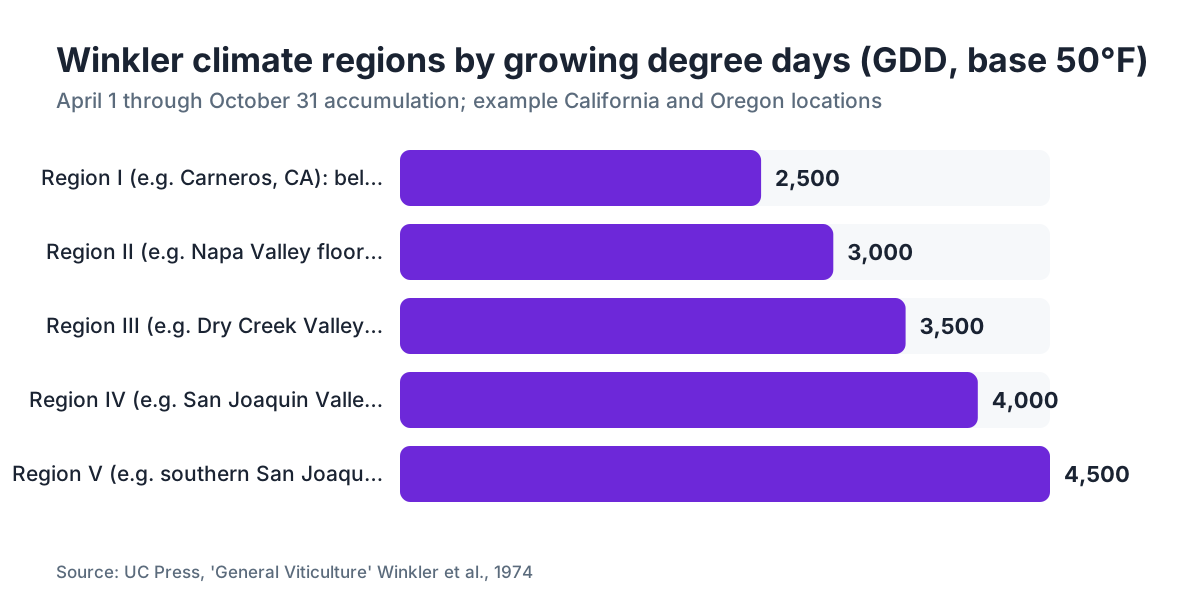
Winkler and Amerine published the original climate classification in the 1940s, and the 1974 textbook codified five regions:
| Region | GDD Range (°F) | Example Locations | Well-suited Varieties |
|---|---|---|---|
| I | Below 2,500 | Carneros (CA), Willamette Valley (OR) | Pinot Noir, Chardonnay, Pinot Gris |
| II | 2,501 to 3,000 | Napa Valley floor, Sonoma Valley | Cabernet Sauvignon, Merlot, Sauvignon Blanc |
| III | 3,001 to 3,500 | Dry Creek Valley, parts of Paso Robles | Zinfandel, Barbera, Syrah |
| IV | 3,501 to 4,000 | San Joaquin Valley north | Table and raisin grapes, some Zinfandel |
| V | Above 4,000 | Southern San Joaquin Valley | Thompson Seedless, raisin varieties |
Calculating your own index is easy if you have a weather station or access to NOAA data for a nearby site. Pull the daily max and min, average them, subtract 50, drop negatives, sum April through October [2]. UC Davis's viticulture extension pages walk through worked examples for California sites [3].
Here's the honest limitation. GDD captures heat accumulation but misses diurnal swing, fog, wind, and frost risk. Carneros and coastal Sonoma can share similar GDD totals with inland sites and still grow completely different fruit, because the afternoon fog patterns are so different. Use Winkler as a starting point, not a verdict.
If you're after the original textbook, 'General Viticulture' by Winkler et al. is available through UC Press and through many university library systems. The PDF circulates informally online, but the UC Press print edition is the authoritative version. Some university libraries offer digital access.
How do you choose the right grape variety and rootstock for your site?
Variety selection is the single decision that follows your vineyard the longest. Get it wrong and you're either replanting in 10 years or selling fruit at a discount for 30. Get it right and the site does half your work for you.
Start with climate. The Winkler region hands you a shortlist of varieties with realistic ripening windows. Then layer in soil type, water availability, disease pressure, and your intended market. A Region I site with well-drained loam in a cool coastal valley suits Pinot Noir beautifully. The same variety on a Region III valley floor in heavy clay will fight you on color, on pH, and on rot.
Rootstock selection matters just as much and usually gets less attention than it deserves. The main reasons to graft are phylloxera resistance, nematode management, and soil adaptation. Some rootstocks, like 5C Teleki and 101-14 Mgt, run low vigor and suit shallow or dry sites. Others, like 1103 Paulsen and 110 Richter, root deep and handle drought better. St. George (ER 1202) pushes high vigor and suits sandy soils with nematode pressure [4].
Clonal selection matters too, though the data is thinner than you'd like. UC Davis Foundation Plant Services keeps a catalog of certified clean plant material, and the clonal performance work from their field trials is the best available domestic data on how clones of Cabernet Sauvignon, Pinot Noir, and Chardonnay actually behave in California conditions [4].
Growers in the Pacific Northwest should check WSU Extension, which publishes variety and rootstock recommendations for Washington and Oregon that account for the region's winter hardiness risks [5].
One practical note. Certified virus-indexed plant material costs more upfront, roughly $3 to $6 per vine more than uncertified material depending on variety and nursery. Pay it. Leafroll virus alone can cut yields 20 to 50 percent, and it's essentially unmanageable once the vineyard is infected.
What training systems and trellis configurations work best for wine grapes?
Training systems set canopy architecture, and canopy architecture sets fruit exposure, disease pressure, harvest efficiency, and your mechanization options. There's no single best system. There are clear wrong choices for a given context.
Here are the main systems used in wine grape production in the United States.
Vertical Shoot Positioning (VSP) is the dominant system for premium wine production. Shoots are trained upward and tucked into foliage wires, creating a thin, well-exposed canopy. It suits moderate-vigor varieties in cooler climates. The main criticism: on high-vigor sites it produces heavy shading even with aggressive shoot thinning and hedging.
Scott Henry divides the shoot zone, training alternate shoots up and down, which effectively doubles the fruiting surface. It's a solid fix for high-vigor sites where VSP turns into a shaded mess. It costs more labor at shoot thinning time but can lift fruit quality in the right setting.
Head-trained vines, own-rooted or staked (often called gobelet or bush vine), are common in old-vine Zinfandel blocks in California and in dry-farmed settings. Low infrastructure cost, no trellis to maintain. The tradeoff is that mechanization is nearly impossible and yield assessment gets harder.
Lyre, Geneva Double Curtain (GDC), and other divided canopy systems suit high-vigor sites and work well for higher-yielding programs where quality targets allow it. GDC in particular has a strong research base from Cornell [6].
Trellis height and wire placement affect both canopy work and labor cost. A fruiting wire at 36 to 42 inches works for most VSP systems. Too low and you invite mudsplash disease; too high and canopy work gets harder. Row spacing interacts with equipment width, so map your rows to the equipment you actually own before you plant.
How do canopy management practices affect fruit quality?
Shoot thinning, leaf removal, hedging, and crop thinning are the main canopy tools. Each one redirects the vine's energy. The goal is almost always the same: get sunlight into the fruiting zone without stressing the vine to the point that it shuts down.
Shoot thinning happens early, usually at 6 to 12 inches of shoot growth. Removing excess shoots before they lignify is cheap and fast, and it's the highest-leverage move you have. Do it after lignification and it costs more while the benefit mostly evaporates.
Leaf removal in the fruit zone improves air circulation, cuts botrytis and powdery mildew pressure, and raises anthocyanin and flavonoid development in red varieties. UC Davis research found that early leaf removal (at or just after fruit set) in Pinot Noir improved color and reduced bunch rot compared to late removal or none [3]. The timing caveat: aggressive early leaf removal in very hot regions causes sunburn. On Region IV and V sites, partial shade on the west face of the canopy actually helps berry integrity.
Crop thinning (green drop) is the priciest and most argued-over tool. Dropping clusters at veraison to lower crop load concentrates sugars and phenolics in the fruit that stays. The honest read: the quality response is highly site and variety dependent. In a high-yielding, low-quality-target program it's rarely economical. In a premium Cabernet or Pinot block aiming below 3 tons per acre, it can make a real difference in phenolic ripeness. There's no universal threshold, and anyone who tells you to always drop to X tons per acre is oversimplifying.
Tracking your actual pruning weights, shoot counts, and yield per vine across several seasons is the only way to understand your own vine balance. The Ravaz index (yield divided by pruning weight) is the standard tool for this. A ratio between 3 and 7 generally means reasonable balance, with values above 10 pointing to overcropping [1].
What are the most common grapevine diseases and how do you manage them?
Powdery mildew (Erysiphe necator) is the most economically damaging fungal disease in most North American wine regions. It infects all green tissue and wrecks fruit quality and yield when it runs unchecked. The critical period runs from just before bloom through about four to six weeks post-fruit set. UC Davis's ipm.ucanr.edu resource gives you the best openly available disease management calendars for California, including the Gubler-Thomas powdery mildew risk model, which uses temperature and time to forecast infection pressure and time sprays [3].
Botrytis cinerea (gray mold) thrives in wet, humid conditions near harvest. Tight-clustered varieties like Gewurztraminer, Pinot Gris, and Pinot Noir get hit harder. Canopy management is your first line of defense and fungicides are the backup. Resistance to common Botrytis chemistry (the SDHI and QoI classes especially) is a real and growing problem, so rotating mode of action is not optional.
Downy mildew (Plasmopara viticola) stays rare in dry western regions but turns serious in humid eastern and Pacific Northwest climates. Cornell's integrated pest management program covers eastern disease pressure in detail [6].
Grapevine leafroll virus (GLRaV types 1 through 9) spreads mainly through mealybugs and soft scale insects. Symptoms show as leaf rolling, interveinal reddening in reds, and delayed or incomplete ripening. There's no cure. Management comes down to certified planting material and mealybug control [5].
Pierce's Disease (Xylella fastidiosa, spread by glassy-winged sharpshooter) is a serious constraint in parts of California and the Gulf Coast. UC Davis runs the primary public research effort on it through its Pierce's Disease Research Program [3].
For spray records across all these programs, the regulatory requirement (and the practical need) is to record product, rate, target pest, application date, REI, and applicator credentials for every application. VitiScribe was built to handle that record trail without the paperwork mess, but a well-organized spreadsheet works too, as long as you capture every required field.
What does the EPA Worker Protection Standard require for vineyard spray programs?
The EPA's Agricultural Worker Protection Standard (WPS), revised in 2015 and effective January 2017, applies to any agricultural employer using pesticides. For a vineyard that means requirements for handler training, decontamination supplies, emergency assistance, central posting of pesticide application information, and restricted-entry interval (REI) compliance [7].
The 2015 revision added several new requirements that caught some growers off guard. The minimum age for handlers is 18, and it's also 18 for workers entering treated areas under the revised rule. Annual training is now required for both workers and handlers (handler training ran every five years under the earlier standard; now it's yearly). Application-specific information has to be posted at a central location within 24 hours of each application and kept posted through the end of the REI.
The posting has to include the product name, EPA registration number, active ingredient, location treated, date and time of application, and the REI. For a vineyard running multiple spray passes a week during peak season, that's a real administrative load.
The EPA's official WPS page at epa.gov carries the full regulatory text, compliance guides, and training materials in English and Spanish [7]. The required worker training has to cover the topics specified in the standard; you can use EPA-approved training programs or a state equivalent.
State pesticide rules layer on top of WPS. California's Department of Pesticide Regulation (CDPR) has some of the strictest requirements in the country, including mandatory electronic reporting of pesticide use for agricultural operations [8]. Washington State's Department of Agriculture keeps separate licensing and record-keeping rules [5].
The practical minimum for any vineyard spray record: product name, EPA reg number, active ingredient, crop and site, application date and time, application rate and total amount used, equipment used, applicator name and license number, target pest, wind speed and direction at application, and REI. Keep records for at least two years. Some states require longer.
How does vineyard irrigation management affect grape quality?
Water management might be the most nuanced decision a vineyard manager makes over and over through the season. Too much water gives you excessive vigor, shading, and diluted fruit. Too little gives you berry shrivel, stuck fermentations from high Brix at low pH, and stressed vines that can't rebuild canopy after harvest.
Regulated Deficit Irrigation (RDI) is the dominant strategy in premium wine grape production. You apply less water than full evapotranspiration replacement, holding the vine under mild to moderate stress during specific growth stages to control vigor and improve fruit quality. Pre-veraison mild stress shrinks berry size, which raises the skin-to-pulp ratio and phenolic concentration. Post-veraison moderate stress slows sugar accumulation and stretches hang time, letting phenolic ripeness catch up with Brix.
The tool for monitoring vine water status is pressure chamber measurement of leaf water potential. Midday stem water potential between -8 and -12 bars generally signals mild to moderate stress in most varieties [3]. Below -16 bars you're heading into severe stress that can cause permanent damage in some variety and rootstock combinations.
Drip irrigation is the standard in modern premium vineyards. Microsprinklers show up where frost protection is needed, since drip won't help you there. Overhead sprinklers for frost protection carry disease risk during the season but stay the most reliable protection on frost-prone sites.
Dry-farming rests on the premise that vine roots reach deep enough to draw subsoil moisture without supplemental water. It works on sites with enough winter rainfall recharge and enough soil depth. In genuinely shallow soils or low-rainfall years, dry farming isn't a philosophy. It's just stress. Know your soil and your water table before you commit to it.
What soil and site factors matter most for vineyard establishment?
Slope, aspect, soil depth, drainage, and soil texture all interact. No single factor dominates everywhere, but drainage comes closest to universal importance. Grapevines are famously tolerant of poor soils and famously intolerant of waterlogged roots. Wet, poorly drained sites grow disease-prone, low-vigor vines that rarely make compelling wine.
Soil depth sets rooting volume and water and nutrient storage. Shallow soils (under 18 inches to a restrictive layer) can work in high-rainfall areas with strong winter recharge. In dry climates they force early water stress and demand more management. Deep, well-drained soils over fractured rock, gravel, or loam suit most wine varieties well.
South-facing slopes in the Northern Hemisphere catch more direct radiation and pile up more heat units than flat or north-facing sites at the same latitude. This matters most in cool-climate regions where pushing ripeness is a genuine struggle. In already-hot regions, a north-facing slope or higher elevation can be an asset.
Soil pH shapes nutrient availability more than most growers appreciate. Grapevines grow across a pH range of about 5.5 to 8.5, but nutrient availability peaks in the 6.0 to 7.0 band. Manganese toxicity can show up in very acid soils, and iron and zinc deficiency is common in high-pH calcareous soils. Pre-plant soil testing is cheap compared to fixing problems after the vines are in the ground.
For Oregon and Washington, WSU Extension publishes site evaluation guides built around the freeze-risk conditions in the Columbia Valley and Willamette Valley [5].
A detailed site survey before planting should include soil profile pits at multiple locations, a soil texture analysis, a drainage evaluation (percolation test or profile observation), slope and aspect mapping, frost pocket identification, and a review of neighboring operations' history where you can get it. Spending $2,000 to $5,000 on pre-plant site analysis before you sink $25,000 to $60,000 per acre into a new vineyard is one of the few unambiguously correct recommendations in this business.
How do you set up a vineyard record-keeping system that survives a compliance audit?
The records auditors and state inspectors actually pull fall into a few clear buckets: pesticide application records, worker safety training documentation, irrigation and fertilization logs, scouting and pest monitoring records, and harvest records including yield per block and pick date. Fall short in any one bucket consistently and you have a compliance gap.
Pesticide application records are the highest-risk area. California's CDPR requires annual reporting of pesticide use to the county agricultural commissioner, with most large operations required to report electronically [8]. The EPA WPS posting and record requirements apply everywhere [7]. A spray record missing the REI, applicator license number, or EPA reg number is not a valid spray record.
Worker safety training records need to show who was trained, what program was used, the date of training, and the trainer's credentials. Keep a signed roster. If you can't prove the training happened, then as far as an auditor is concerned, it didn't.
Organic and certified sustainable programs add another layer of third-party certification paperwork. CCOF, SCS Global, and Lodi Rules each use different record-keeping formats, but all of them require documented inputs, field activity logs, and prohibited substance declarations.
VitiScribe's field operations platform captures all of this in one place, linking spray records to specific blocks, calculating REI windows automatically, and generating compliant pesticide use reports. It's worth a look if you're managing more than a few blocks and spending real time on paper records.
The honest advice for any size operation: whatever system you use, the record has to be made at the time of the activity. Reconstructing spray records from memory at the end of the season is not a system. It's a liability.
What university and extension resources are the best for ongoing viticulture education?
Three programs lead on research-backed viticulture content in the United States.
UC Davis Viticulture and Enology (ucanr.edu and their V&E department pages) runs the largest and best-funded viticulture research program in the country. The UC IPM program at ipm.ucanr.edu has the best openly available pest management guidelines by crop and region [3]. Their Foundation Plant Services catalog covers certified clean plant material. UC cooperative extension farm advisors are county-based and often the most practically useful resource for site-specific questions.
Cornell University's College of Agriculture and Life Sciences runs the primary viticulture research program for eastern and cool-climate North American production. Their work on downy mildew, botrytis, and cold hardiness speaks directly to anyone farming east of the Rockies or in cool Pacific Northwest sites [6]. Cornell Cooperative Extension keeps county-based advisors throughout New York.
Washington State University Extension covers the Pacific Northwest with research specific to the Columbia Valley, Yakima Valley, and Walla Walla regions [5]. Their publications on cover crops, irrigation scheduling, and cold injury management are especially strong.
For the Winkler textbook, UC Press is the publisher of record for 'General Viticulture' [1]. The 1974 revised edition is the standard reference. Newer regional guides include 'Sunlight into Wine' by Richard Smart and Mike Robinson (which covers canopy management in more detail) and 'Viticulture: Volume 1, Resources' edited by Coombe and Dry for Australian conditions (useful for hot, dry climates anywhere).
Online short courses through UC Davis Extension and Cornell's online programs give working managers structured continuing education without a full degree program. The UC Davis online viticulture certificate program covers the full curriculum from Winkler basics through harvest management.
How does the Winkler 'General Viticulture' textbook differ from modern viticulture resources?
The 1974 Winkler textbook is foundational, and it's also 50 years old. Being honest about what it covers and what it skips matters.
What it does exceptionally well: climate classification, variety adaptation, vine physiology basics, training system principles, and the foundational soil and nutrition framework. The five-region GDD classification in the book is still the most widely cited climate framework in American viticulture [1]. The chapter on vine physiology remains a solid introduction to how grapevines actually grow and respond to management.
What it doesn't cover: precision irrigation tools like pressure chamber protocols and deficit irrigation scheduling (which came together from the 1980s onward), modern rootstock breeding and phylloxera biotype diversity (a major issue in California since the 1980s), molecular disease diagnostics, the spread of wine production into new North American regions with very different conditions than California, cover crop and soil biology management, and any of the digital or data-driven monitoring tools now available.
So the honest answer is this. Read Winkler for the framework. Layer in the UC Davis IPM guidelines, WSU Extension publications, and Cornell resources for anything pest and disease specific. Then reach for newer texts on irrigation and soil biology. Richard Smart's canopy management work from the 1980s and 1990s filled a major gap the original textbook left open. The UC Davis viticulture certificate curriculum is currently the strongest synthesis of Winkler's framework with modern research.
For a vineyard manager outside California, especially in the East or Pacific Northwest, the Winkler climate regions are a useful starting point that will need reinterpretation. The original calibration was entirely California-based. Cornell and WSU have done the most work adapting the framework to their regions.
Frequently asked questions
What are the five Winkler climate regions for grape growing?
The five Winkler regions are defined by growing degree days (GDD, base 50°F, April through October): Region I is below 2,500 GDD (cool, suited to Pinot Noir and Chardonnay), Region II is 2,501 to 3,000 (Cabernet Sauvignon, Merlot), Region III is 3,001 to 3,500 (Zinfandel, Syrah), Region IV is 3,501 to 4,000, and Region V is above 4,000 GDD (table and raisin grapes). The framework was developed at UC Davis.
Where can I find the 'General Viticulture' Winkler PDF or the original textbook?
The authoritative edition is 'General Viticulture' by Winkler, Cook, Kliewer, and Lider, published by UC Press (revised 1974). UC Press is the official publisher. Some university libraries offer digital access through their catalogs. Informal PDFs circulate online but may be incomplete or poorly scanned. For current guidance on topics the 1974 text doesn't cover, UC Davis Extension, Cornell, and WSU publish free online resources.
How do I calculate growing degree days for my vineyard?
Average your daily high and low temperature, subtract 50°F (the base), and record the result if positive (zero if negative). Sum these daily values from April 1 through October 31. NOAA weather stations provide historical daily temperature data for nearby locations. UC Davis cooperative extension publishes regional GDD summaries for California counties, which you can compare against your on-site weather station data.
What spray records does the EPA Worker Protection Standard require me to keep?
The EPA WPS requires posting application-specific information within 24 hours of each pesticide application and keeping it posted through the end of the REI. Required details include product name, EPA registration number, active ingredient, treated location, application date and time, and the REI. Training records showing who was trained, when, and with what program must also be kept. California additionally requires annual pesticide use reporting to the county agricultural commissioner.
What is vine balance and how do you measure it?
Vine balance describes the relationship between vegetative growth and crop load. The Ravaz index (yield in kg per vine divided by pruning weight in kg per vine) is the standard measurement. A ratio of 3 to 7 generally indicates reasonable balance; values above 10 suggest overcropping. Collecting pruning weight data by block each dormant season and pairing it with your yield records is the most practical way to track balance over time.
What rootstock should I use for a phylloxera-infested site?
Any grafted rootstock with V. rupestris, V. riparia, or V. berlandieri parentage provides phylloxera resistance. Selection should consider more than phylloxera. Soil drainage, vigor needs, and nematode pressure all matter. 101-14 Mgt suits lower-vigor needs in moderate soils. 110 Richter and 1103 Paulsen root deeper for drought-prone sites. 3309 Couderc suits cool, moist soils. Consult UC Davis Foundation Plant Services or WSU Extension for region-specific recommendations.
How early should I thin shoots for canopy management?
Shoot thinning is most cost-effective when shoots are 6 to 12 inches long, before they lignify. At that stage removal is fast, the canopy hasn't committed to excess growth, and the vine's energy gets redirected early. Waiting until after shoot lignification still helps airflow and fruit exposure but costs considerably more labor time and delivers less benefit, because the vine has already invested energy in those shoots.
How does regulated deficit irrigation improve wine grape quality?
Regulated deficit irrigation (RDI) applies less water than full evapotranspiration replacement to hold vines under mild to moderate stress at specific growth stages. Pre-veraison mild stress shrinks berry size, concentrating skin-to-pulp ratio and phenolic compounds. Post-veraison moderate stress slows sugar accumulation, extending the window for phenolic ripeness. Midday stem water potential measured with a pressure chamber, typically targeting -8 to -12 bars for mild stress, guides irrigation timing.
What is the best university extension resource for viticulture pest management?
UC Davis's Integrated Pest Management (IPM) program at ipm.ucanr.edu has the most detailed, openly available pest management guidelines for wine grapes, including fungicide timing models like the Gubler-Thomas powdery mildew risk model. Cornell Cooperative Extension is the leading resource for eastern and cool-climate disease management, particularly downy mildew. WSU Extension publishes Pacific Northwest-specific disease and pest management guides for Columbia Valley and Willamette Valley producers.
What diseases should I prioritize in a humid vineyard climate?
In humid climates, powdery mildew, botrytis bunch rot, and downy mildew top the priority list. Powdery mildew pressure exists in most climates but turns especially difficult in warm humid summers. Botrytis thrives in dense canopies and wet harvest periods; leaf removal and cluster thinning are your best preventative tools. Downy mildew is a wet-weather disease that rarely troubles western desert-climate vineyards but can devastate eastern and Pacific Northwest blocks in wet springs.
How do I know if my vineyard soil needs amendment before planting?
Get a soil profile evaluation (pits at multiple locations) and a lab soil test covering pH, organic matter, major nutrients, and texture before planting anything. Soil pH outside the 6.0 to 7.0 range may need lime or sulfur amendment, which is far easier to incorporate pre-plant. Drainage should be tested with a percolation test. The cost of pre-plant analysis, typically $2,000 to $5,000 for a thorough site evaluation, is negligible against the cost of new vineyard establishment.
Can I dry-farm wine grapes, and under what conditions does it actually work?
Dry farming works where winter rainfall recharges soil moisture deep enough for vine roots to reach through the growing season, typically requiring 20 or more inches of annual rainfall and soil depth allowing deep rooting. It fails in shallow soils, drought years with poor recharge, or regions with less than about 15 inches of annual precipitation. It's not a philosophical position; it's an agronomic one. Know your soil depth and water table before you commit.
What records do I need to keep for an organic vineyard certification?
Organic certification requires documented field activity logs covering all inputs (fertilizers, pest control materials, soil amendments), purchase invoices for all inputs, a current organic system plan updated annually, buffer zone maps, and records showing prohibited substances were not used. Third-party certifiers like CCOF conduct annual inspections and review your records. The USDA National Organic Program sets the federal standard, and most certifiers require records kept for five years.
What is the Ravaz index and what values indicate a healthy vine?
The Ravaz index divides crop yield per vine (in kg) by pruning weight per vine (in kg) from the same season's dormant pruning. It's a simple, reliable measure of vine balance. Values between 3 and 7 generally indicate a balanced vine where vegetative growth and fruit production sit in reasonable proportion. Values above 10 suggest overcropping; very low values (below 2 or 3) may indicate excess vigor or under-cropping. Collect both yield and pruning weight data by block each season to track trends.
Sources
- University of California Press, 'General Viticulture' by Winkler, Cook, Kliewer, and Lider (revised 1974): Five Winkler climate regions defined by GDD base 50°F April through October; Ravaz index and vine balance concepts; foundational vine physiology framework
- NOAA National Centers for Environmental Information, Climate Data Online: Daily maximum and minimum temperature data used for calculating growing degree days by site
- UC Davis Integrated Pest Management Program, University of California Agriculture and Natural Resources: Powdery mildew Gubler-Thomas risk model; leaf removal timing research; Pierce's Disease research program; midday stem water potential thresholds for deficit irrigation
- UC Davis Foundation Plant Services, University of California Davis: Certified virus-indexed plant material catalog; rootstock performance and selection guidance; clonal trial data for California wine varieties
- Washington State University Extension, Viticulture and Enology: Pacific Northwest variety and rootstock recommendations; cold hardiness and freeze-risk site evaluation; leafroll virus and mealybug management; pesticide record-keeping requirements for Washington State
- Cornell University College of Agriculture and Life Sciences, Viticulture and Enology Program: Geneva Double Curtain trellis system research; downy mildew and botrytis management for eastern humid climates; cool-climate variety adaptation
- U.S. Environmental Protection Agency, Agricultural Worker Protection Standard (WPS): 2015 revised WPS requirements: annual handler and worker training, minimum age 18, central posting of application information within 24 hours, REI compliance, emergency assistance provisions
- California Department of Pesticide Regulation (CDPR), Pesticide Use Reporting: California mandatory pesticide use reporting requirements; electronic reporting for large agricultural operations; county agricultural commissioner reporting deadlines
- USDA National Organic Program, Agricultural Marketing Service: Federal organic certification standards including prohibited substance lists, organic system plan requirements, and record-keeping requirements
- UC Davis Viticulture and Enology Department, University of California Davis: Winkler index regional calibration for California; viticulture certificate program curriculum; deficit irrigation and canopy management research
Last updated 2026-07-10