Glassy-winged sharpshooter monitoring logs and reporting requirements
TL;DR
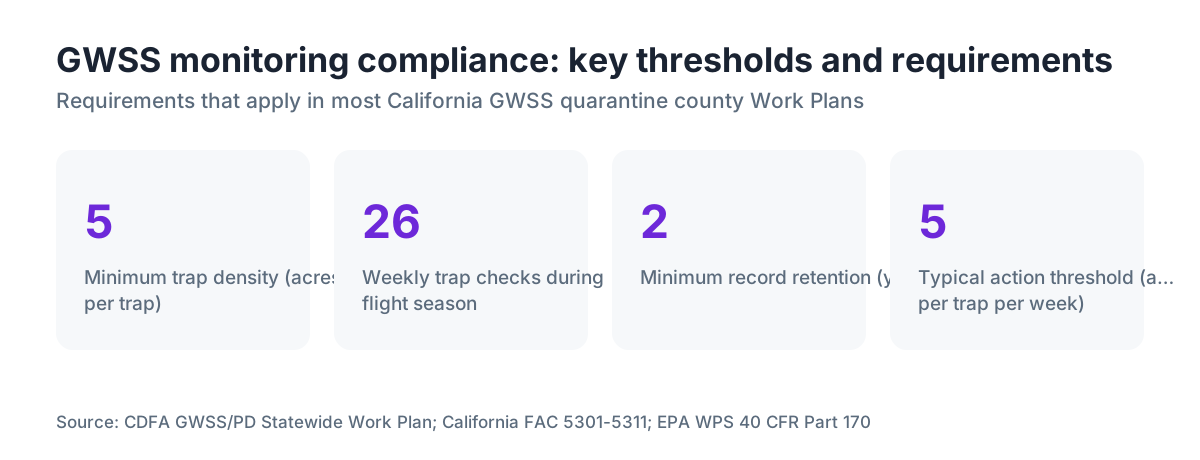
- California growers in Pierce's disease high-risk areas must run yellow sticky traps (minimum 1 per 5 acres in most programs), check them weekly during flight season, and report counts to their county agricultural commissioner under CDFA's Statewide GWSS Program.
- Keep records at least two years.
- An inspector can ask to see them at any time.
What is the glassy-winged sharpshooter and why does monitoring matter?
The glassy-winged sharpshooter (Homalodisca vitripennis) is a large leafhopper, about half an inch long, that carries Xylella fastidiosa, the bacterium behind Pierce's disease. Pierce's disease kills grapevines. Not weakens them. Kills them, usually within two to five years of infection, with no cure and no recovery. [1]
California's San Joaquin Valley and Southern California wine regions learned this the hard way in the late 1990s and early 2000s, when GWSS populations exploded after the insect arrived on ornamental nursery stock. By 2000, Temecula Valley had lost an estimated 40 percent of its wine grapes. [2] That outbreak is why California now runs one of the most detailed arthropod-monitoring compliance frameworks in U.S. agriculture.
Monitoring logs are the backbone of that framework. A trap check you didn't record might as well never have happened, because your county ag commissioner, a CDFA inspector, or a nursery certification auditor will ask to see the paper (or the digital equivalent). Gaps in your records create compliance exposure and can void a certification even when your actual pest pressure is low.
For growers in the Temecula Valley wine country near South Coast Winery or the Paso Robles area near Paso Robles Wineries, the money is real. CDFA's GWSS/Pierce's Disease Control Program ties quarantine movement restrictions and certified nursery stock eligibility straight to documented monitoring compliance. [3]
Which growers are legally required to monitor for GWSS?
Any grower in a CDFA-designated GWSS quarantine area or a Pierce's disease high-risk area listed in the current GWSS/PD Work Plan has to monitor. That's the short answer. The longer answer has a few more layers.
California Food and Agricultural Code sections 5301 through 5311 give the Secretary of Food and Agriculture authority to establish quarantine zones for GWSS and to set monitoring, treatment, and reporting conditions inside them. [4] CDFA updates the quarantine boundary list every year, and it currently covers most of Southern California, the Central Valley, and parts of the Central Coast.
Outside formal quarantine zones, monitoring may still apply if you:
- Operate a licensed nursery shipping plant material to other counties (California Department of Food and Agriculture Nursery and Seed Program, pest cleanliness requirements)
- Take part in a CDFA cost-share or grant program for biological control or trap monitoring
- Hold a Vineyard Registration certificate under a county-level Pest Management Alliance whose work plan covers GWSS
Growers with no legal obligation to monitor are still smart to do it. UC Cooperative Extension monitoring reports from Tulare and Kern counties found that vineyards running consistent weekly trap checks detected GWSS an average of three weeks earlier than visual scouting alone, which buys you earlier treatment decisions. [5]
Not sure whether your parcel sits inside a current quarantine zone? The CDFA Pest and Damage Record database and your county agricultural commissioner's office are the two fastest ways to check. Don't rely on a neighbor's read of the boundary. Those lines move.
What do GWSS monitoring logs need to include?
CDFA's GWSS/PD Work Plan and county ag commissioner guidelines want the fields below on each monitoring record. Requirements shift a little by county, so pull the current Work Plan for yours. These fields show up in nearly every version.
| Field | What to record | Notes |
|---|---|---|
| Date of trap check | Full date (MM/DD/YYYY) | Time of day is optional but helpful |
| Trap ID or location | Unique identifier tied to a field map | GPS coordinates preferred |
| Trap type | Yellow sticky card, yellow pan trap, other | Most programs specify yellow sticky |
| GWSS adult count | Number found on trap since last check | Sex (M/F) if required by program |
| Other sharpshooter species | Blue-green, red-headed, etc. | Some programs track all leafhopper vectors |
| Trap condition | Intact, damaged, full, replaced | Note replacement date |
| Pest manager/scouter | Name (and PCA license number if applicable) | Required for licensed programs |
| Initials or signature | Person conducting the check | Required for most official programs |
Some county programs (Riverside and San Diego in particular) also want the nearest GPS coordinate and a photo of the trap card. Check with your commissioner.
The trap check data has to tie to a field map showing trap placement against vineyard blocks, roads, and property boundaries. A bare list of numbers isn't enough. The numbers need to be anchored to a spot on the ground. This is where a lot of small operations fall short. A hand-drawn map with labeled stakes is legally fine, but a georeferenced digital map makes audits far easier and is worth the one-time setup.
UC Davis has published a sample GWSS monitoring form through the California Statewide Integrated Pest Management Program that matches CDFA Work Plan requirements. It's a reasonable starting template if you're building a log from scratch. [6]
How often do you check traps and what is the required monitoring season?
Most CDFA county Work Plans want trap checks every 7 days during the primary GWSS flight season. That season usually runs March through October in Southern California and the Central Valley, though CDFA shifts the windows based on degree-day accumulation models. [3]
Weekly checks work out to 26 to 32 trap visits per trap per season. Run 10 traps on 50 acres and that's 260 to 320 logged visits. Skipping a week during harvest crunch or when you're shorthanded is understandable, but it leaves a documented gap. A few missed checks with a note explaining why (equipment failure, staff illness) are manageable. A pattern of gaps reads like non-compliance to an auditor.
Trap density in most California programs is 1 trap per 5 acres for vineyards under 50 acres, with some adjustment for larger parcels. Place traps at the vineyard perimeter and near known GWSS host plants (citrus, oleander, crape myrtle) on neighboring properties. [5]
Off-season (November through February in most areas), you generally don't have to run sticky traps. Some programs still want at least one trap check per month in warm winters to track overwintering adults. Read your current county Work Plan. It's usually a free PDF on the commissioner's website.
When and how do you report GWSS trap counts to the county ag commissioner?
Reporting frequency depends on your county Work Plan, and it varies. Most California counties structure it three ways.
Routine reporting: Trap count summaries submitted monthly during flight season. Most counties take submissions by email or web portal, though a handful still want paper. Riverside County's GWSS program, for one, uses a standardized Excel template emailed to the commissioner's office by the 10th of each month covering the prior month.
Threshold-triggered reporting: If GWSS counts pass the action threshold in your Work Plan (often 5 or more adults per trap per week in vineyards, though it varies), you have to notify the county on a much shorter clock, sometimes 48 to 72 hours. That triggers an inspector visit and may require a documented treatment response.
Annual summary: At season's end, most Work Plans want a full-season summary submitted by December 1 (dates vary by county). CDFA rolls these up into its statewide population maps.
Certified nurseries run on tighter timelines. Under California's Nursery Stock Certification program for GWSS-host plants, any detection of GWSS adults or eggs on nursery stock requires same-day notification to the county commissioner and a hold on shipments. [4]
One thing growers keep underrating: keep copies. Submit a report, keep a timestamped copy. If the county portal goes down or an email bounces, your copy is your protection.
What records do you need to keep, and for how long?
Two years is the minimum retention in most CDFA GWSS Work Plans. That's the floor, not the target. Three years is safer, because it covers a full CDFA compliance audit cycle and lines up with the pesticide recordkeeping rules that overlap your spray files under the Worker Protection Standard. [7]
Records that belong in the same file as your monitoring logs:
- Trap placement map (dated, updated whenever you move traps)
- Trap purchase receipts or lot numbers (useful if a trap type ever gets questioned)
- Any treatment applications triggered by GWSS counts (these are pesticide application records with their own retention rules under California pesticide law, typically three years)
- Correspondence with your county ag commissioner, including submission confirmations
- Any CDFA inspector visit reports or notices of compliance or violation
The EPA's Worker Protection Standard requires pesticide application records (including applications made in response to GWSS detections) to be kept for two years and made available to employees, designated representatives, and inspectors on request. [7] These WPS records aren't the same as monitoring logs, but they have to be consistent with them. If your logs show a high GWSS count on July 15 and your spray records show no application until August 20, an auditor will ask what happened in between.
Digital records are fine. California law doesn't require paper. It requires records that are legible, retrievable, and tamper-evident in the sense that retroactive edits are trackable. A shared spreadsheet that auto-logs changes clears that bar. A Word document someone quietly edited last week doesn't, at least not as cleanly.
How do GWSS monitoring requirements connect to nursery certification?
This is where a lot of vineyard managers hit a requirement they didn't see coming. If you buy bare-root or container vines from a California nursery, that nursery is supposed to have kept GWSS monitoring logs and met pest cleanliness standards. When you plant certified stock, that documentation chain traces back to you.
The California Department of Food and Agriculture Nursery and Seed Program runs the Nursery Stock Certification Program, which requires licensed nurseries in GWSS-positive areas to monitor for GWSS adults and eggs on a schedule the county sets. [4] Buy certified clean vines and you're buying stock that came off a monitored, compliant operation.
Why does this land on the vineyard manager? Replant after Pierce's disease losses with vines from a nursery that wasn't compliant, and you have no certification trail. CDFA or your county commissioner can require you to prove the source's compliance, and if you can't, the planting can face restrictions.
Ask for a copy of the nursery's current Pest Cleanliness Certificate and lot-level GWSS inspection records when you take delivery of certified vines. File it with your own monitoring records. It adds maybe five minutes at delivery and closes a real gap.
What UC and extension resources can help you build a compliant monitoring program?
UC Cooperative Extension and the UC Davis Statewide IPM Program have produced the most useful GWSS monitoring guidance anywhere, and most of it costs nothing.
UC Davis's California Statewide IPM Program has a full GWSS pest management page with trap placement guidelines, degree-day models for predicting flight activity, and sample monitoring forms that match CDFA Work Plan data requirements. [6]
UC Riverside's Center for Invasive Species Research did much of the original population dynamics work on GWSS in California and keeps technical publications on monitoring design, including trap height, trap spacing, and seasonal timing by region. [8]
WSU Extension has published guidance for growers in Washington's growing Pierce's disease risk zone in the Yakima Valley. The focus is early detection, since GWSS isn't established in Washington yet but movement through the nursery trade is a documented risk. [9]
Cornell's New York State IPM Program covers GWSS in the context of imported plant material and Eastern U.S. quarantine risk. Useful background if you're sourcing scion wood or plant material across state lines. [10]
For an operation that wants compliant digital logs without building a spreadsheet from scratch, tools like VitiScribe handle trap check data entry, flag weeks where counts pass threshold, and generate the monthly summary reports most county Work Plans require, with export formats most commissioners accept. Not a requirement. But past 20 traps across multiple blocks, the manual alternative gets painful fast.
UC Cooperative Extension farm advisors in Fresno, Tulare, Kern, Riverside, and San Diego counties are your best local read on how a statewide rule actually plays out in your specific county Work Plan. Call them. Answering these questions is their job.
What are the penalties for failing to comply with GWSS monitoring requirements?
California Food and Agricultural Code sections 5301 through 5311 give county agricultural commissioners authority to issue notices to comply, stop-movement orders, and civil penalties for GWSS quarantine violations. [4] Penalty amounts aren't set in one table. They depend on the nature of the violation, whether it's a first offense, and whether the grower cooperated.
Here's what non-compliance actually looks like in the field.
First, you'll probably get a Notice to Comply rather than an immediate fine, especially if the lapse was administrative (missing paperwork) rather than substantive (never monitoring and sitting on an undetected outbreak). County commissioners tend to prefer correction over enforcement against a cooperative grower.
Second, ship nursery stock or grapes into a non-quarantine area without monitoring records and your shipment stops. That's an economic penalty with no appeal clock.
Third, loss of eligibility for CDFA cost-share programs. Several biological control programs (release of Gonatocerus ashmeadi, the GWSS egg parasitoid) are open only to growers in documented compliance with their monitoring Work Plans.
Fourth, for vineyards near large commercial operations, a neighboring grower or a Pest Management Alliance can file a complaint that triggers a formal inspection. You don't want to be the operation that dragged the whole alliance into a compliance review.
The real cost is usually opportunity, not fines. Keep the logs current and that risk goes away.
How do you set up a practical GWSS monitoring log system for a small vineyard?
Here's what actually works for a 10 to 50 acre operation, built from published extension guidance and CDFA program requirements.
Start with a trap map. Walk the vineyard perimeter, mark trap locations on a site map (a hand-drawn one is fine), and give each location a permanent ID (T-01, T-02, and so on). Note the date you installed each trap. Keep the map with your records.
Use yellow sticky cards in the dimensions your county Work Plan specifies (most call for 3 x 5 inch or 5 x 8 inch yellow Pherocon AM or equivalent cards). Change them on a set schedule, typically every two to four weeks during peak season, and log the replacement date separately from the count date.
Build a simple log sheet or spreadsheet with the fields from the table earlier in this article. One row per trap check. Fill it the same day as the check, not at the end of the week. Memory errors compound over a season.
Set a calendar alert for your weekly check. Not an intention. An alert. The checks that slip are almost always the ones with no reminder attached.
At the end of each month during flight season, tally counts by trap, flag any that passed threshold, and prepare your county submission. Keep a timestamped copy.
For operations tracking records across multiple blocks and generating reports on a fixed schedule, VitiScribe's monitoring log module is worth a trial, mostly because its reports use the field naming conventions CDFA and county Work Plans expect, which drops the reformatting step from monthly submissions.
At season's end, compile the full-season record into one document, archive it with your other field records, and write the retention date (two years minimum, three recommended) on the file.
How do GWSS monitoring logs connect to your broader vineyard compliance records?
GWSS monitoring doesn't sit in its own box. It crosses at least three other compliance systems most California vineyards already run.
Pesticide application records. If GWSS counts trigger a treatment, that application has to be recorded under California's pesticide reporting system (through the county system, on the DPR pesticide use report). The monitoring log is the documented justification for the application. Without a log showing a threshold-exceeding count, an application looks arbitrary to a compliance inspector. [11]
Worker Protection Standard records. Any pesticide application made in response to GWSS detections falls under EPA WPS requirements when agricultural workers re-enter treated areas. WPS requires central posting of pesticide application information, notification, and restricted-entry interval documentation. Your monitoring log and your WPS records have to tell the same story. [7]
Organically certified vineyards. If you hold USDA NOP organic certification and a GWSS population triggers a treatment decision, only OMRI-listed or NOP-compliant products can go on. Your monitoring log is part of the organic system plan documentation showing you had pest pressure that justified intervention. The certifier will read it. [12]
For vineyard operations running multiple compliance streams at once, the paperwork load is real. Keeping monitoring logs, spray records, and WPS documentation in one organized system, paper or digital, closes the gaps between systems that create the most risk.
Frequently asked questions
Do I need to monitor for GWSS if I'm outside the current California quarantine zone?
Not legally, unless your county Work Plan or a cost-share program you're in requires it. But if you're within 50 miles of the quarantine boundary or near known GWSS host ornamentals like oleander or citrus, voluntary monitoring is genuinely worthwhile. GWSS populations expand fast, quarantine boundaries move, and the early detection data you generate now is useful to your county ag commissioner even when it isn't required.
What trap type does CDFA recommend for GWSS monitoring?
Yellow sticky cards are the standard. Most CDFA county Work Plans specify yellow Pherocon AM-style sticky cards, typically 3 x 5 or 5 x 8 inches, placed at vine canopy height on the vineyard perimeter. Pan traps filled with yellow-tinted soapy water show up in some research programs but are less common in routine compliance monitoring. Check your specific county Work Plan for any required brand or size.
How do I submit my GWSS trap data to the county agricultural commissioner?
Most California counties now take monthly email submissions using a standardized form or Excel template from the commissioner's office. Some counties have a web portal. A few still want paper. The deadline is typically the 10th of the following month for the prior month's data, but it varies. Contact your county commissioner directly to confirm the current format and deadline before your first submission of the season.
What counts as an action threshold for GWSS in vineyards?
There's no single statewide fixed threshold. Most CDFA county Work Plans set a working threshold of 5 or more GWSS adults per trap per week as a trigger for heightened attention or treatment consideration, but it varies by county, vine growth stage, and proximity to known infection sources. UC Cooperative Extension farm advisors in your county are the best source for the threshold your Work Plan currently uses.
Can I use a phone app or digital tool to keep GWSS monitoring logs?
Yes. California law requires records to be legible and retrievable but does not require paper. Digital logs, apps, or spreadsheets all work as long as they capture every required field, can be exported or printed for submission, and keep an audit trail showing when entries were made. If the app allows backdated entries with no timestamp, that's a weakness worth fixing before an inspection.
How far apart should GWSS sticky traps be placed in a vineyard?
Most CDFA programs and UC extension guidance recommend one trap per 5 acres as a baseline density, with traps on the vineyard perimeter, especially on sides facing known GWSS host plants. For parcels near citrus orchards or ornamental plantings with oleander or crape myrtle, tighter spacing on that edge is advisable. Trap height should be at the top of the vine canopy, roughly 3 to 6 feet above ground.
Do GWSS monitoring requirements apply to organic vineyards differently than conventional ones?
The monitoring and reporting requirements are the same regardless of certification status. The difference shows up at the treatment stage: an organic vineyard's response to threshold-exceeding counts is limited to OMRI-listed or NOP-compliant materials, and that treatment has to be documented in the organic system plan and reported to the certifier. The monitoring log itself is the same document either way.
What happens if a GWSS adult is found on nursery stock I just received?
For California-licensed nurseries, a GWSS adult found on regulated stock triggers same-day notification to the county agricultural commissioner and a hold on any pending shipments. For the receiving vineyard, the practical steps are to isolate the material, notify your county commissioner, and document the find with photos and the trap or inspection record. Do not plant the material until you have commissioner clearance.
How long do I have to keep GWSS monitoring records?
CDFA GWSS Work Plans typically specify a two-year minimum. Pesticide application records triggered by GWSS counts have to be kept three years under California Department of Pesticide Regulation rules. Keeping all GWSS-related records for three years covers both requirements and gives you a buffer if an audit reaches back to a prior season. Store a backup copy off-site or in cloud storage.
Are GWSS monitoring requirements the same across all California counties?
No. Each county in the GWSS quarantine or high-risk zone has its own Work Plan with county-specific trap density, submission schedule, threshold levels, and reporting format. Riverside County's requirements differ from Fresno County's. Get the current Work Plan PDF from your specific county agricultural commissioner's office at the start of each season. Don't assume last year's version still applies.
Does the Worker Protection Standard apply to GWSS monitoring activities?
WPS applies to pesticide applications made in response to GWSS detections, not to the monitoring itself. Trap checking isn't a pesticide application. If an employee checks traps and enters treated areas within a restricted-entry interval, WPS re-entry rules apply to that entry. The monitoring log and the spray record together establish whether a re-entry situation existed, which is why the two records need to be consistent.
What is the GWSS biological control program and how does monitoring connect to it?
CDFA coordinates releases of Gonatocerus ashmeadi and related egg parasitoids as biological controls for GWSS. Taking part in these release programs typically requires documented compliance with the county GWSS Work Plan, including current monitoring logs. The monitoring data also helps CDFA judge whether parasitoid releases are cutting GWSS populations over time. Growers not current on monitoring are generally ineligible.
Sources
- CDFA Pierce's Disease and GWSS Program overview: Xylella fastidiosa causes Pierce's disease, which kills grapevines within two to five years of infection with no cure
- UC ANR, Pierce's Disease of Grapevines (Publication 21600): Temecula Valley lost an estimated 40 percent of its wine grapes following GWSS-driven Pierce's disease outbreak circa 2000
- CDFA GWSS/PD Statewide Work Plan, current edition: CDFA Work Plans specify flight season monitoring windows and trap check frequency (typically weekly, March through October in Southern California)
- California Food and Agricultural Code, Sections 5301-5311 (via California Legislative Information): California FAC 5301-5311 authorizes the Secretary of Food and Agriculture to establish GWSS quarantine zones and mandate monitoring, treatment, and reporting
- UC Cooperative Extension, Tulare and Kern County GWSS Monitoring Reports: Vineyards with consistent weekly trap monitoring detected GWSS populations an average of three weeks earlier than visual scouting alone
- UC Davis California Statewide IPM Program, GWSS pest management guidelines: UC Davis IPM Program provides sample GWSS monitoring forms and trap placement guidelines matching CDFA Work Plan data requirements
- EPA Worker Protection Standard (40 CFR Part 170): EPA WPS requires pesticide application records to be kept for two years and made available to workers, designated representatives, and inspectors on request
- UC Riverside Center for Invasive Species Research, GWSS publications: UC Riverside CISR produced foundational population dynamics research on GWSS and publishes monitoring design guidance including trap height and spacing
- Washington State University Extension, Pierce's Disease and GWSS risk resources: WSU Extension covers GWSS detection protocols for Washington State's Yakima Valley, where GWSS is not yet established but nursery trade movement is a documented risk
- Cornell University New York State IPM Program, exotic pest resources: Cornell NYSIP covers GWSS in context of imported plant material and quarantine risk for Eastern U.S. growers
- California Department of Pesticide Regulation, Pesticide Application Records requirements: California DPR requires pesticide application records to be kept for three years; the monitoring log serves as the documented justification for threshold-based applications
- USDA National Organic Program, 7 CFR Part 205: USDA NOP organic certification requires pest management actions to be documented in the organic system plan; monitoring logs are part of that documentation
Last updated 2026-07-10