Water use reporting requirements for vineyard operations by state
TL;DR
- At least 17 western U.S.
- states require vineyard operators to report groundwater or surface water use annually, with thresholds ranging from 0 to 25 acre-feet per year depending on the state.
- California, Washington, and Oregon have the most active enforcement programs.
- Eastern states generally rely on riparian rights and report less, but that is changing fast in drought-prone regions.
Why do vineyards face water reporting requirements at all?
Grapes are thirsty. A California wine grape vineyard uses roughly 1 to 3 acre-feet of water per acre per season depending on variety and climate, and that adds up fast across even a 50-acre block [1]. State water agencies care because irrigation withdrawals directly affect stream flows, aquifer levels, and downstream users. When a vineyard pumps from a shared aquifer without reporting, the agency loses the data it needs to manage the basin.
The legal backbone is different in the West than the East. Western states operate under prior appropriation: your water right has a priority date, and you can lose it or have it curtailed if you don't document beneficial use. Reporting keeps the priority clock alive. Eastern states mostly use riparian rights, which tie water use to land ownership and historically required fewer permits, but that's changing as droughts hit Virginia, North Carolina, and the mid-Atlantic.
The short version: if your vineyard is west of the 100th meridian, assume you have a reporting obligation. If you're east of it, check your state agency anyway because many states quietly added reporting rules in the last decade.
What are the water reporting rules in California for vineyards?
California has the most layered water reporting system in the country for agricultural users. The State Water Resources Control Board (SWRCB) runs the Electronic Water Rights Information Management System (eWRIMS), and most vineyard operators with a water right post-1914 already file annual reports there [2]. Pre-1914 rights have a separate, lighter reporting path but are still subject to curtailment notices.
The bigger change came with the Sustainable Groundwater Management Act (SGMA), signed in 2014. SGMA requires groundwater sustainability agencies (GSAs) in medium- and high-priority basins to track extractions. In many vineyard-heavy basins, including Paso Robles and portions of the Central Coast, that means metering and annual reporting to your local GSA even if you have no surface water right at all [2]. Paso Robles had mandatory water reporting and pumping fees in place before SGMA; the rule there goes back to the 2013 groundwater ordinance.
For surface water rights, California's Annual Water Report (eWRIMS) is due January 1 through July 1 for the preceding calendar year. Failure to file can result in a $1,000 per day fine under Water Code Section 1055.3 [2]. The SWRCB also operates the Water Use Efficiency group, which audits large agricultural users.
Wineries on the Paso Robles wineries corridor have had to build groundwater accounting into their operations budgets for years now. If you're buying vineyard land in any California critically overdrafted basin, the GSA reporting requirements are a due-diligence item, not an afterthought.
UC Davis Extension covers SGMA compliance basics in their agricultural water management courses and recommends that vineyard operators maintain meter logs going back at least five years to support any challenge to a curtailment order [3].
What does Washington State require for vineyard water reporting?
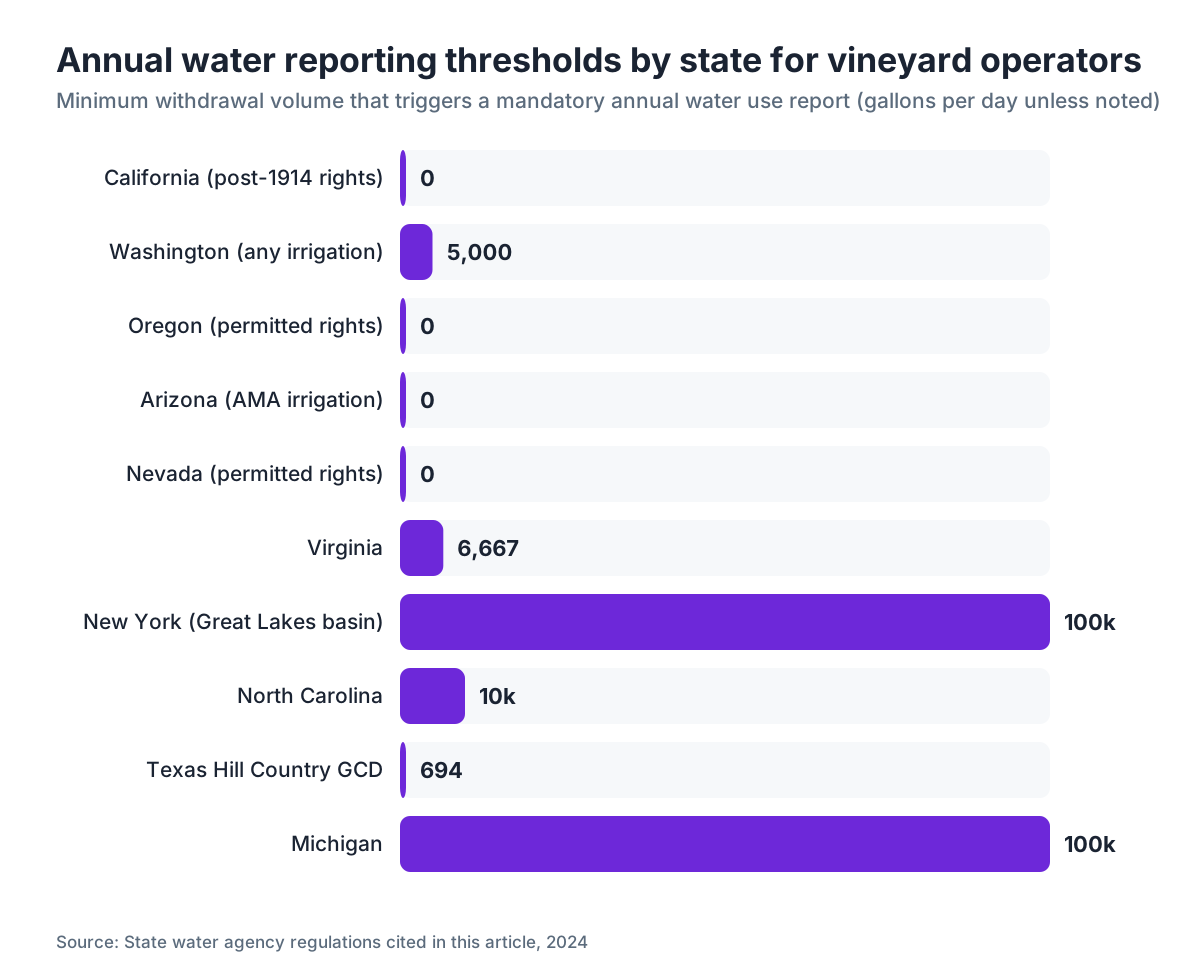
Washington runs its water rights through the Department of Ecology under the Water Resources Act of 1917 (RCW 90.03). Any water diversion over 5,000 gallons per day, or any new groundwater well, requires a water right permit and annual water use reports filed through Ecology's WaterTrax system [4]. Vineyards in the Yakima basin also fall under the Yakima River Basin Water Enhancement Project (YRBWEP), which has its own accounting requirements.
Washington State University Extension notes that many small vineyard operations incorrectly assume a domestic well exemption covers agricultural irrigation. It does not. The domestic exemption caps at 5,000 gallons per day for household use; any irrigation beyond that threshold requires a water right, even for a 5-acre vineyard block [4].
Ecology issues curtailment orders in dry years based on priority dates, and vineyards that haven't filed their annual use reports can lose the ability to challenge a curtailment. The filing deadline is March 31 for the prior year's use. Penalties for unpermitted diversion can reach $5,000 per day under RCW 90.03.600 [4].
What are Oregon's water use reporting rules for vineyards?
Oregon's Water Resources Department (OWRD) requires annual water use reports for any water right holder using surface water or a permitted groundwater right. The form is the Annual Water Use Report (WRD 503), due April 1 for the prior year [5]. All vineyard operators with any Oregon water right should already be filing this.
Oregon also has a water use survey program that pulls in agricultural users outside the formal permit system when the agency is trying to characterize a basin. Willamette Valley vineyards saw increased scrutiny starting around 2019 as the valley's groundwater basins came under review. The threshold that typically triggers mandatory participation in a basin survey is 1 acre-foot per year of groundwater use, though OWRD can set lower thresholds by rule.
Oregon State University Extension has published guidance noting that vineyards relying on seasonal ponds or impounded water still need a storage right and must report both storage volume and releases [5].
How do water reporting rules differ in eastern vineyard states like Virginia and New York?
Eastern states have traditionally required far less water reporting from agricultural users, but the gap is closing. Here's how the major eastern wine states stack up:
| State | Reporting required? | Threshold | Agency | Deadline |
|---|---|---|---|---|
| Virginia | Yes (large users) | Over 300,000 gallons/month | DEQ | Annual, Feb 28 |
| New York | Yes (large users) | Over 100,000 gallons/day from same source | DEC | Annual, March 31 |
| Pennsylvania | No mandatory ag reporting | No state threshold | DEP | None currently |
| North Carolina | Yes (certain basins) | Over 10,000 gallons/day | DEQ | Annual |
| Michigan | Yes | Over 100,000 gallons/day | EGLE | Annual, April 30 |
Virginia's rule under the Virginia Water Protection Permit program (9VAC25-210) applies to most commercial vineyard operations larger than about 30 irrigated acres [6]. New York's reporting falls under the Great Lakes-St. Lawrence River Basin Water Resources Compact for users in that watershed, with separate rules for other basins under the Environmental Conservation Law.
Cornell Cooperative Extension advises New York vineyard managers that even users below the threshold should keep voluntary irrigation logs because the state has used voluntary data in past drought management proceedings [7]. That's free insurance.
North Carolina tightened its rules in 2022, requiring capacity permits for new groundwater withdrawals above 10,000 gallons per day, which catches most commercial vineyard irrigation systems.
What water reporting rules apply specifically in Arizona, Nevada, and New Mexico?
These three states sit in some of the most water-stressed vineyard territory in the country, and their rules reflect that.
Arizona operates an Active Management Area (AMA) system under the Groundwater Management Act of 1980. Any agricultural irrigation in an AMA requires an irrigation water right and annual reporting to the Arizona Department of Water Resources (ADWR). The Phoenix, Prescott, Tucson, Pinal, and Santa Cruz AMAs all cover significant vineyard areas in Sonoita-Elgin and the Verde Valley. Farmers in AMAs must file an Annual Irrigation Report showing acres irrigated and water applied, due April 30 [8]. Outside AMAs, Arizona has no general reporting requirement, but new wells still need permits in most counties.
Nevada's State Engineer controls all water in the state. Any diversion requires a permit, and annual proof of beneficial use must be filed or the right can be forfeited. Nevada water law explicitly states that water rights not exercised for five consecutive years are subject to forfeiture under NRS 533.060 [9]. That's a real risk for part-time vineyard operations.
New Mexico operates under the Office of the State Engineer (OSE). Annual reports are required for surface water diversions, and all wells (except domestic wells under 3 acre-feet per year for individual household use) require permits and annual reports [10]. New Mexico's Mesilla and Mimbres basins, home to most commercial vineyards, are declared underground water basins where the no-reporting domestic exemption does not apply.
What does reporting actually involve, and how much does compliance cost?
The mechanics vary by state but the core elements are consistent: meter readings, acres irrigated, source type (groundwater or surface), and in some states, crop type. California's eWRIMS online portal is reasonably well-designed. Washington's WaterTrax is clunky but functional. Oregon's paper form option still exists though they push electronic submission.
Meter installation is the single biggest up-front cost. A totalizing flow meter suitable for vineyard irrigation lines runs $300 to $1,500 installed depending on pipe diameter and meter type [11]. Some states (California SGMA basins, for example) require specific meter accuracy standards, typically within plus-or-minus 5 percent. Budget for annual calibration checks, which typically cost $50 to $200 per meter.
Staff time to compile and file a single annual report ranges from 2 to 6 hours for a well-organized operation. If you're pulling data from handwritten field logs and trying to reconcile them months later, that number climbs. This is where having a record system that logs meter reads as you go, rather than reconstructing them in March, matters. Tools like VitiScribe let you log irrigation events and meter reads in the field so annual reports take 30 minutes instead of a day.
Total annual compliance cost for a 50-acre vineyard running two wells, including meter maintenance and staff time, runs roughly $400 to $1,200 per year. Legal help for a contested water rights proceeding is a separate universe. That can run $10,000 to $50,000 easily and is why good records matter in the first place.
Are there federal water reporting requirements that apply to vineyards?
The short answer: not a direct federal water use reporting requirement for agricultural operations. The EPA regulates water quality through the Clean Water Act and the Safe Drinking Water Act, but water quantity reporting stays with the states.
The one federal overlay that catches vineyard operators by surprise is the Bureau of Reclamation's reporting requirement for users with contracts on federal irrigation projects. If your vineyard receives water through a Bureau of Reclamation project, like parts of the Central Valley Project or the Yakima Project, your water service contract almost certainly includes annual reporting obligations and sometimes acreage verification. The Bureau's 2009 SECURE Water Act reporting expanded this [12].
The EPA's Worker Protection Standard (WPS), revised in 2015, does not require water quantity reporting but it does require pesticide application records that can intersect with irrigation timing records during re-entry interval tracking [13]. That's not a water report, but it's a reason vineyard record systems often need to capture both water application and spray events together.
The USDA Farm Service Agency (FSA) collects acreage reports and some irrigation data through the Common Land Unit (CLU) system as a condition of program eligibility, but that's voluntary for operations not enrolled in USDA programs.
What happens if a vineyard misses a water use reporting deadline?
Consequences range from nothing to losing your water right, depending on the state and how long you've been non-compliant.
At the mild end: Oregon and Virginia typically send a notice and give 30 to 60 days to cure. First-time failures rarely result in fines if you respond promptly. At the serious end: California's SWRCB can issue a $1,000 per day civil liability under Water Code Section 1055.3 for failure to file [2], and Washington can pursue criminal penalties for willful unpermitted diversion under RCW 90.03.400.
The worst outcome isn't a fine. It's forfeiture or abandonment of a water right. Nevada's five-year non-use rule and similar provisions in New Mexico mean that a right you didn't document using, you may not get back. In a basin where new applications are closed, losing a historical right is an unrecoverable business loss.
The practical advice: set a calendar reminder for each state's deadline, keep a copy of every submission with the confirmation number, and store meter calibration certificates with your water records. Agencies rarely go after operators who missed once and self-corrected. They do pursue operators who routinely fail to file.
How do you set up a water use record-keeping system that satisfies multiple state requirements?
Multi-state vineyard operations, or operations that buy fruit from multiple states, need records that satisfy the most demanding requirement in the set. California with SGMA is almost always the floor if you operate there.
The minimum record set that satisfies all major western state requirements:
- Meter serial number and installation date for each diversion point
- Monthly meter reads with reader initials and date
- Annual total diversion volume by source (groundwater vs. surface)
- Acres irrigated by block, with crop type (wine grape varieties generally count as one crop type for reporting)
- Meter calibration certificates
- Copies of all filed reports with submission confirmation
Keep seven years of records. California specifically recommends this for SGMA compliance. Washington keeps water rights enforcement windows open long enough that five-year retention is the practical minimum.
WSU Extension's water management resources include templates for logging diversion data that map to the WaterTrax reporting format [4]. UC Cooperative Extension Fresno County has published similar templates for SGMA-affected basins [3]. Those are free and worth downloading even if you adapt them to your own system.
If you're managing records across multiple vineyard properties, a spreadsheet breaks down eventually. Digital field logs that timestamp and geotag each water entry make audits manageable. By the time you're looking for records three years later to respond to an agency inquiry, you'll be glad you didn't rely on handwritten notebooks in a field truck. For a practical look at how a vineyard field ops system can tie irrigation records to compliance calendars, the VitiScribe platform has a water logging module built around eWRIMS and WaterTrax output formats.
What are the water reporting rules for vineyards in Colorado, Idaho, and Texas?
Colorado administers water rights through water courts and the State Engineer's office. All water rights holders must file annual diversion records with the Division Engineer in their division; this has been required since at least 1971 under CRS 37-92-308 [14]. Colorado's system is unique: your annual diversion record is public and used by water courts to adjudicate future disputes. Missing filings genuinely weaken your priority claim. Colorado vineyards in the Grand Valley, Delta-Montrose area, and the Front Range are all in administrated divisions with this requirement.
Idaho's Department of Water Resources requires annual diversion reports from all water rights holders. The state is currently completing its Snake River Basin Adjudication, which has pulled thousands of agricultural users, including vineyards in the Sunnyslope and Snake River AVAs, into formal reporting. Failure to report in Idaho can result in the right being listed as unused in the adjudication, which creates a legal presumption of abandonment.
Texas, famously, treats groundwater as private property under the rule of capture (Edwards Aquifer Authority v. Day, 2012). However, most groundwater conservation districts (GCDs) covering vineyard areas like the Texas Hill Country require well registration and annual pumping reports. The Hill Country GCD requires an annual report for any well producing over 25,000 gallons per year [15]. Surface water in Texas is still state property and requires a permit from the Texas Commission on Environmental Quality (TCEQ) with annual reporting.
How are water reporting requirements changing, and what should vineyard operators watch for?
The trend is clear: more states, lower thresholds, more enforcement. The drivers are drought frequency, groundwater depletion, and interstate compact obligations.
A few things to watch in the next two to five years:
California GSA plans are in their implementation phase through 2040. Many basins that were classified as medium-priority, and faced lighter rules, are being reclassified. If your vineyard is in a basin currently below the SGMA threshold, check again in 2025.
Oregon initiated a review of its Willamette Valley groundwater rules in 2023. New mandatory reporting obligations for smaller users are likely before 2027.
Washington's 2018 Hirst decision fix (SB 6091) resolved some rural permit-exempt well issues but left agricultural users unchanged. Watch for Ecology rulemaking on agricultural water use accounting in the Yakima and Columbia basins.
Virginia expanded its water withdrawal registration program to include users as small as 300,000 gallons per month starting in 2022. More threshold reductions are plausible given the state's drought experience.
The safest posture: meter everything, log everything, file on time. The marginal cost of being a good water reporter is low. The cost of not having records when the agency calls is not.
Frequently asked questions
Do small vineyards under 10 acres have to report water use?
It depends entirely on the state and water source. In California SGMA basins, there is no acreage exemption: any extraction in a medium or high priority basin must be tracked and reported to the local groundwater sustainability agency. In Washington, the 5,000 gallon per day threshold can be hit by a small vineyard on a dry summer week. Check your state agency before assuming size exempts you.
What is the penalty for not filing a water use report in California?
Under California Water Code Section 1055.3, the State Water Resources Control Board can impose civil liability of up to $1,000 per day for failure to file required water use reports. In practice, first violations typically result in a notice to comply. Chronic non-filers face formal enforcement. Losing the ability to contest a curtailment order is a separate, often larger consequence of poor filing history.
Does irrigation with recycled water require reporting in the same way?
Recycled water is regulated separately in most states. In California, recycled water use is reported to the Regional Water Quality Control Board rather than eWRIMS, and the reporting form differs. However, some GSAs are beginning to track recycled water deliveries within their groundwater accounting. Washington and Oregon treat recycled water permits as separate from water rights, with their own annual reporting forms.
Do I need a water meter to comply with reporting requirements?
For most western states with mandatory reporting, yes, a calibrated totalizing flow meter is required or strongly implied. California SGMA regulations explicitly require metering to a specified accuracy standard for groundwater extractions in managed basins. Arizona AMA rules require meters. Some states allow estimation methods for small users, but metered data is almost never successfully challenged in an enforcement proceeding, while estimates often are.
Can a vineyard lose its water right for non-reporting?
Yes. Nevada law (NRS 533.060) allows forfeiture of a water right after five consecutive years of non-use, and poor reporting records are used as evidence of non-use. New Mexico has similar provisions. Colorado's water court system uses annual diversion records as primary evidence of use; missing records weaken priority claims. California doesn't have an automatic forfeiture rule but can initiate revocation proceedings for rights not beneficially used.
What is an acre-foot, and how does it translate to vineyard irrigation?
One acre-foot equals 325,851 gallons, or roughly the amount needed to cover one acre of land to a depth of one foot. A typical California wine grape vineyard uses 1.5 to 2.5 acre-feet per acre per season. A 20-acre vineyard might apply 30 to 50 acre-feet per year. Most state reporting thresholds are set in acre-feet annually, so knowing your total diversion in acre-feet is the starting point for understanding your obligations.
How does the Sustainable Groundwater Management Act affect Paso Robles vineyard operators specifically?
Paso Robles had a groundwater ordinance predating SGMA, and the area's Groundwater Sustainability Agency has required metering and annual extraction reporting since at least 2014. Under SGMA, the Paso Robles Groundwater Basin was designated critically overdrafted, requiring aggressive sustainability plans. Vineyard operators face both the GSA extraction reporting requirement and, in some cases, assessed fees on pumped water. These requirements are in addition to any surface water right reporting.
What records do I need to keep if I buy water from an irrigation district rather than pumping myself?
Your obligation shifts but doesn't disappear. You still typically need to keep delivery records from the district (meter tickets or delivery slips), acreage reports showing what land you applied the water to, and any crop reports required under the district's service contract. California's SGMA requirements apply to extractions, not to district deliveries, but your district's own reporting to the GSA may rely on your reported acreage data.
Does North Carolina require water reporting from vineyards in the Yadkin Valley AVA?
North Carolina requires capacity permits and annual reporting for any withdrawal over 10,000 gallons per day under G.S. Chapter 143, Article 21. Most commercial vineyard irrigation systems in the Yadkin Valley can hit that threshold in a dry week. Operators should register withdrawals with the NC Division of Water Resources. The state tightened enforcement after the 2007 and 2016 droughts exposed how many agricultural users were unregistered.
Where do I find the actual reporting form for my state's water use report?
California: eWRIMS portal at waterrightsmaps.waterboards.ca.gov. Washington: WaterTrax at fortress.wa.gov/ecy/wateruse. Oregon: OWRD online filing at apps.wrd.state.or.us. Arizona: ADWR Annual Irrigation Report at azwater.gov. Virginia: DEQ's online water withdrawal reporting at deq.virginia.gov. For other states, start at your state's environmental or natural resources agency website and search for 'water right annual report'.
Are there any federal grants or cost-share programs to help vineyards pay for water metering?
Yes. USDA's Environmental Quality Incentives Program (EQIP) includes irrigation efficiency practices that can pay 50 to 75 percent of the cost of flow meters and monitoring equipment for qualifying agricultural operations. Some state programs also offer cost-share: California's SWEEP (State Water Efficiency and Enhancement Program) has covered metering in past funding rounds. Applications compete annually; contact your local NRCS office for current payment schedules.
How far back do water use records need to be kept?
California SGMA guidance recommends keeping extraction records for at least seven years to support basin adjudications and sustainability plan reviews. Washington's Water Resources Act doesn't specify a retention period but water rights enforcement windows are long enough that five years is the practical floor. Arizona ADWR recommends five years. A safe default for any multi-state operation: keep everything for seven years, including meter calibration certificates and filed report confirmations.
Does vineyard water reporting interact with pesticide application records in any state?
Not directly for legal purposes: water quantity reporting and pesticide records are separate regulatory systems. However, the EPA's Worker Protection Standard requires pesticide application records that include application dates and irrigation re-entry intervals. Some states (California, Washington) audit farm records across programs at once, and an operator with good water logs but no spray records creates questions. Keeping both in one record system avoids gaps that look suspicious during an inspection.
What if my vineyard straddles a state line?
You have obligations in both states, and they don't align. Each state's water right, reporting deadline, form, and threshold apply independently. The same physical well may need to be reported to two separate agencies if the aquifer is classified differently on each side. Interstate compacts on rivers like the Colorado, Snake, and Rio Grande add a federal layer. Get a water rights attorney familiar with both states before drilling any new wells in a border property situation.
Sources
- UC Agriculture and Natural Resources, Water Use in California Agriculture: California wine grape vineyards use roughly 1 to 3 acre-feet of water per acre per season depending on variety and climate.
- California State Water Resources Control Board, Water Rights Program and eWRIMS: Annual water use reports for post-1914 rights are due by July 1 in California; failure to file can result in $1,000 per day civil liability under Water Code Section 1055.3; SGMA requires groundwater extraction reporting in medium and high priority basins.
- UC Cooperative Extension, SGMA and Groundwater Management Resources: UC Cooperative Extension recommends vineyard operators maintain meter logs going back at least five years to support challenges to curtailment orders.
- Washington State Department of Ecology, Water Rights Program: Washington requires water rights permits for diversions over 5,000 gallons per day and annual use reports due March 31; penalties for unpermitted diversion can reach $5,000 per day under RCW 90.03.600.
- Oregon Water Resources Department, Annual Water Use Reporting: Oregon's Annual Water Use Report (WRD 503) is due April 1 for the prior year; storage rights require reporting of both stored volume and releases.
- Virginia Department of Environmental Quality, Water Withdrawal Reporting: Virginia's water withdrawal reporting requirement under 9VAC25-210 applies to users withdrawing over 300,000 gallons per month; annual report due February 28.
- Arizona Department of Water Resources, Agricultural Water Use Requirements: Arizona Active Management Area farmers must file an Annual Irrigation Report showing acres irrigated and water applied, due April 30.
- Nevada Division of Water Resources, Water Rights Law: Nevada water law under NRS 533.060 allows forfeiture of a water right not exercised for five consecutive years.
- U.S. Bureau of Reclamation, SECURE Water Act Reporting: Bureau of Reclamation water service contracts on federal irrigation projects include annual reporting obligations and sometimes acreage verification under the 2009 SECURE Water Act.
- Colorado Division of Water Resources, Annual Diversion Records: Colorado requires all water rights holders to file annual diversion records with the Division Engineer under CRS 37-92-308; missing filings weaken priority claims in water court proceedings.
- Texas Hill Country Underground Water Conservation District: The Hill Country Underground Water Conservation District requires an annual pumping report for any well producing over 25,000 gallons per year.
Last updated 2026-07-10