Grape bud break in spring: what it means and how to manage it
TL;DR
- Grape bud break begins when dormant buds swell and push green tissue, usually after 50 to 100 growing degree days (base 50°F) accumulate in spring.
- It's the riskiest frost window of the year.
- Timing shifts with variety, site, and training system.
- Managing it well means tracking GDD daily, knowing your variety's threshold, and having a frost plan ready before the night it matters.
What actually happens during grape bud break?
Bud break is the moment a grapevine's dormant bud swells, cracks its brown scales, and pushes the first green tissue into open air. Simple to watch. There's a precise biological sequence underneath it.
Over winter, buds sit in a state called endodormancy. The vine has internally blocked growth no matter how warm it gets. Somewhere between late December and February, depending on variety and climate, that internal block releases and the bud enters ecodormancy, meaning outside temperature is now the only thing holding growth back [1]. From that point, accumulated heat drives development forward.
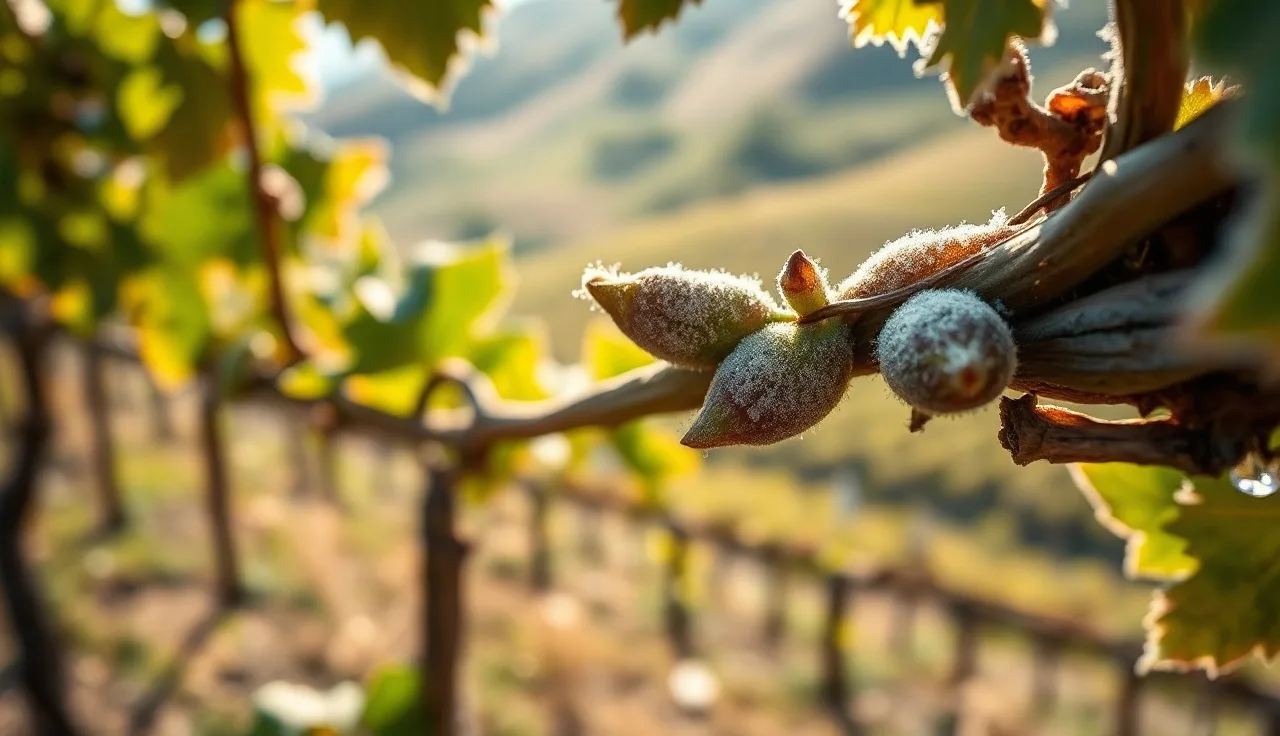
Most viticulturists stage this with the Eichhorn-Lorenz (E-L) scale, which runs from stage 1 (winter dormancy) through stage 47 (berry ripening). Bud break spans roughly E-L stages 1 through 5 [2]. Stage 4 is the classic "green tip" moment most frost-damage tables reference. Stage 5, when the first leaf shows, is sometimes called wool stage because the emerging shoot wears a fuzzy, cotton-like coating.
The vine is doing something expensive in this window. It's spending the carbohydrate reserves it stored in roots and trunk wood all last season. If a late frost kills those first shoots, the vine pushes secondary and tertiary buds, but those carry lower yield potential because they developed later and often hold fewer inflorescences.
When does bud break typically happen, and what drives the timing?
Calendar date is almost useless on its own. Bud break runs on growing degree day (GDD) accumulation, variety genetics, and microsite conditions, not the month on the wall.
The standard heat summation model for grapevines uses a base temperature of 50°F (10°C). You start counting GDD from January 1 in most U.S. regions, or from the date the vine exits endodormancy if you want precision. A GDD is calculated as: ((daily max temp + daily min temp) / 2) minus 50. Negative values count as zero. Most Vitis vinifera varieties begin bud break after 50 to 100 GDD have accumulated [3].
Here are approximate calendar ranges by region. The variability inside each range is real.
| Region | Typical bud break window | Common vinifera varieties |
|---|---|---|
| Napa/Sonoma, CA | Mid-February to mid-March | Chardonnay, Cabernet Sauvignon |
| Willamette Valley, OR | Late March to mid-April | Pinot Noir, Pinot Gris |
| Finger Lakes, NY | Late April to mid-May | Riesling, Cabernet Franc |
| Columbia Valley, WA | Late March to late April | Cabernet Sauvignon, Riesling |
| Midwest/Upper Midwest | Late April to mid-May | Marquette, Frontenac, Itasca |
Site factors matter enormously. Cold air drains downhill, so vines on valley floors can break bud 7 to 14 days later than hillside vines at the same vineyard, which sounds protective until you realize they also catch the heaviest frosts when cold air pools at the bottom. South-facing slopes soak up heat faster and often push earliest. Wind machines and big water bodies moderate temperatures and shift timing too [4].
Variety genetics set the threshold. Early-budding varieties like Chardonnay and Pinot Noir push before later ones like Cabernet Sauvignon and Grenache. Among the cold-hardy varieties bred for northern climates, Itasca tends to break bud a bit later than Marquette or Frontenac, which is an advantage in frost-prone Minnesota and Wisconsin sites. University of Minnesota variety notes describe Itasca as moderate-to-late in bud break relative to other cold-hardy releases, which trims its exposure to late spring frosts [5].
Why is bud break the most dangerous frost window of the year?
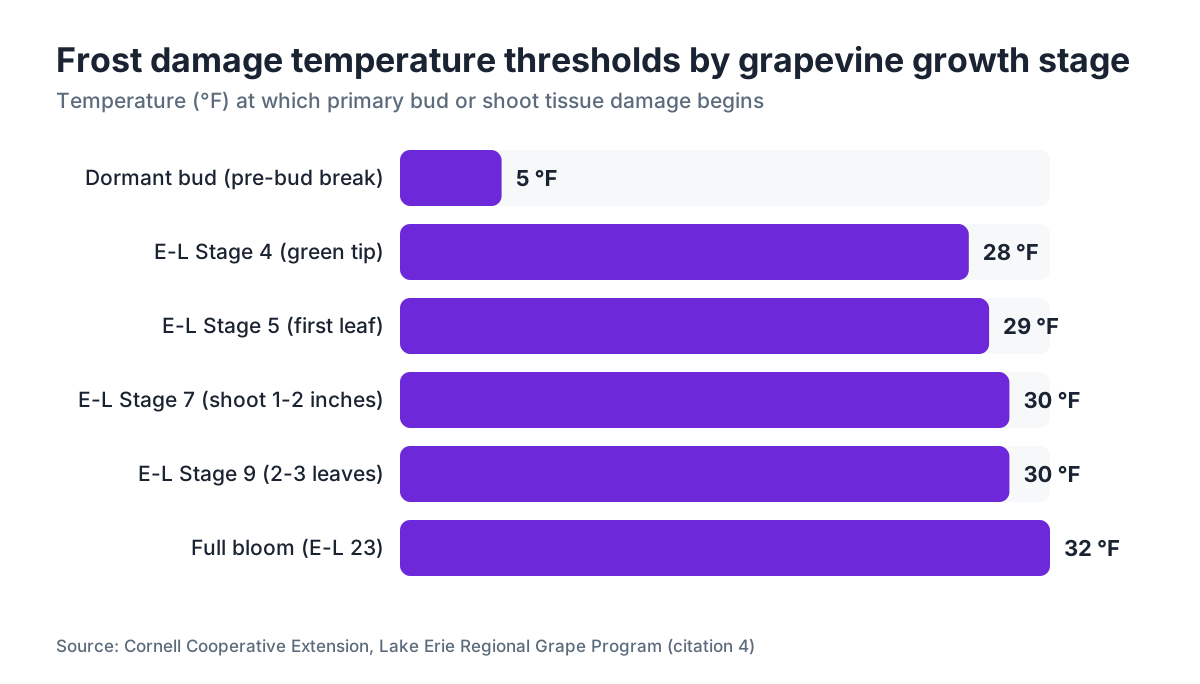
A hardened dormant bud can survive -5°F to -20°F depending on variety and how well it acclimated. At green tip (E-L stage 4), that tolerance collapses to about 28°F (-2.2°C). By the time an inch of shoot shows, damage begins around 30°F (-1.1°C), and at full bloom the threshold sits near 32°F (0°C) [3].
The vine loses decades of cold hardiness in about two weeks. That's the whole problem.
Two degrees decides a season here. At 28°F for three hours, you might lose 20% of primary buds. At 26°F for the same stretch, you could lose 80%. Cornell Cooperative Extension's viticulture program at Geneva, New York publishes frost damage tables that break this out by variety and growth stage, and they're worth printing and keeping in the truck [4].
Primary buds carry the highest percentage of fruit-bearing shoots. Secondary buds, which the vine pushes if the primaries die, typically carry 30 to 60% fewer clusters depending on variety [4]. Tertiary buds are often completely vegetative. Losing primaries won't kill the vine, but it can cut your crop by half or more.
The practical danger window runs from green tip through about three to four inches of shoot growth. During that stretch, every forecast below 32°F earns active monitoring and a plan. In a short-season region, one hard frost at this stage decides whether you have a commercial crop at all.
How do you measure and track growing degree days before bud break?
You need a max/min thermometer or a weather station at canopy height, not the airport station five miles down the road. Airport sensors sit over tarmac and read two to four degrees warmer on clear, calm nights than your vine rows do. Your on-site number is the only one that counts for frost decisions.
The math: GDD per day = ((Tmax + Tmin) / 2) - 50. Sum from January 1. If the daily average falls below 50°F, that day contributes zero. Most vineyard weather stations and farm weather apps do this automatically, but knowing the formula helps you catch bad output.
WSU's AgWeatherNet gives free GDD tracking to Washington growers through a network of on-farm stations [6]. California's CIMIS network does the same for California [7]. For other states, the National Weather Service's climate services and NOAA's Regional Climate Centers publish historical GDD data you can use to calibrate your local station.
A paper log works fine too. Date, Tmax, Tmin, daily GDD, cumulative GDD. Five minutes a day. The point is that once cumulative GDD approaches 50 to 80, you should already be walking vines every day and checking frost forecasts every night. The vine gives you almost no warning.
What do the Eichhorn-Lorenz (E-L) stages at bud break look like in the field?
You'll hear E-L 4, E-L 5, and E-L 7 tossed around in extension bulletins. Here's what to actually look for in the row:
E-L Stage 1: Hard, brown, closed bud. Winter dormancy. No frost risk at normal late-winter temperatures.
E-L Stage 2: Bud scales begin to separate slightly. Still looks dormant to an untrained eye, but the scales fit a little looser. Hardiness starts to slip.
E-L Stage 3: Wool stage. Soft, woolly, cotton-like tissue between the scales becomes visible. Frost tolerance drops fast now.
E-L Stage 4: Green tip. A distinct green point of tissue shows at the center of the wool. This is the reference point for most frost damage tables. Damage starts around 28°F.
E-L Stage 5: First leaf just separating from the shoot tip. Still tight, but unmistakably a leaf. Damage risk at 29 to 30°F.
E-L Stage 7: First leaf expanded to about 25% of final size. Shoot is 1 to 2 inches long. Damage at 30°F with even a short exposure.
E-L Stage 9: Two to three leaves separated, shoot growing actively. 30 to 31°F is now dangerous. You're fully in the frost window.
The real skill is reading these stages fast across hundreds of vines, because they won't all move together. Vines on south-facing row ends often lead by four to seven days. Those lead vines are your early warning system for where frost damage lands first [2].
How do you protect vines from frost at bud break?
Four methods actually work: wind machines, overhead sprinklers, heaters, and site selection (which you can only decide before you plant). Passive tricks like row covers exist, but they're labor-heavy and hard to scale past a small block.
Wind machines mix the warmer air sitting 30 to 50 feet above the vineyard down to canopy level. They pay off when the temperature inversion is strong, meaning calm, clear nights with a real temperature gap between ground level and the air above. They fade in windy conditions (the inversion breaks up on its own) and do nothing in advective frost, where cold air moves in horizontally. A typical propeller-style wind machine covers 10 to 15 acres and can lift temperatures 2 to 4°F under good inversion conditions [4].
Overhead sprinklers protect by releasing latent heat as water freezes on the tissue, holding bud temperature near 32°F as long as water keeps flowing. One rule breaks people: once you start, you cannot stop until temperatures climb above freezing. Stop mid-event and ice keeps forming without the latent heat buffer, which does more damage than running nothing at all. Application rate needs to hit at least 0.10 inches per hour, and your system has to carry that load. This method also burns through water, which is a hard constraint in dry regions [4].
Propane or diesel heaters are the oldest method. They work, and they cost real money in fuel and labor. An under-vine heater setup for a commercial block can burn $200 to $400 per night in fuel alone, and that swings widely with fuel prices and heater density.
Honest truth: no single method holds up alone in a severe event. Serious frost operations stack them. A wind machine running plus heaters at the row ends, or sprinklers plus a wind machine to spread the latent heat effect. Cornell's viticulture team publishes a frost protection decision guide worth reading before the season, not the night of [4].
What should you do in the vineyard right at bud break?
Start walking vines daily once you're within 20 GDD of your variety's expected threshold. You're checking four things: stage of bud development block by block, which vines are furthest ahead (your frost sentinels), any disease pressure that snuck in over winter, and equipment readiness.
Pruning timing feeds into all of this. In a late-frost region, delayed pruning is a real strategy. Unpruned canes carry more total bud mass, so per-spur heat accumulates a little slower, and the net effect is that pruned vines often break a few days earlier than unpruned canes of the same variety in the same block. Some growers leave a portion of canes on until frost risk passes, then finish pruning. It adds labor. It can save a crop.
Spray timing matters here too. Many dormant-season fungicide and insecticide applications have to go on before bud break or at very early green tip, before leaf tissue is exposed. Read the label. The EPA Worker Protection Standard (WPS), covering agricultural pesticide use under 40 CFR Part 170, sets requirements for restricted-entry intervals (REIs) and early-entry PPE that apply any time you enter a treated area, scouting at bud break included [8].
Tie your spray dates to E-L stage, more than the calendar, and your records get more useful every year. A record that reads "E-L stage 5, green tip" tells you more than "April 14" when you're looking back three seasons at disease patterns. This is where digital record-keeping earns its keep. VitiScribe lets you log E-L stage next to each spray event, so your records reflect what the vine was doing, not what the calendar said.
How does bud break timing affect the whole-season crop cycle?
Early bud break sets up earlier bloom, earlier veraison, and an earlier harvest. Sounds like a clean win. It's messier in practice.
In cool climates, early bud break buys more growing degree days before the first fall frost, which can be the difference between physiologically ripe fruit and green, under-ripe grapes. It also maxes out your exposure to late spring frosts, and one bad night wipes out all that potential.
In warm climates like Napa or the San Joaquin Valley, very early bud break (sometimes February) pushes harvest into summer heat instead of cooler September nights, which compresses the ripening window and makes acid management harder. The warmest California regions have seen bud break dates creep earlier by an estimated 6 to 8 days over the past 50 years, based on long-term phenology records [9].
Bud break timing also sets your shoot thinning and canopy management schedule. Shoots thinned at 3 to 6 inches leave less wound tissue than shoots pulled later. A precise bud break date in your records lets you schedule that labor with far less guessing.
For mixed-variety vineyards with staggered bud break (common in small mixed blocks and estate plantings), tracking each variety's GDD-to-break threshold tells you which blocks need frost protection first. A vineyard block of early-budding Chardonnay needs a different nighttime watch than a Cabernet Sauvignon block breaking two weeks later.
Does training system or rootstock affect when bud break happens?
Training system has a modest but real effect. Vines with canes trained close to the ground sit in the cold air that pools at the surface. Their south-facing trunks may absorb enough solar radiation to push slightly earlier, then take more frost damage when temperatures drop because they occupy the coldest layer. VSP (vertical shoot positioning) with cordons at 36 to 42 inches keeps buds above that coldest ground-level air.
Rootstock changes phenology too, though less than the scion variety does. 101-14 Mgt and 3309C rootstocks are linked to slightly earlier bud break in some trial data than 110R or 1103P, which lean later. The gap is rarely more than three to five days in most comparisons, but in a frost year that window is not trivial [10].
Spacing and vine age also factor in. Older vines with larger carbohydrate reserves in trunk and root wood push through early-season stress better, though their bud break timing looks similar to younger vines of the same variety on the same site. Young vines in their first two to three years are more vulnerable to late-frost damage because their reserves are thin and recovery from shoot kill is slow.
What records should you keep around bud break for compliance and crop planning?
Compliance records and practical crop records overlap more than you'd expect at bud break.
For pesticide records, the EPA WPS and most state department of agriculture rules require you to record the date, location, product name, EPA registration number, rate, target pest, and applicator identity for every application [8]. Many state ag departments add phenological stage, or at least expect it in an audit. Recording E-L stage at each application closes gaps that calendar dates alone leave open.
For crop insurance, the USDA Risk Management Agency's vineyard policies under the Actual Production History (APH) program often require documentation of adverse weather events that caused loss. A frost during bud break that damages primary buds needs a dated record: weather station data showing the low temperature, the E-L stage at the time, and a post-frost damage assessment by block. Without that paper trail, a claim is hard to support [11].
For long-term management, the most useful record is a plain log: variety, block, first date of E-L stage 4 (green tip), cumulative GDD at that date, and whether a frost event landed within two weeks either side. After five seasons, that log maps your actual frost risk window by block better than any regional average.
Build it digitally instead of in a paper binder and year-over-year comparison gets easy. VitiScribe tracks bud break stages, spray events, and weather notes by block, so the compliance record and the crop record land in the same place.
How is climate change affecting grape bud break dates?
Short version: bud break is getting earlier across most wine regions, and frost risk isn't dropping at the same pace.
A widely cited 2020 study in Nature Climate Change analyzed Burgundy phenology records going back to 1354 and found harvest dates (a proxy for the season's start) have moved about 6 days earlier per degree Celsius of warming, with the sharpest shifts in recent decades [9]. Harvest dates aren't bud break, but they move together, and direct phenology studies from UC Davis and WSU show bud break dates in California and Washington advancing on the order of 5 to 8 days across 50-year records.
The trouble is that last spring frost dates aren't advancing at the same pace in many continental interior regions. In the Midwest, Pacific Northwest valleys, and Appalachian wine country, earlier bud break combined with unpredictable late frost events raises the frequency of damage years compared to historical patterns. A 2019 USDA Agricultural Research Service analysis of California viticulture under climate projections found increased spring frost risk for early-budding varieties even as average temperatures rise [12].
For cold-hardy growers in Minnesota, Wisconsin, and Michigan, this hits a little softer, because varieties like Itasca, Marquette, and La Crescent were bred partly for later bud break relative to the region's frost calendar. Even those varieties aren't immune. Tracking your own GDD-to-break history is still the best local early warning you have.
What extension resources and tools are available for bud break monitoring?
A few that earn their place, more than nice-to-have:
WSU's AgWeatherNet (weather.wsu.edu) provides hourly station data and GDD calculations for Washington growers, with stations dense enough to be genuinely local [6].
California's CIMIS network (cimis.water.ca.gov) covers the state with real evapotranspiration and temperature data, also free [7].
Cornell's Lake Erie Regional Grape Program and Geneva Experiment Station publish variety-specific frost damage tables and bud break timing guides that are the most detailed available for eastern U.S. varieties [4].
The University of Minnesota's cold-hardy grape program at the Horticultural Research Center in Excelsior has published phenology data for Itasca, Marquette, Frontenac, La Crescent, and other northern varieties. For growers working with those releases, U of M is the primary reliable source for bud break GDD thresholds and frost tolerance ratings [5].
NOAA's Climate Prediction Center publishes 6-to-14-day temperature outlooks that help with planning frost protection around bud break. Not precise enough for night-of calls, but good for scheduling propane delivery or an equipment check a week out.
The Winkler heat summation regions, developed at UC Davis, remain a useful frame for comparing regional climates, though they use a full-season GDD sum (April through October, base 50°F) rather than spring accumulation [13]. Region I sits below 2,500 GDD; Region V runs above 4,000 GDD. Knowing your region helps you calibrate expectations against published variety averages.
Frequently asked questions
What temperature causes frost damage at grape bud break?
At green tip (E-L stage 4), tissue damage begins around 28°F (-2.2°C). Once shoot growth reaches 1 to 2 inches (E-L stage 7), damage can start at 30°F. At full bloom the critical threshold rises to 32°F. Duration matters as much as temperature: three hours at 28°F causes more damage than 30 minutes at the same temperature. Cornell Cooperative Extension's frost damage tables break this down by variety and stage.
How many growing degree days does it take for grapes to break bud?
Most Vitis vinifera varieties begin bud break after 50 to 100 growing degree days accumulate (base 50°F, summed from January 1). Cold-hardy hybrids like Marquette and Frontenac have similar thresholds, while Itasca tends to break slightly later. The exact GDD threshold varies by variety, site, and how dormancy release is defined. Tracking your own data over multiple seasons gives more accurate local predictions than regional averages.
When does grape bud break happen in spring in the Midwest?
In the upper Midwest, grape bud break typically falls between late April and mid-May, depending on variety and year. Cold-hardy varieties bred for Minnesota and Wisconsin, like Itasca and Marquette, generally break bud in late April to early May under normal spring conditions. That timing puts them at risk of late frosts through mid-May in many sites. Tracking cumulative GDD from January 1 gives more reliable predictions than calendar dates alone.
What is the Eichhorn-Lorenz scale and how do you use it at bud break?
The Eichhorn-Lorenz (E-L) scale is a numeric staging system for grapevine phenology running from stage 1 (winter dormancy) to stage 47 (berry maturity). At bud break, the key stages are E-L 4 (green tip visible, frost damage starts at 28°F) and E-L 5 (first leaf separating). Using E-L stage rather than calendar date in your spray and scouting records makes data comparable across years with different spring timing.
Does delayed pruning really push back bud break to avoid frost?
Yes, it works, though modestly. Leaving unpruned canes on the vine slows heat accumulation per individual bud and generally delays average bud break by three to seven days compared to fully pruned vines. The effect is strongest in marginal climates. The tradeoff is extra labor at a busy time. Many growers in frost-prone regions leave a portion of canes as a sacrificial set through peak frost season, then finish pruning once risk drops.
What's the difference between primary, secondary, and tertiary buds at bud break?
Each node on a grapevine cane holds three buds: the primary, largest and most productive; the secondary, a backup; and the tertiary, smallest and last resort. Under normal conditions, only the primary breaks and grows. When frost kills primary buds, secondary buds push. Secondaries typically carry 30 to 60% fewer clusters than primaries. Tertiaries are often vegetative only. Protecting primaries through the frost window is where crop protection is won or lost.
How do wind machines protect vines at bud break, and when don't they work?
Wind machines pull down warmer air from a temperature inversion layer sitting 30 to 50 feet above the vineyard, mixing it with the cold air at canopy level. A typical propeller wind machine covers 10 to 15 acres and can raise temperatures 2 to 4°F under ideal inversion conditions. They lose effectiveness in advective frost events (cold moving horizontally on wind) and on cloudy nights when inversion layers don't form. They're most reliable on calm, clear nights.
What records do you need to document frost damage at bud break for crop insurance?
For a USDA RMA vineyard crop insurance claim after a frost event at bud break, you need: on-site weather station data showing the low temperature and duration, the E-L developmental stage of each affected variety at the time, a dated post-frost damage assessment by block, and evidence of normal cultural practices. Claims without temperature records and phenological stage documentation are much harder to support. Keep this data in a format you can produce quickly on request.
How does the Itasca grape variety's bud break timing compare to other cold-hardy varieties?
Itasca, released by the University of Minnesota in 2017, has moderate-to-late bud break timing relative to other cold-hardy Minnesota varieties like Marquette and Frontenac. That later break is one of the variety's practical advantages in Upper Midwest sites where late spring frosts threaten early-budding varieties. U of M variety notes describe Itasca as well-suited to sites with frost risk through early May. Its GDD-to-break threshold is similar to Frontenac Gris in most field observations.
Is it true that bud break is happening earlier because of climate change?
Yes, across most wine regions. Long-term phenology records, including a 2020 Nature Climate Change study of Burgundy data back to 1354, show harvest dates advancing roughly 6 days per degree Celsius of warming, with bud break moving in parallel. UC Davis and WSU data show similar trends in California and Washington. The concern is that last spring frost dates aren't advancing as fast in many regions, raising frost damage risk for early-budding varieties even as growing seasons warm overall.
Can you use row covers or fabric frost protection for grapevines at bud break?
Row covers work on small blocks and in emergencies, but they're hard to scale. Floating row cover fabric (polypropylene, 0.5 to 1.5 oz per square yard) can provide 2 to 4°F of protection. The labor to install and remove it from a commercial planting before and after each frost event makes it impractical for most operations over an acre or two. It's a reasonable backup for a small trial block of a new variety, not a primary frost strategy for a working vineyard.
What spray applications need to happen at or just before bud break?
Dormant sprays for scale insects and mites (horticultural oil or lime sulfur) must go on before green tissue emerges, typically targeting E-L stages 2 to 3. Early bud break is also the window for preventive fungicide applications targeting powdery mildew and black rot, which begin at green tip. Always read the product label: some materials injure emerging green tissue. Record the E-L stage alongside each application date so your spray records reflect actual vine development, more than calendar timing.
How do you tell the difference between frost-damaged and healthy buds after a bud break frost event?
Cut through a suspect bud or young shoot tip with a clean blade and look at the cross section. Healthy tissue is green to white. Frost-killed tissue turns brown to black at the center within 24 to 48 hours of the event. Primary buds on a given cane can die while secondary buds survive, or the whole node dies depending on temperature severity. Walk the block systematically and estimate the percentage of dead primary buds per variety per block to assess crop loss for replanning and insurance documentation.
Sources
- UC Davis Viticulture and Enology, Eichhorn-Lorenz phenological stages reference: The Eichhorn-Lorenz scale and its application to bud break staging from E-L 1 through E-L 9
- Cornell University Cooperative Extension, Viticulture Program, Frost and Cold Injury in Grapevines: GDD base 50°F accumulation threshold for bud break (50-100 GDD) and frost damage temperature thresholds by E-L stage
- Washington State University AgWeatherNet, GDD tracking and vineyard weather stations: Free GDD calculation and on-farm station data for Washington growers
- California Department of Water Resources, CIMIS evapotranspiration and temperature network: Free California vineyard weather data including temperature records used for GDD tracking
- U.S. Environmental Protection Agency, Worker Protection Standard for Agricultural Pesticides, 40 CFR Part 170: WPS requirements for restricted-entry intervals, early-entry PPE, and record-keeping for pesticide applications in vineyards
- Chuine I. et al., Nature Climate Change, 2020, long-term Burgundy phenology records: Harvest dates (phenology proxy) advancing approximately 6 days per degree Celsius of warming, with accelerated shift in recent decades
- UC Davis Viticulture and Enology, Rootstock Trial Data and Phenology Effects: Rootstock effects on bud break timing; 101-14 Mgt and 3309C associated with slightly earlier bud break vs 110R or 1103P, difference rarely exceeding 3-5 days
- USDA Risk Management Agency, Actual Production History Crop Insurance for Grapes: Documentation requirements for vineyard crop insurance claims following weather damage events including frost at bud break
- USDA Agricultural Research Service, Climate Change and California Viticulture, 2019 projections: Increased spring frost risk for early-budding California varieties under warming climate projections despite rising average temperatures
- UC Davis Viticulture and Enology, Winkler Heat Summation Regions: Winkler regions defined by full-season GDD accumulation (April-October, base 50°F): Region I below 2,500 GDD, Region V above 4,000 GDD
Last updated 2026-07-09