Grape fungal diseases after fruit set and before veraison
TL;DR
- The stretch from fruit set to veraison is the highest-risk period for botrytis bunch rot, powdery mildew, and downy mildew in most wine grape regions.
- Infections that set now cause losses at harvest even when symptoms show up weeks later.
- Tight spray timing tied to cluster stages, aggressive canopy work, and clean records are the defense that actually holds.
Why is the period between fruit set and veraison so risky for grape fungus?
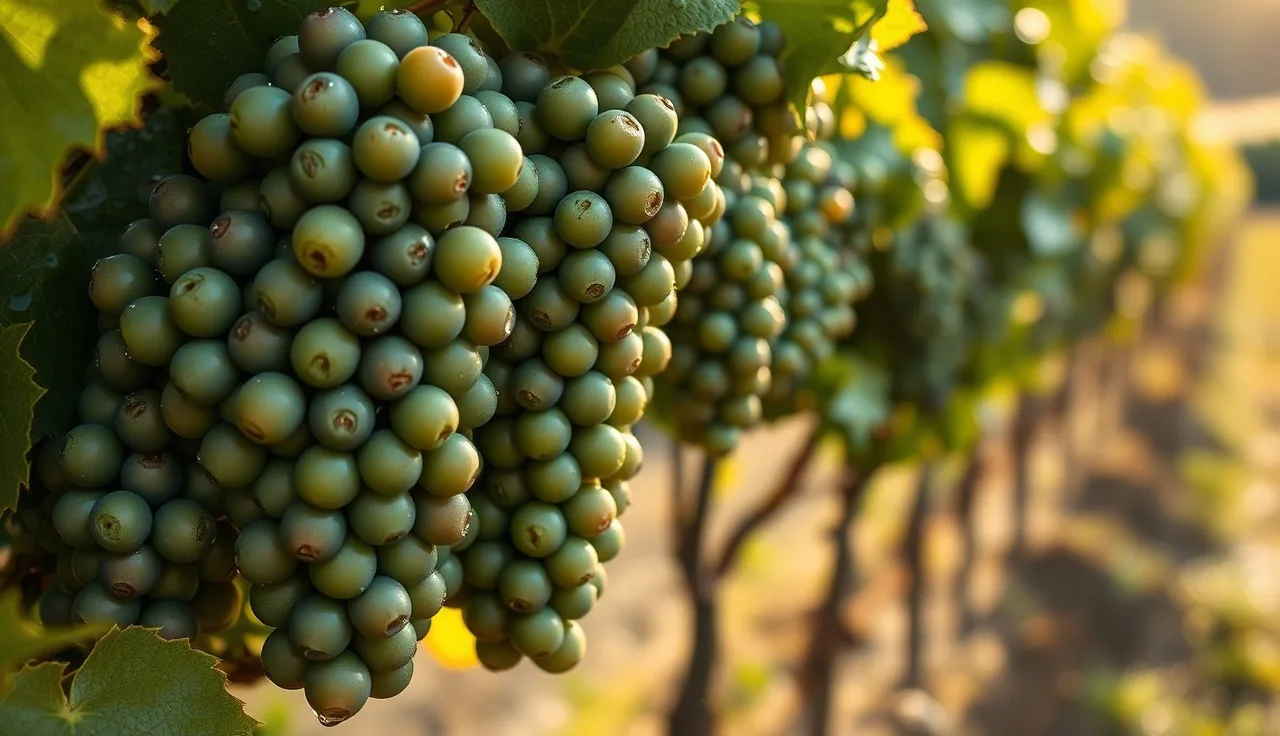
Green berries are the problem. Right after fruit set they're thin-skinned, easily cracked by normal growth, and packed tight against each other in the cluster. Relative humidity inside a dense cluster canopy regularly hits 95 percent or higher, even on warm afternoons, because the leaves trap moisture and kill airflow. [1] That's the micro-climate fungi live for.
Botrytis cinerea, the pathogen behind gray mold, infects at temperatures as low as 41°F and does its best work between 65°F and 75°F with free moisture or high humidity. Powdery mildew (Erysiphe necator) doesn't even need wet leaves. It germinates and infects in dry conditions on high humidity alone, and its generation time is just five to seven days when the weather cooperates. One missed spray interval, and the population explodes. Downy mildew (Plasmopara viticola) needs free water to release its spores but throws new infections fast once it gets that water. [2]
The deeper trap is latent infection. Botrytis infects the flowers at bloom and then goes quiet inside the berry tissue. It doesn't show gray sporulation until conditions shift at veraison, when the berry softens and sugar climbs. By the time you see rot, the infection is weeks old. That's why spraying after symptoms appear almost never saves that year's clusters. Catch it from fruit set through berry touch, or don't catch it at all.
Which fungal pathogens matter most between fruit set and veraison?
| Pathogen | Common name | Infection requirements | Primary damage window |
|---|---|---|---|
| Botrytis cinerea | Gray mold / bunch rot | 65-75°F, high RH or free water | Fruit set to veraison (latent), veraison onward (visible) |
| Erysiphe necator | Powdery mildew | RH >40%, 68-77°F optimal, NO free water needed | Fruit set to 8 weeks post-fruit-set |
| Plasmopara viticola | Downy mildew | Free water, >50°F | Shoot elongation through berry touch |
| Botrytis cinerea (secondary) | Sour rot complex | Follows powdery mildew skin damage | Near veraison onward |
| Phomopsis viticola | Phomopsis cane and leaf spot | Wet conditions post-budbreak, residual fruit infection | Mostly pre-fruit-set but persists |
Powdery mildew gets more attention than it deserves in some regions, and botrytis gets shrugged off. The reason is simple: powdery mildew paints a dusty white coating you can spot from the tractor seat. Botrytis in the fruit-set-to-veraison window is invisible until it's a disaster.
One threshold is worth memorizing. UC Davis research on powdery mildew found that berries are most susceptible from shortly after fruit set until they hit roughly 8°Brix, which lands three to six weeks post-fruit-set depending on variety and region. [3] After that, the skin toughens and resistance climbs, though infection can still happen. Gap your fungicide program during that window and you're gambling with real money.
Sour rot is technically a complex, bacteria and yeast riding along with Botrytis, not a pure fungal disease. But its entry point is almost always skin damage from powdery mildew, insect feeding, or growth cracking. Stopping powdery mildew in this window does double duty.
What does botrytis look like on young clusters after fruit set?
You won't see the classic gray fuzz on green berries at this stage. Early botrytis in the fruit-set-to-veraison window is mostly invisible, and that's exactly what makes it dangerous.
Here's what you might catch instead: rachis browning or a water-soaked look on the cluster stem, single berries that shrivel and dry without coloring up, or a faint brown ring at the berry stem end. All of it looks like normal berry shot or heat stress at first glance. In wet years on very dense varieties like Pinot Noir or Muscat Blanc, where berries touch by late fruit set, you can find early sporulation buried in the cluster interior.
Check the old flower parts. Botrytis colonizes the dried floral debris trapped in the cluster at berry set, and those dead stamens and petals are the primary inoculum source for latent infection in young berries. [4] UC Davis extension recommends blowing or shaking loose floral debris out mechanically where you can. It's also why the bloom and fruit-set sprays carry so much weight: you're hitting that first colonization event before it hides.
By veraison, a block that never got a fungicide program shows the obvious gray sporulating mold on softened berries, berries shatter at a touch, and the rot runs through the cluster fast. A Pinot Noir block at 20 percent botrytis incidence at harvest is common in wet years without intervention. In bad years, losses top 50 percent.
What fungicide spray timing is recommended between fruit set and veraison?
The standard UC Davis and Cornell approach hangs the post-fruit-set program on cluster development stages, not calendar dates, because phenology predicts risk better than the day of the year does. [5]
For botrytis, the sprays that count come at bloom (20-50 percent capfall), at fruit set, and at bunch closure (when the berries in a cluster start touching). That bunch closure spray is the last door into the cluster interior before the canopy seals it shut. After closure, spray penetration into the cluster falls off a cliff.
For powdery mildew, the interval tightens through the susceptibility window. Seven-to-ten-day intervals are standard with protectant products (sulfur, copper, mineral oil). Systemic DMI fungicides (sterol demethylation inhibitors, FRAC group 3) and SDHI products (FRAC group 7) can stretch to ten to fourteen days if the block has no current pressure, but that's a judgment call built on your local weather and last season's history. [6]
For downy mildew, fungicides have to go on before sporulation. The 10-10-24 rule from the Goidanich model, or simpler regional thresholds from WSU extension, gives you a trigger: once you've logged 10°C overnight temperatures, 10mm rain in 24 to 48 hours, and actively growing tissue, you're in a primary infection period. Apply before the event or within 24 hours for contact products. Use a systemic with post-infection activity within 48 to 72 hours. [7]
One thing that's easy to miss: re-entry intervals and pre-harvest intervals start ticking the moment you spray. Track them from the first fruit-set application so you don't get boxed out of a late-season spray you need.
Running several fungicide chemistries and juggling their intervals is where growers get burned. A digital spray log that flags FRAC group rotation and PHI conflicts pays for itself the first time it stops a noncompliant application. VitiScribe's spray record module is built for exactly this, flagging re-entry and pre-harvest interval conflicts as you log each spray.
How does canopy management reduce fungal pressure between fruit set and veraison?
Fungicides aren't the whole game, and leaning on them alone gets expensive fast while breeding resistance. Canopy management is the cheapest effective lever you have against botrytis, and to a smaller degree against powdery mildew in humid regions.
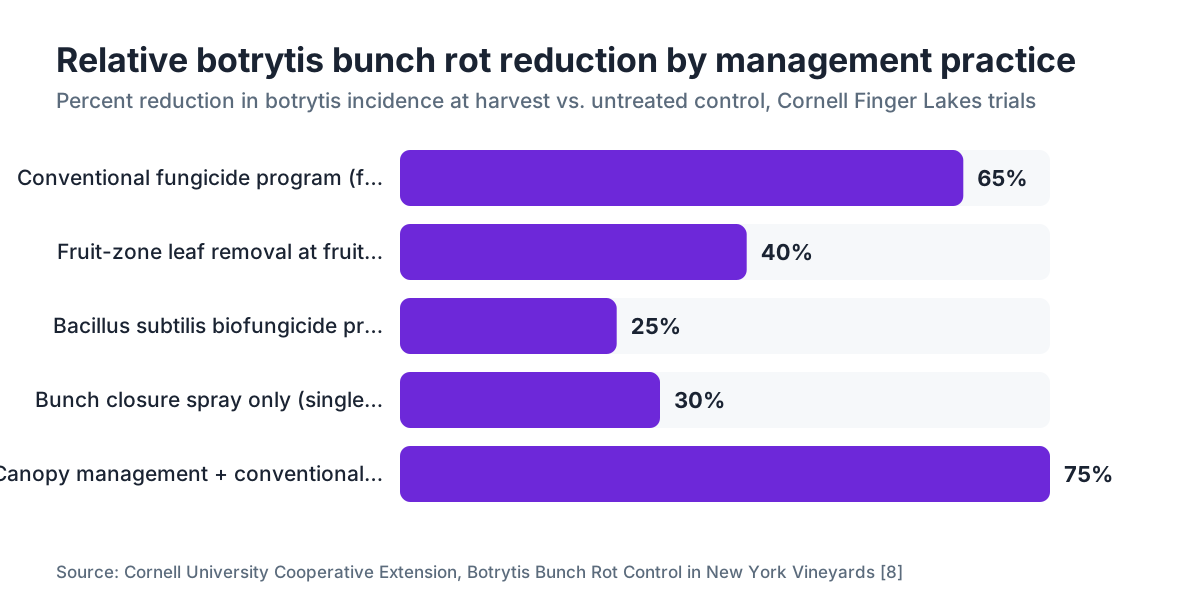
Leaf removal in the fruit zone, usually the two to four basal leaves on the east or north face of the row (shade side in warm climates, sun side in cool climates), drops cluster humidity hard. A Cornell study in the Finger Lakes found fruit-zone leaf removal at or shortly after fruit set cut botrytis incidence 30 to 50 percent at harvest against untreated controls. [8] The mechanism is boring and reliable: better airflow dries the cluster faster after rain or dew.
Timing matters. Pulling leaves at or just after fruit set also throws a little sun on the berries, which thickens the skin and raises natural resistance. Waiting until after bunch closure, when berries already touch, loses most of the benefit, because you've let the humid pocket build for weeks.
Shoot positioning, hedging, and lateral removal all push toward the same thing: a canopy that lets air move and spray reach the fruit. A tangled, unhedged shoot mass over the fruit zone throws shade that slows drying and blocks UV. Both feed fungal growth. None of this is hard viticulture. The real constraint is getting crews into the vineyard at the right time.
On dense-clustered varieties like Pinot Noir, cluster thinning to cut berry count, or choosing looser-clustered clones at planting, drops botrytis risk at the structural level. You will not fix a tight-clustered Muscat block by spraying harder. Canopy work and cluster thinning are the actual levers.
What are the FRAC group rotation rules and why do they matter in this window?
Fungicide resistance is documented, not theoretical. Botrytis cinerea is notorious for building resistance to several fungicide classes at once. Multi-drug-resistant Botrytis strains have turned up in vineyards across California, the Pacific Northwest, and the eastern U.S. [9]
The Fungicide Resistance Action Committee (FRAC) sorts every active ingredient into a group by mode of action. The core rule: never apply the same FRAC group twice in a row, and cap any single high-resistance-risk group at two applications per season.
For botrytis in the fruit-set-to-veraison window, the groups you'll reach for are:
- FRAC 2 (boscalid, related SDHIs): high resistance risk
- FRAC 7 (fluopyram, fluxapyroxad): high resistance risk
- FRAC 9 (cyprodinil): medium resistance risk
- FRAC 12 (fenhexamid): medium risk
- FRAC 17 (fludioxonil): low resistance risk
- FRAC M (multi-site: sulfur, copper, captan): no resistance risk
A workable rotation for three post-fruit-set botrytis sprays: fruit-set spray with a FRAC 9+12 combination (Vangard + Elevate), bunch closure spray with a FRAC 7 product (Luna Experience), then a pre-veraison spray with FRAC 17 (Scholar/fludioxonil) if downy mildew pressure is also in play. Sulfur applied for powdery mildew in between doesn't conflict.
Don't file resistance rotation under paperwork. A resistance failure in a high-value block during a wet year is financially brutal, and there's no fix mid-season once it shows up.
What canopy and spray records do you legally need to keep?
In most U.S. wine grape states, the pesticide application record requirement comes from federal law and state pesticide registration together. At the federal level, the EPA's Worker Protection Standard (WPS) requires employers of agricultural workers to keep records of each pesticide application: product name, EPA registration number, active ingredient, rate applied, date, location, and the re-entry interval. [10] Those records stay on file for two years and must reach workers and handlers on request within 15 days.
California piles on the most. The state's Department of Pesticide Regulation requires licensed applicators to file a Notice of Intent (NOI) before applying any restricted material, and Pesticide Use Reports (PURs) go to the county agricultural commissioner monthly. [11] Washington State requires pesticide application records within 24 hours of application, retained for two years, per WSU Extension guidance. [12]
Compliance aside, clean spray records are what save you when an audit lands. If you can't produce a log showing your FRAC rotations, the PHI math for each product, and the re-entry intervals posted at field entry, you're exposed to regulatory action and, if a drift or water-quality complaint hits, civil liability.
Practical advice: keep records in a format that timestamps every entry and exports cleanly. Paper logbooks are legal, but they're slow to audit and easy to fumble. On VitiScribe or any similar platform, the application log should calculate your PHI countdown and flag conflicts before you spray, not after the fact.
For vineyards selling grapes under a third-party audit standard (SIP, Lodi Rules, CCOF organic), spray records are the main document reviewed at audit. Missing or incomplete records fail the audit even when the applications themselves were done right.
How do organic vineyards manage grape fungus between fruit set and veraison?
Organic vineyards have real tools, but the spray intervals run shorter and the margin for error is thinner. The base kit is sulfur for powdery mildew, copper for downy mildew, and biofungicides for botrytis.
Sulfur is the workhorse. It handles powdery mildew at seven-day intervals and is OMRI-listed. Two cautions: it's phytotoxic above roughly 90°F, so skip applications when the forecast tops that within 24 hours, and it has a short residual, so rain or heavy dew inside 24 hours of spraying wipes out the deposit. [3]
Copper works for downy mildew and is OMRI-listed, but repeated use loads the soil. California's CDFA has been tracking copper accumulation in vineyard soils, and some regions with long organic histories are already near levels that hurt soil biology. [13] The EPA's copper registration cap sits at 4 pounds of metallic copper per acre per year for most products. Use it on triggers, not on a calendar.
Botrytis is where organic options get thin. Biofungicides based on Bacillus subtilis (Serenade) or Trichoderma have shown activity in trials, but protection runs lower than synthetics. Cornell trials found Bacillus-based biofungicides cut botrytis incidence 15 to 35 percent in some years, against 50 to 70 percent for conventional programs. [8] Worth a slot in the rotation. Not worth betting the crop on in a high-pressure year.
The real organic edge is canopy discipline. A well-opened canopy in an organic block regularly beats a conventionally sprayed dense canopy on botrytis outcomes, because the physical environment moves the number harder than any input does.
Does the grape variety affect fungal risk between fruit set and veraison?
Yes, a lot. Cluster architecture is the main variable. Tight-clustered varieties build the high-humidity, physically sheltered pocket Botrytis wants. Loose-clustered varieties dry faster even in wet years and let spray reach the cluster interior.
High botrytis risk: Pinot Noir, Pinot Gris, Pinot Blanc, Gewürztraminer, Muscat Blanc, Riesling, Zinfandel (thick-skinned but compact), Grenache.
Lower botrytis risk: Cabernet Sauvignon (thicker skin, moderately open cluster), Malbec, Syrah, Merlot (moderate), Sauvignon Blanc (moderate to high in some clones).
Powdery mildew susceptibility runs on a different axis. Cabernet Franc and Chardonnay are notably susceptible. Carignan and Grenache sit at moderate. Some hybrids and PIWI varieties (Pilzwiderstandsfähig, German for fungus-resistant) carry resistance genes from wild Vitis species and need far fewer fungicide inputs. Marquette, Frontenac, and Regent are common examples in cool-climate and organic U.S. operations. [2]
If you're in a humid region planting new blocks, pick variety and clone on disease resistance. The spray program cost gap between a Pinot Noir block and a Regent block in a wet New York or Oregon year is large, and it compounds over the life of the planting.
How does weather forecasting help you time fungicide applications in this window?
Weather-based disease models have been around for years and stay underused. They aren't perfect. They beat calendar spraying every time.
For powdery mildew, the UC IPM Powdery Mildew Risk Index uses accumulated degree hours above 50°F plus RH above 90 percent to predict infection periods. You can get it through the UC IPM website, and it's built into several weather platforms used in California and the Pacific Northwest. [3]
For downy mildew, the EFI (Electronic field inoculum) model and the simplified 10-10-24 rule are the common tools. WSU's Decision Aid System (DAS) folds weather data into disease models for the Pacific Northwest and costs nothing to access. [7]
Botrytis has no single dominant model, but relative humidity duration inside the canopy is the most reliable predictor. If canopy RH holds above 85 percent for more than 15 consecutive hours after a rain event during the fruit-set-to-veraison window, most extension programs call the infection risk high.
Here's the practical move: put a cheap data logger in your fruit zone, more than a general weather station. The micro-climate inside a dense cluster zone can read 10 to 20 percentage points of RH higher than a standard station. That gap decides whether you spray after a borderline rain.
For vineyard managers across different appellations, from Paso Robles to the Finger Lakes, the disease pressure calendar slides six to eight weeks on latitude and maritime influence alone. Don't borrow spray timing from a different climate zone. Find your regional extension program and use their thresholds.
What worker safety rules apply when spraying fungicides during this window?
The EPA's Agricultural Worker Protection Standard (WPS), revised in 2015, governs pesticide safety for all agricultural workers in the U.S., vineyard crews included. The WPS requires that workers not enter treated areas until the re-entry interval (REI) expires; that the REI and application information get posted at a central location and at field entry points; that workers get safety training before entering treated areas; and that personal protective equipment (PPE) on the label is followed exactly, because the label is the law. [10]
For the common fungicides in this window, REIs range widely:
- Sulfur wettable powder: 24-hour REI in most formulations
- Copper hydroxide products: 24-48 hours depending on formulation
- DMI fungicides (e.g., Rally/myclobutanil): 24 hours typical
- SDHI + DMI combinations (e.g., Luna Experience): 12-24 hours
- Fludioxonil (Scholar): 12 hours
- Captan: 24-48 hours
Verify the REI on the current registered label for the exact product you're using. Don't run off a generic assumption. Labels change between registration cycles.
California also requires a Hazard Communication Standard posting and a heat illness prevention plan when workers are in the field. If you're applying restricted-use pesticides, the applicator must hold a current Qualified Applicator License or Certificate in California. Washington State runs parallel requirements. [12]
REI violations are among the more common findings in agricultural labor inspections. Your spray records, timestamped with REI calculations, are your primary defense.
How do you know if your fungicide program is actually working?
The honest answer: you often don't know until veraison, which is why prevention discipline beats in-season reaction.
The monitoring that works between fruit set and veraison comes down to three habits.
First, run weekly cluster inspections on your highest-risk varieties. Open 25 to 50 randomly chosen clusters per block and look for early botrytis (brown rachis tissue, shriveled single berries) and powdery mildew on interior berry surfaces. Record findings by date, by block.
Second, use a disease severity scale. UC IPM recommends a simple 0-4 scale for powdery mildew (0 = no disease, 4 = greater than 50 percent cluster surface infected). A score of 1 or higher in a block during the susceptibility window should trigger a spray review. [3]
Third, at veraison, run a formal incidence count on 50 to 100 clusters per block. The percentage with any visible botrytis becomes your baseline for comparing programs year over year. Over three to five years that data tells you which blocks are structurally high-risk and which fungicide programs actually move the number.
Nobody has good real-time data on latent botrytis between fruit set and veraison. The closest thing is molecular diagnostics (PCR testing of cluster samples), which some labs offer but which isn't routine for growers. Cost runs roughly $50 to $150 per sample depending on the lab, and turnaround is three to seven days. At that price and speed, it's more useful for research than for spray timing right now.
Frequently asked questions
Can I skip botrytis sprays between fruit set and veraison if the weather is dry?
In a genuinely dry year with low humidity, you can trim the number of botrytis applications in this window. You can't skip powdery mildew sprays, since E. necator infects without free water. UC Davis still recommends the fruit-set and bunch-closure botrytis sprays even in dry years, because latent infection from bloom-period inoculum sits in the cluster. Skipping costs less now and usually costs more at harvest.
What temperature is too hot for sulfur applications in the vineyard?
Most sulfur labels warn against application at or above 90°F, or when temperatures above 90°F are forecast within 24 hours. Phytotoxicity at high heat burns leaves and berries. Some formulations set the threshold at 85°F, so read your specific product label. In the Central Valley or Paso Robles, that constraint means early morning applications only during summer heat spikes.
How long does powdery mildew remain infectious on grape clusters after fruit set?
Berries carry the highest powdery mildew infection risk from shortly after fruit set until roughly 8°Brix, a window of three to six weeks depending on variety and region. After that threshold, skin resistance climbs sharply. UC Davis research identified this window as the period of greatest susceptibility. Infections that establish here can stay latent and cause delayed scarring or secondary rot entry points at veraison.
Is downy mildew a concern on grape clusters between fruit set and veraison?
Yes, though downy mildew's sharpest cluster damage hits during bloom and early fruit set. After fruit set, it can still infect young berries during wet spells, causing a hardening called 'oil spot' or internal discoloration. The main concern shifts to leaf infection keeping inoculum pressure alive. Keep copper or systemic downy mildew fungicides in the rotation through berry touch if your region runs wet spring and early summer patterns.
What is bunch closure and why does it matter for fungicide timing?
Bunch closure is the stage when berries in a cluster grow large enough to touch, sealing the cluster interior off from outside air. Once closure happens, spray penetration into the cluster drops hard and internal humidity climbs. The bunch closure spray, usually a botrytis fungicide, is the last real chance to coat the internal rachis and berry surfaces before harvest. Missing it is one of the most common causes of late-season botrytis outbreaks.
How many botrytis sprays are typically needed between fruit set and veraison?
Most extension programs recommend two to three targeted botrytis applications after fruit set: one at or just after fruit set, one near bunch closure, and optionally one between if weather turns wet and the variety is high-risk (Pinot Noir, Riesling). A fourth near early veraison may pay off in severe pressure years. More than four applications in a season with the same FRAC group chemistry drives up resistance risk sharply.
Do PIWI or hybrid grape varieties need fungicide sprays between fruit set and veraison?
PIWI varieties (fungal-resistant interspecific hybrids like Marquette, Regent, or Aromella) carry genuine resistance to powdery and downy mildew and need far fewer fungicide inputs. Often one or two applications per season cover it instead of a full conventional program. Botrytis resistance in PIWI varieties depends on cluster architecture, so tight-clustered resistant varieties still benefit from canopy management and may need a bunch-closure botrytis spray in wet years.
Can botrytis infections from before veraison be reversed with late sprays?
No. Established latent infections can't be reversed with fungicides. Fungicides are protectants and narrow post-infection curatives, not eradicants of established colonization. Late-season applications near veraison can slow secondary botrytis spread and cut inoculum landing on healthy berries, but they can't undo damage from infections that set at fruit set or during the pre-veraison period. Prevention in the critical window is the only strategy that works.
How do I calculate the pre-harvest interval for fungicides I apply at bunch closure?
The pre-harvest interval (PHI) is stated on each product's registered label in days. From your bunch closure application date, add the PHI to get the earliest legal harvest date for that block. If bunch closure lands 50 to 60 days before your target harvest, products with 7 to 14 day PHIs give you room. A 30-day PHI product applied at bunch closure can still be compliant, but track the date precisely. Log it at time of application.
What records do I need to keep for vineyard fungicide applications under EPA worker protection rules?
Under the EPA Worker Protection Standard, you record: product name, EPA registration number, active ingredient(s), application date, location treated, rate applied, total amount applied, and the re-entry interval. Records stay on file two years and reach workers or their representatives within 15 days of request. California and Washington add filing obligations on top (California PURs, Washington's 24-hour logging requirement). Keep records in a timestamped format you can export.
Is gray mold (Botrytis cinerea) the same as sour rot in grapes?
Related, not identical. Gray mold is a pure Botrytis cinerea infection with the characteristic gray sporulation. Sour rot is a complex of Botrytis plus secondary bacteria, acetic acid bacteria, and wild yeasts, producing a vinegary smell and brown slime. Botrytis skin damage is usually the entry point for sour rot organisms. Controlling Botrytis before and at veraison cuts sour rot incidence, but sour rot also needs insect exclusion, since vinegar flies (Drosophila) carry the bacteria.
Should I use a wetting agent or spreader-sticker with fungicide sprays on grape clusters?
Spreader-sticker adjuvants can improve coverage on waxy young berry surfaces, which repel water-based solutions. For powdery mildew on berries, better sticking can stretch residual. For botrytis sprays, penetration into the cluster interior matters more than sticking to outer berry surfaces, and adjuvants don't fix the physical access problem after bunch closure. Read each product's label for adjuvant compatibility, since some DMI and SDHI fungicides restrict adjuvant types.
How does leaf removal timing affect powdery mildew risk on grape clusters?
Early leaf removal at or just after fruit set improves spray penetration and increases airflow that dries berry surfaces faster. It also exposes berries to moderate UV, which suppresses powdery mildew spore germination. Cornell research found fruit-zone leaf removal reduced powdery mildew incidence on clusters compared to minimal canopy management. Timing matters: leaf removal after bunch closure is far less effective because the critical infection period has already passed.
What is the 10-10-24 rule for downy mildew in vineyards?
The 10-10-24 rule is a simplified infection threshold: when nighttime temperatures top 10°C (50°F), rainfall exceeds 10mm, and the rain period runs 24 hours or more, conditions are enough for primary downy mildew infection. Apply protectant fungicides before the event, or systemic products with post-infection activity within 24 to 48 hours after. WSU Extension uses variations of this model in the Pacific Northwest. Accuracy improves with actual canopy-level weather data instead of regional station averages.
Sources
- UC Davis Department of Plant Pathology, Grape Botrytis Management: Relative humidity inside dense grape clusters regularly reaches 95 percent or higher, creating favorable conditions for Botrytis cinerea infection.
- Cornell University, Department of Plant Pathology and Plant-Microbe Biology, Grape Disease Management: Erysiphe necator (powdery mildew) can infect grapes without free water, requiring only high relative humidity, with a generation time of five to seven days under ideal conditions; PIWI varieties carry genuine resistance genes from wild Vitis species.
- UC IPM, Grape Powdery Mildew Management Guidelines: Grape berries are most susceptible to powdery mildew from shortly after fruit set until approximately 8 degrees Brix; sulfur is phytotoxic above approximately 90 degrees F.
- UC IPM, Grape Botrytis Bunch Rot and Blight Management Guidelines: Botrytis colonizes dried floral debris trapped in the cluster at berry set, and this debris is the primary inoculum source for latent infection in young berries; mechanical removal of loose debris is recommended.
- UC Cooperative Extension, Fungicide Timing for Botrytis Bunch Rot in Wine Grapes: The post-fruit-set botrytis program should be structured around cluster development stages: bloom, fruit set, and bunch closure are the critical spray timings.
- FRAC (Fungicide Resistance Action Committee), FRAC Code List for Fungicides: SDHI (FRAC group 7) and DMI (FRAC group 3) fungicides carry high to medium resistance risk and should be limited to two applications per season with mandatory FRAC group rotation.
- Washington State University Extension, Grape Downy Mildew Management: WSU's Decision Aid System integrates weather data with downy mildew models for the Pacific Northwest; the 10-10-24 rule (10°C, 10mm rain, 24-hour period) is used as a primary infection threshold.
- Cornell University Cooperative Extension, Botrytis Bunch Rot Control in New York Vineyards: Fruit-zone leaf removal at or shortly after fruit set reduced botrytis incidence by 30 to 50 percent at harvest; Bacillus-based biofungicides reduced botrytis incidence by 15 to 35 percent compared to 50 to 70 percent for conventional programs.
- American Phytopathological Society, Multi-Drug Resistant Botrytis cinerea in U.S. Vineyards: Multi-drug-resistant Botrytis cinerea strains have been detected in vineyards across California, the Pacific Northwest, and the eastern United States.
- U.S. EPA, Agricultural Worker Protection Standard (WPS), 40 CFR Part 170: The WPS requires that pesticide application records including product name, EPA registration number, active ingredient, rate, date, location, and re-entry interval be kept for two years and made accessible to workers within 15 days.
- California Department of Pesticide Regulation, Pesticide Use Reporting: California requires Pesticide Use Reports (PURs) for restricted materials to be filed monthly with the county agricultural commissioner, and Notice of Intent prior to application.
- Washington State Department of Agriculture, Pesticide Application Records Requirements: Washington State requires pesticide application records within 24 hours of application and retained for two years.
- California Department of Food and Agriculture, Copper in California Agricultural Soils: CDFA has tracked copper accumulation in vineyard soils; the EPA's copper registration cap is 4 pounds of metallic copper per acre per year for most products.
Last updated 2026-07-10