Wine grape veraison: what it is, when it happens, and what to do
TL;DR
- Veraison is the onset of grape ripening.
- Berries soften, change color, and start loading sugar while acids fall.
- It usually lands 40 to 70 days before harvest, depending on variety and climate.
- This is the most actionable two-week window of the season.
- Crop thinning, canopy work, and irrigation calls made here shape what you pick.
What exactly is veraison in wine grapes?
Veraison is the switch from berry growth to berry ripening in wine grapes. Before it, berries are hard, green, and packed with malic acid. They act like small leaves, doing their own photosynthesis. At veraison, all of that changes at once.
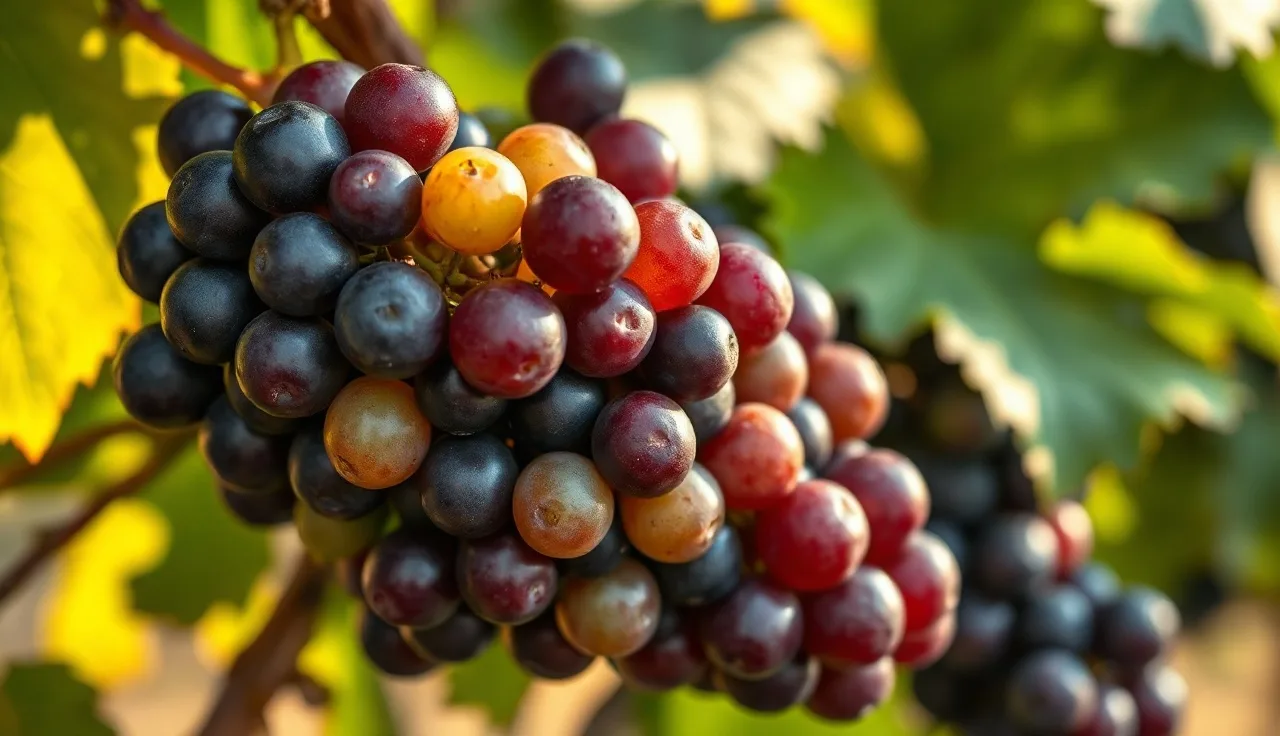
The berry stops adding fresh weight from cell division and starts swelling through cell enlargement. Chlorophyll breaks down. In red varieties, anthocyanin synthesis kicks in and berries shift from green to red, purple, or blue-black over about 10 to 14 days [1]. White varieties turn a translucent yellow-green instead, but the physiology underneath is identical. Sugar, mostly glucose and fructose, starts loading into the berry through the phloem. Titratable acidity falls as malic acid gets metabolized, and tartaric acid concentration drops through dilution as the berry swells.
The French word (véraison) just means "change of color." But color is one symptom of a much bigger reset. Berry texture softens. The seed coat hardens and turns brown. Aroma precursors begin building. This is the moment the vine commits its resources to seed maturation and, for the winemaker, to fruit quality.
Not every berry hits veraison at once. It moves from the tip of the cluster toward the peduncle (the stem attachment) and from the outside of the bunch inward. Full cluster veraison can take 10 days or more on a single vine.
When does veraison happen, and how do you predict it?
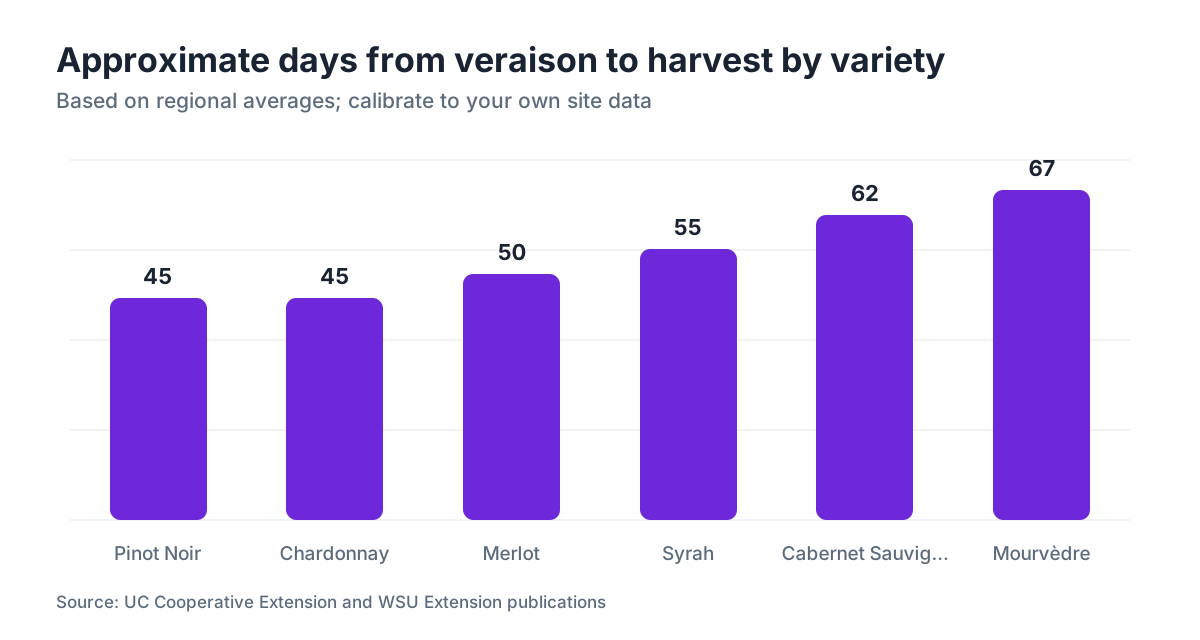
Veraison timing swings hard by variety, region, and vintage. In the Northern Hemisphere it generally falls between late June and mid-August. In the Southern Hemisphere, late December through February. Early varieties like Pinot Noir and Chardonnay reach veraison 2 to 3 weeks ahead of late ones like Cabernet Sauvignon, Mourvèdre, or Petit Verdot [2].
Growing degree days (GDD, base 50°F / 10°C) are the most common predictive tool. UC Davis research set up regional heat summation zones, and extension services in California, Washington, and Oregon publish accumulated GDD maps updated weekly through the growing season [3]. Pinot Noir in the Willamette Valley usually hits veraison around 1,400 to 1,600 GDD (base 50°F). Cabernet Sauvignon in Napa might not get there until 2,000 GDD or beyond. These are ballpark figures. Don't treat any single GDD threshold as gospel.
Here's a field method that works: count back from your expected harvest date. If you're targeting 23 to 24 Brix and you know your variety's historical harvest date, veraison usually lands 40 to 70 days before that date [4]. Write down last year's dates. Keep a block-by-block log. Three or four vintages of your own numbers beat any regional average.
Temperature is the dominant driver, but vine water status, crop load, and soil type all move the date. A heavily cropped block hits veraison later than a lightly cropped one. Vines under real water stress before veraison can speed up the transition, though it can wreck the evenness of your fruit.
| Variety | Relative veraison timing | Approx. days to harvest after veraison |
|---|---|---|
| Pinot Noir | Early | 40-50 |
| Chardonnay | Early | 40-50 |
| Merlot | Mid | 45-55 |
| Syrah | Mid-late | 50-60 |
| Cabernet Sauvignon | Late | 55-70 |
| Mourvèdre | Late | 60-75 |
Those ranges come from UC Cooperative Extension and WSU Extension publications. Calibrate them to your own site [3][5].
What physical and chemical changes happen in the berry at veraison?
The changes at veraison run deep, and understanding them tells you why the decisions you make right now carry so much weight.
Sugar accumulation is the change everyone watches. Brix (soluble solids) climbs from near-zero at pre-veraison to a harvest target of 22 to 26 Brix depending on style. That sugar comes from photosynthesis in the leaves, moved into the berry through the phloem. After veraison, accumulation runs roughly 0.3 to 0.5 Brix per day under normal conditions, though temperature, water status, and crop load all shift the rate [4].
Acid metabolism happens in parallel. The berry actively respires malic acid, and hot afternoons speed that breakdown. That's why grapes in very hot climates can shed acid fast after veraison. Tartaric acid concentration also falls, but mainly through dilution as the berry swells, not through metabolism. The malic-to-tartaric ratio at harvest matters for whether you'll want malolactic fermentation.
Anthocyanin biosynthesis in reds runs on light and temperature. Berry surface temperature, not ambient air, drives the enzymes. Above roughly 35°C / 95°F at the berry surface, anthocyanin synthesis gets suppressed, which is why the timing of a heat event relative to veraison matters so much [1]. UC Davis research found berry temperatures in dense, shaded canopies regularly top 40°C on hot days, knocking back color development.
Phenolic development also starts. Skin and seed tannins that built up earlier now begin to polymerize and soften. Methoxypyrazines, the compounds behind herbaceous notes in Cabernet Sauvignon and Sauvignon Blanc, start degrading after veraison, which is one argument against harvesting underripe [6].
Water movement inside the berry changes too. Before veraison, water comes in mostly through the xylem. At veraison, xylem flow essentially stops and the phloem takes over as the main pipe for both water and sugar [4]. That shift drives your irrigation strategy, covered below.
How do you identify veraison in the vineyard?
Spotting veraison sounds obvious. Getting the timing right for management decisions takes more precision than a casual walk-through.
In red varieties the cue is easy to see: berries turn from green to red, purple, or blue-black. Watch for the first colored berries on individual clusters. That moment, when maybe 1 to 5% of berries on a cluster show any color, is the true onset. Miss it by a week if you only walk your blocks twice a week.
White varieties are about texture more than color. Berries soften and lose the firm, waxy feel of the green stage. They turn translucent instead of opaque green. Squeeze one: a pre-veraison berry resists and springs back, a post-veraison berry gives.
A refractometer helps here. Green-stage berries read near zero Brix, sometimes nothing at all. Once berries pass roughly 5 to 6 Brix, veraison has started [4]. That's faster and more precise than eyeballing it, especially in whites or in bad light.
Some growers track "percent completion" by sampling 100 to 200 berries across a block and counting the fraction that has turned. 50% veraison is the usual reference point for timing management actions, because it roughly marks when most of the crop has begun the shift.
Healthy veraison looks like even color across clusters, no shriveling or shot berries, and a short gap between the first colored berries and full-block completion. Uneven veraison, with some clusters fully green while others are well-colored, usually points to uneven vigor, patchy water, or crop load that varies across the block.
What canopy management should you do at veraison?
Veraison is one of the last real windows for canopy work before harvest, and most of what you do now you can't take back.
Leaf removal around the fruit zone is the highest-leverage move for most growers. Exposing clusters to morning sun and airflow improves color in reds, cuts disease pressure (Botrytis especially), and evens out ripening. WSU Extension research found that east-side leaf removal in the Pacific Northwest consistently raised anthocyanin concentration and lowered cluster rot [5]. Timing matters. Leaf removal at or just after veraison onset works without much sunburn risk in most climates. Done much later, it can trigger berry shrivel or sunscald.
Shoot positioning and hedging should be basically done by veraison. Lateral shoot removal in the fruit zone, if you skipped it earlier, can still happen now. You want a canopy that doesn't shade the fruit zone but keeps enough leaf area to ripen the crop.
Crop thinning at veraison is the most argued-over intervention. Pulling clusters or parts of clusters now can concentrate sugar and flavor in the fruit that stays by cutting the demand on the vine. Cornell research found crop thinning at or just before veraison gave more consistent ripening than thinning at fruit set [6]. Here's the honest caveat: the payoff hinges on your baseline crop load. If you're already balanced (roughly 3 to 6 tons per acre for most quality programs), late thinning may not move the needle and it costs you real revenue. Carrying 8 or 10 tons? Thinning at veraison is worth it.
Most growers I've talked to thin earlier, then do a final walk-through at veraison to drop anything clearly behind or showing disease. That combination beats saving all the thinning for veraison.
How should you manage irrigation at and after veraison?
The xylem-to-phloem switch at veraison changes how the berry answers to vine water status, and that changes your irrigation plan.
Before veraison, moderate water stress (regulated deficit irrigation, or RDI) is a common way to slow shoot growth and concentrate flavor. After veraison, hard stress no longer controls vegetative growth well because shoot elongation has mostly stopped. Instead, post-veraison stress affects berry size, skin-to-pulp ratio, and acid retention [7].
A common target is a midday stem water potential of about -10 to -14 bar (mild to moderate stress) after veraison. You drop lower only on purpose, in high-end programs chasing small berries and concentrated flavor. UC extension guidance suggests post-veraison irrigation should avoid extreme stress (below -16 to -18 bar) in most commercial programs [7].
Here's the trap. Plenty of growers cut water too hard after veraison thinking they're building quality, and they end up with dehydrated berries, high pH from concentrated potassium, and skins that are thick and dry instead of supple. That isn't quality. It's just stress.
Rain at and after veraison means watching for berry splitting and Botrytis. Rapid rehydration of a stressed vine after a dry stretch can crack berries, and cracks open the door to bunch rot. If you've been running a heavy deficit and a real rain event (more than 0.5 to 1 inch) is in the forecast, a pre-rain irrigation can ease the osmotic gradient and cut the cracking risk.
What disease and pest pressures are highest at veraison?
Berry skin gets more permeable at veraison, and that alone makes this a high-disease window. Botrytis cinerea is the main worry for most wine grape growers worldwide. It uses the softening skin, plus any mechanical damage or insect feeding, to get established [8].
Your Botrytis risk at veraison rides on a few things: canopy density (dense canopies trap humidity), cluster architecture (tight varieties like Pinot Noir and Riesling are far more prone than loose ones like Grenache), and weather. If you're heading into veraison with a wet forecast, a protective fungicide targeting Botrytis is worth it on susceptible varieties. Materials with Botrytis activity at this timing include FRAC Group 17 (fenhexamid), Group 7 (boscalid), and Group 12 (fludioxonil), among others [8]. Rotate modes of action and check your spray records for what you've already burned this season, because Botrytis resistance is real and documented in many regions.
Powdery mildew (Erysiphe necator) risk doesn't vanish at veraison. Berries get somewhat less susceptible after full veraison, but clusters still finishing the transition remain at risk, and rachis infections can run late. Most extension programs recommend keeping a mildew program going through at least 3 to 4 weeks post-veraison in high-pressure sites [5].
Leafhoppers and thrips often peak in late summer, causing stippling and, in the case of western grape leafhopper, cutting into photosynthetic capacity right when you need it for post-veraison ripening. Spotted wing drosophila is a growing problem at veraison because damaged or cracked berries give it a spot to lay eggs.
Spray record-keeping here is non-negotiable. EPA's Worker Protection Standard requires re-entry intervals (REIs) to be posted and observed, and pre-harvest intervals (PHIs) for anything applied at veraison have to be tracked against your harvest date [9]. A spray today has to clear its PHI before your earliest possible pick. If you're logging applications in a tool like VitiScribe, the PHI countdown against your target harvest date shows in real time, so you skip the last-minute scramble through label stacks before you call in the crew.
What records should you keep starting at veraison?
From a compliance angle, veraison through harvest is the most paperwork-heavy stretch of the year. Here's what you actually need.
Pesticide application records are the base. California, Washington, Oregon, and most other wine grape states require every restricted-use pesticide (RUP) application to be recorded within 24 hours, with specific fields: applicator name, license number, product name, EPA registration number, site treated, acres treated, amount applied, date, and target pest [10]. General-use pesticides carry lighter state requirements but still fall under EPA WPS posting rules and any state-specific rules.
Field scouting records that document disease pressure, pest counts, and the reasoning behind a spray aren't required everywhere by law. But they're what you need to defend a spray call if a residue question or neighbor complaint lands. They're also the first thing a premium buyer's vineyard audit asks for.
Brix monitoring logs from veraison to harvest give you a ripening curve per block. Sample 100 or more berries per block on a system (10 berries from 10 vines spread across the block), and record date, Brix, pH, and TA. These logs document your harvest reasoning and back up block-level quality claims if you sell grapes.
Irrigation logs, crop thinning records, and any labor activity that triggers WPS training documentation should all get captured block by block. EPA WPS requires that handlers who mix, load, or apply pesticides get annual training, and that training records be kept for two years [9].
For operations selling to wineries, plenty of buyer contracts now want field records through a certified third-party program (Lodi Rules, LIVE, SIP, CCOF, and others). Each program has its own format, but they all want the same core data: what you did, where, when, and why.
How does veraison timing affect harvest date planning?
Veraison date is the single best harvest predictor you've got, and most seasoned growers anchor their fall calendar to it.
The historical average from veraison to harvest across varieties and regions is 40 to 70 days. The range inside a single block in a single vintage can still be wide. A veraison that shows up 10 days late in a cool vintage squeezes the ripening window if fall rain or frost is a concern. A very early veraison in a hot year can push you into an August harvest, which stacks up labor and logistics pressure.
Record the date when 50% of berries in each block have started color change, or when Brix passes 6 to 8. Then project forward with a variety-specific average and adjust for current GDD accumulation forecasts. The NOAA Climate Prediction Center publishes seasonal temperature outlooks that genuinely help with this planning [11].
Harvest logistics matter more than most growers admit. If veraison comes early and your winery contract sets a minimum Brix, your window may be tight. If you farm several varieties and blocks, the spread of veraison across your portfolio decides whether you can pick everything yourself or need to contract crews. Call your labor contractor and winery contact as soon as veraison timing gets clear. Don't wait until you're at 23 Brix to have that conversation.
For small wineries running estate fruit, the veraison-to-harvest window is when cellar prep starts: check fermentation gear, order dry goods, get refrigeration serviced. A lot of harvest problems trace back to calls made, or skipped, at veraison.
How does variety or site affect what veraison looks like?
Veraison doesn't look the same everywhere, and the differences matter in the field.
Tight-clustered varieties like Pinot Noir and Riesling often show uneven veraison inside clusters because the interior berries sit shaded, with a different microclimate than the outside. In very tight clusters, interior berries can lag a full week. That's one reason cluster and shoot thinning are so standard in Pinot Noir programs.
Loose, open-clustered varieties like Grenache or Viognier tend to color more evenly because light and air get in better. Their transition runs faster and more uniform.
Site factors count too. Blocks on heavier soils that hold more water enter veraison later and take longer than blocks on well-drained rocky ground. South-facing slopes in the Northern Hemisphere bank more heat and reach veraison earlier than north-facing slopes, sometimes by one to two weeks in the same variety. Elevation swings are big in mountain and hillside vineyards, where a 500-foot gain can delay veraison by 5 to 10 days versus valley floor blocks.
The vineyard characteristics you've tracked over the years (soil type, aspect, elevation, vine age, rootstock) are what let you build a reliable block-by-block veraison calendar. Young vineyards (under 5 years) tend to show more erratic veraison than mature vines with established roots.
Rootstock affects water and nutrient uptake, which in turn moves veraison timing and evenness. High-vigor rootstocks like 1103P or 140Ru can delay veraison compared to lower-vigor options on the same scion. Worth factoring in when you plan block sequencing for harvest.
What does uneven or poor veraison mean for fruit quality?
Millerandage and shot berries get confused with uneven veraison, but they're separate problems. Shot berries, the tiny seedless ones that never develop right, are set at fruit set and are already there before veraison. Millerandage (uneven berry sizing, with some berries staying small and green) can look worse under uneven veraison but starts earlier, from pollination and fertilization trouble.
Uneven veraison itself, where berries on one cluster sit at very different ripeness stages, creates real harvest headaches. Green berries bring high malic acid, high methoxypyrazines (vegetal character), and low sugar into the fermentation. Pick when the majority is ripe and the lagging green berries drag the average down. Wait for the green fraction to catch up and the early berries may go overripe.
Crop thinning at veraison specifically to pull green, lagging clusters is one answer. Some operations sort at the table to remove green berries after harvest. Neither is free: thinning costs yield, sorting costs time and labor.
The root causes of chronic uneven veraison are worth diagnosing instead of managing around year after year. Common ones: too much shoot or cluster density creating shade, patchy soil moisture or fertility, disease pressure (leafroll virus in particular, which badly delays veraison in infected vines [12]), and overcropping. Leafroll deserves a specific mention because infected vines can hit veraison 2 to 4 weeks late, crush the ripening window, and never fully ripen red varieties before fall temperatures drop. If you have blocks with chronic late, uneven veraison and you haven't tested for leafroll, test them.
For growers at operations like Paso Robles wineries or South Coast Winery in Southern California, where fall heat runs intense and erratic, uneven veraison is a real quality risk, because any late berries may never build color and flavor before harvest or fall rain arrives.
What should you stop doing after veraison?
Some practices make sense before veraison and turn counterproductive or outright harmful after it.
Stop applying nitrogen. Post-veraison nitrogen pushes vegetative growth at the cost of ripening and can raise Botrytis susceptibility by keeping shoot tips growing. If your petiole samples earlier in the season showed a nitrogen deficiency, the time to fix it was before veraison, not now.
Stop aggressive shoot tipping or hedging that strips significant leaf area. The leaves above the fruit zone are still making sugar for ripening. Pulling 20 to 30% of the canopy post-veraison to manage growth can meaningfully slow ripening in cool or marginal vintages.
Go easy with copper-based fungicides in the final weeks before harvest. Copper residue limits apply in some markets and certified programs, and late applications can leave detectable copper on skins that affects fermentation.
Many growers also stop cover crop mowing and cultivation by veraison, to avoid disturbing beneficial insects and to let the vineyard floor dry down, which cuts humidity and Botrytis pressure in the fruit zone. There's practical sense in that, though it depends heavily on your cover crop species and local conditions.
For record-keeping, if you track everything in a platform like VitiScribe, veraison is a natural checkpoint to audit your spray program: confirm PHIs are on track for your target harvest windows, verify every application is fully documented before harvest-period paperwork ramps up, and flag any compliance gaps now instead of at crush.
Frequently asked questions
How long does veraison take from start to finish?
In a single cluster, the first berries may color up 10 to 14 days before the last ones. Across a whole block, first visible color change to near-complete veraison typically takes 2 to 4 weeks, depending on crop load, canopy density, and weather. Tight-clustered varieties like Pinot Noir tend to have longer, less even transitions than open-clustered varieties like Grenache.
Can you tell the harvest date from veraison timing?
It's a useful estimate, not a guarantee. Add 40 to 70 days to your veraison date depending on variety, then adjust for GDD accumulation rates through the rest of the season. Most experienced growers use it as a planning anchor for crews and winery scheduling, then refine the actual date with weekly Brix, pH, and TA readings starting 3 to 4 weeks before the estimated window.
What causes uneven veraison across a block?
The most common causes are vine-to-vine variation in crop load, soil water availability, or canopy shading. Leafroll virus is an underappreciated cause of badly delayed, uneven veraison and is worth testing for if the problem persists. Overcropped vines consistently lag balanced vines. Soil variation across a block, such as heavy clay pockets next to well-drained ground, also shows up as veraison unevenness.
Should you thin clusters at veraison or earlier in the season?
Earlier thinning at fruit set or just after lets the vine redirect resources over a longer period and gives more even berry development. Veraison thinning works best as a corrective step: pulling clusters clearly behind in ripening, showing disease, or blocking the rest of the crop from uniform maturity. Cornell research found veraison thinning improved ripening consistency but had less impact on berry size than earlier thinning.
What pesticide pre-harvest intervals apply at veraison?
Every registered pesticide label carries a pre-harvest interval (PHI), the minimum days between application and harvest. At veraison, with harvest 40 to 70 days out, most products still sit inside their PHI window. But some materials, like certain systemic fungicides, have 14 to 21 day PHIs, so a late application 3 weeks before harvest needs a check. Always verify against the current label. EPA WPS also requires PHI and REI information to be posted at the field during and after application.
How does heat affect veraison and berry quality?
Heat speeds veraison onset through faster GDD accumulation, but extreme temperatures (above roughly 35°C berry surface) inhibit anthocyanin synthesis in red varieties, cutting color. High heat also speeds malic acid degradation, which can leave red wines flat and low-acid at harvest. Heat events during veraison are especially damaging because berries are most sensitive to temperature extremes during the transition.
What does veraison look like in white wine grapes?
White varieties make no anthocyanins, so there's no shift to red or purple. Berries turn from opaque green to translucent yellow-green and soften noticeably to the touch. Sugar climbs from near zero to several Brix in the first week after veraison. A refractometer is more reliable than the eye for confirming onset in whites, since the color change is subtle and easy to miss.
Is leaf removal at veraison good or bad?
Leaf removal in the fruit zone at or just after veraison onset is generally good: it improves light for color in reds, cuts humidity and Botrytis pressure, and evens ripening. The risk is sunscald if you're in a hot climate and pull too much, too fast, on the west or southwest side. East-side removal is lower risk in most regions. WSU Extension recommends fruit-zone leaf removal as a standard disease-management practice in the Pacific Northwest.
What is the relationship between veraison and wine style?
Harvest timing relative to veraison drives wine style more than almost any other field call. Picking closer to veraison (lower Brix, higher acid, more herbaceous character) gives leaner, higher-acid styles. Waiting longer allows more sugar, acid loss, and flavor development. The methoxypyrazines behind herbaceous character in Cabernet Sauvignon and Sauvignon Blanc degrade steadily after veraison, so early harvest keeps them and late harvest reduces them.
Does irrigation before veraison affect when veraison happens?
Yes. Water stress before veraison can speed the onset by signaling the vine to shift from vegetative to reproductive mode earlier than it otherwise would. Heavy irrigation that keeps vines well-watered before veraison tends to delay it. Most deficit programs in quality production apply moderate stress from fruit set through veraison to control shoot growth, which can pull the veraison date slightly earlier than fully irrigated vines.
How does leafroll virus affect veraison?
Grapevine leafroll-associated viruses (GLRaVs) rank among the most economically damaging vineyard diseases worldwide. Infected vines can show veraison delayed by 2 to 4 weeks versus healthy vines in the same block, badly squeezing the ripening window. Red varieties with leafroll often fail to fully develop color and sugar before fall. If you have blocks with chronic late, uneven veraison, leafroll testing (ELISA or PCR-based) is a worthwhile investment.
What records are legally required during veraison and through harvest?
Restricted-use pesticide application records must be filed within 24 hours in California and most western wine grape states. EPA Worker Protection Standard compliance requires keeping handler training records for two years and posting application information including REI at the field. Certified organic operations must keep all input records for 5 years under USDA NOP rules. State requirements vary, so check your state department of agriculture for formats and deadlines.
What Brix should grapes be at veraison?
At onset, Brix reads near zero in the first berries showing color, rising to 5 to 8 Brix within the first week as sugar loading picks up. By the time a block reaches 50% veraison, average Brix across all berries (including still-green ones) often reads 4 to 8. Once full veraison finishes, roughly 2 to 3 weeks after onset, Brix commonly runs 10 to 14, depending on variety and conditions.
How does elevation affect veraison timing?
Higher elevation means cooler temperatures and slower GDD accumulation, which delays veraison. A rough rule of thumb: each 500-foot gain in elevation delays veraison by about 5 to 10 days in most regions, though the real number depends on local topography, aspect, and air drainage. Mountain and hillside vineyard managers need to account for this in variety selection and harvest planning.
Sources
- UC Davis Viticulture and Enology, 'Anthocyanins and Color Development in Wine Grapes': Berry temperatures above approximately 35°C inhibit anthocyanin synthesis; anthocyanin biosynthesis is regulated by light and temperature at veraison.
- UC Cooperative Extension, 'Grape Varieties and Maturity Timing': Early-ripening varieties like Pinot Noir and Chardonnay reach veraison 2 to 3 weeks ahead of late-ripening varieties like Cabernet Sauvignon.
- UC Cooperative Extension, 'Growing Degree Days and Vineyard Heat Summation': Pinot Noir typically hits veraison around 1,400 to 1,600 GDD (base 50°F); Cabernet Sauvignon may not reach veraison until beyond 2,000 GDD.
- UC Davis Department of Viticulture and Enology, 'Berry Development and Ripening': Rate of Brix accumulation after veraison averages roughly 0.3 to 0.5 Brix per day; xylem flow essentially stops at veraison and phloem becomes the dominant water and sugar conduit.
- Washington State University Extension, 'Grapevine Canopy Management': East-side fruit-zone leaf removal in the Pacific Northwest consistently improved anthocyanin concentration and reduced cluster rot incidence; mildew programs recommended through 3 to 4 weeks post-veraison in high-pressure environments.
- Cornell University College of Agriculture and Life Sciences, 'Crop Load Management in Vineyards': Crop thinning at or just before veraison produced more consistent ripening than thinning done at fruit set; methoxypyrazines degrade progressively after veraison.
- UC Cooperative Extension, 'Regulated Deficit Irrigation in Vineyards': Post-veraison irrigation should be managed to avoid extreme stress below -16 to -18 bar in most commercial programs; target midday stem water potential of approximately -10 to -14 bar post-veraison.
- UC IPM Program, 'Botrytis Bunch Rot of Grape': Botrytis cinerea exploits softening berry skin at veraison; FRAC Group 17, Group 7, and Group 12 fungicides have activity against Botrytis at this timing.
- U.S. EPA, 'Agricultural Worker Protection Standard (WPS)': EPA WPS requires re-entry intervals to be posted and observed; handler training records must be maintained for two years.
- California Department of Pesticide Regulation, 'Pesticide Use Reporting': Restricted-use pesticide applications must be recorded within 24 hours of application with applicator name, license number, product name, EPA registration number, site, acres, amount, date, and target pest.
- NOAA Climate Prediction Center, 'Seasonal Outlooks': NOAA Climate Prediction Center publishes seasonal temperature outlooks useful for harvest date planning from veraison.
- UC Cooperative Extension, 'Grapevine Leafroll Disease': Leafroll virus can delay veraison by 2 to 4 weeks compared to healthy vines in the same block, dramatically compressing the ripening window.
Last updated 2026-07-09