Grape powdery mildew fungus: what every vineyard manager needs to know
TL;DR
- Grape powdery mildew is caused by the fungus Erysiphe necator (formerly Uncinula necator), the most economically damaging fungal disease in most wine grape regions worldwide.
- It overwinters as chasmothecia in bark or dormant mycelium inside buds, releases spores from budbreak onward, and can cut yields 30-40% in a bad year.
- Sulfur, DMI fungicides, and strict protectant timing carry any real program.
What fungus causes grape powdery mildew?
Grape powdery mildew is caused by Erysiphe necator, an obligate biotrophic ascomycete that lives only on living plant tissue. You'll still see the old name Uncinula necator in older textbooks and some spray guides, but E. necator is the accepted current taxonomy. Obligate biotroph means it cannot finish its lifecycle on dead organic matter. That single fact shapes everything about how the disease spreads and why it's so hard to knock out once it's established.
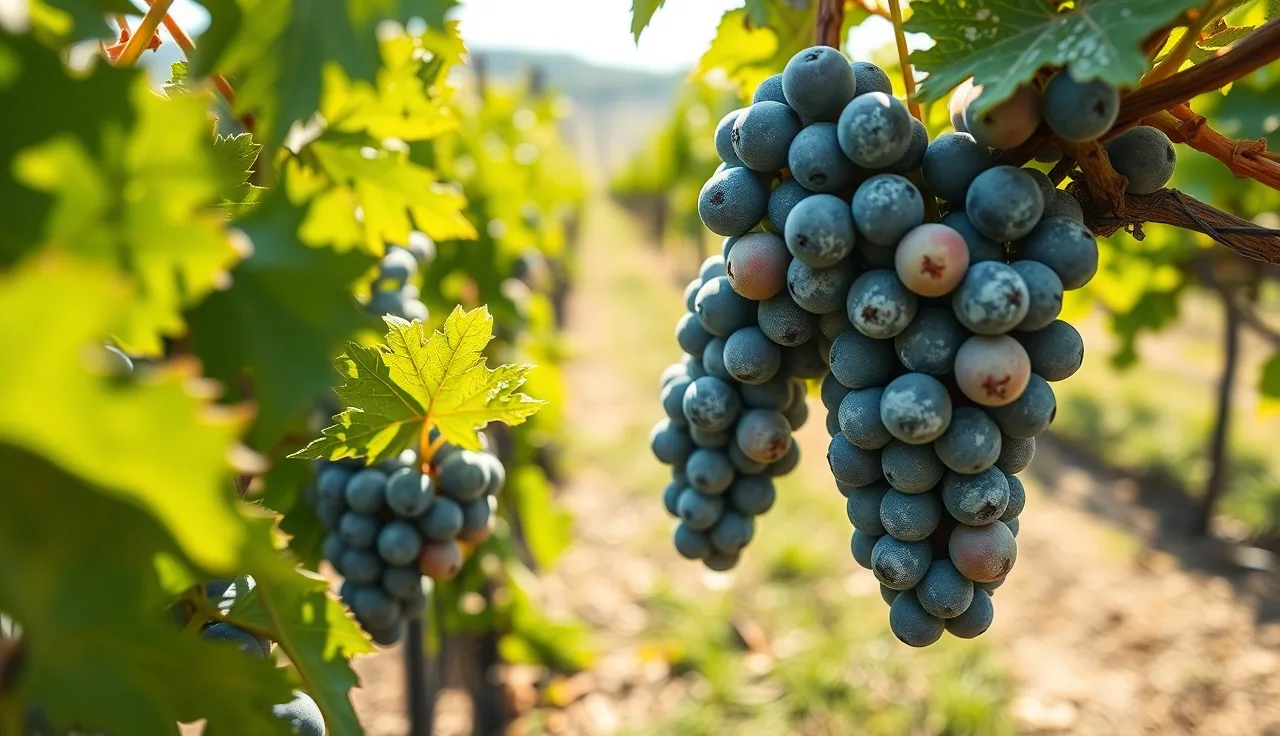
The fungus colonizes the outside surface of green tissue. It sends haustoria (feeding structures) into epidermal cells to pull nutrients without killing the cell right away. That's why infected tissue looks powdery white before it looks dead. The white coating is a mass of conidiophores and conidia sitting right on the leaf or berry surface [1].
Two genetic lineages of E. necator infect grapevines in North America. Researchers call them Group A and Group B. Group A overwinters mostly as dormant mycelium inside buds. Group B leans on chasmothecia (sexual fruiting bodies) in bark. Cornell plant pathologist Wayne Wilcox documented this split, and it matters in the field: Group A infections can show up very early, sometimes before ascospore release from chasmothecia is even a concern [2].
The grape powdery mildew genome was sequenced and published in Nature Communications in 2019. It gave researchers a clearer look at the effector proteins the fungus uses to suppress plant immunity. That data now drives resistance-gene screening at breeding institutions, though commercial cultivars with durable resistance are still years from wide planting [3].
How does grape powdery mildew spread and overwinter?
The two overwintering strategies are the single most useful thing a manager can understand, because they tell you when the first inoculum actually arrives.
Group B and many isolates in humid regions make chasmothecia, dark round bodies about 150-200 micrometers across that show up to the naked eye as tiny black dots in bark. They release ascospores in spring when temperatures warm and rain or dew adds moisture. UC Davis plant pathology research puts primary ascospore release starting at roughly 0.5 inch of shoot growth and running through bloom [4]. One wet event can release thousands of spores from a single bark patch.
Group A skips that step. The mycelium sits dormant inside bud tissue, and when the bud breaks the fungus is already riding the emerging shoot. These infections appear at 2-3 inch shoot growth with no rain trigger. That's why your first spray gets timed to budbreak, not to weather.
After establishment, the asexual cycle is ferociously fast. Conidia can germinate in as little as 4-6 hours in the right conditions. The latent period from infection to new spore production runs roughly 5-7 days at 68-77°F (20-25°C) [1]. One unsprayed week during a warm dry stretch can set off an exponential jump in inoculum.
Conidia move by wind, not water. Rain washes conidia off leaves and reduces spread for a bit, which is why powdery mildew hits harder in low-rainfall regions like California's Central Valley or Paso Robles than in the wet Northeast, where downy mildew usually grabs more attention. Relative humidity between 40 and 100% supports germination. Temperatures between 68 and 86°F are optimal, though the fungus can infect from about 50°F to 90°F [4].
Heat above 95°F actually suppresses and kills surface mycelium. Some Central Valley growers count on summer heat to knock back late-season pressure. In most regions that's not a plan you can bank on.
What does powdery mildew look like on grapes and leaves?
Early leaf infections show a faint white to gray powdery coating, usually on the upper surface first. The patches start circular, then run together. Heavily infected leaves may yellow and drop early.
On shoots, look for a white feltlike coating that turns grayish-brown as the tissue matures. Infected shoots can come out stunted or distorted.
Berry infection is the economic kill shot. When it hits early (at or before berry set through about 3-4 weeks post-bloom), the fungus colonizes the berry surface and the cuticle essentially stops expanding while the flesh keeps growing. The skin cracks and splits, and secondary Botrytis or sour rot walks right in through those cracks. A 2016 UC Cooperative Extension survey in Napa and Sonoma counties found berry infection at the 2-5mm stage produced the most severe yield losses [5].
Harvest-time berry symptoms include dull gray or brownish russeting, sometimes a subtle powdery coating if the infection is still active, and the musty or fishy odor winemakers hate. Even low fruit infection can push off-aromas into finished wine, so winery intake specs often set tolerance as low as 1-3% of clusters showing symptoms.
Chasmothecia appear as small black dots in the white mycelium late in the season, mostly on leaf undersides and bark. If you're seeing those, write down where the hot spots are. That bark is inoculum source number one next spring.
When is the grapevine most vulnerable to powdery mildew infection?
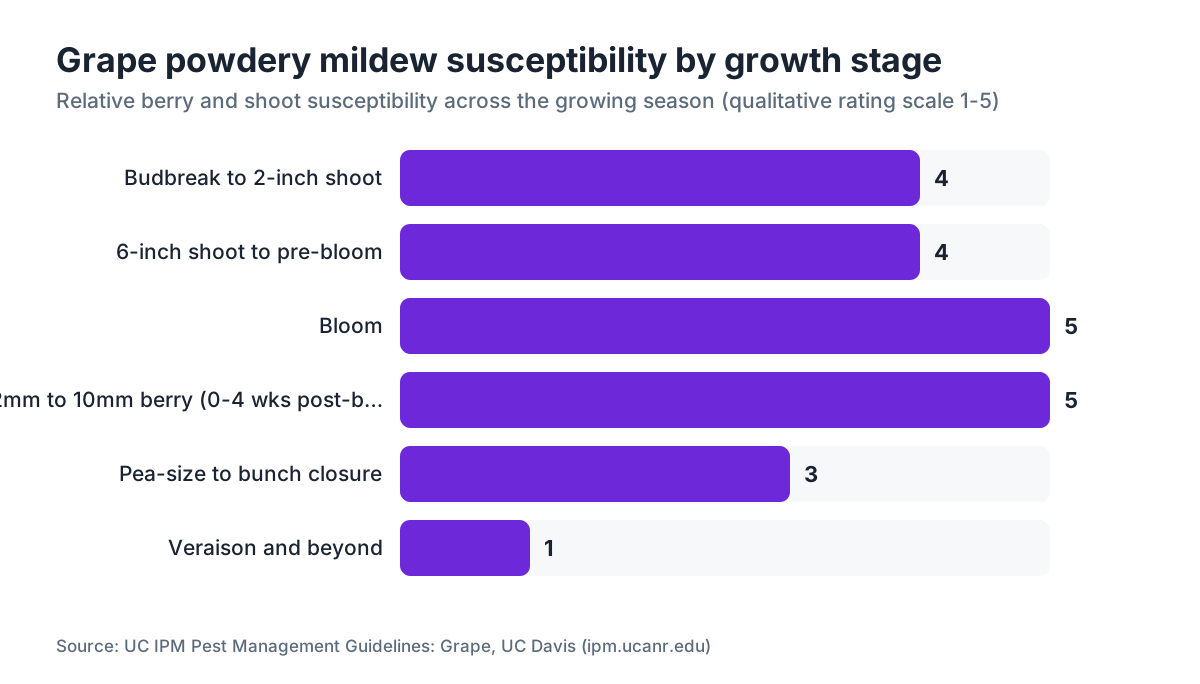
There's a clear high-susceptibility window every spray program should be built around: budbreak through about 4-6 weeks post-bloom, roughly the pea-size to bunch-closure berry stage [1][4].
Before bloom, you're protecting leaves and young shoot tissue, which matters for vine health and canopy integrity. The berry is most susceptible from right after fruit set until it reaches about 10mm diameter and starts hardening its cuticle. Washington State University extension puts the critical berry protection window at 0 to 4 weeks post-bloom [6].
The table below shows susceptibility by growth stage.
| Growth Stage (E-L Scale) | Approximate Timing | Susceptibility Level |
|---|---|---|
| Budbreak to 2-inch shoot (E-L 4-7) | Early spring | High (Group A mycelium) |
| 6-inch shoot to pre-bloom (E-L 12-17) | Late spring | High |
| Bloom (E-L 19-23) | Bloom week | Very high |
| 2mm to 10mm berry (E-L 27-29) | 0-4 weeks post-bloom | Critical |
| Pea-size to bunch closure (E-L 31-32) | 4-8 weeks post-bloom | Moderate |
| Veraison and beyond (E-L 35+) | Late summer | Low to negligible |
After bunch closure, the canopy microclimate gets more humid and spray penetration gets worse, but the berry itself resists better as the cuticle matures. Programs that pour resources into the pre-bloom through 4-weeks-post-bloom window are making the right call.
What are the most effective fungicides for grape powdery mildew?
Sulfur is still the workhorse. It's cheap (roughly $2-5 per acre per application for wettable formulations), has a long track record, and resistance is essentially a non-issue. Minimum effective temperature is around 65°F; below that, efficacy drops off fast. The phytotoxicity threshold sits around 90-95°F, so hot climates give you a narrow window, and applications within 2 weeks of an oil spray can also cause burn. On a tight budget, a well-timed sulfur program carries you through most seasons in moderate-pressure regions [4].
Demethylation inhibitor (DMI) fungicides, the triazoles like myclobutanil (Rally), tebuconazole, and tetraconazole, are the most widely used systemic materials. They have kickback (post-infection) activity up to about 72-96 hours after infection. The downside is resistance. Reduced sensitivity in E. necator to DMIs is documented in California, New York, and Washington [2]. UC Davis recommends rotating DMIs with other chemistry classes to slow resistance.
Quinone outside inhibitor (QoI, or strobilurin) fungicides like azoxystrobin and trifloxystrobin work well but carry a hard rule: never more than two consecutive applications, and always alternate with a different mode of action. Single-gene resistance to QoIs is well-documented in E. necator populations across major wine regions [2].
Succinate dehydrogenase inhibitors (SDHI) like fluxapyroxad and penthiopyrad are newer chemistry with good efficacy. Resistance monitoring is still catching up, so treat them as high-value materials to rotate in, not a program backbone.
Potassium bicarbonate (Kaligreen, MilStop) is an OMRI-listed option with decent contact activity and zero resistance risk. It works best as a preventive or at very early infection. Good for organic programs or as a rotational partner.
Biological options like Bacillus subtilis (Serenade) and Reynoutria sachalinensis products (Regalia) show moderate suppression in trials but rarely hold up alone under high pressure. They fit a reduced-risk program during low-pressure periods or late season.
The EPA requires applicators to follow label directions as a matter of federal law under FIFRA Section 12. The label is the law, not a suggestion. Confirm registration in your state before you buy anything [7].
How do you build a powdery mildew spray program that actually works?
The core idea is protectant timing. You're keeping the fungal germ tube from punching through the cuticle, not trying to kill colonies after they've settled in. Once the white powder is visible, you've already lost 5-7 days of infection history.
Start at budbreak. That first application at 0.5-1 inch shoot growth targets the Group A overwintering mycelium before it throws a generation of conidia. Sulfur or a low-rate DMI both work here.
Hold a 7-14 day spray interval through the critical window (budbreak through 4 weeks post-bloom). Tighten to 7-10 days during warm dry weather in the 68-86°F range. A rain event that wets the canopy doesn't stretch your window the way it would with downy mildew. It just suppresses dispersal for a moment, then the clock resets the minute things dry out.
Rotate modes of action. A practical rotation might run sulfur (early), DMI (pre-bloom), QoI (bloom), SDHI (post-bloom), DMI (3 weeks post-bloom), sulfur (close out the window). Build your own rotation around which modes of action you've leaned on hard in that block and what your local extension office knows about resistance nearby.
Disease models help. The UC Davis powdery mildew model, available through UC IPM, uses degree days base 50°F to predict when 10% of chasmothecia have released ascospores and when the epidemic threshold is coming [4]. WSU provides similar modeling for Pacific Northwest growers [6]. These models don't replace scouting. They help you decide whether to hold at 14 days or tighten to 7.
Canopy management matters as much as the spray program. Dense shaded canopies favor the fungus with moderate temperatures, low UV, and poor spray penetration. Leaf pulling in the fruit zone (done carefully to avoid sunburn in hot climates) opens up the cluster environment and improves coverage. It's one of the cheapest disease tools you have. Cornell extension documents 30-50% reductions in cluster disease incidence from fruit-zone leaf pulling in New York trials [2].
For records, each application needs the product name, EPA registration number, rate, timing (growth stage and date), and operator. This isn't optional. It's required under EPA Worker Protection Standard regulations (40 CFR Part 170) [8]. If you're running multiple blocks with different programs, keeping those records clean is genuinely hard on paper. A platform like VitiScribe pulls those records into printable spray logs automatically, which matters when a CDFA or state ag inspector shows up.
Post-harvest applications are worth a look if you had high pressure. A late sulfur or DMI spray after harvest but before leaf drop cuts the chasmothecia load going into the bark and sets you up better next spring. Not everyone does it. In high-pressure blocks the cost-to-benefit math is solid.
How does resistance to fungicides develop in E. necator and what can you do?
Fungicide resistance in powdery mildew is a real operational problem, not a theory. UC Davis documented DMI resistance in California vineyard populations as early as the late 1990s, and strobilurin (QoI) resistance followed about a decade later [2]. Resistance builds because every application selects for individuals carrying target-site mutations, and powdery mildew throws a huge number of conidia per cycle, giving selection a big population to work with.
The main mechanisms are well-characterized in the genome. CYP51 gene mutations reduce DMI binding. The G143A mutation in the cytochrome b gene confers high-level QoI resistance. These mutations turn up in California, New York, Washington, and most major European wine regions [3].
The practical answer is rotation and mixture. FRAC (Fungicide Resistance Action Committee) groups the modes of action and publishes recommendations annually. DMIs are FRAC Group 3, QoIs are Group 11, SDHIs are Group 7, and sulfur is Group M2, a multi-site material with no documented resistance in powdery mildew. Never apply more than two consecutive applications of any Group 11 fungicide. For Group 3 DMIs, rotate to a different FRAC group every 2-3 applications [9].
Suspect resistance when you see breakthrough despite well-timed applications at label rates. Contact your local extension office. Some labs offer sensitivity testing on collected spore samples, though it isn't widely available commercially. The honest answer: most growers manage suspected resistance by empirically rotating out the suspect chemistry and documenting whether control improves.
What do organic growers use for powdery mildew on grapes?
Organic programs work, but they need tighter intervals and more spray events, which adds labor cost. The approved materials with the best track record start with sulfur.
Wettable sulfur and sulfur dusts are the backbone of organic programs. OMRI-listed formulations are widely available. Same temperature constraints apply as in conventional programs.
Potassium bicarbonate raises the pH on the leaf surface and disrupts fungal cell membranes. The efficacy is real but modest under high pressure. Use it in combination or during low-pressure stretches.
Copper gets used in organic viticulture, but it has no efficacy against powdery mildew. Copper is for downy mildew and bacterial diseases. Don't confuse the two.
Biological materials like Bacillus subtilis (Serenade) and products containing Reynoutria sachalinensis (Regalia) carry OMRI listing and show consistent suppression in university trials, though rarely equal to synthetic programs under high inoculum pressure [4].
Mineral oil at 1-2% concentration has shown activity against powdery mildew in trials, with low resistance risk. Phytotoxicity is the catch. Don't apply within 2 weeks of sulfur, and test rates on a small area of your specific cultivar first.
For certified organic growers, National Organic Program (NOP) compliance means any input has to be on the National List of Allowed and Prohibited Substances (7 CFR Part 205, Subpart G) or specifically approved by your certifier [10]. Confirm before buying any new material.
Which grape varieties are most susceptible to powdery mildew?
All Vitis vinifera cultivars are highly susceptible. The genus Vitis co-evolved in North America alongside E. necator, but V. vinifera came from Eurasia with zero natural resistance when the fungus reached Europe in the 1840s (almost certainly on plant material from North America). The 1850s powdery mildew epidemic in France gutted vineyards before sulfur dust was identified as the remedy.
Among vinifera, there's meaningful variation. Chardonnay, Cabernet Sauvignon, and Merlot rate moderately susceptible. Muscat varieties and Cabernet Franc get cited as more susceptible. Carmenere and Syrah run somewhat less susceptible in comparative trials, though the data shifts by region.
Native American species (V. labrusca, V. riparia, V. rupestris) carry partial resistance. Hybrids bred from crosses with these species, like Vignoles, Marquette, or Frontenac, show variable but often meaningfully better resistance than vinifera. Cornell's grape breeding program has been developing vinifera-like hybrids with powdery mildew resistance for decades, and some USDA ARS accessions carry Ren-gene resistance loci [2].
True powdery mildew resistance in a wine-quality vinifera-like variety is still more a breeding target than a commercial reality for most growers. The 2019 genome data sped up identification of effector genes that suppress host resistance, which should speed up marker-assisted selection in breeding programs going forward [3].
What are the EPA Worker Protection Standard requirements for powdery mildew sprays in vineyards?
The EPA's Worker Protection Standard (40 CFR Part 170) applies to any agricultural employer or handler who uses pesticides, and it covers most fungicide applications in commercial vineyards. The 2015 revised WPS took effect in January 2017 for most provisions [8].
Restricted entry intervals (REI): Every label lists an REI, the time workers must stay out of a treated area after application. For common powdery mildew materials, REIs run from 4 hours (many sulfur formulations) to 12 hours (most DMIs) to 48 hours for some materials. The label REI is the legal minimum. Your state may require longer for certain materials.
Personal protective equipment (PPE): Handlers must wear the PPE listed on the label during mixing, loading, and application. For DMI and QoI applications this usually means a long-sleeved shirt, long pants, chemical-resistant gloves, and eye protection.
Application-specific information must be posted in a central location within 24 hours of application, including the product name, EPA registration number, location treated, date and time, and the REI. That record stays posted until the REI expires.
Annual pesticide safety training is required for all workers and handlers. Training records must be kept for 2 years.
The records you keep for compliance are nearly identical to what a good IPM program needs anyway: date, product, rate, block, applicator, and REI. The honest operational problem is keeping those records consistent across a full season with multiple applicators and a lot of spray events. A vineyard operations log, on paper or in software, is the only way to stay clean at inspection time.
For Oregon, California, and Washington growers: your state ag department stacks layers on top of federal WPS for certain restricted-use pesticides, and some counties add notification rules for spray near schools or homes. Check your state ag department for current requirements. California's DPR, for one, requires monthly pesticide use reporting.
How do you scout for powdery mildew and know when to spray?
Scouting isn't glamorous, but it's where money gets saved or lost. For a 20-acre block, walk at least 20-30 representative vines every 7-10 days from budbreak through bunch closure, sampling leaves from multiple canopy positions and checking both surfaces.
Record what you see: percentage of shoots showing any symptom, percentage of clusters with any infection. UC IPM recommends an action threshold of 1% or more of shoot tips showing symptoms before bloom, because once you cross that without active protection, you're already behind [4]. Post-bloom, even 1% cluster infection is a real yield and quality risk given how fast the disease moves at that stage.
Degree-day models add predictive power to your scouting calendar. The UC Davis model predicts ascospore release and epidemic risk using cumulative degree days base 50°F from January 1. When the model flags high risk, shorten your spray interval whether or not you're seeing symptoms yet. This is preventive management, the only mode that works against an obligate biotroph that's inside the tissue before you can see it.
Keep scouting records with your spray records. If you ever have to defend a spray decision to a certifier, a buyer, or a state auditor, the scouting data that triggered each application is the difference between a clean record and a messy conversation.
VitiScribe and similar platforms let you log scouting observations tied to GPS block locations, then pull spray decisions and records from the same interface, which closes the gap between field observation and paperwork.
How much does grape powdery mildew cost and what yield losses can it cause?
The economic damage falls into three buckets: direct yield loss, quality reduction (and the price penalty that follows), and the cost of the spray program itself.
Yield loss estimates in the literature run from negligible in low-pressure years with good programs to 30-40% in high-pressure unmanaged or poorly managed seasons [1][5]. Early berry infection causing skin cracking and secondary rots is the most dramatic mechanism. Research published in the American Journal of Enology and Viticulture found that even 3% cluster infection at harvest was detectable in sensory evaluation of finished wine [11].
Wine quality penalties are real and measurable. Off-aromas from mildewed fruit include ethyl acetate, acetic acid, and musty volatile compounds. Some wineries discount grapes with visible mildew by $100-300 per ton, or reject them outright, depending on contract language. In premium appellations where grapes trade at $2,000 to $5,000+ per ton, a 5% quality penalty on 10 tons is a $10,000-25,000 hit.
The spray program costs money too. A conventional full-season program in a moderate-pressure region runs roughly $100-250 per acre in materials alone, across 6-12 spray events. Labor and equipment push that higher. An organic program with tighter intervals can cost more in labor even when materials are cheaper.
Worldwide, powdery mildew is estimated to be the most economically significant fungal disease of grapevines. The exact global figure is hard to pin down. Industry estimates often cite losses in the hundreds of millions of dollars annually, but the methodology behind those numbers varies, so treat them as order-of-magnitude, not precise. The farm-level math is clearer: in most regions, a well-run spray program costs far less than the yield and quality losses from letting the disease run.
Frequently asked questions
What is the scientific name of the fungus that causes grape powdery mildew?
The fungus is Erysiphe necator, formerly classified as Uncinula necator. It's an obligate biotrophic ascomycete, meaning it survives and reproduces only on living plant tissue. Both names still show up in spray guides and research, so knowing both saves confusion when you're reading older extension publications.
Can grape powdery mildew spread in rainy weather?
No, rain suppresses spread. Powdery mildew conidia disperse by wind, not water, and rainfall physically washes spores off surfaces and briefly interrupts dispersal. High humidity supports germination, but free moisture on leaves isn't required. That's what separates powdery mildew from downy mildew, which absolutely needs liquid water to sporulate and spread.
How do you tell powdery mildew apart from downy mildew on grapes?
Powdery mildew shows white powdery growth on the upper leaf surface and berry skin, caused by E. necator. Downy mildew (Plasmopara viticola) produces white cottony sporulation on the lower leaf surface and needs wet weather to develop. Berries hit by downy mildew shrivel and turn brown rather than crack. The two often require different fungicides, so correct ID matters.
At what temperature does powdery mildew infect grapevines?
Infection happens across a wide range, roughly 50°F to 90°F, but the optimal range for conidia germination and infection is 68-86°F. Temperatures above 95°F kill surface mycelium. Below 50°F, germination is very slow. That's why warm dry late spring and early summer weather drives the worst epidemics in most California and Pacific Northwest regions.
How many days after infection does powdery mildew become visible?
The latent period from infection to visible symptoms and new spore production runs roughly 5-7 days at optimal temperatures of 68-77°F. Cooler weather stretches that out. Because the disease is already established and sporulating before you see it, waiting for visible symptoms to trigger your first spray is the most common management mistake growers make.
Is sulfur spray effective against grape powdery mildew?
Yes, sulfur is one of the most effective and cost-effective materials available. Wettable sulfur and sulfur dust have no documented resistance issues in powdery mildew and cost roughly $2-5 per acre per application in materials. Limits include reduced efficacy below 65°F and phytotoxicity risk above 90-95°F or within 2 weeks of an oil application. It's the backbone of both conventional and organic programs.
What is the critical spray timing for preventing berry infection by powdery mildew?
The critical window is from fruit set through about 4 weeks post-bloom, when the berry sits at the 2mm to 10mm stage. Washington State University extension identifies this as the period of maximum berry susceptibility. Missing coverage during this window is the most common reason growers end up with cracked, mildewed clusters at harvest regardless of how well they protected the canopy.
Can powdery mildew damage reduce wine quality even at low infection levels?
Yes. Research published in the American Journal of Enology and Viticulture found cluster infection rates as low as 3% at harvest produced sensory-detectable off-aromas in finished wine. Many premium wineries set intake rejection thresholds at 1-3% cluster incidence. The off-aromas include musty and acetic notes from fungal metabolites and secondary microbial activity in cracked berries.
What is the difference between FRAC Group 3 and Group 11 fungicides for powdery mildew?
Group 3 (DMIs, including triazoles like myclobutanil and tebuconazole) inhibit ergosterol biosynthesis and have moderate systemic activity with kickback up to 72-96 hours. Group 11 (QoIs/strobilurins like azoxystrobin) inhibit mitochondrial respiration and work very well but carry higher resistance risk. Both groups have documented resistance in E. necator. FRAC recommends no more than two consecutive Group 11 applications per season.
How do organic grape growers manage powdery mildew without synthetic fungicides?
The primary tools are sulfur (wettable or dust), potassium bicarbonate, and biological products like Bacillus subtilis. Spray intervals usually tighten to 7-10 days versus 10-14 in conventional programs. Fruit-zone leaf pulling is especially important in organic systems to improve coverage and reduce disease-favorable microclimates. Certified materials must be on the NOP National List per 7 CFR Part 205.
What spray records are legally required for powdery mildew applications in vineyards?
EPA's Worker Protection Standard (40 CFR Part 170) requires application-specific information (product name, EPA registration number, treated location, date and time, and restricted entry interval) posted centrally within 24 hours of application. State ag departments may require additional pesticide use reports; California's DPR requires monthly reporting of all pesticide applications. Records must typically be kept for 2 years.
Has the grape powdery mildew fungus genome been sequenced?
Yes. The E. necator genome was sequenced and published in Nature Communications in 2019. It revealed the effector proteins the fungus uses to suppress host plant immunity. That data now speeds resistance-gene screening in breeding programs. It also confirmed the genetic basis for fungicide resistance mutations, including CYP51 changes linked to DMI resistance and the G143A cytochrome b mutation conferring QoI resistance.
Do degree-day models help predict grape powdery mildew risk?
Yes, and they're worth using. UC Davis's powdery mildew model uses cumulative degree days (base 50°F from January 1) to predict ascospore release timing and epidemic risk. WSU provides similar tools for Pacific Northwest growers. These models help you decide whether to stay at a 14-day spray interval or tighten to 7 days, and they help justify spray decisions in your records.
Which grape varieties are most resistant to powdery mildew?
All Vitis vinifera varieties are highly susceptible. Some, like Muscat and Cabernet Franc, get cited as more susceptible than Chardonnay or Cabernet Sauvignon, but all require active management. Hybrids with North American Vitis species in their background, including Cornell-developed varieties like Marquette and Frontenac, show meaningfully better resistance, though not immunity. True durable resistance in wine-quality vinifera-like varieties remains a breeding goal.
Sources
- UC Cooperative Extension, UC IPM Pest Management Guidelines: Grape, Powdery Mildew: E. necator obligate biotrophy, 5-7 day latent period at optimal temperature, conidial germination timeline, and berry susceptibility window
- Cornell University, New York State IPM Program, Grape Powdery Mildew, Wayne Wilcox: Group A and Group B genetic lineages of E. necator, DMI and QoI resistance documentation, leaf pulling trial results
- Nature Communications, Erysiphe necator genome sequence (2019): Grape powdery mildew genome sequenced in 2019 revealing effector proteins and confirming CYP51 and G143A resistance mutations
- University of California Division of Agriculture and Natural Resources, UC IPM Grape Powdery Mildew: Primary ascospore release timing at 0.5 inch shoot growth, degree-day model base 50°F, sulfur temperature requirements and constraints, action threshold of 1% shoot tips before bloom
- UC Cooperative Extension, Napa and Sonoma counties, Berry infection at 2-5mm stage yield loss survey (2016): Berry infection at 2-5mm stage produces most severe yield losses; 30-40% yield loss range under high pressure
- Washington State University Extension, Grape Powdery Mildew Management: Critical berry protection window is 0-4 weeks post-bloom; degree-day modeling tools for Pacific Northwest growers
- U.S. Environmental Protection Agency, Federal Insecticide Fungicide and Rodenticide Act (FIFRA): Under FIFRA Section 12, the pesticide label is a legally binding document and applicators must follow label directions
- U.S. Environmental Protection Agency, Worker Protection Standard 40 CFR Part 170: WPS requirements for REI posting, PPE, training records, and application-specific information; revised 2015 rule effective January 2017
- Fungicide Resistance Action Committee (FRAC), FRAC Code List: FRAC group classifications: DMIs are Group 3, QoIs are Group 11, SDHIs are Group 7, sulfur is Group M2; recommendation against more than two consecutive Group 11 applications
- USDA Agricultural Marketing Service, National Organic Program, 7 CFR Part 205: Certified organic inputs must be on the National List of Allowed and Prohibited Substances under NOP regulations
- American Journal of Enology and Viticulture, Powdery mildew effects on wine sensory quality: Cluster infection rates as low as 3% at harvest produce detectable off-aromas in finished wine sensory evaluation
Last updated 2026-07-10