Grape growing stages: a complete guide for vineyard managers
TL;DR
- Grapevines move through nine phenological stages each year: dormancy, bud swell, bud break, shoot growth, flowering, fruit set, veraison, harvest, and post-harvest senescence.
- Each stage has its own temperature thresholds, spray windows, and scouting priorities.
- Knowing exactly where your vines are right now, not what month it is, drives almost every field decision you make.
Why do the grape growing stages matter so much for day-to-day operations?
Every field decision, from when to spray sulfur to when to start deficit irrigation, keys to a phenological stage, not a calendar date. The vine doesn't care what month it is. It responds to accumulated heat units, soil temperature, and daylength. A cold spring in Washington's Yakima Valley pushes bud break two weeks later than the same variety in California's San Joaquin Valley. Run your spray program on calendar dates and you'll either miss the window or waste product.
Researchers at UC Davis and Washington State University have spent decades documenting these stages with a standardized scale called the modified E-L (Eichhorn-Lorenz) system, which numbers vine development from stage 1 (dormant) through stage 47 (full dormancy after leaf fall) [1]. Most growers track a simplified version with nine practical stages. That's what this guide covers.
The other reason stages matter is regulatory. The EPA Worker Protection Standard (WPS) ties certain restricted-entry intervals (REIs) and personal protective equipment (PPE) requirements to crop growth stages, and California's Department of Pesticide Regulation requires your pesticide application records to include the crop growth stage at time of application [2]. If your record just says "April 12" with no growth stage, you're out of compliance in a lot of jurisdictions.
The stages aren't academic. They're the operational backbone of the whole year.
What are the nine main grape growing stages in order?
Here's the list. Timing is approximate for a mid-latitude wine grape region (say 35 to 47 degrees north) and your local growing degree day accumulation will shift these windows.
- Dormancy (roughly December through February)
- Bud swell (late February to early March)
- Bud break, also called "woolly bud" (March to early April)
- Shoot growth and leaf development (April through May)
- Flowering and bloom (late May to early June)
- Fruit set (June)
- Berry development and veraison (July through August)
- Harvest ripening (August through October, depending on variety)
- Post-harvest senescence and leaf fall (October through November)
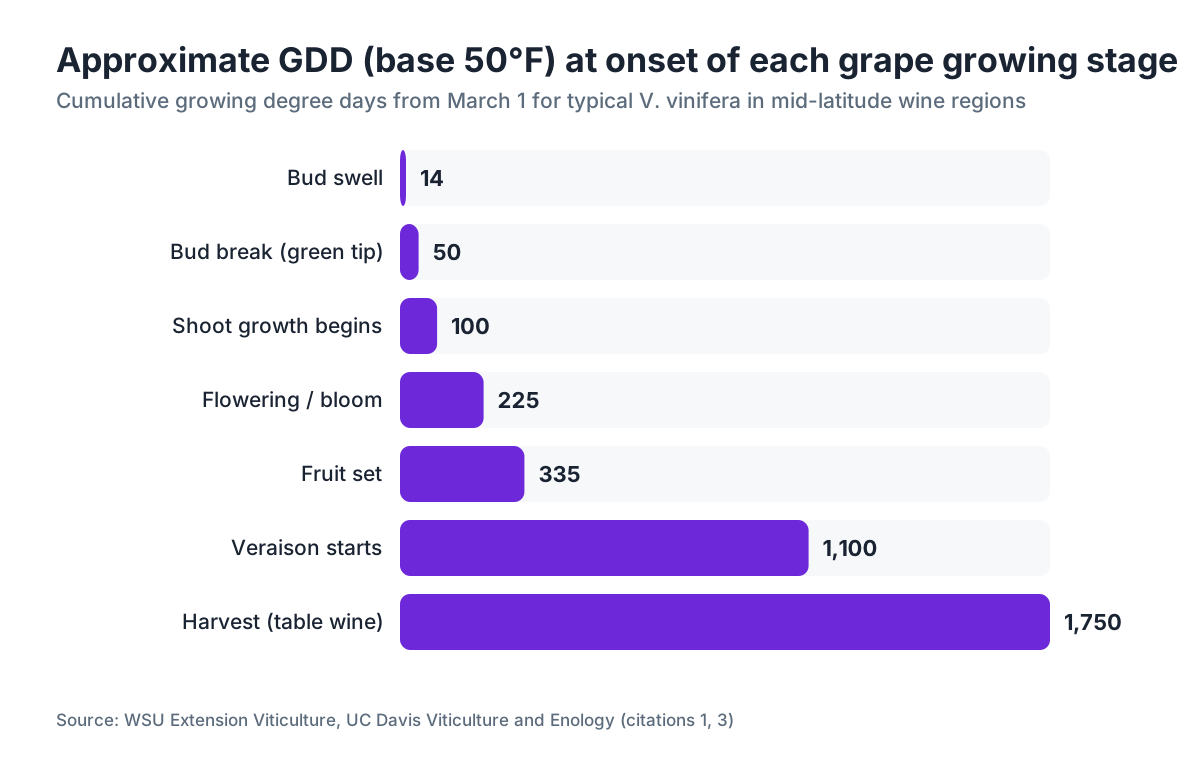
The table below maps these stages to their approximate E-L numbers, cumulative growing degree days (base 50°F) at onset, and the main management focus for each.
| Stage | E-L # range | Approx. GDD (base 50°F) | Primary focus |
|---|---|---|---|
| Dormancy | 1-4 | 0 | Pruning, infrastructure, soil work |
| Bud swell | 4-5 | 0-28 | Final pruning, spray prep |
| Bud break | 5-7 | 28-50 | Frost protection, first fungicide |
| Shoot growth | 7-12 | 50-150 | Shoot thinning, training, mildew pressure starts |
| Flowering | 12-23 | 150-300 | Botrytis and powdery mildew sprays, minimal disturbance |
| Fruit set | 23-27 | 300-370 | Canopy management, cluster thinning assessment |
| Veraison | 32-35 | 900-1300 | Final cluster thinning, bird netting, irrigation decisions |
| Harvest | 38-47 | 1300-2200+ | Sampling, timing logistics |
| Post-harvest | 47+ | N/A | Compost, cover crop, last nutrient applications |
GDD thresholds in this table draw from WSU Extension's viticulture publications and are approximate for Vitis vinifera [3]. They vary by variety, rootstock, and clone. Chardonnay breaks bud at lower GDD accumulations than Cabernet Sauvignon. Track your own block history for the most reliable local baseline.
For a closer look at how these stages play out across specific growing regions, the vineyard overview covers regional variation in depth.
What actually happens during dormancy and why does pruning timing matter?
Dormancy is not inactivity. The vine moves carbohydrate reserves from the canes and leaves into the trunk and root system all the way through late October and November [4]. By true dormancy in December, roughly 50 to 70 percent of the plant's total non-structural carbohydrate (NSC) reserves sit in the permanent wood. That stored starch fuels bud break and early shoot growth the next spring, before the vine has enough leaf area to make its own energy.
This drives pruning timing in a concrete way. Prune too early (October or early November, before the vine has hardened off) and you interrupt that carbohydrate loading. Prune too late (right at bud swell in late February or early March) and you risk stimulating the buds you're trying to remove, and you lose the wound-callusing window before pathogen pressure climbs. Cornell's viticulture extension recommends pruning after the vine has received at least 250 hours below 45°F, which in most northeastern wine regions falls between late January and late February [4].
Frost risk is the other pruning lever. Delayed pruning, where you leave multiple canes on the vine and finish in a second pass just before bud break, pushes bud break back seven to fourteen days in most studies. That delay can pull you out of a late frost window. The tradeoff is more labor per acre.
Dormancy is also your window for dormant-season copper sprays targeting Phomopsis cane and leaf spot and black rot. A single copper application at half-inch green (E-L stage 5) has more efficacy evidence behind it than one made during deeper dormancy, but the dormant window works as a clean-up application for many disease programs.
Do your infrastructure work now. Replace stakes, fix trellis wires, calibrate sprayers, pull tissue and soil samples. You won't have time once the season starts.
What is bud break and what temperatures trigger it?
Bud break, technically budburst, is E-L stage 5 through 7. It starts when the bud scales separate and you see a tiny tuft of brown wool poking out (woolly bud, E-L 5), then moves to green tip (E-L 7) when the first leaf tissue shows. This is one of the highest-anxiety stretches of the year, because the emerging shoot tissue is frost-sensitive from the moment it appears.
Bud break itself runs on heat accumulation above the base 50°F threshold. But the trigger that lets the vine leave endodormancy (deep dormancy) in the first place is chilling hours accumulated below about 50°F during winter. Most V. vinifera varieties need roughly 1,000 to 1,500 hours below 50°F to satisfy their chilling requirement [5]. In warm-winter regions like parts of the San Joaquin Valley, insufficient chilling causes erratic bud break, reduced fruitfulness, and uneven shoot development.
Once endodormancy is satisfied and air temperatures climb, bud swell and bud break follow quickly. The critical frost damage threshold for exposed green shoot tissue is around 28°F (-2.2°C) for short exposures, though 30°F for several hours can cause partial damage [5]. At true bud break with less than half an inch of green showing, the damage threshold sits slightly higher, around 30°F. Once shoots are a few inches long, the growing point is more exposed and even 30°F for less than two hours does damage.
Frost protection at this stage runs to wind machines (effective across about 4°F of temperature inversion), overhead sprinklers (effective but water-hungry), and delayed pruning. Smudge pots and propane heaters work but carry real labor and fire risk.
How does shoot growth and canopy development affect disease pressure?
Once shoots are actively growing in April and May, the vine hits its highest-demand spray window for powdery mildew (Erysiphe necator) and downy mildew (Plasmopara viticola). UC Davis plant pathology research has shown that powdery mildew infections established between E-L stages 12 and 17 (5 to 15 leaves unfolded) account for the majority of late-season fruit infections, because early colonies build inoculum load for the rest of the year [6].
Shoot growth here can be fast. Under good conditions, shoots elongate one to three inches per day. So a spray you put on Tuesday at six inches of shoot growth is protecting a shoot that's fourteen inches by the following Monday, with genuinely new unprotected tissue on the end. Spray intervals during active shoot growth should run seven to ten days maximum for contact fungicides, and even systemic materials generally shouldn't stretch past fourteen days in a high-pressure season.
Shoot thinning is the other big job. Pulling excess shoots opens up air circulation in the canopy, which directly cuts disease pressure and improves spray penetration. Most training systems target about three to five shoots per linear foot of cordon. Do it early (four to six inches of shoot length) and it's fast. Wait until shoots are two feet long and you're pulling the same number of shoots while damaging twice as much canopy.
There's a real economic case for spending on early canopy work. UC Cooperative Extension estimates powdery mildew losses in California vineyards average 10 to 15 percent of crop value in unmanaged blocks, but drop below 2 percent with a well-timed fungicide program paired with good canopy management [6]. Those numbers should motivate early action.
This is also where spray record entries multiply fast. Keeping growth stage, product, rate, REI, and weather conditions in a single system matters a lot more once you're making three to five applications a month. Tools like VitiScribe are built for this kind of running field record, tying each spray entry to the crop stage at time of application to satisfy state pesticide record requirements.
What happens during flowering and why should you stay out of the vineyard?
Flowering (bloom) runs from roughly E-L stage 17 through 23. Individual flowers open progressively over a ten to fourteen day window per block, with the cluster tip opening last. Grape flowers are perfect flowers, meaning each has both stamens and a pistil, and under normal conditions V. vinifera is primarily self-pollinating. Wind helps. Insects help some. What you really need is warm, calm, dry weather.
The biggest agronomic risk at bloom is shatter, also called coulure. Shatter happens when fertilization fails and flowers drop without setting berries. Cool temperatures (below 60°F during bloom), heavy rain, or wind that knocks flowers off all cause it. Boron deficiency is another driver: boron is required for pollen tube growth, and deficient vines show high rates of failed fertilization even in good weather [7].
Stay out of the vineyard as much as you can during peak bloom. Tractor traffic, leaf removal, and foot traffic all shake the canopy at exactly the wrong moment. Some growers make an exception for a targeted Botrytis fungicide at early bloom, because the calyptra (flower cap) as it falls creates an infection court for the fungus. That spray earns the disturbance. Skip the unnecessary passes.
Keep sulfur off during bloom. Sulfur applied above 90°F causes phytotoxicity generally, but even at lower temperatures, sulfur applications during bloom are linked to reduced fruit set in multiple trials. Shift your mildew program to non-sulfur materials (DMI fungicides, quinoxyfen, potassium bicarbonate) for the two to three week bloom window.
What is veraison and what does it tell you about harvest timing?
Veraison is E-L stage 35. It's the moment berries begin to soften, change color (in red varieties from green to red or blue-black), and switch their metabolism from accumulating organic acids to accumulating sugar. It's not a uniform event. In one cluster, berries can be at different stages of veraison across a week to ten days. Across a whole block, the process takes two to three weeks.
Veraison is the starting gun for the harvest countdown. The rule of thumb is that harvest falls about forty to fifty days after the start of veraison, but that varies with variety, climate, and what you're making. Sparkling wine base from Pinot Noir might come in thirty days post-veraison at 19 Brix. Late-harvest Zinfandel might still be on the vine sixty days post-veraison at 32 Brix.
What you measure at veraison tells you plenty. Berry weight combined with berry count gives you your first reasonably reliable yield estimate. Titratable acidity (TA) at veraison, typically 12 to 18 g/L, will fall hard (by 50 to 70 percent) before harvest as malic acid is respired and diluted. Knowing your starting TA lets you anticipate the harvest window more tightly.
This is also your last practical window for cluster thinning. Removing clusters at or just before veraison improves remaining berry composition in multiple trials, though the effect on Brix at harvest stays modest unless you're pulling 30 percent or more of the clusters. The bigger payoff shows up in anthocyanin concentration and tannin structure in red varieties, which improve when you're not pushing photosynthate through too many clusters [8].
Bird netting goes on now if you use it. Deer exclusion fencing should already be in place, but check it.
How do you decide when to harvest?
There's no universal harvest threshold. This is genuinely one of those areas where winemaker preference, market, and style drive the answer more than any physiological formula. Here's the data-driven side.
Brix is the most common field measurement, taken with a handheld refractometer on composite berry samples. Typical harvest ranges: sparkling wine grapes at 17 to 20 Brix, white table wines at 21 to 24 Brix, red table wines at 23 to 26 Brix, dessert styles at 28 Brix and up. Those are ranges, not targets. A Riesling headed for a high-acid off-dry style might come in at 20 Brix. A California Zinfandel aimed at a 15.5 percent alcohol market might hang until 28 Brix or beyond.
pH and TA matter as much as Brix. UC Cooperative Extension recommends measuring all three on every sampling pass [9]. A grape at 24 Brix with a pH of 3.85 and TA of 4.5 g/L is chemically a different animal from one at 24 Brix, pH 3.35, and TA 7.2 g/L, even though the refractometer reads the same.
Seed and skin maturity assessment (tasting seeds for greenness or bitterness, tasting skin for grippy versus smooth tannins) became a standard part of harvest decisions after Peynaud's work on phenolic ripeness spread in the 1980s and 1990s. It doesn't replace Brix and pH. It supplements them.
Start sampling at least two to three weeks before your expected harvest window. Sample by variety, by block, and if a block varies by soil type or aspect, sample those subzones separately. A hundred-berry composite sample, pulled from multiple rows and multiple positions on the cluster, beats grabbing a bunch from the end row because it's convenient.
Weather in the final two weeks can flip the whole picture. A heat spike can push a block from 22 to 26 Brix in five days while collapsing acid. Rain can dilute sugars and trigger Botrytis in tight-clustered varieties. Have a harvest window plan and a contingency for the year the weather forces your hand early.
What happens after harvest and why does post-harvest care affect next year?
Most growers mentally check out after picking. That's a mistake.
The vine has four to six weeks of active photosynthesis left after harvest, depending on when frost arrives. That post-harvest photosynthesis is the main way the vine reloads its carbohydrate reserves for the following spring. Research at UC Davis found that vines defoliated right after harvest had much lower non-structural carbohydrate concentrations in their permanent wood at dormancy than vines left with functional foliage until natural leaf fall [4]. Those lower reserves tracked directly with reduced fruitfulness and shoot vigor the next spring.
Post-harvest is your window for a phosphorus or potassium application if tissue sampling flagged deficiencies. Phosphorus moves slowly through most vineyard soils, so applying it now gives it the winter to work toward the rootzone. Petiole sampling at bloom and berry sampling at veraison are the most reliable readouts of what your vines actually need; leaf blade sampling is less predictive for most nutrients.
Powdery mildew overwintering structures (cleistothecia) get deposited on bark during the growing season and become the primary inoculum source the following spring. A post-harvest copper or lime sulfur application, or a dormant-season wettable sulfur spray, can cut this load. It won't wipe it out, but reducing inoculum pressure into the next season is worth something in a high-pressure block.
Cover crops should go in now if they aren't established yet. A between-row cover crop at this stage improves soil structure over winter, cuts erosion on sloped sites, and can add nitrogen (legume-based mixes) or organic matter (cereal rye, oat). WSU Extension's cover crop guidance for vineyards covers timing and species selection for different Pacific Northwest conditions [3].
How do growing degree days (GDD) help predict stage timing?
Growing degree days (GDD) are the practical tool for predicting when your vines move from one stage to the next. The math is simple: average the daily high and low temperature, subtract the base temperature (50°F for grapevines), and sum those values from a start date (usually January 1 or March 1, depending on the system). Negative values count as zero.
A day with a high of 78°F and a low of 52°F contributes (78+52)/2 - 50 = 15 GDD (base 50).
The Winkler system, developed at UC Davis, classifies wine regions into five heat summation zones (Region I through V) based on April 1 through October 31 GDD accumulation [1]:
| Winkler Region | GDD (base 50°F) Apr-Oct | Example location |
|---|---|---|
| I | < 2,500 | Carneros, CA; most of Germany |
| II | 2,501-3,000 | Napa Valley floor, Willamette Valley |
| III | 3,001-3,500 | Santa Cruz Mountains, parts of Paso Robles |
| IV | 3,501-4,000 | Central San Joaquin Valley |
| V | > 4,000 | Hottest interior California valleys |
The Winkler system classifies regions; it isn't a within-season stage predictor. But the base logic is the same. UC Davis's Viticulture and Enology department still uses GDD accumulation as the standard framework for predicting stage timing in research and extension work [1].
For within-season prediction, WSU Extension's AgWeatherNet lets Washington growers look up daily GDD accumulation for their specific location and variety, which is genuinely useful for calibrating spray timing and harvest prediction [3]. Similar tools exist through UC IPM and Cornell's Network for Environment and Weather Applications.
Nobody has perfect local data for every variety on every site. The closest most growers get is three to five years of their own block-level phenology records matched against local weather station data. That history is worth keeping. It's the most reliable prediction tool you'll ever have.
What are the biggest pest and disease risks at each growth stage?
Disease and pest risk isn't spread evenly across the season. The most vulnerable windows for each major threat:
Powdery mildew (Erysiphe necator): highest vulnerability from E-L 12 (5 leaves unfolded) through E-L 29 (berry at 6mm diameter). That's roughly mid-April through late June in most regions. Infections after E-L 29 rarely cause economic damage on fruit. The UC IPM guidelines lay the foundation for a risk-based spray program during this window [6].
Downy mildew (Plasmopara viticola): needs free water for sporulation, so spring rain events are the trigger. Primary infection season runs about the same as powdery mildew but stretches further into summer in the humid eastern US. Cornell's NEWA network generates infection risk predictions from local weather and vineyard leaf wetness data [10].
Botrytis bunch rot (Botrytis cinerea): two main infection windows. At bloom (when calyptras fall and leave exposed flower tissue), and at or just before harvest in tight-clustered varieties after any rain event. Resistant varieties and open canopies carry meaningfully lower Botrytis pressure.
Grape leafroll-associated viruses: spread mainly by soft scale insects, particularly vine mealybug (Planococcus ficus). Symptoms show up most clearly post-veraison: red varieties show leaves rolling downward with interveinal reddening while the veins stay green. There's no cure. Roguing infected vines and replanting with certified virus-tested material is the only tool.
Leafhopper: two main species in California (Erythroneura elegantula and E. variabilis). Scouting should start at 100 percent bud break and run through mid-summer. UC IPM's leafhopper treatment threshold is 15 to 20 nymphs per leaf across three to five leaves per vine for the second generation [6].
For grape berry moth (Paralobesia viteana) in the eastern US, Cornell's phenology model uses GDD accumulation from January 1 to predict egg hatch and peak larval activity, which is far more accurate than calendar-based spray timing [10].
The EPA Worker Protection Standard (WPS) sets REIs and PPE requirements across all growth stages. For any pesticide applied where workers may re-enter within the REI, the WPS requires employers to provide specific training, post warning signs, and supply appropriate PPE [11]. Growth stage records matter here because some pesticides carry different REIs applied during flowering versus vegetative growth.
How should you keep records across the growing season for compliance?
In California, the Department of Pesticide Regulation's pesticide use reporting (PUR) system requires that every commercial pesticide application be recorded, and the record must include the crop growth stage at time of application, among other fields [2]. Most other major wine states have similar requirements, though the specific fields and timelines differ. Federal organic certification standards demand even more detail, including spray history and input documentation for the three years prior to certification.
Beyond pesticides, a practical vineyard record system should capture:
- Phenology observations by block (dates of bud break, bloom, veraison, harvest) with the growth stage tied to specific actions
- Tissue and soil sample results with dates
- Irrigation volumes and timing
- Yield by block at harvest
- Any frost events and observed damage
These records compound in value. After five years you have a local phenology model more predictive than any regional average. You can look back and say: in every year bud break came before March 20, we had powdery mildew pressure above threshold by mid-May. That's actionable.
A tool like VitiScribe keeps these records in one place and ties each field action to a crop stage, which both satisfies state compliance requirements and builds that year-over-year pattern database. That said, a well-kept spreadsheet or even a paper field notebook beats no records at all. Pick the system you'll actually use.
Frequently asked questions
How many stages does a grapevine go through in a single year?
A grapevine cycles through nine main phenological stages each year: dormancy, bud swell, bud break, shoot growth, flowering, fruit set, berry development and veraison, harvest ripening, and post-harvest senescence. Researchers use the more granular Eichhorn-Lorenz (E-L) scale, which identifies up to 47 discrete stages, but for practical field management the nine-stage framework covers the key decision points.
When does bud break typically happen for wine grapes?
Bud break timing depends on accumulated growing degree days (base 50°F) and chilling hours satisfied over winter, not the calendar. In most western US wine regions it falls between late February and early April. Eastern US regions run slightly later. Most Vitis vinifera varieties begin bud break after accumulating roughly 28 to 50 GDD (base 50°F) from March 1, per WSU Extension viticulture guidelines.
What temperature damages grapevine buds during bud break?
Exposed green shoot tissue at bud break is damaged around 30°F for sustained exposure and killed at 28°F (-2.2°C). Once shoots are several inches long, the growing tip is more vulnerable and even a brief dip to 30°F can cause significant damage. Woolly bud stage (E-L 5) has slightly more cold tolerance than fully emerged green tip (E-L 7). Wind machines and overhead irrigation are the main frost protection tools at this stage.
What is veraison and when does it happen?
Veraison is the stage (E-L 35) when berries begin softening, changing color in red varieties, and shifting from acid accumulation to sugar accumulation. It typically occurs between late July and mid-August in most northern hemisphere wine regions, roughly 900 to 1,300 GDD after March 1. The process takes two to three weeks to complete across an entire block. Harvest generally follows forty to fifty days after the start of veraison, depending on style and variety.
How do I calculate growing degree days for my vineyard?
Take the daily high temperature plus the daily low, divide by two to get the mean, then subtract 50°F (the base temperature for grapevines). Any result below zero counts as zero. Add these values daily from your start date, usually March 1 or January 1 depending on the system. Free tools like WSU Extension's AgWeatherNet and UC IPM's weather stations automate this calculation for registered vineyard locations.
Why is flowering such an important stage for grape yield?
Flowering determines berry set, and poor set directly cuts yield and can cause uneven cluster development. Cool temperatures below 60°F, rain, and boron deficiency are the main causes of shatter (coulure), where flowers drop without fertilizing. Mechanical disturbance during bloom also hurts set. Avoid sulfur fungicides during this window because they can reduce set. Most growers minimize vineyard traffic during the ten to fourteen day bloom period.
What does Brix measure and what range should I harvest at?
Brix measures total dissolved solids in berry juice, which is primarily sugar. It's measured with a handheld refractometer on composite berry samples. Target ranges vary by style: sparkling base wines typically harvest at 17 to 20 Brix, white table wines at 21 to 24 Brix, red table wines at 23 to 26 Brix. UC Cooperative Extension recommends measuring Brix alongside pH and titratable acidity on every sampling pass, since all three together determine harvest timing more accurately than Brix alone.
When should I do post-harvest fertilization in the vineyard?
Post-harvest is the preferred window for phosphorus and potassium corrections if tissue or soil sampling identified deficiencies. Phosphorus moves slowly through most soils, so applying it in October or November gives it time to reach the rootzone before spring. Nitrogen applications are generally not recommended post-harvest because they can delay hardening off and increase frost susceptibility. Base fertilizer decisions on petiole sampling at bloom or berry sampling at veraison rather than guessing.
Does delayed pruning actually push back bud break?
Yes, with a real but moderate effect. Leaving multiple canes unpruned until just before bud break (then removing them in a second pass) typically delays bud break by seven to fourteen days compared to full early pruning, per Cornell viticulture extension guidance. The mechanism is that unpruned buds compete with each other, slowing overall development. The tradeoff is roughly 25 to 40 percent more labor per acre for the second pruning pass.
What records do I legally need to keep for each pesticide application in a vineyard?
Requirements vary by state, but California's pesticide use reporting (PUR) system requires records including product name, EPA registration number, amount applied, application date, acreage, crop type, and crop growth stage. The EPA Worker Protection Standard adds requirements for REI posting and PPE documentation. Organic certifiers require input and spray records going back three years prior to certification. Check your state's department of agriculture for specific fields and retention periods.
How do I identify powdery mildew early in the season?
Early powdery mildew infections show as small white or grayish powdery spots on the upper surface of young leaves, usually in patches. Infected shoot tips may be stunted or distorted. The highest-risk window is E-L stages 12 through 29, roughly from five leaves unfolded through berry at 6mm. UC IPM's grape powdery mildew guidelines recommend scouting every seven to ten days during this window and applying fungicides on a seven to fourteen day interval depending on product and weather.
What is the Winkler scale and how does it relate to grape growing?
The Winkler scale, developed at UC Davis, classifies wine regions into five heat zones (Region I through V) based on cumulative growing degree days (base 50°F) from April 1 through October 31. Region I is below 2,500 GDD and suits early-ripening varieties like Pinot Noir. Region V exceeds 4,000 GDD and suits table grape and raisin production. It's primarily a regional site selection and variety matching tool, not a within-season stage prediction tool.
Can grapevines recover from frost damage at bud break?
Yes, partially. Grapevines have primary, secondary, and tertiary buds at each node. If the primary bud is frost-killed, the secondary bud breaks, though secondary buds are typically 40 to 80 percent as fruitful as primary buds depending on variety. Tertiary buds are rarely fruitful at all. Severe frost that kills both primary and secondary buds can reduce crop by 50 percent or more for that season, with no recovery within the same year.
How long after veraison should I wait to harvest?
The conventional starting point is forty to fifty days after the beginning of veraison, but the actual harvest date depends on Brix, pH, titratable acidity, and tasting assessment of seed and skin maturity rather than a fixed count of days. Sparkling base wines may be picked thirty days post-veraison; late-harvest styles may hang sixty or more days. Begin sampling at least two to three weeks before your expected window and sample at least weekly as you approach target parameters.
Sources
- UC Davis Viticulture and Enology, Winkler Regions and E-L Scale: The modified Eichhorn-Lorenz (E-L) scale numbers vine development from stage 1 (dormant) through stage 47; the Winkler scale classifies regions by GDD base 50°F accumulated April 1 through October 31.
- California Department of Pesticide Regulation, Pesticide Use Reporting: California pesticide use reporting requires that records include crop growth stage at time of application.
- Washington State University Extension, Viticulture and Enology: WSU Extension provides GDD accumulation thresholds for bud break and other phenological stages for Pacific Northwest wine grape varieties, and AgWeatherNet provides station-level GDD data.
- Cornell University Cooperative Extension, Viticulture Program: Cornell viticulture extension recommends pruning after at least 250 hours below 45°F; research documents that post-harvest defoliation reduces carbohydrate reserves in permanent wood at dormancy.
- UC Cooperative Extension (UC ANR), Frost Protection for Vineyards: Exposed green shoot tissue is frost-damaged at approximately 30°F and killed at 28°F; most V. vinifera varieties require approximately 1,000 to 1,500 chilling hours below 50°F to satisfy endodormancy.
- UC Integrated Pest Management Program, Grape Pest Management Guidelines: Powdery mildew infections established between E-L 12 and 17 account for the majority of late-season fruit infections; UC Cooperative Extension estimates mildew losses average 10 to 15 percent of crop value in unmanaged blocks.
- UC Cooperative Extension (UC ANR), Boron Nutrition in Vineyards: Boron deficiency reduces pollen tube growth and causes high rates of failed fertilization (shatter/coulure) during flowering even under favorable weather conditions.
- UC Davis Department of Viticulture and Enology, Cluster Thinning Research: Cluster thinning at or just before veraison improves anthocyanin concentration and tannin structure in red varieties when 30 percent or more of clusters are removed.
- UC Cooperative Extension (UC ANR), Harvest Decision Guidelines for Wine Grapes: UC Cooperative Extension recommends measuring Brix, pH, and titratable acidity on every sampling pass to determine harvest timing.
- Cornell University Network for Environment and Weather Applications (NEWA), Grape Disease and Pest Models: Cornell's NEWA system provides disease forecasting models for downy mildew and grape berry moth phenology prediction based on local weather station data.
- US EPA Worker Protection Standard for Agricultural Pesticides: The EPA Worker Protection Standard (WPS) sets restricted-entry intervals, PPE requirements, and training mandates for pesticide applications in agricultural settings including vineyards.
Last updated 2026-07-09