Growing grape vines: a complete field guide for wine grapes
TL;DR
- Growing grape vines for wine takes 3 to 5 years from planting to a usable crop.
- Success depends on matching variety and rootstock to your site's soil, climate, and disease pressure.
- Train your canopy early, manage water and nutrition carefully, and keep spray records that satisfy EPA Worker Protection Standard requirements from day one.
What do grape vines actually need to grow well?
Grapes are one of the most site-sensitive crops you can grow. Get the site right and the vine almost trains itself over time. Get it wrong and you spend years fighting problems that no spray program can fix.
Vitis vinifera, the species behind almost every wine grape you've heard of, wants full sun, at least 150 to 180 frost-free days, and a soil that drains well but holds enough moisture to carry the vine through summer stress. UC Davis Cooperative Extension puts the ideal annual rainfall for wine grape production somewhere between 20 and 35 inches, with most of it falling outside the growing season [1]. Supplemental irrigation fills the gap in drier regions, but you want the vine working a little, not drowning.
Soil depth matters more than soil texture. Roots need at least 3 feet of rooting depth to buffer against drought and temperature swings. Shallow hardpan or a high water table is a bigger problem than sandy loam. A basic soil pit before you plant tells you more than a soil test alone.
Heat accumulation, measured in growing degree days (GDD) base 50°F, is the single most predictive variable for variety selection. Sparkling wine varieties like Chardonnay ripen well at 2,500 to 2,900 GDD. Cabernet Sauvignon wants 3,200 to 3,800 GDD. Planting Cabernet in a cool coastal site because you like the variety is how you end up with perpetually underripe fruit and a spray calendar full of botrytis treatments [2].
How do you choose the right grape variety and rootstock?
Variety and rootstock are two separate decisions, and conflating them is one of the most expensive mistakes you can make in vineyard establishment. The variety determines what wine you'll make. The rootstock determines whether the vine survives your soil.
In North America, virtually all commercial vinifera is grafted onto phylloxera-resistant rootstock. Phylloxera, a root-feeding aphid-like insect, wiped out most European vineyards in the 19th century and is still present in most wine regions. Own-rooted vinifera in phylloxera-endemic soils is a slow-motion crop loss waiting to happen. Cornell's viticulture program identifies rootstock selection as one of the highest-value decisions in vineyard establishment, with choices affecting vine longevity, drought tolerance, soil pH adaptation, and ultimate crop level [3].
Common rootstocks and what they're good for:
| Rootstock | Soil type fit | Drought tolerance | Vigor imparted | Notes |
|---|---|---|---|---|
| 110R | Sandy to loam | High | Moderate-high | Good for dry sites |
| 5C Teleki | Clay, moderate pH | Moderate | Moderate | Widely planted in cool climates |
| 3309C | Light soils, low pH | Low-moderate | Low-moderate | Good for quality focus |
| 101-14 Mgt | Moderate to heavy | Low | Low | Good for vigor control |
| 1103P | Sandy, dry | Very high | High | Nematode resistance too |
| St. George | Heavy, wet | Moderate | Very high | Use only where you need the vigor |
For disease-resistant hybrid varieties (DRVS) like Marquette, Aromella, or Traminette, own-rooted planting is possible in some regions and is common in the upper Midwest and Northeast where phylloxera pressure is lower. Still worth checking with your state extension office before skipping the graft.
Variety selection also has regulatory dimensions. Many states require you to declare planted varieties on your winery or grower license. Washington State University's viticulture extension is particularly good on cold-hardy variety options for northern sites [4].
What is the grape vine growing timeline from planting to first harvest?
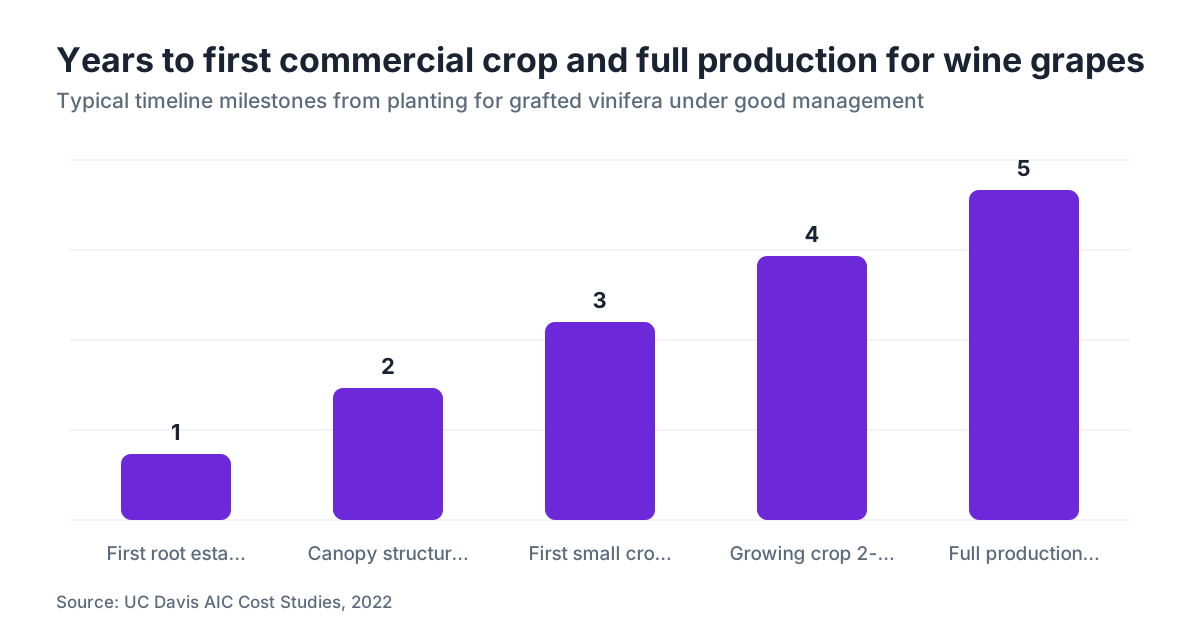
Year one is about root establishment, not canopy. You plant dormant, grafted one-year-old vines in early spring, once soil temperature reaches around 50°F. The vine's energy goes underground first. Shoot growth looks underwhelming. That's fine. Cut back to two to three healthy shoots and train a single trunk upward. Don't rush it.
Year two, the vine has enough root mass to push harder. You start shaping the permanent structure: the trunk and, depending on your training system, the arms or cordons. Let it grow, but keep it directional. Crop load at this stage should be zero or very light. Pulling clusters in year two feels painful. It pays off in vine longevity.
Year three is when most growers see the first small commercial crop, typically 1 to 2 tons per acre depending on variety, training system, and vine health. Some vineyards push for a crop in year two under ideal conditions, but the consensus in extension literature is that this shortens the productive life of the vine [1].
Full production, meaning 3 to 6 tons per acre for most varietals in well-managed conditions, comes at year four or five and beyond. The vine's break-even economics track closely to this timeline. UC Davis enterprise budgets for wine grape production in California show establishment costs running $15,000 to $35,000 per acre depending on trellis system, irrigation, and land costs, with positive cash flow typically arriving in years four to six [5].
How do you train and trellis grape vines properly?
Training system choice is a long-term structural commitment. You're not going to switch from vertical shoot positioning (VSP) to a Scott Henry or a Geneva Double Curtain five years in without significant cost and canopy disruption.
VSP is the most widely taught system in UC Davis and Cornell extension materials because it works in moderate-vigor conditions, produces a manageable canopy, and fits mechanization. Shoot tips are tucked upward between two sets of foliage catch wires, keeping the fruiting zone exposed and the canopy open. Open canopies dry out faster after rain, which matters enormously for fungal disease pressure.
High-vigor sites, heavy soils, and irrigated desert vineyards often need divided canopy systems that spread leaf area and reduce shading. Excessive shading is the enemy. It cuts bud fruitfulness for the following year, promotes disease, and messes with berry flavor development.
Trellis infrastructure typically consists of end posts (4 to 5 inches diameter, 8 feet long, set 3 feet deep), line posts every 20 to 24 feet, and two to four runs of 12.5-gauge high-tensile wire. End post anchoring, either with deadman anchors or angle braces, is where a lot of growers cut corners and regret it. A poorly anchored end post in year one becomes a sagging trellis in year five.
Spacing is regional. California coastal sites often plant at 4 by 8 feet or 5 by 8 feet. Warmer, flatter, more mechanized vineyards tend to run 8 by 12 or wider to allow tractor access on multiple implements.
How much water do grape vines need, and how do you irrigate them?
Grapevines are drought-tolerant relative to most horticultural crops, but that tolerance is not unlimited and it varies dramatically by rootstock, soil, and phenological stage.
Regulated deficit irrigation (RDI) is the standard management strategy in most irrigated wine regions. The concept is simple: apply enough water to keep vine stress at a moderate level (measured by midday stem water potential, typically maintained between negative 8 and negative 12 bars from fruit set through veraison), then back off after veraison to push ripening [9]. WSU Extension's irrigation management publications for Washington wine grapes detail how to use pressure chamber readings to calibrate irrigation scheduling rather than guessing from ET data alone [4].
Drip irrigation is nearly universal in new plantings because it delivers water precisely to the root zone, reduces evaporation loss, and allows fertigation. Surface drip (one or two emitters per vine) is simpler to manage than subsurface, though subsurface has advantages in some soils for keeping the surface dry and reducing fungal splash.
Establishing young vines through their first two dry seasons requires more attentive irrigation than mature vines. Let a newly planted vine hit severe water stress before it has a real root system and you can stunt it for good. Weekly soil moisture checks or tensiometer monitoring is not overkill in year one and two.
What pests and diseases hit grape vines, and how do you manage them?
The main fungal diseases you'll deal with are powdery mildew (Erysiphe necator), downy mildew (Plasmopara viticola), and botrytis bunch rot (Botrytis cinerea). In the eastern US and Pacific Northwest, black rot (Guignardia bidwellii) is also serious. Your region determines your disease priority, but powdery mildew is almost universal across wine regions and is the one disease where skipping a spray at the right growth stage can cost you the entire crop.
Powdery mildew has never developed meaningful resistance to sulfur, unlike some DMI fungicides where resistance is now common. That makes sulfur a workhorse. The catch: sulfur applications above about 90°F can burn foliage. Timing your applications around the 5 to 10 day interval from budbreak through fruit set, when the berry is most susceptible, is where the disease is won or lost.
Insect pressure varies by region. Leafhoppers, grape berry moth (eastern US), mealybug, and the increasingly problematic spotted lanternfly (Lycorma delicatula) in the mid-Atlantic and Northeast require different management tactics. USDA monitoring maps for spotted lanternfly should be checked annually if you're in a risk zone.
All spray applications in commercial vineyards fall under the EPA Worker Protection Standard (WPS), which requires trained workers, posted pesticide safety information, and restricted-entry intervals (REIs) to be enforced. The WPS was revised in 2015 and covers agricultural establishments where pesticides are applied on crops [6]. Keeping accurate spray records, including product, rate, application date, REI, and applicator name, is a legal requirement under most state pesticide regulations and a practical necessity for any winery audit or organic certification.
This is exactly where a field operations system helps. If you're tracking multiple blocks across multiple varieties with different spray timings, a digital spray log prevents the compliance gaps that show up in state inspector visits. VitiScribe was built around this workflow for small and mid-size vineyard operations.
For more perspective on how real vineyards manage these decisions, the operations at Ponte Winery and South Coast Winery in Southern California illustrate how warm-region disease pressure shapes spray programs differently from coastal or mountain sites.
Can you grow grape vines in containers, and what does that take?
Yes, and it works better than most people expect, with realistic expectations about scale and yield.
Growing grapes in a container is practical for home gardeners, urban growers, patios, and anyone without the soil or space for a full vineyard row. It's not a commercial production strategy. You're not going to make 300 cases of wine from container-grown grapes, but you can absolutely grow a healthy vine that produces a few pounds of ripe fruit annually.
Container requirements:
- Minimum container size: 15 to 20 gallons for a productive vine. Smaller pots restrict roots and require more frequent watering.
- Drainage is non-negotiable. Grapes in waterlogged containers get crown rot within a season.
- Use a well-draining potting mix, not native soil. A mix of 60% high-quality potting medium, 20% perlite, and 20% coarse sand works well for most situations.
- A sturdy support structure is needed even in a container. A trellis against a south-facing wall works well.
Variety choice matters more in containers because the vine can't range its roots for moisture or nutrients. Compact, early-ripening varieties work better: Cabernet Franc ripens earlier than Cabernet Sauvignon and handles container stress more gracefully. Concord and other American-type grapes are genuinely tough and productive in containers.
Fertilization in containers requires attention because nutrients leach with every watering. A slow-release balanced fertilizer applied in early spring, plus a dilute liquid feed through the growing season, keeps the vine from going yellow. Watch for potassium deficiency specifically, which shows up as leaf margin scorch and is common in container-grown grapes.
Watering is the main management task. Containers dry out fast in summer heat. Daily watering in peak summer is not unusual for a large container in a hot climate. A drip emitter on a timer is worth setting up if you're growing more than one or two containers.
How do you prune grape vines, and when does pruning happen?
Pruning is the single highest-leverage annual task in a vineyard. Done right, it sets crop load, canopy structure, and vine health for the entire growing season. Done wrong or skipped, the vine over-produces, fruit quality drops, and the next pruning job gets harder.
Pruning happens during dormancy, after the vine has had time to harden off fully in late fall but before budbreak the following spring. In most wine regions, January through early March is the window. Pruning too early (before hard frost is past) risks exposing fresh cuts to cold damage. Pruning too late means you're cutting off shoots that are already pushing, which wastes the vine's energy.
There are two fundamental approaches:
- Cane pruning: you remove all but one or two canes from the previous year, each with 10 to 15 buds. Those canes become the fruiting wood for the coming year. Pinot Noir, Riesling, and Grenache are commonly cane-pruned because they have better bud fruitfulness near the base of a longer cane.
- Spur pruning: you retain a permanent cordon (a horizontal arm) and prune back lateral spurs along it to two to three buds each. Cabernet Sauvignon, Syrah, and Zinfandel are commonly spur-pruned. It's faster and more suited to mechanization.
Bud count per vine is the practical translation of crop load management. A rough rule used in many wine regions is 3 to 4 buds retained per ton of expected crop per acre. If you're targeting 4 tons per acre on a 6-foot by 10-foot spacing (roughly 726 vines per acre), you're retaining roughly 2 to 4 buds per vine at the low end. This math simplifies a lot of complexity, but it gives you a sanity check.
Pruning wounds are also an entry point for trunk diseases like Eutypa dieback and Botryosphaeria. Large pruning cuts on high-value old-vine material are sometimes treated with wound sealants or protective fungicides. Cornell's disease management guidelines cover this in detail [3].
What nutrients do grape vines need, and how do you manage vine nutrition?
Grapevines are not heavy feeders compared to vegetable crops, which is partly why they do well in low-fertility soils that would starve corn or tomatoes. But that doesn't mean nutrition is passive.
Nitrogen is the most commonly managed nutrient. Too little and the vine is weak, shoots are thin, and fruit set suffers. Too much and you get rampant vegetative growth, dense shaded canopy, delayed ripening, and high disease pressure. Most guidelines target a leaf blade nitrogen of 0.9 to 1.1% at bloom, measured from a standard petiole or blade sample taken at full bloom. UC Davis ANR publications give detailed sampling protocols and target ranges by growth stage [12].
Potassium deficiency is the most common micronutrient problem in California vineyards, particularly on sandy or light soils. It shows up as marginal leaf scorch in summer and can cause poor berry set. Potassium also affects tartrate chemistry in the berry, which matters for wine quality.
The standard diagnostic tool is the petiole analysis, a leaf tissue sample taken at two growth stages (bloom and veraison) and sent to a lab. It's inexpensive, around $20 to $40 per sample, and gives you actual nutrient status rather than guessing from soil tests alone. Soil tests tell you what's there. Petiole tests tell you what the vine is actually taking up.
Boron deficiency causes poor fruit set and is common in leached coastal soils. A single foliar boron spray at 10% bloom can make a noticeable difference in set. Zinc deficiency, which shows up as small leaves and uneven berry sizing ("hen and chicks"), responds well to zinc sulfate sprays at woolly bud.
What are the legal and compliance requirements for growing wine grapes commercially?
Commercial grape growing carries real regulatory obligations that catch a lot of new growers off guard.
Pesticide records are required by law in every US state. The specifics vary, but most states require you to keep records of each pesticide application for a minimum of two years (some require three or more). Records must include the product name and EPA registration number, rate applied, crop and site treated, date and time, applicator name and license number, and REI. The EPA WPS requires this information to be available to workers and handlers [6].
Water rights and well permits apply if you're irrigating from groundwater or surface water. California, Washington, Oregon, and most western states have adjudicated water rights systems. Drilling a well or pulling from a creek without a valid water right is a significant legal exposure.
Pesticide applicator licensing is required if you're making the applications yourself on a commercial operation. In most states, you need a private applicator certificate at minimum, which requires passing a written exam. Using restricted-use pesticides (RUPs) requires a certified applicator's license in most states.
Organic certification, if you're pursuing it, adds audit requirements through an accredited certifying agent, an organic system plan (OSP), and product input pre-approval through the National Organic Program. USDA NOP maintains the allowed and prohibited substances list [7].
Grower registration with your state agriculture department is often required before you can sell grapes commercially. In California, this is the county agricultural commissioner's office. In New York, it's the Department of Agriculture and Markets. Check before you plant if you plan to sell.
For vineyards keeping up with compliance across multiple blocks, managing spray records, water use logs, and worker safety documentation in one place saves real time at audit. Tools like VitiScribe are built for exactly this workflow, especially once you're running more than a few acres and the paper trail gets unwieldy.
Wineries that source from multiple growers, like the operations profiled at Gervasi Vineyard or larger scale producers near Paso Robles Wineries, often require growers to submit spray records as a condition of grape purchase contracts.
How do growing conditions vary by region for wine grape production?
American Viticultural Areas (AVAs) exist for a reason. The USDA TTB administers AVA designations based on geographic and climatic distinctiveness, and there are now over 250 AVAs in the US [8]. That number tells you how much microclimate variation matters in grape growing.
California's North Coast (Napa, Sonoma, Mendocino) is the reference point for most textbook viticulture: cool maritime mornings, warm afternoons, low summer rainfall, and well-drained hillside soils. It produces conditions that ripened Cabernet Sauvignon consistently before most other US regions figured out how.
Washington State's Columbia Valley is very different: a semi-arid continental climate with extreme summer sun exposure (up to 17 hours of daylight near the summer solstice), cold winters that can kill vines outright, and almost no natural precipitation during the growing season. Every WSU extension recommendation reflects those conditions, particularly around cold hardiness and irrigation management [4].
The Finger Lakes in New York and the Lake Erie appellation represent cool-climate production at the eastern edge of commercial viability for vinifera. Riesling and Gewurztraminer thrive. Cabernet Sauvignon mostly doesn't. Cornell's viticulture research is specifically tailored to these conditions and to the hybrid varieties that make sense there [3].
Texas Hill Country, Virginia, and the mid-Atlantic are growth regions with increasing commercial acreage but ongoing challenges from Pierce's disease (spread by glassy-winged sharpshooter) in warmer areas, and high humidity disease pressure in others.
Choosing a variety without understanding your GDD accumulation, frost date window, and primary disease pressures for your specific region is the most predictable path to disappointment.
How do you read a grape vine's growth stage to time spray and cultural operations?
Growth stage identification is the backbone of spray timing, pruning decisions, irrigation adjustments, and harvest planning. The standard system used in viticulture research and extension is the modified E-L (Eichhorn-Lorenz) scale, which runs from stage 1 (winter dormancy) through stage 47 (berry ripe for harvest) [11].
The stages growers reference most often:
- E-L 4 to 5: Woolly bud to green tip. Marks start of disease susceptibility. First sulfur or copper applications go here in high-pressure regions.
- E-L 9: Shoot at 10 cm. Powdery mildew protection begins in earnest.
- E-L 19 to 23: Bloom and full bloom. Most critical window for powdery mildew, botrytis, and nutrient sampling.
- E-L 31 to 33: Fruit set to small berries. Berry sizing and disease management converge.
- E-L 35: Veraison onset. Color change in red varieties. Shift from growth management to ripening management.
- E-L 38: Harvest ripe. Defined by Brix (sugar), titratable acidity, and pH targets that vary by wine style.
When growers say "I spray every 10 days," the calendar is almost irrelevant. What matters is disease risk (which is weather-driven) and growth stage (which sets susceptibility). UC Davis disease forecasting models like the powdery mildew risk model integrate both [2].
For harvest timing specifically, the targets depend on wine style. Sparkling wine base grapes are picked at 19 to 21 Brix. Table wine grapes typically range from 22 to 26 Brix depending on variety and style goals. Late harvest and dessert wines go higher, sometimes above 30 Brix in botrytis-affected fruit.
Frequently asked questions
How long does it take grape vines to produce fruit?
Most grapevines produce a small crop in year three and a commercial-scale crop by year four or five. Year one and two are establishment: you're building roots and trunk structure, not harvesting fruit. Harvesting too early, especially in year two, can permanently weaken the vine. UC Davis extension budgets assume positive cash flow arriving in years four to six for California wine grape operations.
What is the easiest grape vine to grow for a beginner?
Concord and other American-type Vitis labrusca varieties are the most forgiving: they're cold-hardy, disease-resistant, and productive without sophisticated management. For wine grapes, Marquette and Frontenac (cold-hardy USDA-bred hybrids) are much easier than vinifera in northern climates. Pinot Gris and Chardonnay are workable starting vinifera varieties in moderate climates, but they demand real disease management attention from the start.
How do you grow grapes in a container successfully?
Use a 15 to 20 gallon container minimum with excellent drainage. A mix of quality potting medium, perlite, and coarse sand works well. Compact, early-ripening varieties like Cabernet Franc or early-season table grapes handle container stress better than late-ripening types. Expect to water daily in summer heat and fertilize regularly since nutrients leach fast. A trellis or support structure is required even in a container.
What rootstock should I use for wine grapes?
Rootstock choice depends on your soil type, phylloxera pressure, and desired vine vigor. 110R suits dry sandy sites with high drought stress. 3309C works well on light soils where you want lower vine vigor for quality. 101-14 is a standard moderate-vigor option for well-drained loam. Cornell and UC Davis extension both publish detailed rootstock selection guides matched to regional soil conditions. Never plant vinifera own-rooted in phylloxera-endemic ground.
How much water do grape vines need per week?
Mature wine grape vines in California need roughly 1.5 to 2.5 acre-inches of water per week during peak summer demand, though regulated deficit irrigation intentionally keeps vines slightly stressed after fruit set. Young vines in their first two seasons need more attentive, frequent watering to establish roots. A pressure chamber measuring midday stem water potential is the most accurate way to schedule irrigation rather than relying on calendar timing.
Can you grow wine grapes without pesticides?
In low-humidity, low-disease-pressure environments like parts of eastern Washington or Southern California, minimalist spray programs are realistic. In humid regions (east coast, Pacific Northwest, Great Lakes), unsprayed vinifera almost always suffers serious powdery or downy mildew damage. Certified organic programs rely on sulfur, copper, and biological products rather than synthetic fungicides, but they still require active spray management. Disease-resistant hybrid varieties reduce spray needs significantly.
What spray records do I need to keep for a commercial vineyard?
Most US states require pesticide application records including product name, EPA registration number, application date, site, rate, applicator name, and restricted-entry interval (REI). Records must be kept for at least two years (three or more in some states). The EPA Worker Protection Standard requires this information be available to agricultural workers and handlers. Organic certification adds additional audit requirements through a USDA-accredited certifier.
What is the best soil for growing grape vines?
Well-drained, moderately fertile soil with at least 3 feet of rooting depth. Grapes tolerate many textures from sandy loam to clay loam, but waterlogged or compacted soils cause root disease and chronic stress. Soil pH between 5.5 and 7.0 suits most varieties. High-fertility soils produce over-vigorous vines with quality problems. Rocky, low-fertility hillside soils often produce the most concentrated wine grapes.
How do you know when wine grapes are ready to harvest?
Harvest timing combines Brix (sugar content measured with a refractometer), titratable acidity, pH, and sensory evaluation of seeds, skins, and flavors. Sparkling wine grapes are typically picked at 19 to 21 Brix. Table wine grapes target 22 to 26 Brix depending on wine style. Tannin ripeness in red varieties often lags behind sugar ripeness. Most growers take berry samples from multiple vine locations across the block and average the results over the last two to three weeks before picking.
Do grape vines need a lot of sun?
Yes. Full sun is essentially required for commercial wine grape production. Grapes need 7 to 8 hours of direct sun daily to ripen fruit adequately. Canopy management, specifically keeping leaves from shading the fruiting zone, is one of the main summer tasks precisely because excessive leaf shade reduces fruit quality, bud fruitfulness for the following year, and increases fungal disease pressure. Orientation of vine rows north-south maximizes morning and afternoon sun exposure on both sides of the canopy.
How far apart should I plant grape vines?
Spacing depends on training system, equipment, and site vigor. Common wine grape spacings in California range from 4 by 8 feet (high-density, quality-focused) to 8 by 12 feet (mechanized, moderate-vigor sites). Row width must accommodate your tractor and spray equipment. In-row spacing affects competition between vines, which slightly stresses them and often improves fruit concentration. Tighter spacing increases establishment cost but generally produces better fruit quality on moderate-vigor sites.
What is the difference between cane pruning and spur pruning?
Cane pruning removes all but one or two year-old canes and retains 10 to 15 buds per cane as the season's fruiting wood. It suits varieties with low basal bud fruitfulness, like Pinot Noir and Riesling. Spur pruning keeps a permanent cordon and prunes lateral spurs back to 2 to 3 buds each. It's faster, better suited to mechanization, and works well for Cabernet Sauvignon, Syrah, and Zinfandel. Both approaches accomplish the same goal: setting the right number of buds for your target crop level.
How do you manage phylloxera in a vineyard?
There is no chemical cure for phylloxera once it's in your soil. Prevention is the only practical approach: plant vinifera on resistant rootstock, avoid moving soil or equipment from infested sites, and source certified phylloxera-free nursery material. Fumigation before planting can reduce, but not eliminate, soil pest populations. Own-rooted vinifera in phylloxera-endemic regions will eventually decline, usually showing symptoms 5 to 15 years after infestation depending on soil type and rootstock.
What growing degree days do different wine grape varieties need to ripen?
Müller-Thurgau and Pinot Gris ripen at around 2,500 GDD (base 50°F). Chardonnay and Pinot Noir need 2,500 to 2,900 GDD. Merlot ripens at around 2,900 to 3,200 GDD. Cabernet Sauvignon needs 3,200 to 3,800 GDD. Grenache and Mourvèdre need the most heat, above 3,500 GDD. These ranges vary by clone, rootstock, and site, but they give a reliable first screen for variety selection before you commit to planting.
Sources
- UC Davis ANR Publication 3343, Wine Grape Varieties in California: Ideal annual rainfall for wine grape production is 20 to 35 inches; establishment costs and year-three first crop timeline referenced in UC Davis enterprise budgets
- UC Statewide Integrated Pest Management Program (UC IPM), Grape Pest Management Guidelines: Powdery mildew risk model and growing degree day variety heat requirements for variety selection
- Cornell Cooperative Extension, Appellation Cornell Viticulture Program: Rootstock selection as a high-value establishment decision; pruning wound disease management for Eutypa and Botryosphaeria
- Washington State University Extension, Wine Grape Viticulture: Irrigation scheduling using midday stem water potential; cold-hardy variety options and Columbia Valley climate characteristics
- UC Davis AIC Wine Grape Establishment and Production Costs, California: Vineyard establishment costs of $15,000 to $35,000 per acre in California; positive cash flow typically in years four to six
- US EPA Worker Protection Standard (WPS), 40 CFR Part 170: EPA WPS requires pesticide application records, posted safety information, and restricted-entry interval enforcement on agricultural establishments; revised 2015
- USDA National Organic Program, Allowed and Prohibited Substances: NOP maintains the allowed and prohibited substances list for certified organic grape production
- UC Davis Viticulture and Enology, Regulated Deficit Irrigation for Wine Grapes: RDI targets midday stem water potential between negative 8 and negative 12 bars from fruit set through veraison
- Cornell University Cooperative Extension, Eichhorn-Lorenz Grapevine Growth Stages: Modified E-L scale growth stage descriptions used to time spray and cultural operations in viticulture
- UC Davis ANR, Petiole Sampling and Plant Nutrition for Vineyards: Target leaf blade nitrogen of 0.9 to 1.1% at bloom; petiole analysis sampling protocols and target nutrient ranges
Last updated 2026-07-09