Pruning grape vines during growing season: what to cut and when
TL;DR
- Growing-season pruning means suckering, shoot thinning, hedging, leaf removal, and green topping.
- It opens the canopy, improves fruit quality, and cuts disease pressure.
- Timing decides everything.
- Work done before bloom carries the most risk to your crop load.
- Work after fruit set forgives more.
- Most cuts go by hand or hedger from bud break through veraison.
What is growing-season pruning and how is it different from dormant pruning?
Dormant pruning sets the vine's framework and decides how many buds carry the crop. Growing-season pruning manages the canopy the vine actually builds from those buds. The goals are related but they are not the same. Dormant cuts remove wood. Green cuts remove or redirect living shoot growth while the vine is photosynthesizing and moving carbohydrates around.
The difference that matters is consequence. A bad dormant cut can be partly fixed the next year. A bad green cut cannot. Remove too many shoots before bloom and you can lose half your crop for the current vintage with no way to get it back. That asymmetry is the whole reason to understand what each in-season operation does before you pick up shears or fire up the hedger.
Green pruning covers several jobs. Suckering removes shoots from the trunk and below the head. Shoot thinning reduces shoot density at the cordon or cane. Shoot positioning and hedging train shoots upward and top the canopy. Leaf removal pulls or blows leaves out of the fruit zone. Lateral trimming takes out secondary shoots that thicken the canopy mid-season. Each one has its own timing window and its own way to hurt you. [1]
The goal across all of them is the same. Get light and air into the canopy. UC Davis viticulture extension work links canopy light interception above roughly 60 percent to higher disease pressure, weaker anthocyanin development in reds, and elevated malic acid at harvest. [1]
When should you start suckering and removing basal shoots?
Suckering is the first green job most vineyards do. It starts 2 to 4 weeks after bud break, once shoots are long enough to see clearly but before they harden into wood. You are pulling any shoot growing from the trunk below the head, from the base of the vine, or from rootstock below the graft union. Rootstock suckers left alone become a real problem, especially on vigorous rootstocks like AXR1 or 5C.
Get it done early. A sucker at 4 inches snaps off in seconds. That same sucker at 12 inches needs a cut and leaves a wound. Early timing cuts both labor time and the wound surface you expose to pathogens like Eutypa lata, the wood disease that shows up years later as dead spurs and dying cordons. Washington State University's viticulture team notes that large pruning wounds made while the vine is growing are especially open to Eutypa infection during wet weather. [2]
Many growers skip the clippers on small suckers and just rub them off with a gloved hand or a burlap pad while the tissue is soft. That leaves no wound at all. It is slower per vine. It is a lot faster than dealing with Eutypa in year eight.
On a mature block, a good crew can sucker 400 to 600 vines an hour by hand at the right growth stage. Wait too long and that rate drops below 200.
How do you thin shoots without hurting your crop?
Shoot thinning happens between 2 and 8 inches of shoot growth, before shoots tangle in the trellis wire. You remove double or triple shoots from a single spur position and pull overall density down to the target set during dormant pruning, usually 3 to 6 shoots per foot of cordon depending on variety and trellis.
The risk is right there in front of you. Remove a shoot carrying two flower clusters and those clusters are gone. So the rule most experienced viticulturists follow is simple. Thin to the most vigorous shoot at each spur position, keeping the one with the best angle and the most inflorescences. Take out shoots growing the wrong way (downward, inward toward the trunk, crossing others) before you touch any healthy upright shoot.
Cornell's viticulture extension in New York recommends finishing shoot thinning by 6 inches of growth on vinifera, because labor time climbs steeply once shoots start to intertwine and the odds of grabbing the wrong shoot climb with it. [3] For hybrids like Marquette or Frontenac, which often push 3 to 5 shoots per node, early thinning matters even more.
Watch frost. Do not thin during a frost window without a plan. If a late frost hits a freshly thinned block, you have already removed the secondary buds that would have recovered the crop. On frost-prone sites, many growers hold off until after the last expected frost date and accept a messier canopy as the price of insurance.
Shoot density targets by system look roughly like this:
| Trellis system | Target shoots per foot | Notes |
|---|---|---|
| VSP (vertical shoot positioned) | 3-5 | Aim for 4 inch spacing |
| Sprawl / Geneva Double Curtain | 4-6 | Canopy splits, so density higher |
| Lyre / U-trellis | 3-4 per arm | Two arms per vine |
| Scott Henry | 4-6 | Half shoots trained down |
[1][3]
What does hedging and topping do, and when is it worth doing?
Hedging, also called topping or shoot hedging, trims the tops and sometimes the sides of the canopy with a mechanical hedger or hand shears once shoots grow past the top trellis wire. The first benefit is purely mechanical. It lets equipment through the row and cuts the wind resistance that pulls fruiting wires down.
The physiological effect depends on timing. Early topping before bloom, below the first wire, can push carbohydrates toward the clusters and improve fruit set in high-vigor varieties. Most growers top 6 to 12 inches above the top catch wire, which usually means cutting somewhere between 12 and 18 nodes on the shoot.
Tractor-mounted hedgers are common on vineyards over 20 acres. A decent three-point hedger runs roughly $8,000 to $20,000 depending on whether you cut one side or both at once, and whether the machine does a horizontal top cut along with vertical side cuts. [4] On smaller blocks, or on hillsides where a tractor cannot run cleanly, hand crews with cordless pole hedgers are the practical call.
Over-topping is a real mistake. Cut too hard below the last cluster and you force lateral growth right below the cut. Those laterals thicken the canopy exactly where you want light and air, around the fruit zone. If you fight dense lateral regrowth around the clusters every August, look at how low your hedging cuts are going.
Research from UC Davis found that leaving 12 to 15 leaves above the top cluster is generally enough for adequate photosynthesis after hedging. [1] Cut shorter than that and you starve the clusters of carbohydrates during the lag phase, when they can least afford it.
Should you remove leaves from the fruit zone, and when?
Leaf removal is one of the highest-return operations you can do. It is also one of the most commonly botched.
The idea is simple. Pull or blow leaves off the cluster zone on the morning-sun side of the row. That opens airflow around the fruit, drops humidity, and gets spray into the clusters. In tight-clustered varieties like Pinot Noir and Grenache, the payoff in botrytis pressure alone can be big. Cornell research on leaf removal in New York vinifera found that early removal, at bloom to fruit set, cut botrytis incidence by 30 to 60 percent compared to no leaf removal, depending on how wet the season ran. [3]
Timing splits into two schools. Early leaf removal, at or just before bloom, loosens berry set and reduces cluster compactness. That mechanical effect on berry size and cluster shape pays off all season by keeping air moving inside the cluster. It costs more labor because you are working before shoots have positioned themselves cleanly, but the canopy benefit lasts.
Late leaf removal, from fruit set through early bunch closure, gives less architecture benefit but still improves light and spray coverage. In hot climates like the Central Valley or inland Paso Robles, you may leave the afternoon-sun side leafed out on purpose to keep thin-skinned varieties from burning. Strip both sides bare in a 100-degree August in Paso Robles and you get raisins on the vine, not wine grapes. [See also: /paso-robles-wineries]
Pneumatic leaf removers are everywhere now. They are faster than hand crews and blunter. They tend to over-strip light-cropped blocks and under-strip dense ones. A follow-up hand pass on the problem spots usually earns its keep.
Here is a rule of thumb for the fruit zone. Stick your open hand into the cluster zone from the side of the row. You should see daylight from every direction. If your hand disappears, there is too much leaf cover.
How does in-season pruning change disease and pest management?
Open canopies change the math on spray programs. Do leaf removal and hedging right and spray penetration into the fruit zone jumps, which means you can often hit adequate coverage with less volume and fewer passes. WSU extension spray calibration guidance shows that a dense canopy can need 2 to 3 times the spray volume of an open VSP canopy to put equivalent deposits on interior leaves and clusters. [2]
There is a direct cost and resistance angle. If you run 8 to 10 fungicide applications a season because botrytis keeps finding shelter in a closed canopy, opening that canopy might get you the same control with 5 to 6 applications. Fewer sprays means lower chemical cost and less selection pressure for resistance.
Pests shift too. Leafhoppers favor dense, shaded canopies. Powdery mildew, which wants shade and moderate temperatures, is genuinely harder to manage in a well-opened VSP block than in a sprawl or gobelet system that shades itself. Opening the canopy also changes beneficial insect habitat, so it is not a clean win on every pest.
Then there is worker protection. Under EPA's Worker Protection Standard, any worker or handler entering a treated area during a restricted entry interval (REI) needs specific protections, training, and sometimes personal protective equipment. [5] The rule reaches far. The 2015 revised WPS applies to any agricultural employer using a pesticide on an agricultural establishment, vineyards included, and it strengthened requirements around record-keeping and handler training. [5] Keeping a clean canopy record, including when green work happened relative to spray applications, is what keeps a WPS inspection short.
If you track spray records and canopy work in the same place, software like VitiScribe can link the two, so your REI windows and your pruning crew schedules never quietly overlap.
What tools do you need for growing-season pruning?
Hand shears are the baseline. Felco and Bahco dominate production vineyards, and both make ergonomic models built for repetitive cuts. The Felco No. 2 is essentially the industry standard at around $60 to $80 retail. [4] Pneumatic shears are faster for high-volume suckering and lateral trimming, but they need an air compressor or CO2 tank on the tractor, which adds a layer of complexity.
For shoot thinning in a small block, shears and a padded thumb guard are all you need. For leaf removal on more than 5 acres, a pneumatic blower attachment on a tractor, units like the Clemens or Pellenc systems, runs $4,000 to $15,000 and pays for itself in labor within a few seasons on a production block.
Hedgers range from cordless pole models for hand crews to tractor-mounted three-point units. If you run a tractor hedger, calibration matters. Set the cutting height before the season, not mid-block. A hedger that drifts 3 inches lower than you intended across 50 rows removes a lot more canopy than you planned.
Sanitation between vines matters more than most people admit. Disinfecting shears between cuts, especially in blocks with known virus or wood disease, slows pathogen spread. A 70 percent isopropyl alcohol spray or a freshly mixed 10 percent bleach solution on the blades is standard. Bleach corrodes metal and needs rinsing, so most crews stick with alcohol in the field.
On a vineyard with mixed block ages and varieties, keep a dedicated kit per block on anything suspected to carry leafroll virus or Grapevine fanleaf virus. It cuts cross-contamination risk for the price of a second pair of shears.
How do labor timing and costs break down for green pruning operations?
Labor is the dominant cost in every in-season pruning job. Dormant pruning packs into a 6 to 10 week window. Green work spreads across the whole growing season, from bud break through veraison. That creates scheduling pressure, especially on mixed vineyards with varieties at different growth stages.
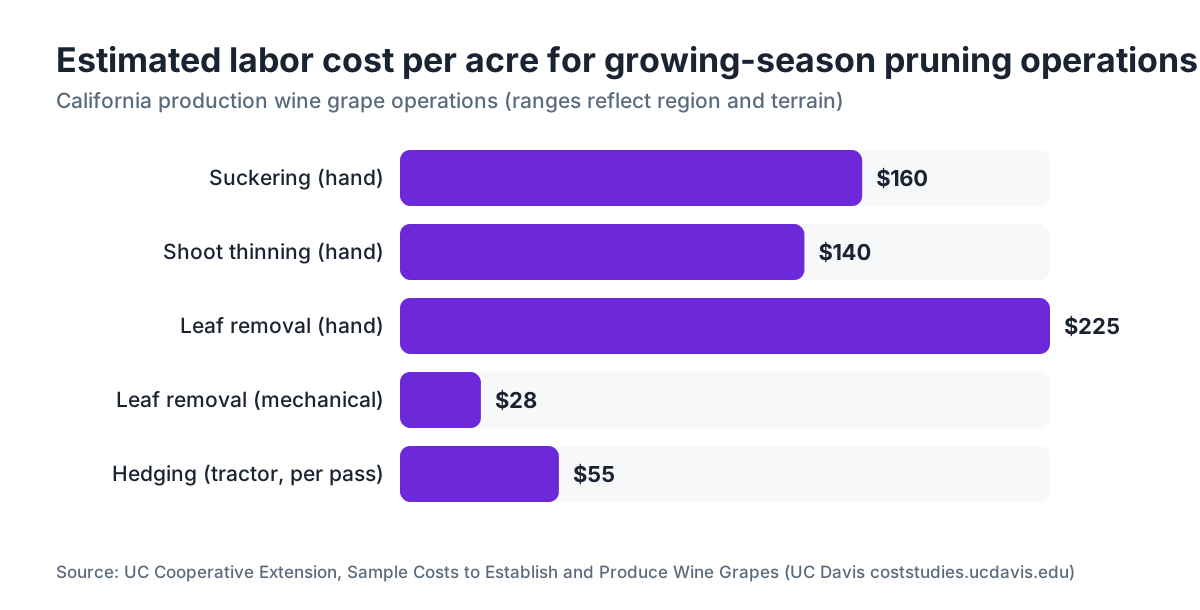
The University of California's vineyard cost studies, published through UC Cooperative Extension, give a workable benchmark for California production wine grape operations. Suckering runs roughly $120 to $200 per acre, shoot thinning $100 to $180 per acre, hand leaf removal $150 to $300 per acre, and tractor hedging $30 to $80 per acre per pass. [6] Those figures come from the San Joaquin Valley and North Coast cost studies and will run higher in high-wage regions or on hard terrain.
Mechanical leaf removal runs roughly $15 to $40 per acre per pass when you own the equipment. Far cheaper per acre than hand work, but it needs capital up front and a follow-up hand pass on tight clusters.
Timing windows are tight. Shoot thinning has maybe a 10 to 14 day window before shoots tangle. Miss it and the labor rate per acre climbs 30 to 50 percent while workers untangle shoots before they can even make a cut. Building your crew calendar around growth stage, not calendar date, is the only reliable way to hit these windows.
On a mountain winery or any hillside vineyard, treat every per-acre figure as a floor. Steep terrain slows equipment access, forces more hand work, and drives labor hours per acre up 20 to 60 percent depending on slope.
What are the risks of over-pruning during the growing season?
Over-pruning during the growing season is a real problem, and it usually comes from well-meaning overcorrection rather than neglect.
The most common version is heavy leaf removal stacked on aggressive hedging. Strip too much leaf area, especially after fruit set, and the vine cannot photosynthesize enough to ripen the fruit. You see it at harvest as elevated malic acid, weak color in reds, and high titratable acidity. In warm climates, a bare canopy also exposes berries to direct sun, and sunburn shows up as bleached, flattened patches on the cluster shoulders.
Over-thinning shoots before bloom is the other frequent error. Target 4 shoots per foot, remove too hard, and land at 2.5, and your crop load drops right along with it. In a year when you needed the yield for cash flow, that is a serious operational miss.
Every extra cut is a pathogen entry point. Botrytis cinerea can colonize leaf-removal wounds on the peduncle and pedicel of clusters. Eutypa lata enters trunk and cordon wounds. Neither needs a large wound, but more cuts mean more doors, especially during wet weather.
The honest answer on the right level of intervention is that it varies by site, variety, rootstock, and vintage weather. Nobody has universal good data on exactly how many leaf-removal passes are optimal across all wine regions. The closest thing to site-specific guidance is trial plots in your own vineyard, tracked over several seasons. Start conservative. Add intensity in later seasons only if the results earn it.
How does growing-season pruning work in organic or low-input programs?
In certified organic vineyards, green pruning carries extra weight because it partly replaces synthetic fungicides in the disease toolkit. An open canopy removes the conditions botrytis and powdery mildew need, which means canopy decisions directly affect how hard you lean on allowable materials like sulfur, copper, and biologicals.
The USDA National Organic Program does not restrict mechanical cultural practices like pruning or leaf removal. Those operations are unrestricted regardless of certification. [7] The compliance complexity is in wound treatments. Any material applied to cuts must appear on the National List of Allowed and Prohibited Substances if it is used on a certified operation.
For organic growers in wet climates like the Finger Lakes or the Willamette Valley, early leaf removal at bloom is close to mandatory. Botrytis pressure without synthetic fungicides and without canopy management can threaten the whole crop in a wet summer. WSU extension's organic viticulture guidance treats canopy management as the single most important cultural tool for disease control in organic systems. [2]
In biodynamic programs, timing of canopy work is sometimes keyed to the biodynamic calendar, with cuts scheduled on root days or flower days depending on the practitioner. There is no peer-reviewed research confirming a yield or quality difference from calendar-timed pruning, though growers who follow it often report better wound healing. My honest take: it probably does not hurt and costs nothing extra, but it is not where I would spend mental energy before getting the canopy basics right.
How do you keep records of growing-season pruning for compliance and traceability?
Record-keeping for in-season pruning sits where a few compliance frameworks meet. If your pruning crews are pesticide handlers, or workers re-entering treated areas, the EPA WPS requires you to keep records of pesticide applications and REI periods, and to inform workers before they enter. [5] A pruning crew entering a block 12 hours after a sulfur application is inside an REI, full stop, and the WPS documentation rules apply.
Beyond WPS, many state agriculture departments, California's CDFA among them, require pesticide use reports for any restricted-material application, and those records have to map to specific blocks and dates. [8] Pairing spray records with your canopy work calendar, so you can show exactly when a block was last sprayed and what REI applied when the crew went in, is the cleanest way to satisfy an inspection.
Wineries selling to larger buyers or chasing sustainability certifications (Certified California Sustainable Winegrowing, LIVE, SIP Certified) usually find canopy management documentation named explicitly in the audit. [9] These programs want to see that canopy practices are intentional and tracked, not improvised.
For blocks with several operations happening in close sequence, a simple field log is enough: date, block ID, operation type, crew size, and any notable observations. Digital tools like VitiScribe pull spray records, canopy work logs, and REI tracking into one place, which cleans up both day-to-day coordination and the end-of-season compliance review.
What do university extension programs recommend for each variety type?
Extension recommendations split by variety type, climate, and trellis. Here is the short version of where UC Davis, Cornell, and WSU land on the common scenarios.
For vinifera in cool coastal climates (Pinot Noir, Chardonnay, Pinot Gris), UC Davis and Cornell both recommend early, aggressive leaf removal on the morning-sun side starting at or before bloom, shoot thinning to 4 to 5 shoots per foot, and hedging to 12 to 15 leaves above the top cluster. Both programs flag the same trap: delaying leaf removal past fruit set in tight-clustered varieties is a common cause of botrytis. [1][3]
For vinifera in hot inland climates (Cabernet Sauvignon, Merlot, Zinfandel in the San Joaquin or Paso Robles areas), UC Davis recommends keeping more basal leaves to shield fruit from sunburn and managing vigor through irrigation and cover crops rather than heavy shoot removal. Leaf removal, if you do it, is light and aimed at the shaded side of the row. [1]
For cold-climate hybrids in the Midwest and Northeast (Marquette, Frontenac, Noiret), Cornell's viticulture team notes that many hybrids run over-vigorous on high-fertility sites and take harder shoot thinning than vinifera would tolerate, sometimes down to 3 shoots per foot, paired with mid-summer lateral trimming to hold back the dense secondary canopy these varieties love to build. [3]
WSU's guidance for Washington Riesling and Syrah addresses the VSP system that dominates the Columbia Valley. It recommends shoot thinning finished by 4 to 6 inches of growth and hedging to 16 to 18 leaves per shoot, keeping enough leaf area for the high sugar accumulation those varieties need in the dry, hot Columbia Basin. [2]
The thread through all three programs: the right answer depends on your site's vigor. Any recommendation from a university publication is a starting point for your own observation, not a universal prescription.
Frequently asked questions
Can you prune grape vines during the growing season without hurting the crop?
Yes, with timing and restraint. Suckering, shoot thinning, hedging, and leaf removal are standard in-season operations that improve fruit quality when done right. The main risk is removing too much foliage before or around bloom, which can reduce fruit set. Operations after fruit set are generally safer, but you still have to calibrate them to your climate and variety.
When is the best time to trim grape vines during the growing season?
Suckering starts 2 to 4 weeks after bud break when shoots are 3 to 6 inches long. Shoot thinning should finish by 6 to 8 inches of growth, before shoots tangle. Leaf removal in the fruit zone works best at or just before bloom for cluster loosening, or post fruit-set for light exposure. Hedging happens once shoots pass the top trellis wire, repeated as needed through mid-summer.
How much can you cut off a grape vine during the summer?
UC Davis viticulture research says keep 12 to 15 leaves per shoot above the top cluster after hedging, and hold enough basal leaves in hot climates to prevent sunburn. In cool climates, moderate to aggressive leaf removal on the morning-sun side is fine. Removing more than 40 percent of total leaf area at once risks under-ripening and elevated acidity at harvest.
What is shoot thinning and when should you do it?
Shoot thinning removes excess shoots from spur positions to reduce canopy density and match crop load to the vine's capacity. Do it between 2 and 8 inches of shoot growth, before shoots tangle in trellis wires. Cornell extension recommends finishing by 6 inches of growth for vinifera. Target density depends on trellis system, typically 3 to 5 shoots per foot for VSP.
Does leaf removal actually reduce botrytis in tight-clustered varieties?
Yes, measurably. Cornell research found early leaf removal at bloom to fruit set cut botrytis incidence by 30 to 60 percent in New York vinifera blocks compared to no leaf removal, depending on season wetness. The effect comes from better airflow around clusters, lower humidity, and improved spray penetration. Early removal also loosens cluster architecture, reducing the berry-to-berry contact where botrytis spreads.
What tools do you need to prune grape vines during the growing season?
Hand shears (the Felco No. 2 is the industry standard at roughly $60 to $80) handle most operations. Pneumatic blower attachments handle large-scale leaf removal for $4,000 to $15,000. Tractor-mounted hedgers run $8,000 to $20,000 for most configurations. Cordless pole hedgers work on small or steep blocks. Disinfect shears between rows in blocks with known virus or wood disease using 70 percent isopropyl alcohol.
How does growing-season pruning affect spray coverage and pesticide use?
Significantly. WSU extension research shows a dense canopy can need 2 to 3 times the spray volume of an open canopy to hit equivalent deposits on interior leaves and clusters. Open canopies from good shoot thinning and leaf removal improve spray penetration, which can cut application frequency and chemical costs. This also matters for EPA Worker Protection Standard compliance, since fewer applications mean fewer REI windows to schedule crews around.
Do organic vineyard rules restrict in-season pruning?
No. The USDA National Organic Program does not restrict mechanical cultural practices, including pruning, shoot thinning, hedging, or leaf removal. Those operations are unrestricted regardless of certification status. Compliance complexity arises only if you apply a material to pruning wounds, in which case that material must appear on the NOP National List of Allowed and Prohibited Substances.
What records do you need to keep for growing-season pruning?
At minimum, a field log with date, block ID, operation type, crew size, and any spray applications in that block within the preceding 30 days. If crews enter a block within a pesticide's restricted entry interval (REI), EPA Worker Protection Standard documentation requirements apply. Sustainability certifications like CCSWC and LIVE typically require documented canopy management practices as audit evidence.
How is growing-season pruning different for cold-climate hybrid varieties?
Cold-climate hybrids like Marquette and Frontenac often push 3 to 5 shoots per node and build dense secondary canopies faster than vinifera. Cornell's viticulture team recommends harder shoot thinning for these varieties, sometimes down to 3 shoots per foot, plus mid-season lateral trimming to manage the vigorous secondary growth. Over-crowded hybrid canopies raise disease pressure and slow sugar accumulation significantly.
Can you sucker grape vines by hand instead of using shears?
Yes, and it is often the better move on small suckers. Rubbing them off at 3 to 4 inches of growth with a gloved hand or burlap pad leaves no wound, which closes one entry point for Eutypa lata and other wood pathogens. It is slower per vine than shears but faster than cutting larger suckers and treating wounds. Hand rubbing works best when you catch the growth stage early, within 2 to 3 weeks of bud break.
What happens if you miss the shoot thinning window?
Labor cost rises 30 to 50 percent as crews spend time untangling shoots before making cuts, per University of California cost study benchmarks. Accuracy drops too. It is harder to tell which shoot to remove once they intertwine, which raises the chance of taking the wrong one and losing clusters. The canopy benefit also shrinks, because you have already lost weeks of better light distribution during the pre-bloom period.
How many times do you need to hedge grape vines in a season?
Most production vineyards on moderate to high vigor sites hedge 2 to 4 times a season, starting once shoots pass the top catch wire and repeating as regrowth appears. High-vigor sites with heavy irrigation may hedge 4 to 6 times. Low-vigor dry-farmed sites in warm climates may hedge once or not at all. Each tractor pass costs roughly $30 to $80 per acre, so managing vigor through irrigation and cover crops cuts total hedging cost.
Is it too late to do leaf removal after veraison?
Late leaf removal after veraison gives very little disease benefit and almost no cluster architecture benefit, since berry size is already set. It can help color development in red varieties if light is genuinely limiting at that stage, and it helps harvest equipment access. Most viticulturists treat post-veraison leaf removal as a last resort for problem blocks, not standard practice. The earlier you do it, the more benefit per unit of labor.
Sources
- UC Davis Viticulture and Enology, Canopy Management: Canopy light interception above 60 percent linked to higher disease pressure and reduced anthocyanin development; 12 to 15 leaves above top cluster recommended after hedging
- Washington State University Extension, Viticulture and Enology: Dense canopies require 2 to 3 times spray volume vs open VSP canopy; large pruning wounds during active growth are susceptible to Eutypa infection; canopy management is primary tool in organic disease management
- Cornell Cooperative Extension, Viticulture Program: Early leaf removal at bloom to fruit set reduced botrytis incidence 30 to 60 percent in NY vinifera; shoot thinning recommended completed by 6 inches of growth for vinifera; hybrids benefit from harder thinning to 3 shoots per foot
- Felco, Pruning Shear Product Line: Felco No. 2 is an industry-standard hand pruning shear priced approximately $60 to $80 retail
- EPA, Worker Protection Standard for Agricultural Pesticides: The 2015 revised WPS applies to all agricultural employers using pesticides on agricultural establishments including vineyards; requires REI documentation, worker notification, and handler training
- UC Cooperative Extension, Sample Costs to Establish and Produce Wine Grapes: Suckering $120 to $200 per acre, shoot thinning $100 to $180 per acre, hand leaf removal $150 to $300 per acre, tractor hedging $30 to $80 per acre per pass in California production vineyards
- USDA Agricultural Marketing Service, National Organic Program: NOP does not restrict mechanical cultural practices including pruning or leaf removal; materials applied to wounds must appear on National List of Allowed and Prohibited Substances
- California Department of Food and Agriculture, Pesticide Use Reporting: California requires pesticide use reports for restricted-material applications mapped to specific blocks and dates
- California Sustainable Winegrowing Alliance, Certified California Sustainable Winegrowing: CCSWC certification audits require documented canopy management practices as audit evidence
- WSU Extension, Spray Application Technology in Vineyards: VSP systems with 3 to 5 shoots per foot target recommended for Washington Columbia Valley Riesling and Syrah; hedging to 16 to 18 leaves per shoot maintains adequate photosynthesis
Last updated 2026-07-09