Grape powdery mildew models: how to use them to time your sprays

TL;DR
- Grape powdery mildew models turn temperature data into infection risk scores so you spray when Erysiphe necator is actually a threat.
- The UC IPM model tracks degree-days above 50°F and flags high-risk windows.
- Used right, growers cut 2 to 4 sprays a season without more disease.
- First spray still goes on at 1 to 3 inch shoots, no matter the score.
What is a grape powdery mildew model and why should you care?
A powdery mildew model is a forecasting tool. It takes daily temperature data, sometimes humidity or leaf wetness too, and turns it into a risk score that tells you whether Erysiphe necator is likely infecting your vines right now. It does not replace scouting. It replaces the calendar.
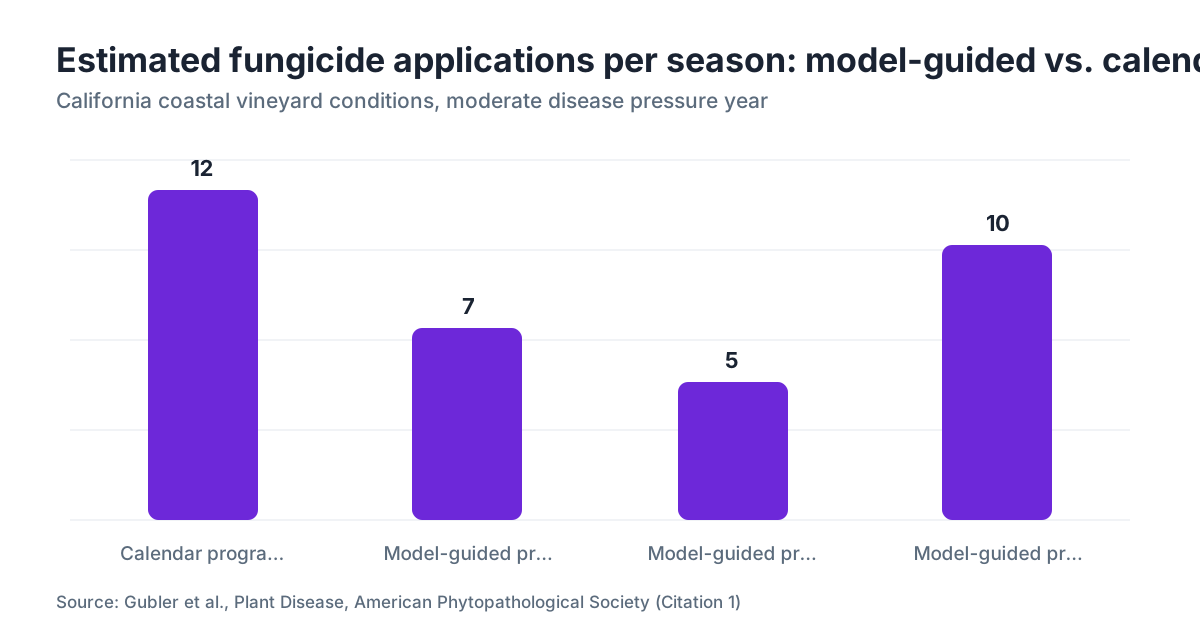
Calendar spraying, where you go out every 10 to 14 days no matter the weather, made sense when forecasting tools did not exist. Now they do. UC Cooperative Extension trials in coastal California found model-guided programs cut fungicide applications by roughly 30 to 50 percent versus calendar programs in moderate-pressure years [1]. In a wet year the model often calls for the same number of sprays, so you are not left exposed.
Powdery mildew is the most economically damaging fungal pathogen in California vineyards and ranks in the top three across most American wine regions [2]. It overwinters as chasmothecia in bark and as dormant mycelium in infected buds, then releases ascospores in spring when rain hits and temperatures climb above roughly 50°F. The model tracks those triggers so you know when the first spores are flying. That timing beats almost anything else you can do.
Run a vineyard in a Mediterranean climate with long dry summers and you might figure the model matters less. It does not. Dry summers still throw morning fog, dew, and the odd marine layer that opens infection windows, especially in the coastal stretch from Paso Robles south to Temecula.
How does the UC IPM powdery mildew model actually work?
The UC IPM grape powdery mildew model runs two calculations side by side. One tracks degree-day accumulation, how much growth the pathogen has made since January 1. The other is a sporulation risk index that flags windows where temperature favors fast colony expansion [3]. It was developed largely at UC Davis and is maintained through the UC Statewide IPM Program.
Degree-days for E. necator build above a base temperature of 50°F (10°C). The model flags the first real infection risk period when cumulative degree-days hit about 50 DD50 after budbreak. That lines up with shoots 1 to 3 inches long, the most susceptible tissue stage. Inflorescences through roughly 3 to 4 weeks post-bloom, when berries reach the size of a small pea (about 8 to 10 mm across), are the highest-risk period for fruit infection [4].
The sporulation index runs on its own. It scores each day on whether nighttime temperatures stayed above 50°F and whether the daytime high stayed below 95°F. E. necator is odd among fungal pathogens. It needs no free water to germinate. It sporulates better in warm, dry conditions, which is exactly why it thrives where most other mildews fail. Temperatures above 95°F (35°C) knock down conidial germination hard, and sustained readings above 104°F kill surface mycelium. That summer heat suppression is real, but do not lean on it in coastal regions where afternoon highs rarely reach 95°F.
The powdery mildew index rolls these factors into a 0 to 100 scale. Scores above 40 mean moderate risk. Above 60 is high risk, and the model recommends a protectant application within 24 to 48 hours. The UC IPM website (ipm.ucanr.edu) runs the model against your local weather station data or manual readings [3].
Cornell's Network for Environment and Weather Applications (NEWA) runs a parallel model built on the same biology but calibrated to New York weather [5]. Washington State University Extension recommends the UC model as a starting framework for Pacific Northwest growers, adjusted for the region's cooler late season [6].
What are the key temperature thresholds the model uses?
Get the thresholds into your head. They let you make quick field calls with no laptop in hand.
| Condition | Threshold | Effect on E. necator |
|---|---|---|
| Minimum for degree-day accumulation | 50°F (10°C) | Base temperature for growth |
| Optimal growth range | 68-77°F (20-25°C) | Fastest colony expansion |
| Heat suppression begins | 95°F (35°C) | Conidial germination drops sharply |
| Lethal to surface mycelium | 104°F+ (40°C+) | Kills active colonies |
| Ascospore release trigger | Rain + >50°F | Primary spring inoculum dispersal |
| Infection period duration | 6-14 hours | Time at optimal temp for germ tube penetration |
The 6 to 14 hour infection period is the one growers misread most. You do not need rain. You need relative humidity above about 40 percent and temperatures in the 68 to 77°F range for a sustained stretch. A foggy morning that gives way to a warm afternoon can be an infection event in midsummer [4].
The model weights nighttime temperature heavily because E. necator germinates and drives infection threads into leaf epidermal cells at night. Days with nighttime lows above 60°F and daytime highs below 90°F are your highest-risk periods. Ask any grower in coastal Sonoma and they will tell you that describes a lot of June and July.
What the model misses is canopy microclimate. A dense, poorly managed canopy runs interior temperatures and humidity that swing far from your weather station reading. A vine with 8 to 10 shoots per foot of cordon, trained into a wall with no shoot positioning, is making its own weather inside. The model gives you field-level risk. The canopy multiplier is on you.
How do you get weather data into the UC IPM powdery mildew model?
The simplest path is the online tool at ipm.ucanr.edu. It lets you pick from the CIMIS weather station network (California Irrigation Management Information System) and runs the model automatically [7]. If your vineyard sits within a reasonable distance of a CIMIS station, this costs nothing beyond the minute it takes to check.
More than 5 to 10 miles from a reliable station, especially in a valley or coastal pocket with its own microclimate, and the station data will lie to you in quiet ways. Night temperatures in a frost pocket can run 8 to 12°F colder than the nearest hilltop station. Coastal fog is hyperlocal. In those spots, an on-site station logging temperature and relative humidity every 15 minutes earns its keep at $300 to $800. Davis Instruments, Onset HOBO loggers, and a few ag-specific vendors sell units in that range accurate enough for the model.
Several vineyard management platforms can pull your station data, run the UC IPM model, and flag spray days by alert. If you already log spray records and scouting notes digitally, VitiScribe can pull weather feeds and flag risk windows next to your application records, so your spray timing rationale lives in one place. That matters for compliance, which comes later.
Growers in New York, Pennsylvania, and the mid-Atlantic get the practical equivalent in Cornell's NEWA (newa.cornell.edu), calibrated for those climates [5]. WSU Extension's WSU-DAIS system covers Washington and Oregon growers with similar functionality [6].
When does the model say to make your first powdery mildew spray?
Here is where a lot of growers get it wrong. First spray timing is not about a risk score crossing a threshold. It is about shoot length.
The UC IPM guidelines are blunt: the first fungicide application goes out at 1 to 3 inches of shoot growth, period, no matter what the model's risk index reads that week [3]. The overwintering chasmothecia release their first ascospores right around this stage, and you need protectant material on the tissue before those spores land. No model has inputs fast enough to catch that first release reliably.
After that first application, the model takes over. Check the risk index every 48 to 72 hours. When it crosses your threshold (UC recommends 40 for susceptible varieties, some programs use 55 to 60 for tolerant ones), spray again. When it stays below threshold for a long stretch, stretch your interval to 18 to 21 days instead of the usual 10 to 14.
Two moments demand extra attention no matter the score. The first runs 2 to 3 weeks before bloom through 3 to 4 weeks after. Berry skin cells are dividing fast and the cuticle is thin. Infection here causes the scarring, russeting, and cracking that ruins fruit quality. The second is any gap in coverage of 14 days or more, because colony growth may have already gotten ahead of you.
Susceptible varieties earn tighter thresholds and shorter intervals. Chardonnay, Cabernet Sauvignon, Zinfandel, and Pinot Noir all count as susceptible [2]. Varieties with some field tolerance, like Carignan and Barbera, can run the model more loosely.
What fungicide classes work best, and how does the model inform rotation?
The model tells you when to spray. Resistance management tells you what to spray. Separate decisions, but they play off each other.
The main FRAC code groups used against grape powdery mildew:
- FRAC 3 (DMI / sterol inhibitors): myclobutanil, tebuconazole, blended products. Systemic, with kickback activity up to 72 to 96 hours after infection.
- FRAC 11 (QoI / strobilurin): azoxystrobin, pyraclostrobin, trifloxystrobin. Systemic, but resistance is already documented in California and the east coast [8].
- FRAC 7 (SDHI): fluxapyroxad, penthiopyrad. Newer, systemic, use sparingly to keep them working.
- FRAC U6 (ametoctradin): newer mode of action, often premixed with FRAC 45.
- FRAC M (sulfur): contact only, no resistance risk, cheap, but phytotoxic above roughly 90 to 95°F and it needs high coverage.
- FRAC 19 (polyoxin D): biological-adjacent, low resistance risk, handy early season.
The model changes how you rotate. On a calendar program, you rotate by application number: spray 1 is FRAC 3, spray 2 is sulfur, spray 3 is FRAC 11, and on down the list. On a model program, you rotate by risk level. High-risk windows, bloom through 4 weeks post-bloom and any high-index period, get your systemic with kickback activity. Low-risk periods, when the index sits below 40 and conditions have been unfavorable for 10-plus days, are good times to burn a contact material like sulfur or a biological, saving your synthetic systemics for when they earn their price.
Do not run strobilurins (FRAC 11) more than twice a season. Resistance in E. necator populations is documented in California wine country and multiple east coast regions [8]. Seeing apparent failures on azoxystrobin-based products? Test your local population (UC Davis Plant Pathology offers diagnostic services) or switch to FRAC 3 and watch the response.
Sulfur is your best friend for budget and resistance prevention, but it has rules. Do not apply within 14 days of an oil spray. Do not apply when temperatures will top 90 to 95°F within 24 hours. At 95°F or above, phytotoxicity risk climbs fast.
How do you document model-guided spray decisions for compliance?
Pesticide application records are a legal requirement in every U.S. state with commercial grape production. California's rules under Food and Agricultural Code Section 12981 require records within 24 hours that include product name, EPA registration number, pest treated, application rate, total volume, and site identification [9]. The federal EPA Worker Protection Standard under 40 CFR Part 170 adds posting of application records in a central location accessible to workers and handlers, plus specific safety information before workers enter treated areas [10].
Where the model adds value is proof of your rationale. Regulators and crop insurance adjusters sometimes ask why you sprayed on a given date, or why you skipped a date your neighbors did not. A log that reads "model index = 67 on June 14, applied FRAC 3 within 24 hours" is a defensible record. A log that says "sprayed June 14" is not.
The minimum record for each model-triggered spray: date and time of application, the model risk score that triggered it, the weather station source for that score, product name, EPA reg number, FRAC code, rate per acre, total acres treated, applicator name, and re-entry interval. That is longer than most states legally demand. It also protects you.
Digital tools, and VitiScribe is built around this exact workflow, can attach a model risk score to each spray record automatically, which makes audit trails close to hands-off. Use a dedicated tool or a well-organized spreadsheet. Either way, recording why you sprayed matters as much as recording what you sprayed.
How accurate are powdery mildew models, and what do they get wrong?
Honest answer: pretty good, not perfect, and the failure modes are predictable.
A 2006 study by Gubler and colleagues in Plant Disease formed the biological basis for the current UC IPM model. It validated the model against field disease assessments across multiple California counties and found model-guided programs matched or beat calendar programs in most site-years tested [1]. That is the closest thing to a gold-standard validation the model has.
Where models fail:
Microclimate mismatch. If your data comes from a station 8 miles away and 400 feet higher, your degree-day accumulation can be off by 2 to 4 days in a given week. Over a season, that compounds.
Varietal susceptibility is not in the model. It calculates risk for a generic susceptible variety. Chardonnay in a dense canopy in coastal Sonoma might need action at an index of 35. Carignan on a steep Mendocino slope with good air drainage might be fine at 60.
Canopy density is not in the model either. A well-positioned canopy with 15 to 20 leaves per square foot and 50 percent light penetration behaves nothing like a dense wall. The model cannot see inside your rows.
Late-season pressure gets underestimated. After veraison, the model's economic threshold logic shifts because mature berry skins resist infection better. But leaves keep infecting and building overwintering inoculum for next year. Growers who quit the model at veraison sometimes pay the following spring.
Nobody has good multi-year accuracy data across diverse American wine regions outside California. The Cornell and WSU models are well-reasoned adaptations, but their regional validation datasets are smaller. Take the exact threshold numbers with a grain of salt if you farm in Virginia, the Texas Hill Country, or the Willamette Valley.
How do grape powdery mildew models compare to other disease forecasting tools?
Powdery mildew models are the most mature and best-validated disease models in viticulture. Here is how they stack up.
| Disease | Primary model | Validation status | Input requirements |
|---|---|---|---|
| Powdery mildew (E. necator) | UC IPM / NEWA | Extensive field validation [1] | Temp, degree-days |
| Downy mildew (Plasmopara viticola) | PLANT-Plus / EPI-Vine | Moderate validation | Temp, RH, leaf wetness |
| Botrytis bunch rot | BC-MCA / BOTCAST | Limited validation | Temp, RH, bloom timing |
| Black rot (Guignardia bidwellii) | Spotlit / Cornell | Regional validation in east | Temp, leaf wetness hours |
Downy mildew models need leaf wetness duration, which means a leaf wetness sensor on your station, more than a thermometer. Most growers who try to run a downy mildew model without that sensor get bad outputs. Powdery mildew's relative simplicity, temperature-driven and no free water required, is what makes it the best candidate for a model-guided program. The biology cooperates with the modeling.
Botrytis models exist, but their practical value in vineyards is far lower. Botrytis management is so tied to canopy, harvest timing, and variety that a risk score rarely changes a well-run program. Spray at bloom and cluster close, manage the canopy, pick before extended rain. The model adds little.
Growers in the paso robles wineries region or the south coast winery area of Southern California face powdery mildew as the dominant fungal concern. Downy mildew shows up rarely enough in those climates that a powdery mildew model alone covers most of your forecasting needs.
What do UC Davis and other extension programs recommend for model use?
UC Davis Plant Pathology and the UC Statewide IPM Program give explicit guidance: use the powdery mildew risk index as the primary driver for spray timing from the 6-inch shoot stage through 4 weeks post-bloom, and as one input among several from post-bloom through veraison [3].
The UC IPM guidelines are free at ipm.ucanr.edu and get updated periodically. The Grape Pest Management guidelines, sometimes called the blue book, were compiled by the UC Division of Agriculture and Natural Resources and remain the authoritative California reference [2]. The powdery mildew section states plainly that "the model is most useful as a guide for timing the first application and for adjusting subsequent spray intervals during periods of low disease risk."
Cornell's Viticulture and Enology program at Geneva recommends NEWA as the primary forecasting tool for New York growers and publishes annual spray guides that pair model output with fungicide class rotation calendars [5]. The guidance is free, specific, and grounded in Geneva's own trial data.
WSU Extension's recommendations for Pacific Northwest growers lean on the UC framework but add guidance for the Yakima Valley's sharp temperature swings and the Columbia Basin's low humidity baseline, conditions that suppress E. necator in ways coastal California programs do not account for [6].
Growers near the mountain winery elevations of the Appalachian or Sierra Nevada foothills should call their state land-grant extension directly. The model thresholds may need local calibration, and your state extension agent is the right first call.
How do you integrate the model with your existing spray program?
Start with your current spray calendar and lay it over last season's model risk scores. You can run the UC IPM model retroactively on historical weather data. Most CIMIS and NEWA stations archive 5 to 10 years of daily readings. Do this and you will almost certainly find 2 to 4 applications in a typical season where the model sat below 40 for the whole preceding week. Those are your first candidates to cut or stretch.
Do not cut applications inside the critical bloom window (2 weeks before through 4 weeks after bloom), no matter the model reading. The cost of fruit infection there is too high. Think of the model as controlling your pre-season and post-veraison intervals, not your bloom-protection sprays.
Phased rollout beats flipping a switch. Year one: run the model alongside your calendar program but change nothing. Just watch where the model would have had you act differently. Year two: start stretching intervals when the model holds below 40 for more than 10 straight days. Year three: let the model drive your decisions everywhere except the bloom protection window.
Talk to your PCA (Pest Control Adviser) before you change the program. In California, a licensed PCA is required to make pesticide recommendations on commercial vineyards, and they should know the UC IPM model. If yours does not, that is a conversation worth having. The model has been published science since the Gubler et al. 2006 work. It is not a fringe approach [1].
Run multiple blocks with different varieties, exposures, or canopy densities? Run the model separately for each rather than smearing one site-average score across all of them. A north-facing Chardonnay block in a canyon behaves nothing like a south-facing Cabernet block on a ridge 200 feet up.
What does a full-season powdery mildew model log look like?
A practical season log needs six columns at minimum: date, cumulative degree-days, model risk index, action taken (spray or no-spray), product and FRAC code if sprayed, and notes on canopy or weather quirks. Keep it weekly from budbreak through harvest and you end up with a season summary that pays off at crop insurance renewal and in any talk with a county ag commissioner.
Here is what a condensed California coastal season might look like:
| Date | Cum. DD50 | Risk Index | Action |
|---|---|---|---|
| April 2 (2" shoots) | 58 | N/A | First spray: FRAC 3 |
| April 16 | 112 | 44 | Spray: sulfur |
| April 28 | 167 | 28 | No spray, index low |
| May 10 (bloom -10 days) | 229 | 52 | Spray: FRAC 3 |
| May 20 (full bloom) | 298 | 61 | Spray: FRAC 7 |
| June 3 (post-bloom) | 412 | 67 | Spray: FRAC 3 |
| June 18 | 521 | 38 | Spray: sulfur (interval 15 days) |
| July 5 | 688 | 22 | No spray, index low, heat event |
| July 20 (pre-veraison) | 811 | 44 | Spray: sulfur |
| August 8 (post-veraison) | 978 | 29 | No spray |
That is 7 applications on a model-guided program. A calendar program in the same conditions runs 10 to 13 applications at 10 to 14 day intervals from April through August. The savings are real, in product cost and in labor.
What makes the log useful for compliance is a brief rationale in the notes column: "index below 40 for 11 days, no spray," or "bloom window, sprayed regardless of index." That is the documentation that answers the question when someone asks why your spray frequency looks off next to your neighbors.
Want real-world context on how other operations handle records and field workflows? Look at how established properties like gervasi vineyard or larger estates in appellations like allegretto vineyard resort talk about their vineyard practices.
Frequently asked questions
What is the UC IPM powdery mildew model and is it free to use?
Yes, it is completely free. The UC Statewide IPM Program hosts the grape powdery mildew model at ipm.ucanr.edu. You select a CIMIS weather station near your vineyard, input your starting date and variety susceptibility, and the tool calculates degree-day accumulation and a daily risk index from 0 to 100. No subscription or registration required.
What temperature is too hot for grape powdery mildew to spread?
Conidial germination drops sharply above 95°F (35°C) and surface mycelium dies at sustained temperatures above 104°F (40°C). Do not count on heat suppression in coastal regions where daytime highs rarely reach 95°F. Even inland valleys can get enough morning fog and moderate temperatures to open infection windows before afternoon heat builds.
How many sprays can I realistically cut using a disease model?
In moderate-pressure years, UC Cooperative Extension trials found model-guided programs cut applications by roughly 30 to 50 percent versus calendar programs. In high-pressure years with frequent favorable infection conditions, the reduction is smaller, sometimes only 1 to 2 sprays. In very low-pressure years, savings can run larger. The model does not save you sprays during the critical bloom protection window.
Do I need a special weather station to run the powdery mildew model?
Not necessarily. The UC IPM model runs on the state CIMIS network, which you can access free online. If your vineyard is within 5 to 10 miles of a reliable CIMIS station, that data is enough. If your site has a distinct microclimate, a simple temperature and humidity logger ($300 to $800) gives you better inputs than distant station data.
When should I make my first powdery mildew spray of the season?
At 1 to 3 inches of shoot growth, no matter the model's risk index. This timing matches the first ascospore release from overwintering chasmothecia. UC IPM guidelines are explicit on this. After that first protectant application, switch to model-guided timing for later sprays. Do not skip the first spray waiting for the index to rise.
What is the most critical period for grape powdery mildew infection?
The 2 weeks before bloom through 3 to 4 weeks after bloom, when berries are roughly pea-sized (8 to 10 mm across). During this window, berry skin cells divide rapidly and the cuticle is thin. Infection here causes russeting, cracking, and the secondary Botrytis that follows. Many growers hold a fixed spray interval through bloom regardless of model scores.
Is powdery mildew worse in dry weather or wet weather?
Unlike most fungal pathogens, Erysiphe necator needs no free water to germinate or spread. It thrives in warm, dry conditions between 68 and 77°F. That is why powdery mildew is the dominant mildew in California's Mediterranean climate, while downy mildew, which needs leaf wetness, is more of a problem in the humid eastern United States.
What fungicide FRAC codes should I rotate through a powdery mildew season?
Use FRAC 3 (DMI fungicides) and FRAC 7 (SDHI) for high-risk periods, especially around bloom. Limit FRAC 11 (strobilurins) to two applications per season due to documented resistance in E. necator populations in California and the east coast. Use FRAC M (sulfur) for low-risk periods and as a resistance-management bridge. Never apply sulfur when temperatures will exceed 90 to 95°F.
Does the powdery mildew model work for all grape varieties equally?
No. The model calculates risk for a generic susceptible variety and does not adjust for variety-specific tolerance. Chardonnay, Cabernet Sauvignon, Zinfandel, and Pinot Noir count as susceptible and warrant action at lower index scores. Carignan and Barbera carry some field tolerance. For highly susceptible varieties, some PCA advisors recommend acting at a model index of 35 rather than the standard 40.
What records do I need to keep for model-guided pesticide applications in California?
California requires application records within 24 hours including product name, EPA registration number, pest treated, rate, total volume, and site ID under Food and Agricultural Code Section 12981. For model-guided programs, also document the model risk score and weather station source that triggered the decision. That rationale protects you with crop insurance adjusters and county ag commissioners.
How does the Cornell NEWA model differ from the UC IPM model?
Both use temperature-driven degree-day accumulation from the same biological research by Gubler et al. The NEWA model is calibrated for northeastern U.S. weather, including higher humidity baseline and more frequent rain than California. Cornell runs NEWA at newa.cornell.edu and integrates it with New York state weather station data. The biological thresholds are similar; the regional calibration differs.
Can I use the powdery mildew model in organic vineyards?
Yes, and it may be even more useful for organic programs. Organic materials like sulfur, potassium bicarbonate, and copper have shorter residual activity and narrower application windows than synthetic fungicides. Knowing exactly when infection risk is high lets you time those shorter-residual materials precisely. Run the model the same way; just match your products to your organic certification program's approved materials list.
What does the EPA Worker Protection Standard require for powdery mildew fungicide applications?
Under 40 CFR Part 170, growers must provide safety information to workers before they enter treated areas, post application records centrally, and restrict entry during the re-entry interval (REI) for each product. REIs for common powdery mildew fungicides range from 4 hours (sulfur) to 24 hours (some DMI products). Records must be kept for two years and must include the specific pesticide, rate, and treated area.
Should I keep spraying after veraison to protect against powdery mildew?
Berry skins get more resistant after veraison, so fruit protection matters less. But leaves stay susceptible, and heavy late-season foliar infection builds overwintering inoculum that raises disease pressure next spring. If the model index stays above 50 after veraison and your canopy still holds significant green leaf area, a late-season application of sulfur or a low-resistance-risk material is worth considering.
Sources
- Gubler et al., Plant Disease 2006 - UC powdery mildew model field validation: Model-guided programs achieved equivalent or better disease control compared to calendar programs in field trials; model use reduced applications by roughly 30-50% in moderate-pressure years
- UC Division of Agriculture and Natural Resources - Grape Pest Management (UC ANR Publication 3343): Powdery mildew is the most economically significant fungal pathogen in California vineyards; Chardonnay, Cabernet Sauvignon, Zinfandel, and Pinot Noir classified as susceptible varieties
- UC IPM - Grape Powdery Mildew Guidelines (ipm.ucanr.edu): First fungicide application recommended at 1-3 inches shoot growth; model most useful from 6-inch shoot stage onward; risk index thresholds and degree-day base of 50°F described
- UC IPM - Grape Pest Management: Powdery Mildew infection period requirements: Infection period of 6-14 hours at optimal temperatures; inflorescences through berries up to 8-10 mm diameter are highest-risk tissue; RH above ~40% needed for infection without free water
- Cornell NEWA - Network for Environment and Weather Applications, viticulture disease models: Cornell NEWA provides powdery mildew and other grape disease models calibrated for northeastern U.S. weather patterns, free to use with regional weather station data
- Washington State University Extension - Viticulture grape disease management: WSU Extension recommends the UC model framework as a starting point for Pacific Northwest growers, with adjustments for Yakima Valley temperature swings and Columbia Basin low humidity
- California DWR - CIMIS California Irrigation Management Information System: CIMIS provides statewide network of weather stations with daily temperature and ET data used as inputs for the UC IPM disease models; data access is free
- UC Davis Plant Pathology - Fungicide resistance in Erysiphe necator populations: Strobilurin (FRAC 11) resistance documented in E. necator populations in California wine country and multiple east coast regions; limiting to two applications per season recommended
- California Department of Pesticide Regulation - Pesticide application records requirements (CA Food and Agricultural Code Section 12981): California requires pesticide application records within 24 hours of application including product name, EPA registration number, pest treated, rate, total volume, and site identification
- EPA - Worker Protection Standard 40 CFR Part 170: Federal EPA WPS requires posting of application records in a central location, safety information provided before workers enter treated areas, and restricted entry during re-entry intervals; records kept two years
- UC Cooperative Extension - Powdery mildew fungicide efficacy and FRAC code rotation guidelines for wine grapes: FRAC 3 DMI fungicides and FRAC 7 SDHI recommended for high-risk periods; sulfur (FRAC M) recommended as contact material for low-risk periods; phytotoxicity risk above 90-95°F described
Last updated 2026-07-09