Grape powdery mildew: a plant pathology report for vineyard managers
TL;DR
- Grape powdery mildew, caused by Erysiphe necator, is the most economically damaging fungal disease in most wine-grape regions.
- It attacks green tissue from budbreak through veraison and can cut yields 30 to 50% in bad years.
- Control depends on three things: early scouting, spray timing tied to growth stage and weather risk, and accurate records.
- Miss the pre-bloom window and you lose the crop.
What causes grape powdery mildew and why does it matter?
Grape powdery mildew is caused by Erysiphe necator (formerly classified as Uncinula necator), an obligate biotrophic fungus that lives entirely on the surface of living plant tissue. [1] Most fungi need free water to germinate. This one doesn't. Conidia germinate at relative humidity as low as 25 to 40%, and heavy rain actually kills them, which is why powdery mildew dominates in warm, dry regions like California's Central Coast, Washington's Columbia Valley, and the interior valleys of Europe. [1]
The economic stakes are real. Yield losses of 30 to 50% have been documented in experimental trials on heavily infected vineyards, and quality losses from cracking, secondary Botrytis, and flavor contamination can total out entire clusters. [2] UC Davis plant pathologists have ranked E. necator at the top of the California grape disease priority list for more than two decades. No single pathogen costs the state's growers more per season in fungicide spending and crop loss combined. [2]
Understanding the biology is not optional. Once you know how the fungus overwinters, spreads, and infects, you can build a spray program around real risk windows instead of a calendar. That saves money and takes pressure off your chemistry.
How does powdery mildew overwinter and spread in the vineyard?
Erysiphe necator survives winter in two forms. Knowing which one dominates in your block tells you how early your risk starts.
The main inoculum source in most North American vineyards is mycelium overwintering inside dormant buds. Pathologists call the result flag shoots. [1] These infected buds push out in spring already coated in white mycelium, and they become the season's first sporulation epicenters. In regions with a strong chasmothecia population (the sexual fruiting bodies, formerly called cleistothecia), ascospores released from old bark or leaf litter also start infections, though how much each source matters varies by site. [3]
Once those first infection sites are set, the secondary cycle moves fast. Conidia mature in 5 to 7 days under ideal conditions (68 to 77 degrees F, low humidity) and ride the wind across the canopy. [1] A single flag shoot in a well-trained, open canopy can still infect clusters within a 3 to 5 row radius during a peak sporulation event. In a dense, poorly hedged canopy, the whole block can collapse in two or three infection cycles. There is no natural firebreak in a continuous vine canopy.
The fungus stops active growth above 95 degrees F and takes real damage after 6 or more hours above 100 degrees F, which hands some arid-region growers a mid-season breather. [1] Don't count on heat alone. Napa Valley regularly spikes above 100 degrees F in July and August, yet mildew pressure comes right back as soon as conditions moderate. The fungus rides out those spikes in shaded berry interiors and interior canopy zones where leaf temperatures run 10 to 15 degrees cooler than ambient.
Which grapevine tissues are most susceptible, and when?
The susceptibility window is tighter than most growers assume. Green tissue is susceptible. Lignified tissue is not. That one sentence drives almost every timing decision in a good program.
Berries are the highest-value target, and they run most susceptible from just before bloom (10 to 14 days pre-bloom, around E-L stage 17) through four to six weeks post-bloom (E-L stage 29). [2] During that window the berry skin cuticle is still expanding and thin. After it, cell division slows, the cuticle thickens, and berries turn progressively more resistant. By veraison, skin infections on established fruit are rare, though the fungus can persist inside clusters on rachis tissue and on overwintered spores on stems.
Leaves stay susceptible from budbreak through roughly 7 to 10 weeks post-budbreak, when they reach full expansion. Young shoot tips stay susceptible all season. [1]
Here is the stage-by-stage risk map that Cornell's plant pathology group and the UC Cooperative Extension programs both use as a teaching framework:
| E-L Growth Stage | Approx. Timing | Tissue Susceptibility | Priority |
|---|---|---|---|
| 1 to 7 (budbreak to 2-inch shoot) | Late March, April | Flag shoot emergence | High (primary inoculum) |
| 12 to 17 (pre-bloom) | May, early June | Shoot tips, young leaves, cluster | Very High |
| 17 to 23 (bloom, fruit set) | June | Flowers, newly set berries | Critical |
| 23 to 29 (2 to 4 weeks post set) | June, July | Young berries (most susceptible) | Critical |
| 29 to 35 (berry expansion) | July | Berries, canopy | Moderate |
| 35 to 38 (veraison) | August | Canopy (berries less susceptible) | Low, Moderate |
| Post-veraison | Aug, harvest | Senescent tissue | Low |
If you have to miss a spray, miss one after veraison. Never miss one between pre-bloom and four weeks post-fruit set. [2]
How do disease-risk models like UC IPM Grape Powdery Mildew and the Gubler-Thomas model work?
The Gubler-Thomas model, developed at UC Davis in the 1990s and still the most widely used disease-risk tool for E. necator in North America, uses three consecutive days of hourly temperature data to build a cumulative risk index. [2] The index runs 0 to 100. Thresholds vary by program, but the standard read is: below 30 is low risk; 30 to 60 is moderate (extend intervals cautiously); above 60 is high (tighten to 7 days or less for most chemistry). The full model is free through the UC IPM website. [2]
Washington State University folded the same temperature-driven logic into its Decision Aid System (DAS), which also layers in infection hours and grapevine phenology. [4] Cornell's IPM resources adapt the framework for the Finger Lakes and Hudson Valley, where wet springs stack Botrytis risk on top of mildew pressure. [3]
The real value of these models is telling you when to skip a spray. That is where the money and the resistance-management savings live. In a cool, dry May in the Pacific Northwest, the model might show 10 straight days of low risk. Spraying anyway burns time, money, and chemistry for no disease benefit.
One honest caveat. The models were built and validated mostly on Northern California coastal and valley data and on Washington's Columbia Valley. If you farm unusual microclimates, high elevation, or odd temperature patterns, treat the model as direction, not a prescription. Nobody has fully validated Gubler-Thomas across every US wine-grape region.
What fungicides work against grape powdery mildew, and how do you manage resistance?
Fungicide resistance in E. necator is not a future threat. It is a present constraint on how you farm. Resistance to DMI fungicides (demethylation inhibitors, FRAC Group 3), once the backbone of many California programs, is documented and widespread. [2] Strobilurin resistance (FRAC Group 11) is confirmed in several regions. Run the same chemistry class three or four times in a row and you select hard for resistance, and you lose that class on your farm.
UC Davis, Cornell, and WSU all recommend the same thing: rotate strictly by FRAC code, not by trade name. [2][3][4] Going from Rally (myclobutanil, FRAC 3) to Pristine (boscalid plus pyraclostrobin, FRAC 7 and 11) is not a true rotation if the block already saw a Group 11 the spray before. The rotation has to happen at the class level.
Here is a working fungicide class summary for grape powdery mildew:
| FRAC Group | Examples | Mode of Action | Resistance Risk | Notes |
|---|---|---|---|---|
| 3 (DMI) | Myclobutanil, tebuconazole | Sterol biosynthesis inhibitor | High (confirmed resistance widespread) | Use early season only; rotate strictly |
| 7 (SDHI) | Boscalid, fluxapyroxad | Succinate dehydrogenase inhibitor | Moderate, High | Never use consecutively |
| 11 (QoI/strobilurin) | Azoxystrobin, trifloxystrobin | Respiration inhibitor | High (confirmed resistance) | Some labels require a partner fungicide |
| 13 (Anilinopyrimidines) | Cyprodinil | Methionine biosynthesis inhibitor | Moderate | Less common in US grape programs |
| 50 (Quinoxyfen) | Quintec | Oxysterol binding protein | Moderate | Excellent early-season material |
| M (Multi-site) | Sulfur, copper, JMS Stylet oil | Broad disruption | Very Low | Backbone of resistance management |
| U6 (OSBP-like) | Metrafenone (Vivando) | Unknown | Low | Excellent for resistance rotations |
Sulfur is still the workhorse for powdery mildew in organic and resistance-management programs. It is cheap, it works, it has no known resistance mechanism, and it holds the disease well at the right interval (7 to 10 days in high-risk periods, 10 to 14 days when risk is low). [2] The catch: sulfur applied within 14 days of certain oil products, or during temperatures above 90 degrees F, can burn tissue. Read the label.
Potassium bicarbonate (Milstop, Kaligreen) and mineral oils (JMS Stylet Oil) also carry good efficacy data for powdery mildew and slot well into organic programs or as rotation partners. [5]
How do you scout for powdery mildew effectively?
Scouting is where programs succeed or fail, and most growers don't scout hard enough in early spring, exactly when finding disease is cheapest to act on.
Start at budbreak. Walk your highest-risk blocks first: susceptible varieties (Chardonnay, Cabernet Sauvignon, Zinfandel, and Pinot noir all run moderately to highly susceptible; Riesling and Gewurztraminer are moderate), blocks with a history of pressure, and dense-canopy blocks with poor air movement. [1][2]
The flag shoot protocol: examine the first 10 to 15 shoots per vine on 20 vines per block at budbreak. Flag shoots show a white powdery coating on the shoot tip, young leaves, and sometimes petioles before anything else appears. Even 1 to 2 flag shoots per 100 vines is a meaningful infection level and warrants a tight early-season program. [2]
After bloom, shift to clusters. The UC IPM recommendation is to count the percentage of clusters with any symptoms on at least 20 vines per 5-acre sampling unit. [2] At 5% cluster infection, you have already blown past the economic threshold in most premium wine-grape contracts. Some contracts specify zero tolerance.
Write down scouting dates, observer, location, and findings every time. Many state IPM reporting frameworks require this documentation, and it is worth its weight when you have to justify a spray to an auditor or a buyer. A tool like VitiScribe makes GPS-tagged, date-stamped records fast enough that you actually create them in the field instead of reconstructing the season from memory in December.
What should a grape powdery mildew spray record include to be compliant?
Spray record requirements come from several directions at once: the EPA Worker Protection Standard (WPS), FIFRA (the Federal Insecticide, Fungicide, and Rodenticide Act), and individual state pesticide use reporting rules. [6][7] California's pesticide use reporting (PUR) system is the most demanding in the country, requiring growers to report every restricted-use and many general-use applications to their county agricultural commissioner within 7 days. [8] Most other major wine-grape states (Washington, Oregon, New York) ask for less detail but still require you to keep spray records for at least 2 years.
At a minimum, a legally sound fungicide spray record in any US state includes:
- Application date and time of day
- Applicator name and license number (if the label requires a licensed applicator)
- Product name, EPA registration number, and formulation
- Active ingredient and FRAC code (best practice even where not required)
- Application rate (oz or lb per acre, and per gallon of water if diluted)
- Total product used and total acres treated
- Field or block identifier, crop and variety
- Target pest
- Application method and equipment
- Wind speed and direction at application (required on many labels)
- Temperature and humidity if the label calls for it (especially for sulfur)
- Pre-harvest interval (PHI) and restricted-entry interval (REI) as printed on the label [6]
The WPS requires that pesticide application and hazard information be posted at a central location within 24 hours of application and kept for 30 days after the REI expires. [6] For a fungicide like sulfur with a 24-hour REI, that means the record is effectively live for 25 days after application.
State nuances matter. In California, county agricultural commissioners can audit PUR records going back three years and can levy fines starting at $500 per violation per day. [8] In New York, the Department of Environmental Conservation can request records under 6 NYCRR Part 325. [9] Know your own state's rules.
One piece of advice worth taking: put the FRAC code on every spray ticket. No state I know of legally requires it, but it is the fastest way at harvest to confirm you rotated chemistry the way you planned, and the fastest way to answer a sustainability auditor.
How does grape variety susceptibility affect your powdery mildew management plan?
Variety choice is the strongest long-term tool you have against powdery mildew, and it is the one most growers can't change on a whim. If you are planting new blocks, this decision is worth a lot of thought.
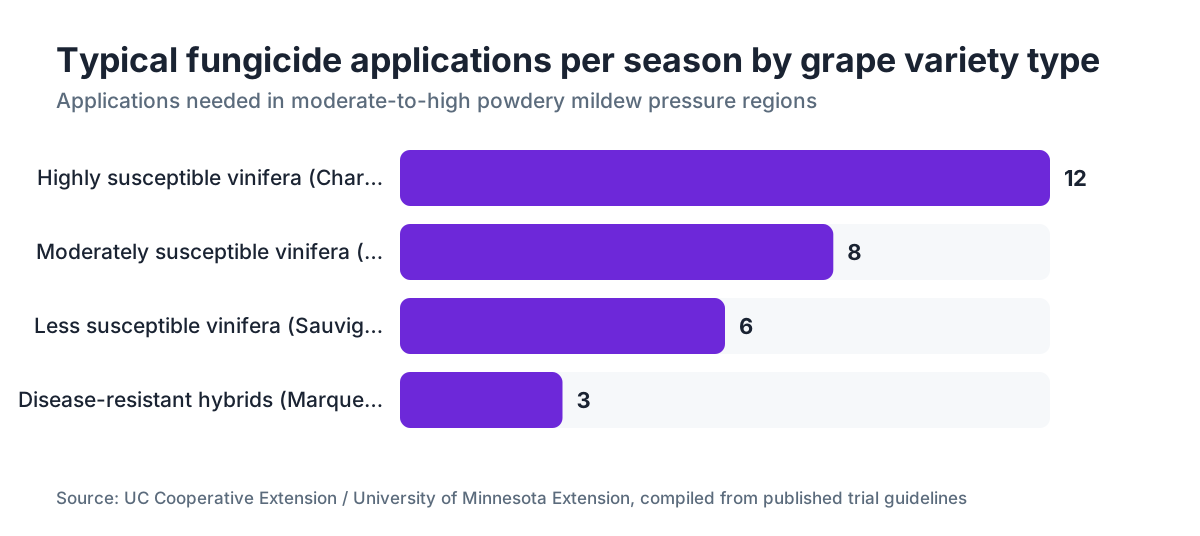
Vitis vinifera varieties are universally susceptible to E. necator because they evolved on a separate continent from the pathogen. American Vitis species (V. rotundifolia, V. riparia, V. rupestris) carry real natural resistance, and many disease-resistant hybrids bred by Cornell, the University of Minnesota, and European programs carry resistance genes from those American parents. [3][10] Marquette, Frontenac, La Crescent, and Traminette all show sharply reduced mildew pressure compared to vinifera, which allows programs of 2 to 4 applications against the 6 to 12 typical for susceptible vinifera. [10]
Within vinifera, the ranking still matters. Chardonnay and Cabernet Sauvignon sit among the higher-susceptibility varieties and consistently show earlier, worse infection in comparative trials. Sauvignon Blanc and Syrah tend to run somewhat less susceptible, though both still need a full program. Riesling is moderate. [1][2]
For growers farming vineyards planted to highly susceptible vinifera in warm, mildew-prone country (the interior of Paso Robles, the warmer blocks in Napa), budgeting for 8 to 12 fungicide applications a season is realistic, not excessive. Growers in cooler coastal blocks with better air movement may hold the line with 5 to 8.
What is the role of canopy management in powdery mildew control?
Canopy management is no substitute for chemistry, but it changes how much chemistry you need and how well what you apply actually works.
The mechanism is simple. E. necator thrives in the warm, humid, low-UV pocket inside a dense canopy. Open the canopy and you get more air movement, lower humidity around clusters, better spray penetration, and more UV, which kills conidia on exposed surfaces. [1][2]
The field evidence is strong. Leaf removal in the cluster zone at fruit set (typically 1 to 3 leaves off the east or shaded side of the shoot) is one of the most cost-effective moves a vinifera grower can add. UC Davis cooperative extension trial data consistently shows leaf removal at fruit set cutting cluster infection rates by 20 to 50% against non-removed controls when it runs alongside a standard spray program. [2]
Hedging and shoot positioning count too. Shoots hanging down into the fruit zone shade clusters and trap moisture. A tidy, vertically shoot-positioned canopy with an open middle is biologically different from a tangled, lax one, and that difference turns up in your disease pressure by midsummer.
None of this ends the need to spray. It cuts the number of applications, improves the ones you make, and lowers your total fungicide load, which is good for resistance management and for the budget.
How do you write a formal powdery mildew disease report for a vineyard block?
A plant pathology field report for powdery mildew is a different animal from a spray record. It is the written output of a scouting event, and it forms the documented basis for what you decide to do. Buyers, sustainability certifiers (California Sustainable Winegrowing Alliance, LIVE, Salmon-Safe), and increasingly lenders want proof that your spray program ran on documented scouting data, not a fixed calendar. [11]
A complete disease report for a powdery mildew scouting event should include:
Header block
- Block ID, variety, rootstock, plant year
- GPS coordinates or vineyard map reference
- Scouting date and start/end time
- Scout name
- Growth stage at scouting (use E-L staging)
- Gubler-Thomas or DAS risk index for the preceding 3 to 7 days (if available)
Observation data
- Number of vines examined
- Sampling protocol (every Nth vine, random walk, targeted high-risk areas)
- Count or percentage of vines with flag shoot symptoms (early season)
- Count or percentage of shoots infected per infected vine
- Count or percentage of clusters infected
- Severity rating (0 to 4 or 0 to 5 scale; describe your scale)
- Location of infection within cluster (tip, rachis, all surfaces)
- Photos with date-timestamp
Context and action section
- Disease pressure compared to last scouting date and same date last year
- Risk model output
- Recommended action (spray, skip, adjust interval)
- Fungicide selected and FRAC code
- Next scouting date scheduled
This looks like a lot on paper. In practice, a trained crew member can finish one block in 20 to 30 minutes on a tablet or a paper form later moved to a spreadsheet. Tools that timestamp, GPS-tag, and pull risk from weather data cut that time down hard. VitiScribe was built for this field-to-record workflow, and growers using it report scouting records that used to eat an afternoon a week now take under an hour.
If you are writing a report in a more academic or certifying context (a university trial, a pesticide use permit, a third-party IPM audit), the California Department of Pesticide Regulation's guidance on pest management record documentation is a useful template for what regulators expect to see. [8]
What does E. necator infection look like, and how do you distinguish it from other grape diseases?
Powdery mildew is one of the more distinctive grape diseases to look at, but early flag shoots and young cluster infections get confused with spray residue, sulfur deposits, and sometimes early Botrytis or Phomopsis. Know what you are actually seeing before you decide what to do.
Classic symptoms:
- White to gray powdery growth on both leaf surfaces, heaviest on the upper surface
- Young shoot tips coated in white mycelium, stunted and distorted
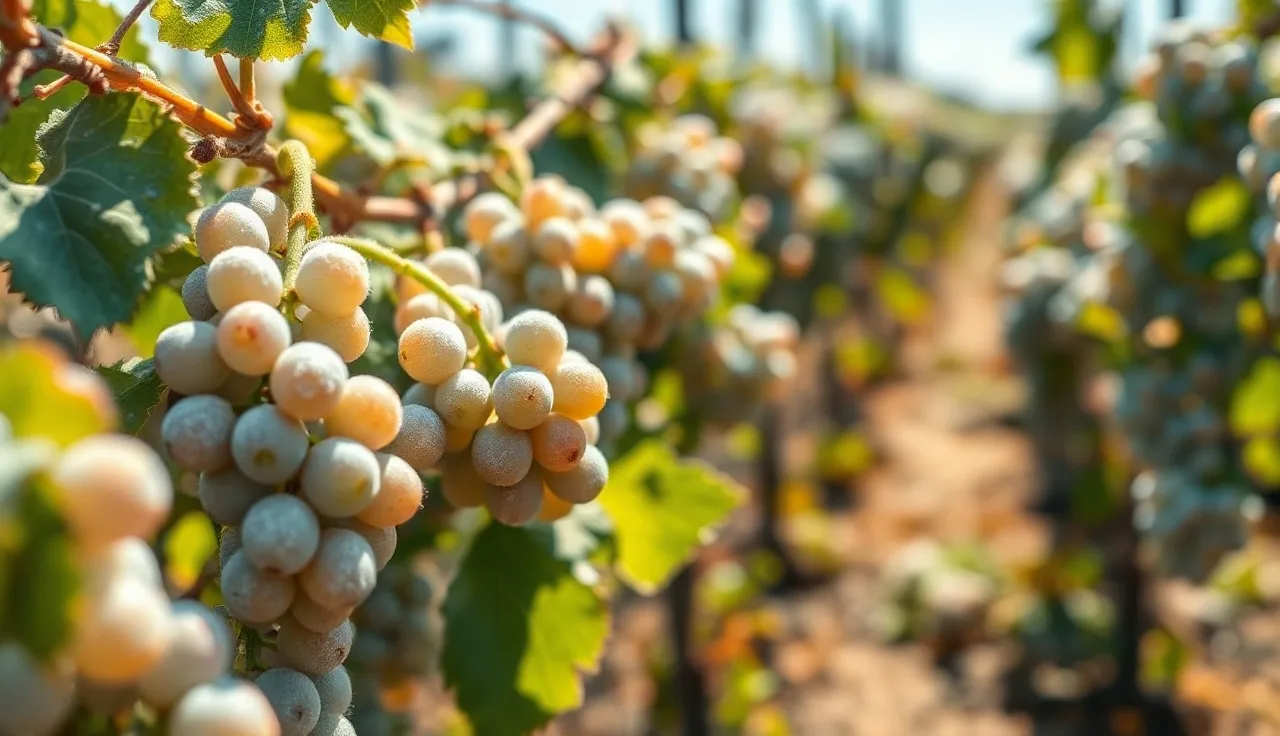
- Berries with a white powdery coating that rubs off to reveal green skin underneath (early), or russet-brown scarring once the infection has run
- Berries that crack or split at veraison from restricted skin expansion, often followed by secondary Botrytis
- A faint musty, mousy odor in heavily infected clusters, noticeable at harvest
Telling it apart from the look-alikes:
- Sulfur spray residue does not rub off to reveal green tissue. It scatters as a yellow-gray dust. Powdery mildew rubs off to show healthy green beneath.
- Botrytis (gray mold) makes a gray-brown fuzzy sporulation, not white, and needs free water to infect. The sporulation looks clearly different at 10x under a hand lens.
- Phomopsis shoot blight causes dark lesions and eventual stem splitting, not white powdery growth. That tissue is brown, not white.
- Downy mildew (Plasmopara viticola) makes white sporulation only on the leaf underside, with matching yellowish oil spots on top. It needs free water to infect and is absent from many dry western vineyards.
When you are unsure, a 10 to 20x hand lens will show E. necator's branched conidiophores. A sample sent to a plant diagnostic lab (every major land-grant university runs one: UC Davis Plant Pathology, the Cornell Plant Disease Diagnostic Clinic, the WSU Plant Pest Diagnostic Clinic) can confirm ID within a few days. [3][4][12]
How do organic vineyards manage powdery mildew without synthetic fungicides?
Organic powdery mildew management is tighter on timing but doable in most regions. Fewer tools means each one has to be used right.
Sulfur is the anchor. Wettable or micronized sulfur at 2 to 4 lb product per acre on a 7 to 10 day interval during critical periods works when coverage is good and temperatures cooperate (between 50 and 90 degrees F at application). [5] Below 50 degrees F, sulfur vaporizes too slowly to do much. Above 90 to 95 degrees F, phytotoxicity risk climbs fast, worst on heat-sensitive varieties like Concord.
Kaolin clay (Surround WP) has some data behind it for mildew reduction through a physical barrier, though the evidence is less consistent than sulfur's. It performs better inside an integrated program than as a standalone.
Potassium bicarbonate disrupts the cell membrane of E. necator by shifting surface pH. Products like Milstop (85% potassium bicarbonate) show good efficacy data applied at or just after initial infection, which makes them a useful knockdown when scouting turns up early disease. [5]
Neem-based products and mineral oils (JMS Stylet Oil) carry efficacy data and are OMRI-listed for organic use. The main limit is phytotoxicity in heat and the need for thorough coverage.
Here is the honest part. In a high-pressure year, in a susceptible region, on a highly susceptible variety, an organic program can fail even when you execute it well. The break you feel may not be chemistry resistance at all. It may just be the biological ceiling of the available materials against a heavy inoculum load in a favorable environment.
Frequently asked questions
At what temperature does grape powdery mildew stop spreading?
Erysiphe necator conidial germination is inhibited above 95 degrees F, and the fungus is killed by 6 or more hours above 100 degrees F. Optimal sporulation and infection runs between 68 and 77 degrees F. Below about 50 degrees F, activity slows sharply. Heat events above 100 degrees F suppress disease temporarily, but the fungus survives in shaded canopy interiors and resumes when temperatures moderate.
What is the difference between powdery mildew and downy mildew on grapes?
Powdery mildew is caused by Erysiphe necator and produces white powdery growth on upper leaf surfaces and green tissue without free water. Downy mildew is caused by Plasmopara viticola, a water mold, and produces white sporulation only on leaf undersides with yellow oil spots on top. Downy mildew needs wet conditions to infect and is absent from many dry western vineyards where powdery mildew is severe.
How many fungicide sprays does a typical wine-grape vineyard need for powdery mildew?
Most susceptible vinifera varieties in moderate-to-high pressure regions need 6 to 12 fungicide applications per season, concentrated between pre-bloom and four weeks post-fruit set. Disease-resistant hybrids bred at Cornell or the University of Minnesota may need only 2 to 4. The exact number depends on variety susceptibility, region, canopy density, disease pressure, and the risk model output for that season.
How long before harvest should I stop spraying fungicides for powdery mildew?
Each fungicide has a pre-harvest interval (PHI) on the label, and that is the legally binding minimum. Common intervals: sulfur is 0 days; many DMI fungicides (Rally, Procure) are 7 days; some strobilurins (Pristine) are 7 days; Quintec is 7 days. Check the current label for every product every season, because PHIs can change when labels get revised. Organic buyers and some premium wineries set shorter or zero-tolerance windows.
What does the Gubler-Thomas powdery mildew model tell you, and where can I access it?
The Gubler-Thomas model uses three consecutive days of hourly temperature data to calculate a disease risk index from 0 to 100. Scores above 60 mean high risk and suggest spray intervals of 7 days or less. It is free through the UC IPM Grape Pest Management Guidelines at ipm.ucanr.edu. Washington State University's Decision Aid System offers similar functionality calibrated for Pacific Northwest conditions.
Are spray records for grape powdery mildew fungicides required by federal law?
Yes. FIFRA requires growers to keep records of restricted-use pesticide applications for at least two years and make them available to state lead agencies on request. The EPA Worker Protection Standard requires application information posted at a central location within 24 hours and kept for 30 days after the restricted-entry interval expires. Many states add stricter rules; California's PUR system requires reporting within 7 days of application.
What is the most susceptible grapevine growth stage for powdery mildew infection?
Berries are most susceptible from 10 to 14 days before bloom through four to six weeks after fruit set, roughly E-L stages 17 through 29. During that window the berry skin cuticle is thin and expanding fast. After it, berries develop resistance. Leaves stay susceptible from budbreak through roughly 7 to 10 weeks of age. Shoot tips stay susceptible all season.
How do I manage powdery mildew fungicide resistance in my vineyard?
Rotate strictly by FRAC code, not trade name. Never apply the same FRAC group in consecutive applications during the same season. Work in multi-site materials (sulfur, copper) as rotation partners, since they carry no known resistance risk. Avoid DMI and strobilurin fungicides as standalone materials, because confirmed resistance is widespread in E. necator. Track which FRAC codes hit each block by recording them on every spray ticket.
Can powdery mildew affect wine quality even if berry infection looks mild?
Yes. Even low-level E. necator infection in clusters can produce off-flavors in finished wine. Infected berries carry compounds including a mushroom-like lactone (1-octen-3-ol) and other volatiles detectable at parts-per-billion levels. Some research suggests infection as low as 3% of cluster surface area can produce sensory-detectable flaws in sensitive varieties. Zero cluster tolerance in premium programs is not excessive.
Does leaf removal help reduce powdery mildew on grapes?
Yes, with solid evidence behind it. Removing 1 to 3 leaves from the cluster zone at or just after fruit set improves air circulation, lowers canopy humidity, increases UV that kills conidia, and improves spray penetration into the cluster zone. UC Davis cooperative extension trial data consistently shows a 20 to 50% reduction in cluster infection against non-removed controls when it runs with a standard fungicide program.
What plant diagnostic labs can confirm whether I have powdery mildew or another grape disease?
Every major land-grant university in wine-grape states runs a plant disease diagnostic clinic. UC Davis Department of Plant Pathology, the Cornell Plant Disease Diagnostic Clinic, and the WSU Plant Pest Diagnostic Clinic all accept grape samples. Submission fees typically run $25 to 75 per sample for standard identification. Most labs confirm E. necator versus other pathogens within 3 to 5 business days using visual examination and, when needed, molecular ID.
What is the restricted-entry interval for sulfur on grapes?
The restricted-entry interval for wettable sulfur on grapes is typically 24 hours under the EPA Worker Protection Standard for most labeled products. You still have to read the specific product label, because formulations vary. The WPS also requires that the REI and other application information be posted at the establishment's central location within 24 hours and stay posted for 30 days after the REI expires.
Are disease-resistant grape varieties worth planting to reduce powdery mildew pressure?
For growers with flexibility in variety selection, yes. Cornell, the University of Minnesota, and European programs have released varieties like Marquette, Frontenac, La Crescent, and Traminette that carry real resistance from American Vitis species. These typically need 2 to 4 fungicide applications per season against 6 to 12 for susceptible vinifera. The tradeoff is market acceptance and stylistic constraints that depend heavily on your region and buyers.
Sources
- UC IPM, Grape Pest Management Guidelines: Powdery Mildew: Erysiphe necator biology including conidia germination at 25 to 40% relative humidity, optimal infection temperatures of 68 to 77°F, tissue susceptibility windows, and overwintering as mycelium in dormant buds
- UC Davis Plant Pathology / UC Cooperative Extension, Grape Powdery Mildew Management: Yield losses of 30 to 50% in severely infected vineyards, Gubler-Thomas risk model description and thresholds, berry susceptibility window from pre-bloom through 4 to 6 weeks post-fruit set, leaf removal efficacy data
- Cornell University, Plant Disease Diagnostic Clinic and Grape IPM resources: Chasmothecia ascospore inoculum in wet-spring regions, Finger Lakes and Hudson Valley IPM framework, Cornell disease-resistant grape breeding, Cornell Plant Disease Diagnostic Clinic services
- Washington State University Extension, Grape Powdery Mildew: WSU Decision Aid System (DAS) for disease risk modeling, WSU Plant Pest Diagnostic Clinic services, FRAC rotation guidance for Pacific Northwest conditions
- UC Davis, Organic Management of Powdery Mildew in Grape: Efficacy of potassium bicarbonate (Milstop, Kaligreen) and sulfur for organic powdery mildew control; temperature constraints for sulfur application (phytotoxicity above 90 to 95°F)
- US EPA, Worker Protection Standard for Agricultural Pesticides: WPS requirements for posting pesticide application information within 24 hours, retaining records for 30 days post-REI, and minimum spray record elements including REI and PHI
- US EPA, Federal Insecticide Fungicide and Rodenticide Act (FIFRA): FIFRA requirement to keep restricted-use pesticide application records for at least two years
- California Department of Pesticide Regulation, Pesticide Use Reporting: California PUR requirement to report pesticide applications to county agricultural commissioner within 7 days; fines starting at $500 per violation per day; 3-year audit window
- New York State Department of Environmental Conservation, 6 NYCRR Part 325 Pesticide Reporting: New York State pesticide record-keeping requirements under 6 NYCRR Part 325
- University of Minnesota Extension, Cold-Hardy and Disease-Resistant Grape Varieties: Disease-resistant hybrid varieties (Marquette, Frontenac, La Crescent, Traminette) require substantially reduced fungicide programs of 2 to 4 applications vs. 6 to 12 for susceptible vinifera
- California Sustainable Winegrowing Alliance, Certified California Sustainable Winegrowing Program: Third-party sustainability certification requires documented scouting records to justify spray program decisions
- UC Davis Department of Plant Pathology, Plant Diagnostic Clinic: UC Davis Plant Disease Diagnostic Clinic accepts grape samples for E. necator and other pathogen identification
Last updated 2026-07-09