Grape powdery mildew scientific name, biology, and control
TL;DR
- Grape powdery mildew is caused by Erysiphe necator Schwein., an obligate biotrophic fungus once classified as Uncinula necator.
- It is the most economically damaging fungal disease of grapevines worldwide and can wipe out a crop when left alone.
- The asexual stage is Oidium tuckeri.
- Every spray-timing and resistance-management call you make comes back to this organism's lifecycle.
What is the scientific name of grape powdery mildew?
The fungus behind grape powdery mildew is Erysiphe necator Schwein., in the family Erysiphaceae, order Erysiphales, phylum Ascomycota [1]. You will still see the old name Uncinula necator in older literature, spray guides, and some equipment labels, but that classification changed in the late 1990s when molecular phylogenetics reorganized the Erysiphales. Both names point to the same fungus.
The asexual (anamorph) stage is Oidium tuckeri Berk., named after Edward Tucker, the English gardener who first described the disease on European grapevines in 1845 in Margate, Kent. Oidium tuckeri is what you see every season: the white, talcum-powder colonies on leaves, shoots, and berries. The sexual stage, Erysiphe necator, produces the overwintering cleistothecia (called chasmothecia in current mycology) that carry the fungus through winter [2].
Here is the full taxonomy worth knowing. Kingdom Fungi, Phylum Ascomycota, Class Leotiomycetes, Order Erysiphales, Family Erysiphaceae, Genus Erysiphe, Species necator. The genus Erysiphe covers powdery mildews on hundreds of plant hosts. The species name necator comes from the Latin for "killer," which is blunt and accurate.
Is Erysiphe necator the same as Uncinula necator?
Yes, completely. For decades the standard name was Uncinula necator, and it still shows up on EPA-registered pesticide labels, extension spray guides printed before roughly 2002, and USDA disease databases nobody has updated. The reclassification happened after researchers compared ribosomal DNA sequences across powdery mildew genera and found that Uncinula species sat inside Erysiphe [3].
Here is what that means at the desk. If an old WSU or UC Davis spray guide says Uncinula necator, trust it. The biology, thresholds, and chemistry all apply directly to the fungus you are managing. Don't waste time hunting for a second source.
The anamorph name Oidium tuckeri has also stuck around on some OMRI-listed product labels, particularly sulfur formulations that have been sold since the 1800s. Regulatory agencies recognize all three names, so you will not fail a pesticide record audit for citing any of them. Current scientific publications use Erysiphe necator.
How does Erysiphe necator survive the winter and infect new growth?
Erysiphe necator overwinters two ways, and knowing which one runs your region sets your early-season scouting [4].
The main survival route in most California and Pacific Northwest vineyards is dormant mycelium inside bud scales. The fungus colonizes bud tissue during the previous season and rides out with shoot growth in spring. These flag shoots, the first infected shoots visible in spring, carry white, feltlike mycelium from the first expanded leaves. Cornell and UC Davis both call flag shoot incidence in a block one of the best early-season risk signals you have [2][4].
The second route is cleistothecia. These small, dark, round structures form on infected tissue late in the season, drop to the vineyard floor or stay on the bark, and release ascospores during rain events after budbreak. In humid eastern regions like the Finger Lakes or Virginia, ascospore release can be the dominant primary inoculum, and weather-based models built around rain and temperature accumulation predict infection risk from this source [4].
After primary infection, secondary spread through conidia is fast. A single infected leaf can produce tens of thousands of conidia per square centimeter per day at optimal temperatures. The disease is entirely airborne. Water splash is not required for spread, which is one reason it does so well in dry, warm summers that would shut down Botrytis or downy mildew.
What temperature and humidity conditions favor powdery mildew outbreaks?
Erysiphe necator is odd among fungal plant pathogens. It does best in warm, dry weather, not wet. Optimal colony growth and conidial germination run between 70°F and 86°F (21°C to 30°C) [1][4]. Germination can happen across a broad range, from roughly 50°F to 95°F, but slows sharply outside the 68°F to 86°F band.
High relative humidity above 40 percent speeds germination and infection. Free water on the leaf surface, though, actually blocks conidial germination. That is why overhead irrigation or morning dew can briefly suppress the disease, and why afternoon drying with warm temperatures kicks it right back on.
Heat helps you for a moment. Temperature at or above 95°F (35°C) kills conidia outright, which is why some inland California appellations get a natural mid-summer break in pressure during heat spikes. The break is temporary. Nights fall back into the optimal range and the disease resumes.
Many commercial models use degree-day accumulation above a 50°F base since budbreak to estimate when first flag shoots appear and when ascospore release peaks. The UC Davis Powdery Mildew Risk Index, developed by Doug Gubler and colleagues, uses a 7-day temperature index to sort infection risk into low, medium, or high, which then sets spray intervals [4]. UC IPM describes the index in full, and it is still one of the most widely used management tools in California viticulture.
| Temperature Range | Effect on Erysiphe necator |
|---|---|
| Below 50°F (10°C) | Germination essentially stops |
| 50-68°F (10-20°C) | Slow growth, low infection risk |
| 68-86°F (20-30°C) | Optimal growth and conidiation |
| 86-95°F (30-35°C) | Growth slows, heat stress on conidia |
| Above 95°F (35°C) | Conidia killed, colonies suppressed |
What grapevine parts does powdery mildew attack, and when is infection most damaging?
Erysiphe necator infects every green, above-ground part of the vine: leaves, shoots, tendrils, flower clusters, and berries [1][2]. The damage hierarchy runs berries first, clusters second, leaves and shoots a distant third in most seasons.
Berries are most susceptible from bloom through roughly 4 to 6 weeks after fruit set, the window before véraison starts. Young berry skin has a thin cuticle and is still growing fast. Infections here scar and crack the epidermis, cause direct fruit loss to splitting and secondary Botrytis, and put off-flavors into the wine. Research cited by UC Cooperative Extension found that as little as 3 percent powdery mildew coverage on berries at harvest can produce detectable sensory defects in wine [2]. Three percent. That is a number worth remembering.
Flower cluster infection is the single most damaging event. Infected flowers fail to set, and infections that establish at bloom are hard to eradicate once the rachis is colonized. That is why the spray window from 10 to 20 percent bloom through 4 weeks post-bloom is treated as non-negotiable by most advisors.
Leaf infections matter more than they look. Severe leaf infection cuts photosynthesis and, worse, the infected tissue pumps out conidia that then hit the fruit. Defoliation from severe infection is rare but real in unmanaged organic blocks, and it sets vine development back hard.
How do you identify grape powdery mildew in the field?
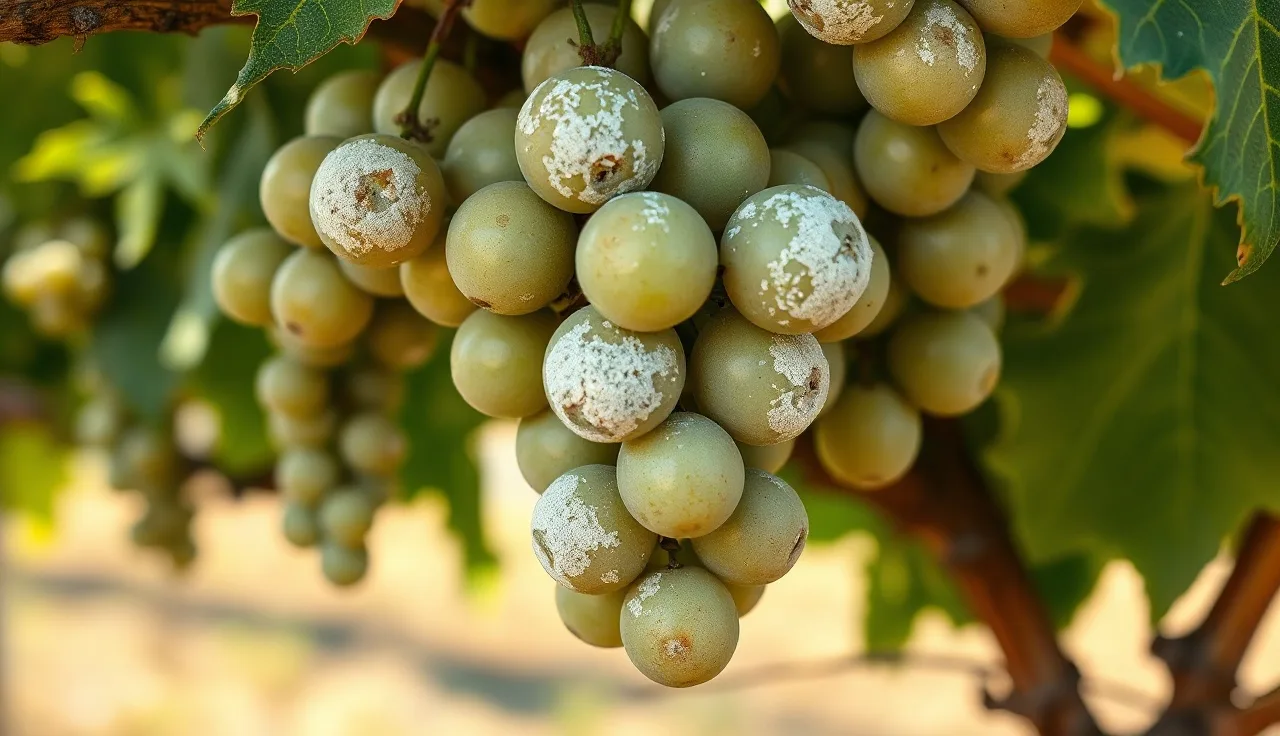
The classic sign is white to grayish-white powdery colonies on the surface of infected tissue [1][4]. On leaves you often see the colonies first on the upper surface, though the fungus colonizes both sides. Infected leaves can develop chlorotic patches on top that match mycelial colonies underneath.
On berries, early infections look like a faint, weblike white coating that thickens into a denser colony. Infected berries turn tan or brown once the colony dies, leaving visible scarring. In advanced cases the berries crack and shrivel.
Flag shoots are the giveaway in spring. Look for a shoot with leaves fully coated in white mycelium coming straight out of an infected bud. Scouting for flag shoots at the 5 to 10-leaf stage is standard in regions where mycelial overwintering is the main inoculum.
Visual confirmation is usually easy. Powdery mildew has that dry, white coating that wipes off with your finger, unlike downy mildew (Plasmopara viticola), which forms gray-white sporulation mostly on the leaf undersurface and needs free moisture to spread. If you are unsure, a 10x hand lens shows the upright conidiophores of Oidium tuckeri standing off the surface. For a lab confirmation, any plant diagnostic lab at a land-grant university can identify it from a fresh sample.
What fungicide chemistries are registered for Erysiphe necator on grapevines?
Fungicides for grape powdery mildew break into several FRAC (Fungicide Resistance Action Committee) groups, and rotating between groups is the only reliable way to hold off resistance [5][11].
Sulfur is FRAC Group M2, a multi-site contact fungicide with no known resistance risk. It has been used on grapevines since the 1850s, costs $15 to $40 per acre per application depending on formulation and rate, and is still the backbone of most spray programs. Sulfur is phytotoxic above roughly 90°F to 95°F on sensitive varieties, so keep it clear of heat events and don't apply within 2 weeks of an oil spray.
DMI fungicides (demethylation inhibitors, FRAC Group 3) include myclobutanil and tebuconazole. They are systemic and give both protectant and curative activity inside a 3 to 4-day post-infection window. Reduced DMI sensitivity in Erysiphe necator populations has been documented in California, New York, and Oregon [5].
QoI fungicides (strobilurins, FRAC Group 11) like azoxystrobin and trifloxystrobin work well but carry serious resistance risk. Resistance alleles turn up at high frequency in some California counties. Most extension programs now treat QoIs as support chemistries, not program anchors, and cap them at 2 applications per season.
SDHI fungicides (FRAC Group 7, succinate dehydrogenase inhibitors) like fluxapyroxad are newer. Resistance monitoring for SDHIs in E. necator is still thin but building.
Potassium bicarbonate (FRAC Group NC) and biological products (Bacillus subtilis, Reynoutria sachalinensis extract) registered under reduced-risk programs round out the toolkit for organic and transitional blocks.
| FRAC Group | Chemistry | Example AI | Resistance Risk |
|---|---|---|---|
| M2 | Inorganic sulfur | Sulfur | None documented |
| 3 | DMI / triazole | Myclobutanil, Tebuconazole | Moderate, documented |
| 11 | QoI / strobilurin | Azoxystrobin | High, documented |
| 7 | SDHI | Fluxapyroxad | Low-moderate, emerging |
| U6 | Cyflufenamid | Cyflufenamid | Low, newer |
| NC | Biochemical | Potassium bicarbonate | None |
| BM02 | Microbial | Bacillus subtilis | None |
How do you build a spray program that manages resistance in Erysiphe necator?
Resistance management for E. necator is not optional in a commercial block. Reduced DMI sensitivity has been documented in California since the early 2000s, and QoI resistance alleles show up at high frequency in some Napa and Sonoma samples [5]. The upshot is simple: a program built around one or two FRAC groups stops working.
FRAC guidelines and UC Davis extension both say to rotate fungicides from different groups in consecutive applications and never apply the same FRAC group more than twice in a row. Cornell's viticulture program says the same for Finger Lakes and Hudson Valley growers, with one extra rule: QoIs (Group 11) capped at 2 applications per season total, not per interval [4][6].
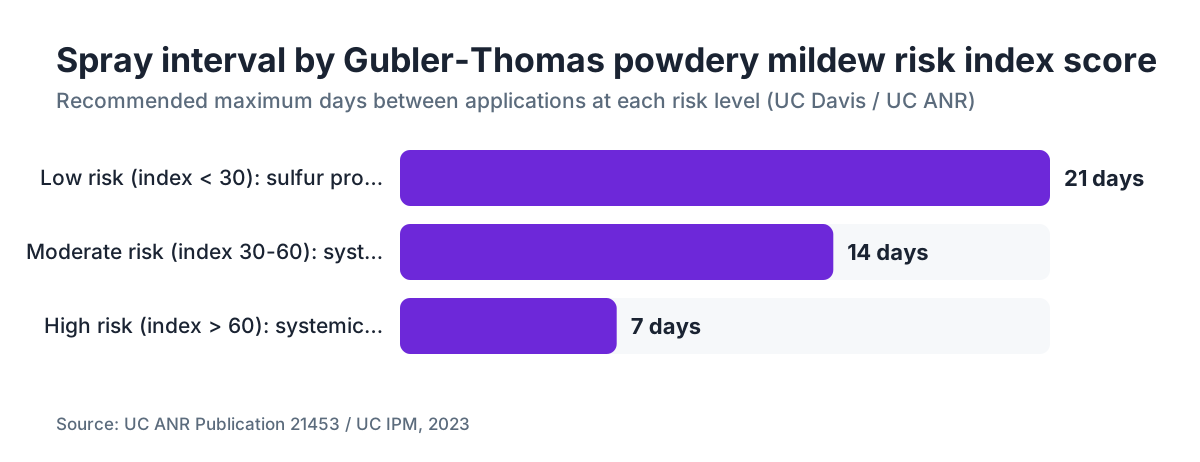
Timing carries as much weight as chemistry. The stretch from 10 percent bloom to 4 weeks post-fruit set gets your highest-efficacy materials on your shortest intervals. Push intervals past 14 days during warm, dry weather in that window and you hand the disease an opening. Many advisors lean on the UC Davis Powdery Mildew Risk Index here. A 7-day score below 30 means low risk (21-day sulfur intervals hold), 30 to 60 means moderate risk (14-day intervals, think about adding a systemic), and above 60 means high risk (7-day intervals, systemic chemistries warranted).
If you keep spray records in a dedicated platform, logging FRAC groups with each application makes end-of-season resistance audits painless. VitiScribe builds FRAC rotation tracking into its spray record module, so you can see group sequences across a whole season at a glance. That is handy when you are prepping for a GAP audit or a PCA review.
For organic programs, sulfur anchors every application, with potassium bicarbonate or mineral oil rotated on a 7 to 14-day schedule during high-risk periods. Biological products like Bacillus subtilis strain QST 713 add useful suppression as supplements. They cannot carry the program alone under heavy pressure.
What does the EPA Worker Protection Standard require for powdery mildew spray records?
The EPA Worker Protection Standard (WPS), at 40 CFR Part 170 with the 2015 revision, requires agricultural employers to keep records of pesticide applications on agricultural establishments [7]. Those records must include the product name, EPA registration number, active ingredient, amount applied, location, date and time, and the restricted-entry interval (REI).
For powdery mildew fungicides, REIs vary. Most sulfur formulations carry a 24-hour REI. Many DMI and QoI products also carry 24-hour REIs, though some formulations run higher. Cyflufenamid (Torino) carries a 12-hour REI. Always check the specific product label. The label is the law.
WPS requires you to post pesticide application information at a central location workers can reach and to give oral and written notification when REIs are in effect. Records must be kept for 2 years [7]. States pile on: California's DPR requires licensed PCAs to submit recommendation documents and operators to keep records for 3 years under the California Food and Agricultural Code [8].
WPS also requires training for every worker who enters treated areas during REIs and for early-entry workers, using EPA-approved materials, with training records kept. Missing records is one of the most common WPS citations in vineyard inspections.
Which grape varieties are most susceptible to Erysiphe necator?
Every Vitis vinifera variety is highly susceptible to Erysiphe necator because vinifera evolved in Eurasia with no prior exposure to the pathogen, which is native to North America [1][2][10]. Within vinifera there is a gradient. Chardonnay, Cabernet Sauvignon, Syrah, and Pinot Noir are heavily susceptible. Carignan and Grenache are sometimes called slightly more tolerant, but no commercial vinifera variety carries meaningful genetic resistance.
North American Vitis species, especially Vitis rotundifolia (muscadine) and to a lesser degree Vitis labrusca hybrids, carry native resistance to E. necator. That resistance is the foundation for breeding programs at Cornell, UC Davis, and USDA-ARS working to move powdery mildew resistance into wine-quality varieties [6]. Several PIWI varieties (fungus-resistant varieties) from European breeding programs, including Regent, Cabernet Blanc, and Souvignier Gris, express quantitative resistance drawn from North American Vitis introgressions. These varieties can stretch spray intervals a lot, sometimes down to 2 or 3 applications a season instead of 8 to 12, which changes the whole economics of growing in humid regions.
For conventional vinifera blocks, variety selection does not remove the problem. You manage it with fungicide programs and canopy work. You do not dodge it.
How does canopy management affect powdery mildew pressure?
Dense canopies build a microclimate E. necator loves, two ways. They raise relative humidity in the fruiting zone, and they block spray penetration so fungicide coverage on clusters goes poor [4]. Both push disease pressure up and program efficacy down.
Leaf removal in the cluster zone, standard in most quality vinifera viticulture, cuts berry infection directly. Cornell trials and multiple European studies found that pulling 1 to 2 leaf layers from the eastern or morning-sun side of the cluster zone at or shortly after fruit set reduced powdery mildew on berries by 40 to 60 percent in some trials, independent of the fungicide program [6]. It also improves air movement and drying, which knocks back secondary Botrytis.
Shoot positioning and hedging decide how well sprayers reach the fruit. A well-positioned, hedged VSP (vertical shoot positioning) trellis gives far better cluster-zone coverage than a sprawling, unmanaged canopy. If your spray records show heavy fungicide use and you are still getting berry infections, canopy architecture is usually the problem, not chemistry or timing.
Irrigation timing matters too. Morning cycles that wet the canopy before midday dry off faster than late-afternoon irrigation, which leaves wet tissue heading into the optimal overnight temperature range for germination.
If you want to see what a well-run vineyard spray and canopy program looks like at the regional level, appellations like Paso Robles, where warm, dry summers drive intense E. necator pressure, are useful examples of what holds up under sustained pressure.
What do university extension programs recommend for scouting grape powdery mildew?
UC Davis, Cornell, and Washington State University all publish free, peer-reviewed powdery mildew management guides, and their scouting protocols line up closely [2][4][6][9].
Budbreak through the 10-leaf stage: scout for flag shoots in every block, especially blocks with a history of late-season disease. Walk the row middles and check shoot tips on at least 50 shoots per block. Record flag shoot incidence as a percentage. Even 1 percent means primary inoculum is present and your program needs to be running.
Bloom through 4 weeks post-fruit set: the highest-priority window. Examine flower clusters and young berries on at least 50 clusters per block per week. Record incidence (percent of clusters infected) and severity (percent of cluster surface infected). Cornell's disease management guide gives an action threshold of 1 to 5 percent cluster incidence as the trigger to tighten spray frequency or move to a higher-efficacy chemistry [6].
Mid-season through véraison: keep scouting weekly. Note whether infections are active (white mycelium present) or old (tan, scarred tissue, no fresh sporulation). Active late-season leaf infections still produce conidia that threaten late-ripening clusters and feed cleistothecia production for next year.
Post-harvest: assess cleistothecia density on bark and leaves if you want an estimate of inoculum load for next season. Not routine for most operations, but worth doing in blocks with chronic pressure.
WSU extension also pushes the Gubler-Thomas powdery mildew risk model (available through licensed weather station networks in Washington) to match scouting intensity to environmental risk, so you are not spending the same hours in low-risk early weeks as during the high-risk bloom window [9].
Good scouting records feed good spray records. A tool like VitiScribe lets you log scouting observations and link them straight to your spray applications, so your PCAs and certifiers can see the whole decision chain.
Frequently asked questions
What is the full scientific name and classification of grape powdery mildew?
Grape powdery mildew is caused by Erysiphe necator Schwein., Kingdom Fungi, Phylum Ascomycota, Class Leotiomycetes, Order Erysiphales, Family Erysiphaceae. The asexual stage is Oidium tuckeri Berk. The older name Uncinula necator refers to the same organism. Every published extension management guide under either name applies to the same pathogen.
Why was the name changed from Uncinula necator to Erysiphe necator?
The reclassification followed molecular phylogenetic studies in the late 1990s that compared ribosomal DNA sequences across powdery mildew genera. Those studies found that Uncinula species, including U. necator, grouped inside the genus Erysiphe rather than forming a separate lineage. Index Fungorum and MycoBank now list Erysiphe necator as the accepted name, with Uncinula necator as a synonym.
What does Erysiphe necator look like under a microscope?
Conidia of the Oidium stage are barrel-shaped or cylindrical, roughly 25 to 35 micrometers long and 12 to 17 micrometers wide, and form in chains on upright conidiophores. Cleistothecia (chasmothecia) are spherical, dark brown to black, 75 to 110 micrometers across, with appendages that have hooked or coiled tips, a distinguishing feature of the Erysiphaceae.
Can grape powdery mildew spread to other plant species?
Erysiphe necator infects only grapevines in the genus Vitis. It does not spread to vegetable crops, fruit trees, or ornamentals. Other powdery mildew species affect those crops but are distinct fungi. E. necator from grape will not infect squash, roses, or cereal grains, so intercropping those species in a vineyard creates no cross-infection risk from E. necator.
Is sulfur still effective against Erysiphe necator given resistance concerns?
Yes. Sulfur is a multi-site contact fungicide in FRAC Group M2, and no resistance mechanism has been documented in E. necator populations. Resistance to single-site fungicides like DMIs (Group 3) and QoIs (Group 11) is a documented problem, but sulfur stays fully effective. It is also the cheapest option, typically $15 to $40 per acre per application, and is accepted in organic programs.
When should I apply the first powdery mildew spray of the season?
Most extension programs recommend starting at the 2 to 4-inch shoot growth stage, roughly 30 to 50 growing degree days after budbreak. If you scout and find flag shoots earlier, start at first flag shoot sighting. UC Davis and Cornell both stress that protecting tissue from the moment it emerges beats waiting for visible symptoms, since early shoot growth is when the infection cycle is shortest to interrupt.
How long does it take for Erysiphe necator to complete an infection cycle?
At optimal temperatures (68 to 77°F), conidia germinate within 4 to 8 hours of landing on susceptible tissue, and new conidia come off the resulting colony within 5 to 7 days. A single warm week with no fungicide protection allows multiple infection cycles. The latent period from germination to new spore production ranges from about 5 days at 77°F to 2 weeks or more at cooler temperatures.
What is the difference between grape powdery mildew and grape downy mildew?
Grape powdery mildew (Erysiphe necator) is an ascomycete that thrives in warm, dry conditions and produces white powdery colonies on all green tissue. Downy mildew (Plasmopara viticola) is an oomycete that requires free moisture, spreads by zoospores, and produces grayish-white sporulation mainly on leaf undersurfaces. They need different chemistries. Most DMIs and QoIs hit both, but sulfur has no activity against Plasmopara viticola.
Do I need to keep spray records for powdery mildew applications if I am a small farm?
Federal WPS requirements at 40 CFR Part 170 apply to agricultural employers who hire workers to handle pesticides or work in treated areas, regardless of farm size. California adds requirements under the California Food and Agricultural Code, with records kept for 3 years. Even farms exempt from WPS coverage benefit from records for FSMA traceability, GAP audits, and winery purchasing requirements. Short answer: yes, keep them.
Are PIWI or hybrid grape varieties immune to powdery mildew?
No variety is fully immune, but several PIWI varieties bred with Vitis rotundifolia or other resistant North American Vitis species carry quantitative resistance that sharply cuts susceptibility. Varieties like Regent, Cabernet Blanc, and Souvignier Gris may need only 2 to 4 fungicide applications per season under moderate pressure, against 10 to 14 for vinifera. They are not immune. A severe season or a compromised canopy can still produce economically significant infections.
What is the Gubler-Thomas powdery mildew risk index?
The Gubler-Thomas index, developed at UC Davis, is a 7-day running index based on daily temperature. Days with temperatures between 70 and 85°F add 20 points; days between 50 and 70°F or 85 and 95°F add 10 points; days above 95°F reset the index to 0. The resulting score sets spray intervals: below 30 is low risk, 30 to 60 is moderate, above 60 is high.
Can powdery mildew infections on grapes be cured after symptoms appear?
DMI fungicides (Group 3) offer curative activity within 72 to 96 hours of infection, before symptoms show, not after colonies are established. Once you see mature white mycelium on berries, you are in suppression mode, not eradication. Mature colonies can be partly knocked back by some materials, but berry scarring and infection inside the skin are permanent. Prevention and early intervention always beat late-season rescue attempts.
What native North American region did Erysiphe necator originate from?
Erysiphe necator is native to eastern North America, where it evolved alongside native Vitis species like Vitis labrusca and Vitis riparia. Those species developed tolerance to the pathogen over millions of years of co-evolution. The disease reached Europe with American vines in the mid-1840s, was first described in England in 1845, and spread fast through European vineyards because Vitis vinifera had no prior exposure and carries no native resistance.
Sources
- UC IPM, UC Division of Agriculture and Natural Resources: Powdery Mildew of Grape: Erysiphe necator (formerly Uncinula necator) is the causal organism; optimal temperature range 70-86°F; infects all green tissue
- UC Cooperative Extension: Grape Powdery Mildew Management in California Vineyards: Oidium tuckeri anamorph; flag shoot biology; as little as 3% berry infection at harvest produces detectable wine sensory defects
- Index Fungorum, Royal Botanic Gardens Kew: Species record for Erysiphe necator: Uncinula necator reclassified as Erysiphe necator following molecular phylogenetic revision of Erysiphales; synonym status
- UC ANR Publication 21453: Grape Pest Management, Powdery Mildew chapter: Two overwintering mechanisms: dormant mycelium in buds and cleistothecia; Gubler-Thomas risk index thresholds and spray interval guidance
- UC Davis Department of Plant Pathology: Fungicide Resistance in Erysiphe necator: Documented DMI and QoI resistance in California E. necator populations; FRAC group rotation recommendations
- Cornell Cooperative Extension: Grape Powdery Mildew Management Guide: Flag shoot scouting protocol; action threshold 1-5% cluster incidence; QoI cap 2 applications per season; leaf removal reducing berry infection 40-60%
- EPA Worker Protection Standard, 40 CFR Part 170: Required pesticide application record contents; records must be kept for 2 years; worker training and REI posting requirements
- California Department of Pesticide Regulation: Pesticide Use Reporting: California requires pesticide application records to be kept for 3 years under California Food and Agricultural Code
- Washington State University Extension: Pacific Northwest Plant Disease Management Handbook, Grape Powdery Mildew: WSU recommendations for scouting protocols and use of Gubler-Thomas model in Pacific Northwest vineyards
- USDA National Agricultural Library: Erysiphe necator taxonomy and host range: Erysiphe necator restricted to Vitis genus hosts; native to eastern North America; introduced to Europe in 1840s
- FRAC (Fungicide Resistance Action Committee): Code List for Fungicides: FRAC group assignments for sulfur (M2), DMIs (3), QoIs (11), SDHIs (7), and cyflufenamid (U6) used against grape powdery mildew
Last updated 2026-07-09