How to scout for grape powdery mildew every week (extension guide)

TL;DR
- Scout vineyards for powdery mildew every 7 days from bud break through veraison, or more often during high-risk periods above 50°F.
- Focus on shoot tips, cluster stems, and the undersides of basal leaves.
- A single missed infection cycle can cost 20-80% yield loss on susceptible varieties.
- Extension programs at UC Davis, Cornell, and WSU all recommend weekly intervals as the minimum effective frequency.
Why does weekly scouting matter for grape powdery mildew?
Powdery mildew (Erysiphe necator, formerly Uncinula necator) is the single most damaging fungal disease in most North American vineyards. Losses run from cosmetic surface colonies on leaves all the way to complete cluster destruction and shorter vine life from repeated defoliation. The catch is that the disease moves fast. Under ideal conditions (65-77°F, relative humidity above 40%, no free water needed) a single infection cycle completes in 5-7 days [1]. A colony that was invisible Monday morning can be sporulating and infecting neighboring tissue by the following weekend.
Weekly scouting is not arbitrary. It matches the biological clock of the pathogen. Stretch your interval to 10 or 14 days and you're almost certain to miss a complete infection cycle during the riskiest stretch of the season. The UC Davis Integrated Pest Management (IPM) program puts it plainly: the critical period runs from early shoot growth through 3-4 weeks after bloom, and scouting at least once per week during that window is the minimum to keep any real awareness of what's happening [1].
The money argument holds up too. Analysis from University of California Cooperative Extension puts uncontrolled powdery mildew losses at 20-80% of yield on susceptible wine grape varieties, depending on canopy architecture and regional climate [2]. Even on resistant varieties, late-season cluster infections drag down fruit quality and open the door to Botrytis as a secondary pathogen. Weekly scouting is the cheap insurance, not the expensive option.
When should you start scouting each season?
Start at bud break. Not at bloom, not when you first see symptoms. By the time white colonies show up in the canopy, the fungus has already run through several infection cycles and populations are well established.
E. necator overwinters as chasmothecia (formerly called cleistothecia) in bark and as mycelium in dormant buds. Primary inoculum releases during the first rains after bud swell. Cornell's New York State IPM program points to flag shoots (shoots arising from infected buds) as one of the most reliable early indicators, and they appear right at or just after bud break, before any spray program has begun [3]. Find a flag shoot in week two of the season and you know the pathogen overwintered successfully in that block. That single detection reshapes your entire spray calendar.
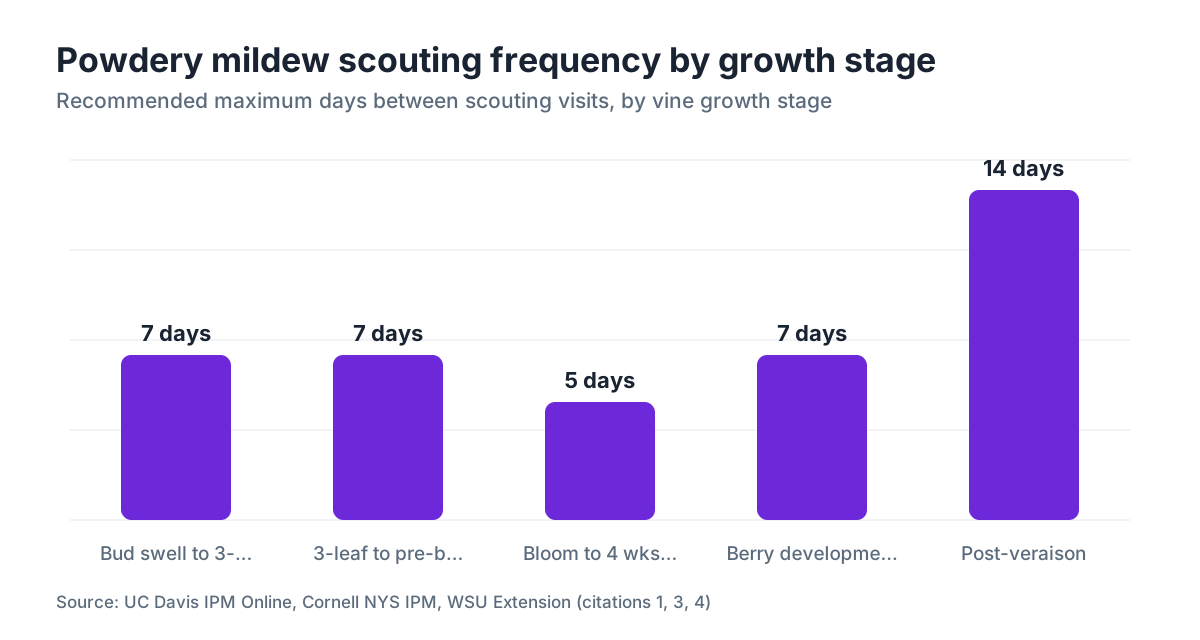
Here's the seasonal scouting timeline that matches what extension programs across the major grape-growing regions recommend:
| Growth Stage | BBCH Code | Scouting Frequency | Priority Sites to Check |
|---|---|---|---|
| Bud swell to 3-leaf | 01-13 | Weekly | Dormant buds, first emerging shoots (flag shoot check) |
| 3-leaf to pre-bloom | 13-57 | Weekly | Shoot tips, young leaves, basal leaves underside |
| Bloom to 4 weeks post-bloom | 61-75 | Every 5-7 days, or more often | Cluster stems (rachis), young berries, shoot tips |
| Berry development to veraison | 75-81 | Weekly | Cluster faces, leaves |
| Post-veraison | 81-89 | Every 10-14 days | Clusters for late infections, general monitoring |
The bloom-to-4-weeks-post-bloom window in that table is no accident. Berries are most susceptible from just before bloom until they reach roughly 8% Brix. WSU Extension names this period as the stretch when infection causes the most direct economic damage, because infected berries crack and shatter at harvest [4].
What exactly should you look at during each scouting visit?
Powdery mildew shows up differently depending on which tissue is infected and how far the colony has advanced. Knowing what to look for on each tissue type saves time and reduces misses.
Shoot tips show the classic white to gray powdery coating first. New growth is the most susceptible, and colonies on shoot tips mean the disease is actively climbing through the canopy. Check the top 2-3 internodes.
Leaves, particularly basal leaves (the oldest leaves near the base of the shoot), often show infections on the underside before the upper surface. Early colonies on the underside look like faint pale spots or areas of slightly oily texture that later develop white sporulation. Hold leaves up to the light or flip them. This step gets skipped far too often.
Cluster stems (rachis and pedicels) are where powdery mildew does the most serious damage. Infected stems turn brown or black and go brittle. Berries on infected stems may fail to develop normally or crack at harvest from restricted growth. Check the rachis on every cluster you examine, harder than you check the berry surface.
Berries before veraison show white colonies that are easy to spot. After veraison the fungus doesn't sporulate visibly on berries, but late infections cause russeting and cracking that only turn obvious at harvest. Unusual cluster cracking at picking with no clear cause? Late powdery mildew is always a suspect.
Per the UC Davis IPM guidelines, check a minimum of 10 randomly selected shoots and their associated leaves per sampling area, or about one shoot per vine in smaller blocks [1]. In blocks larger than 10 acres, split the block into zones based on variety, canopy architecture, or irrigation management, and sample each zone separately. Disease pressure is rarely uniform across a large block.
How do you record what you find in a way that's actually useful?
Your scouting data is only as good as your recording system. Verbal reports and mental notes disappear. A written or digital log that captures the date, location within the block (row number and position), growth stage, tissue type examined, approximate disease incidence (percent of samples showing infection), and severity (light/moderate/heavy) gives you a record you can compare week over week and season over season.
Incidence and severity are different metrics. Incidence is the percentage of scouted units showing any infection at all. Severity is how much of each infected unit is affected. For management decisions, incidence usually drives action thresholds. Cornell's guidelines suggest a threshold of 5-10% incidence on leaves during the pre-bloom period warrants a spray application if you're not already on a preventive program [3]. Some advisors set that threshold lower, at 3%, for high-value wine grape blocks or blocks with a documented history of heavy pressure.
A paper scouting form works fine, but it creates a transcription step later if you're keeping digital records for regulatory compliance. Vineyard operations software closes that gap. VitiScribe, for instance, lets you log scouting observations from your phone in the field and ties them to your pesticide application records, which matters when state agricultural agencies or certification auditors ask for integrated data. Whatever system you use, the whole thing rests on consistency: same observer methods, same record format, every week.
Weather data belongs in your scouting log too, or at least next to it. Temperature and relative humidity readings from the week before your observation help explain what you're seeing and predict what comes next. Many extension programs recommend keeping your scouting log and your weather station data in the same folder, digital or physical, so you can read them together.
What disease risk models should inform your scouting timing?
Scouting every seven days is the floor, not the ceiling. Risk models tell you when to tighten your frequency or when you can ease off a little.
The UC Davis/UCCE powdery mildew risk index, often called the 'Gubler-Thomas model' after its developers, is the most widely adopted model in the US. It uses a 7-day rolling average temperature to calculate a risk index from 0 to 100. An index above 60 means high infection risk and calls for more frequent scouting and shorter spray intervals. An index below 30 suggests low risk, though it never suggests you skip scouting entirely [5].
The model rests on a core finding: Erysiphe necator sporulation and germination is optimized between 68-77°F (20-25°C), and the fungus needs a minimum of 6 consecutive hours above 50°F (10°C) for germination to occur. Below 50°F or above 95°F (35°C), germination rates drop sharply. That's why a late spring cold snap can interrupt an early season epidemic, and why a hot inland summer temporarily suppresses surface mildew colonies even without sprays.
WSU's Decision Aid System (DAS), available through their extension network, applies similar logic to Pacific Northwest conditions and pulls in local weather station data [4]. New York growers can access Cornell's integrated weather-based alerts through the Network for Environment and Weather Applications (NEWA) platform, which pushes powdery mildew risk forecasts from local station data [3].
None of these models replace scouting. They tell you when to be extra diligent. During a high-risk week, scout on day five instead of day seven. During a cool, dry stretch with a risk index below 30, you might shift to a 10-day interval in low-pressure blocks while holding seven days in blocks with a history of problems.
How do you use scouting data to make spray decisions?
Scouting without a decision framework is just walking. The data you collect should drive three decisions: whether to spray, what to spray, and when to spray.
The first decision, whether to spray, depends on the action threshold for your block and growth stage. Most extension programs recommend a preventive approach during the high-risk window (bud break through 4 weeks post-bloom), meaning you apply fungicides on a calendar schedule calibrated to your risk model rather than waiting for symptoms. The reason is simple: once you can see sporulating colonies with the naked eye, you're already behind. Protectant fungicides work far better applied before infection than after [1].
After the high-risk window closes (around veraison), you can shift to a reactive approach. Treat if scouting shows active infection spreading, skip if pressure is low. This is when your weekly scouting data earns its keep, because it lets you cut spray costs in low-pressure years without giving up control.
For spray selection, scouting data on resistance history matters. If you saw control failures with a particular fungicide class (FRAC Group 3 DMIs, Group 11 QoIs) in a previous season, documented in your scouting logs, that's your justification for rotating to an alternative class. Resistance management is not possible without multi-year records showing what was sprayed and whether it worked.
Timing is the third decision. Powdery mildew fungicides hold a protectant window of 7-14 days depending on the product and conditions. Some products with post-infection ('kickback') activity are labeled for up to 72-96 hours after infection. Knowing from your weather log and risk model that a high-risk infection period hit on specific days lets you pick a product with the right kickback activity and time your application to it, instead of defaulting to a fixed calendar.
What are the worker protection standard requirements during scouting?
Scouting puts workers in fields that may have been recently treated. That's not a minor compliance footnote. The EPA Worker Protection Standard (WPS), revised in 2015 and enforced under 40 CFR Part 170, sets legally binding rules for field reentry [6].
The WPS requires that workers (including scouts who are not pesticide handlers) not enter a treated field during the Restricted Entry Interval (REI) unless specific early entry provisions are met. REIs for common powdery mildew fungicides run from 4 hours (some sulfur products) to 24 hours (many DMIs and QoIs) to 48 hours in specific cases [6]. Before you send anyone into a block to scout, confirm the REI for the most recently applied product and verify that the interval has expired.
The 2015 WPS revisions strengthened several provisions that hit scouting operations directly. Employers must provide pesticide safety training to all agricultural workers before they enter treated fields. That training has to happen at least annually. Decontamination supplies (water, soap, single-use towels) must be available within a quarter-mile of where workers are working in fields treated within the last 30 days. And the central display rule means the pesticide application information, including product name, EPA registration number, active ingredient, REI, and the location and description of the treated area, must be posted at a central location on the establishment [6].
One practical detail catches growers off guard: if your scout is a contract employee rather than a direct hire, WPS responsibilities still fall on you as the agricultural employer if you are directing the work. The standard covers 'any employer who employs workers or handlers on an agricultural establishment' [6]. Calling a scout an independent contractor to dodge WPS compliance is not a valid exemption.
How do experienced growers set up their weekly scouting route?
Good scouting is not random. A structured route run consistently by the same person (or the same small team) on roughly the same day each week gives you comparative data worth having. Random routes give you data that's hard to read.
Most experienced vineyard managers divide blocks into scouting units of 5-10 acres and designate specific sentinel vines within each unit. These sentinel vines are not necessarily the worst vines in the block. They're the consistently observed vines that give you a reliable baseline. Some advisors pick sentinels in areas historically prone to early pressure (low spots, dense canopy, north-facing rows with slower drying) so the sentinels work as an early warning system.
The route itself should be walkable in a reasonable time. A realistic estimate for thorough weekly scouting is 20-40 minutes per 5-acre unit when you're examining shoot tips, leaf undersides, and clusters together. Rushing the route produces unreliable data. If you don't have time to do it properly, narrow the scope to sentinel vines rather than walk faster and miss things.
Recording observations in the field, not later from memory, is non-negotiable. If you're managing records across multiple blocks, an integrated field log that connects to your spray records saves real administrative time. See the general guide to vineyard operations for a broader look at how field records fit into a management system.
Once you have two or three seasons of weekly logs from the same route, patterns show up. You'll know which rows always run early pressure, which sentinel vines tend to lead the rest of the block, and what weather patterns come before your worst seasons. That's local knowledge no extension model or general guideline can hand you.
What does university extension actually recommend for scouting protocols?
The three major grape extension programs in the US, UC Davis, Cornell, and Washington State University, agree on the fundamentals but split on some regional specifics.
UC Davis IPM Online publishes a detailed grape powdery mildew pest management guideline covering identification, monitoring, and management. Their scouting recommendation: check 10 randomly selected shoots per sampling site, recording incidence on leaves, shoots, and clusters separately. They specifically call for stepping up scouting frequency during the 2-4 weeks after bloom and during any weather period where the Gubler-Thomas index holds above 60 for multiple consecutive days [1].
Cornell's New York State IPM program publishes the Scaffolds bulletin, a timed-interval spray guide for grape diseases that treats scouting data as a modifier. Their extension specialists recommend that growers combine their scouting records with the NEWA weather-based risk forecasts for the most accurate spray timing [3]. Cornell also publishes research on the effectiveness of different scouting methods, including pheromone-baited traps for grape berry moth (relevant when you're scouting for multiple pests on the same route) [3].
WSU Extension covers the particular challenges of the Pacific Northwest, including the Columbia Valley and Willamette Valley appellations, where maritime or desert conditions create very different risk profiles than California or New York. Their extension publications note that in some eastern Washington blocks, mildew pressure can be relatively low in very dry years, which makes scouting data even more important for avoiding unnecessary spray applications [4].
All three programs agree on one thing that's easy to overlook: the quality of your scouting data depends on the training of your observers. A scout who can't recognize a flag shoot, or who mistakes spider mite stippling for early powdery mildew, produces data that leads you to wrong decisions. Annual training, even just reviewing identification photos and protocols at the start of each season, is worth the hour it takes.
How do you track scouting records for compliance and certification audits?
In California, growers must keep pesticide application records for three years under the California Department of Pesticide Regulation (CDPR) requirements [7]. Most other states have similar rules under their own pesticide regulations. Scouting records are not legally required as a standalone document in most states, but they are required in practice if you hold a USDA Organic certification, a third-party sustainability certification (Certified California Sustainable Winegrowing, LIVE, Salmon-Safe, and the like), or if your winery buyer's contract includes Integrated Pest Management (IPM) documentation requirements.
For organic certification, the USDA National Organic Program (NOP) requires certified operations to keep records sufficient to demonstrate compliance with their organic system plan [8]. Your organic system plan almost certainly commits you to scouting before spraying. If an inspector asks for evidence that you scouted before applying a copper or sulfur spray, your scouting logs are that evidence. Missing logs are a common audit finding.
For sustainability certifications, the specifics vary by program, but the pattern holds: you need to show that spray decisions were informed by monitoring data. A spray log alone doesn't prove that. A spray log plus matching scouting entries does.
Keeping scouting records in a format that links to your pesticide application records makes audit prep much faster. VitiScribe is built around exactly that linkage, connecting field observations to spray records and generating the documentation formats CDPR, NOP auditors, and third-party certification bodies typically request. Whether you use dedicated software or a well-organized spreadsheet system, the architecture matters: scouting date, observer, location, disease rating, and the resulting spray decision should be traceable in a single lookup, not scattered across three binders.
What are common scouting mistakes that lead to control failures?
Control failures rarely happen because the fungicide stopped working. They happen because the application was too late, too sparse, or aimed at the wrong tissues. Scouting mistakes are usually the upstream cause.
Starting too late is the most common one. Growers who begin scouting at visible shoot growth miss the flag shoot window entirely. By the time they're looking, primary inoculum has already moved from overwintering sites into the new canopy. They're playing catch-up for the rest of the season.
Scouting only the upper canopy is the second mistake. Powdery mildew often establishes on the lower, interior canopy first, where air circulation is poor and spray penetration is reduced. Cluster infections that start inside the canopy are invisible from a walkthrough. You have to reach into the vine.
Confusing powdery mildew with other disorders is a real problem. Edema on leaves can look like early powdery mildew colonies. Spray burn from sulfur or copper can also throw up white or bleached patches. When in doubt, a hand lens (10x or 20x) settles the question fast. Powdery mildew mycelium has a cottony or powdery texture that physical injuries and nutrient disorders don't replicate. Send a sample to your local UC, Cornell, or WSU Cooperative Extension office if you're unsure. Most county farm advisors or extension plant pathologists can turn around a visual identification quickly.
Last one: not recording what you don't find. Scouts who only log positive detections create records that look like every negative week was never visited. Record every scouting visit, including the date, location, growth stage, and a 'none detected' notation when the block looks clean. That record protects you against the assumption that you weren't paying attention.
Frequently asked questions
How often should you scout vineyards for powdery mildew?
Scout every 7 days at minimum from bud break through veraison. During the highest-risk period (2 weeks before bloom through 4 weeks after bloom), tighten to every 5 days if your risk model shows sustained high infection conditions. UC Davis, Cornell, and WSU extension programs all recommend weekly as the minimum interval during the season's active growth phase.
What does powdery mildew look like on grape leaves and clusters?
On leaves, look for white to gray powdery or cottony patches, most often on the underside of basal leaves first. On cluster stems, infections cause browning and brittleness. On berries before veraison, you'll see white powdery growth on the berry surface. After veraison, infected berries often crack or show russeting without visible mycelium. A 10x hand lens confirms the cottony texture.
When does the Gubler-Thomas risk model say infection risk is high?
The Gubler-Thomas index (developed at UC Davis) uses a 7-day rolling average temperature. A risk index above 60 means high infection potential and calls for shorter spray intervals and more frequent scouting. Temperatures between 68-77°F with the fungus having access to plant tissue for 6 consecutive hours above 50°F represent optimal infection conditions.
What are the most susceptible grape varieties to powdery mildew?
Most Vitis vinifera varieties are highly susceptible. Cabernet Sauvignon, Chardonnay, and Pinot noir are among the most commonly affected because of their wide planting and dense canopy architecture. American hybrid varieties and some newer interspecific crosses carry partial resistance, but no commercial wine grape variety is fully immune. Your local extension office can provide a variety resistance rating for your specific region.
Does powdery mildew need wet leaves or rain to infect?
No. Unlike Botrytis or downy mildew, Erysiphe necator does not need free water for infection. It requires only moderate humidity (above 40% RH) and temperatures above 50°F for germination. Irrigation that wets foliage can suppress surface colonies temporarily, but it doesn't prevent infection. This is why powdery mildew is a serious problem even in dry climates like California's Central Valley.
What are the REI requirements for entering a vineyard to scout after a fungicide application?
Under the EPA Worker Protection Standard (40 CFR Part 170), scouts cannot enter treated fields until the Restricted Entry Interval listed on the pesticide label has expired. REIs for common powdery mildew fungicides run from 4 hours (some sulfur products) to 24 hours (most DMIs and QoIs). Check the specific label for every product applied. Early entry provisions exist but require personal protective equipment specified on the label.
How many vines should you check per scouting visit?
UC Davis IPM guidelines recommend examining at least 10 randomly selected shoots per sampling area, checking leaves, shoot tips, and clusters on each shoot. For blocks larger than 10 acres, divide the block into management zones and sample each zone separately. In practice, many experienced managers also designate sentinel vines in historically high-pressure areas and check those on every visit as an early-warning check.
Can you use aerial or remote sensing to scout for powdery mildew?
Drone or satellite imagery can identify canopy stress patterns consistent with heavy disease pressure or severe defoliation, but current commercial remote sensing cannot reliably detect early-stage powdery mildew colonies, which are surface-level and visually subtle. Remote sensing is a supplement to ground-level scouting, not a replacement. Most extension programs do not yet recommend imagery as a primary detection tool for this pathogen.
What records do you need to keep for organic certification scouting compliance?
USDA National Organic Program (NOP) regulations require certified operations to maintain records demonstrating compliance with their organic system plan, which typically commits growers to monitoring before spraying. Keep dated scouting logs that record who scouted, which blocks were visited, growth stage, what was observed, and the resulting management decision. These records should be retained for at least 5 years and be available for inspection.
Does scouting data help with powdery mildew fungicide resistance management?
Yes, significantly. Multi-year scouting logs that record disease severity alongside your spray program history let you identify control failures linked to specific fungicide classes (FRAC Groups 3, 7, or 11 are the most common resistance concerns). Documented control failures justify rotating to alternative FRAC groups or adding a contact material like sulfur. Without records, resistance management is guesswork.
What free tools or apps do extension programs offer for powdery mildew scouting?
Cornell's NEWA (Network for Environment and Weather Applications) offers free weather-based disease risk forecasts including powdery mildew, accessible at newa.cornell.edu. UC Davis offers the Gubler-Thomas model through UC IPM Online (ipm.ucanr.edu). WSU's Decision Aid System (DAS) provides similar tools for Pacific Northwest growers. All three are free to use and updated regularly with local weather station data.
How do you scout for powdery mildew in a high-trellis or sprawling canopy system?
Dense canopies make interior scouting harder but more important. Put extra effort on interior shoots and the basal leaf layer, which get reduced spray coverage and poorer air circulation. Use a hook or cane to pull shoots outward for inspection without breaking them. Some advisors increase their minimum sample size by 50% in sprawling or high-vigor blocks to compensate for the greater variability in infection pressure within the canopy.
Sources
- UC Davis IPM Online, Grape Powdery Mildew Pest Management Guidelines: Scout at least once per week during bud break through 4 weeks post-bloom; examine 10 randomly selected shoots per sampling site; the critical susceptibility window runs from early shoot growth through the post-bloom period
- University of California Cooperative Extension, Grape Powdery Mildew Economic Impact: Uncontrolled powdery mildew can cause yield losses of 20-80% on susceptible wine grape varieties depending on canopy architecture and regional climate
- Cornell University, New York State IPM Program, Grape Pest Management: Flag shoots are a reliable early-season indicator of E. necator overwintering success; a threshold of 5-10% incidence on leaves warrants spray intervention; NEWA provides weather-based powdery mildew risk forecasts
- Washington State University Extension, Grape Powdery Mildew Management: Berries are most susceptible from just before bloom until approximately 8% Brix; infected berries crack and shatter at harvest; WSU Decision Aid System provides regional risk modeling
- Gubler, W.D., Felice, B., Lalancette, N. and Stark, A., 1996, UC Davis Gubler-Thomas Powdery Mildew Risk Index, Plant Disease: The 7-day rolling average temperature risk index above 60 indicates high infection potential; Erysiphe necator sporulation is optimized at 68-77°F with a minimum of 6 consecutive hours above 50°F required for germination
- U.S. Environmental Protection Agency, Worker Protection Standard, 40 CFR Part 170: WPS requires that workers not enter treated fields during the REI; the 2015 revisions require annual training, decontamination supplies within a quarter-mile, and a central display of pesticide application information; REIs range from 4 to 48 hours for common fungicides
- California Department of Pesticide Regulation, Pesticide Application Records Requirements: California growers must maintain pesticide application records for three years under CDPR requirements
- USDA Agricultural Marketing Service, National Organic Program Regulations, 7 CFR Part 205: NOP requires certified operations to maintain records sufficient to demonstrate compliance with their organic system plan; missing scouting logs are a common audit finding
- Cornell University NEWA, Network for Environment and Weather Applications: NEWA provides free weather-based grape powdery mildew risk forecasts from local station data for New York and surrounding states
- UC Davis IPM Online, Erysiphe necator Biology and Disease Cycle: Under ideal conditions (65-77°F, RH above 40%), a single E. necator infection cycle completes in 5-7 days; the fungus overwinters as chasmothecia in bark and as mycelium in dormant buds
- WSU Decision Aid System for Grape Pest Management: In dry eastern Washington seasons, mildew pressure can be relatively low, making scouting data important for avoiding unnecessary spray applications
- EPA Worker Protection Standard, Agricultural Worker Requirements, 40 CFR Part 170: WPS covers any employer who employs workers or handlers on an agricultural establishment, including those directing contract scouting labor
Last updated 2026-07-09