Grape powdery mildew in Washington: a season-long management guide
TL;DR
- Powdery mildew (Erysiphe necator) is the most economically damaging fungal disease in Washington vineyards.
- Management runs year-round: dormant oil applications, tight spray windows from budbreak through fruit set, fungicide rotation to slow resistance, and accurate spray records for WPS compliance.
- Miss the 2-week window around bloom and you can lose 50% or more of a crop.
Why is powdery mildew such a serious problem in Washington vineyards?
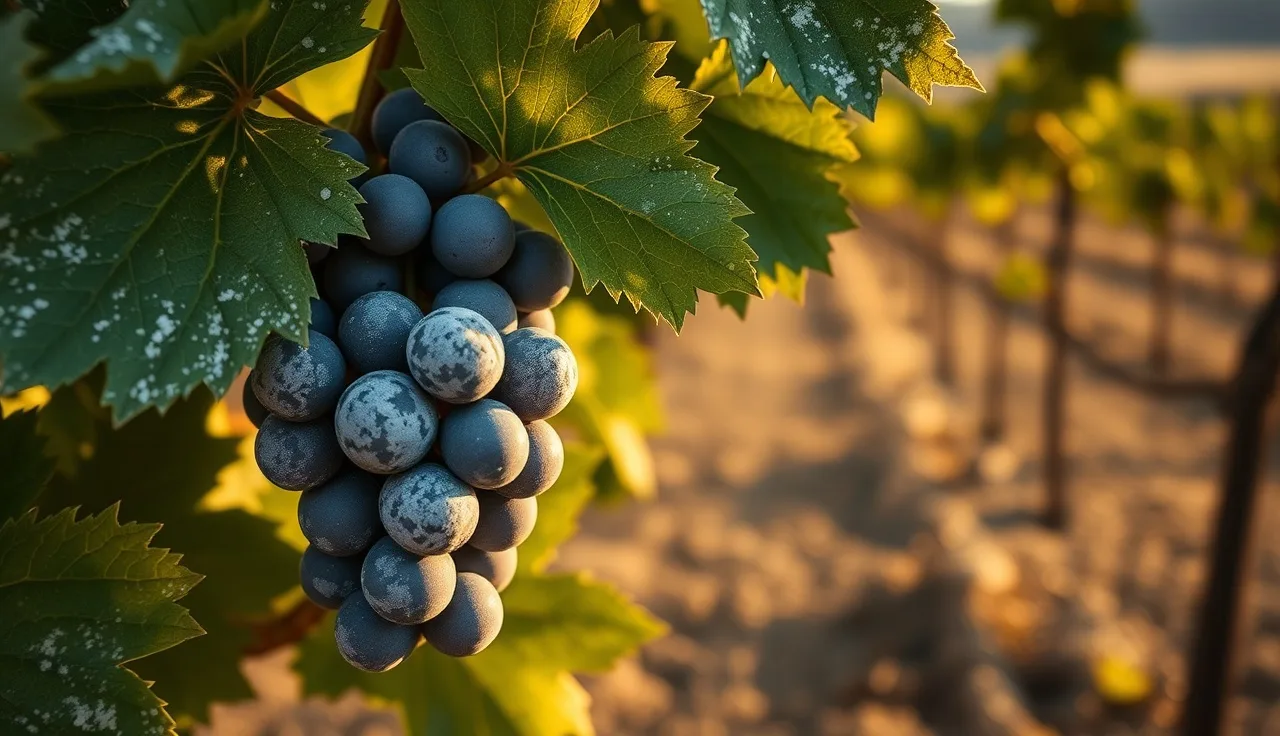
Powdery mildew, caused by the obligate fungal pathogen Erysiphe necator (formerly Uncinula necator), is the single most economically damaging disease in Washington State wine grape production. Washington State University Extension estimates it can reduce yields by 20 to 80 percent in unmanaged or poorly managed vineyards. In bad years, berry infection leads to rachis death, cracking, and secondary Botrytis, and susceptible varieties can lose the whole crop. [1]
The Columbia Valley's warm, dry days and cool nights sound hostile to fungal disease, but powdery mildew does not need rain or free water to germinate. It thrives in exactly the conditions eastern Washington delivers: temperatures between 70 and 85°F (optimum growth), moderate humidity under the canopy, and the rapid shoot growth that comes with irrigated high-vigor vines. Western Washington vineyards face similar risk, with the added complication of actual wet weather overlapping the infection window. [1]
The pathogen overwinters as cleistothecia (sexual fruiting bodies) in bark and as dormant mycelium inside dormant buds. That bud-resident mycelium is particularly dangerous because it produces "flag shoots" early in the season, heavily colonized shoots that release enormous quantities of conidia right when berries are most susceptible. WSU research has consistently identified flag shoot emergence before budbreak as the primary early-season inoculum source in eastern Washington. [2]
Susceptibility varies widely by variety. Chardonnay, Cabernet Sauvignon, Merlot, and Syrah are all rated moderately to highly susceptible. Riesling sits at moderately susceptible. Gewürztraminer is among the most susceptible white varieties grown in the state. Concord and other V. labrusca types have moderate resistance, though they are not immune. If you're managing a mixed vineyard, prioritize spray coverage on Chardonnay and Gewürztraminer blocks. [1]
When does the infection season actually start in Washington?
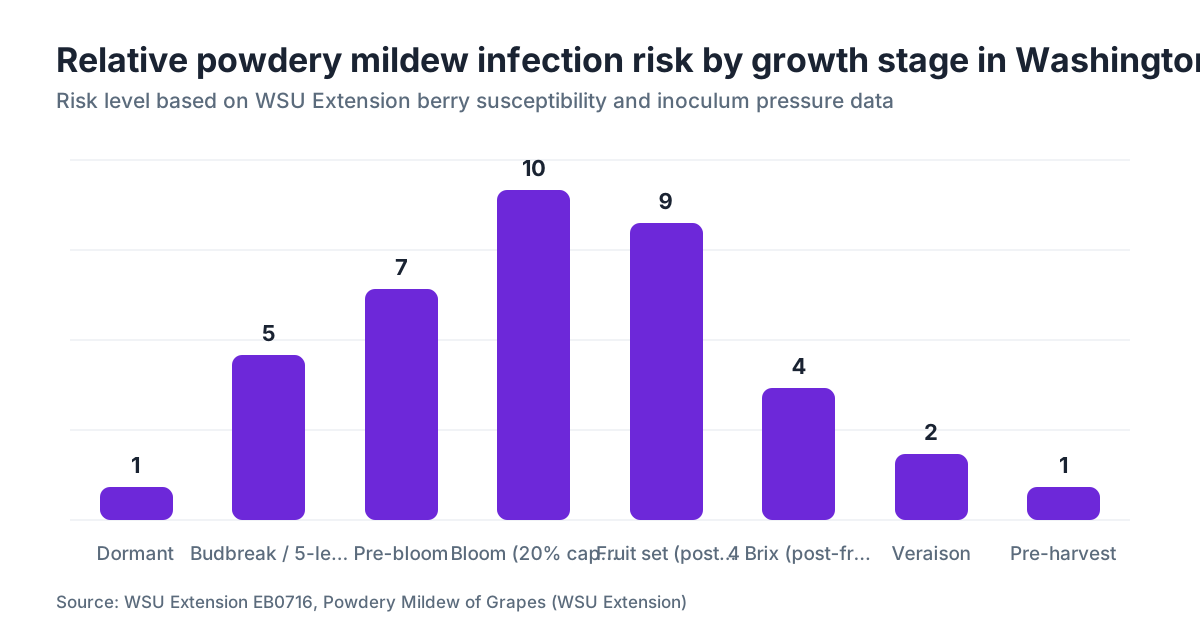
The critical period for primary infection begins at budbreak, typically late March to mid-April in the Columbia Valley and a week or two later in the Yakima Valley and Walla Walla depending on elevation and microclimate. The 10-day period from 50% budbreak through the 5-leaf stage is when flag shoot tissue is first exposed and when dormant lime-sulfur or narrow-range oil applications deliver their best return. Wait longer than that and those materials become phytotoxic and less effective. [2]
The single most important spray timing in the entire season is the period bracketing bloom, from about 20% cap fall through 10 days post-bloom. Berry skin susceptibility peaks at this stage because the cuticle is thin and the tissue is growing fast. WSU Extension's disease management calendar identifies this 2-to-3-week window as the "critical period" where a lapse in coverage causes disproportionate crop damage. Once berries reach approximately 4% sugar (Brix), skin resistance increases sharply, and disease risk from new berry infections falls off quickly, though rachis infection remains a concern through veraison. [2]
Primary infection from overwintered chasmothecia (the current preferred term for cleistothecia) is triggered by spring rainfall, but in eastern Washington those rain events are often sparse. Flag shoots are the more reliable inoculum source. Since they emerge from infected buds whether or not it rains, you can't delay your program waiting for a wet forecast. The standard WSU recommendation is to run a calendar or degree-day schedule rather than waiting for observed disease, especially on susceptible varieties.
What does a year-round powdery mildew management program look like?
Year-round management of powdery mildew in Washington falls into four phases: dormant, early season, critical period, and post-fruit set through harvest.
Dormant phase (November through budbreak): The main tool here is dormant-applied lime-sulfur at 3 to 4% concentration, or JMS Stylet Oil, applied at late dormancy (tight cluster to swollen bud). These materials kill overwintering mycelium in buds and reduce the flag shoot population. WSU recommends a single well-timed dormant application rather than multiple light passes. Precision matters more than volume. [2]
Early season (budbreak through 5-leaf stage): Continue sulfur-based programs at 7-to-10-day intervals. Wettable sulfur is the workhorse material in Washington because it costs little, works well, and carries essentially no resistance risk. The effective temperature window for elemental sulfur is 65 to 90°F; below 65°F it is nearly inactive, and above 95°F it becomes phytotoxic. Eastern Washington heat events in July and August can make sulfur risky late in the season, which is one reason to front-load your program and shift to other materials later. [3]
Critical period (20% cap fall through 2 weeks post-bloom): This is where you want your best, most systemic materials. DMI (sterol demethylation inhibitor) fungicides such as tebuconazole, myclobutanil, and trifloxystrobin-based premixes dominate Washington programs during bloom. FRAC group 3 (DMIs) and FRAC group 11 (QoIs/strobilurins) both work here, and both carry resistance risk if overused. Alternate FRAC groups every application. Resistance to QoIs (Group 11) has been documented in Washington vineyards, so do not use them as your primary material or in consecutive applications. [4]
Post-fruit set through harvest: Berry susceptibility drops significantly by about 4 Brix, but rachis, petiole, and shoot infections can still cause problems, especially in dense canopies. Return to sulfur rotations extended to 14-day intervals in moderate-risk conditions. Canopy management, opening up the fruit zone, does as much work as chemistry during this phase. Tighten spray intervals back to 7 to 10 days if July brings a cool wet stretch. [1]
Year-round management of grape powdery mildew comes down to not letting any phase slide. A clean start through dormant treatment plus a tight critical-period program together do more work than any single product choice.
Which fungicide groups work best, and how do you rotate them to prevent resistance?
Washington growers have a well-stocked fungicide toolbox, but the tool that has lost the most edge is the QoI (strobilurin) group. FRAC Group 11 resistance in E. necator was first confirmed in eastern Washington vineyards in the early 2010s, and a 2014 WSU study found resistant isolates in multiple Yakima Valley and Columbia Valley blocks with heavy strobilurin use histories. [4] The practical consequence: don't rely on products like azoxystrobin or trifloxystrobin as standalone materials, and never apply them in back-to-back sprays.
Here is a working rotation framework based on WSU Extension and FRAC guidance:
| FRAC Group | Mode of Action | Example Active Ingredients | Max per Season | Notes |
|---|---|---|---|---|
| M2 (Sulfur) | Multi-site | Elemental sulfur, lime-sulfur | No formal limit | Backbone of program; no resistance risk; temp-sensitive |
| 3 (DMI) | Sterol synthesis | Tebuconazole, myclobutanil, propiconazole | 3-4 apps | Rotate within group; reduced sensitivity documented |
| 7 (SDHI) | Succinate dehydrogenase | Fluxapyroxad, fluopyram | 2 apps | Use only in critical period |
| 11 (QoI) | Respiration | Azoxystrobin, trifloxystrobin | 2 apps max | Resistance present in WA; never solo or back-to-back |
| 13 (Amine) | Sterol synthesis | Spiroxamine | 2 apps | Limited Washington data; effective where DMI sensitivity reduced |
| U8 (Cyflufenamid) | Unknown | Cyflufenamid | 2 apps | High efficacy; expensive; save for critical period |
| U13 (Quinoxyfen) | Unknown | Quinoxyfen | 2 apps | Strictly preventive; no curative activity |
The rotation most Washington growers actually run: sulfur from budbreak to about 5-leaf, then a DMI or SDHI/DMI premix from 5-leaf through bloom, then back to sulfur or a DMI-sulfur combination post-fruit set. That keeps Group 11 exposure to 1 or 2 applications per year, typically at a high-risk timing like bloom. [4]
Read labels for pre-harvest intervals before you schedule late-season applications. Tebuconazole (PHI varies by product, often 14 days on grapes) and some premixes have longer PHIs than sulfur. The EPA label is the law, and a PHI violation at harvest creates a compliance problem that no crop insurance covers.
How do Washington's growing conditions change your spray interval decisions?
The standard spray interval recommendation for powdery mildew on grapes is 7 to 14 days, but that range is wide enough to matter. In eastern Washington during rapid shoot growth in May and early June, 7-day intervals are the right choice even with no rain in the forecast. Fast tissue production combined with warm nights makes infection conditions ideal whether or not the canopy looks wet. [1]
WSU Extension has promoted the Disease Pressure Index (DPI), a degree-day accumulation model that accounts for temperature and humidity to estimate infection risk. The model runs through WSU's Decision Aid System (DAS), an online tool that pulls weather station data from the AgWeatherNet network covering major Washington wine regions. Running DAS through the critical period gives you a data-backed argument for tightening or relaxing intervals, which matters when you're trying to cut program costs without taking on unmanaged risk. [5]
Western Washington is a different situation. Willamette Valley protocols (developed largely in Oregon but directly applicable to Washington's Puget Sound and Lewis County growing areas) call for much tighter intervals and heavier reliance on systemic materials because wet springs create high infection pressure from both powdery mildew and downy mildew at once. If you're growing grapes west of the Cascades, WSU's advice for eastern Washington is a starting point, not a ceiling.
Canopy architecture matters too. A vineyard trained to a Scott Henry or VSP with good shoot positioning and leaf removal in the fruit zone has measurably lower humidity inside the canopy and better spray penetration. A dense, tangled canopy on the same irrigation and chemistry program carries higher disease pressure. This is why powdery mildew management isn't purely a spray record problem. It is also a pruning, training, and shoot positioning problem.
What spray records are legally required in Washington State?
Washington State law requires commercial pesticide applicators, which includes most vineyard operations applying restricted-use pesticides, to keep written application records for a minimum of two years. The Washington State Department of Agriculture (WSDA) governs this under the Washington Pesticide Application Act, RCW 17.21. Required record elements include date and time of application, pest(s) treated, pesticide product name and EPA registration number, application rate, total amount applied, target site description, and applicator license number. [6]
Federal Worker Protection Standard (WPS) requirements layer on top of state requirements. Under 40 CFR Part 170 (the revised WPS rule that took full effect in 2017), agricultural employers must keep records of all pesticide applications for 30 years for WPS purposes specifically, covering the restricted-entry interval (REI), product name, and application location. The 30-year WPS retention requirement is longer than Washington's two-year state requirement, so WPS governs. [7]
For every sulfur or fungicide application in your powdery mildew program, you need to post the central posting location with the product name, location treated, REI, and the date and time the REI expires before workers can enter the treated area. Sulfur has a 24-hour REI for early-entry activities, dropping to 4 hours for certain tasks depending on the label. Systemic fungicides like myclobutanil have REIs ranging from 24 to 48 hours depending on the specific product and label version. Always check the current label. [7]
Many Washington vineyards still keep spray records in spiral notebooks or spreadsheets. That works legally. The practical problem is that handwritten records are hard to audit, easy to lose, and almost impossible to aggregate across a multi-block operation at harvest when a buyer or certification auditor asks for documentation. This is exactly where a vineyard record-keeping tool like VitiScribe pays for itself: spray records are timestamped, geo-tagged by block, and exportable in a format auditors actually accept. It does not replace the legal obligation, but it makes meeting it easier.
How do you scout for powdery mildew and decide when to respond?
Scouting for powdery mildew in Washington should start at budbreak and continue weekly through veraison. The early-season flag shoot is your most important scouting target: look for shoots with shortened internodes, stunted leaves, and white powdery growth on the undersides of leaves and young shoot tips. Finding even one or two flag shoots per acre is significant and points to overwintered mycelium in those buds. [2]
From bloom through fruit set, scout every 5 to 7 days in susceptible varieties. On berries, early infections show as small chlorotic spots that develop a white powdery coating. On rachis tissue, look for brown-gray discoloration and necrosis. By the time symptoms are obvious on a cluster, you are well past the window for effective chemical suppression of that tissue.
A practical scouting protocol used widely in the Yakima Valley: walk each block on a diagonal pattern, examine 10 shoots on each of 5 vines per acre (50 shoots per acre minimum in high-risk blocks), and record percent incidence of infected shoots and infected clusters separately. WSU Extension's Viticulture program recommends this approach and provides scouting forms through its online resources. [1]
Decision thresholds are informal in most Washington programs because the economic threshold for a zero-tolerance crop like wine grapes is extremely low. Any powdery mildew on clusters before harvest is commercially unacceptable for most buyers. The practical threshold is simple: if you see it on clusters, you've already missed a spray window. The real decision is whether to tighten spray intervals based on early-season pressure and weather forecasts, not whether to spray at all.
What are the best practices for organic and low-input management in Washington?
Organic grape production in Washington is a real and growing segment, and the disease management toolkit for organic certification (USDA NOP) is narrower but workable. The primary tools are elemental sulfur, potassium bicarbonate, JMS Stylet Oil, neem oil products, and copper compounds (limited by allowed cumulative rates under NOP). Lime-sulfur is also allowed under NOP but carries stricter state signal word requirements. [8]
Sulfur remains the backbone of organic programs for exactly the same reasons it dominates conventional early-season programs: it costs little, works well, and E. necator has shown no ability to develop resistance to it. The protocol is the same, just without the option to bring in a synthetic DMI or SDHI at bloom. That means organic growers need to front-load even more aggressively, hold tighter intervals through the critical period, and lean harder on canopy management to make up for the reduced systemic activity of their materials.
Potassium bicarbonate products (OMRI-listed) have efficacy data supporting their use as a supplemental material or as a rotation partner with sulfur. They work through a different mechanism and can go on in the heat windows when sulfur becomes phytotoxic, which makes them useful for July and August applications in eastern Washington. [9]
Bio-rational materials like Bacillus subtilis (Serenade) have shown inconsistent efficacy in published Washington trials, and the closest available data suggests they perform better as part of an integrated program than as standalone treatments. Nobody has great data on bio-rational-only programs in the Columbia Valley's high-pressure, dry-heat environment. Honest answer: if you're converting to organic, plan for tighter intervals and accept some increase in scouting labor.
How does powdery mildew management connect to other vineyard records and certifications?
Washington wine grape buyers increasingly require documented spray records as part of purchase contracts. Large buyers like Chateau Ste. Michelle require full-season spray logs from growers, and third-party sustainability certifications such as LIVE Certified, Salmon-Safe, and the Washington Sustainable Winegrowing (WAWGG/SWG) program audit pesticide application records as part of their scoring. [10]
The Washington Sustainable Winegrowing program, administered by the Washington State Wine Commission, has an explicit record-keeping requirement for pesticide applications including the FRAC group for each fungicide used. Your spray log needs more than product name and rate; you also need the mode of action recorded to demonstrate responsible resistance management. [10]
GAP (Good Agricultural Practices) and FSMA (Food Safety Modernization Act) compliance also touch spray records indirectly. Under FSMA Produce Safety Rule (21 CFR Part 112), grapes used for wine currently fall outside the Produce Safety Rule's produce definition, but growers who also sell table grapes or run mixed operations may face additional documentation requirements. Know where your operation stands before an audit arrives. [11]
Keeping all of this straight across multiple blocks, multiple materials, and multiple regulatory frameworks is where paper logs genuinely fail. VitiScribe was built for exactly this: one place where spray date, product, FRAC group, rate, REI expiration, and block location all live together and can be pulled for any audit format your buyer or certifying body needs.
For growers also running a destination winery or tasting room, the spray record infrastructure that covers your vineyard connects directly to your overall compliance picture. You can see how other estate operations handle documentation by reading about operations like Gervasi Vineyard or how regional producers in established markets like Paso Robles wineries have built their compliance workflows.
What does WSU Extension recommend as the complete program for eastern Washington?
WSU Extension's most current integrated management recommendations for grape powdery mildew in eastern Washington break down into a phased calendar that reflects the state's dry continental climate. This is summarized from WSU's EB0716 publication and related extension materials. [2]
Dormant to tight cluster: Lime-sulfur at 3% v/v or JMS Stylet Oil at label rate. Single application timed to late dormancy. Purpose: kill overwintered mycelium and reduce flag shoot frequency.
Budbreak to 5-leaf: Wettable sulfur at 3 lb per acre per week intervals (7-10 days). Begin immediately at first green tissue. This phase is short but skipping it is expensive.
5-leaf to 20% cap fall: Continue sulfur; consider adding a DMI (FRAC 3) application at 5-leaf and pre-bloom if disease pressure from scouting or degree-day models is elevated.
Bloom through 2 weeks post-fruit set (critical period): DMI or SDHI + DMI premix at label rate. Interval of 7 days maximum. Alternate FRAC groups each application. This is the only period where WSU recommends stepping up to higher-cost systemics as the primary material.
Post-fruit set through veraison: Return to sulfur-based program at 10-14 day intervals. Maintain leaf removal and shoot positioning. Monitor for rachis infection.
Post-veraison through harvest: Sulfur applications can continue but watch PHIs. Most sulfur labels carry a 7-day PHI on grapes, but verify the specific product label. Discontinue all applications by the label's PHI before harvest.
WSU Extension's recommendation is explicit that this calendar represents a high-efficacy standard: "Unprotected vines during the bloom period can suffer severe bunch infections regardless of weather conditions." [2] That language appears directly in the EB0716 publication and should be on your wall.
How do you manage powdery mildew on young vines and in newly established blocks?
Young vines in their first two to three years are actually at higher risk from powdery mildew in some ways, not lower. They produce the rapidly growing succulent tissue that the pathogen colonizes most easily, and they haven't developed the thicker bark and shoot structure that older, established vines have. In a new block, you won't have the infection history data you have in a mature block, so you're flying with fewer instruments. [1]
For first- and second-year vines, WSU recommends maintaining full protective coverage from the point of first green tissue. Don't cut corners on new plantings. The goal for a new block is a clean plant with minimal overwintering inoculum in the first two to three years; every infection event in year one adds to the bud-resident mycelium pool that creates flag shoots in year two. Front-load aggressively.
Spray coverage on young vines is mechanically easier in one sense (shorter vines, easier to reach) but logistically tricky because young vine canopies are sparse and irregular. Calibrate your sprayer specifically for the young-vine pass; the output that works for a mature VSP trellis will over-apply to a first-leaf vine. Reduce gallons per acre while holding coverage concentration.
Variety selection for new plantings in Washington increasingly considers disease resistance. Varieties bred with partial resistance to powdery mildew, including some PIWI varieties and newer Cornell and WSU releases, are entering commercial production in small amounts. The disease pressure reduction from a partially resistant variety is real, though even resistant varieties are not immune and still need a reduced spray program.
Frequently asked questions
What temperature range does powdery mildew grow best at in Washington vineyards?
Erysiphe necator grows fastest between 70 and 85°F. Sporulation and infection are nearly halted below 50°F or above 95°F. Eastern Washington's typical May and June daytime temperatures of 75 to 88°F sit close to optimal for the fungus, which is why the critical period from bloom through fruit set coincides with the region's warmest spring weather.
Does powdery mildew require wet weather or rain to spread in Washington?
No. Unlike downy mildew, Erysiphe necator does not need free water or rain to germinate and spread. Conidia germinate best in moderate humidity (40 to 70% RH) with no liquid water required. Eastern Washington's dry, irrigated conditions are not a barrier to infection. Canopy humidity from drip or sprinkler irrigation plus a dense canopy microclimate are enough.
How long do I need to keep spray records in Washington State?
Washington State law (RCW 17.21) requires a minimum of 2 years for pesticide application records. The federal Worker Protection Standard (40 CFR Part 170) requires 30 years for WPS-specific records. The longer WPS requirement governs. Keep application records with product name, EPA reg number, rate, date, target site, and REI information for at least 30 years.
What is the restricted-entry interval (REI) for common powdery mildew fungicides used on grapes?
REIs vary by product and label version. Wettable sulfur typically carries a 24-hour REI (4 hours for some early-entry activities with PPE). Myclobutanil (Eagle 20EW and similar) has a 24-hour REI. Some SDHI premixes run 12 to 48 hours. Always read the specific product label for the current REI. Labels are the law; older reference sheets may not reflect label revisions.
Which Washington wine grape varieties are most susceptible to powdery mildew?
Gewürztraminer and Chardonnay rank among the most susceptible varieties in Washington commercial production. Cabernet Sauvignon, Merlot, and Syrah are moderately to highly susceptible. Riesling is moderately susceptible. Concord and other V. labrusca types have lower but not zero susceptibility. Susceptibility rating drives spray interval and material selection decisions throughout the season.
Can I use just sulfur for the entire season, or do I need synthetic fungicides?
Sulfur alone can produce adequate control in moderate-pressure years in eastern Washington, particularly in well-managed canopies with tight intervals through bloom. However, WSU trials consistently show that a DMI or SDHI application at or around bloom reduces cluster infection rates more reliably than sulfur alone during rapid berry development. Organic growers make sulfur work, but they accept more scouting labor and tighter intervals to compensate.
How do I know if my vineyard has QoI-resistant powdery mildew?
The practical indicator is poor control after two or more consecutive QoI applications with good coverage and correct timing. Confirmed resistance requires a lab assay (bioassay or molecular testing). The WSU Plant Pest Diagnostic Clinic can test samples. Given that QoI resistance has been confirmed in Yakima and Columbia Valley blocks since the early 2010s, the default recommendation is to treat resistance as present and limit Group 11 use to 1 to 2 applications per season, never consecutive.
What is a flag shoot and why does it matter for powdery mildew management?
A flag shoot is a shoot that emerges from a bud already colonized by overwintered E. necator mycelium. It shows up at budbreak with stunted, distorted growth, shortened internodes, and heavy white sporulation on leaves. Flag shoots produce massive quantities of conidia very early, seeding the entire vineyard before primary infection from chasmothecia even begins. Reducing flag shoot frequency through dormant oil treatment is one of the highest-leverage early-season decisions.
When should I stop spraying for powdery mildew before harvest?
Berry susceptibility to new infections drops sharply once fruit reaches roughly 4 Brix. After that threshold, the main risk is rachis infection in dense canopies. On the application side, you must stop by the pre-harvest interval (PHI) stated on the product label. Wettable sulfur PHIs are commonly 7 days but vary by product. DMI fungicides like tebuconazole often have 14-day PHIs. Always confirm the current label PHI; never rely on memory.
How does the WSU Decision Aid System (DAS) help with powdery mildew spray timing?
WSU's Decision Aid System pulls real-time data from the AgWeatherNet weather station network covering major eastern Washington wine regions and runs degree-day and infection risk models for powdery mildew. It estimates daily infection risk based on temperature and humidity, which lets you time spray applications more precisely instead of defaulting to fixed-interval schedules. Access is free at weather.wsu.edu. It is most useful from budbreak through fruit set.
Is potassium bicarbonate approved for use in organic Washington vineyards against powdery mildew?
Yes. Potassium bicarbonate products with OMRI listing are approved under USDA National Organic Program rules. They work through a different mechanism than sulfur (pH disruption of fungal cell walls) and can go on during heat events when sulfur becomes phytotoxic above 90 to 95°F. Efficacy trials support their use as a rotation partner with sulfur in organic programs, though standalone potassium bicarbonate programs have performed less consistently than sulfur-based programs in Washington trials.
Do Washington sustainable winegrowing certifications require fungicide FRAC group records?
Yes. The Washington Sustainable Winegrowing program, administered by the Washington State Wine Commission, requires documentation of FRAC groups for fungicide applications as part of its resistance management scoring. A spray record that lists only product name and rate is insufficient for full compliance with SWG audit requirements. You need the active ingredient and FRAC group recorded for each application.
How does canopy management affect powdery mildew pressure in Washington vineyards?
Leaf removal in the fruit zone, typically done at or just after fruit set, reduces canopy humidity around clusters and improves spray penetration. Dense, tangled shoot canopies hold humidity at the cluster level and block fungicide coverage on inner berries. WSU research supports fruit-zone leaf removal on the morning sun side as reducing both powdery mildew and Botrytis pressure by improving airflow and light exposure, independent of spray program adjustments.
What happens if powdery mildew infects grape berries before harvest in Washington?
Infected berries crack under pressure during ripening, providing entry points for secondary Botrytis cinerea infection. Severe infection causes rachis death, bunch collapse, and complete crop loss on affected clusters. Even sub-visible infections at harvest can produce off-flavors (musty, moldy notes) in the finished wine detectable at very low levels. Most Washington grape purchase contracts specify zero tolerance for visible powdery mildew at delivery.
Sources
- WSU Extension, Grape Powdery Mildew management: Powdery mildew can reduce yields by 20 to 80 percent in unmanaged Washington vineyards; variety susceptibility ratings for Chardonnay, Gewürztraminer, and other Washington varieties
- WSU Extension EB0716, Powdery Mildew of Grapes: Flag shoot inoculum source, dormant application recommendations, critical bloom period, and full-season calendar for eastern Washington; direct quote: 'Unprotected vines during the bloom period can suffer severe bunch infections regardless of weather conditions'
- WSU AgWeatherNet / Decision Aid System: Free online disease pressure index and degree-day infection risk model for Washington vineyards using real-time AgWeatherNet station data
- Washington State Pesticide Application Act, RCW 17.21 (WSDA): Commercial pesticide applicators in Washington must maintain written application records for a minimum of two years
- EPA Worker Protection Standard, 40 CFR Part 170: WPS requires 30-year retention of pesticide application records; central posting REI requirements before workers can enter treated areas
- USDA National Organic Program, allowed materials: Elemental sulfur, potassium bicarbonate, JMS Stylet Oil, and lime-sulfur are permitted under NOP for organic grape production
- Washington Sustainable Winegrowing Program, Washington State Wine Commission: SWG requires FRAC group documentation in pesticide records; third-party certification programs audit spray logs as part of scoring
- FRAC Code List, Fungicide Resistance Action Committee: FRAC group classifications, mode of action descriptions, and maximum application per season guidance for fungicides used in grape powdery mildew programs
Last updated 2026-07-10