Grape powdery mildew white coating: what it is and how to stop it
TL;DR
- The white or gray powdery coating on grape leaves, shoots, and berries is grape powdery mildew, caused by the fungus Erysiphe necator.
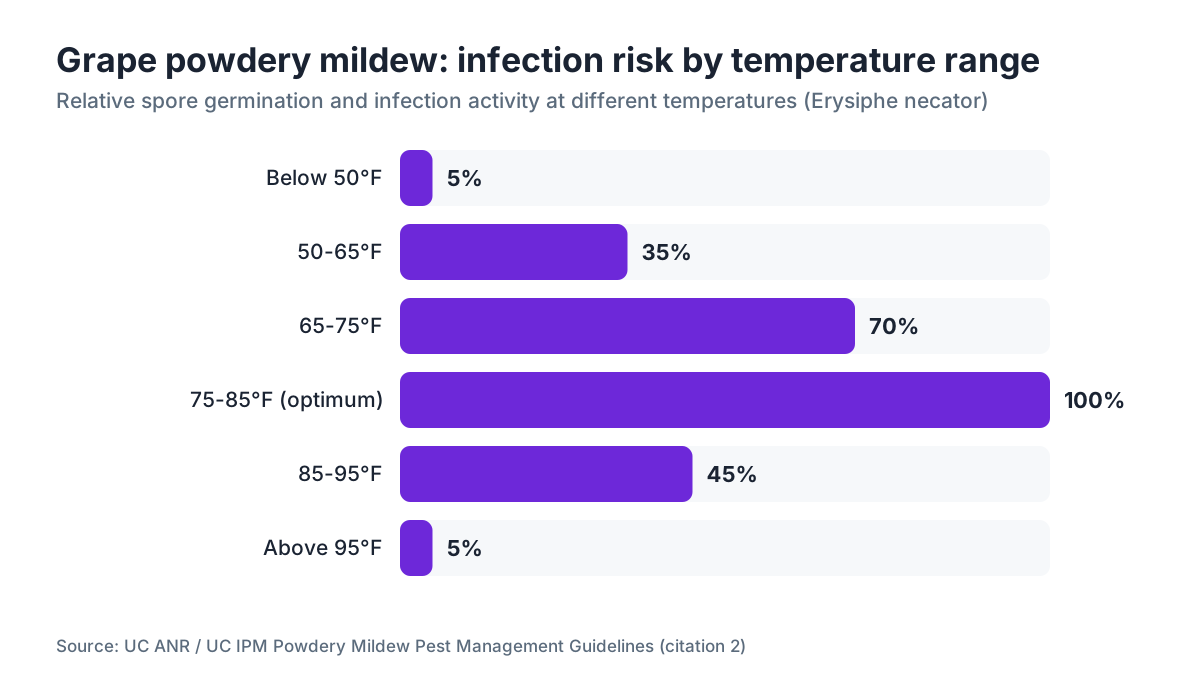
- It spreads fastest at 70-85°F and needs no rain.
- Sulfur, potassium bicarbonate, and DMI fungicides control it if you act before 10% shoot infection.
- Left alone, it can cut yield 30% or more and wreck berry quality.
What is the white coating on grape leaves and berries?
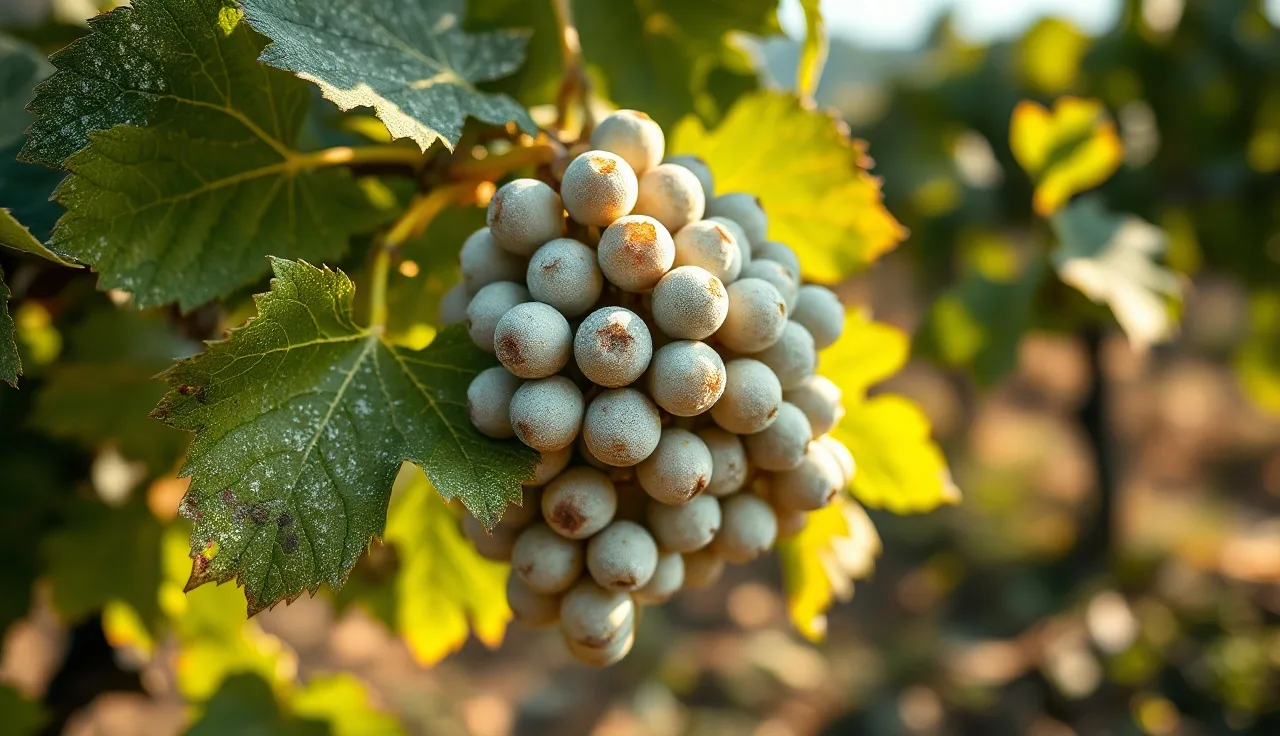
That powdery white or grayish film on your vines is Erysiphe necator (formerly Uncinula necator), the fungus behind grape powdery mildew. What you're looking at is the external mycelium and chains of spores called conidia, sitting right on top of the leaf or berry skin. Unlike most fungal diseases, this one lives almost entirely on the surface of plant tissue instead of inside it. [1]
It shows up first on young, actively growing tissue. Young leaves curl or pucker slightly before the powder appears. Shoots can show dark brown or black patches under the white growth, called netting or russeting. On berries, infection before the fruit reaches about 8 Brix stops the skin from growing while the flesh keeps expanding, and the berry splits open. That wound invites Botrytis and other secondary rots. Infection after 15 Brix usually doesn't split berries, but it leaves brown netlike scars that make premium fruit unsellable. [2]
Here's what growers get wrong: no visible white coating does not mean the vine is clean. The fungus colonizes tissue and does damage before sporulation is visible to the naked eye. By the time you see a thick white mat, you're already behind the infection curve.
How does grape powdery mildew spread and what conditions drive it?
Erysiphe necator overwinters two ways. It sits as dormant mycelium inside infected buds, and it forms chasmothecia, dark spherical structures, in bark crevices and on wood left in the vineyard. Infected buds are the worse of the two because they produce flag shoots, which show heavy infection right at bud break and feed inoculum to the whole block. [1]
The fungus doesn't need rain. It needs moderate temperature and moderate humidity. The optimum range for infection and spore germination is 70-85°F (21-29°C). Above 95°F (35°C), surface mycelium dies, which is why some hot interior valleys get a natural break in disease pressure in midsummer, then a rebound in fall when temperatures drop. [2] Below about 50°F, spore germination is close to nothing.
Spores move by wind. A single flag shoot can release millions of conidia on a dry, breezy afternoon. Scouting for flag shoots at bud break earns its keep every year, and it matters most in the seasons you least expect pressure.
Humidity matters, but not the way it does for rain-driven diseases. Powdery mildew hates free water on the leaf; rain can wash spores off. What it wants is high relative humidity (above 40%) with no rainfall. Marine-influenced regions, morning fog, and dense canopies with poor airflow are ideal for it. The UC Davis Grape Powdery Mildew Risk Index, built into tools like UC IPM's weather-based model, turns temperature and leaf wetness data into a running spore index so you can time sprays instead of guessing. [3]
Which grape varieties are most susceptible to powdery mildew?
Every Vitis vinifera variety is susceptible. Your European wine grapes have essentially no genetic resistance to Erysiphe necator, because the pathogen co-evolved in North America while vinifera evolved in Eurasia. [1]
Inside vinifera, susceptibility varies. Chardonnay, Cabernet Sauvignon, Pinot Noir, Merlot, and Sauvignon Blanc run moderately to highly susceptible. Muscat varieties are among the worst hit. Riesling and Gewürztraminer are high-risk too. Carignan shows a bit more tolerance in some studies, but I wouldn't bank on it.
American species like Vitis labrusca and hybrids bred from them carry some partial resistance. The real story for Eastern growers who need reduced-spray programs is the commercial hybrids: Marquette, Frontenac, Traminette, and other Cornell and University of Minnesota releases. Cornell's breeding program has documented resistance scores for dozens of these varieties. [4] If you're planting in a high-pressure region and spray cost is a genuine concern, read that list before you commit.
Canopy architecture matters almost as much as variety. A dense, shaded canopy on any variety will have worse pressure than an open, well-managed one. Shoot thinning, fruit-zone leaf removal, and hedging aren't optional in high-pressure sites.
When in the season is the vine most vulnerable to powdery mildew damage?
The highest-risk window runs from 1 inch of shoot growth through about 8 weeks post-bloom, or until berries hit roughly 8 Brix. That's when berry infection causes the skin-cracking damage that destroys crop value. [2]
Bud break to 6-inch shoots. Flag shoot scouting and first sprays go here. Chasmothecia from last year are releasing ascospores now too, adding to the inoculum load.
Bloom through 3 weeks post-bloom is the single most important window. Flowers and newly set berries are extremely susceptible. A WSU study found fruit infection during this window can cut yield by 30% or more in severe years. [5] Missing a spray interval here is the most expensive mistake you can make all season.
Véraison onward. Berries get more resistant to new infection after 15 Brix, but shoot and leaf infection keeps going and hurts vine health heading into dormancy. Late infection also loads up the overwintering inoculum you'll fight next spring.
Most of the spray decisions that decide your crop happen in the first 8 weeks after bud break. Everything after that is damage control and next-year inoculum management.
What are the best fungicides to treat grape powdery mildew white coating?
Sulfur is the backbone of most programs and has been for over 150 years. It's cheap, low on resistance risk, and effective at 3-4 lb/acre of wettable sulfur or equivalent. Know the limits: don't apply within 2 weeks of an oil spray (phytotoxicity), don't apply above 90°F (burn risk), and some variety and rootstock combinations are sulfur-sensitive at certain stages. [6] Liquid sulfur is easier on spray gear but costs more per acre.
DMI fungicides (demethylation inhibitors, FRAC Group 3, like tebuconazole and myclobutanil) are your next tier. They move systemically and can kick back early infections, but resistance is real and documented in California, Washington, and New York populations. [5] Never run a single FRAC group across your whole program.
QoI fungicides (strobilurins, FRAC Group 11) are mostly done for grape powdery mildew because resistance is widespread in major production areas. Ask your local extension office before using them. In some regions they still work; in others they're basically water. [3]
Potassium bicarbonate works on contact and has a short residual. It's OMRI-listed and fits a low-input or organic program at 2.5-5 lb/acre, especially mid-season when hot days make sulfur burn a worry.
Milk, yes, really. Studies have shown skim milk or whey at 10-20% dilution has activity against powdery mildew, tied to free-radical activity under UV light. Nobody builds a commercial program on it, but it's worth knowing for organic growers stuck without other products.
| Fungicide class | FRAC group | Resistance risk | Organic eligible | Typical cost/acre | REI |
|---|---|---|---|---|---|
| Wettable sulfur | M02 | Low | Yes (OMRI) | $5-15 | 24 hr |
| Potassium bicarbonate | NC | Low | Yes (OMRI) | $10-25 | 4 hr |
| Myclobutanil (DMI) | 3 | Moderate | No | $15-30 | 24 hr |
| Tebuconazole (DMI) | 3 | Moderate | No | $15-35 | 24 hr |
| Metrafenone | 50 | Low-Moderate | No | $30-60 | 12 hr |
| Cyflufenamid | U06 | Low-Moderate | No | $40-70 | 12 hr |
Costs are rough 2024 estimates based on typical labeled rates. Always read the label for your region and crop stage.
How do you build a spray program to prevent powdery mildew all season?
A good program isn't calendar spraying. It's holding coverage through the critical window and rotating chemistry to slow resistance.
Start at bud break (1-inch shoot) if you had pressure last year or found overwintering structures in your bark. Sulfur is fine for that first spray. From bud break through bloom, run a 7-10 day interval in most regions, tightened to 7 days or less in a high-pressure year or a warm, foggy site.
Rotate FRAC groups every 2 sprays at minimum. A simple rotation looks like this: sulfur, DMI, sulfur, potassium bicarbonate, DMI, sulfur. No single mode of action dominates, which slows selection for resistance. FRAC publishes resistance risk ratings for every registered group. [6]
After véraison, stretch intervals to 14-21 days and lean harder on sulfur. The crop is protected; now you're managing canopy health and next year's inoculum.
Keep spray records for every application: product name, EPA registration number, rate, water volume, growth stage, and the applicator's name. That's not optional. EPA's Worker Protection Standard requires pesticide application records be kept for 2 years, and many state agriculture departments require the same or longer for restricted-use products. [7] If you want a field-ready way to log all of this without paper chaos, VitiScribe's application log captures the required WPS fields from your phone and exports in compliance-ready formats.
Calibrate your sprayer every season. A 10% nozzle wear problem means you're under-applying by 10% across the whole block, and that margin is the difference between adequate coverage and a disease break.
Can you manage powdery mildew organically?
Yes, and certified growers do it routinely. It takes tighter spray intervals and more attention to coverage, but it's done commercially at scale in California, Oregon, and New York.
Sulfur is the foundation, applied on a 7-10 day interval from bud break through 8 weeks post-bloom. Add potassium bicarbonate for mid-season rotation and to cover gaps on hot days when sulfur burn is a risk. Copper fungicides are allowed under NOP but do essentially nothing against powdery mildew; their job is downy mildew and bacterial diseases. [10]
Neem oil and other plant-based oils are OMRI-listed and have some activity, but the 2-week buffer around sulfur limits how you fit them in. Kaolin clay (Surround) has shown modest effects in some trials as a physical barrier, mostly on berries right around bloom.
Canopy management isn't a supplement to an organic spray program. It IS part of the program. A well-opened fruit zone with good airflow meaningfully cuts disease pressure. UC Davis research has shown that fruit-zone leaf removal plus a full sulfur program gives results comparable to more intensive conventional programs on moderately susceptible varieties. [3]
Be honest about your site. An organic program on Chardonnay in a foggy coastal valley is a different animal than the same program on the same variety in a dry inland site. Your farm advisor or extension office knows what's actually achievable where you farm.
What do EPA and state regulations require for powdery mildew spray records?
Federal law under the EPA Worker Protection Standard (40 CFR Part 170) requires that pesticide application records include the product name, EPA registration number, active ingredient, amount applied, application date, location, and the name of the person who applied it. These records have to be kept at least 2 years and made available for inspection. [7]
For restricted-use pesticides (RUPs), California, Washington, New York, and most other production states require records be filed with the county agricultural commissioner within a set window, often 30 days after application but sometimes monthly. California's Department of Pesticide Regulation requires monthly reporting of RUP use to the county ag commissioner. [8]
The WPS also requires a pesticide safety information station in the field, worker training before entry into treated areas, and posted re-entry intervals (REIs). For most powdery mildew fungicides, REIs run from 4 hours (potassium bicarbonate) to 24 hours (sulfur, most DMIs). [7]
The 2015 WPS revisions expanded record-keeping requirements and broadened the definition of agricultural worker. EPA's WPS training materials are available in English and Spanish on its worker safety page. [7]
One practical note: don't mix your spray records into your irrigation and nutrition logs and then try to reconstruct them at audit time. That's where growers get burned. A simple field log that captures every spray, even low-risk ones like sulfur, keeps you clean with the EPA and your organic certifier.
How do you scout for powdery mildew before the white coating appears?
Waiting for visible white growth to start scouting is too late. The UC Davis protocol calls for examining 10 shoots per location at 5 to 10 locations per block during the bud break through bloom period, hunting for flag shoots: shoots that emerge from infected buds with a silver-gray or bleached look, often with curled or distorted leaves, before any white powder shows. [3]
Past bloom, shift to 10 clusters per location and 10 leaves per location on the shoot directly behind the cluster. Record the percent of shoot tips, leaves, and clusters with any symptoms. More than 10% shoot tips infected at any point before bloom is a signal to tighten your program or start it if you haven't.
Black light scouting is worth knowing about. Under ultraviolet (black light) at around 365 nm, powdery mildew mycelium glows a bright greenish-white, so you can catch infections before they're visible in daylight. It's not standard on most operations, but some research blocks and premium producers use it during the high-risk window.
Weather-based models add a quantitative layer. Washington State University's powdery mildew model and the UC IPM risk index are free online and help you decide when to tighten intervals based on accumulated risk units instead of the calendar. [5] They don't replace scouting; they make your scouting results easier to read.
Record what you find every time, including zero-infection observations. A record of clean scouting is evidence your program is working, and it's exactly the kind of documentation that supports compliance audits and organic certification.
What damage does powdery mildew cause if you let it go untreated?
The economic damage from untreated powdery mildew is documented and large. A WSU study found severe infection during the bloom-to-fruit-set window can cut yield by 30% or more on susceptible varieties. [5] That's direct crop loss, before you count the quality hits.
Berry splitting from early infection opens the door to Botrytis cinerea, Aspergillus, and sour rot organisms. In a wet harvest, a block that had heavy early powdery mildew can go from marketable to worthless in 2-3 weeks around harvest as the secondary rots pile on. Winery contracts often carry mold and rot clauses that allow rejection over specific Botrytis thresholds, so a powdery mildew problem in June turns into a contract problem in September.
Late-season leaf infection doesn't hurt this year's crop directly, but it shrinks photosynthetic area and stresses the vine into dormancy. Across back-to-back high-pressure years, that cumulative stress shows up as reduced bud fertility and smaller clusters the following season.
Then there's the wine. Research in the American Journal of Enology and Viticulture found wines made from mildew-infected fruit had reduced varietal aroma and increased off-flavors from fungal metabolites, including geosmin-related compounds at high infection levels. [9] That kind of outcome ends contracts and wrecks buyer relationships.
The math is simple. A full-season spray program runs roughly $80-200/acre in most regions, which is almost always less than the cost of even a moderate crop loss, never mind a bad one.
How do you know if your fungicide program is failing mid-season?
The clearest tell is active sporulation, visible white coating, on tissue you sprayed within the past 7-10 days. Fresh white powder on new growth after a recent application means something is wrong: coverage was thin, the interval was too long, or you've got resistance in your population.
DMI resistance (FRAC 3) is the most common explanation in established vineyards in California and Washington. UC Davis researchers have documented reduced sensitivity to myclobutanil and tebuconazole in field populations across the North Coast and Central Coast. [3] If you suspect resistance, switch FRAC groups now and call your farm advisor or extension specialist about fungicide sensitivity testing. UC Davis Plant Pathology has run resistance screening programs; contact them for current testing options.
Inadequate coverage is the other common cause. A sprayer with worn nozzles, or a canopy so dense the spray never reaches the interior, leaves colonized tissue untreated even when the product works fine. Spray all sides of the canopy. Water-sensitive paper placed in the fruit zone and shoot zone is a cheap, fast way to confirm your spray is actually landing where it needs to.
If you're staring at an obvious mid-season failure, your moves are: switch to a different FRAC group, tighten your interval to every 5-7 days for 2-3 cycles, open the fruit zone with canopy work, and hit it with a contact material like potassium bicarbonate or sulfur as a knockdown. Don't just pile on more of the material that's already failing. VitiScribe's spray log pulls your full product history by block instantly, which makes diagnosing a resistance pattern far faster than digging through paper.
Does removing infected leaves and clusters help control powdery mildew?
It helps, but it won't replace fungicide applications. Pulling heavily infected shoot tips and leaves in a small vineyard or high-value block can meaningfully cut local inoculum, especially early before the fungus spreads across the canopy. On commercial acreage, it's too labor-intensive to serve as a primary control.
Fruit-zone leaf removal at or shortly after bloom does double duty: it improves spray penetration and airflow, and it strips out some early-infected tissue. Cornell research on leaf removal timing and intensity in the fruit zone documented clear reductions in Botrytis and powdery mildew on clusters in varieties prone to both. [4] Leaf removal is standard practice in well-run vineyards for canopy reasons alone, and the disease benefit is a real bonus on something you should already be doing.
Cluster removal on badly infected shoots has a place. If you're already cluster thinning and you spot heavily infected clusters early, pulling them removes inoculum and stops the worst fruit from becoming secondary infection centers. But be realistic: at 20-30% cluster infection, removal is salvage, not control.
Take all removed infected material out of the vineyard and bury it or compost it in a covered pile. Don't leave it in the row where spores keep dispersing. Obvious, and routinely ignored.
Frequently asked questions
Is the white powder on my grapes safe to eat?
Powdery mildew on grapes isn't toxic to humans in small amounts, but the fungus produces off-flavors and usually signals secondary rots that are the bigger problem. Berries with visible mildew coating, splitting, or browning shouldn't be eaten fresh. For wine, even low levels of mildew on fruit can push detectable off-flavors into the finished bottle.
What is the difference between powdery mildew and downy mildew on grapes?
Powdery mildew (Erysiphe necator) makes a white or gray powdery coating on the upper leaf surface and green tissue. Downy mildew (Plasmopara viticola) makes pale yellow oil spots on the upper surface and white cottony growth underneath. Downy mildew needs rain and free moisture to spread; powdery mildew doesn't. Different pathogens, different fungicide programs.
Can I use baking soda to treat powdery mildew on grapes?
Baking soda (sodium bicarbonate) has some contact activity in home garden settings at about 1 tablespoon per gallon of water. The commercial version uses potassium bicarbonate, which works better and doesn't build sodium in the soil. Neither replaces a full spray program on a commercial block, but potassium bicarbonate products are OMRI-listed and fit organic programs.
When should I start spraying for powdery mildew in the season?
Start at 1-inch shoot growth if you had pressure last season or farm a historically high-risk site. Even after a clean prior season, starting by 6-inch shoots is standard in most regions. Bloom through 3 weeks post-bloom is the highest-risk stretch. Don't stretch spray intervals during those weeks no matter how clean the vineyard looks.
How long does powdery mildew survive in the vineyard over winter?
Erysiphe necator overwinters as dormant mycelium inside infected buds and as chasmothecia on bark and cane surfaces. Both survive the whole dormant season and turn into active inoculum at bud break. Old wood, unpruned stubs, and canes left in the vineyard are high-risk overwintering sites. Removing infected prunings cuts, but doesn't eliminate, carry-over inoculum.
Does hot weather kill grape powdery mildew?
Temperatures above 95°F (35°C) for several hours can kill surface mycelium and cut sporulation, which creates natural disease breaks in hot inland valleys in midsummer. But the fungus survives in shaded canopy interiors and in buds, and disease rebounds when temperatures drop in late summer and fall. Hot weather isn't reliable control and shouldn't justify skipping sprays.
What spray interval do I need to prevent powdery mildew on grapes?
During the high-risk period from bud break through 8 weeks post-bloom, a 7-10 day interval is standard for most fungicides. Sulfur and contact materials need the shorter end. Systemic DMI fungicides can stretch to 10-14 days in low-pressure conditions but should tighten to 7 days during bloom. After véraison, 14-21 day intervals are typical.
Can powdery mildew spread from grapes to other plants in my garden?
Grape powdery mildew (Erysiphe necator) is host-specific to Vitis species. It can't infect roses, cucumbers, squash, or other garden plants that show their own powdery mildew. Those are different powdery mildew species. The reverse holds too: cucurbit or rose powdery mildew won't infect your vines.
What records do I legally need to keep for powdery mildew fungicide applications?
Under EPA's Worker Protection Standard, keep records at least 2 years that include product name, EPA registration number, active ingredient, amount applied, application date, location treated, and applicator name. For restricted-use pesticides, most states require added reporting to the county agricultural commissioner, often within 30 days. Check your state Department of Agriculture for specifics.
How do I know if powdery mildew has built up resistance to my fungicides?
The main sign is active sporulation on tissue sprayed within 7-10 days. DMI (FRAC 3) resistance is documented in California and Washington wine grape regions. If you see fresh white powder shortly after an application and coverage was adequate, switch FRAC groups now. Contact your extension specialist about fungicide sensitivity testing; UC Davis and WSU have run regional resistance monitoring.
Are any grape varieties resistant to powdery mildew?
All Vitis vinifera varieties are susceptible. Partial resistance exists in American species and hybrids bred from them, including Cornell and University of Minnesota releases like Marquette, Frontenac, and Traminette. These hybrids need fewer fungicide applications but aren't immune. If you farm a high-pressure region and want to cut spray inputs, review Cornell's variety resistance ratings before planting.
What's the economic cost of untreated grape powdery mildew?
A WSU study found severe infection during bloom through fruit set can cut yield by 30% or more on susceptible varieties. Beyond yield, secondary rots from berry splitting can make fruit unmarketable entirely. A full-season spray program usually costs $80-200 per acre in materials, which is almost always less than the value of even a moderate crop loss, before quality downgrades and contract penalties.
Can I see powdery mildew with a black light (UV lamp)?
Yes. Erysiphe necator mycelium glows a bright greenish-white under UV light at around 365 nm, which lets you detect infections before they're visible in daylight. Research settings and some premium producers use it during the high-risk window. It's not standard commercial practice, but it's a legitimate early-detection tool if you have a UV lamp.
Sources
- UC ANR / UC Davis Plant Pathology, Grape Powdery Mildew (Erysiphe necator) pest note: Erysiphe necator is an obligate fungal pathogen that lives on the surface of grape tissue; overwinters as dormant mycelium in infected buds and as chasmothecia in bark crevices
- UC ANR Grape (Wine) Powdery Mildew, UC IPM Pest Management Guidelines: Berry infection before 8 Brix causes skin splitting; infection after 15 Brix causes russeting scars; optimum disease temperature range is 70-85°F
- UC Davis Department of Plant Pathology, Powdery Mildew Research and Extension: UC Davis Grape Powdery Mildew Risk Index embedded in UC IPM; DMI fungicide resistance documented in North Coast and Central Coast populations; leaf removal in fruit zone reduces disease pressure
- Cornell University CALS Viticulture Extension, Powdery Mildew Management and Resistant Varieties: Fruit zone leaf removal documented to reduce both Botrytis and powdery mildew infection on clusters; Cornell hybrid varieties have documented resistance ratings
- Washington State University Extension, Grape Powdery Mildew Management: Severe powdery mildew infection during bloom to fruit set can reduce yield by 30% or more; WSU powdery mildew prediction model available online; QoI resistance widespread in regional populations
- Fungicide Resistance Action Committee (FRAC), FRAC Code List for Grape Pathogens: FRAC group classifications, resistance risk ratings, and mode-of-action rotation guidance for all registered fungicide classes including FRAC 3 DMIs and FRAC M02 sulfur
- U.S. EPA Worker Protection Standard (WPS), 40 CFR Part 170: WPS requires pesticide application records to be kept for at least 2 years; records must include product name, EPA registration number, active ingredient, amount applied, date, location, and applicator name; REIs must be posted
- California Department of Pesticide Regulation, Pesticide Use Reporting: California requires monthly reporting of restricted-use pesticide applications to the county agricultural commissioner
- American Journal of Enology and Viticulture, 'Effect of powdery mildew infection on wine aroma compounds': Wines made from mildew-infected fruit showed reduced varietal aroma character and increased off-flavors associated with fungal metabolites at high infection levels
- USDA National Organic Program (NOP), Allowed and Prohibited Substances List: Sulfur, potassium bicarbonate, and copper fungicides are allowed under NOP for organic production; neem oil and kaolin clay are OMRI-listed
- WSU Viticulture and Enology Extension, Fungicide Resistance in Grape Powdery Mildew: Resistance to DMI fungicides documented in Washington State powdery mildew populations; program rotation by FRAC group recommended to slow resistance development
Last updated 2026-07-09