Pruning grape vines on a trellis: a complete field guide
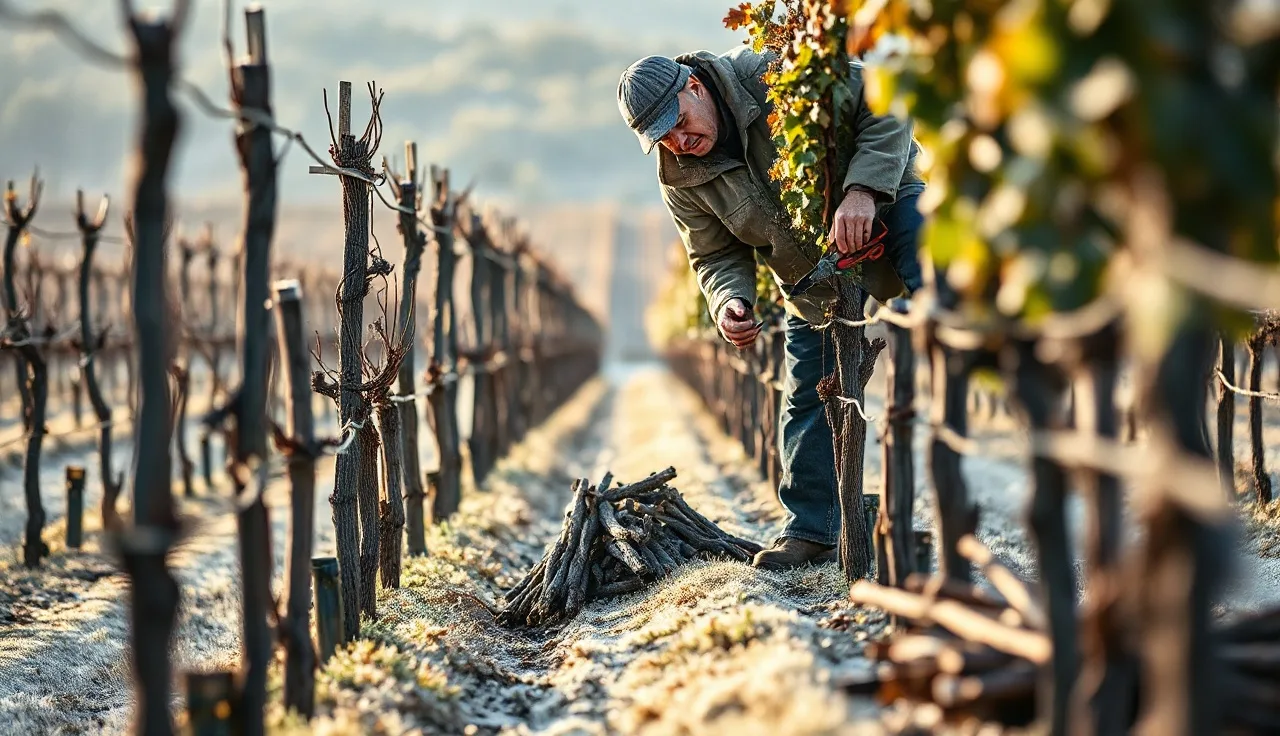
TL;DR
- Pruning trellised grape vines means cutting off 85-95% of last year's growth each dormant season to balance vigor, set crop load, and keep the vine inside its trellis.
- The two methods are spur pruning and cane pruning.
- Timing, cut placement, and bud count per vine are the three variables that decide next year's yield and fruit quality.
Why trellis pruning decisions matter more than most growers expect
Vines are vigorous. Left alone, a healthy Cabernet Sauvignon pushes 40 or 50 shoots from every available node, shades itself into a mess, and sets a crop so big it never ripens. The trellis gives you a structure to work from. The pruning is what controls what happens inside that structure.
UC Cooperative Extension puts the standard figure at 85-95% of the prior season's wood removed during dormant pruning [1]. That number surprises new growers. It sounds violent. But it reflects a plain biological fact: a vine's ability to ripen fruit comes mostly from its root system and permanent wood, not from how many shoots you leave hanging.
Get it wrong in either direction and you pay all season. Leave too many buds and you get a dense, humid canopy that feeds disease and thins out fruit flavor. Leave too few and the vine overcompensates, throwing long fat shoots that fight the trellis and ripen green-tasting fruit. The trellis you're working with, whether that's vertical shoot positioning (VSP), a Geneva Double Curtain (GDC), or a plain two-wire setup, decides which pruning method actually makes structural sense.
Write your pruning down. Bud count per vine, date, weather, who did the work. If you want to log that next to spray and harvest records, VitiScribe keeps it in one place. A legal pad works too. The record matters more than the tool.
What is the difference between spur pruning and cane pruning?
Spur pruning keeps short 2-bud stubs along a permanent cordon; cane pruning ties out one or two long canes fresh each year and cuts the rest off. The variety decides most of it. Cabernet and Zinfandel spur prune fine because their basal buds are fruitful. Pinot Noir and Riesling need cane pruning because their lowest buds barely fruit at all.
Here's the spur version in detail. You keep a cordon that runs horizontally along the trellis wire, studded with spurs. Each spur gets cut to two buds. Those two buds push two shoots: one fruits this season, and the other one you cut back to two buds next winter to renew the spur. Cabernet Sauvignon, Merlot, Grenache, and Zinfandel all carry fruitful buds close to the base of each shoot, which is exactly what spur pruning needs [2].
Cane pruning throws out the permanent cordon. You pick one or two long canes (last year's shoots) near the head of the vine, tie them along the wire, and remove everything else. You leave 10-15 buds per cane, plus a renewal spur of 1-2 buds near the head so you've got a replacement cane ready next year. Pinot Noir, Riesling, Chardonnay, and Gewurztraminer nearly always need this, because their basal buds are poorly fruitful and a 2-bud spur would give you almost no crop [2][3].
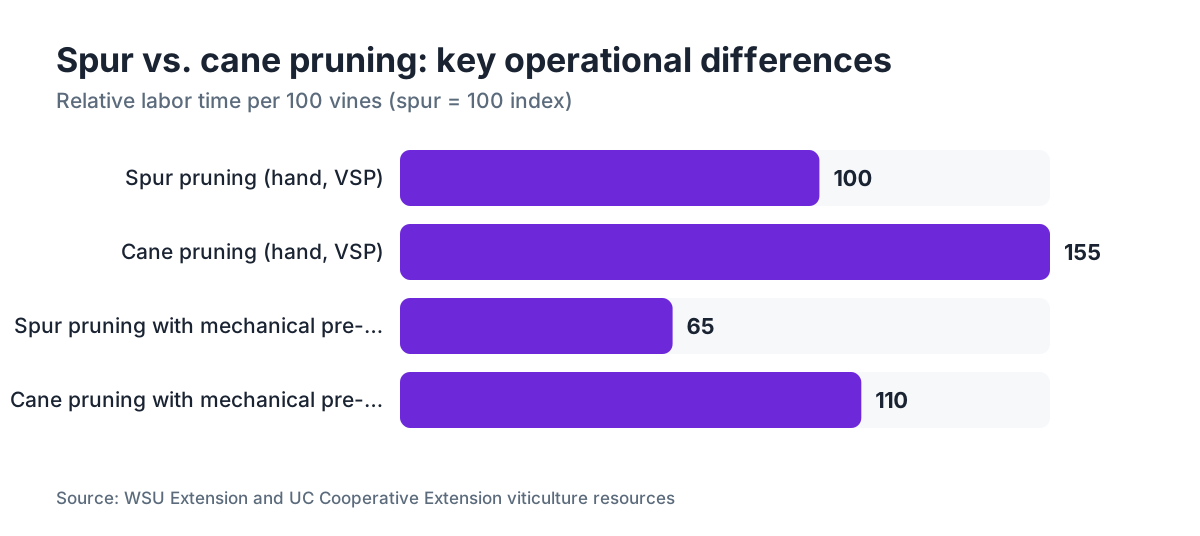
WSU Extension frames the trade-off cleanly: cane pruning takes more labor and skilled workers who can spot a good cane, while spur pruning is faster and easier to pre-prune by machine [3].
Here's a practical comparison:
| Feature | Spur Pruning | Cane Pruning |
|---|---|---|
| Permanent cordon? | Yes | No (head or short trunk) |
| Buds left per spur | 2 | 10-15 per cane |
| Best varieties | Cab Sauv, Merlot, Grenache | Pinot Noir, Riesling, Chardonnay |
| Labor per vine | Lower | Higher |
| Skill required | Moderate | High |
| Risk if done wrong | Spur creep | Vine exhaustion from poor cane selection |
When should you prune trellised grape vines?
Prune during dormancy, which in most wine regions means late January through early March in the Northern Hemisphere. The vine needs to be fully dormant first, which usually shows up as a few weeks of temperatures below 10C (50F) and full leaf drop [1].
Prune too early, right after leaf drop in November or December, and you leave cut wood exposed to winter cold longer, which raises cold-damage risk in marginal climates. Prune very late, once buds are swelling, and you knock swelling buds off by hand while the vine bleeds sap from fresh cuts. Neither is a disaster in most regions. Both are avoidable.
Cold-climate growers in the Finger Lakes and parts of Colorado use a trick called delayed or late dormant pruning. You hold off until buds just start swelling, maybe 10-20% showing green, before your final cuts. The wait lets cold-damaged canes show themselves, because dead wood is obvious at that stage, so you can prune around the damage. Cornell's viticulture team recommends this exact approach where late spring frost is a real threat [4].
Warm regions play a different game. In Paso Robles or the Central Valley, timing is about labor scheduling and holding off early bud push, not cold. Early February is typical there.
How do you make the right cut when pruning a trellised vine?
Cut placement is one of those things a picture teaches better than a paragraph, which is why before-and-after pruning photos are so useful for training crews. Here are the mechanics anyway.
Spur pruning: cut each spur to two nodes. Make the cut about 3-5mm (a quarter inch) above the upper bud, angled slightly away from it so bleeding sap and callus tissue don't sit against the bud. Cut flush with the bud, or angle the cut into it, and you damage it. Cut too high, more than 10mm above, and you leave a dead stub called a snag, which becomes a doorway for wood diseases like Eutypa lata and Botryosphaeria [5].
Cane pruning uses the same individual cut, but cane selection is the real skill. You want a cane about pencil thick (8-12mm diameter), grown in well-lit canopy, with moderate internodes (not the fat, stretched-out internodes of a bull cane), sitting in a spot that lets you tie it along the wire without bending it hard. Canes from dense shade carry poorly developed buds no matter how healthy they look.
Sharp tools matter more than most people admit. A clean cut heals faster and leaves less torn tissue for pathogens to move into. Sharpen your bypass loppers and hand pruners at the start of the season and touch them up midseason. Felco and ARS are the two brands most professional crews use, and both hold an edge. Skip cheap box-store loppers for anything past a hobby vine or two.
Tool sanitation between vines is a real recommendation if you've got Grapevine Leafroll-associated virus or any graft-transmissible disease in the block. A 10% bleach solution works, or commercial disinfectants, though bleach corrodes blades over time. Some crews sterilize with a small torch instead [5].
How many buds should you leave per vine?
Balanced pruning ties bud count to how much wood the vine grew: roughly 20-30 buds per pound of dormant prunings, with a floor near 20 buds. The formula came from Nelson Shaulis at Cornell and has been refined over decades [4]. You weigh the prunings from a vine or a sample of vines, and that weight tells you how many buds to keep.
So a vine that drops 0.75 lb of prunings might get 15-22 buds. A vigorous vine dropping 2 lbs might get 40-60. This is where vineyard-specific calibration beats generic advice.
Most commercial operations don't weigh every vine. They use average block weights and apply one standard bud count across the block. That's a fair efficiency trade, as long as you recheck the numbers every few years or whenever a block drifts toward too much vigor or too little.
Some working starting points. A VSP spur-pruned bilateral cordon on moderate-vigor Cabernet runs 40-60 buds per vine, meaning 20-30 spurs at 2 buds each. A cane-pruned Pinot Noir on a typical Finger Lakes or Willamette Valley site runs 20-30 buds total, two canes at 10-15 buds plus renewal spurs. Treat these as first guesses, not targets. Your actual shoot counts, shoot length, and fruit quality from prior seasons are what should move the number.
What does a before-and-after pruning picture of a grape vine actually show?
A before-and-after pruning photo shows the whole point of the job in two frames. Before: a tangled web of brown canes shooting off in every direction. After: either a tidy cordon lined with stubs (spur-pruned) or a clean trunk with one or two tied-down canes (cane-pruned). The pile of wood on the ground usually shocks people who've never done it.
Good photos also show the shape of the permanent structure. A well-built spur-pruned cordon has evenly spaced spurs, ideally 15-20cm (6-8 inches) apart, running close to the wire without big kinks or drooping sections. Spurs should point upward so their shoots grow into the canopy on their own, no tucking needed.
After photos reveal problems too. Spur creep, where spurs march outward along the cordon year after year until they stand 10-15cm off it, shows up clearly. So does dead wood from Eutypa, which reads as discoloration in cross-section cuts. Fixing a crept cordon means selecting a well-placed basal shoot each year, training it as a new close-in spur, and slowly retiring the old creeping ones.
If you're training a crew, a live demonstration on an actual vine beats any photo. But photos are the next best thing, and UC Cooperative Extension's winegrape production resources include illustrated pruning guides that are genuinely useful [1].
How do you train a young vine on a trellis in years one through three?
Training builds the permanent structure on a young vine; pruning manages the fruiting wood on a mature one. People lump the two together, but keeping them separate makes the early years clearer.
Year one is about roots and getting one straight shoot to the first wire. Cut the young vine to 2-3 buds, pick the strongest shoot that comes up, tie it to a stake, and strip everything else. Don't crop it. If the shoot reaches the wire, pinch the tip to push lateral growth. If it doesn't reach the wire, cut back to 2-3 buds and try again in year two [1].
Year two: if the shoot made the cordon wire, start building the cordon arms. Cut back to a single cane, tie it along the wire, and let laterals develop. Pull off any flower clusters. The vine is still building structure and root reserves, and cropping it now usually sets back long-term productivity [1].
Year three lets many operations take a partial crop, roughly 50% of mature-vine yield, by leaving fewer buds and dropping some clusters during the season. Full production usually starts year four or five, depending on rootstock, variety, and site vigor.
One timing note. If a young vine is growing hard (shoot over 1 meter, cane diameter over 8mm), push through training faster. If it's weak and thin, wait. Patience is cheaper than forcing structure onto an under-developed vine.
What are the most common pruning mistakes on trellised vines?
Leaving too many buds is the most common error, usually from growers nervous about losing yield. The vine answers with a wall of shoots, the canopy closes up, and then you spend real money on shoot thinning, leaf pulling, and hedging you never needed. That dense canopy also feeds botrytis and powdery mildew later in the year.
Spur creep is the slow-motion version. Every winter you keep the same spurs, but they lengthen a little as you cut farther out to find live wood. After 10 years you've got spurs 8-10cm long, standing off the cordon, throwing shoots at odd angles. The fix is patient: each year, find a shoot near the base of a creeping spur, keep it as a new close-in spur, and retire the old one.
Skipping the renewal spur on a cane-pruned vine leaves you with nowhere to pull next year's cane. You always keep that 1-2 bud renewal spur near the head so a well-placed young cane is waiting next dormant season.
Cutting into old wood for no reason opens the vine to trunk disease. Any large wound in wood more than 2-3 years old is a possible infection site for Eutypa, Botryosphaeria, or Esca. UC Davis trunk disease research estimates Eutypa dieback alone costs California's wine grape industry tens of millions of dollars a year [5]. Wound protectants (Topsin-M is labeled for this) help when a large wound can't be avoided.
What are the worker safety and regulatory requirements for vineyard pruning crews?
Pruning crews handle sharp tools in tight rows, often on wet ground in cold weather. The US framework starts with the EPA Worker Protection Standard (WPS), 40 CFR Part 170, which covers agricultural workers including hand labor in vineyards [6].
Three WPS pieces matter most for pruning. Workers must complete agricultural worker safety training before they do fieldwork. You have to provide decontamination supplies (water, soap, paper towels) at the field. And you have to honor restricted-entry intervals (REIs) posted from prior pesticide applications [6]. Dormant-season sprays like copper or dormant oil can carry REIs that overlap pruning timing, so check your spray records before you send a crew down the row.
OSHA hand tool standards (29 CFR 1910.242) apply on top of WPS. Pruning shears cause a meaningful share of vineyard hand injuries, most of them to the non-dominant hand. Kevlar-lined gloves on the non-cutting hand are cheap insurance. A short crew safety talk at season start, covering tool handling and the hazards of a trellised row (wire at eye level, uneven footing), costs nothing and prevents real injuries.
California adds Cal/OSHA's heat illness prevention rules, which can trigger even in February or March when temperatures spike. California growers should also know the state's paid sick leave law and any county-specific agricultural labor rules. California DPR publishes state-specific WPS implementation guidance worth reading before the season [10].
Keep written records of crew training, tool inspection, and any incidents. That's good practice and, under WPS, a requirement. VitiScribe's field records module logs worker training dates alongside spray and pruning records so it's all in one place for a compliance audit.
How does your trellis system change how you prune?
The trellis and the pruning system are one decision, not two. They're designed together, and changing one without the other usually breaks something.
Vertical Shoot Positioning (VSP) is the most common trellis in premium regions worldwide. It sets a cordon wire around 90cm high with two or three pairs of foliage catch wires above. VSP almost always pairs with spur pruning for varieties that tolerate it, since the cordon is built for bilateral spurs. It keeps the fruiting zone narrow and the canopy open, which is why it works in disease-prone regions and for varieties that want sun on the fruit [2].
Geneva Double Curtain (GDC) came out of Cornell for high-vigor sites and splits the canopy into two downward curtains. It's spur-pruned, and the extra surface area soaks up vigor without the canopy closure a single VSP row would show on the same site. Cornell's original research on GDC showed 30-60% yield gains on high-vigor sites versus VSP without giving up quality markers [4][9].
The Scott Henry system divides the canopy like GDC but trains shoots both up and down. It's less common than VSP or GDC and shows up mostly in some Oregon and New Zealand operations. It mixes spur and cane pruning by variety.
Head-trained, own-rooted old vines (the Rhone, old California Zinfandel, traditional Spanish vineyards) have a stake, not wires. Those get gobelet (bush) pruning, a different job entirely. If you're on a wire trellis, which covers most commercial vineyards you'll meet, VSP with spur or cane pruning handles the overwhelming majority of cases.
For more on how vineyard layout shapes daily operations, the vineyard overview covers the bigger picture.
How do you manage pruning on older vines with trunk disease?
Trunk disease is spreading across most wine regions, and pruning is both the cause and part of the cure. The grapevine trunk diseases (GTDs) group covers Eutypa dieback, Botryosphaeria dieback, Esca, and Petri disease. UC Davis and INRAE (France's agricultural research agency) have both tracked rising incidence, with some California surveys finding infection in over 60% of vines in blocks older than 15 years [5].
Every pruning wound is a possible infection site. The two practices with the strongest evidence behind them are double pruning (a mechanical pre-prune in fall that strips most of the cane length, then a hand-prune in late dormancy to final bud count) and wound protection with registered fungicides right after cutting.
Double pruning cuts wound exposure time hard. The large wounds from the fall pass are made while the vine is still active and callusing fast, so by final-prune time they've healed and the small final cuts happen in true dormancy. WSU's research on double pruning in Washington found it meaningfully lowered Eutypa infection rates versus a single pass in standard dormancy [3].
For vines already showing symptoms (stunted shoots, wedge-shaped brown discoloration in cross-section, dead cordon sections), the standard fix is trunk renewal: train a sucker or low shoot as a new trunk, then remove the infected old trunk over 2-3 seasons. Pulling an infected trunk all at once strips too much of the root-to-canopy connection. Doing it gradually keeps the vine alive.
Wound protectants registered for grape trunk disease include Topsin-M (thiophanate-methyl) and some Trichoderma-based biological products. Apply within 24 hours of cutting for best efficacy [5].
What equipment and tools do you actually need for trellis pruning?
For a small operation the list is short: bypass hand pruners, bypass loppers, a pruning saw for larger cuts, and a coil of tying tape or biodegradable clips for cane pruning. That's it.
Hand pruners handle anything under about 2cm, which is most spur and cane wood. Felco 2 and Felco 7 (ergonomic) are the standard for good reasons: repairable, cheap and available spare parts, and they hold an edge. ARS 120DX is another reliable pick, usually a bit cheaper. Electric hand pruners (Felco 801 or Infaco models) cut repetitive strain sharply on big crews making thousands of cuts a day, but they run $400-800 each and need battery management. For a solo grower or small crew, that's a luxury. For a 50-acre block with a 5-person crew, they pay for themselves in reduced injury costs.
Loppers handle thicker wood and old spur removal. A standard 60-70cm bypass lopper is fine. Skip anvil-style pruners and loppers on grape wood; they crush instead of cut and leave messier wounds.
Mechanical pre-pruning equipment (tractor-mounted hedgers and rotary cutters that make a rough pass down the row) is common on large operations. It doesn't replace hand-finishing, but it cuts most of the cane length off before the crew makes final cuts. For blocks over 10-15 acres, the economics usually favor renting or owning a pre-pruner.
For tying cane-pruned vines, Max Tapener tape guns and biodegradable raffia are common. Some growers use soft wire ties. Avoid anything that won't break down or expand as the cane thickens into a cordon, or you'll get girdling in 3-5 years.
Frequently asked questions
How much of a grape vine should you cut off when pruning?
You typically remove 85-95% of the previous season's growth during dormant pruning. That sounds extreme, but it matches how vines work: the root system and permanent wood hold the energy reserves, and the fruiting wood is renewed every year. UC Cooperative Extension cites this range as standard for wine grape production. Leaving too much wood leads to overcropping, canopy density, and poor ripening.
When is the best time of year to prune grape vines on a trellis?
Late dormancy, generally late January through early March in most Northern Hemisphere wine regions. The vine should have been dormant for several weeks first. In cold climates, waiting until buds just begin to swell (10-20% bud swell) helps you spot cold-damaged canes before final cuts. Cornell University recommends this late-dormant approach for frost-prone regions like the Finger Lakes.
What is the difference between spur pruning and cane pruning on a trellis?
Spur pruning keeps a permanent cordon with short 2-bud stubs along the wire. It suits varieties with fruitful basal buds like Cabernet Sauvignon and Zinfandel. Cane pruning replaces the cordon with 1-2 long canes (10-15 buds each) tied out fresh every year. It suits varieties like Pinot Noir and Riesling whose lowest buds are poorly fruitful. Cane pruning takes more skill and labor per vine.
How many buds should I leave on each vine?
Balanced pruning formulas suggest 20-30 buds per pound of pruning weight removed. For a typical moderate-vigor spur-pruned Cabernet Sauvignon block, 40-60 buds per vine (20-30 spurs at 2 buds each) is a reasonable start. For cane-pruned Pinot Noir, 20-30 total buds across two canes plus renewal spurs is typical. Calibrate the actual number from your vine's shoot weight, shoot count, and fruit quality history.
Can I prune grape vines in the fall or do I have to wait for winter?
You can make a mechanical pre-prune in fall to remove most cane length, but final pruning to bud count should wait for full dormancy. Early pruning right after leaf drop exposes wounds to winter cold longer and can raise cold injury. The recommended practice is to wait for mid-dormancy or, in cold climates, late dormancy when you can read cold damage in canes before deciding final cuts.
What tools do professional pruners use on grape vines?
Most professional crews use bypass hand pruners (Felco 2, Felco 7, or ARS 120DX are the standard choices) and bypass loppers for thicker wood. Large operations increasingly run electric hand pruners (Felco 801 or Infaco models, $400-800 each) to cut repetitive strain injuries. Pruning saws handle trunk work. Sharpen all tools at season start; dull blades leave torn wounds that heal slowly and invite disease.
How do you prune a grape vine that has gotten out of control or overgrown on a trellis?
Find the main trunk and permanent structure first, then remove everything that doesn't contribute to it. If the cordon has spur-crept badly, start selecting basal shoots near the cordon each year to replace long spurs gradually. Don't strip large amounts of old wood at once; that shocks the vine. Plan a 2-3 year renovation. If trunk disease is involved (wedge-shaped brown discoloration in cuts), train a replacement trunk from a basal sucker.
Do you need to treat pruning wounds on grape vines?
For small spur cuts, no treatment is needed and vines callus on their own. For large wounds (removing a cordon arm, trunk renewal work), a registered wound protectant like Topsin-M (thiophanate-methyl) or a Trichoderma-based biological product is worth applying within 24 hours. UC Davis trunk disease research shows wound protectants meaningfully reduce Eutypa and Botryosphaeria infection when large cuts are unavoidable.
What are the signs that a grape vine was pruned incorrectly?
Common signs: spur creep (spurs extending far from the cordon), heavy shoot density and canopy closure mid-season from too many buds left, dead spur tips from snags cut too far above buds, and cordon sections dying back from Eutypa or Botryosphaeria where wounds were made carelessly. On cane-pruned vines, poor cane placement shows up when shoots grow at awkward angles or hang below the fruiting wire.
Are there worker safety requirements for vineyard pruning crews?
Yes. The EPA Worker Protection Standard (40 CFR Part 170) requires agricultural worker safety training before fieldwork, decontamination supplies at the field, and compliance with restricted-entry intervals from prior pesticide applications. OSHA hand tool standards (29 CFR 1910.242) also apply. In California, additional Cal/OSHA heat illness prevention rules apply. Keeping written training records is both good practice and a WPS requirement.
How does the trellis system affect which pruning method you use?
They're designed together. VSP (vertical shoot positioning) naturally pairs with spur pruning for varieties that tolerate it and cane pruning for those that don't. Geneva Double Curtain is a spur-pruned system built for high-vigor sites and was shown in Cornell research to raise yields 30-60% on vigorous sites versus VSP. Head-trained bush vines use gobelet pruning rather than trellis-based methods. You can't change the pruning method without reconsidering the trellis architecture.
How do you prune a grape vine in year one, two, and three on a trellis?
Year one focuses on roots: cut back to 2-3 buds, select one strong shoot, tie it to a stake, and remove all fruit. Year two begins developing cordon arms along the wire if shoot height allows; take no crop. Year three allows a partial crop at roughly 50% of mature capacity by leaving fewer buds and dropping some clusters. Full production usually starts year four or five, depending on rootstock vigor and site.
What is spur creep and how do you fix it on an established vine?
Spur creep is the gradual lengthening of spurs as you cut farther from the cordon each year to reach live wood, often reaching 8-10cm after a decade. It makes shoots start far from the wire and tangles the canopy. The fix is gradual: each year, keep a shoot that grew near the base of a creeping spur as a new 2-bud spur, and retire the old long one. Full renovation of a crept cordon usually takes 3-5 years.
How do before and after pruning pictures help with training crews?
Before-and-after images make the end target visible. They show the change from tangled dormant growth to a clean cordon with evenly spaced spurs or a neatly tied cane with a renewal spur. They also expose structural problems like spur creep, misaligned cordons, and dead wood that are hard to describe in words. UC Cooperative Extension's illustrated winegrape production guides include pruning images that work well as crew training references.
Sources
- UC Cooperative Extension, Winegrape Production Manual (ANR Publication 3383): Dormant pruning removes 85-95% of the previous season's growth; year-by-year training guidance for young vines
- UC Davis Viticulture and Enology, Pruning and Training Winegrapes: Spur pruning suitability for basal-bud-fruitful varieties; cane pruning for Pinot Noir, Riesling, and Chardonnay
- Washington State University Extension, Pacific Northwest Pest Management Handbooks and Viticulture Resources: Cane pruning labor requirements compared to spur pruning; double pruning to reduce Eutypa infection rates
- Cornell University Cooperative Extension, Viticulture Program: Balanced pruning formula (20-30 buds per pound pruning weight); delayed dormant pruning for cold climates; GDC yield research
- UC Davis Department of Plant Pathology, Trunk Diseases of Grapevines: Eutypa dieback causes tens of millions in annual California losses; >60% infection in older blocks; wound protectant efficacy within 24 hours
- US EPA, Worker Protection Standard (40 CFR Part 170): WPS agricultural worker training requirements, decontamination supplies, and restricted-entry interval compliance for vineyard field workers
- UC Cooperative Extension, Spur vs. Cane Pruning for Wine Grapes: VSP trellis and pruning system pairing; spur spacing recommendations of 15-20cm on bilateral cordons
- Cornell University, Geneva Double Curtain Trellis System (original Shaulis research summary): GDC showed 30-60% yield increases on high-vigor sites compared to VSP without sacrificing quality markers
- California Department of Pesticide Regulation, Agricultural Worker Safety: California-specific WPS implementation and additional Cal/OSHA requirements for vineyard field crews
Last updated 2026-07-09