Grape véraison: what it is, when it happens, and why it matters
TL;DR
- Véraison is the annual moment when grape berries shift from hard and green to soft and colored.
- Sugar starts loading, acids start dropping.
- It usually happens 6 to 8 weeks before harvest.
- Timing moves with variety, climate, and vine stress.
- What you observe and record at véraison drives every spray, irrigation, and harvest call that follows.
What exactly is véraison in grapes?
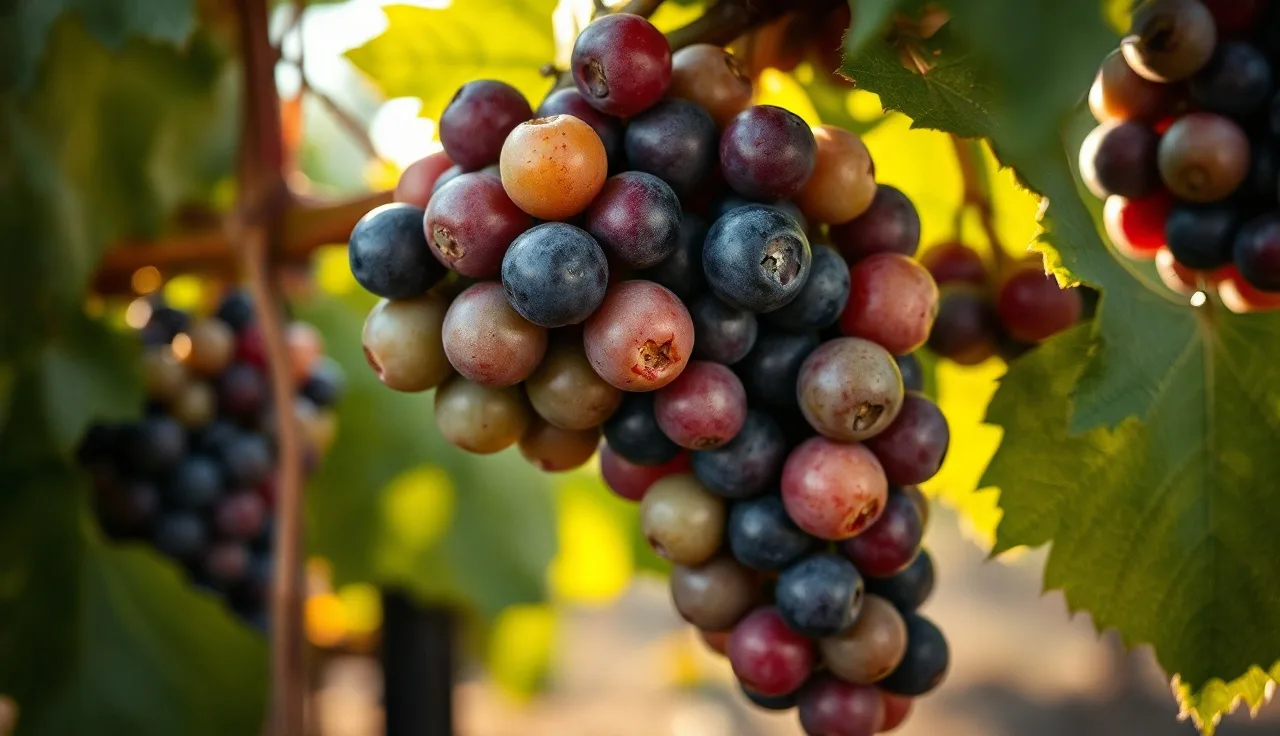
Véraison (say it veh-ray-ZOHN, borrowed from French) is the technical name for the onset of grape ripening. It marks the point when individual berries stop building only cell mass and start loading sugar, lose their green chlorophyll, soften, and, in red varieties, begin making anthocyanin pigments. White varieties don't turn red. They turn translucent and golden instead of opaque green.
The word comes from Old French for "change of color," and color really is the most visible signal. But the biochemical changes under that color shift are what growers actually care about. According to UC Davis Viticulture and Enology, véraison is the transition from Phase II to Phase III of berry development, a switch from cell division and enlargement to active sugar loading through the phloem [1].
One berry doesn't represent the cluster. One cluster doesn't represent the block. Véraison is staggered. The first berries to turn can show up days or weeks before the last ones in the same block catch up. That stagger, sometimes called the "véraison window," is itself a data point about vineyard uniformity and vine stress.
For the grower, véraison is a starting gun, not a celebration. You've got roughly 45 to 65 days to harvest. The spray calendar shifts, the irrigation strategy changes, and the sampling schedule starts.
What causes véraison to happen when it does?
Heat accumulation is the trigger, measured in growing degree days (GDD). Viticulture researchers use a 50°F (10°C) base temperature, and most Vitis vinifera varieties need somewhere between 1,200 and 1,800 GDD from budburst to reach véraison, depending on the cultivar and the calculation method [2].
Abscisic acid (ABA) is the main hormonal driver. ABA concentration in the berry rises sharply at véraison onset, and that rise responds to water deficit, temperature, and the balance between shoot growth and fruit load. A vine carrying too much crop relative to its leaf area can delay véraison. A vine under hard water stress before véraison can trigger it early. Neither is what you want.
Day length has a secondary effect. Research from WSU's viticulture program confirms that short-day signals speed up the ABA-driven ripening process, which is part of why late-season varieties in northern latitudes sometimes struggle: shorter days push ripening while temperatures are already falling [3].
Rootstock and soil matter too. Deep, well-drained soils with lower nitrogen tend to give earlier, more uniform véraison. Heavy soils with excess water and nitrogen push vegetative growth, compete with fruit development, and scatter berry softening across a longer window.
Here's the practical payoff. Keep GDD records from the same site over several years and you can start calling véraison within a week or two. That's worth doing. It lets you schedule labor, plan spray intervals, and warn your winemaking team early.
When does véraison happen for different grape varieties?
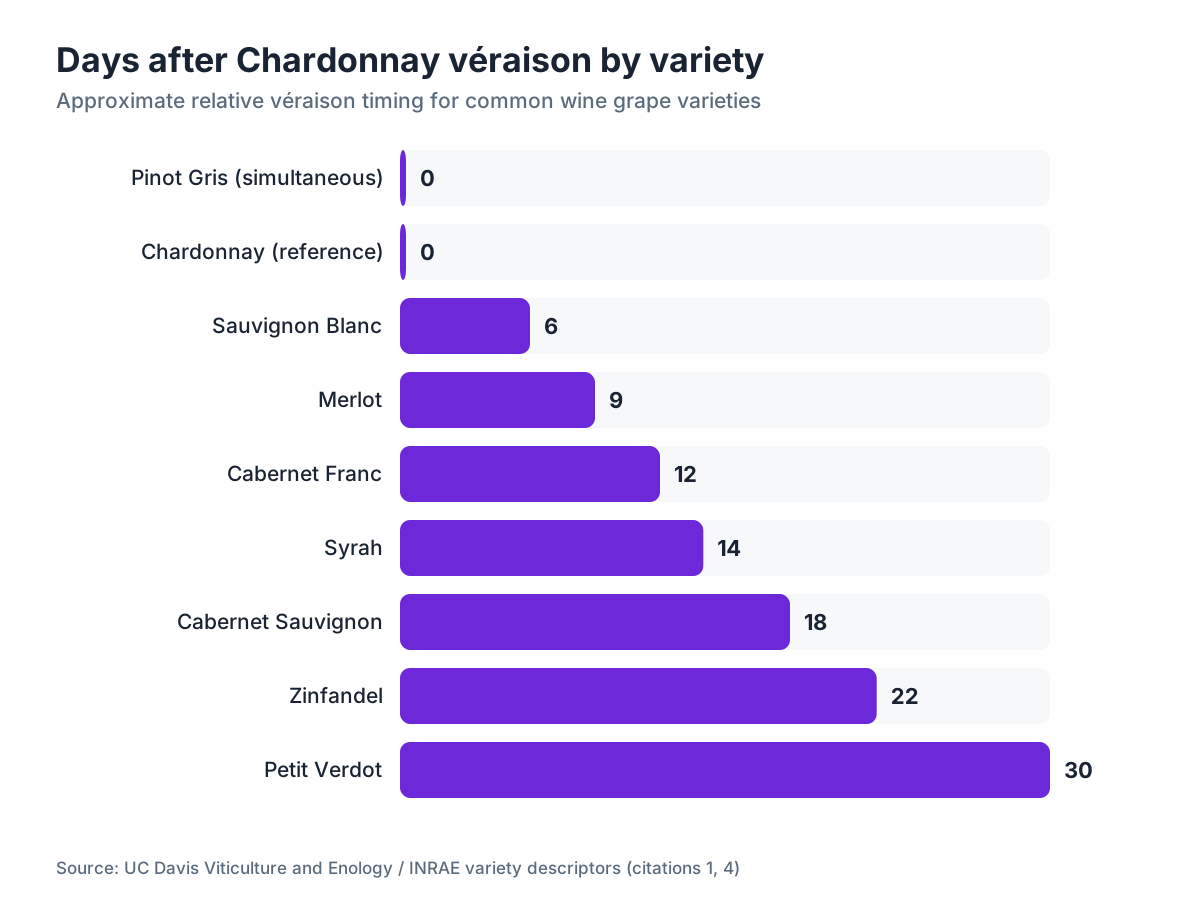
Timing is relative to climate, so calendar dates mislead more than they help. The more useful frame is where the variety sits in the ripening order, often expressed as days relative to Chasselas doré (a Swiss reference variety) or relative to Chardonnay in California and Oregon.
The table below shows approximate véraison timing for common wine grape varieties relative to the regional base variety, using data from UC Davis and INRAE (France's national agronomic research institute) variety descriptors [1][4].
| Variety | Type | Véraison relative to Chardonnay | Typical GDD at véraison (base 50°F) |
|---|---|---|---|
| Pinot Gris | White | Simultaneous | ~1,250 to 1,350 |
| Chardonnay | White | Reference | ~1,300 to 1,400 |
| Sauvignon Blanc | White | +5 to 7 days | ~1,350 to 1,450 |
| Merlot | Red | +7 to 10 days | ~1,400 to 1,500 |
| Cabernet Franc | Red | +10 to 14 days | ~1,450 to 1,550 |
| Syrah | Red | +12 to 16 days | ~1,500 to 1,600 |
| Cabernet Sauvignon | Red | +14 to 21 days | ~1,550 to 1,700 |
| Zinfandel | Red | +18 to 25 days | ~1,600 to 1,750 |
| Petit Verdot | Red | +25 to 35 days | ~1,700 to 1,850 |
Note: these GDD ranges are estimates pulled from several UC Davis and INRAE sources. Your site values will differ with microclimate, rootstock, and canopy management. Track your own block-level GDD over at least three seasons before you treat any number as a firm threshold.
In the Napa Valley, Chardonnay véraison usually lands in mid-July [1]. In the Finger Lakes of New York, the same variety usually reaches véraison in early August [5]. At Paso Robles, heat accumulation can push Zinfandel through véraison by mid-July [6]. The calendar date matters far less than the cumulative heat.
How do you accurately assess when véraison starts in a vineyard block?
The standard field method is a percentage count at a fixed sample size, often the 100-berry count. Walk a set transect through the block, pick one berry from each of 100 pre-selected vines (take it from the middle of the cluster shoulder), and score each for softness and color change. The share of softened or colored berries is your véraison percentage.
A working definition from Cornell Cooperative Extension puts véraison onset at the point when roughly 5 to 10% of berries show color change or softening, and full véraison at 80 to 90% [5]. The gap between those benchmarks runs from about 7 days in hot, uniform conditions to 20-plus days in stressed or mixed blocks.
A few things I've learned in the field:
Don't sample only the easy vines at row ends. Those see more sunlight and often lead the block by several days, which gives you an optimistic read. Sample mid-row vines too.
Mark your sample vines with flagging tape at budburst. Repeat sampling on the same vines all season so your percentage calculations stay comparable over time.
Check clusters at multiple canopy positions. Exterior clusters in afternoon sun consistently lead interior shaded clusters at véraison. That gap drives your canopy management calls.
Some growers add a firmness squeeze: a berry at véraison gives slightly under thumb pressure, a pre-véraison berry doesn't. It's crude, but it catches white-variety berries that haven't changed color much yet.
Record your assessment date, sample vine numbers, percentage, and weather. Three years of those records and you'll have a site-specific early-warning model no extension bulletin can hand you.
How does véraison affect your spray program?
Véraison changes the threat profile in the vineyard, and that should change your spray calendar. Before véraison your main fungal targets are downy mildew (Plasmopara viticola), powdery mildew (Erysiphe necator), and Botrytis bunch rot. After véraison, rising sugar and softening skin make Botrytis the dominant concern, especially in dense canopies with poor airflow.
Powdery mildew risk doesn't vanish at véraison, but the window for new infections narrows as berry sugar climbs past about 8 Brix. Research from UC Davis found berries become substantially resistant to powdery mildew once they reach roughly 8 to 10 Brix, which often falls two to three weeks after véraison [1].
Fungicide selection is where timing bites. The EPA Worker Protection Standard (WPS) sets pre-harvest intervals (PHIs) that become operationally binding once véraison starts. Say you're using a fungicide with a 30-day PHI and you target harvest at 50 days post-véraison. You've got roughly a 20-day application window after véraison before that product is locked out. Map your material rotation with PHIs against your expected harvest date [7].
Record-keeping stakes peak here. California DPR requires pesticide use reports for any restricted-use pesticide application, and those records must capture application date, product, rate, acreage, and operator [8]. Oregon and Washington run similar reporting requirements [3]. If a compliance audit lands after harvest, your véraison-window spray records will get the hardest look. Keep them in one system, not on scattered clipboards. VitiScribe's spray log module time-stamps applications and counts PHI days down against your block-level harvest projections, which earns its keep during this compressed window.
One opinion. Stop reaching for broad-spectrum materials at véraison unless you have a documented disease threshold that justifies it. The beneficial arthropods you've built all season get knocked back for marginal late gains, and residue on the fruit goes up. That's not a regulatory position. It's an agronomic one, and most farm advisors I've watched actually follow it.
Should you irrigate differently at and after véraison?
Yes, and the shift is fairly well-defined. Before véraison, moderate water deficit (stem water potential around -6 to -9 bars, depending on variety and region) can help control excessive vegetative growth and improve color in red varieties. After véraison, the goals change.
Past véraison, continued moderate stress can concentrate flavor compounds and anthocyanins in reds. But severe stress after véraison shrinks berries beyond what helps quality, drains vine reserves heading into dormancy, and causes uneven ripening if the stress swings across the block.
WSU Extension recommends monitoring stem water potential weekly from véraison to harvest, targeting -10 to -14 bars for red wine varieties chasing concentration and keeping whites closer to -8 to -12 bars to protect aromatics and avoid burning off too much acid [3].
Drip timing matters a lot here. Irrigating heavily right after a big heat event during ripening can dilute flavor compounds. The guidance from UC Cooperative Extension is to use several smaller irrigation events rather than one large one after véraison, which holds vine water status steadier and cuts berry splitting risk from wild tension-and-fill cycles [2].
Rain during this window is a different animal. You can't control it, but you can answer it with canopy work. Get a significant rain event between véraison and harvest and you should be out assessing canopy density, pulling leaves around the cluster zone to restore airflow. That's the single most effective Botrytis response left to you once the rain has already fallen.
What physiological changes happen inside the berry after véraison?
Understanding the chemistry helps you set better targets and timing, so it's worth a walk through the four things moving inside the berry.
Sugar: glucose and fructose both build fast after véraison, loaded in through phloem transport. The rate runs roughly 0.1 to 0.4 Brix per day in moderate climates, faster during heat events [1]. That rate slows as harvest nears and berry sugar reaches equilibrium with available phloem sugar.
Acids: malic acid drops sharply after véraison from both dilution as the berry grows and active respiration. Warmer temperatures speed malic respiration, which is why warm-climate wines tend toward lower total acidity. Tartaric acid declines more slowly and stays more stable. The ratio of tartaric to malic is a rough proxy for the ripening temperature history [4].
Anthocyanins: in red varieties, synthesis starts at véraison and peaks around 25 to 35 days later, then can fall if temperatures run too high (above about 35°C/95°F). Anthocyanin accumulation is more temperature-sensitive than sugar accumulation, which is why late-season heat spikes can hand you high-Brix wines with weak color.
Aromatics: varietal terpenes (Muscat, Riesling, Gewürztraminer) and methoxypyrazines (Cabernet Franc, Sauvignon Blanc) run on different curves. Methoxypyrazines are actually highest before véraison and decline through ripening. If you're trying to cut herbaceous character in Cabernet Franc, that trajectory started well before véraison.
Tannins: seed tannins are largely formed before véraison and polymerize over the ripening period. Skin tannins rise after véraison. Seed tannin ripeness, often read by seed color turning green to brown, is one of the better late-season indicators of whether the fruit is truly ready for red wine.
How does véraison timing affect harvest date prediction?
The simplest model counts forward from first véraison (5 to 10% berry color change) by 45 to 65 days, depending on variety and target style. That range is wide because it has to be. A Pinot Noir block in the Willamette Valley aimed at sparkling base might come off 40 days after véraison. The same block aimed at still wine might wait 55 to 60 days. A Napa Cabernet Sauvignon aimed at high-extraction red often goes 60 to 70 days.
More precise prediction uses post-véraison GDD. Cornell's viticulture group has published work suggesting Riesling in the Finger Lakes needs roughly 800 to 1,000 GDD (base 50°F) after véraison to reach typical harvest maturity [5]. Build a block-specific GDD-to-harvest model over three to five seasons and you get the most reliable prediction available without expensive instrumentation.
Harvest date prediction reaches well past logistics. Winery scheduling, tank availability, refrigerated truck booking, and labor commitments all need lead time. A block-level véraison date recorded accurately, paired with historical GDD data, gets you to a harvest window inside maybe plus or minus 5 days. That's workable. "I'll call you when it's ready" is not.
Some growers at Paso Robles wineries and coastal California properties use commercial weather services that layer GDD forecasting onto the véraison observation to generate rolling harvest date estimates. It beats simple heat-unit math because it pulls in actual forecast data instead of historical averages. But your own site history stays the foundation.
What vineyard management decisions should you make right at véraison?
Véraison is a decision node more than an observation. Here's what should happen in most blocks within a few days of confirmed véraison.
Green harvest (crop thinning): if fruit load looks heavy relative to canopy size, véraison is your last effective window for crop thinning. Dropping clusters after véraison does speed ripening of the remaining fruit, but the quality benefit fades fast the later you go. Work from UC Davis shows diminishing returns on crop thinning past full véraison (80%-plus color change) for most varieties [1].
Leaf removal: if the cluster zone is dense and Botrytis pressure worries you, do a light leaf pull on the east side of the canopy (morning sun, afternoon shade) at or just after véraison. Aggressive removal on the full afternoon-sun side can sunburn berries. The berry surface can run 5 to 10°C hotter than ambient air under direct sun.
Shoot positioning: any positioning work you haven't finished needs to happen now. Shaded interior shoots competing with fruit are mostly a liability after véraison.
Verify spray record completeness: every application from the start of the season should be logged before the véraison-window applications begin. Good time to cross-check product labels against EPA WPS re-entry intervals (REIs). Restricted-entry intervals don't disappear at véraison. If you're applying a fungicide with a 12-hour REI, workers harvesting a few weeks later need the last application date [7].
Running multiple varieties? Keep a block-by-block véraison log. A platform like VitiScribe or a well-organized spreadsheet both work. What matters is that the data is dated, block-specific, and there at harvest when you're trying to reconstruct the season.
How does climate and vintage affect the uniformity of véraison?
Uniformity is the real quality signal at véraison, more than timing. A block that reaches 80% véraison over 7 days is in far better shape than one that takes 21 days to get there. Faster blocks ripen more uniformly, which means less sorting at harvest and better batch consistency.
High vine-to-vine variability in véraison onset usually traces to soil variability, irrigation zone boundaries, vigor differences, or disease load. If part of your block lags every year, that's a signal to check soil electrical conductivity variation or root distribution, not a reason to sit and wait for the block to catch up.
Cool, wet springs followed by hot early summers tend to give rapid, uniform véraison because the vine hasn't been in a long stress state. Extended spring drought followed by irregular summer rain can scatter véraison badly. The 2011 vintage in the Finger Lakes gets cited as a case of delayed, non-uniform véraison driven by a cool, wet summer that pushed some blocks 10 to 14 days past their historical average [5].
There isn't great longitudinal data on véraison timing shifts from climate change at the vineyard level. The closest systematic work is a paper by Morales-Castilla et al. in Nature Climate Change reporting that European wine regions have seen véraison advance by roughly 6 days per decade since the 1980s, driven mostly by warming [9]. That rate points toward real variety-site reconsideration for growers planning long-term blocks.
What records do you legally need to keep around véraison?
The legal record-keeping rules at véraison are the same as any other part of the season. The practical stakes are highest here, because spray activity is high and harvest is close.
Federal: the EPA Worker Protection Standard (40 CFR Part 170) requires employers to keep pesticide application records including product name, EPA registration number, active ingredient(s), application date, location, amount applied, and the name of the person applying. Records must be kept for two years [7].
California: the California Department of Pesticide Regulation (CDPR) requires pesticide use reports for restricted-use pesticides filed monthly with the county agricultural commissioner, submitted within the first 10 days of the following month. Organic exempt materials still need documentation of organic certification status and material approval [8].
Washington: WSDA requires pesticide records retained for two years. The department also requires that any pesticide application near harvest carry documented pre-harvest interval compliance, logged per product per application [3].
Oregon: ODA requirements line up closely with federal WPS, with current requirements for each registered product available through the state's pesticide program [10].
Beyond legal minimums, the most consequential record you can keep at véraison is a timestamped véraison assessment by block. Some states with appellations or winegrape contracts require harvest notification windows. Documenting your véraison date builds the paper trail that justifies your harvest date to a winery buyer or appellation authority if questions come up.
What should you tell your winemaking team at véraison?
This is an often-skipped conversation that costs people real friction later. At or within a few days of confirmed véraison, the winemaking team (you, an in-house winemaker, or a custom crush facility) needs four things.
The véraison date and percentage by block. More than "Cab started turning." Block name, assessment date, percentage.
A projected harvest window, even a rough one. "Based on current heat accumulation and historical patterns, Block 4 Cabernet Franc is likely to hit harvest window September 15 to 25" beats silence. Fine to caveat that weather will move it.
The current spray history summary, specifically which materials went on in the last 30 days and their PHIs. A winemaker who knows you applied a 30-day PHI product two weeks ago can plan around it. One who finds out at harvest cannot.
Any issues: uneven blocks, disease pressure, anything odd in canopy health. A winery sorting a Botrytis-affected lot at 2am is not the moment for them to learn you saw early symptoms three weeks back.
If you supply fruit to a winery destination like a larger vineyard operation or a regional cooperative, check your contract for notification clauses tied to véraison. Some contracts require formal written notice within a set window of véraison onset, with harvest date estimates to follow. Miss those clauses and you can create real logistical, sometimes legal, complications.
Frequently asked questions
How long does véraison last from start to finish?
In a well-managed, uniform block, véraison usually takes 7 to 14 days to go from first color change (5 to 10% of berries) to near-complete color change (80 to 90%). Stressed vines, high crop loads, or significant soil variability can stretch that window to 3 weeks or more. The longer the véraison window, the wider your ripening spread at harvest.
Does véraison look different in white grapes versus red grapes?
Yes. In red varieties, véraison is obvious: green berries turn red, purple, or blue-black. In whites, the change is subtler. Green opaque berries turn translucent, then golden or yellow. The softening happens in both types. In white varieties, softness under light thumb pressure is often the most reliable single field indicator.
Can you force or accelerate véraison?
Not really, not safely. Severe water stress can push véraison earlier, but at the cost of vine health and fruit uniformity. Some growers girdle (scoring the bark to slow carbohydrate flow to roots) to advance véraison by a few days on table grapes, but it's rare in wine grapes and carries real vine stress risk. Crop thinning before véraison can modestly advance timing.
What Brix level should grapes be at véraison?
At the onset of véraison, most varieties sit between 3 and 7 Brix. Sugar accumulation accelerates after that, gaining roughly 0.1 to 0.4 Brix per day depending on temperature. By mid-ripening (about 3 to 4 weeks after véraison), expect 12 to 16 Brix in most varieties. Harvest targets vary widely by style, from 18 to 19 Brix for sparkling base to 26-plus Brix for late-harvest wines.
How does water stress before véraison affect berry size and quality?
Moderate pre-véraison water stress (stem water potential around -6 to -9 bars) restricts berry size modestly and can improve skin-to-pulp ratio in reds, which concentrates color and tannin. Severe pre-véraison stress stunts berry development permanently; those cells don't recover after irrigation resumes. UC Cooperative Extension recommends monitoring stem water potential rather than scheduling irrigation by calendar to manage this precisely.
Does véraison timing predict harvest quality?
Early véraison generally correlates with earlier harvest and, in cool climates, better fruit maturity because the fruit gets more ripening days before fall temperatures drop. But early véraison alone doesn't guarantee quality. What happens in the 6 to 8 weeks between véraison and harvest, especially temperature patterns, rainfall, and disease pressure, shapes final fruit quality as much as timing does.
What diseases are most concerning right after véraison?
Botrytis bunch rot (Botrytis cinerea) is the primary concern after véraison. Rising sugar and softening skins make berries highly susceptible, especially in dense canopies with poor airflow. Powdery mildew risk drops substantially once berries pass about 8 to 10 Brix. Sour rot, a bacterial-fungal complex often entering through Botrytis wounds or mechanical damage, becomes a real risk later in ripening, particularly after rain.
How do you track GDD to predict véraison?
Calculate GDD daily: maximum temperature plus minimum temperature, divided by 2, minus the base temperature (50°F for grapevines). Sum from budburst date. Most varieties show véraison between 1,200 and 1,700 GDD accumulated. After three or more seasons of on-site GDD tracking paired with observed véraison dates, you'll have a block-specific threshold more reliable than any published average.
Should you thin clusters at véraison?
Yes, if the block is overcropped relative to leaf area. Drop clusters showing the least color change first; those will be the last to ripen and widen your harvest window. Véraison is the last practical timing for crop thinning: after 80% color change, the ripening benefit of further thinning drops sharply. Aim for clusters-per-shoot based on your canopy assessment, not an arbitrary percentage.
What data should I record at each véraison assessment?
At minimum: assessment date, block ID, sample size (number of vines assessed), percentage of berries showing color change or softening, notes on distribution within the block (uniform vs. patchy), and ambient conditions. If you take stem water potential measurements, log those too. These records feed harvest predictions, become evidence for compliance reviews, and build your long-term site model.
Is there a difference between véraison in Cabernet Sauvignon and Pinot Noir?
Yes, and it's significant. Pinot Noir reaches véraison 14 to 21 days earlier than Cabernet Sauvignon in most sites, reflecting its early-ripening genetics. Pinot also tends to have a shorter, more compressed véraison window in good conditions. Cabernet Sauvignon véraison is often more staggered, especially in blocks with diverse rootstocks or soil variation. The two should always run on separate spray and assessment schedules.
How does shade affect when berries hit véraison?
Significantly. Clusters shaded by dense canopy can lag exterior clusters by 5 to 10 days on the same vine. That's a direct argument for leaf removal around the cluster zone before véraison. Shaded clusters also show weaker color development after véraison even once they catch up in timing, because anthocyanin synthesis needs light. Canopy management before véraison pays off more than intervention after.
Can late-season high temperatures reverse color development at véraison?
Yes. Temperatures above 35°C (95°F) directly inhibit anthocyanin synthesis and can degrade existing pigments, causing color rollback in reds. Sugar accumulation continues even at those temperatures, so berries can hit high Brix with poor color. This is sometimes called heat bleaching, and it's a real concern in inland California, Arizona, and other hot wine regions during late-season heat events.
Sources
- UC Davis Viticulture and Enology, Grape Berry Development: Véraison marks the transition from Phase II to Phase III of berry development, initiating active sugar loading; berries become substantially resistant to powdery mildew once they reach approximately 8 to 10 Brix post-véraison
- UC Cooperative Extension, Irrigation of Winegrapes in California: Base temperature of 50°F used for GDD calculation in Vitis vinifera; multiple smaller post-véraison irrigation events recommended over single large ones to reduce berry splitting risk
- Washington State University Extension, Viticulture and Enology: Short-day signals accelerate ABA-driven ripening; post-véraison stem water potential targets of -10 to -14 bars for red wine varieties seeking concentration
- INRAE (Institut National de Recherche pour l'Agriculture, l'Alimentation et l'Environnement), Vitis Variety Database: Malic acid drops sharply after véraison due to dilution and respiration; tartaric to malic ratio is a proxy for ripening temperature history; relative véraison timing data by variety
- Cornell Cooperative Extension, Viticulture Program: Véraison onset defined as 5 to 10% berry color change, full véraison at 80 to 90%; Riesling in Finger Lakes needs roughly 800 to 1,000 GDD post-véraison to harvest maturity; 2011 vintage saw delayed non-uniform véraison from cool wet summer
- UC Cooperative Extension, San Luis Obispo County, Paso Robles AVA resources: Heat accumulation in Paso Robles can advance Zinfandel véraison to mid-July
- US EPA, Worker Protection Standard, 40 CFR Part 170: Pesticide application records must include product name, EPA registration number, active ingredient, date, location, amount applied, and applicator name; records retained two years; pre-harvest intervals and re-entry intervals apply through harvest
- California Department of Pesticide Regulation, Pesticide Use Reporting: California requires pesticide use reports for restricted-use pesticides filed monthly with county agricultural commissioner within 10 days of month following application
- Morales-Castilla et al., Nature Climate Change, 2020, Diversity buffers winegrowing regions from climate change losses: European wine regions have seen véraison advancing by roughly 6 days per decade since the 1980s, driven primarily by warming temperatures
- Oregon Department of Agriculture, Pesticide Program: Oregon pesticide application record requirements align with federal WPS; PHI compliance must be documented per product per application near harvest
Last updated 2026-07-09