Overgrown grape vine pruning: how to rescue a neglected vine
TL;DR
- Reclaim an overgrown grape vine over one to three dormant seasons.
- Remove dead wood, pick the strongest canes for a new cordon or spur structure, and cut spurs back to two or three buds.
- Never take more than half the canopy in a single year.
- Expect two to four years to reach full production.
What actually happens to a vine when pruning is skipped for years?
A neglected vine rarely dies. It just stops making useful fruit. Skip pruning for two, three, or five years and the vine pours its energy into wood instead of grapes. You get a mass of overlapping canes, blind wood (sections that lost their fruitfulness because they were too shaded to differentiate buds properly), and a canopy so dense that disease pressure climbs fast. Bunch rots, powdery mildew, and Botrytis all thrive in the stagnant air inside a neglected canopy.
Here's the good news. The permanent structure, the trunk and main cordons, often survives fine under all that chaos. Cornell's viticulture extension puts it plainly: most Vitis vinifera and hybrid varieties tolerate severe corrective pruning if it's staged carefully, because the root system stays healthy even when the top is a mess [1]. Rescuing a neglected vine means reconnecting that healthy root system to a productive, manageable canopy.
The vine's carbohydrate reserves live in the roots and the permanent wood. Cut everything off at once and you draw down those reserves faster than new growth can rebuild them. The vine pushes shoots, stalls, and dies by midsummer. That's why the multi-season approach exists. It isn't timidity. It's plant physiology.
When is the right time to prune an overgrown grape vine?
Dormant season is the window. For almost every wine grape region in North America that means late January through early March, after the coldest weeks pass but before the buds swell. Prune too early, say November or December right after leaf drop, and you expose fresh cuts to hard freezes. The tissue at the cut end can die back several inches, and you lose buds you were counting on [2].
Prune too late, once the buds have cracked open and shoots run two to four inches long, and you're doing 'late pruning.' It's a valid tool for frost-prone sites because it delays the vulnerable green tissue by one to three weeks. But for a renovation it costs you. The vine already spent carbohydrate reserves pushing those shoots, and you'll cut most of them off anyway. Do the heavy corrective work while the vine is truly dormant.
WSU Extension gives a practical rule: prune when about 50 percent of the buds on a test cane start to swell (the 'delayed dormant' moment), because wound-closure response is fastest then and infection through cuts is lowest [3]. In eastern Washington that's typically late February to mid-March. In California's Central Valley it can be early January. Watch the vines, not the calendar.
One timing note specific to neglected vines: if the vine has dead or diseased wood, cut that out first regardless of season. Dead wood infected with Eutypa lata or Botryosphaeria keeps spreading through winter. Getting infected wood off the property (don't leave it in the row) matters more than perfect timing on those cuts.
How do you assess an overgrown vine before you start cutting?
Spend five minutes per vine before you pick up the saw. Trace the trunk from the ground up. Is it straight, or has it split into multiple trunks from old pruning wounds? Are there large callused-over stubs from previous cuts? Those stubs are often dead inside and harbor trunk disease fungi. Scratch the bark with your thumbnail. Green tissue means live wood. Brown or black means dead.
Identify the existing cordon structure if there is one. In a Guyot or cane-pruned system there may be no permanent cordon at all, just a trunk. In a VSP (vertical shoot positioning) cordon system, look for the horizontal arms that run along the trellis wire. If those cordons are alive and the spur positions along them still carry viable wood, you may only need to clean up, not start over.
Make three lists before you cut: (1) wood that's definitely dead and comes out no matter what, (2) the best candidate cane or cordon arm you want to keep and train as the new structure, (3) everything else that you'll cut back hard but not necessarily remove entirely in year one. That third category is your insurance. If your first-choice candidate winter-kills, you need a backup.
Photograph the vine from both sides before you start. Sounds obvious. But a before-and-after record matters for your spray and field operations log, and if you're running multiple blocks, a photo record keeps you honest about which vines got which treatment. On a record-keeping platform like VitiScribe, attaching a field photo to the pruning event takes thirty seconds and saves arguments later.
What is the right method for pruning overgrown grape vines in year one?
Year one is about removing the worst wood and setting the skeleton you want, not chasing full production. Here's a sequence that works.
First, remove all dead wood back to live tissue. Cut until the cross-section is white or cream with no brown staining. On a badly neglected vine this alone can take off 40 percent of the mass.
Second, select one or two of the strongest, best-positioned canes from last season's growth as your keepers. 'Strong' means pencil-diameter or slightly thicker, well-lignified (tan or brown bark, not green), with nodes spaced about four to six inches apart. 'Best-positioned' means they arise near the trunk or from the cordon arms at a point where you actually want a spur or a new cordon extension.
Third, cut everything else back hard. Not off entirely in most cases, just back to two-node stubs. Those stubs push shoots in spring, you keep the most vigorous one, and by year two you have options. Remove completely any canes that cross through the center of the canopy or grow downward.
Fourth, tie your keeper canes loosely to the trellis wire. In a cordon system, the keeper cane becomes the new cordon extension, so you want it horizontal and attached before growth begins. In a cane-pruned Guyot system, arch the cane and tie both ends to a wire.
UC Davis Cooperative Extension's pruning guide recommends leaving 20 to 40 more buds than your target in year one, then thinning shoots in late spring to the count you want [2]. That buffer protects you if frost or mechanical damage takes out some buds after pruning.
Heavily neglected vines run 15 to 25 minutes each in year one, against five to eight minutes for a well-maintained vine. Budget accordingly.
How does cordon pruning grape vines work differently from cane pruning in a renovation?
The distinction matters a lot in a renovation, because the two systems fail differently when neglected.
Cordon grape vine pruning builds on permanent horizontal arms (the cordons) that stay on the trellis year after year. Spur positions sit every six to eight inches along the cordon, each cut to two or three buds every dormant season. When this system gets neglected, the cordons usually survive, but the spur positions turn into 'spur cluster' tangles with five or six two-year and three-year stubs stacked on top of each other. Each stack pushes buds farther from the permanent wood, dropping fruit quality and choking the trellis. Cordon renovation means cleaning those clusters back to a single spur stub, even if you sacrifice a year of yield at that position.
Cane pruning (Guyot or similar) replaces the bearing wood entirely each year. There are no permanent spurs. When this system is neglected, you lose track of which wood is one-year-old (fruitful) versus older (not). The renovation task is simpler in concept: find the one-year canes, the ones with smooth lighter-colored bark and clearly visible leaf scars spaced four to six inches apart, and cut everything older back to short renewal spurs.
Not sure which system a neglected block used? Look at the trellis. Multiple wires at different heights (a foliage wire set and a lower fruiting wire) point to a VSP cordon system. A single wire at about 36 inches, with vines arched over it, is usually a Guyot cane system.
Cordon renovation forces the hardest call: keep the existing cordon or remove it and retrain from a basal shoot. Keep it if more than 70 percent of the spur positions are alive and the cordon is free of large dead sections. Remove and retrain if it's more than half dead or you see the dark cross-section staining of Eutypa running through the wood [4].
How many years does it take to fully renovate a neglected vine?
Two to four years, honestly, depending on how badly the vine was neglected and how hard you push each dormant season.
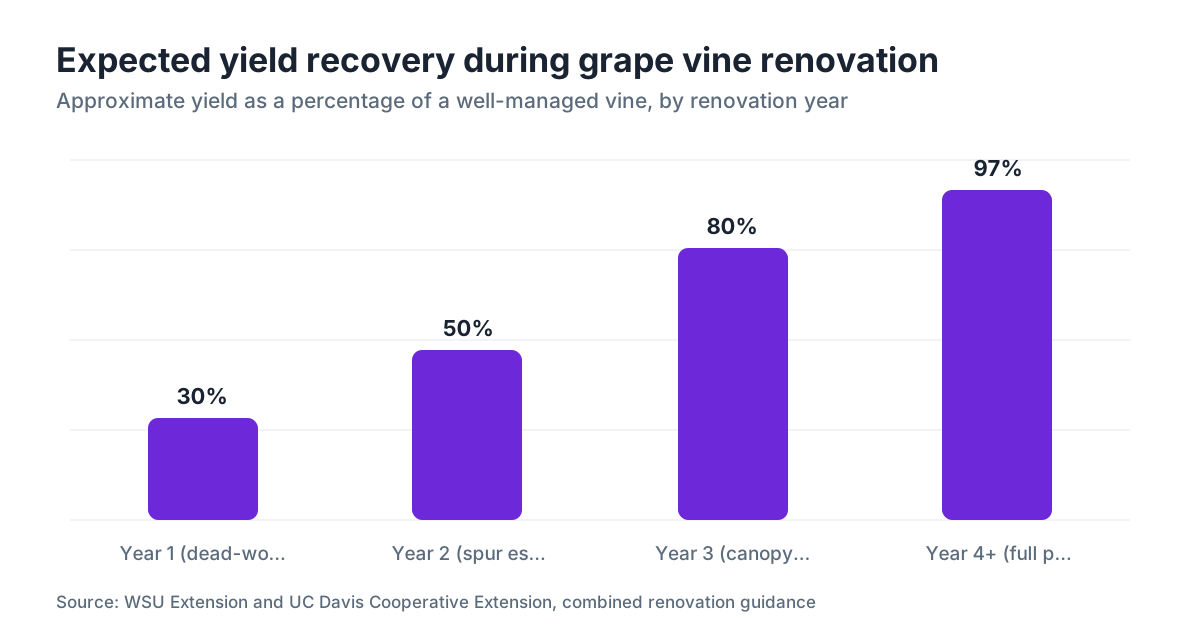
Year one: Remove dead wood, select the new structure, cut back everything else. Yields drop hard, often 50 to 70 percent below a well-pruned vine, because you're sacrificing fruitful wood to build the skeleton.
Year two: The vine has rebounded with vigorous shoots off your year-one stubs. Now you pick the best of those as permanent spur positions, cut them to two buds, and remove anything that doesn't fit the target structure. Yields recover to maybe 40 to 60 percent of normal.
Year three: Most vines with a solid trunk and living cordons run near-normal production if you've stayed consistent. Spur positions are set, the canopy is open, and you're pruning like a normal vine again.
Year four and beyond: You're managing, not renovating. The vine should hit full target yield by year four unless it had trunk disease that forced you to cut around it.
These timelines match what WSU Extension describes for 'double pruning' renovation programs in Washington wine country, where the first dormant cut is rough removal and the second (same dormant season, a few weeks later) is the precision work [3]. That two-cut approach in a single season can compress the timeline by a year.
| Renovation Year | Typical Yield vs. Managed Vine | Main Task |
|---|---|---|
| Year 1 | 20-40% | Dead wood removal, structure selection |
| Year 2 | 40-60% | Spur position establishment |
| Year 3 | 70-90% | Canopy refinement |
| Year 4+ | 95-100% | Normal annual pruning |
What tools do you actually need, and how should you maintain them?
A neglected vine needs more than bypass pruners. Here's the honest kit.
Bypass hand pruners (Felco 2 or equivalent) handle canes up to about 3/4 inch diameter. That's most of your day. For older wood from 3/4 inch to two inches, a curved pruning saw or loppers finish the job faster with less arm fatigue. For cordon removal or major trunk surgery, a reciprocating saw with a pruning blade is not overkill on a big renovation block.
Blade hygiene matters more than most managers admit. Eutypa lata, the main trunk disease fungus in wine grapes, spreads through infected pruning tools. Cornell's plant pathology group recommends disinfecting blades between every vine in an infected block, using a 10 percent bleach solution or 70 percent isopropyl alcohol [1]. It's inconvenient. It's also real. At minimum, disinfect between every three to five vines and immediately after cutting visibly infected wood.
Wound protectants are debated. The old advice was to paint every cut with a latex-based sealant. Current UC Davis research finds wound sealants give modest benefit on cuts larger than one inch and little measurable benefit on smaller cuts [4]. Making large saw cuts on trunks? A sealant is reasonable. For normal cordon and spur work, sharp clean cuts that heal fast beat sealant on dull cuts.
Gloves and eye protection are not optional. The federal Worker Protection Standard under EPA 40 CFR Part 170 requires that workers who handle pesticide-treated foliage or work in treated areas observe restricted-entry intervals, and a physical barrier (gloves) is part of the PPE requirements even for non-application tasks in treated fields [5]. Even outside a pesticide REI window, heavy leather gloves prevent the repetitive-strain lacerations that make a three-week pruning push miserable.
How do trunk diseases affect your pruning decisions on neglected vines?
This is the variable that can rewrite your whole renovation plan. The two most common trunk diseases in North American vineyards are Eutypa lata (Eutypa dieback) and Botryosphaeria (Bot canker). Both spread mainly through pruning wounds and both kill permanent wood progressively.
The diagnostic sign in both cases is dark cross-sectional staining when you cut through infected wood. Eutypa makes a V-shaped wedge of dead tissue inside the cordon or trunk. Bot cankers show as dark streaking [9]. If more than 30 to 40 percent of your renovation cuts show this staining, you're not renovating a neglected vine anymore, you're managing a diseased one, and the math changes.
For a heavily infected trunk, the standard move is trunk renewal: cut the whole trunk back to a basal shoot arising below the infection. That shoot becomes the new trunk. You lose three to five years of production from that vine position, but you potentially buy the vine another decade. UC Davis Plant Pathology extension material on Eutypa describes cutting 15 cm (about six inches) below any visible discoloration to reach truly healthy tissue [4].
If infection is in the cordons but not the trunk, cordon removal and retraining from a shoot at the trunk head is the better call. You lose one cordon arm for two seasons but keep the trunk investment.
None of this is cheap. Trunk renewal on a mature vine can cost you two to four years of crop from that position. Run the math on your block, knowing that a vine with active Eutypa loses roughly 2 to 8 percent of yield annually even when managed, per UC Davis disease management estimates [4]. A vine that's both diseased and neglected is probably not worth a full renovation.
What records do you need to keep when pruning overgrown vines?
More than you'd guess, especially in a regulated AVA, selling to a winery with traceability requirements, or running a certified organic or sustainable program.
At minimum, your pruning records should capture: date of work, block and row identifiers, type of cut made (renovation pruning, cordon removal, trunk renewal), bud count left per vine if you track that, and any trunk disease observations. Apply any wound protectant and that's a pesticide or adjuvant application, which needs logging with the product name, EPA registration number, rate, and applicator name under most state Department of Agriculture rules.
California's Department of Pesticide Regulation requires written pesticide use records within 72 hours of application, vineyard treatments included [6]. Even if pruning wounds aren't your main spray concern, a copper-based wound protectant is a reportable pesticide application in California, Oregon, and Washington.
A field operations platform that ties block maps to pruning events and auto-generates the state pesticide use report format saves real time here. VitiScribe is built for this kind of vineyard compliance record, linking the pruning event log to your spray records in one place. A well-organized paper log works too, if you're disciplined about it.
For USDA Organic certification, the National Organic Program (NOP) requires that any material applied to pruning wounds sit on the NOP-approved materials list. Standard latex wound paints are generally compliant. Copper-based materials are allowed with restrictions on total annual copper accumulation [7].
How do you handle worker safety and EPA compliance during a pruning renovation?
Pruning itself, no chemicals, isn't regulated under EPA's Worker Protection Standard (WPS). But most neglected vines get pruned in the same blocks where dormant sprays (copper, oil, sulfur) go on either shortly before or shortly after pruning. That overlap creates WPS obligations.
The WPS under 40 CFR Part 170 requires that agricultural employers notify workers before they enter treated areas, post application information, and provide access to safety data sheets [5]. During a dormant-spray-and-prune program, workers moving through blocks where copper or lime sulfur went on within the restricted-entry interval (REI) need the PPE specified on the pesticide label.
For pruning crews specifically, the main non-chemical risk is repetitive motion injury to hand, wrist, and shoulder. OSHA's general industry ergonomics guidance, while not vineyard-specific, applies to agricultural operations under state plans in California, Washington, and Oregon [8]. Rotating pruners between vine types and building in short rest cycles isn't a regulation, but it keeps your crew working through a six-week season.
Hiring a contract pruning crew for the renovation? Your pesticide application records from the prior 30 days need to be available to them before they enter treated blocks. That's not optional. EPA has stepped up WPS enforcement in wine grape states since the 2015 revision of the standard [5].
What are the most common mistakes when pruning an overgrown grape vine?
The biggest one is doing too much in year one. Cutting a neglected vine all the way back to clean structure in a single session feels great. Then the vine pushes a mass of uncontrolled shoots from the cuts, the carbohydrate reserves crash, and by August the vine looks worse than when you started. Stage the work.
The second most common mistake is keeping the wrong wood. Growers preserve thick, impressive old canes because they look substantial. Older canes with peeling gray bark and wide internode spacing are poor bearers. The best fruiting wood is pencil-diameter, one-year-old, with nodes at about four to six inches. Cornell's viticulture extension has a useful rule: a cane thicker than 3/4 inch is too vigorous and pushes mostly vegetative growth, while a cane thinner than a pencil is too weak to fill out clusters [1].
Third: not disinfecting tools. As covered above, you can spread Eutypa vine to vine all day if your blades aren't clean.
Fourth: cutting flush to the parent wood on spur stubs. Leave a small heel (about 1/4 inch) on each stub to protect the bud closest to the parent wood. A flush cut can damage that basal bud.
Fifth: pruning into wet or frozen wood. Cuts made when the wood is frozen or saturated don't seal properly and invite pathogens. If the forecast shows hard frost within 48 hours, hold off. A few days won't matter. A wound infection will.
What should you expect from yield and fruit quality after renovation?
Fruit quality on a renovated vine usually improves faster than yield. An open canopy with good air flow and sun exposure produces better berry color, higher sugar, and lower bunch rot pressure even before the vine is back to full crop. Many growers get better wine from year-two renovation fruit than from the over-cropped, shaded clusters the neglected vine was throwing.
Yield, as the table shows, takes three to four years to fully recover. For wine grape contracts, read your grower agreement before you start. Some winery contracts carry minimum delivery tonnage with penalties for shortfalls. A multi-year plan that drops your deliverable by 50 percent in year one has to be disclosed to your buyer. Some wineries adjust contract terms or provide renovation support. Others won't, and you need to know that before you cut.
For small estate wineries doing their own farming, the yield drop is a winemaking constraint. Build cave stock from other sources during the renovation years, or plan around reduced production. The economics usually pencil out: a properly managed vine at full production for 20 more years beats a neglected vine struggling for five.
Evaluating a property and wondering whether a block is worth renovating? WSU Extension offers a threshold: if the vine density after removing dead vines would fall below 60 percent of the intended plant spacing, replanting is often more economical than renovation [3]. Renovation makes sense when the permanent structure (trunk and main cordons) is mostly sound and the neglect sits in spur and cane management, not deep trunk disease.
Frequently asked questions
Can you prune an overgrown grape vine all the way back in one year?
You can, but it carries real risk. Removing more than 50 to 60 percent of the canopy at once stresses the vine's carbohydrate reserves hard. The vine may push weak, unproductive shoots and decline through summer. A two- to three-season staged renovation is safer and builds a more productive structure. Reserve single-season severe cuts for vines with pervasive trunk disease where saving the permanent wood isn't an option.
How many buds should I leave on an overgrown vine during renovation?
In year one, leave 20 to 40 buds per vine on your keeper canes, then shoot-thin in spring to your target shoot count. That buffer covers frost loss or mechanical damage. By year two, you can manage toward your normal target, which for most VSP cordon systems is 40 to 60 shoots per vine depending on vine size and variety. UC Davis extension recommends calibrating bud load to vine size, not a fixed number per vine.
What is the difference between spur pruning and cane pruning on a neglected vine?
Spur pruning leaves two- to three-bud stubs (spurs) on a permanent cordon each season. Cane pruning replaces the bearing cane entirely each year with a new one-year-old cane. For renovation, cane-pruned vines are often easier to reset because you're already expected to remove all old fruiting wood annually. Cordon spur systems require cleaning overgrown spur clusters back to single spurs, which can mean losing a season of production at those positions.
How do I know if a neglected vine has trunk disease or is just overgrown?
Make a clean cross-sectional cut through the cordon or trunk and look at the interior wood. Healthy tissue is cream to white. Eutypa lata makes a wedge of dark brown or black tissue inside the cross section. Botryosphaeria shows dark streaking along the grain. Overgrown but healthy vines have clean white interior wood even if the outside looks chaotic. If you see staining, test additional cuts 15 cm lower until you reach clean wood.
When is the best time of year to start renovating an overgrown vineyard block?
Late dormant season, typically late January through early March in most North American wine regions. The vine's buds should be swelling but not yet open. Cutting too early exposes wounds to hard freezes. Cutting too late wastes carbohydrate reserves the vine already spent on shoot growth. Watch the vine, not the calendar. 'Delayed dormant,' with 50 percent bud swell, offers the fastest wound closure response.
Does cordon pruning grape vines require different tools than cane pruning?
Not fundamentally different tools, but cordon renovation involves more saw work. Removing old spur clusters that have built up into thick woody masses takes a pruning saw or loppers, not hand pruners. You'll also retie or replace trellis ties more often because cordon renovation moves wood around. A folding pruning saw with a curved blade handles most cordon renovation cuts quickly and cleanly.
How do you renovate a grape vine that has split into multiple trunks?
Multiple trunks from a single vine are common after years of poor pruning. Select the best-positioned, healthiest single trunk and train it as your permanent structure. Cut the others back to short stubs in year one to reduce competition, then remove them entirely in year two once the main trunk holds dominance. If both trunks are equally healthy, some growers keep two trunks as insurance against winter injury.
What pruning wound protectants actually work on grape vines?
Evidence is mixed. UC Davis research finds wound sealants protect against Eutypa infection mainly on cuts larger than one inch in diameter, made during the high-risk window from late October through early February. Products containing Trichoderma, a biocontrol fungus, have shown some efficacy in replicated trials. Standard latex paint has limited efficacy. For small spur cuts, sharp tools and fast wound closure matter more than any sealant.
Can I renovate grape vines in summer or fall instead of during dormancy?
Summer 'green pruning' (shoot thinning, leaf removal) is standard practice and separate from structural renovation. Major structural cuts, cordon removal, trunk renewal, should not happen during the growing season. The vine is moving carbohydrates up to the canopy, so a major cut then redirects energy chaotically and leaves large wounds exposed at the hottest, driest time of year. Do structural renovation only during dormancy.
How does pruning an overgrown grape vine affect disease pressure in the following season?
Opening the canopy cuts disease pressure a lot. Dense, neglected canopies create the humidity and stagnant air that Botrytis, powdery mildew, and downy mildew need to spread. Even a partial year-one renovation that removes crossing and interior canes usually drops bunch rot incidence enough to see at harvest. Full renovation to an open VSP canopy can reduce fungicide spray intervals by one to two sprays per season.
Do I need a permit or any compliance records to prune and renovate vineyard vines?
Pruning itself requires no permit. But apply any wound protectant registered as a pesticide and California, Oregon, and Washington all require written application records within 72 hours under state DPR or Department of Agriculture rules. Organic-certified vineyards must use only NOP-approved materials on pruning wounds. Keep block-level records of pruning dates, vine treatment, and any material applied. Those records support regulatory compliance and grower contract traceability.
How long does it take to prune one acre of overgrown grape vines?
At 15 to 25 minutes per vine for year-one renovation, and a typical VSP block at 400 to 500 vines per acre, you're looking at 100 to 200 person-hours per acre, against 30 to 60 hours for a well-maintained block. Two skilled pruners cover about half an acre per day on a heavily neglected renovation. Budget realistically. Rushing the work leads to poor cut decisions and inconsistent spur selection.
What vine varieties are hardest to renovate after being overgrown for several years?
Thin-barked varieties prone to trunk disease, like Chardonnay and Syrah, are harder to renovate because neglected pruning wounds get disproportionately infected by Eutypa. Varieties with naturally vigorous regrowth, like Zinfandel and Grenache, tend to regenerate well from trunk-renewal cuts. Hybrid varieties bred for cold climates (Marquette, Frontenac) are generally more forgiving of renovation pruning than V. vinifera with narrower cold-hardiness windows.
Sources
- Cornell Cooperative Extension, Viticulture Program: Most Vitis vinifera and hybrid varieties tolerate severe corrective pruning if staged carefully; tool disinfection recommended between vines in infected blocks; cane diameter guidelines for fruitfulness.
- UC Davis Cooperative Extension, Grapevine Pruning Guide: Leave 20 to 40 more buds than target in year one of renovation, then shoot-thin in late spring; early pruning after leaf drop exposes cuts to freeze dieback.
- Washington State University Extension, Wine Grape Production: 50 percent bud swell (delayed dormant) as optimal pruning moment; double pruning renovation program; renovation vs. replant threshold at 60 percent vine density.
- UC Davis Plant Pathology, Eutypa Dieback of Grapevine: Eutypa lata causes 2-8 percent annual yield loss in infected vines; cut 15 cm below visible discoloration for trunk renewal; wound sealants provide measurable benefit only on cuts larger than one inch.
- US EPA, Worker Protection Standard (40 CFR Part 170): WPS requires notification, posting, SDS access, and PPE for workers in pesticide-treated agricultural areas; enforcement activity increased in wine grape states after 2015 revision.
- California Department of Pesticide Regulation, Pesticide Use Reporting: California requires written pesticide use records within 72 hours of application, including copper-based wound protectants applied in vineyards.
- USDA National Organic Program: NOP requires that all materials applied to pruning wounds in certified organic vineyards appear on the approved materials list; copper is allowed with annual accumulation restrictions.
- US Department of Labor OSHA, Agricultural Operations: OSHA general industry ergonomics guidelines apply to agricultural operations under state plans in California, Washington, and Oregon.
- UC Davis IPM, Botryosphaeria Canker of Grapevine: Botryosphaeria shows dark streaking in cross-sectional cuts; spreads through pruning wounds; removal and disposal of infected wood recommended.
- WSU Extension, Dormant Pruning and Canopy Management in Wine Grapes: Double pruning in a single dormant season (rough cut then precision cut) can compress multi-year renovation timeline by approximately one year.
Last updated 2026-07-09