Mechanical pruning grape vines: what it saves, what it costs, and when it makes sense
TL;DR
- Mechanical pruning uses hedging, skirting, or prepruning machines to trim grape vines faster and cheaper than hand crews.
- Labor savings typically run 50-70% per acre.
- Yield and quality trade-offs depend heavily on trellis system, variety, and whether mechanical work is paired with follow-up hand finishing.
- It makes the most sense in high-volume, lower-price-point vineyards with cordon or spur-pruned systems.
What is mechanical pruning for grape vines, and how does it work?
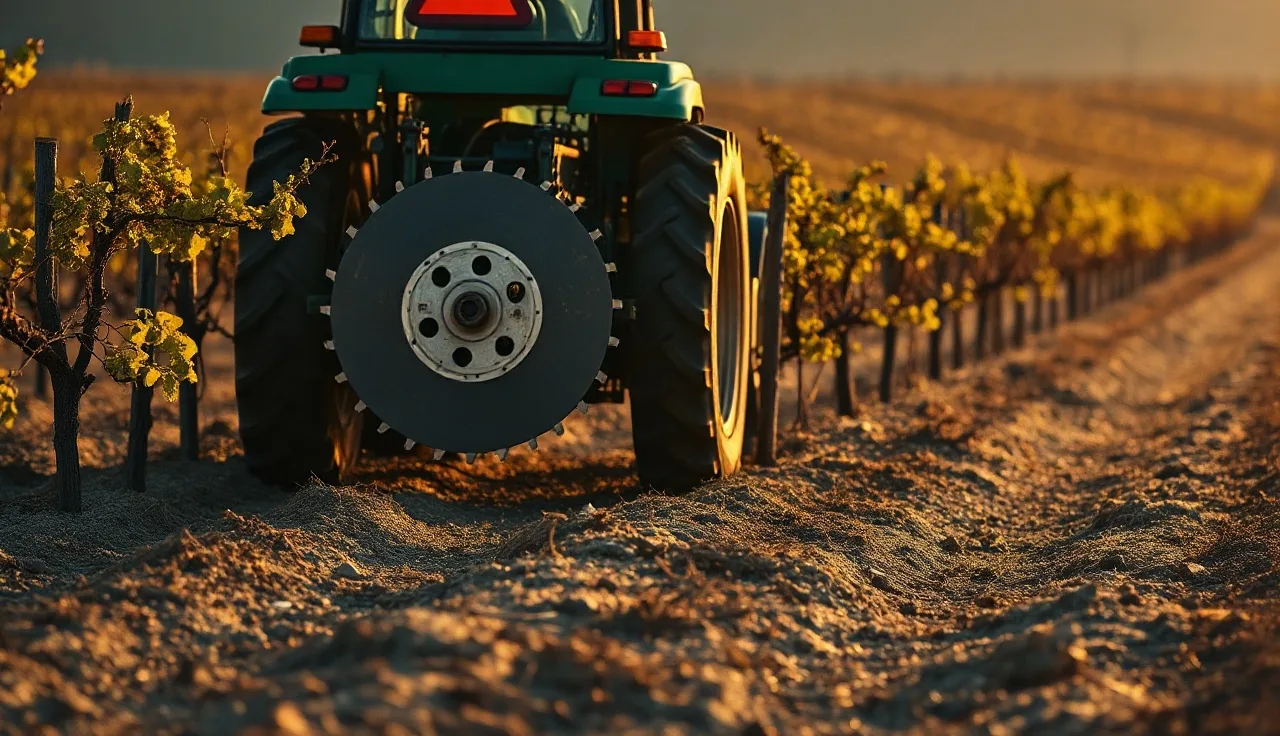
Mechanical pruning uses tractor-mounted circular saw blades or reciprocating hedge-bar cutters to remove last season's wood from the vine canopy. The machines straddle the row and cut at pre-set heights and widths, doing in a single pass what a hand pruner does over several minutes per vine.
A few distinct operations get lumped under the same term. Prepruning (also called mechanical pre-cutting or hedging) happens before hand crews follow up to finish the job, and it's the most widely adopted form. Skirting removes shoot growth hanging below the fruiting zone. Full mechanical pruning replaces hand work almost entirely, leaving minimal or zero hand finishing. Each approach lands differently on cost, canopy quality, and long-term vine health.
The equipment ranges from simple fixed-angle bar cutters bolted to a standard tractor to GPS-guided machines with adjustable heads and cameras. Most California and Pacific Northwest commercial operations run mid-range gear, not the robotic systems you see at trade shows. A capable prepruning setup costs $15,000 to $60,000 depending on configuration [1].
Cordon-trained, spur-pruned vines are the best candidates. Cane-pruned systems like Guyot are harder to mechanize cleanly because the machine can't identify and spare the renewal canes the way a skilled hand pruner can.
How much money does mechanical pruning actually save per acre?
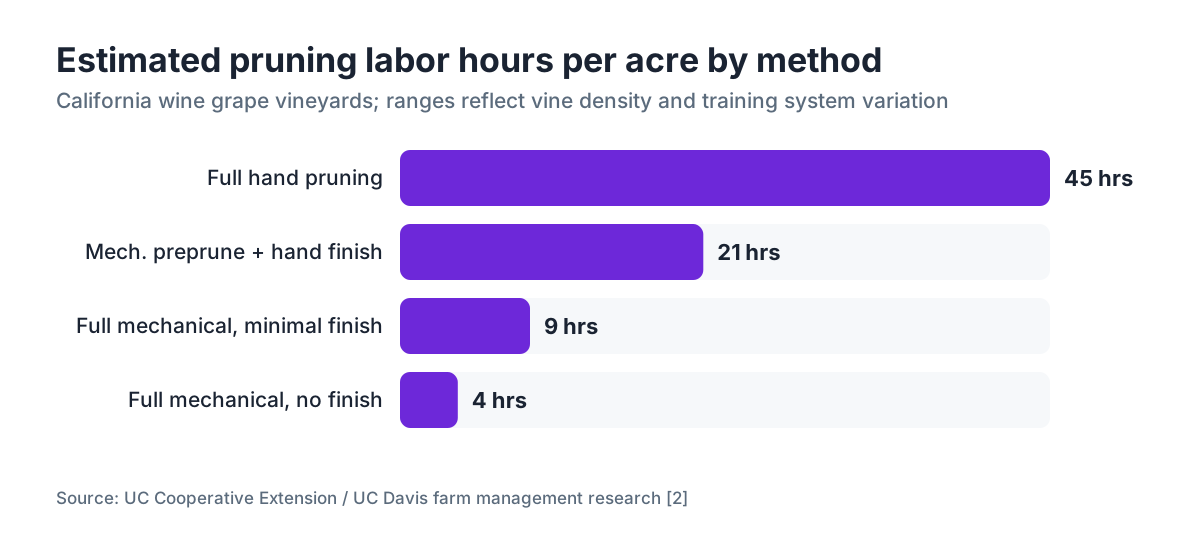
It depends on your finishing ratio, but the savings are real. UC Davis farm management research pegs hand pruning labor at roughly 30 to 60 hours per acre in California wine grape vineyards, depending on vine density and training system [2]. At $18 to $25 per hour including payroll taxes and housing, full hand pruning runs $540 to $1,500 per acre per season.
Mechanical prepruning plus hand finishing typically cuts total hours by 40 to 60 percent. Full mechanical with minimal finishing can reach 70 percent labor reduction, though quality risk climbs right alongside it. Washington State University Extension research found that mechanical pruning combined with mechanical harvesting can reduce total seasonal labor by more than 70% in high-trained bilateral cordon systems [3].
The machine isn't free. Custom hire rates for mechanical prepruning in California run roughly $80 to $150 per acre per pass as of 2023-2024 figures from farm advisor surveys, though those numbers shift with fuel costs and regional demand. Own the equipment and spread it across 200-plus acres, and your per-acre machine cost drops well below the custom rate.
The break-even math is simple. If hand pruning costs you $900 per acre and mechanical prepruning plus 40% of the hand labor costs $400, you save $500 per acre. On 100 acres, that's $50,000 a season. The savings compound every year, which is why big Central Valley operations converted long before premium appellations touched it.
What are the real trade-offs for vine health and fruit quality?
This is where growers in premium appellations slow down, and they're right to. The concern isn't imaginary. Mechanical pruning leaves more wood than careful hand pruning. Spurs elongate over multiple seasons of mechanical-only work, pushing the fruiting zone outward and opening the door to dead arm and other wood diseases through rough cuts [4].
Cornell University research on New York wine grapes found that vines managed with full mechanical pruning for several consecutive seasons showed greater spur elongation and increased Eutypa dieback incidence compared to hand-pruned controls, particularly in varieties already prone to wood disease [4]. That's a real long-term cost, and it never shows up in your first-year savings calculation.
Fruit quality effects are murkier. Mechanical pruning usually leaves more buds, which raises crop load. Higher crop load tends to dilute flavor and delay ripening. Some growers claw back with mechanical shoot thinning or cluster thinning later in the season, which adds back some of the labor you just saved. In a $12-a-bottle category, that trade pencils out. Trying to make Napa Cabernet at $80 a bottle, the math falls apart.
The honest picture from published research: for bulk and commodity wine grapes, yield differences between full mechanical and hand pruning are modest, sometimes favoring the mechanical side because of the higher bud count. For premium varieties where concentration matters, mechanical-only pruning underperforms over a multi-year horizon, consistently. Mechanical preprune with skilled hand finishing is where most serious operations land.
One more thing. Cut wound size matters. Mechanical blades make larger, less precise cuts than a sharp hand shear. Bigger wounds callus slowly and create more entry points for Botrytis, Botryosphaeria, and Eutypa. Some growers apply wound protectants after mechanical passes, which adds cost but cuts disease pressure.
Which trellis and training systems work best with mechanical pruning?
Bilateral cordon with spur pruning is the gold standard for mechanization. Vine structure is predictable row to row, the cutter heads calibrate once per block, and the machine never has to decide which wood to keep. High cordon systems (Scott Henry, Smart-Dyson, Geneva Double Curtain) work too, as long as fruiting wire height stays consistent across the block.
Cane-pruned systems are genuinely tough for full mechanical pruning. The machine cuts away renewal canes along with everything else, leaving you no good wood for next season unless someone hand-finishes behind it. Some operations preprune cane-pruned blocks to strip out old clusters and tangled wood, then hand crews select and tie canes. You get 30 to 40 percent labor savings instead of 60 to 70 percent, but the system holds.
Head-trained vines (gobelet), common in old-vine Zinfandel and Grenache blocks, are almost impossible to mechanize well. The irregular architecture means the machine either leaves too much wood or takes healthy spurs. These blocks stay hand-pruned, period.
Row spacing matters too. Most mechanical pruners are built for rows 9 to 12 feet apart. Older vineyards planted at 6 to 8 foot rows often can't fit the equipment, or they force a narrow-profile tractor setup that limits cutting head options. Planning a new vineyard and want mechanical options? Design around 10 to 12 foot rows from the start.
WSU Extension tells growers to evaluate block uniformity first: vine-to-vine variation in spur height, cordon straightness, and wire tension all decide whether a mechanical pass does clean work or leaves a mess that costs more to fix than it would have to hand-prune [3].
What does the research say about mechanical prepruning vs full mechanical pruning?
The line between prepruning and full mechanical gets glossed over in the trade press, and it matters. Prepruning is a fast speed pass before dormancy fully breaks, removing about 80 percent of the wood so hand crews finish in a fraction of the time. Full mechanical aims to do the whole job in one or two passes with no follow-up.
Research from UC Davis and UC Cooperative Extension, summarized in their Grape Pest Management guidelines, consistently shows that mechanical prepruning with hand finishing produces vine health and quality close to full hand pruning while saving 40 to 60 percent on labor [2]. Full mechanical without finishing produces acceptable results for bulk wine but raises wood disease risk and can shrink berry size and skin-to-juice ratios in premium varieties.
A practical point: timing the mechanical pass matters a lot. Run the machine before budbreak, while vines are fully dormant, and callus tissue gets its best shot at forming before spring disease pressure builds. Late mechanical pruning after green tissue emerges damages shoots and stresses the vine. Most experienced operators target the January to mid-February window in California, slightly later on cooler Pacific Northwest sites [3].
Blade type also shapes the outcome. Circular saw blades cut cleaner than reciprocating hedge bars but run slower and cost more to maintain. Reciprocating bars are faster and cheaper but leave ragged wound surfaces. In high-disease-pressure settings (humid climates, Eutypa-prone varieties like Chardonnay and Cabernet Sauvignon), cleaner cuts matter enough to justify the slower saw-blade option.
What worker safety and EPA compliance issues come with mechanical pruning?
Mechanical pruning sits at the intersection of equipment safety and pesticide compliance, and both areas deserve attention.
On the equipment side, tractor-mounted pruning machines carry serious PTO and blade hazard exposure. OSHA's agricultural machinery standards (29 CFR 1928) require guarding on power take-off shafts and rotating cutting components. Operator training and a written equipment safety protocol are required, not optional, if you have any employees running the equipment [5].
Pesticide residue exposure is a separate issue. Mechanical pruning generates large quantities of cut wood and cane material that may carry residue from the prior season. Under the EPA Worker Protection Standard (40 CFR Part 170), workers must be told about pesticide applications and any restricted-entry intervals in effect. The WPS was revised in 2015 and requires that employees who handle treated plant material in ways that could result in skin contact receive appropriate PPE and training [6]. EPA guidance treats "harvesting, thinning, pruning, training, and other hand labor tasks in pesticide-treated areas" as covered activities under the WPS.
For record-keeping, document the operator's training, any pesticide exposure potential, and the dates and block locations of mechanical pruning passes. This is exactly the field operation record that belongs in your spray and activity log. Tools like VitiScribe are built for it: logging what happened, in which block, on which date, so the documentation is ready when a labor inspector or pesticide compliance auditor asks.
California adds requirements under the Pesticide Safety Information Series and the Cal/OSHA heat illness prevention standard (Title 8, Section 3395), both of which apply to outdoor agricultural workers during pruning season [7].
How do you set up a mechanical pruning program for your vineyard?
Start by auditing your blocks for mechanization suitability. Score each block on trellis system (cordon/spur is yes, cane-pruned is maybe, head-trained is no), row spacing (9-plus feet preferred), vine-to-vine cordon height consistency (under 4 inches of variation is ideal), and wood disease history. Blocks with heavy Eutypa or dead arm need disease remediation before you add the stress of mechanical pruning.
Decide on custom hire versus ownership. Custom hire makes sense below 50 to 80 acres of suitable blocks. Under that, the per-acre custom rate beats amortizing a purchase plus maintenance. Above 100 to 150 acres of mechanizable vineyard, ownership starts to win. Get quotes from several custom operators and ask specifically about blade type, speed settings, and whether they adjust cut height block by block.
Calibrate before you commit. Run a test pass on one or two rows before the whole block. Check cut height against your target spur length (typically 2 nodes for most spur-pruned systems), look at wound surface quality, and walk the rows to see whether the machine missed wood in the vine center or cut into the cordon. Adjust blade height and machine speed before you proceed.
Train your hand-finishing crew on what the mechanical pass is supposed to do and what they need to correct. If finishers don't understand the system, they'll over-prune or under-prune trying to compensate for an unfamiliar canopy, and you lose the efficiency you were chasing.
Keep records of each block's mechanical pruning date, operator, machine settings, and your read on the resulting canopy before hand crews go through. That baseline lets you track spur elongation over multiple seasons and make the call about whether a given block needs more hand finishing.
How does mechanical pruning fit into a full pruning and training system?
Mechanical pruning doesn't stand alone. It's one part of the annual training and pruning cycle that also includes shoot positioning, hedging, shoot and leaf removal, and harvest. The decisions you make at pruning time set the canopy architecture for every operation that follows.
Over-prune mechanically (cutting too hard, removing too many nodes) and you cut yield and stress the vine. Under-prune (leaving too much wood) and you get crowded canopies that trap humidity, raise disease pressure, and make mechanical harvesting messier. Getting the node count right matters as much by machine as by hand. It's just harder to verify in real time when the machine moves at 2 to 4 mph.
Pruning and training grape vines is also about vine longevity. A vine trained correctly in years one through four accepts mechanical pruning well in year five and beyond. A vine trained poorly in youth, with multiple cordon attempts, irregular spur positions, and crossing arms, stays a poor mechanical candidate no matter the variety or trellis.
Some operations pair mechanical pruning with mechanical harvesting in a fully mechanized production model. Managed well, on the right varieties and trellis, that combination can cut total annual field labor by more than half. WSU Extension has documented the approach in detail for Washington Riesling and Chardonnay blocks on high bilateral cordon [3].
For vineyards in destination wine country, where the vineyard itself is part of the visitor experience, see how operations like those at Paso Robles wineries balance efficiency with the aesthetics visitors expect walking the vine rows.
What varieties respond well or poorly to mechanical pruning?
Variety matters more than most equipment guides admit. Varieties with naturally vigorous growth and thick cordons handle mechanical pruning better, because the larger wood base gives more structural stability as spur length creeps up over seasons of mechanical work.
Varieties that do reasonably well with mechanical management in published research include Cabernet Sauvignon (high vigor, forgiving of variable node counts), Merlot, Syrah, Chardonnay (though disease risk demands clean cuts), and most high-volume whites like French Colombard and Thompson Seedless in bulk categories [2].
The problem children include Pinot Noir (low vigor, sensitive to overcropping, irregular budbreak), Zinfandel (irregular cane development, high disease susceptibility), and any variety with a strong tendency toward irregular node spacing or basal bud fertility issues. Zinfandel in particular pushes unevenly after mechanical pruning, which makes canopy management a headache through the growing season.
Gewurztraminer and other early-budding varieties carry extra risk from late mechanical pruning, because any delay in the pass can damage emerging shoot tissue.
Nobody has clean variety-by-variety data on multi-season mechanical pruning outcomes across every wine grape grown in North America. The closest full body of work comes from the UC Cooperative Extension viticulture farm advisor network and the Australian Wine Research Institute, though Australian conditions don't map perfectly to California or Pacific Northwest sites.
Is mechanical pruning right for small vineyards and estate operations?
Bluntly: for most vineyards under 20 acres, owning a mechanical pruner doesn't pencil out. The equipment investment is big, the blocks often mix trellis systems that limit mechanization, and the premium-variety focus common in estate operations pushes toward hand finishing anyway.
Even so, small operations can benefit from custom-hire prepruning on their most mechanizable blocks. Have 8 acres of cordon-spur Cabernet in one block? A custom operator running a preprune pass before your crew goes through can save 15 to 20 labor hours on that block alone. At $22 per hour loaded labor cost and 18 hours saved, that's nearly $400, against a custom hire cost of maybe $110 to $130 per acre for those 8 acres.
Small estates that pride themselves on hand-crafted viticulture sometimes resist mechanical work for positioning reasons, not agronomic ones. That's a legitimate business call, but make it consciously. The vine doesn't know whether the shears are held by a hand or a machine. The question is whether the resulting canopy architecture fits the variety and site.
For vineyard managers who want to track the real cost and outcome data from any mechanical pruning trials they run, a good field record system earns its keep. VitiScribe lets you log block-level activity, attach labor hours and contractor invoices, and review the data year over year, so you can actually see whether your mechanical pruning investment is doing what you hoped.
For a look at how mid-size estate operations approach this balance, the vineyard overview at VitiScribe covers the full range of operational decisions involved.
What are the most common mistakes growers make with mechanical pruning?
The single biggest mistake is running a mechanical pruner on a block that isn't structurally ready for it. If cordon heights vary by 8 inches vine to vine, a fixed-height cutting head scalps the low ones and leaves too much wood on the tall ones. The fix isn't a better machine. It's fixing the canopy before you mechanize.
The second common mistake is treating mechanical pruning as an excuse to scout less. After a mechanical pass, you need eyes on the canopy to catch vines where the machine cut into the cordon, missed a spur position, or left wood that will cause trouble. Most mechanized operations should walk each block at least once before budbreak.
Skipping wound management in disease-prone blocks is another error that compounds season over season. If your vineyard has a history of Eutypa or Botryosphaeria and you add the larger wound surfaces of mechanical pruning without a wound protectant or fungicide, you accelerate a problem that takes years to fully surface and years to remediate.
Last, some growers mechanize and then forget to update their node-count targets. Switch from hand to mechanical and your bud retention per vine climbs, because the machine leaves more wood. Don't adjust your crop load expectations and overcropping in the first mechanized season blindsides you. Revisit your target buds per vine and your historical yield data before that first mechanical season.
Frequently asked questions
How much does it cost to mechanically prune one acre of wine grapes?
Custom hire mechanical prepruning runs roughly $80 to $150 per acre per pass in California as of 2023-2024, based on farm advisor survey data. Full mechanical pruning (two passes, no hand finishing) may run $150 to $250 per acre all-in. Compare that to hand pruning at $540 to $1,500 per acre depending on vine density and training system. Your total cost depends heavily on whether you include hand finishing.
Can you mechanically prune cane-pruned vines?
Not fully. Mechanical prepruning works on cane-pruned vines: the machine removes old clusters and bulk wood before hand crews select and tie renewal canes. Full mechanical pruning doesn't work because the machine can't identify which canes to preserve for the coming season. On cane-pruned systems, mechanical prepruning typically saves 30 to 40 percent of labor, not the 60 to 70 percent achievable with spur-pruned systems.
Does mechanical pruning hurt vine longevity?
Over multiple seasons without hand finishing, mechanical pruning causes spur elongation, which moves the fruiting zone outward and creates larger, rougher cut wounds. Cornell research found increased Eutypa dieback incidence in mechanically pruned vines over several seasons compared to hand-pruned controls. Mechanical preprune with skilled hand finishing largely avoids this problem. Full mechanical on susceptible varieties in humid climates carries real long-term vine health risk.
What trellis systems are compatible with mechanical grape vine pruning?
Bilateral cordon with spur pruning is the best fit. High cordon systems like Scott Henry and Geneva Double Curtain also work if wire height is consistent. Cane-pruned systems (Guyot, single or double) allow mechanical prepruning but not full mechanical. Head-trained gobelet vines are not compatible with mechanical pruning due to their irregular architecture. Row spacing below 9 feet often prevents standard equipment from fitting.
How does mechanical pruning affect grape quality and wine style?
Mechanical pruning typically leaves more buds, increasing crop load and potentially diluting flavor concentration. For bulk and commodity wine, yield effects are modest and sometimes positive. For premium varieties where concentration matters, full mechanical pruning consistently produces lower fruit quality over a multi-season horizon compared to hand or hand-finished pruning. The impact is most pronounced in low-vigor varieties like Pinot Noir.
What are the EPA Worker Protection Standard requirements for mechanical pruning crews?
Under 40 CFR Part 170, the EPA Worker Protection Standard covers workers who handle treated plant material, including pruning in pesticide-treated areas. Employers must provide safety training, inform workers of pesticide applications and restricted-entry intervals, and supply appropriate PPE when residue exposure is likely. The WPS was revised in 2015 and these requirements apply to all agricultural employers with covered workers, including pruning operations.
What time of year should mechanical pruning be done?
Most California operators target January through mid-February, while vines are fully dormant. Running the machine after budbreak damages emerging shoot tissue and stresses the vine. In cooler Pacific Northwest sites, the window shifts slightly later, typically February through mid-March. Timing the mechanical pass during full dormancy gives wound tissue the best chance to callus before spring disease pressure builds.
Is mechanical pruning worth it for a small vineyard under 20 acres?
Owning equipment generally doesn't pencil out below 50 to 80 acres of mechanizable vines. For smaller operations, custom hire mechanical prepruning on suitable blocks can still save meaningful labor. An 8-acre cordon-spur block might save 15 to 20 labor hours through prepruning, which at loaded labor cost of $22 per hour returns $330 to $440 in savings against a custom hire cost of roughly $110 to $130. It depends on your specific labor and custom-hire rates.
What equipment do you need for mechanical grape vine pruning?
A tractor-mounted cutting head with either circular saw blades or reciprocating hedge bars is the core piece of equipment. Entry-level prepruning setups start around $15,000; mid-range units with adjustable heads run $30,000 to $60,000. You'll also need a tractor with appropriate horsepower for the implement, row spacing to accommodate the machine width, and consistent vine cordon height across the block for reliable cut quality.
How does mechanical pruning compare to hand pruning for disease management?
Mechanical pruning makes larger, less precise cuts than sharp hand pruners, which slows callus formation and creates more disease entry points. Botrytis, Botryosphaeria, and Eutypa are the primary concerns. In high-disease-pressure environments, applying a wound protectant or registered fungicide after mechanical cuts helps reduce infection. Circular saw blades make cleaner cuts than reciprocating bars and are preferable in disease-prone blocks, though they're slower and cost more to maintain.
Can mechanical pruning be combined with mechanical harvesting?
Yes, and this is common in high-volume operations. WSU Extension has documented that mechanical pruning combined with mechanical harvesting on high bilateral cordon systems can reduce total seasonal field labor by more than 70 percent. The two systems work best together when the trellis was designed for both from the start, with consistent wire heights, adequate row spacing, and variety selection suited to mechanical management.
How do you track mechanical pruning activities for compliance purposes?
At minimum, document the block or block section, date of operation, equipment operator, machine settings or cut height, custom hire contractor if applicable, and a brief canopy condition assessment before and after. California requires detailed pesticide activity records under the Department of Pesticide Regulation, and mechanical pruning passes in blocks with recent pesticide applications should be cross-referenced to your spray records to satisfy WPS documentation requirements.
Which grape varieties are hardest to mechanically prune?
Pinot Noir is probably the most difficult premium variety: low vigor, sensitive to crop load changes, and irregular budbreak make mechanical-only pruning risky. Zinfandel is also problematic due to irregular cane development and disease susceptibility. Early-budding varieties like Gewurztraminer are at higher risk from timing errors. Head-trained varieties like old-vine Grenache or old-vine Zinfandel in gobelet training are essentially incompatible with mechanical pruning regardless of timing.
Sources
- UC Cooperative Extension, Sonoma County: Vineyard Mechanization equipment cost ranges: Realistic equipment cost for a capable prepruning setup runs $15,000 to $60,000 depending on configuration
- UC Davis Viticulture & Enology / UC Cooperative Extension: Grape Pest Management and vineyard labor guidelines: Hand pruning labor runs roughly 30 to 60 hours per acre in California wine grape vineyards; mechanical prepruning with hand finishing produces outcomes close to full hand pruning while achieving 40 to 60 percent labor savings
- Washington State University Extension: Vineyard Mechanization publications: Mechanical pruning combined with mechanical harvesting can reduce total seasonal labor by more than 70 percent in high-trained bilateral cordon systems; WSU recommends evaluating block uniformity before mechanizing
- Cornell University, Department of Horticulture / Cornell Cooperative Extension: Wood disease and mechanical pruning research, New York wine grapes: Vines managed with full mechanical pruning for several consecutive seasons showed greater spur elongation and increased Eutypa dieback incidence compared to hand-pruned controls
- OSHA: 29 CFR Part 1928, Occupational Safety and Health Standards for Agriculture: OSHA agricultural machinery standards require guarding on power take-off shafts and rotating cutting components; operator training is required for employees operating tractor-mounted equipment
- US EPA: Worker Protection Standard, 40 CFR Part 170: The WPS states that harvesting, thinning, pruning, training, and other hand labor tasks in pesticide-treated areas are covered activities; workers must receive training and PPE when residue exposure is likely
- California Department of Industrial Relations, Cal/OSHA: Heat Illness Prevention Standard, Title 8, Section 3395: Cal/OSHA heat illness prevention standard applies to outdoor agricultural workers including pruning crews in California
- California Department of Pesticide Regulation: Pesticide Safety Information Series for agricultural employers: California has additional pesticide safety requirements under the Pesticide Safety Information Series that apply to agricultural field workers during pruning season
- UC Davis Viticulture & Enology: Varieties and disease susceptibility in mechanized viticulture: Varieties including Cabernet Sauvignon, Merlot, Syrah, and Chardonnay respond reasonably well to mechanical management in published research; Pinot Noir and Zinfandel are more problematic
- WSU Extension: Mechanical harvesting and pruning in Washington State wine grape production: WSU Extension has documented mechanical pruning combined with mechanical harvesting on high bilateral cordon systems reducing total seasonal field labor by more than 70 percent
Last updated 2026-07-09