Grapes powdery mildew prevention: the complete field guide
TL;DR
- Powdery mildew (Erysiphe necator) is the most damaging fungal disease in vineyards worldwide.
- Prevention means starting sulfur or FRAC 3 sprays before shoots hit 1 inch, holding 7 to 14 day intervals through bloom, and pairing canopy work with FRAC rotation.
- Caught early, it's controllable.
- Ignored past berry set, crop loss reaches 100%.
What is powdery mildew and why does it hit grapes so hard?
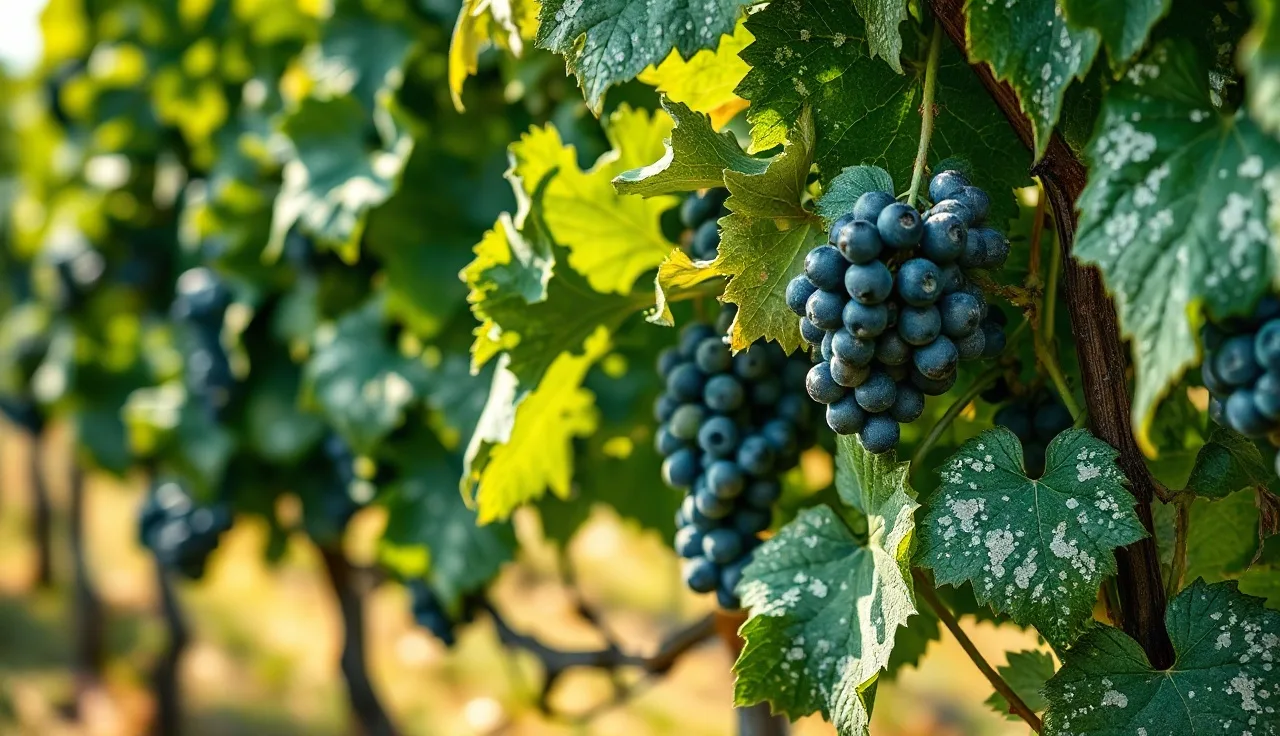
Powdery mildew on grapes is caused by Erysiphe necator (formerly Uncinula necator), an obligate fungal pathogen. Obligate means it only grows on living plant tissue, which sets it apart from most other vineyard fungi. That same biology means the fungus overwinters inside dormant buds and in bark as chasmothecia (sexual fruiting bodies). It's already on your vines before you see a single symptom in spring [1].
The disease hits every green part of the plant: leaves, shoots, tendrils, and worst of all, berries. On leaves you'll see white, powdery colonies that wipe off easily and come right back. On berries the story is uglier. Infections before or during bloom cause berries to split, harden, or russet. Infected fruit smells rancid and raises volatile acidity in the wine, which wrecks quality even at low disease levels [2].
Vinifera is a sitting duck. American species and many hybrids carry partial resistance, but even a resistant variety can break down in a bad year or a sloppy canopy. Grow Chardonnay, Pinot Noir, Cabernet Franc, or any other Vitis vinifera at a vineyard, and you're growing exactly the host this pathogen wants.
Spores germinate across a wide temperature band, roughly 50°F to 90°F, with the sweet spot around 68°F to 77°F. Here's the part that catches people off guard: unlike downy mildew, E. necator needs no free water to germinate. Relative humidity above about 40% is enough. That's why fog-prone coastal sites and dense canopies get hammered even through a dry summer [1].
When does powdery mildew season actually start in the vineyard?
The season starts earlier than most growers think. Ascospores, the primary inoculum, release from chasmothecia around bud swell in spring, usually with the first sustained rains. UC Davis researchers found that ascospores account for about 80% of primary infections in California vineyards, not overwintered mycelium in buds [1]. So your spray program has to be running before any disease shows.
The critical window runs from 1-inch shoot growth (roughly early to mid-April in most California and Pacific Northwest sites, later in New York and the Mid-Atlantic) through about 4 to 6 weeks after bloom. Berries are most susceptible from just before bloom until they hit around 15 Brix [2]. Past 15 Brix, the skin lignifies and resists new infection. That doesn't mean you drop the sprayer at veraison, because leaf and shoot infections keep producing inoculum, but the urgency falls off fast.
The standard 10 to 14 day interval under low to moderate pressure tightens to 7 days or less during bloom. Bloom is the highest-risk period of the whole year. Don't stretch intervals during bloom to save money. One skipped spray never pays for a lost crop.
WSU's powdery mildew risk model uses degree days to predict infection periods [3]. Cumulative degree days base 50°F from January 1 tell you when to expect the first flag shoots, the heavily infected, twisted shoots that emerge from infected buds. A flag shoot means primary inoculum is already releasing [10]. See one, and you're behind.
What are the most effective fungicides for powdery mildew prevention?
Sulfur is still the backbone of most programs, and it earns the spot. It's cheap (roughly $2 to $6 per acre per application depending on formulation), carries no resistance after decades of use, works as both a protectant and an early curative, and leaves no residue that worries wine buyers [4]. Wettable and micronized sulfur both perform well. Liquid flowables stick better in wind.
The one hard rule with sulfur: never apply when temperatures will top 90°F within 24 hours, and some labels set the line at 95°F. Phytotoxicity in heat burns leaves and berries. Read the label for the exact number on your product.
Beyond sulfur, these are the classes that matter:
| FRAC Code | Class | Example Active Ingredients | Resistance Risk | Notes |
|---|---|---|---|---|
| 3 | DMI / Triazole | Myclobutanil, Tebuconazole, Metconazole | Moderate | Curative up to 96 hrs post-infection; rotate |
| 7 | SDHI | Fluxapyroxad, Boscalid | High | Never use alone; always tank-mix |
| 11 | QoI / Strobilurin | Azoxystrobin, Trifloxystrobin | Very high | Resistance widespread; limit to 2 apps/season |
| 50 | Quinoxyfen | Quinoxyfen | Moderate | Strong protectant; pre-bloom focus |
| U8 | Cyflufenamid | Cyflufenamid | Moderate | Excellent protectant activity |
| M2 | Inorganic sulfur | Wettable/micronized sulfur | None | Program backbone |
| BM02 | Potassium bicarbonate | Kaligreen, Armicarb | None | OMRI-listed; mainly curative |
FRAC codes matter because resistance to FRAC 11 (strobilurins) is now effectively universal in E. necator across the major U.S. winegrowing regions [5]. The EPA and FRAC both say no single mode of action should run more than twice a season, and given the documented resistance, strobilurins arguably don't deserve two shots [5].
Organic programs lean on sulfur and copper. Potassium bicarbonate has eradicant activity and is OMRI-listed. Neem oil has weak preventive activity and isn't a reliable primary tool. Mineral programs run tighter intervals (5 to 7 days in high pressure) than conventional ones because they give less systemic protection [4].
How do you build a spray program that prevents resistance?
Resistance management isn't optional anymore. E. necator has developed resistance to FRAC 3 (DMI/triazoles), FRAC 7 (SDHIs), and FRAC 11 (strobilurins) in California, Oregon, Washington, and New York vineyards [5]. Cornell's New York State IPM program puts it plainly: "Resistance to QoI fungicides (FRAC group 11) is widespread in New York vineyards, and these materials provide little to no control" [6].
A sensible rotation for a conventional California grower looks like this:
- Applications 1-2 (bud swell through 6-inch shoot): Wettable sulfur or FRAC 50
- Applications 3-4 (pre-bloom): FRAC 3 + sulfur tank-mix, or FRAC U8
- Applications 5-6 (bloom through pea-size berry): FRAC 7 + FRAC 3 premix, sulfur between if interval allows
- Applications 7-10 (pea-size through 15 Brix): Alternate FRAC 3, FRAC 50, sulfur; add FRAC 7 if pressure holds
- Post 15-Brix: Sulfur alone if canopy disease is present
Two rules carry most of the weight. Never apply two consecutive sprays of the same FRAC code. Never apply a FRAC 7 material alone without a partner from a different mode of action. SDHIs select for resistance fast when used solo.
Track what you spray. This is where a digital spray record earns its keep. On paper, it's easy to lose count of how many times a chemistry has gone out in a season. A tool like VitiScribe can flag when you've hit the rotation limit on a FRAC code, which is the alert that keeps you from burning out a chemistry mid-season. Keep those records regardless, for EPA Worker Protection Standard compliance [7] and any certification audit.
Does canopy management actually prevent powdery mildew?
Yes, and by a lot. Canopy management is the most underrated tool in a powdery mildew program. E. necator thrives in shaded, humid pockets. Dense canopies choke air circulation, slow drying after dew, and shade the fruit zone where fungicide coverage matters most.
UC Cooperative Extension work on shoot positioning and leaf removal found that opening the canopy enough to dapple sunlight through the fruit zone lowered powdery mildew incidence measurably against unmanaged controls [1]. Part of the mechanism is physical (faster drying, UV light is mildly fungicidal). Part of it is coverage: no leaf wall blocking the sprayer from the clusters.
Leaf removal in the fruit zone, one to two leaves on the sun-exposed side after fruit set, improves both spray penetration and airflow. Pull too hard before bloom and you risk sunburn. The right window is just after fruit set in most climates, though in cooler sites some growers do a partial pull at bloom to cut humidity. On California's Central Coast, morning fog makes that timing worth real thought.
Shoot positioning and early-summer hedging keep the canopy organized so fungicide reaches the clusters. A Bordeaux system or vertically shoot-positioned (VSP) trellis with proper summer hedging is always easier to protect than a sprawl. Your neighbors matter too. A vineyard immediately upwind carrying unmanaged mildew is a spore source no matter what you do on your own ground.
How do weather and forecasting tools help time sprays?
The Gubler-Thomas powdery mildew risk model, developed at UC Davis, is the most widely used disease forecasting tool in California viticulture [1]. It runs on temperature thresholds: three or more consecutive hours between 70°F and 85°F, with wet leaves or high humidity, counts as a moderate to high infection event. The model lives on the UC IPM website and inside several commercial weather services.
WSU's Decision Aid System (DAS) does the same job for the Pacific Northwest, modeling both powdery and downy mildew risk from local weather data [3]. A grower with an on-site weather station can feed data straight into these models for site-specific risk instead of leaning on a regional station that may miss the difference between a valley floor and a hillside.
Forecasting tools answer two questions well. Should I tighten my interval this week? Can I safely stretch one during a low-risk stretch? They don't replace scouting. Walk the vines weekly through the season and look hard at flag shoots and the cluster zone. If you spot colony growth after a forecast said low risk, trust your eyes.
The Skybit and Spectrum Technologies platforms both sell vineyard weather services with disease risk outputs. Basic service runs roughly $200 to $600 a year at recent pricing, though that moves. Some county Farm Bureaus offer shared weather network access for less.
What does powdery mildew damage actually cost grape growers?
Uncontrolled powdery mildew can wipe out 100% of a crop in a bad year on susceptible varieties. That's not hyperbole. It's documented in published extension literature from UC Davis and Cornell [2][6]. Even partial infection carries outsized cost, because E. necator-infected fruit raises laccase enzyme activity, which oxidizes juice and wine. A load with as little as 3% to 5% visible berry infection can measurably push volatile acidity and browning in finished wine [2].
Some wineries reject loads above a set threshold, commonly cited around 2% to 3% visible berry infection. If your winery contract has a quality adjustment clause, powdery mildew is one of the fastest ways to trip a price cut.
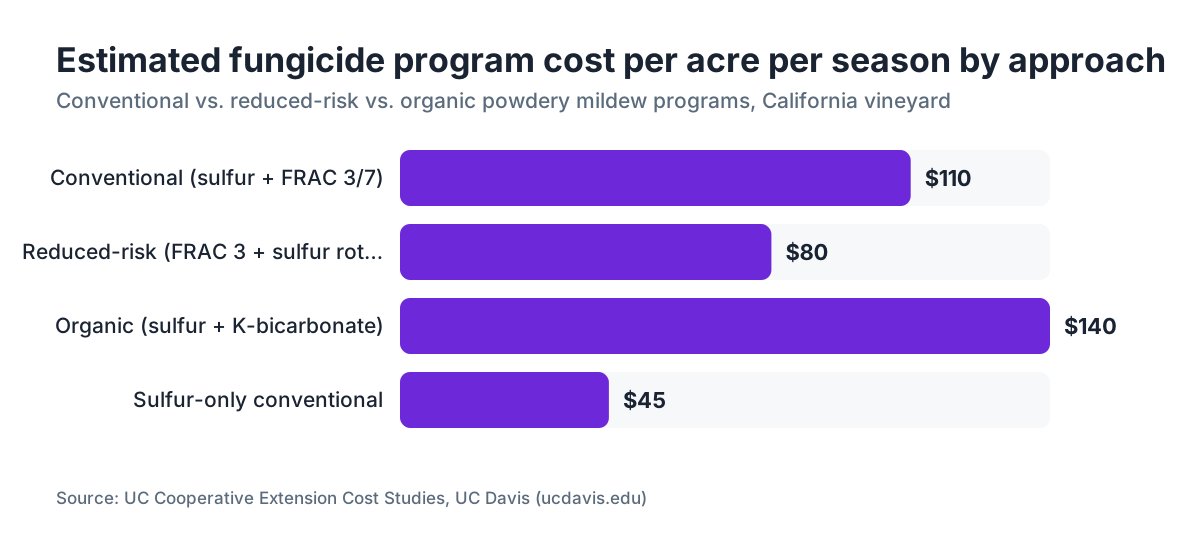
Fungicide costs for a managed conventional California program run roughly $40 to $120 per acre per season depending on application count and chemistry, per UC Cooperative Extension cost studies [4]. Organic programs can cost more, because tighter intervals mean more passes, and labor becomes the bigger line item than materials at that point.
The break-even math is simple. Chardonnay at $1,500 to $3,000 per ton in a coastal appellation, even a 10% yield loss on 5 acres, is real money gone. Spending $400 to $600 on fungicide materials across a season to protect that yield is not a close call.
The chart below breaks down cost by program type.
How do you cure powdery mildew on grapes once you see it?
Be honest about what "cure" means. E. necator has no true systemic cure once berry tissue is infected. The fungus sends haustoria into host cells, and once colonization sets up inside the berry skin, you can't kill it without damaging the berry. What curative fungicides actually do is stop the fungus from making more spores, which limits spread.
For foliar infections on leaves and shoots caught within 72 to 96 hours of the infection event, FRAC 3 DMI fungicides like myclobutanil have real curative activity [2][6]. Spray as soon as you identify the event. The 96-hour window closes fast, and temperatures above 95°F cut efficacy. Potassium bicarbonate also knocks back actively visible colonies and is accepted in most organic programs.
For berry infections visible before veraison, there's no practical cure. The goal shifts to protecting the healthy fruit that's left and slowing secondary spore spread. Keep intervals tight. Don't skip applications hoping it clears on its own. Infected berries turn into inoculum for the clusters next to them.
Post-veraison, if pressure is high, some growers keep running sulfur at reduced rates to suppress sporulation on leaves even though the berries are past the susceptible window. Whether that's worth the labor depends on how much disease you have and what next year's inoculum burden is shaping up to be.
What are the EPA Worker Protection Standard requirements for powdery mildew sprays?
The EPA Worker Protection Standard (WPS), 40 CFR Part 170, covers every agricultural pesticide application, including the fungicides in your powdery mildew program [7]. If you have agricultural workers or pesticide handlers, you have WPS obligations no matter how small the operation.
The core requirements for a spray program: train workers before they enter treated areas, post pesticide application information (active ingredient, location treated, date and time of application, and the restricted entry interval) either at a central location or on a WPS poster, and keep decontamination supplies within a quarter mile of workers in treated areas [7].
Restricted Entry Intervals (REIs) matter most during the active spray season. Sulfur usually carries a 24-hour REI. FRAC 3 materials like myclobutanil usually run 24 hours. Some SDHIs land at 12 to 24 hours. Check the specific product label. "The label is the law" is a cliche because it's literally true under FIFRA, the Federal Insecticide, Fungicide, and Rodenticide Act [8].
Spray records have to document the product name, EPA registration number, target pest, application rate, total amount applied, location, date, and applicator name for each application. Many states (California, Oregon, Washington, New York) require pesticide application reports filed with the county agricultural commissioner or state department of agriculture within a set window: California requires reporting for restricted-use pesticides and monthly reporting for general use pesticides [9]. Know your state's rules. They vary, and the penalties are real.
For California sites, the Paso Robles wineries region and other areas under San Luis Obispo County jurisdiction carry county-level reporting on top of state requirements.
Which grape varieties have the best resistance to powdery mildew?
True resistance to E. necator in Vitis vinifera is basically nonexistent. Every vinifera variety is susceptible. The differences are in degree, not immunity. Cabernet Sauvignon, Zinfandel, and Chardonnay rank among the most susceptible. Riesling and Grenache get cited as slightly less so, but under high pressure the practical gap is small [6].
American species and hybrids are a different animal. Vitis rotundifolia (muscadine) and Vitis labrusca carry strong natural resistance. Hybrids bred for resistance include Norton (V. aestivalis) and the Cornell-bred varieties Traminette, Marquette, Frontenac, and the newer Geneva releases, which show strong to very strong resistance to both powdery and downy mildew [6]. These matter more every year for East Coast and Midwest growers facing brutal disease pressure.
The USDA Agricultural Research Service's grape genetics program has been moving resistance genes from wild species into vinifera backgrounds. European breeding programs have released the PIWI group, including Regent, Solaris, and Muscaris, with meaningful powdery mildew resistance. They're commercially available but haven't won broad acceptance in premium wine regions yet.
For a grower weighing a replant, the resistant-variety math is striking. A Cornell extension study found resistant hybrids needed an average of 0.9 fungicide applications per season for powdery mildew control, against 10 to 15 for vinifera under New York conditions [6]. Over a vineyard's life, that's a big cut in labor and materials.
How do you build a season-long powdery mildew prevention calendar?
Build the calendar around phenological stages, not dates. Spring timing shifts 2 to 4 weeks across years and regions, and the vine tells you where you are better than the calendar does.
Dormant to bud swell: If last year had heavy pressure, consider a dormant lime sulfur spray at 3% to 5% concentration. It's caustic, it demands full PPE with eye protection and chemical-resistant gloves, and it has a narrow window (green tissue burns), but it cuts overwintering chasmothecia on bark and canes [11].
1-inch shoot through 6-inch shoot: First fungicides. Sulfur every 10 to 14 days, or a FRAC 50 material. Risk is still low here, but you're covering the initial ascospore release.
Pre-bloom (two weeks out) through bloom: Tightest interval of the season. 7 days conventional, 5 to 7 days organic. Use your best chemistry here. FRAC 3 or FRAC U8, often tank-mixed with sulfur. Do not miss an application in this window.
Post-bloom through berry touch (clusters closing): High risk continues. Keep rotating. Layer in canopy work (leaf removal, shoot positioning, hedging) to improve coverage and airflow.
Berry touch through 15 Brix: Risk drops as skin matures. You can stretch to 10 to 14 days if pressure is low. Keep rotating.
Post 15 Brix through harvest: Sulfur or bicarbonate if foliar disease warrants. Focus on limiting inoculum for next year. Avoid materials with long preharvest intervals.
After harvest: One lime sulfur application after leaf drop cuts overwintering inoculum. Optional, but worth it on high-pressure sites [11].
For coastal California operations like mountain winery or south coast winery sites, morning fog stretches the high-risk window and often justifies tighter intervals than inland growers run. Know your site.
What application equipment gives the best powdery mildew spray coverage?
Coverage is everything with powdery mildew fungicides, especially protectants like sulfur that don't move systemically. A sulfur particle that never reaches the cluster zone does nothing. Air-blast sprayers are standard in commercial vineyards and work well when calibrated right, and calibration is the single biggest variable in whether a program works [4].
Three numbers drive air-blast calibration: water volume in gallons per acre, nozzle orientation relative to the canopy, and ground speed. The common mistake is running too little water (under 40 gallons per acre) into a dense canopy, which starves the interior fruit zone. UC Cooperative Extension recommends 50 to 100 gallons per acre for most conventional canopies, higher for the densest ones [4]. Dropping below label minimum volumes can also break the label's use directions.
Adjuvants can improve coverage on waxy leaf surfaces, though the benefit with sulfur is modest. Silicone spreader-stickers improve rainfastness, which matters if rain is forecast within 24 hours of application.
For small blocks or hard-to-reach sections, backpack and handheld electrostatic sprayers work but cost a lot more labor. A properly calibrated air-blast unit on a small tractor is almost always faster and lays down more consistent coverage per acre.
Drone application is coming, with early commercial programs running in California and Washington. The coverage data against air-blast is still thin. The closest published comparison found drone application reached adequate coverage in open canopies but underperformed in dense VSP systems. Worth watching, not worth betting your season on yet.
If you're managing spray records across multiple blocks and chemistries, digital application logs pay off for both compliance and season-to-season review. VitiScribe's spray log tracks applications by block, product, REI, and preharvest interval in one place.
Frequently asked questions
How often should I spray for powdery mildew on grapes?
During bloom, spray every 7 days. Before bloom and after fruit set, 10 to 14 days is standard for conventional programs with systemic materials. Organic programs using sulfur or bicarbonate need 5 to 7 days during high-risk periods. Extend intervals only during low-risk stretches confirmed by scouting and forecasting tools. Never extend during bloom.
Can powdery mildew spread from grapevines to other plants?
No. Erysiphe necator is host-specific to Vitis species. It doesn't spread to vegetables, ornamentals, or other fruit crops. Other powdery mildew species attack cucurbits, roses, and cereals, but those are different pathogens that won't infect your vines. You don't need to worry about cross-contamination with other crops in or near the vineyard.
Is baking soda an effective treatment for powdery mildew on grapevines?
Sodium bicarbonate (baking soda) has some curative activity on visible colonies but degrades quickly and can cause phytotoxicity with repeated use as sodium builds up in the leaf. Potassium bicarbonate (products like Kaligreen or Armicarb) is the commercial version, works better, and is OMRI-listed for organic programs. Treat it as a supplemental tool, not a substitute for a structured preventive program.
What is the best fungicide for organic grape powdery mildew control?
Wettable or micronized sulfur is the primary organic tool and the most cost-effective. Potassium bicarbonate has good curative activity and is OMRI-listed. Copper sulfate gets used sometimes but does less against powdery mildew than downy mildew. Apply sulfur at 5 to 7 day intervals during high-risk periods, never above 90°F. UC Davis extension recommends this as the standard organic backbone.
How do I know if my vineyard has resistance to DMI fungicides?
Submit samples to plant pathology labs at UC Davis, Cornell, or Washington State University for resistance profiling. Practically, suspect resistance when a well-timed, correctly dosed FRAC 3 application shows no suppression of visible colonies inside the expected 96-hour curative window. Resistance to FRAC 3 materials is documented but not yet universal. Check with your state extension service for current regional resistance reports.
Does powdery mildew overwinter in the vineyard?
Yes. The fungus overwinters two ways: as chasmothecia (sexual spore bodies) on bark and fallen leaves, and as mycelium inside dormant buds. Both become inoculum in spring. The mix varies by region. UC Davis research found ascospores from chasmothecia account for about 80% of primary infections in California. A dormant lime sulfur application reduces chasmothecia and lowers early-season pressure.
What temperature kills powdery mildew on grapes?
E. necator is inhibited above 95°F and below about 50°F, but neither reliably kills established infections on the vine. Temperatures above 95°F for several consecutive hours can kill surface mycelium, yet infected tissue still carries the pathogen. Hot, dry stretches may cut visible symptoms without eliminating the fungus. Don't skip sprays during a heat wave expecting the heat to fix it.
Can I use neem oil to treat powdery mildew on grapes?
Neem oil has weak preventive activity against E. necator and is OMRI-listed. Published vineyard efficacy data is thin. It may reduce sporulation somewhat but consistently underperforms sulfur and potassium bicarbonate in direct comparisons. Some growers add it as a tank-mix in organic programs, but it's not reliable as a stand-alone primary tool. Use it as a supplement, not a substitute.
How does powdery mildew affect wine quality even at low infection levels?
E. necator-infected berries raise laccase enzyme activity in juice, which drives oxidation and browning. Even 3 to 5% visible berry infection can measurably increase volatile acidity and reduce free sulfur dioxide stability in finished wine, per UC Davis extension literature. Infected fruit also produces off-aromas described as mushroom or moldy. Many wineries set rejection thresholds at 2 to 3% visible berry infection.
What spray records do I need to keep for powdery mildew applications?
At minimum: product name, EPA registration number, application date and time, target site and pest, application rate, total amount applied, REI, and applicator name. California requires pesticide application reports to the county agricultural commissioner, with restricted-use pesticides reported within a short window and general use pesticides monthly. Oregon and Washington have similar rules. These records also satisfy WPS compliance under 40 CFR Part 170.
How does row orientation affect powdery mildew pressure?
North-south rows maximize afternoon sun on both sides of the canopy and speed drying after morning dew, both of which cut disease pressure. East-west rows keep one side shaded most of the day, building the humid microclimate E. necator likes. The effect is real on sites with persistent morning fog or dew. On flat, wind-exposed sites with good air drainage, orientation matters less.
When is it too late in the season to prevent powdery mildew berry infection?
Berry skin becomes resistant to new E. necator infection around 15 Brix, typically 4 to 8 weeks after veraison depending on variety and site. Before that, especially from bloom through pea-size berry, berries are highly susceptible. If you miss the bloom-to-pea-size window without protection and infection sets in, there's no practical way to rescue those berries. After 15 Brix you can reduce sprays but shouldn't stop entirely if foliar disease is present.
Are there powdery mildew forecasting tools available for free?
Yes. UC Davis publishes the Gubler-Thomas risk model through the UC IPM website at no cost. WSU's Decision Aid System is available through WSU Extension free for basic access. The California Department of Food and Agriculture also funds regional weather station networks with publicly accessible data. These tools work best paired with on-site weather monitoring, since microclimate conditions can differ a lot from regional averages.
Sources
- UC Davis Cooperative Extension, Grape Powdery Mildew Management Guidelines (UC IPM): E. necator overwinters in buds and as chasmothecia; ascospores account for about 80% of primary infections in California; Gubler-Thomas risk model uses temperature thresholds for infection prediction
- UC Cooperative Extension, Powdery Mildew of Grape (ANR Publication 7221): Berries are most susceptible from just before bloom until about 15 Brix; infected berries elevate laccase and volatile acidity; FRAC 3 materials have curative activity within 96 hours
- Washington State University Extension, Grape Powdery Mildew Decision Aid System: WSU Decision Aid System models powdery mildew risk using degree days and weather data for Pacific Northwest vineyards
- UC Cooperative Extension, Sample Costs to Establish a Vineyard and Produce Winegrapes: Fungicide costs for managed conventional California vineyard programs run roughly $40 to $120 per acre per season; recommended spray volume 50 to 100 gallons per acre for most canopy types
- Fungicide Resistance Action Committee (FRAC), Grape Powdery Mildew Resistance Recommendations: Resistance to FRAC 11 (QoI/strobilurin) fungicides is widespread in E. necator populations across major U.S. winegrowing regions; no single mode of action should exceed two applications per season
- Cornell University New York State IPM Program, Powdery Mildew of Grapes: QoI fungicide resistance is widespread in New York vineyards; resistant hybrid varieties required average 0.9 fungicide applications per season vs. 10-15 for vinifera under New York conditions; Riesling and Grenache slightly less susceptible than Chardonnay and Zinfandel
- U.S. EPA, Worker Protection Standard for Agricultural Pesticides, 40 CFR Part 170: WPS requires worker training before treated area entry, posting of pesticide application information, and decontamination supplies within a quarter mile of workers; applies to all agricultural pesticide applications
- U.S. EPA, Federal Insecticide, Fungicide, and Rodenticide Act (FIFRA): Pesticide labels are legally binding under FIFRA; applying a product in a manner inconsistent with its label is a federal violation
- California Department of Pesticide Regulation, Pesticide Use Reporting Requirements: California requires pesticide application reports to the county agricultural commissioner: restricted-use pesticides on a short timeline, general use pesticides monthly
- WSU Extension, Powdery Mildew Control in Wine Grapes (EB2088): Flag shoot emergence indicates primary inoculum is already releasing; spray intervals should tighten to 7 days or less during bloom period in Pacific Northwest vineyards
- Oregon State University Extension Service, Powdery Mildew of Grape: Lime sulfur dormant application at 3-5% concentration reduces overwintering chasmothecia populations; requires narrow application window before green tissue emergence
- USDA National Organic Program, Allowed and Prohibited Substances (7 CFR Part 205): Sulfur, copper, and potassium bicarbonate are allowed materials under the National Organic Program for disease management in crops
Last updated 2026-07-09