Grapes powdery mildew treatment after infection has started
TL;DR
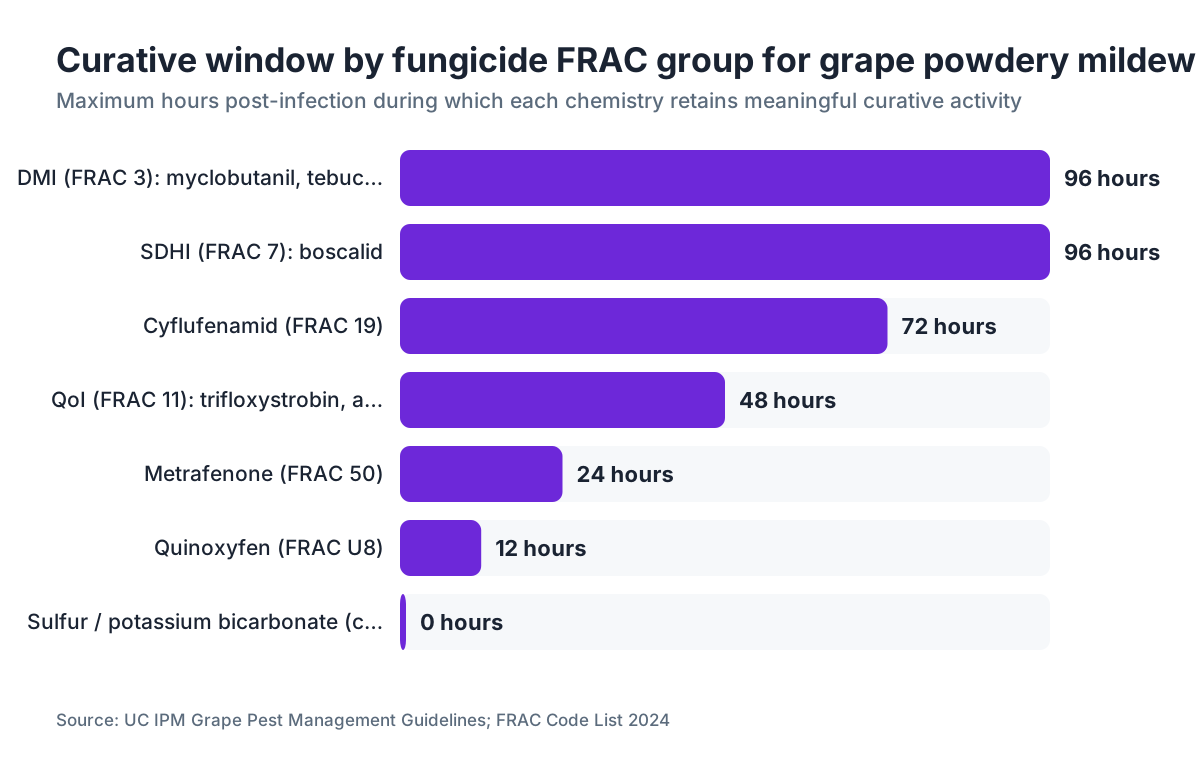
- Once powdery mildew (Erysiphe necator) infects grapevines, you have roughly a 72 to 96 hour post-infection window where DMI and SDHI fungicides can stop a colony from establishing.
- Systemic materials like myclobutanil, tebuconazole, and boscalid move into infected tissue.
- Sulfur and bicarbonates do not.
- Fast application, honest resistance rotation, and clean records separate a manageable outbreak from a lost vintage.
How does powdery mildew infect grapes, and why does timing matter so much?
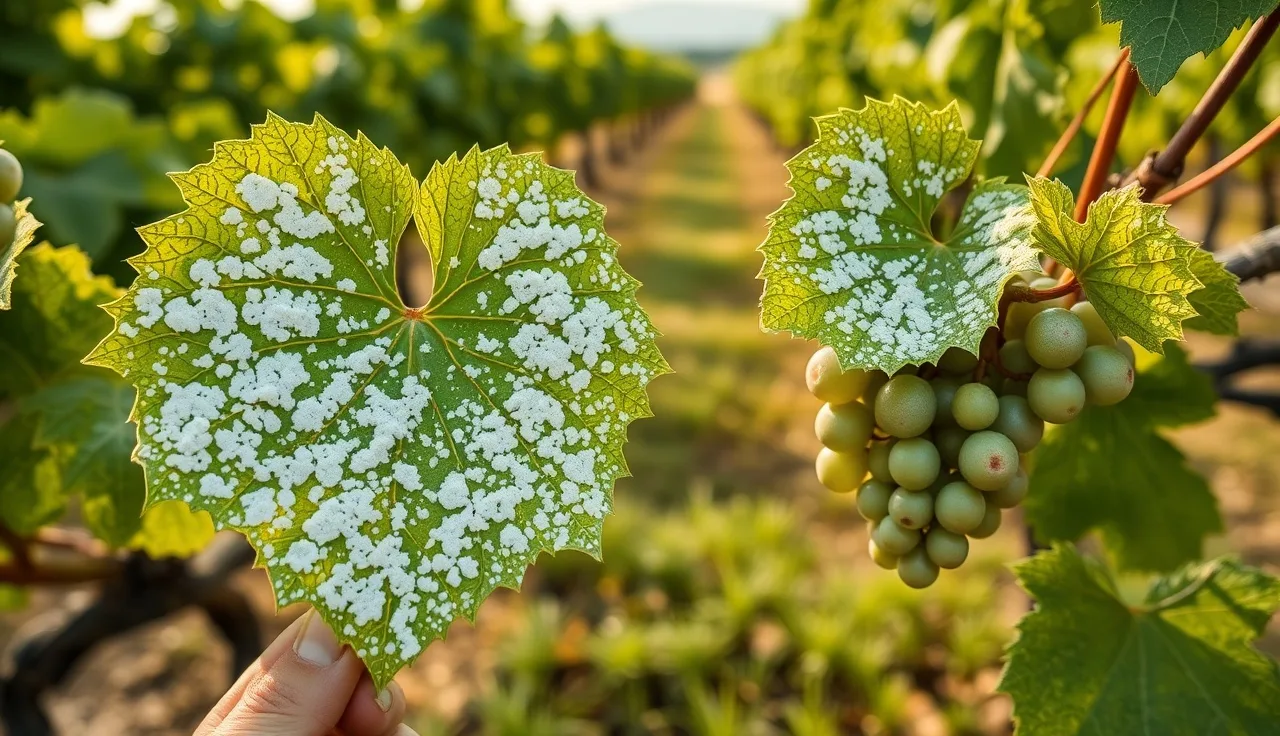
Erysiphe necator, the fungus behind grape powdery mildew, is an obligate parasite. It lives only on living plant tissue, and it runs its entire infectious cycle above the cuticle, which is why you can see the white mycelium with the naked eye. That surface habit is both a weakness and a strength. The fungus is exposed, but it also moves fast.
The cycle runs roughly like this. Ascospores or conidia land on green tissue. Given the right conditions (air temperatures between 50°F and 95°F, an optimum around 68 to 77°F, and relative humidity above 40%), germination starts within a few hours [1]. A germ tube penetrates the epidermal cell, forms a haustorium (the feeding peg), and starts pulling nutrients out of the plant. The external colony, the white powder you notice, becomes visible around 5 to 7 days later. By then the fungus has already reproduced asexually and thrown off a second generation of conidia.
That gap between infection and visible symptom is the latent period, and it's the reason reactive sprays so often seem to fail. You see a few white spots, you spray, you expect the problem to stop. But the spots you can see are infections from five to seven days ago, and invisible new infections happened yesterday. The fungicide you put on today is working against tomorrow's risk, not last week's.
Spray after you see symptoms and you're already behind. The only questions are how far behind, and what a product can still do at that stage.
What is the post-infection treatment window for powdery mildew on grapes?
The curative window for DMI and SDHI fungicides runs about 72 to 96 hours after an infection event. That's the number of hours during which a systemic material can still penetrate infected tissue and shut down colony development before the fungus starts to sporulate. Miss that window and you're managing spread, not the infection you already have.
For the systemic chemistries used in vineyards, that 72 to 96 hour window holds for DMI (demethylation inhibitor) fungicides like myclobutanil (Rally), tebuconazole (Elite), and triadimefon, and for SDHI (succinate dehydrogenase inhibitor) fungicides like boscalid, sold in the premix Pristine [2]. QoI (quinone outside inhibitor) fungicides, the strobilurins like trifloxystrobin (Gem) and azoxystrobin (Abound), have moderate curative activity in the 24 to 48 hour range but come with tight seasonal application limits because of resistance risk. Past 96 hours, curative efficacy drops off for every registered chemistry.
That 72 to 96 hour figure comes from controlled inoculation trials, not field conditions, so treat it as the outer bound. In a commercial block with several infection events stacked on top of each other, you'll rarely know the exact timing of the last spore deposit. The Gubler-Thomas Powdery Mildew Risk Index, developed at UC Davis and used across California and much of the western US, turns temperature data into a disease risk score so you can time sprays to real infection events instead of the calendar [3].
Here's the field rule. If you saw rain, dew, or high humidity three days ago and temperatures sat in the 60s or 70s Fahrenheit, you're inside the curative window or right at its edge. Spray a systemic product today. If it's been more than five days, you're past curative and holding the line on spread.
Which fungicides work after infection has already started?
Powdery mildew fungicides split into two camps once infection is established. Protectants have to sit on the plant surface before spores arrive. Systemics move into the tissue and can interrupt the fungal cycle after penetration. Only the systemics do real curative work.
Protectants (sulfur, copper, bicarbonates, kaolin) have essentially zero curative activity. Sulfur gets misread as a rescue tool more than any other product, and it isn't one. Sulfur works by contact. It has to cover the germinating spore or young mycelium before the haustorium penetrates. Once the fungus is feeding inside the cell, sulfur sitting on the leaf can't reach it [4]. Sulfur still earns a spot in a post-infection program because it suppresses new spore germination on surfaces that are already infected, but it won't clear an established colony.
Systemic fungicides that move in the xylem (upward, acropetal movement) are what actually give you curative activity. Here's how the major FRAC groups stack up.
| FRAC Code | Chemistry | Example Products | Curative Window | Resistance Risk |
|---|---|---|---|---|
| 3 (DMI) | Myclobutanil | Rally 40WSP | 72-96 hr | Medium (single-site) |
| 3 (DMI) | Tebuconazole | Elite 45DF | 72-96 hr | Medium |
| 3 (DMI) | Triadimefon | Bayleton | 72-96 hr | Medium |
| 7 (SDHI) | Boscalid | Pristine (+ QoI) | 72-96 hr | High (single-site) |
| 11 (QoI) | Trifloxystrobin | Gem | 24-48 hr | Very high |
| 11 (QoI) | Azoxystrobin | Abound | 24-48 hr | Very high |
| 19 | Cyflufenamid | Torino | 48-72 hr | Medium |
| 50 | Metrafenone | Vivando | Limited curative | Low |
| U8 | Quinoxyfen | Quintec | Protectant mainly | Low |
Source: UC IPM Grape Pest Management Guidelines; FRAC Code List 2024 [2][5]
For an active infection, a DMI alone or an SDHI/DMI premix applied within 72 to 96 hours of the infection event is the most defensible choice. Strobilurins hit hard, but E. necator populations carrying QoI resistance are documented in California, Washington, New York, and other major wine regions, so leaning on them as your primary curative tool on an infected block is a gamble [5].
Spray volume matters too. UC IPM recommends at least 50 gallons of finished spray per acre for systemic products in a dense canopy, more if you're running a cross-flow airblast at high leaf area index. Underapply and you lose both contact on new spores and translocation into infected tissue.
How bad does an existing infection need to be before you should change your approach?
Severity drives both product choice and spray interval. Below about 10% incidence on shoot tips early in the season (pre-bloom through fruit set), a 14-day systemic program is usually enough. Above 30% incidence at fruit set, or any visible infection on clusters, the math changes fast and you shorten intervals.
The UC IPM program describes a practical severity scale based on the percentage of shoot tips and cluster zones showing visible mycelium [3]. Cluster infection is the outcome that costs you money. Berries stay susceptible from about 1 mm diameter (shortly after fruit set) through roughly 50% sugar accumulation, around 12 to 15 Brix [1]. Infections during the two-to-four week window after fruit set cause the most lasting damage: scarring, berry cracking, secondary Botrytis entry, and reduced wine quality [3]. Active infection on clusters anywhere in that window means dropping to a 7-day interval with a systemic product and tank-mixing a contact material like sulfur (at safe rates, since use above 95°F can burn many varieties) to knock down new spore production on existing colonies.
Past 50% incidence across a block, in-season recovery is limited. You're protecting clean fruit and slowing spread to neighboring blocks, not reversing what's there. That's the point for an honest talk about harvest timing and how the winery wants to handle incoming fruit under mildew pressure.
Variety shifts your threshold too. Chardonnay, Cabernet Franc, Pinot Noir, and Zinfandel sit among the highest-risk varieties. Syrah and Grenache tend to be somewhat less susceptible, though no V. vinifera variety is immune [1].
What does resistance management look like when you're already behind on sprays?
When you've missed intervals and disease is visible, the temptation is to reach for the strongest thing on the shelf, usually an SDHI/QoI premix. It works. The trouble is that hitting a large existing fungal population with single-site chemistry is exactly the condition that selects resistance mutations fastest [5].
FRAC (the Fungicide Resistance Action Committee) recommends no more than two consecutive applications of the same FRAC group before you rotate to a different mode of action [5]. For a catch-up situation, a workable rotation looks like this: first spray a DMI; second spray 7 to 10 days later, an SDHI/DMI premix, or a QoI only if resistance testing says your population is still susceptible; third spray back to a DMI or cyflufenamid; then reassess. Never run a QoI alone. Pair it with a different FRAC code, tank-mixed or alternated.
Some extension programs point growers to UC Davis plant pathology diagnostics or Cornell's Plant Disease Diagnostic Clinic to confirm whether local E. necator populations carry the known QoI resistance allele, the G143A mutation in the cytochrome b gene [5][6]. If your region has documented QoI resistance, strobilurins drop to a supporting role or off the program.
The most durable post-infection program pairs a short-interval systemic rotation with a contact product like sulfur or a bicarbonate to suppress sporulation on existing colonies. You can't reverse the infection already inside the leaf. You can cut the inoculum load feeding the next infection cycle.
How do you apply fungicides correctly for post-infection control?
Application quality matters as much as product choice, maybe more. Powdery mildew sets up on both leaf surfaces, on shoot tips, and on the cluster zone, and every one of those surfaces needs coverage. A perfect product with 60% coverage loses to a mediocre product with full coverage.
For airblast sprayers, calibrate to your canopy. The common error is running the same speed and output in a dense July canopy that worked fine in May. WSU extension recommends raising water volume as the canopy closes, targeting 50 to 100 gallons per acre depending on vine spacing and canopy shape [7]. Drive speed of 2.5 to 3.5 mph is typical. Faster passes cut dwell time and penetration.
For hand-gun application in small vineyards, WSU and UC Davis both recommend spraying to the point of runoff. It feels like a lot, and it's what gets the cluster zone and interior canopy covered [3][7].
Re-entry intervals under the EPA Worker Protection Standard vary by product. Myclobutanil (Rally) carries a 12-hour restricted-entry interval in most states [8]. SDHIs and premixes often run 12 to 24 hours. Check the label. The label is the law. If you're sending workers back into a treated block inside 24 hours, you need the specific REI, not a rule of thumb.
Time of day matters too. Morning application, after the dew dries and before afternoon heat crosses 90°F, is the sweet spot. Sulfur applied above 90 to 95°F on susceptible varieties like Chardonnay or Sauvignon Blanc risks phytotoxicity. Evening sprays work, but they leave residue on wet tissue overnight, which doesn't hurt systemic efficacy though it can raise contact-product concerns.
Record every application: date, product, rate, EPA registration number, application method, REI, target pest, and weather at the time of application. It's a regulatory requirement under state pesticide use reporting programs, including California's system run by CDFA [9], and it's what protects you if a crop gets rejected or a neighbor files a complaint.
What records do you need to keep for powdery mildew spray applications?
Spray records aren't optional in most US wine grape states. California requires pesticide use reports filed with the county agricultural commissioner within 30 days of application under California Food and Agricultural Code section 12981 [9]. Washington, Oregon, and New York carry similar requirements under their own pesticide control acts.
At minimum your records need: date and time of application, operator name and license number, grower name, site location (APN or legal description), crop and crop stage, pest or disease targeted, product name and EPA registration number, amount applied, total area treated, and equipment type. Some states also want wind speed, wind direction, and air temperature.
Beyond the legal floor, a clean spray record is your best diagnostic tool. When mildew breaks through despite sprays, the records tell you whether the interval slipped, whether you missed a block, or whether the disease pressure window fell outside your coverage. Without records, that's just guessing.
A tool like VitiScribe helps here: it structures spray records to match state reporting formats and ties each application to a weather log, so you can reconstruct exactly what happened during an outbreak without digging through handwritten field notes.
If you sell fruit to bonded wineries, spray records are also part of your buyer's food safety audit expectations. Many wineries now require growers to submit them as a condition of purchase, and mildew-related residue concerns (especially DMI residues that can affect yeast fermentation at elevated concentrations) make the documentation matter commercially.
Can organic vineyard operations treat powdery mildew after infection?
Organic vineyards have a harder problem. The most effective post-infection tools are synthetic, and they're off the table. What's left is a narrower set of materials, none of which match the 72 to 96 hour curative activity of a DMI.
Sulfur is OMRI-listed and widely used, but as noted above it's mostly a protectant. Put it on an existing colony and it suppresses spore production somewhat and kills exposed conidia, but it won't reverse haustorial penetration. The closest an OMRI-listed material comes to curative is potassium bicarbonate (Milstop, Kaligreen), which disrupts fungal cell membranes and can cut sporulation on existing colonies, though the efficacy data show it lags DMIs in curative mode [4].
Neem oil products (azadirachtin-based) registered for powdery mildew have some limited post-infection activity but perform inconsistently in field trials. Bacillus subtilis (Serenade) is registered and OMRI-listed, but controlled trials generally show it does better as a protectant than a curative [4].
The honest answer for organic growers: prevention through tight spray intervals (every 7 to 10 days with sulfur or copper during peak risk) is the whole game, and visible symptoms mean the program already failed and needs immediate triage. Shortening the interval to 5 to 7 days with potassium bicarbonate, adding neem to the tank mix, and cutting out heavily infected shoot tips to drop the inoculum load are the tools you've got. Opening the canopy to improve airflow and lower humidity is a slow fix, but a real one.
CSU Fresno and UC Davis have both published on the comparative efficacy of organic options. The consistent finding: no single organic material matches the curative performance of a DMI, and programs that lean on heavy protectant applications timed by disease risk models perform best [3][10].
How does canopy management interact with post-infection treatment?
A fungicide sprayed into a blocked, shaded, humid canopy performs worse than the same product on an open one. That's not a theory. It shows up in spray coverage audits and in disease severity comparisons across trellis systems.
If you're treating an active outbreak, aggressive canopy work done alongside the first post-infection spray earns its labor cost. Remove lateral shoots or suckers closing off the fruiting zone. Cut out shoot tips with visible mycelium and bag them, don't drop them, because the conidia are still viable. Pull leaves on the east side of the canopy in most regions to open up morning airflow and shorten the dew-wetting period.
Cluster-zone leaf removal, done early enough, is one of the better-documented cultural controls. WSU extension data show that moderate cluster-zone leaf removal reduces mildew incidence on clusters even with no change to the fungicide program, by lowering humidity in the microclimate and improving spray penetration [7].
After any mechanical canopy work on infected vines, workers need PPE suited to the pest context, and you log it. If you sprayed a fungicide in the same work session, the REI governs when unprotected workers can go back in.
For vineyard managers building next season's canopy schedule, the link between early leaf removal and lower mildew pressure is strong enough to make it a firm task rather than an optional one.
What does a realistic post-infection spray program look like for the rest of the season?
Say you're at fruit set, you've got 15% incidence on shoot tips, and a few clusters showing early signs. Here's a real program, not an idealized one.
Week 1: Apply a DMI fungicide (myclobutanil or tebuconazole at labeled rate) with sulfur in the tank mix to suppress sporulation. Record everything. Do canopy work the same day or within 48 hours.
Week 2 (7-day interval, given active infection): Apply an SDHI/DMI premix (boscalid + pyraclostrobin, for example) to rotate FRAC groups. Add a wetting agent if the canopy is dense. Assess incidence again at the end of the week.
Week 3: Back to a DMI or a different mode of action (cyflufenamid if it's registered in your state). If incidence is dropping, you can stretch to 10 days. If clusters are holding clean, you're winning.
After veraison: Disease risk drops hard but not to zero. Keep a sulfur-based program going every 14 to 21 days through harvest, and drop any DMI application at least 30 days out from harvest to keep residues in check (confirm against your specific label and buyer requirements).
Pre-harvest intervals for common fungicides: Rally (myclobutanil) is 7 days. Elite (tebuconazole) is 7 days. Gem (trifloxystrobin) is 7 days. Pristine (boscalid + pyraclostrobin) is 0 days [2][3]. Confirm these against the current product label, because they get updated.
Nobody has clean data on whether an aggressive curative program can fully rescue a block sitting above 30% incidence at fruit set. The honest read from the literature: you can likely hold spread off the clean clusters, but infected tissue doesn't recover, and the wine quality hit from heavily infected fruit is real and documented [1].
If you want one place to track all of this, VitiScribe logs spray applications, sets interval reminders, and pulls reports formatted for state pesticide reporting, so the paperwork doesn't slow down the field work.
What are the wine quality and residue impacts of fungicide applications after infection?
This one comes up constantly for growers selling to wineries with residue protocols. Two concerns: the mildew-damaged fruit itself, and fungicide residues at harvest.
On the fruit side, heavily mildewed berries have compromised skins. They crack more easily, which opens the door for Botrytis cinerea and other secondary rots. Mildew-affected skin cells also carry less anthocyanin and altered phenolic profiles. Studies published in the American Journal of Enology and Viticulture have documented that even sub-visible mildew infection on red wine grapes cuts color intensity and shifts tannin structure in the finished wine [1]. No spray program reverses that once the berry is infected.
On the residue side, DMI fungicides, the triazoles especially, inhibit sterol biosynthesis in yeast (they hit the same enzyme pathway in yeast that they target in fungi). At elevated concentrations in juice, DMI residues can slow or stick fermentations. The threshold shifts by yeast strain and compound, but winery labs have documented fermentation trouble at triazole residue levels as low as a few tenths of a mg/kg in some cases. CDFA and the TTB both publish tolerance data, and maximum residue limits for common DMIs on grapes range from 0.5 to 2.0 mg/kg depending on the compound and the destination market [9].
Treating late, inside 30 to 45 days of harvest, means documenting your applications carefully and talking to your winery buyer. Some buyers require residue testing on incoming loads from blocks with late-season DMI applications. That's not punitive. It's risk management, theirs and yours.
Frequently asked questions
Can sulfur fungicide cure powdery mildew that's already on the vine?
No. Sulfur is a contact protectant, not a systemic. It kills fungal spores before germination but cannot penetrate leaf tissue to reach established haustoria. Once the fungus is feeding inside the epidermal cell, sulfur on the leaf surface has no curative effect. It stays useful in post-infection programs to suppress new spore production on existing colonies, but it needs a systemic DMI or SDHI partner for actual curative activity.
How long after a powdery mildew infection event can I still apply a curative fungicide?
The curative window for DMI and SDHI fungicides is roughly 72 to 96 hours after the infection event, based on controlled inoculation trials. QoI strobilurins run shorter, around 24 to 48 hours. Past 96 hours, curative efficacy drops sharply for every registered chemistry. In practice you rarely know the exact timing of infection, so if you've had conducive conditions in the last three days, apply immediately.
What is the Gubler-Thomas risk index and should I be using it?
The Gubler-Thomas Powdery Mildew Risk Index is a temperature-based disease forecasting model developed at UC Davis. It assigns daily risk scores based on how many hours temperatures stayed in the 70 to 85°F optimal range for E. necator. Cumulative scores above 60 signal high infection risk and call for a 7 to 10 day spray interval. It's free, well-validated for California conditions, and applies across warm western wine regions. WSU maintains a modified version for Pacific Northwest conditions.
Which grape varieties are most susceptible to powdery mildew and need the tightest post-infection response?
Among V. vinifera varieties, Chardonnay, Cabernet Franc, Pinot Noir, Zinfandel, and Muscat types rank among the most susceptible. Syrah and Grenache tend to be somewhat less susceptible. Hybrid varieties (like Marquette or Traminette) vary widely. No V. vinifera variety is immune. High-risk varieties call for shortening spray intervals to 7 days during fruit set and bloom, the most economically damaging infection window.
Can I use QoI (strobilurin) fungicides for post-infection treatment of powdery mildew on grapes?
Yes, but with real caution. QoI resistance (the G143A mutation) is documented in E. necator populations across California, Washington, and New York. Hitting a large existing population with a strobilurin under selection pressure speeds resistance. If you use a QoI, always mix it with a fungicide from a different FRAC group, hold total applications to the label maximum (usually 2 to 4), and check whether resistance has been reported in your county through UC Davis or Cornell diagnostics.
What pre-harvest intervals apply to common powdery mildew fungicides on wine grapes?
Common PHIs: myclobutanil (Rally) is 7 days; tebuconazole (Elite) is 7 days; trifloxystrobin (Gem) is 7 days; boscalid + pyraclostrobin (Pristine) is 0 days; azoxystrobin (Abound) is 0 days. Sulfur has no PHI restriction in most states. Always confirm against the current product label and your buyer's residue requirements, because MRL limits for export markets may be tighter than domestic tolerances.
Do organic vineyards have any curative options for powdery mildew after infection?
Limited ones. Potassium bicarbonate products (Milstop, Kaligreen) are OMRI-listed and disrupt fungal cell membranes, giving partial suppression of existing colonies but not true curative activity. Sulfur is OMRI-listed but protectant only. Neem oil and Bacillus subtilis (Serenade) show inconsistent curative results in field trials. The honest answer: organic programs depend on prevention through tight spray intervals and disease risk monitoring, not post-infection rescue.
What state records are required for powdery mildew fungicide applications in California?
California requires pesticide use reports filed with the county agricultural commissioner within 30 days of each application, under California Food and Agricultural Code section 12981. Required fields include product name, EPA registration number, application date, site location, crop, acres treated, amount applied, and operator license number. Washington, Oregon, and New York carry parallel requirements under their pesticide control acts. Keeping records past the legal minimum protects you if a crop is rejected or a neighbor complaint is filed.
Can powdery mildew on grapes at harvest affect wine fermentation?
Yes. DMI fungicide residues in juice can inhibit the same sterol biosynthesis pathway in fermentation yeast that they target in fungi. Triazole residues as low as a few tenths of a mg/kg have been documented to slow or stick fermentations in some yeast strains. Separately, mildew-infected berry tissue shifts phenolic and anthocyanin profiles, cutting color intensity in red wines. Late-season fungicide applications should be documented and disclosed to the receiving winery.
What re-entry intervals apply when workers enter vineyards after fungicide application?
Re-entry intervals under the EPA Worker Protection Standard vary by product. Myclobutanil (Rally) carries a 12-hour REI. Most SDHI and premix products carry 12 to 24 hour REIs. Sulfur products commonly have a 24-hour REI. The label is the legal document; never rely on a general rule. Post the REI and application information on the treated area as WPS requires, and make sure early-entry workers have the required PPE and training.
How does canopy density affect powdery mildew severity and fungicide efficacy?
Dense canopies create warm, humid microclimates that favor E. necator, and they physically block spray from reaching the cluster zone. WSU extension data show that moderate cluster-zone leaf removal reduces mildew incidence on clusters even with no change to the fungicide program. Open canopies improve morning airflow, shorten dew-wetting duration, and allow full coverage with airblast equipment. Aggressive canopy work timed alongside the first post-infection spray often beats adding a fourth fungicide application on cost.
What does a post-infection powdery mildew program cost per acre?
Material costs for DMI fungicides typically run $15 to $35 per acre per application depending on product and rate. SDHI/DMI premixes like Pristine run $25 to $50 per acre. Application costs (custom spray operator or in-house equipment) add $15 to $30 per acre per pass. A six-spray season from pre-bloom through veraison on an alternating systemic program might total $200 to $350 per acre in materials and application combined. These ranges come from PNW and California extension enterprise budgets and vary a lot by operation size.
Is there a difference between post-infection and eradicant activity in powdery mildew fungicides?
Yes, and the distinction matters. Curative activity means stopping colony establishment within the 72 to 96 hour window after infection. Eradicant activity, a term sometimes used for higher-rate DMI applications, means killing established colonies with visible mycelium, typically 7 or more days post-infection. Eradicant activity is weaker and less consistent. Most DMI labels acknowledge some eradicant activity but at reduced efficacy. Curative sprays inside 96 hours beat eradicant applications at day 7 or beyond.
How do I know if my vineyard has fungicide-resistant powdery mildew populations?
Resistance testing through university diagnostic labs is the most reliable method. UC Davis plant pathology and Cornell's Plant Disease Diagnostic Clinic can test E. necator samples for the G143A QoI resistance mutation. Field clues include QoI applications giving visibly less suppression than expected while DMIs still work, or consistent disease breakthrough on blocks with documented strobilurin use over multiple years. If you suspect resistance, shift to DMI-only programs and contact your county farm advisor or state extension plant pathologist.
Sources
- American Journal of Enology and Viticulture (ASEV): Infection cycle temperature and humidity thresholds; berry susceptibility window from 1 mm to roughly 12-15 Brix; wine quality effects of mildew on color and tannin; varietal susceptibility
- UC IPM, Pest Management Guidelines: Grape, Powdery Mildew: FRAC group curative windows, PHI values for myclobutanil, tebuconazole, trifloxystrobin, boscalid+pyraclostrobin; registered fungicide list for grapes; spray volume recommendations
- Cornell Cooperative Extension, Grapes and Wine Program: Protectant-only activity of sulfur; limited curative activity of potassium bicarbonate and Bacillus subtilis vs. DMIs; OMRI-listed material efficacy comparisons
- FRAC (Fungicide Resistance Action Committee), FRAC Code List 2024: QoI resistance G143A mutation documented in E. necator; recommendation of no more than two consecutive applications of same FRAC group; SDHI and QoI single-site resistance risk
- Cornell Plant Disease Diagnostic Clinic: Resistance testing services for E. necator QoI resistance allele confirmation
- Washington State University Extension: Spray volume recommendations 50-100 gallons/acre by canopy density; cluster-zone leaf removal reducing mildew incidence; drive speed calibration for airblast sprayers
- US EPA, Agricultural Worker Protection Standard: REI requirements under WPS; posting requirements for treated areas; early-entry worker PPE and training requirements
- California Department of Pesticide Regulation, Pesticide Use Reporting: California Food and Agricultural Code section 12981 requiring pesticide use reports within 30 days; required data fields; MRL tolerances for DMI compounds on grapes
- California State University, Fresno, Jordan College of Agricultural Sciences: Comparative efficacy of organic materials versus DMIs in curative mode; risk-model-based spray timing performance in organic programs
Last updated 2026-07-09