Grapevine annual growth cycle: budbreak to dormancy explained
TL;DR
- A grapevine moves through six phenological stages each year: dormancy, budbreak, shoot growth and flowering, fruit set, veraison, and harvest, then back into dormancy.
- Each stage has its own temperature triggers, management windows, and risks.
- The cycle is your operating calendar.
- Every spray, pruning cut, and harvest call maps onto a specific window inside it.
What are the stages of the grapevine annual growth cycle?
A grapevine's year runs in a repeating arc: grow, reproduce, rest. Viticulturists split it into six phenological phases. Dormancy (roughly November through February in the Northern Hemisphere), budbreak (March to early April), shoot and leaf growth with flowering (April through June), fruit set and berry development (June through July), veraison (late July through August), and harvest (August through October, which swings hard by variety and climate). After the last fruit comes off, the vine shuts down and dormancy starts again.
The calendar dates move with region, elevation, variety, and vintage. In the Finger Lakes of New York, budbreak might not show until late April. In California's Central Valley, early varieties can push in February [1]. What holds steady everywhere is the sequence, not the date.
Temperature drives each stage, not day length. Growers track heat with growing degree days (GDD), which viticulture measures at base 50°F (10°C). UC Davis uses GDD50 as the standard metric for predicting phenological timing across California wine regions [2]. Cornell's New York State Agricultural Experiment Station runs similar models tuned for the Northeast [3].
Knowing the cycle isn't an academic exercise. Every spray, pruning cut, irrigation set, and harvest call lands in a specific window within these stages. Miss the window and you spray after infection has already happened, prune at the wrong carbohydrate reserve level, or pick fruit that never finished ripening. The cycle runs your whole field season.
What happens during grapevine dormancy and why does it matter?
Dormancy is the vine's winter reset. After leaf fall, the vine pulls carbohydrate reserves (starch converted to soluble sugars) out of the leaves and down into the wood of canes, cordons, and roots. Those reserves fund the first burst of growth at budbreak, before the canopy is big enough to photosynthesize for itself [4].
Dormancy has two phases. Endodormancy is the deep-cold phase where the vine won't grow even if it warms up, because changes inside the bud block growth. Ecodormancy comes next: the vine is ready to grow but cold is holding it back. That distinction matters. Ecodormant vines are the ones a mid-winter warm spell can trick into early budbreak, and early budbreak means more frost exposure.
Winter pruning happens entirely inside the dormancy window, and when you prune has consequences. Prune very early (right after leaf fall, during endodormancy) and you can shave off a little cold hardiness because wound sealing pulls energy. Prune late, close to budbreak, and you tend to push budbreak back a few days, which trims frost risk. On frost-prone sites, plenty of growers delay pruning on the sensitive blocks on purpose. Washington State University Extension recommends exactly that for sites with a late-frost history [5].
Chilling requirement is another dormancy variable. Vines need a set number of hours below about 45°F (7°C) to finish endodormancy and break bud evenly. In warm-winter regions, short chilling gives you uneven budbreak, and a staggered canopy is a headache to manage all season. Most Vitis vinifera varieties need somewhere between 700 and 1,200 chilling hours, with the exact figure tied to variety. Nobody has clean data on this for most clones. The research is mostly extrapolated from rootstock and scion work done decades ago.
What is budbreak and what temperature triggers it?
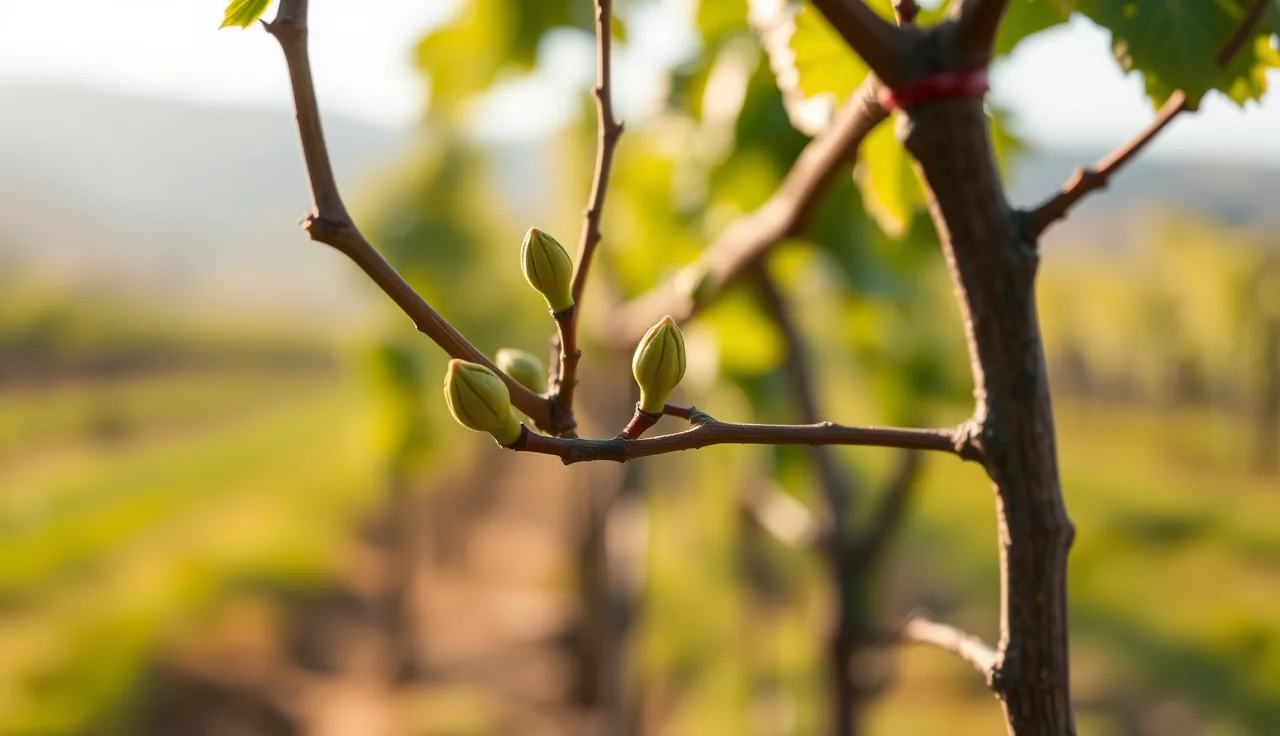
Budbreak is the moment a dormant bud swells and green tissue appears. The very first visible stage is "bud swell," and viticulturists track the micro-stages after it on the Eichhorn-Lorenz (E-L) scale, which runs from stage 1 (winter dormancy) to 47 (leaf fall). Budbreak is E-L stage 4, green shoot tips just visible [4].
The base temperature for grapevine growth sits at 50°F (10°C). Once daily average temperatures hold above that, GDD accumulates and budbreak follows. In practice, most Vitis vinifera varieties break bud after piling up roughly 50 to 150 GDD50 from January 1, depending on variety and site. Chardonnay usually beats Cabernet Sauvignon to it. Riesling is earlier still.
Frost is the big risk here. New shoots at budbreak handle about 32°F (0°C) for a very short stretch, but 28°F (-2°C) for even a few hours kills emerged green tissue [2]. Late frost is a real economic threat. If it takes out the primary buds and the vine is left running on secondary buds, which carry less fruit, a single cold night can erase a big chunk of the crop.
What to do at budbreak: check frost forecasts daily and have your protection gear ready (wind machines, overhead irrigation, or heaters). Assess bud damage in the first warm week to estimate crop load. Put on the first fungicide spray if disease pressure calls for it. In humid regions, the first powdery and downy mildew infection periods can kick off right around budbreak [3].
How does shoot growth and flowering work in a grapevine?
After budbreak, the shoot takes off. In warm weather it can stretch several inches a day. Flower clusters, which actually formed inside the bud the previous summer, come into view as the shoot elongates. By the time shoots hit 8 to 12 inches, you can already spot the small compacted flower clusters (inflorescences) on them.
Flowering (anthesis) usually lands 6 to 9 weeks after budbreak, around E-L stage 23. Individual flowers open and pollen releases. Grapevines are mostly self-fertile and wind-pollinated. Warm, dry, calm weather during flowering gives good fruit set. Cool, wet, or windy weather wrecks pollination and can cause shatter (coulure), where a lot of berries never set at all [4].
Grapevine flowers are tiny and plain, nothing like an apple blossom. The calyptra (a cap of fused petals) pops off as the flower opens. Flowering at a given site usually runs about 1 to 2 weeks. Grenache and Merlot are especially prone to coulure when the weather turns.
For spray records, flowering is one of the tightest windows of the year. The EPA Worker Protection Standard sets specific protections whenever pesticides go onto crops in bloom if pollinators might be present, and some labels flat out prohibit applications during bloom [6]. Know your labels cold before this window arrives.
Shoot positioning, leaf pulling, and hedging usually start during this phase or right after. They open up airflow and let sunlight into the canopy, and both of those cut fungal disease pressure hard.
What is fruit set and how does berry development progress?
Fruit set follows flowering within 1 to 2 weeks. A berry has "set" when the ovary swells after successful pollination and fertilization. Losing 50 to 80 percent of flowers is normal even in ideal conditions, because the vine drops unfertilized flowers on its own. What you want is enough set to hit your target crop load without overcropping.
Berry development from set through veraison covers "Stage I" and "Stage II" of the double-sigmoid growth model researchers use to describe berry growth. In Stage I (roughly 4 to 7 weeks after set), the berry grows fast by cell division. Seeds are developing. The berries are hard, green, and loaded with malic acid.
Stage II is a lag phase. Berry growth slows while seeds mature. The vine is pouring energy into the seeds rather than the pericarp (berry flesh). Stage II runs 2 to 4 weeks.
Keep the canopy dialed in through all of this. Cluster thinning (crop thinning) usually happens in Stage I if you're targeting a specific yield. Shoot thinning, leaf pulling, and hedging keep going. Disease management is live: botrytis, powdery mildew, and downy mildew can all infect developing berries now, and infections that start here often stay invisible until much later in the season [3].
This is a smart point to set up your spray record templates so the pre-harvest intervals (PHIs) that bite at harvest don't sneak up on you. Tools like VitiScribe let you log application dates, products, and rates against block-specific crop calendars, so PHI compliance is automatic instead of a scramble the week before you pick.
What is veraison and what changes occur in the berry?
Veraison (from the French véraison) is the start of ripening. In red varieties you see a fast color shift from green to red or purple. In whites the berries soften and yellow slightly. It marks the start of Stage III of berry development.
At veraison the berry flips from stockpiling acids (mostly malic and tartaric) to stockpiling sugars (mostly glucose and fructose). Anthocyanins, the pigments behind red color, start building in the skin cells. The berry softens fast as cell walls loosen. Most of this plays out inside about a two-week window. Berries in a single cluster don't all turn at once. A cluster might sit at 30 percent red and 70 percent green for a week or so mid-transition [2].
Veraison is a decision checkpoint. You can run a final cluster thinning here, cutting green or partly veraised clusters if the crop is too heavy. Irrigation often changes: some growers hold a mild water stress from veraison to harvest to concentrate flavor and cap berry size. The right level of stress is site-specific and variety-specific enough that blanket numbers aren't much help. UC Davis research points to a stem water potential of about -10 to -12 bars during ripening for Cabernet Sauvignon as a rough target, but that moves with rootstock and soil [2].
Pests and disease change too. Botrytis risk climbs once berries soften. Grape berry moth and other insects home in on ripening fruit. Spray programs have to shift, and PHIs get serious because harvest is only 6 to 10 weeks out.
How do you know when to harvest grapes?
Harvest timing is the season's biggest call, and it never comes down to one number. The classic metrics are soluble solids (Brix), titratable acidity (TA), and pH. A typical Brix target for wine grapes is 22 to 26°Bx across most red and white styles, while sparkling base grapes come off at 18 to 20°Bx [2]. Those are guidelines, not laws, and plenty of good growers will tell you they're necessary but not sufficient.
Seed color (green seeds taste astringent and bitter, brown seeds are physiologically mature), berry texture, and flavor (tannin structure, aromatics) fill in what Brix misses. Walking rows and tasting fruit isn't optional for quality-focused fruit.
Then there's weather. If a rain event with botrytis risk is five days out and your Brix is 0.5 below target, most growers pick. Fruit in the tank beats fruit you might lose to rot.
Harvest for most Northern Hemisphere regions runs from early August (sparkling base or early varieties in warm climates) through November (late-harvest styles, Icewine, or cool-climate varieties). NASS Grape Crush Report data reflect this August-to-November spread across US regions [10]. In California's warm interior valleys, harvest can open around August 1. In the Finger Lakes, Riesling for dry wine often comes off in October [1][3].
Post-harvest work starts the minute the last fruit is off. Getting irrigation, compost, and cover crop seeding done fast sets the vine up for a clean dormancy.
What happens to the vine after harvest and before dormancy?
The post-harvest stretch gets undervalued. Once the fruit is gone, the vine keeps photosynthesizing as long as the canopy still works. That photosynthate runs down into the roots as stored carbohydrate, rebuilding reserves the season drew down. Those reserves power next year's budbreak.
This is why stripping leaves too early, or letting botrytis or another disease trash the canopy before natural leaf fall, taxes next year's crop. The vine needs functional green tissue for 4 to 6 weeks after harvest to load up [4].
Leaf fall triggers on shortening days plus cooling temperatures. Chlorophyll breaks down and the yellow and orange carotenoids show through. In most regions leaves are down by November. Cold-hardening runs in parallel: wood acclimation to freezing starts in September and peaks around December to January.
Foliar nutrient sprays (boron and zinc especially, since both feed next year's fruit set) work best in this post-harvest, pre-leaf-fall window. Fall is also the usual time to soil sample for pH and macronutrients. Lime needs time to react with the soil before the next season starts, so fall is the right window for it.
For recordkeeping, this is when annual spray records get compiled if any state or federal reporting applies. The EPA Worker Protection Standard requires pesticide application records be kept for 2 years, and many states pile on more [6]. Closing the season's records while the data is fresh beats rebuilding them from memory in January.
How do growing degree days predict grapevine phenology?
Growing degree days (GDD) give you a temperature clock for the vine's season. The formula is plain: GDD50 = ((daily max temp + daily min temp) / 2) minus 50°F. Negative values count as zero. You add up the daily numbers from a start date (usually January 1 in California, April 1 in some Northeast models) through the end of the season.
The Winkler Index, developed at UC Davis, sorts wine regions into five categories by total seasonal GDD50:
| Winkler Region | GDD50 Range | Example Regions |
|---|---|---|
| I | Below 2,500 | Carneros, Finger Lakes, Willamette Valley |
| II | 2,501-3,000 | Napa Valley, Sonoma Coast |
| III | 3,001-3,500 | Paso Robles interior, Lodi |
| IV | 3,501-4,000 | Central Valley foothills |
| V | Above 4,000 | San Joaquin Valley floor |
The Winkler Index was published in 1974 by Winkler, Cook, Kliewer, and Lider in the UC Press textbook "General Viticulture." It's still the most cited climate classification for wine in the US [2].
In practice, GDD lets you see phenological stages coming a week or two out. If you're at 400 GDD50 and flowering for your block usually starts around 700 GDD50, you have roughly the lead time you need to line up canopy crews and adjust the spray calendar. Washington State University's AgWeatherNet publishes real-time GDD from vineyard stations across the Pacific Northwest [5].
What are the biggest risks at each growth stage?
Each stage carries its own main threat, and your management calendar should hit them in sequence.
During dormancy the risks are winter cold injury (killing primary buds or trunk wood), rodent damage to the crown and trunk base, and badly timed pruning that leaves the vine exposed. Peak cold hardiness for most Vitis vinifera varieties sits around -5°F to -10°F (-20°C to -23°C) at mid-winter. Below that you get cane and bud kill. Below about -15°F (-26°C), trunk death gets common [3].
At budbreak, frost is the acute threat. Phomopsis cane and leaf spot spores release during early shoot growth in wet weather, with the primary infection window in those first 3 to 4 inches of shoot [3].
During shoot growth and flowering, powdery mildew and downy mildew take over as the dominant fungal threats. Both infect actively growing tissue, and flowering clusters are wide open to them. One missed spray at flowering can seed an epidemic that runs the rest of the season.
From fruit set through veraison, bunch rots (mostly Botrytis cinerea) sit in the background, waiting on tight-clustered varieties, humidity, and any wound from insects or hail. Grape berry moth, leafhopper, and spider mites are the insect and mite concerns through this stretch.
At harvest, the enemy is time. Weather, labor, and PHI compliance all squeeze you at once. Keeping a running tally of days since last application for every product and every block is exactly where small operations make avoidable compliance mistakes.
Post-harvest, the vine is open to trunk diseases (Eutypa, Esca, Botryosphaeria) if big pruning wounds sit exposed. Wound protectants and timing your cuts relative to rain events both matter here [9].
How does the grapevine growth cycle vary by region and variety?
Variety is probably the single biggest driver of timing inside a region. Chardonnay and Pinot Noir are early-budding, early-ripening, which is why they suit cool climates and also why they're frost-prone in those climates. Cabernet Sauvignon, Mourvèdre, and Petit Verdot ripen late. They need a long warm season to hit enough Brix before fall rain and cold show up.
Rootstock shifts timing too, less than variety but still real. 3309 Couderc and 101-14 Millardet tend to give earlier-budding, earlier-ripening vines than a high-vigor rootstock like 110R. On warm, dry sites that hit early-season water stress, a vigorous rootstock that pushes a slightly later, longer season can work in your favor.
Regional timing gaps are wide. Here's a rough comparison of average budbreak and harvest dates across major US wine regions:
| Region | Avg. Budbreak | Avg. Harvest Start |
|---|---|---|
| Central Valley, CA | Late Feb-Early Mar | Early Aug |
| Napa Valley, CA | Mid-Mar | Late Aug |
| Willamette Valley, OR | Mid-Apr | Early Sep |
| Finger Lakes, NY | Late Apr | Late Sep |
| Virginia Piedmont | Early Apr | Early Sep |
Within each region these dates move by variety, 2 to 6 weeks from earliest to latest. A vineyard in a cool coastal climate picking Pinot Noir in September runs a completely different calendar than a Zinfandel block in the Sierra Foothills picking in October.
Climate change is squeezing and shifting these windows. A study in Nature Climate Change found average harvest dates for European wine regions moved earlier by about 6 days per decade between 1981 and 2007 [8]. US data show similar trends, though the research base is thinner.
What recordkeeping is required across the growing season?
Compliance doesn't pause for any growth stage. The EPA Worker Protection Standard (WPS) under 40 CFR Part 170 requires agricultural employers to keep records of all restricted-use pesticide applications for at least 2 years, including product name, EPA registration number, active ingredient, amount applied, application date, location, and the certified applicator's name [6]. State rules in California, New York, Washington, and Oregon usually run past federal minimums and add permit requirements for certain materials.
In California, growers file pesticide use reports (PURs) with their county agricultural commissioner monthly during the application season, covering all pesticide products, not only restricted-use materials [7]. Washington requires PURs for restricted-use materials on a similar schedule.
Beyond pesticide records, quality-focused operations usually track irrigation volume and timing by block, tissue and petiole sampling results by variety and block, fruit maturity data (Brix, TA, pH) by sampling date, and yield by block at harvest. None of these are universally mandated, but together they're the audit trail for understanding why a vintage went the way it did and for showing due diligence to buyers or certifiers.
Build your recordkeeping around the growth cycle rather than around a calendar month. The compliance events cluster at budbreak (first sprays, WPS training renewals), through shoot growth and flowering (the heaviest spray calendar), and at harvest (PHI math, yield records). A tool like VitiScribe structures records around the crop calendar instead of forcing your field data into a generic farm management template.
Frequently asked questions
At what temperature does a grapevine break bud?
Grapevines start accumulating growing degree days above a base of 50°F (10°C). Most Vitis vinifera varieties break bud after piling up roughly 50 to 150 GDD50 from January 1. The exact threshold moves with variety, rootstock, and site history. Chardonnay and Pinot Noir usually break earlier than Cabernet Sauvignon or Syrah under the same conditions.
How long does the grapevine flowering period last?
Flowering (anthesis) usually runs 1 to 2 weeks at a given site. It lands about 6 to 9 weeks after budbreak. Warm, dry, calm weather during this window gives complete fruit set. Cool, wet, or windy conditions cause shatter (coulure), where flowers fail to set. Merlot and Grenache are more prone to coulure than most varieties.
What Brix level is right for harvesting wine grapes?
Most table wine grapes come off at 22 to 26°Bx across red and white styles. Sparkling base wines are picked earlier, at 18 to 20°Bx. Brix is a starting point, not the whole picture. Seed color, berry texture, flavor, pH, and titratable acidity all feed the call. Experienced growers weigh all of it against the coming weather before scheduling the pick.
What is veraison and when does it happen?
Veraison is the start of ripening, marked by color change in reds and softening in whites. It usually hits 45 to 65 days after fruit set, which puts it in late July to August in most Northern Hemisphere wine regions. At veraison the berry flips from acid accumulation to sugar accumulation. Harvest follows roughly 6 to 10 weeks after veraison, depending on variety and target style.
How do I calculate growing degree days for my vineyard?
GDD50 per day equals ((daily max temp + daily min temp) divided by 2) minus 50°F. Negative results count as zero. Add up daily values from January 1 in most Western US models, or April 1 in some Northeast models. Many states run free tools: Washington's AgWeatherNet and California's CIMIS network both deliver GDD from vineyard-area weather stations.
How cold can a grapevine tolerate in winter?
Mid-winter cold hardiness for most Vitis vinifera varieties peaks around -5°F to -10°F (-20°C to -23°C). Below that range, primary bud kill and cane damage get significant. Below roughly -15°F (-26°C), trunk damage and vine death are possible. Cold hardiness isn't static: it peaks in January and drops as temperatures warm in late winter, so late-season cold snaps do the most damage.
Can you spray pesticides on grapevines during flowering?
Some products can go on at flowering, others can't. The EPA Worker Protection Standard and the individual product label set the rules. Many insecticides are prohibited or restricted during bloom because of pollinator risk. Always read the specific label for the product and timing. Some fungicides for powdery mildew are applied through bloom but must meet label requirements for timing and rate.
What happens if a grapevine gets frost after budbreak?
Young shoots are killed around 28°F (-2°C) within a few hours. Primary buds are the most productive; secondary and tertiary buds, the vine's backup, carry less fruit. A severe post-budbreak frost can cut yield by 50 to 100 percent on affected blocks. Protection options include overhead irrigation (ice encapsulation), wind machines to pull warmer air down, and site-level frost risk assessment at vineyard design.
What is the Winkler Index and how is it used?
The Winkler Index classifies wine regions by total seasonal GDD50 from April 1 through October 31. Region I is below 2,500 GDD50 (cool climates like Carneros or the Finger Lakes); Region V is above 4,000 GDD50 (San Joaquin Valley floor). Developed at UC Davis, it helps growers and winemakers judge which varieties will ripen fully in a given climate. It's useful, but climate shifts are testing it.
How long does grapevine dormancy last?
In most Northern Hemisphere wine regions, dormancy runs from leaf fall in November through budbreak in March to April, roughly 4 to 5 months. The depth shifts within that window: endodormancy (deep cold rest) peaks around December to January, then gives way to ecodormancy as it warms. Length depends heavily on climate; in very warm climates, dormancy can be shallow or short.
What is post-harvest vineyard management and why does it matter?
Post-harvest management covers the 6 to 10 weeks between picking and leaf fall. The vine keeps photosynthesizing and loading carbohydrate reserves into trunk and root tissue. Those reserves fuel next year's budbreak. Key tasks: foliar nutrients (boron, zinc), soil sampling, cover crop seeding, and irrigation if the season was dry. Losing canopy function too early to disease or defoliation costs you next year's crop potential.
How many weeks between budbreak and harvest?
Most Vitis vinifera varieties run 150 to 200 days from budbreak to harvest, roughly 22 to 28 weeks. Early-ripening varieties in warm climates sit at the short end. Late-ripening varieties in cool climates stretch the long end. Day-to-day temperature through the season is the biggest source of year-to-year timing differences within any given site and variety.
What are the spray record requirements for vineyards?
The EPA Worker Protection Standard under 40 CFR Part 170 requires 2-year retention of records for all restricted-use pesticide applications. Records must include product name, EPA registration number, active ingredient, rate, date, location, and certified applicator name. California requires monthly pesticide use reports to the county agricultural commissioner for all pesticide products. Washington, Oregon, and New York also run requirements past federal minimums.
Does climate change affect the grapevine growth cycle?
Yes, measurably. A study in Nature Climate Change found European harvest dates moved earlier by about 6 days per decade from 1981 to 2007. US data show similar trends. Earlier budbreak raises frost exposure. Compressed seasons cut the time for flavor development. Some regions are watching variety suitability shift as heat accumulation runs past the optimal range for cool-climate varieties like Pinot Noir and Riesling.
Sources
- UC Agriculture and Natural Resources, UC Cooperative Extension: Budbreak in California's Central Valley can occur as early as February for early-ripening varieties; harvest in the Finger Lakes often occurs in October for Riesling.
- UC Davis Department of Viticulture and Enology: GDD50 is the standard metric used for predicting phenological timing; Winkler Index classification by region; stem water potential target of -10 to -12 bars during ripening for Cabernet Sauvignon; harvest Brix targets of 22-26 for wine grapes; frost damage thresholds at budbreak.
- Cornell Cooperative Extension, New York State Agricultural Experiment Station: GDD models adapted to the Northeast; Phomopsis primary infection window during first 3-4 inches of shoot growth; winter cold injury thresholds for Vitis vinifera; Finger Lakes harvest timing for Riesling; early-season mildew infection periods.
- UC Press: General Viticulture (Winkler, Cook, Kliewer, Lider, 1974), cited via UC Davis Viticulture and Enology: Eichhorn-Lorenz (E-L) phenological scale; carbohydrate reserve loading post-harvest; vine physiology during dormancy and budbreak; the double-sigmoid berry development model.
- Washington State University Extension: AgWeatherNet and Viticulture Program: WSU recommends delayed pruning on frost-prone sites to delay budbreak; AgWeatherNet provides real-time GDD data for Pacific Northwest vineyard stations.
- US EPA: Worker Protection Standard (WPS), 40 CFR Part 170: EPA WPS requires pesticide application records be maintained for 2 years; specific protections required when pesticides are applied to crops in flower if pollinators may be present.
- California Department of Pesticide Regulation: Pesticide Use Reporting: California requires growers to submit pesticide use reports to the county agricultural commissioner monthly during the application season, covering all pesticide products.
- Nature Climate Change (2016), Cook and Wolkovich, on wine-region harvest dates and climate warming: Average harvest dates for European wine regions advanced by about 6 days per decade between 1981 and 2007.
- Oregon State University Extension Service: Pacific Northwest Pest Management Handbook, Grapes: Botrytis cinerea infection risk increases significantly at and after veraison as berries soften; wound protectants and pruning timing relative to rain events reduce trunk disease incidence.
- USDA National Agricultural Statistics Service (NASS): Grape Crush Report: Harvest season for Northern Hemisphere wine regions runs from early August through November depending on variety and region.
Last updated 2026-07-09