Grapevine disease resistance: what growers need to know
TL;DR
- Grapevine disease resistance comes from two places: the vine's own genetics and the spray program you build around it.
- Interspecific hybrids, also called disease-resistant varieties (DRVs), can cut fungicide applications by 50 to 80 percent compared to Vitis vinifera.
- Three moves matter most.
- Pick the right variety for your region, keep clean spray records, and rotate chemistries by FRAC group.
What does grapevine disease resistance actually mean?
Disease resistance in grapevines is a spectrum, not a switch. On one end sit highly susceptible V. vinifera cultivars like Chardonnay and Pinot Noir, which carry almost no natural defense against pathogens native to North America. On the other end sit hybrids bred from resistant North American Vitis species, which mount an immune-like response that slows or stops pathogen growth.
Four pathogens do most of the damage in most wine regions: powdery mildew (Erysiphe necator), downy mildew (Plasmopara viticola), gray mold (Botrytis cinerea), and black rot (Guignardia bidwellii). None of them evolved alongside European grapes. That is exactly why V. vinifera has so little defense against them [1].
Resistance shows up in a few forms. Physical barriers include thicker cuticles and waxy bloom that slow spore adhesion. Biochemical defenses include stilbenes like resveratrol and other phytoalexins the vine makes once it detects infection. Breeders have mapped quantitative trait loci (QTL) for resistance in detail and now target specific loci, Ren1 through Ren9 for powdery mildew and Rpv1 through Rpv29 for downy mildew [2].
Here is the practical part. Variety choice is the single highest-leverage decision you make on disease pressure. Fungicide programs, canopy management, cover crops: all of it is managing around that one foundational call.
Which grapevine diseases cause the most economic damage?
Powdery mildew is the top fungal threat in most North American wine regions by spray cost alone. UC Cooperative Extension estimates California growers spend roughly $150 to $300 per acre per season managing it, and costs run higher in cool coastal appellations where the pressure never lets up [3]. That number leaves out yield loss from infected clusters and the wood infection that drives the cordon dieback growers call 'dead arm'.
Downy mildew rules east of the Rockies and hits the Pacific Northwest hard in wet years. It can strip a block bare inside two weeks under ideal conditions: temperatures between 59 and 77 degrees F with leaf wetness longer than two hours [4]. Botrytis is a quality problem more than a survival threat, but a bad infection in a tight-cluster variety like Pinot Gris can wipe out a block's premium value in a week.
Black rot gets ignored in the mid-Atlantic and Southeast until it shouldn't be. It infects green berries through roughly the same window as downy mildew, and growers often blame the mummified fruit on Botrytis when they find it late in the season.
| Disease | Primary threat region | Favorable conditions | Infection target |
|---|---|---|---|
| Powdery mildew (E. necator) | California, PNW, all regions | 50-95°F, no free moisture needed | Shoots, leaves, clusters |
| Downy mildew (P. viticola) | Eastern US, PNW wet years | >59°F, >2 hr leaf wetness | Leaves, clusters, shoots |
| Botrytis (B. cinerea) | All regions | Cool, humid, dense canopy | Clusters, wounded tissue |
| Black rot (G. bidwellii) | Mid-Atlantic, Southeast | 60-85°F, >6 hr wetness | Berries, leaves, shoots |
The cost of doing nothing is steep. Cornell research found unsprayed V. vinifera can lose 80 to 100 percent of its crop to downy mildew in a wet Northeast year [1].
How are disease-resistant grape varieties bred, and what are Rpv and Ren loci?
Modern disease-resistant variety (DRV) breeding crosses V. vinifera with North American or Asian Vitis species that carry natural resistance genes. The aim is to stack several resistance loci into one variety so a single mutation cannot break the whole defense. Breeders call this pyramiding [2].
For downy mildew, breeders track Rpv loci (Resistance to Plasmopara viticola). Rpv3 from V. rupestris and V. aestivalis, Rpv10 from V. amurensis, and Rpv12 from V. rotundifolia are among the best characterized. A variety carrying Rpv3 plus Rpv10 is far harder for the pathogen to defeat than one carrying either locus alone [2].
For powdery mildew, Ren loci (Resistance to Erysiphe necator) and Run loci lead the breeding targets. Run1 from Muscadinia rotundifolia gives strong resistance but has historically dragged along viticultural baggage. Newer loci like Ren3 and Ren9 have gone into commercial varieties with better wine quality.
USDA-ARS breeding programs, Cornell's grape breeding program, and European programs like Germany's Geilweilerhof institute and France's INRAE have released commercial DRVs over the last two decades. Marquette, Frontenac, La Crescent, and Crimson Cabernet (from UC Davis) all carry stacked resistance loci from this work [5].
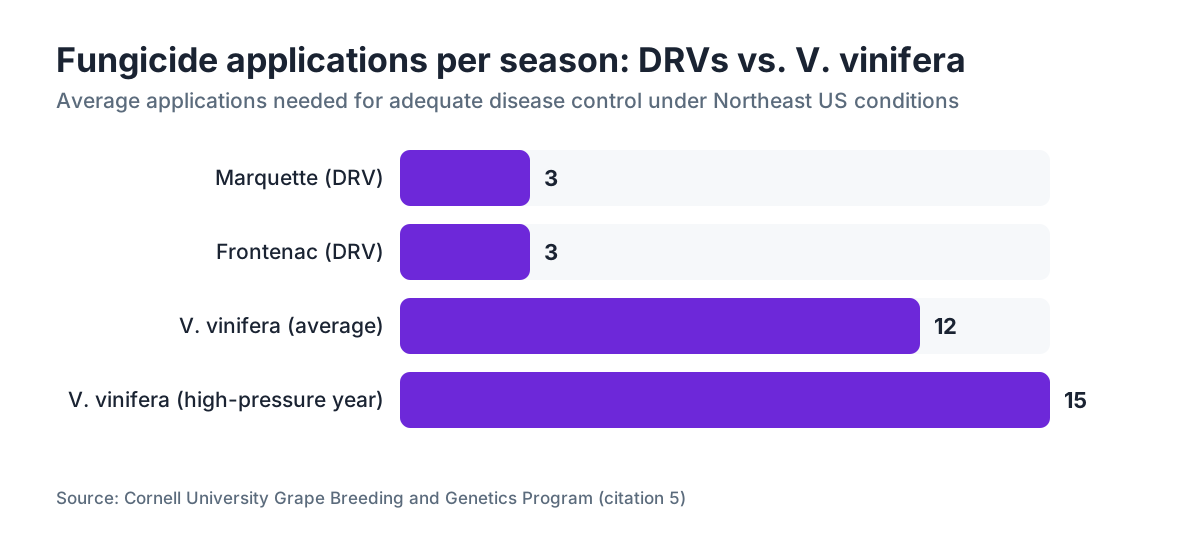
One honest caveat: resistance is not immunity. Under very high inoculum pressure, even strong Rpv pyramiding shows some infection. The goal is cutting your program to two to four applications a season instead of twelve to fifteen, not spraying zero.
What are the best disease-resistant grape varieties for wine production?
The answer depends hard on your region, your market, and whether you can sell a wine most consumers have never heard of.
For cold-climate eastern regions, Cornell's Cold Hardy Grape Breeding Program has released varieties that pair real winter hardiness (surviving -20 to -30 degrees F) with Rpv and Ren resistance [5]. Marquette makes a red in the Pinot Noir neighborhood. La Crescent makes aromatic whites. Frontenac Gris is a workhorse. These do well in Minnesota, Wisconsin, Michigan, and the colder edge of the Finger Lakes.
For the mid-Atlantic and Southeast, varieties from the Virginia Cooperative Extension trial network, including Noiret, Corot Noir, and Traminette, tolerate Botrytis and black rot better than V. vinifera in humid summers [6]. Traminette, a Gewurztraminer hybrid, is one of the better quality whites for hot, sticky conditions.
For the Pacific Northwest and California, UC Davis released Crimson Cabernet in the 2010s, a Cabernet Sauvignon cross with resistance traits, though commercial adoption has stayed thin. The DRVs planted more widely in mild climates tend to be European PIWI varieties (Pilzwiderstandsfähige, or fungus-resistant) like Regent, Solaris, and Sauvignac, which have found footholds in organic vineyards in Oregon and the UK [2].
If you can't or won't leave classic vinifera, the realistic path isn't replanting. It's building a spray program around the resistance the vine lacks. Harder road, more money.
Growers scouting sites for DRVs across California's appellations, from Paso Robles wineries country to coastal blocks, should pull local university trial data before planting. Regional performance swings a lot even inside one state.
How does canopy management affect disease pressure in the vineyard?
Canopy architecture is one of the most underused disease tools you have, and it costs nothing past labor. Dense canopies trap humidity, stretch out leaf wetness, block spray penetration, and build a microclimate that favors powdery mildew, Botrytis, and downy mildew all at once.
Washington State University extension research found that shoot thinning and fruit-zone leaf removal can cut Botrytis incidence by 30 to 50 percent compared to unthinned controls, and the effect holds even in wet years [4]. The mechanism is simple. Better airflow drops leaf wetness below infection thresholds for more hours of the day.
Pulling leaves on the morning-sun side of the canopy (the east side in east-west rows) improves spray coverage and dries the cluster zone faster after rain or dew. Some growers do it mechanically around 25 to 50 percent bloom. Others wait for fruit set. Timing matters because early exposure sets the canopy habit without the sunburn risk of late, aggressive defoliation in hot climates.
Vigorous, nitrogen-heavy growth makes everything worse. Lush green tissue is the most susceptible stage for powdery mildew, especially shoots under six inches. And high-vigor vines slam their canopies shut no matter how well you manage the early season. Cover crops and controlled water stress are your levers for moderating vigor without giving up fruit quality.
Row orientation counts too. North-south rows catch sun on both canopy sides across more of the day, drying faster than east-west rows. That's not a reason to replant. It's worth a hard think at new site design.
What fungicide spray programs work best against grapevine diseases?
A spray program is only as good as the resistance management inside it. Hitting the same mode of action over and over is how you breed fungicide-resistant pathogen populations, and that problem is already loose in California: powdery mildew resistant to DMI fungicides (Group 3) and Botrytis resistant to SDHIs (Group 7) [3].
The FRAC (Fungicide Resistance Action Committee) system sorts fungicides by mode of action [7]. A sound rotation hits at least two or three FRAC groups per season, with the single-site chemistries that have real knockdown power flanked by multi-site protectants like sulfur and copper that carry no practical resistance risk.
For powdery mildew on V. vinifera, UC Cooperative Extension's standard advice is to start sprays at bud break once shoot growth hits one to three inches, and never stretch past 14-day intervals during rapid shoot growth [3]. Sulfur is cheap, effective, and resistance-proof, but it needs more applications than single-site products and burns tissue above 95 to 100 degrees F.
For downy mildew, the 'rule of 10' (10 degrees C, 10 mm rainfall, 10 consecutive hours of leaf wetness) helps time the first spray by conditions rather than a fixed date [4]. Cornell's New York State IPM program publishes regional downy mildew forecasting through its Grape Disease Risk Index. Bookmark it if you farm east of the Mississippi [1].
Spray records are not optional under the EPA Worker Protection Standard or state pesticide law. Every application needs applicator name, product, rate, REI, and field location on file. Tools like VitiScribe let you log spray records by block in the field and export the formats your state ag department or crop insurance auditor actually asks for, which buys back real time at season's end.
| FRAC Group | Mode of action | Example products | Resistance risk |
|---|---|---|---|
| 3 (DMI) | Sterol demethylation inhibitor | Tebuconazole, Myclobutanil | High (documented in PNW, CA) |
| 7 (SDHI) | Succinate dehydrogenase inhibitor | Fluopyram, Penthiopyrad | Medium-high |
| 11 (QoI) | Quinone outside inhibitor (strobilurin) | Azoxystrobin, Trifloxystrobin | High (do not use alone) |
| M3 (Sulfur) | Multi-site contact | Elemental sulfur | Negligible |
| M1 (Copper) | Multi-site contact | Copper hydroxide, Bordeaux | Negligible |
| 9 (Anilinopyrimidine) | Methionine biosynthesis inhibitor | Cyprodinil, Pyrimethanil | Moderate (Botrytis) |
What does California, Cornell, and WSU research say about reducing fungicide use with resistant varieties?
The cleanest data on fungicide reduction from DRVs comes from European PIWI trials and Cornell's Northeast work, because those programs have run longer than most West Coast DRV efforts.
Cornell's Geneva, NY trials found Marquette and Frontenac needed two to four fungicide applications a season for adequate control, against ten to fourteen for neighboring V. vinifera blocks under the same conditions [5]. That's a 60 to 70 percent cut in spray inputs. For an organic operation, or anyone trying to shave pesticide cost, the math lands right away.
UC Davis has leaned toward powdery mildew, since California's dry climate keeps downy mildew secondary. Their Powdery Mildew Risk Index, on the UC IPM website, times applications to infection events instead of the calendar, trimming spray frequency on susceptible vinifera by two to four applications in an average year [3].
WSU Extension covers both downy mildew forecasting and how cover crops and canopy work affect disease incidence in Columbia Valley vineyards. Their publication 'Grape Powdery Mildew' (EB1392) is the best free technical reference for the Pacific Northwest [4].
Nobody has great published economics on the full whole-operation cost gap between farming DRVs and V. vinifera. The closest numbers come from Swiss and German PIWI trials, which found disease-management cost cuts of 60 to 80 euros per hectare per year, roughly $40 to $55 per acre [2]. That figure is directionally right and not cleanly transferable to US costs. Take it as a hint, not a budget line.
How does organic viticulture affect grapevine disease management?
Organic certification takes away your synthetic single-site fungicides, the highest-efficacy tools you own for powdery mildew and Botrytis. What's left is copper, sulfur, bicarbonates, oils, biofungicides like Bacillus subtilis (Serenade), and plant defense elicitors like phosphonate and Regalia (Reynoutria sachalinensis extract).
Copper and sulfur have real efficacy. They've also run for over a century with no meaningful resistance, which is a genuine advantage. The catch is copper accumulates in soil. The EU has capped copper at 6 kg of active ingredient per hectare per year (down from 8 kg), and the USDA National Organic Program limits it to what's necessary and documented [8]. Heavy copper year after year builds toward phytotoxic soil levels, and organic growers need to take that long game seriously.
Biofungicides help, modestly. A 2019 meta-analysis in the journal Plant Disease found Bacillus-based biofungicides cut powdery mildew severity by 30 to 50 percent against untreated controls, but they consistently trailed synthetic fungicides at matched timing [9]. Use them as part of a program, not as a copper-and-sulfur replacement.
For organic growers, DRVs aren't just an option. They're the most rational route to consistent quality. Resistant genetics plus organic inputs can match conventional programs in many seasons. In a wet, high-downy-pressure year it may still fall short. The average-year case holds up well.
Growers in the vineyard planning phase, especially anyone targeting organic certification from day one, should treat variety selection as their primary disease decision.
What does the EPA Worker Protection Standard require for vineyard fungicide applications?
The EPA Worker Protection Standard (WPS), codified at 40 CFR Part 170, sets minimum pesticide-safety requirements for agricultural settings, vineyards included [10]. Any vineyard that hires workers and uses pesticide products labeled for agricultural use is covered.
The core requirements that touch disease programs: post safety information (the WPS safety poster and current SDS documents) somewhere central and accessible, train every agricultural worker on pesticide safety before they enter a treated area, and observe the re-entry intervals (REIs) on each product label. The 2015 revised WPS rules tightened several of these, including mandatory PPE for early entry and a minimum age of 18 for pesticide handlers.
WPS also requires an application-specific record for every pesticide application: product name, EPA registration number, active ingredient, location treated, date and time, rate applied, and the applicable REI [10]. Many states pile their own record-keeping requirements on top of the federal floor.
Sulfur is the most common WPS friction point in vineyards. Sulfur applied in the last 30 days can trigger heat-related illness when workers re-enter in hot weather. The label controls, and plenty of growers skim the fine print.
The phrase most managers miss is that handlers must get pesticide safety training "before performing any handler tasks," per the WPS text. Translation: you can't backfill training after the spray season starts. UC Davis Cooperative Extension keeps a WPS training curriculum in English and Spanish that meets federal requirements [3].
How should growers track disease pressure and spray records to stay compliant?
Two separate obligations get tangled all the time: state pesticide use reporting (PUR), which is an external regulatory filing, and internal spray records, which are your own operational documentation. Both matter. They serve different masters.
In California, the Department of Pesticide Regulation requires a Pesticide Use Report for every restricted-material application, filed monthly with the county agricultural commissioner [11]. That report has to match your internal records. When it doesn't, you're the one explaining the gap.
Internal spray records should capture block or APN identifier, date, time, product name, EPA reg number, rate per acre, total applied, applicator name and certification number, weather (temperature, wind speed, wind direction), and the REI. Some crop insurance programs and organic certifiers want extra fields like target pest and growth stage.
Here's the honest reality. Most small operations track this on paper or a spreadsheet until an audit, an insurance claim, or a sale due-diligence request forces them to rebuild records they never kept well. That rebuild is painful, sometimes impossible.
Software like VitiScribe (vitiscribe.com) is built for exactly this workflow: log applications by block on a phone in the field, auto-fill standard fields from a product library, export PUR-formatted reports. The value isn't the software itself. It's having records that are audit-ready without a scramble.
WSU Extension's free spray record templates cover the minimum fields under WPS and most state PUR programs. A fine starting point if you prefer paper [4].
One discipline pays off outsized: log your scouting notes in the same system as your sprays. When you can show you scouted a block on May 12, found zero powdery mildew, and held the next application until May 26 when the first colony appeared, you've documented a real IPM program. That helps with organic certification, with crop insurance, and with your own learning.
What is the future of grapevine disease resistance research?
CRISPR-based gene editing gets the most academic attention right now. Researchers at UC Davis and several European institutions have edited the MLO gene, a susceptibility gene for powdery mildew, in V. vinifera Chardonnay in tissue culture, producing plants with much lower powdery mildew susceptibility while keeping the Chardonnay genome intact [12]. The distinction from traditional GMO work is that editing changes the plant's own DNA rather than adding foreign genes, and that regulatory line matters a lot for grower adoption and consumer acceptance.
Under current USDA APHIS regulations, some gene-edited plants that could have come from conventional breeding aren't regulated as GMOs. Whether an MLO-edited Chardonnay counts as conventional or as a regulated biotech product is still getting sorted out [12].
The other thread worth watching is the microbiome work. Studies from UC Davis's Department of Viticulture and Enology find that vine-associated microbial communities, especially on leaf and cluster surfaces, shape susceptibility to Botrytis and powdery mildew in ways nobody fully understands yet but that are clearly real [13]. Practical application is probably years out. It opens a door to biological strategies past the current biofungicide toolkit.
For the near term, the most actionable advance for most growers isn't genomics. It's better use of disease forecasting models and better spray records, both of which exist now and sit badly underused. Cornell's Grape Disease Risk Index, UC's Powdery Mildew Risk Model, and WSU's IPM tools are all free and have better evidence behind them than most commercial precision-ag products [1][3][4].
Frequently asked questions
Can you grow disease-resistant grapes for commercial wine production?
Yes. Marquette, Frontenac, Traminette, and European PIWI varieties like Regent and Solaris are grown commercially and produce wines that win regional and national competitions. The market challenge is consumer familiarity, not wine quality. Cornell and university extension programs in Minnesota and New York hold trial data going back 20-plus years on commercial performance of these varieties.
Do disease-resistant varieties taste different from vinifera wines?
Many do, especially first-generation hybrids. Some show foxy or herbaceous notes from residual native Vitis genetics. Modern varieties with several rounds of back-crossing toward vinifera, like Marquette or Crimson Cabernet, land much closer to traditional profiles. Blind tasting studies from Cornell's program have rated Marquette wines comparably to inexpensive commercial Pinot Noirs by trained panels.
How many fungicide applications does a vinifera vineyard need per season?
In most wine regions a standard V. vinifera program runs 10 to 15 applications a season across powdery mildew, downy mildew, and Botrytis combined. Wet eastern regions can need more. California coastal regions often land in the 8 to 12 range for powdery mildew alone. UC Cooperative Extension publishes regional benchmarks; your real number should track disease scouting, not a fixed calendar.
What is the Rpv3 gene in grapevines?
Rpv3 is a quantitative resistance locus giving partial resistance to downy mildew (Plasmopara viticola). It comes from North American Vitis rupestris and V. aestivalis and is one of the most-used resistance loci in European and American PIWI breeding. Varieties carrying Rpv3 alone still need some fungicide coverage; stacking Rpv3 with Rpv10 or Rpv12 gives substantially stronger field resistance.
Is sulfur safe to use on all grape varieties?
No. Sulfur is phytotoxic to some Concord, Muscadine, and certain hybrid varieties. On any variety, sulfur applied within two to three weeks of horticultural oil can cause severe leaf and fruit burn. On all varieties, applications above 90 to 95 degrees F risk heat damage to tissue and worker heat stress. Check the label for temperature restrictions and varietal sensitivities before use.
How do I know if my fungicide program has resistance issues?
The clearest sign is repeated application failure: you spray at label rate on a scouted-clean block and still see disease progress inside the usual protective window. DMI resistance in California powdery mildew is well-documented; SDHI resistance in Botrytis is rising. UC Davis and UC Cooperative Extension have offered pathogen sampling programs. The practical fix is never applying a high-risk FRAC group as the only mode of action in a program.
What records do I need to keep for vineyard pesticide applications?
At minimum under the federal Worker Protection Standard: product name, EPA registration number, active ingredient, location treated, date and time, rate, and applicable re-entry interval. California also requires a monthly Pesticide Use Report filed with the county ag commissioner for restricted materials. Most states have their own PUR rules. Organic certification adds a requirement to document why each application was necessary.
Can CRISPR be used to create disease-resistant Chardonnay?
Researchers at UC Davis and European institutions have already edited the MLO susceptibility gene in Chardonnay tissue culture, cutting powdery mildew susceptibility sharply. No commercial CRISPR-edited wine grape exists yet. Regulatory classification, consumer acceptance, and the time to propagate enough planting material are the main barriers to commercial availability over the next decade.
What is the difference between disease tolerance and disease resistance in grapevines?
Resistance means the vine's genetics actively block infection, cutting colonization and reproduction. Tolerance means the vine carries some infection without major yield or quality loss, but the pathogen still establishes. In practice most 'resistant' commercial varieties are technically tolerant to varying degrees: less disease, not immunity. The distinction matters for spray design, since tolerant vines may still need coverage in high-pressure years.
How does Botrytis resistance develop in grape vineyards?
Botrytis fungicide resistance develops through repeated use of single-site chemistries. SDHI fungicides (FRAC Group 7) and anilinopyrimidines (FRAC Group 9) both have documented resistance in Botrytis cinerea populations across several US wine regions. Resistance management means rotating at least two FRAC groups across Botrytis-targeted applications each season and including multi-site contacts like thiram or captan where label and market allow.
Do disease-resistant varieties require less water or different nutrition?
Not inherently. Water and nutrition needs are driven more by rootstock, soil, and climate than by above-ground resistance genetics. That said, many DRVs came out of cold-climate or humid programs and run more vigorous than some vinifera. Excess vigor worsens canopy density and disease pressure. Nitrogen management and cover crop choices matter more than irrigation changes when you farm DRVs for the first time.
What does IPM mean in the context of vineyard disease management?
Integrated Pest Management in vineyards combines scouting-based decision thresholds, disease forecasting models, cultural practices like canopy management, resistant variety selection, and targeted pesticide use to manage disease with the least effective input. The USDA and land-grant extension programs define IPM frameworks for vineyards. Cornell, UC Davis, and WSU all publish free IPM guidelines. IPM documentation also supports organic certification and some crop insurance programs.
What fungicide groups should I never use back to back on the same block?
Never run two consecutive applications from FRAC Group 3 (DMIs), Group 7 (SDHIs), or Group 11 (strobilurins) on the same block without an intervening application from a different group. These three carry the highest resistance risk in grape pathogens. Standard FRAC guidance limits Group 11 strobilurins to two applications per season per site, always in a mixture with another mode of action.
How do I find disease-resistant grape variety trial data for my region?
Start with your nearest land-grant university extension program. Cornell's viticulture program (viticulture.cals.cornell.edu) publishes Northeast variety trial data. UC Davis Cooperative Extension covers California. WSU Extension covers the Pacific Northwest. The National Grape Registry (ngr.ucdavis.edu) catalogs variety information but isn't a trial data source. For cold-climate varieties, the University of Minnesota grape breeding program publishes detailed performance data going back to the 1990s.
Sources
- Cornell University, New York State IPM Program, Grape Disease Management: Unsprayed V. vinifera can lose 80-100% of crop to downy mildew in a wet year in the Northeast; Cornell publishes the Grape Disease Risk Index for regional forecasting
- OIV (International Organisation of Vine and Wine), Catalogue of Vitis varieties with resistance to downy and powdery mildew: Rpv and Ren loci for downy and powdery mildew resistance have been mapped; Swiss and German PIWI trials show 60-80 euros per hectare per year reduction in disease management costs
- UC Cooperative Extension, UC IPM Grape Pest Management Guidelines: California growers spend roughly $150-300 per acre per season on powdery mildew management; UC IPM publishes the Powdery Mildew Risk Index; WPS training curriculum available in English and Spanish
- Washington State University Extension, Grape Powdery Mildew (EB1392): Shoot thinning and leaf removal can reduce Botrytis incidence 30-50%; the rule of 10 describes downy mildew first-infection thresholds (10°C, 10 mm rain, 10 hours); WSU publishes free spray record templates
- Virginia Cooperative Extension, Viticulture Notes and Variety Trials: Noiret, Corot Noir, and Traminette show better Botrytis and black rot tolerance than V. vinifera in mid-Atlantic humid summers
- FRAC (Fungicide Resistance Action Committee), FRAC Code List for Fungicides: FRAC classification groups fungicides by mode of action; Group 11 strobilurins should be limited to two applications per season per site and always used in mixtures
- USDA Agricultural Marketing Service, National Organic Program Regulations: USDA NOP limits copper use to what is necessary and documented; EU has restricted copper to 6 kg active ingredient per hectare per year
- Plant Disease (APS Journals), Meta-analysis of Bacillus-based biofungicides on powdery mildew: 2019 meta-analysis found Bacillus-based biofungicides reduced powdery mildew severity 30-50% vs untreated controls but consistently underperformed synthetic fungicides at equivalent timing
- U.S. EPA, Worker Protection Standard (40 CFR Part 170): WPS requires pesticide application records including product name, EPA registration number, active ingredient, location, date, rate, and REI; minimum age for pesticide handlers is 18 under 2015 revised rules
- California Department of Pesticide Regulation, Pesticide Use Reporting: California requires a Pesticide Use Report (PUR) for every restricted material application, filed monthly with the county agricultural commissioner
- UC Davis Department of Viticulture and Enology, Gene Editing in Grapevines Research: UC Davis researchers demonstrated CRISPR edits to the MLO susceptibility gene in Chardonnay tissue culture, producing plants with significantly reduced powdery mildew susceptibility
- UC Davis Department of Viticulture and Enology, Vine Microbiome and Disease Susceptibility: Vine-associated microbial communities on leaf and cluster surfaces influence susceptibility to Botrytis and powdery mildew
Last updated 2026-07-09