Grapevine diseases in California: a field guide for growers
TL;DR
- California growers fight powdery mildew, Pierce's disease, Botrytis bunch rot, Eutypa dieback, leafroll, red blotch, and trunk diseases.
- Most losses are preventable with correct spray timing and disciplined scouting.
- Powdery mildew costs the most statewide, roughly $150 million a year.
- Pierce's disease has no cure and kills vines outright, making it the top threat in coastal and Southern California.
What are the most common grapevine diseases in California?
California carries a heavier disease load than most U.S. wine regions. Blame the climate range, the acreage, and one insect: the glassy-winged sharpshooter, a vector that doesn't exist at this scale anywhere else in the country.
The diseases growers lose sleep over sort into four groups. Fungal (powdery mildew, Botrytis, downy mildew, bunch rots). Bacterial (Pierce's disease). Trunk and wood diseases (Eutypa dieback, Botryosphaeria, Esca, Phomopsis). Viral (grapevine leafroll, red blotch). Each group needs a different management approach and a different record-keeping habit.
Powdery mildew (Erysiphe necator) is the most widespread fungal disease in the state and the biggest line item in most spray budgets. UC Davis estimates powdery mildew control costs California growers roughly $150 million per year in fungicides and crop losses combined [1]. Pierce's disease (PD), caused by the bacterium Xylella fastidiosa, is the existential one, especially in the Central Valley, coastal Southern California, and the Temecula Valley. Once a vine is infected, there is no cure.
Trunk diseases are the quiet killers. They set in slowly, shorten vine life without warning, and then one spring you're pulling out a block that should have had 30 years left. Most growers underestimate their trunk disease pressure until they walk the vineyard block by block and actually count.
Growers at Paso Robles wineries and similar inland coastal sites deal mostly with powdery mildew and trunk diseases. Southern California operations, including the country around Ponte Winery and South Coast Winery, face serious Pierce's disease pressure stacked on top of the usual fungal workload.
How do you identify powdery mildew on grapevines?
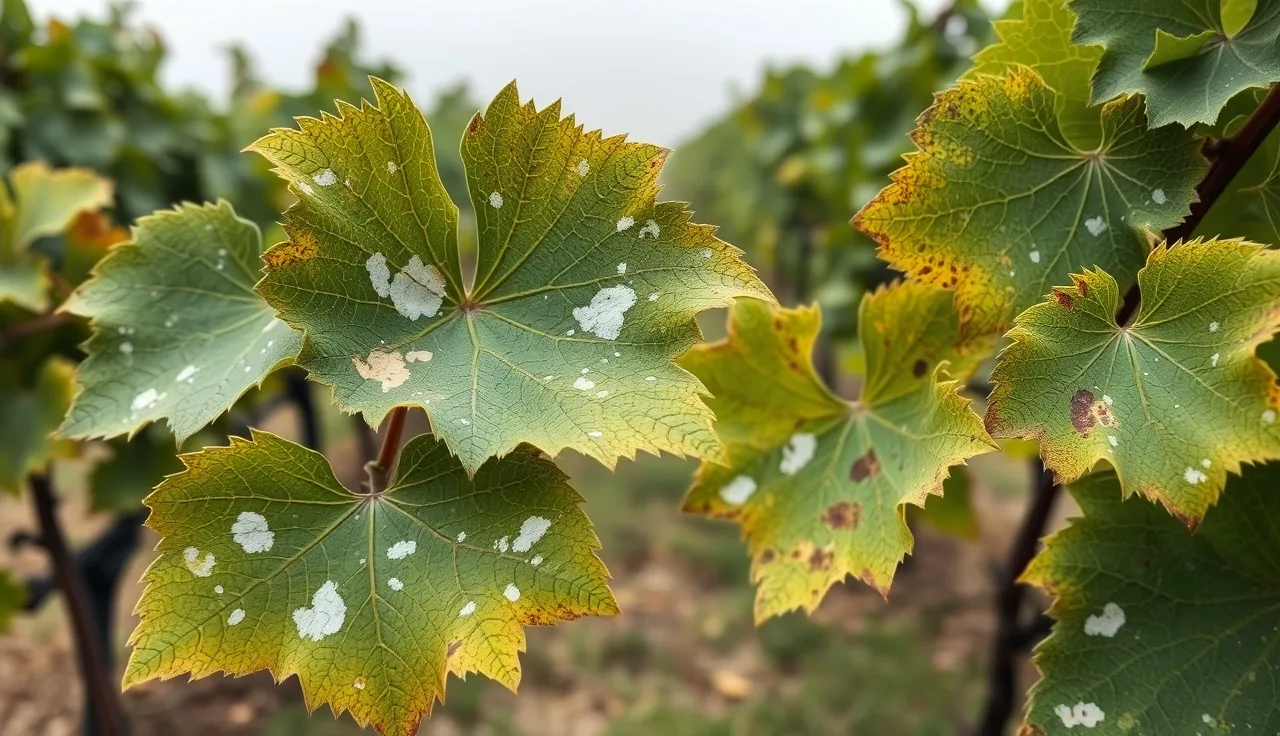
Powdery mildew is the first disease every California grower learns to spot, because missing it early in the season gets expensive fast. Look for a white to gray powdery coating on young shoots, leaves, and berry surfaces.
On berries, infection between bloom and roughly 4 to 6 weeks post-bloom stops the skin from growing while the pulp keeps expanding. The berry splits and secondary bunch rot moves in. Infected shoot tissue turns brown to russet as the season runs on. On leaves, you'll often see chlorotic spots on the upper surface that line up with white mycelium underneath.
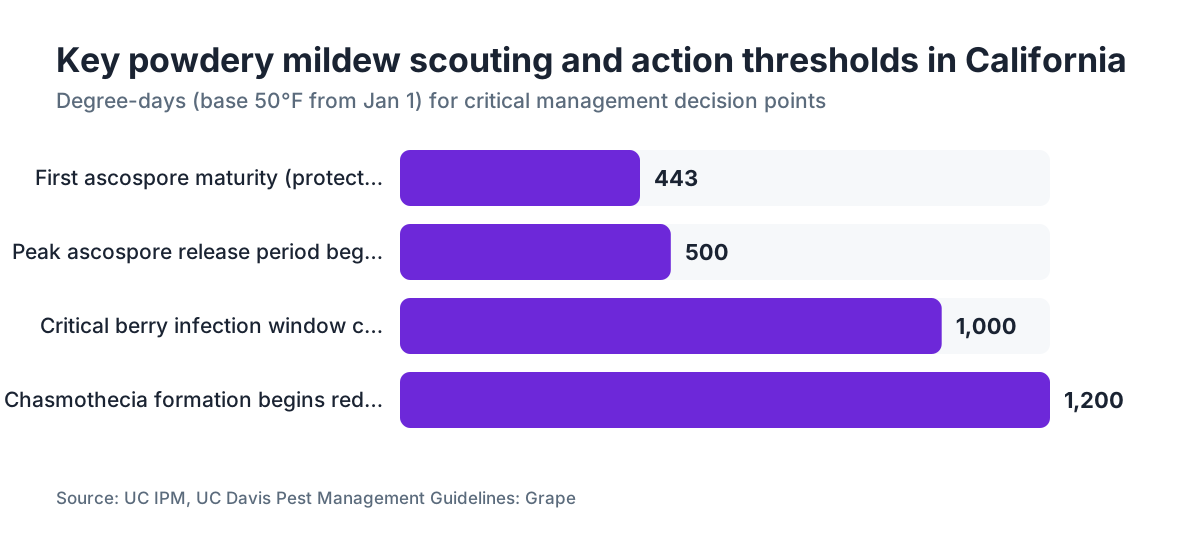
Here's the trap: powdery mildew doesn't need rain. It thrives in the dry California summer because it infects without free water on the tissue. The optimal temperature range for infection is 70 to 85 degrees F, though the fungus sporulates anywhere from about 50 to 90 degrees F [1]. Chasmothecia, the overwintering structures, survive on bark and in bud scales, and the first ascospore releases in spring set off the season's primary infections.
Scout shoot tips and the undersides of leaves at five representative spots per block, starting at budbreak. UC IPM recommends beginning protective fungicide applications at 1-inch shoot growth in high-pressure blocks [1]. UC IPM also runs a degree-day model on cumulative heat after budbreak to predict first-generation ascospore maturity. The threshold is 443 degree-days (base 50 degrees F) from January 1 [1].
Varietal susceptibility swings widely. Chardonnay, Cabernet Sauvignon, Merlot, and Zinfandel all get hit. Riesling and Gewurztraminer are especially sensitive. Some older Rhone varieties show moderate tolerance but none of them are immune.
What is Pierce's disease and why is it so serious in California?
Pierce's disease comes from Xylella fastidiosa, a bacterium that colonizes the water-conducting xylem in grapevines and eventually shuts down water and nutrient movement. Vines die, usually within one to five years, and there is no treatment once the plant is infected [2].
The California Department of Food and Agriculture (CDFA) runs a formal response program because the stakes are that high. The glassy-winged sharpshooter (Homalodisca vitripennis), which reached Southern California in the mid-1990s, is a far more efficient vector than the native sharpshooters. It feeds on more plants, flies farther, and inoculates vines in bigger numbers. CDFA's statewide Pierce's Disease and GWSS program has spent over $60 million on research and control since 2000 [2].
Watch for leaf-margin scorching that creeps inward, often with a yellow halo between the green tissue and the dead brown zone. Leaves drop but leave the petiole attached, which gives the vine an odd, bare look mid-season. Fruit shrivels and won't ripen. On canes, patchy bark maturation leaves green islands surrounded by brown, lignified wood. The disease usually shows up first along vine edges nearest riparian corridors, where sharpshooter numbers run highest.
Management is prevention, full stop. Pull infected vines fast to cut the inoculum. Control sharpshooters with insecticides in high-pressure areas (CDFA has specific guidelines). Plant resistant rootstocks where you can. Keep buffer plantings back from riparian edges. UC Davis has been breeding PD-resistant Vitis vinifera through conventional crosses and, more recently, gene-editing work, though no commercial resistant vinifera variety is widely available yet [2].
Siting a new vineyard in Temecula, Riverside County, or anywhere in Southern California's coastal drainages? Pierce's disease pressure has to be the first thing you evaluate. Not the soil. Not the aspect. The disease.
What trunk diseases affect California vineyards and how do you manage them?
Trunk diseases are wood-infecting fungi that enter through pruning wounds and set up shop in permanent wood. The four you'll run into most in California are Eutypa dieback (Eutypa lata), Botryosphaeria dieback (a complex of Botryosphaeriaceae species), Esca (a complex involving Phaeomoniella chlamydospora and others), and Phomopsis cane and leaf spot (Phomopsis viticola) [3].
Eutypa dieback is the best studied and probably the most costly of the bunch. The fungus enters through fresh pruning wounds and grows through the wood for years before symptoms appear. You'll see stunted, distorted shoot growth off affected spurs, small chlorotic leaves, and eventually dead cordons. By the time you can see it, the wood infection is often years old. UC Davis research found Eutypa infections detectable up to 30 cm from the visible canker margin [3].
Botryosphaeria species have grown more common, likely because drought stress and heat spikes leave vines open to infection. Esca is rarer, but when it hits it can cause a sudden apoplexy in late summer, where a whole vine wilts and dies inside a few days.
Management is almost all prevention. The practices that matter:
- Prune in dry weather when spore dispersal is lowest. Mid-winter, after December, is generally safer in California than late fall or early spring.
- Apply registered wound protectants within hours of cutting, not days. Products with Trichoderma asperellum and T. gamsii (Vintec), or thiophanate-methyl materials, are registered in California and have efficacy data behind them [3].
- Double-prune (a pre-pruning pass by machine, then hand finishing) to shrink the area of fresh exposed wood.
- Remove and destroy infected wood. Don't leave it lying in the rows.
Replanting calls are brutal. A block with 30 to 40% of vines showing Eutypa symptoms is usually past saving through vine-by-vine surgery. Field grafting to keep the root system can work if the disease hasn't dropped below the graft union.
How does Botrytis bunch rot spread and when is treatment timing most critical?
Botrytis cinerea lives in every California vineyard all the time. It's everywhere in decaying plant matter, and it turns into a problem when conditions line up: cool humid weather around bloom and again near harvest, dense canopies that trap moisture, and any berry damage that breaks the skin.
The infection cycle has two critical windows. First is bloom, when Botrytis infects flower parts (anthers and petals especially) that hang on in the cluster as latent infections. Second is veraison through harvest, when berry skins thin, sugar climbs, and any wound from insects, birds, or powdery mildew opens a door.
Tight-clustered varieties carry far more risk: Pinot Noir, Pinot Gris, Gewurztraminer, and Zinfandel with its uneven late-season ripening. Loose-clustered varieties like Grenache and Riesling shrug off Botrytis pressure better.
Bloom applications are the most efficient money you'll spend. UC IPM recommends spraying at 5 to 10% bloom and again at 80 to 100% bloom as the primary control window [1]. Preharvest sprays in high-risk vintages (fog, coastal sites, late-ripening blocks) can trim losses, but resistance management is the whole game here. Botrytis has documented resistance to many FRAC group 1, 2, and 17 fungicides. Rotating groups isn't optional. It's how your program stays alive.
Canopy work often beats fungicides at the margin. Leaf removal in the fruit zone, ideally on the morning-sun side right after fruit set, opens up air movement and dries out the humid microclimate Botrytis needs. UC research backs the practice, and it pays for itself in reduced spray costs across most California coastal settings.
What are grapevine leafroll disease and red blotch, and how do they spread?
These two viral diseases have rewritten how California growers think about planting material over the last twenty years. Both cut sugar and delay ripening, and both ride in on infected nursery stock.
Grapevine leafroll-associated virus complex (GLRaV, with several serotypes, GLRaV-1 and GLRaV-3 being the most damaging economically) rolls leaves downward and shows interveinal reddening in red varieties or interveinal yellowing in whites, mostly in late summer and fall. Infected vines make fruit with lower sugar, thinner color, and maturity delayed by two to three weeks [4]. That's a real yield and quality hit.
Leafroll moves two ways: through infected planting material, and through mealybugs and soft scales (mainly grape mealybug, Pseudococcus maritimus, and obscure mealybug, P. viburni). That mealybug route is why a clean block can pick up the virus after planting if pressure from neighboring blocks runs high.
Grapevine red blotch virus (GRBV) was characterized clearly only in the early 2010s. It causes red blotching on leaves (easy to confuse with leafroll in red varieties), delayed ripening, and lower Brix. The main vector looks to be the three-cornered alfalfa hopper (Spissistilus festinus), though vector research is still moving [4]. Mealybugs don't seem to spread red blotch, which shifts the management priorities.
Control for both starts before you plant. Buy certified, virus-tested material through California's Grapevine Registration and Certification Program, administered by CDFA. This is not paperwork theater. Certified material is tested against a panel of regulated viruses, and it's your best defense against importing the problem. In established vineyards, rogue infected vines where it makes sense, control mealybugs, and confirm block status with serological testing (ELISA or RT-PCR).
What are the rules around pesticide use and spray records in California vineyards?
California runs the strictest pesticide regime in the country, and you need to know both the federal layer and the state layer.
At the federal level, the EPA's Worker Protection Standard (WPS) requires every agricultural employer who uses pesticides to provide safety training, access to labeling and safety data sheets, decontamination supplies, emergency assistance, and posted re-entry intervals (REIs) at treated-field entry points [5]. The WPS was revised in 2015, with the updated requirements taking effect in 2017.
At the state level, California's Department of Pesticide Regulation (CDPR) requires that every commercial agricultural pesticide application go into a Pesticide Use Report (PUR) and get filed with the County Agricultural Commissioner (CAC) monthly [6]. The PUR needs the product name and EPA registration number, the amount applied, the site location (township, range, section, or APN), the acreage treated, the target pest, and the application date and method. Failing to file is a civil violation. CDPR enforcement is real and the fines aren't small.
Restricted Materials need a permit from the County Agricultural Commissioner before you buy or use them. Some vineyard fungicides and insecticides land here, including certain soil fumigants and nematicides used around replant situations. Check with your CAC before you assume a material is unrestricted.
Record-keeping is where a lot of small operations slip. The legal rule is to keep pesticide records for three years [6]. In practice, keep them longer. Compliance audits, organic certification renewals, and buyer food-safety programs often look back further. This is one place digital record-keeping earns its keep. Software built for vineyard operations, like VitiScribe, indexes spray logs by block and product, so pulling a three-year application history for an auditor takes minutes instead of a panicked afternoon.
The UC IPM program publishes the UC Pest Management Guidelines for grapes, listing registered materials, REIs, pre-harvest intervals (PHIs), and resistance notes for every major California grape disease [1]. It's updated regularly. Check it before you finalize any spray program.
How do you build a disease scouting calendar for a California vineyard?
Scouting without a calendar is guesswork. Scouting with one is an early-warning system. Match a target disease to each growth stage and walk the vineyard on schedule.
The calendar below reflects the general disease pattern for a coastal California site (Sonoma, Napa, Santa Barbara). Inland valley sites see earlier powdery mildew risk and heavier Pierce's disease pressure. Cooler fog-influenced sites carry more Botrytis risk.
| Growth Stage | Approximate Timing | Primary Disease Scouts |
|---|---|---|
| Dormant / budbreak | January - March | Trunk disease cankers, Phomopsis on canes |
| 1-6 inch shoot growth | March - April | Powdery mildew (first ascospore release), Phomopsis |
| Pre-bloom | April - May | Powdery mildew, downy mildew |
| Bloom | May - June | Botrytis (petal infection), powdery mildew |
| Fruit set - bunch closure | June - July | Powdery mildew (critical berry window), leafroll/red blotch symptom development |
| Veraison | July - August | Botrytis, powdery mildew, Esca apoplexy, Pierce's disease symptoms |
| Harvest approach | August - October | Botrytis, sour rot, leafroll symptoms (visible now) |
| Post-harvest | October - November | Trunk disease audits, leafroll/red blotch survey before leaf drop |
Post-harvest is the most wasted scouting window in California. Once harvest pressure lifts, it's easy to stop walking the rows. But leafroll and red blotch are most visible in October and November, right before leaf drop, and that's your best window to flag infected vines for removal before next season's mealybugs get moving.
What does Pierce's disease cost California vineyards economically?
The economic hit from Pierce's disease reads differently by region. In the Temecula Valley, PD has killed or forced removal of tens of thousands of vine acres since the glassy-winged sharpshooter established there in the late 1990s. A 2001 CDFA economic analysis put potential PD losses for California at over $1 billion a year if the GWSS spread unchecked into Napa and Sonoma [2]. That was a worst-case projection, but it explains why the control program got funded the way it did.
The ongoing cost in endemic areas is recurring and unglamorous: vector monitoring, insecticide sprays, vine removal, replanting, and lost production during the replant gap. A new block takes four to six years to reach full production. If PD kills it at year three, you've eaten the establishment cost plus the revenue you'd have banked from year four onward until the replacement matures.
There's a financing angle too. Some lenders and crop insurance underwriters in Southern California build PD risk into their terms. Growers in high-risk areas should document their monitoring and control not only for compliance, but because that paper trail carries real weight in loan and policy conversations.
Research spending on PD resistance has been heavy. CDFA and USDA have both funded work at UC Davis and UC Riverside. UC Davis's PD-resistant Chardonnay, built with cisgenesis (moving a resistance gene from a wild grape relative), has shown promise in trials, though regulatory approval for commercial planting is a separate and ongoing process [2].
How do you manage downy mildew in California grapes?
Downy mildew (Plasmopara viticola) gets less attention than powdery mildew here because California's dry summers suppress it on their own. But in cooler, wetter coastal regions (Carneros, Sonoma Coast, the Pacific fog belt), it can cause serious defoliation and crop loss in wet spring years.
The disease needs free water for sporangia and infection. Primary infection starts when you've had at least 0.1 inch of rain, temperatures above 52 degrees F, and at least 10 hours of leaf wetness. Growers shorthand this as the "10/10" rule, though the precise version uses temperature-adjusted degree-hour math [1].
Leaf symptoms are easy to call: pale yellow to chartreuse oil spots on the upper surface with white downy sporulation underneath. On berries, infected clusters brown and shrivel into brown rot if infection hits before bunch closure. After bunch closure the berries turn leathery and gray-brown.
Control options include copper materials (good early season, though California's copper restrictions near waterways apply) and phosphonate products (potassium phosphite and similar), which are common in organic and low-residue programs. Conventional fungicides in FRAC groups 4, 40, and 45 work but carry resistance risk, so rotation is standard.
Across most of California's inland wine country, downy mildew is a minor concern in a normal year. A Paso Robles grower might not spray for it at all in a dry spring. A Sonoma Coast grower needs it in the program every single year.
What do California growers need to know about fungicide resistance management?
Fungicide resistance in California vineyards is documented and real, not theoretical. QoI (strobilurin) resistance in powdery mildew populations has been confirmed in the state, and DMI (sterol-inhibiting) fungicides show reduced efficacy in some regions where they've been leaned on for decades [1].
The Fungicide Resistance Action Committee (FRAC) assigns group codes to fungicides by mode of action. The core rule: never apply the same FRAC group twice in a row, and ideally no more than two consecutive applications before you rotate to a different group. Multi-site fungicides (copper, sulfur, captan) don't carry the same resistance risk because they hit several biological targets at once. They make good anchors in any rotation.
Sulfur is still the backbone of powdery mildew programs in California, and for good reason. It's cheap, it works, it has no resistance issues, and its safety profile beats many synthetics. The catches: sulfur turns phytotoxic when applied within two weeks of oil sprays, or when temperatures top 90 degrees F on the day of application or within 24 hours. Get that timing wrong and you'll burn leaves and fruit.
For Botrytis, FRAC group 2 (benzimidazoles), group 1 (MBC fungicides), and group 17 all have resistant populations in California. The practical move is to build programs around phenylpyrroles (fludioxonil, FRAC 12), SDHI fungicides (FRAC 7), and anilinopyrimidines (FRAC 9), treating any single group as a once-per-season option at most.
Your County Agricultural Commissioner or UC Cooperative Extension farm advisor can tell you which resistance patterns are showing up locally. That regional read beats the general FRAC guidance every time.
How does California regulate grapevine disease reporting and quarantines?
California runs formal quarantine and regulatory programs for several grapevine diseases and their vectors. If you move plant material across county lines, this is your business.
Pierce's disease and the glassy-winged sharpshooter sit at the center of CDFA's regulatory work. GWSS quarantine areas cover parts of Southern California, the San Joaquin Valley, and other counties where the insect has turned up. Inside quarantine zones, movement of regulated articles (nursery stock, plant material that could harbor the vector) is restricted and requires certification [2]. If you buy vine material from or through a quarantine area, know these movement rules before the truck rolls.
Phylloxera (Daktulosphaira vitifoliae) is a separate story but still relevant. California rules restrict moving grapevine material out of phylloxera-infested areas without treatment or certification. The 1980s and 1990s phylloxera disaster in Napa and Sonoma, driven by the failure of the AXR1 rootstock, cost growers an estimated $1 to 2 billion in replanting and lost production [7]. Most growers now plant on phylloxera-resistant rootstocks, but there's no universally immune rootstock, only varying levels of resistance.
CDFA's Grapevine Registration and Certification (R&C) Program governs the production and sale of certified grapevine material in California. Clean foundation stock is kept at UC Davis's Foundation Plant Services (FPS), which tests mother vines against a regulated list of viruses and other pathogens [9]. Buying FPS-certified material is the most reliable way to start a block with known disease status.
Spot something you think is a regulated pest or disease? Report it to your County Agricultural Commissioner. California's Early Detection and Rapid Response approach to new invasive pests means early reporting can trigger a funded response rather than leaving the whole cost on you.
How should small winery owners and vineyard managers keep track of disease management records?
The compliance record-keeping load in California is genuinely heavier than in most other states, and it grows as buyers, auditors, and certifiers pile their own demands on top of CDPR's.
What the law requires: a complete pesticide use record for every application, filed monthly with your CAC and kept for at least three years [6]. Past that legal floor, most third-party food-safety programs, organic certifiers, and sustainability programs (like the California Sustainable Winegrowing Alliance's) want records of scouting decisions, IPM justifications, and application detail at the block level.
Paper can technically meet all of it. But paper creates real risk. Illegible entries, missing fields, and lost records surface in audits far more often on paper. Spray records that don't tie to block maps or GPS points are harder to audit and harder to use for your own planning.
VitiScribe is built for exactly this. Spray-log entry ties applications to specific blocks, auto-fills product REIs and PHIs, and generates the formatted outputs most CACs and auditors accept. Managing more than 20 acres or more than one farm? The time savings alone cover the cost.
Whatever system you run, the habit that matters most is entering data at the time of application, not at the end of the week. Memory errors are the most common problem in pesticide records, and they're the easiest to prevent.
Frequently asked questions
What is the single most economically damaging grapevine disease in California?
It depends on the region. Statewide, powdery mildew causes the most widespread annual losses, estimated at roughly $150 million a year in control costs and crop damage combined. But in Southern California and parts of the San Joaquin Valley, Pierce's disease has no cure and kills vines outright, making it the existential threat there. For any single block that gets PD, it's the most damaging disease by far.
Can you cure Pierce's disease once a vine is infected?
No. There's no effective treatment for a Xylella fastidiosa-infected grapevine. Remove infected vines as fast as you can to cut the bacterium source and reduce the chance vectors pick it up and carry it to neighboring vines. Prevention, through vector management and resistant planting material, is the only realistic strategy.
What grapevine diseases are most common in Napa and Sonoma?
Powdery mildew is the dominant pressure in both appellations. Trunk diseases, particularly Eutypa dieback and Botryosphaeria, hit older vineyards hard. Leafroll virus is present and has driven replanting since the 2000s. Botrytis matters in cooler, wetter years, especially in Carneros and fog-influenced blocks. Pierce's disease pressure stays relatively low compared to Southern California.
How do you tell the difference between leafroll and red blotch on grapevines?
Both cause red discoloration in fall on red varieties, and they're hard to separate by eye. Leafroll usually rolls leaf margins downward along with the interveinal reddening. Red blotch gives red or blotchy patterns without consistent leaf rolling. Definitive diagnosis needs lab testing, either ELISA or RT-PCR. A visual survey can flag suspect vines, but lab confirmation before roguing is worth the cost.
Do I need to report pesticide applications to the county in California?
Yes. California law requires all commercial agricultural pesticide applications to be reported to the County Agricultural Commissioner monthly via a Pesticide Use Report (PUR). The record must include product name and EPA registration number, amount applied, site location, acreage, target pest, application date, and method. Records must be kept at least three years. This applies to all pesticides, including organically certified materials.
What rootstocks protect against phylloxera in California?
No rootstock is 100% phylloxera-immune, but commonly planted rootstocks with good resistance include 110R, 1103P, 3309C, 420A, and various St. George selections. AXR1, widely planted in Napa and Sonoma before the 1980s-90s disaster, has insufficient resistance and is no longer recommended. UC Davis's Foundation Plant Services publishes current rootstock data, including phylloxera resistance ratings.
When is the best time to prune to reduce trunk disease infections in California?
Mid-winter pruning, roughly December through early February, carries lower infection risk than late-fall or early-spring pruning. The wet conditions that drive Eutypa spore release haven't fully set in, and rain events are less frequent in that window across many California regions. Applying registered wound protectants within hours of the cut matters at least as much as timing. Never leave fresh wounds exposed heading into a rain event.
What's the difference between FRAC groups for Botrytis fungicides and why does it matter?
FRAC groups classify fungicides by mode of action. Botrytis has documented resistance to groups 1, 2, and 17 in California. Rotating among groups with different modes of action (groups 7, 9, and 12 are commonly recommended) slows resistance and keeps your program working. Using the same FRAC group repeatedly is the main driver of resistance, and once it's established in a local population, it doesn't go away.
Is downy mildew a serious problem in California vineyards?
In most of California's inland and Central Valley wine country, downy mildew is a minor concern in normal dry years. In cooler, wetter coastal regions like the Sonoma Coast and Carneros, it can cause serious defoliation and crop loss in wet springs. The disease needs free water to infect, so California's dry summers suppress it after June. Fog-belt growers should include it in their spray programs every year.
How does the CDFA Grapevine Registration and Certification Program protect growers?
The CDFA's R&C Program governs production and sale of certified grapevine nursery material in California. Clean foundation stock is kept at UC Davis's Foundation Plant Services, which tests mother vines against a regulated panel of viruses and pathogens including leafroll, red blotch, and fanleaf. Certified material won't guarantee a disease-free vineyard forever, but it means you start with known-clean stock instead of importing problems from the nursery.
What are the EPA Worker Protection Standard requirements for California vineyard pesticide applications?
The EPA's Worker Protection Standard requires agricultural employers to provide pesticide safety training to workers and handlers, post re-entry interval information at field entry points, supply decontamination facilities (water, soap, towels), give access to emergency medical assistance, and provide access to pesticide labeling and safety data sheets. California layers additional requirements on top of the federal WPS. Training records must be kept.
How many years do I need to keep pesticide records in California?
California law requires commercial pesticide application records to be kept at least three years from the date of application. Many sustainability certification programs and organic certifiers want longer retention. Third-party food-safety audits often look back two to three years too. Keeping records for five years is a practical standard that covers most audit and certification scenarios without much added burden.
What's the best way to scout for grapevine diseases without hiring a dedicated pest control adviser?
A structured walk of five representative points per block, checking shoot tips, leaf undersides, and cluster zones at each key growth stage, catches most problems early enough to act. Use the UC IPM degree-day models for powdery mildew to know when first ascospore risk peaks. Post-harvest is the best window for leafroll and red blotch surveys. County farm advisors through UC Cooperative Extension can help calibrate your scouting for local conditions, often at low or no cost.
Sources
- UC IPM, UC Davis - Pest Management Guidelines: Grape: Powdery mildew control costs California growers roughly $150 million per year; 443 degree-days base 50°F threshold for first ascospore maturity; bloom application timing for Botrytis; downy mildew infection requirements
- California Department of Food and Agriculture - Pierce's Disease Control Program: CDFA has spent over $60 million on Pierce's disease research and control since 2000; GWSS quarantine area regulations; PD potential losses estimate exceeding $1 billion annually if GWSS spread unchecked
- UC Davis Department of Plant Pathology - Trunk Diseases of Grapevine: Eutypa infections detectable up to 30 cm from visible canker margins; wound protectant registration and efficacy data for Trichoderma-based and thiophanate-methyl products
- UC Davis Foundation Plant Services - Grapevine Virus Research: GLRaV-1 and GLRaV-3 as most economically significant leafroll serotypes; maturity delays of two to three weeks in infected vines; Spissistilus festinus as red blotch vector
- EPA - Worker Protection Standard for Agricultural Pesticides: WPS revised in 2015, requirements effective 2017; employer obligations including training, REI posting, decontamination supplies, and emergency assistance
- California Department of Pesticide Regulation - Pesticide Use Reporting: California requires monthly Pesticide Use Reports filed with County Agricultural Commissioner; records retained for minimum three years
- UC Cooperative Extension - Phylloxera Replanting in Napa and Sonoma: 1980s-90s phylloxera disaster caused by AXR1 rootstock failure estimated at $1-2 billion in replanting costs and lost production in Napa and Sonoma
- CDFA - Grapevine Registration and Certification Program: CDFA administers the Grapevine R&C Program governing production and sale of certified nursery material in California
- Fungicide Resistance Action Committee (FRAC) - Mode of Action Classification: FRAC group codes for fungicide resistance management; documented QoI and DMI resistance in California powdery mildew populations; Botrytis resistance in FRAC groups 1, 2, and 17
Last updated 2026-07-10