Grapevine diseases: the field guide you can actually use (and download)
TL;DR
- The most damaging grapevine diseases are powdery mildew, downy mildew, Botrytis bunch rot, Eutypa dieback, and Pierce's disease.
- Free, peer-reviewed PDF guides are available from UC Davis, Cornell, and WSU extension.
- This article covers identification, disease cycles, spray windows, and compliance recordkeeping for each major pathogen.
Which grapevine diseases cause the most crop loss?
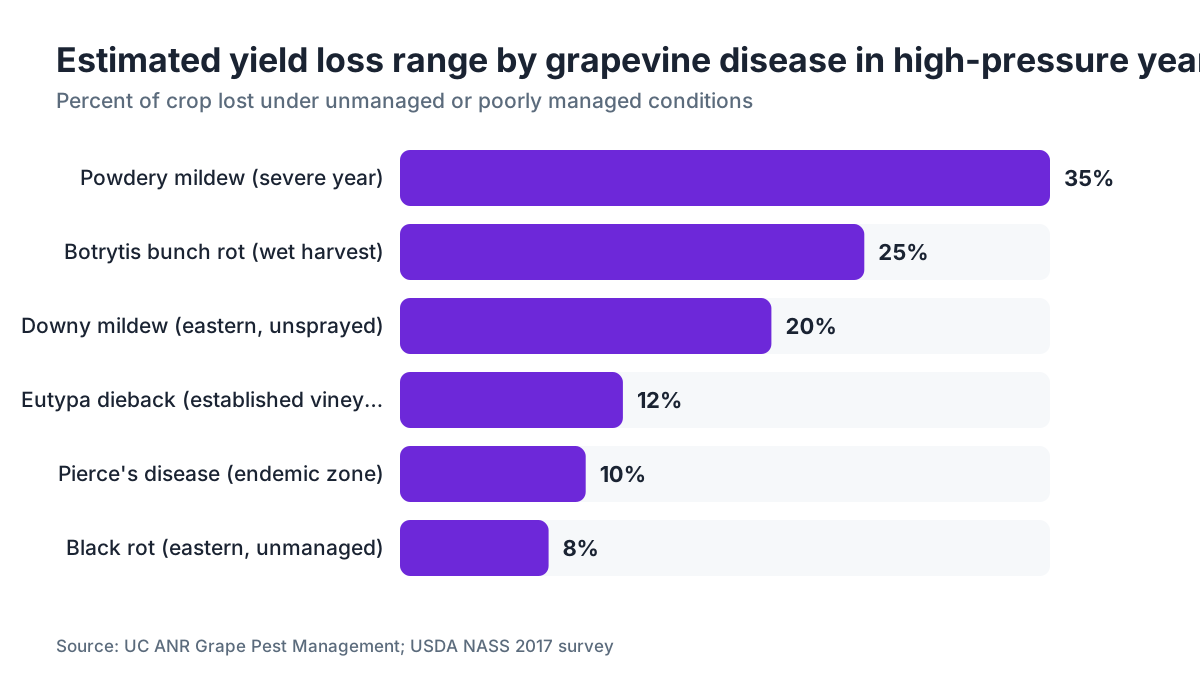
Powdery mildew is the single biggest yield threat in most North American wine regions. UC Davis plant pathologists estimate it can cut yields by 30 to 40 percent in severe outbreak years, and that's before you factor in the quality penalty from infected berries that ferment poorly [1]. Downy mildew is a close second wherever humidity runs high, particularly in the eastern United States and coastal California. Botrytis bunch rot sits in third place for frequency, though it occasionally takes the top spot in wet harvest seasons.
Below those three, the disease picture depends heavily on your region. Pierce's disease, caused by the bacterium Xylella fastidiosa, is essentially a death sentence for vines in hot interior California valleys and parts of the southeastern US [2]. Eutypa dieback and Botryosphaeria canker are the slow killers, trimming years off vine productive life rather than wiping out a single vintage. Crown gall, black rot, and angular leaf scorch round out the list of pathogens every vineyard manager should be able to recognize on sight.
Nobody tracks a single authoritative national crop-loss number for grapevine diseases because most vineyards don't report losses publicly. The closest we have is a 2017 USDA National Agricultural Statistics Service survey that put grape crop losses from disease at roughly 5 to 7 percent of total production value in high-pressure years, though that figure almost certainly understates impact in problem regions [3].
The practical takeaway: learn your top three regional threats cold, build your spray program around their disease cycles, and treat everything else as a secondary concern that responds to the same cultural practices.
How do I identify powdery mildew vs. downy mildew in the vineyard?
Getting these two mixed up is the most common mistake I see from new vineyard managers, and it leads to completely wrong fungicide choices.
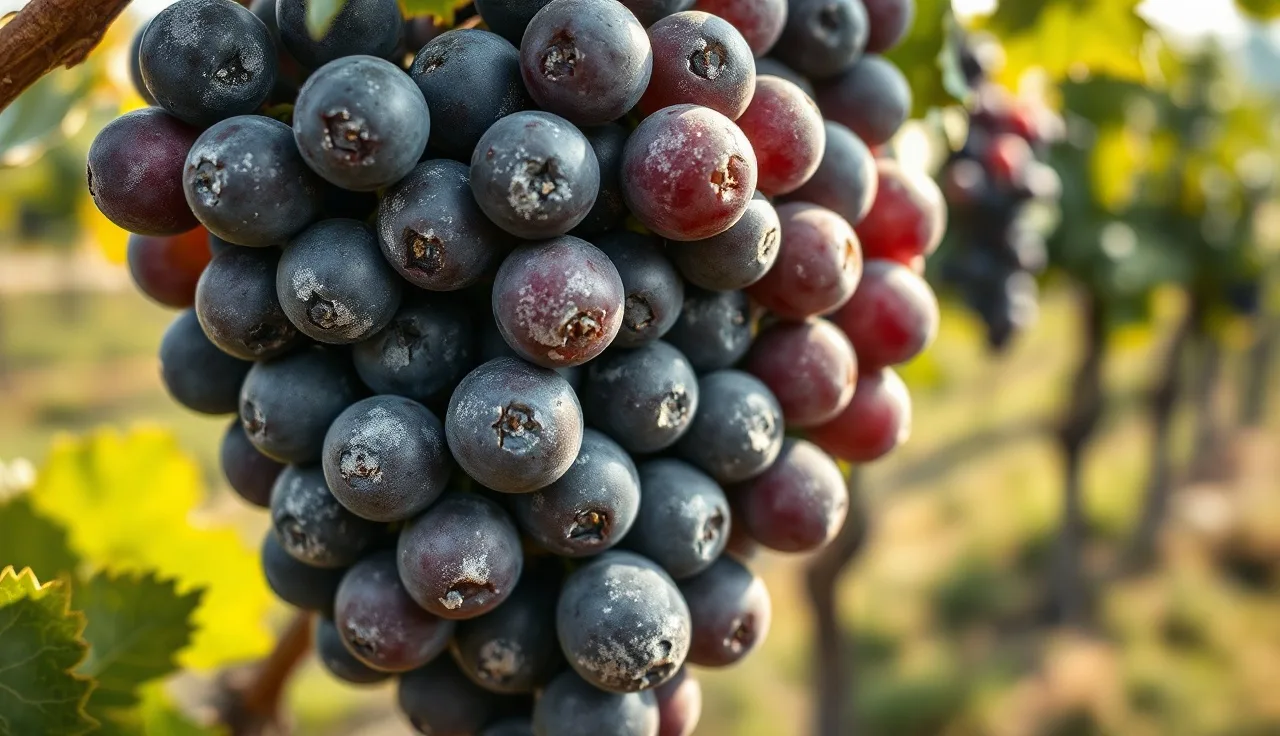
Powdery mildew (Erysiphe necator, formerly Uncinula necator) grows on the surface of plant tissue. You'll see a white-to-gray powdery coating on shoot tips, young leaves, and berries. Infected berries crack and may develop a fishy, musty smell. The mycelium lives on the outside of the tissue, so the upper leaf surface shows symptoms first [1]. Tissue damage shows up as curling, stunting, and webbed russeting on fruit.
Downy mildew (Plasmopara viticola) is a water mold, not a true fungus, and it behaves completely differently. The primary symptom on upper leaf surfaces is an oily, pale-yellow "oil spot" lesion. Flip the leaf over and you'll find white, cottony sporulation on the underside, directly below that oil spot. That underside sporulation is the diagnostic tell [4]. Downy mildew needs free water and warm nights (above about 50°F / 10°C) to sporulate, so symptoms after dry periods tend to pause.
Quick field test: rub the white coating with your finger. Powdery mildew smears and has no real texture. Downy mildew's cottony sporulation has a slightly three-dimensional, fluffy look and doesn't smear the same way.
For confirmed identification, the UC Davis Grape Disease webpage has free PDF fact sheets with color photographs for both pathogens [1]. Cornell's Integrated Pest Management program publishes a comparable illustrated guide for New York and eastern conditions [5]. Both are worth downloading and keeping in your spray shed.
Where can I download free grapevine disease PDFs from university extension programs?
Three programs produce the most reliable, regularly updated disease guides, and all of them are free.
UC Davis Cooperative Extension maintains the "Grape Pest Management" guide series, including individual fact sheets on powdery mildew, downy mildew, Botrytis, Eutypa, and Pierce's disease. The main landing page is at the UC ANR (Agriculture and Natural Resources) website [1]. The full third-edition Grape Pest Management textbook is not free (it runs around $40 through the UC ANR catalog), but the individual disease fact sheets are downloadable PDFs at no cost.
Cornell Cooperative Extension's Integrated Pest Management (IPM) program hosts the New York and Pennsylvania Pest Management Guidelines for Grapes, updated annually [5]. This is probably the most practical document for eastern growers because it pairs disease ID with registered fungicide choices and the 10-day spray window logic that fits humid eastern conditions. The PDF download is free.
Washington State University Extension publishes the "Pacific Northwest Plant Disease Management Handbook," which covers grapevine diseases alongside other crops [6]. WSU also has standalone powdery mildew and downy mildew fact sheets formatted as short PDFs, designed to be printed and laminated for field use.
A few things to check before you download any of these:
- Publication date: disease management guides should be reviewed for the current season because fungicide registrations change. Any guide more than three years old needs cross-checking against current EPA labels.
- Regional fit: UC Davis disease cycle models are calibrated to California conditions. Cornell's guides fit the Northeast. WSU's handbook covers the Pacific Northwest and northern Rockies. Using the wrong regional guide can put you a week or two off on spray timing.
- Fungicide resistance notes: the best guides now include resistance management guidance, especially for powdery mildew, where resistance to QoI (strobilurin) fungicides is widespread [1].
The National Sustainable Agriculture Information Service (ATTRA) also publishes a free PDF overview of organic and reduced-risk disease management for grapes, which is worth having if you're managing under organic certification or running a reduced-input program.
What is the disease cycle for powdery mildew, and when should I spray?
Powdery mildew overwinters as chasmothecia (the sexual fruiting bodies) in bark crevices and on infected wood. When bark temperatures accumulate enough heat in spring, those chasmothecia release ascospores, usually around the time buds are at the 1-inch shoot stage. That primary infection window is when your season's disease pressure is largely set [1].
The fungus doesn't need free water. It actually prefers moderate temperatures (70 to 85°F is ideal) and humid air without rain. That's the counterintuitive part. A dry, warm spring with morning fog is often worse for powdery mildew than a rainy one. UC Davis plant pathologists have modeled that a 6-hour period above 70°F with relative humidity above 40 percent is enough to trigger sporulation [1].
Spray timing logic, practically:
- Start at bud break, not at first symptom. By the time you see white mycelium, infection occurred 7 to 14 days earlier.
- Protect through bloom. Berries are most susceptible from just before bloom through about 3 to 4 weeks after fruit set. Miss this window and no amount of later spraying fully recovers the crop.
- Shorten intervals in warm, dry, foggy weather. Standard 10-14 day intervals can be too long under high-pressure conditions. Some growers tighten to 7 days at bloom.
- Rotate FRAC groups. Never apply the same mode of action more than twice in a row. QoI resistance is common; SDHI resistance is emerging in some regions [6].
For a disease-degree-day model you can run yourself, UC Davis publishes the UC IPM Powdery Mildew Risk Index online [1]. It uses your local temperature data to output a risk level. Not every grower wants to run it daily, but checking it weekly during high-risk periods takes about three minutes and can save you a spray or tell you that you need an extra one.
How does Botrytis bunch rot spread, and what actually stops it?
Botrytis cinerea is everywhere. The spores are airborne, ubiquitous, and they can infect at temperatures from about 32 to 95°F. The disease doesn't get stopped by cold snaps. What it needs is a wound or a natural opening, and then wet conditions for infection to take hold [4].
There are three main infection pathways in vineyards: flower caps falling off at bloom (the cap scar is a direct entry point), berry skin wounds from insects, birds, or hail, and tight cluster architecture that traps moisture and blocks canopy airflow. That last one is the cultural lever most growers ignore.
What actually works:
Canopy management is the highest-return practice for Botrytis reduction. Leaf removal in the fruit zone, done at or just after fruit set, increases airflow, drops humidity, and exposes berries to UV light that kills surface spores. A 2014 study published in the American Journal of Enology and Viticulture found that fruit-zone leaf removal reduced Botrytis incidence by up to 60 percent compared to untreated controls in Pinot noir [4]. Fungicide alone without canopy management consistently underperforms.
Fungicide timing for Botrytis focuses on four windows: bloom, bunch closure, veraison, and pre-harvest (if needed). The bloom and bunch closure applications protect the two periods of highest infection risk. FRAC Group 17 (fenhexamid), Group 7 (boscalid, fluopyram), and Group 2 (iprodione, though resistance is widespread) are the main chemistry choices. Rotate groups every application. Don't apply Group 2 more than once per season in any vineyard with a history of Botrytis pressure.
Honest assessment: if you've got a tight-clustered variety like Pinot noir, Gewurztraminer, or Zinfandel in a wet climate, fungicide alone won't solve your Botrytis problem. You have to get into the canopy.
What is Eutypa dieback and how do I slow it down?
Eutypa lata is the wood pathogen behind the "dead arm" symptom you see in established vineyards: stunted, chlorotic shoots with small, tattered leaves emerging from an arm that looks fine from the outside. Cut into the cane or cordon and you'll find a wedge-shaped canker with dead wood that's often grayish-brown [6].
The infection pathway is almost entirely through pruning wounds. Eutypa spores (ascospores) release during rain events and land on fresh cut surfaces. The window of high risk runs from pruning time through the first several weeks afterward, as long as rain events keep coming. UC Davis research found that wounds stay susceptible for up to six weeks after pruning under wet conditions [1].
Management options, in rough order of effectiveness:
Delay pruning until late in the dormant season. Later pruning shortens the period between wounding and bud break, giving spores less time to infect before natural wound defense kicks in. In practice, this means pushing pruning as late as your labor constraints allow.
Apply wound sealants to large cuts, especially cuts larger than about 2 centimeters in diameter. Topsin-M (thiophanate-methyl) paste or the biological agent Trichoderma harzianum (sold as Vinevax and similar products) applied right after cutting reduces infection rates, though neither is 100 percent effective [6].
Remove infected wood aggressively. Once a cordon shows Eutypa symptoms, the fungus is often well established throughout the wood. Cutting back to healthy tissue, confirmed by the absence of discoloration in cross-section, is the only way to slow spread. Some growers use trunk renewal to replace infected cordons rather than fighting the disease in place.
Eutypa is not a crisis you solve in one season. It's a 10-year management problem, and vineyards without a consistent pruning-wound protocol tend to see it compound over time.
What is Pierce's disease and which regions are most at risk?
Pierce's disease (PD) is caused by the bacterium Xylella fastidiosa, which is spread by sharpshooter leafhoppers, most significantly the glassy-winged sharpshooter (Homalodisca vitripennis) in California [2]. The bacterium colonizes the xylem (water-conducting tissue), causing leaves to scorch at the margins starting in late summer, and eventually kills the vine, typically within two to five years of infection.
Regions with sustained risk: the hot interior valleys of California (San Joaquin, Sacramento, parts of Riverside and San Diego counties), coastal areas near riparian corridors where sharpshooter populations are high, and much of the southeastern United States, particularly Georgia, Florida, and the Gulf Coast states. Cooler regions like the Napa Valley highlands, most of Oregon, and the Pacific Northwest carry low to negligible risk because cold winters kill the bacterium in vines.
The California Department of Food and Agriculture (CDFA) runs an active Pierce's Disease and Glassy-winged Sharpshooter Program, including a monitoring network and quarantine regulations on plant material movement from high-risk counties [2]. Growers in regulated counties should know the movement restrictions, which affect vine cutting sales and nursery stock.
There is no cure for an infected vine. Management is entirely preventive: insecticide applications targeting sharpshooter adults and nymphs in riparian buffer areas, removing infected vines promptly to reduce inoculum, and siting new plantings away from heavily infested riparian corridors where possible. UC Davis has released several PD-resistant grape varieties through a breeding program, though most are still in limited commercial availability as of 2024 [1].
What do spray records for fungicide applications need to include for compliance?
Federal and state compliance requirements for pesticide application records apply to any pesticide with a federally registered label, which covers virtually every commercial fungicide you'd use for disease management. The EPA Worker Protection Standard (WPS) and the Federal Insecticide, Fungicide, and Rodenticide Act (FIFRA) both set minimum recordkeeping requirements [7].
Under FIFRA Section 136i-1, certified applicators applying restricted-use pesticides must keep records for two years that include: the product name and EPA registration number, the total amount applied, the crop treated, the location of application, and the date [7]. Commercial applicators (anyone applying pesticides for hire) must also record the name of the person making the application.
Most states add requirements on top of FIFRA minimums. California requires a Pesticide Use Report (PUR) filed with the county agricultural commissioner within 60 days of each application, including the specific field identifier, acres treated, and pounds of active ingredient applied [8]. Washington and Oregon run similar state-level pesticide reporting systems.
The EPA Worker Protection Standard requires that specific application information be posted or accessible to agricultural workers, including the product name, active ingredient, and re-entry interval (REI) [7]. The WPS 2015 revision tightened requirements around training documentation and central posting of application information. As the California Department of Pesticide Regulation summarizes, "employers must ensure workers and handlers have been trained within the last 12 months" before they can enter treated areas during the REI [8].
Practically, keeping spray records that satisfy all these requirements means capturing at least: date, location (field block), product name, EPA registration number, rate applied (per acre and total), target pest, growth stage of crop, applicator name, and REI. Many managers also log wind speed, temperature, and application equipment used, which is smart practice for any spray efficacy question later.
For vineyards managing multiple blocks with different spray programs, tracking this by hand in a notebook gets messy fast. Platforms like VitiScribe let you log spray events by block as you go, auto-populate REI and restricted-entry dates, and export records in the format your county PCA or ag commissioner expects, which saves a few hours at audit time.
A comparison of key recordkeeping thresholds by jurisdiction is in the table in the next section.
How long do I need to keep pesticide application records, by state?
| Jurisdiction | Minimum retention | Restricted-use record req. | Reporting deadline |
|---|---|---|---|
| Federal (FIFRA) | 2 years | Yes, certified applicators | No filing required |
| California | 3 years | Yes | 60 days post-application |
| Washington | 7 years (commercial) | Yes | 90 days post-application |
| Oregon | 2 years | Yes | 90 days post-application |
| New York | 3 years | Yes | Annual summary filing |
| Michigan | 3 years | Yes | No state filing required |
Sources: California DPR [8], WSU Extension [6], Oregon Department of Agriculture, NY DEC, Michigan MDARD. Federal baseline from FIFRA Section 136i-1 [7].
The federal two-year minimum is the floor, not the ceiling. Several states with active pest reporting programs require three to seven years. Washington's seven-year requirement for commercial applicators is the longest in major grape-growing states. If you operate in multiple states, keep records for the longest applicable period across all your operations.
One practical note: even where two-year retention is the legal minimum, keeping records longer is worth doing. Insurance claims from spray drift incidents or worker exposure complaints can land years after the fact, and complete application records are your primary defense.
What fungicide resistance issues should I know about for grapevine diseases?
Resistance is the real long-term management problem in wine grape fungicide programs, and growers who've had success with a chemistry for a few years tend to underestimate it.
For powdery mildew, QoI (strobilurin) fungicides, including azoxystrobin and trifloxystrobin, have documented resistance in Erysiphe necator populations across California, New York, and the Pacific Northwest [6]. The mechanism is a point mutation in the target enzyme (cytochrome bc1) that's now widespread. Using QoIs as your primary powdery mildew material is no longer appropriate in most regions. They still have some efficacy as a resistance management rotation partner at low pressure, but building a program around them is a mistake.
For Botrytis, Group 2 fungicides (dicarboximides like iprodione and vinclozolin) have resistance problems in many eastern US vineyards. The FRAC (Fungicide Resistance Action Committee) classifies Botrytis resistance risk to multiple chemistry classes as "high" [4].
Resistance management rules that actually work:
- Never apply the same FRAC group more than twice in a row, and preferably not more than twice per season.
- Tank-mixing two materials with different modes of action does slow resistance development, but only if both are applied at full label rates. Half-rate tank mixes don't get the job done.
- Rotate to multi-site fungicides (FRAC Group M) like sulfur, copper, and captan periodically. These carry essentially zero resistance risk because they attack multiple enzyme sites at once.
- Keep records of what you applied and when. You can't manage resistance without a spray history.
Sulfur deserves more credit than it gets as a powdery mildew tool. At 3 to 4 pounds of elemental sulfur per acre, applied on a 7 to 14 day schedule, it gives excellent control and zero resistance risk. The main limitations: don't apply within 2 weeks of an oil spray, don't apply when temperatures will exceed 95°F within 24 hours, and some sulfur-sensitive varieties (like some Chardonnay clones) can phytotox under heat.
Are there disease ID apps or digital tools that work alongside PDF guides?
The PDF guides from UC Davis, Cornell, and WSU remain the most reliable disease identification resources, period. Apps aren't close to replacing them for accurate diagnosis, though they can speed up a first-pass field ID.
That said, a few tools worth knowing about:
Plantix and iNaturalist have grapevine disease libraries and image-matching features. iNaturalist connects you with an identification community that includes actual plant pathologists, which makes it more reliable than AI-only tools for unusual presentations. Neither should be your sole diagnostic resource.
The UC IPM Online website (ipm.ucanr.edu) works like an interactive version of the PDF guides, with photo galleries, decision tools, and a pest management timeline you can filter by region and month [1]. It runs in a mobile browser, so it's usable in the field without carrying a printed guide.
Cornell's VineAlert network (still active as of the last available information) provides regional disease pressure alerts based on weather station data and disease models, formatted as email or text alerts [5]. It's built around the NEWA (Network for Environment and Weather Applications) platform. If you're in the Northeast, signing up for NEWA disease alerts is probably the single highest-value free tool you can add to your program.
For spray recordkeeping that connects to disease management, VitiScribe lets you log observations next to spray events so you can correlate disease pressure with your program over time, which is something a filing cabinet full of paper records can't do efficiently.
For a vineyard manager who wants one reliable field reference, the honest answer is still: download the Cornell guidelines or the UC Davis fact sheets, print the relevant disease pages, laminate them, and keep them in your spray rig. Apps are a nice supplement. They're not a replacement for a good reference with color photos.
How do I build a spray program calendar around the grapevine disease cycle?
A spray program built around disease cycles rather than a calendar date beats a fixed-interval program almost every time. The disease cycle gives you the logic; your weather gives you the timing.
Here's the general framework, keyed to growth stage:
Bud swell to 1-inch shoot: First powdery mildew risk from chasmothecia ascospore release. First application if weather is warm and dry. No downy mildew risk yet (soil temperatures too low for oospore germination in most regions).
Shoot growth through bloom (6-inch shoots to bloom): High powdery mildew pressure. Downy mildew risk begins if you've had rain events followed by warm nights. Botrytis risk starts at bloom, particularly for tight-clustered varieties. This is the densest spray period for most programs.
Fruit set through bunch closure: Continue the powdery mildew program. Botrytis protection at bunch closure is one of the highest-return applications of the season. Downy mildew risk stays live if weather is humid.
Veraison to harvest: Powdery mildew pressure usually drops (berries become more resistant). Botrytis pressure often climbs, especially if late-season rain hits. Pre-harvest interval (PHI) restrictions become the limiting factor in chemistry choices. Read the label for PHI before selecting materials for veraison and later applications.
Post-harvest: Often ignored. Copper applications post-harvest can reduce Eutypa infection risk through remaining pruning wounds and address late downy mildew pressure on leaves. Not mandatory, but a good practice in wet-fall regions.
For a visual reference on timing, the WSU Pacific Northwest Pest Management Handbook has a disease management calendar formatted by growth stage [6]. Cornell's guidelines have a similar calendar formatted by week of the season for New York conditions [5]. Both are free PDF downloads and rank among the most useful one-page references you can tack on a tractor shed wall.
Frequently asked questions
What are the most common grapevine diseases in the United States?
Powdery mildew is the most widespread, affecting vineyards in every major US wine region. Downy mildew is the primary threat in humid eastern states. Botrytis bunch rot causes significant losses nationwide in wet harvest years. Pierce's disease is the dominant concern in hot interior California valleys and much of the Southeast. Eutypa dieback and Botryosphaeria canker affect established vines across most regions.
Where can I find a free grapevine disease identification PDF?
UC Davis ANR publishes free disease fact sheets at ucanr.edu. Cornell Cooperative Extension posts annual New York and Pennsylvania Pest Management Guidelines for Grapes as a free PDF download at their IPM site. WSU Extension covers the Pacific Northwest in their Plant Disease Management Handbook. All three programs update their guides periodically, so check the publication date before using a downloaded copy for spray decisions.
What is the difference between powdery mildew and downy mildew on grapes?
Powdery mildew shows as white-gray powder on the upper leaf surface and berry surface; it thrives in warm, dry conditions and doesn't need free water. Downy mildew appears as oily yellow spots on upper leaves with white cottony sporulation on the underside; it requires free moisture and warm nights. Getting the identification right matters because the fungicide chemistry for each is different.
How do I know if my grapevines have Eutypa dieback?
Look for stunted, chlorotic shoots with small, tattered leaves and zigzag internodes emerging from one arm of an otherwise healthy-looking vine in spring. Cut into the affected cane and you'll see a wedge-shaped brown to gray canker in cross-section. Eutypa infects through pruning wounds during rain events. Confirmation requires laboratory culturing, but the visual symptoms are fairly distinctive once you've seen them.
What fungicide FRAC groups cover powdery mildew on grapevines?
The main options are FRAC Group 3 (DMI fungicides: myclobutanil, tebuconazole, triflumizole), Group 7 (SDHI fungicides: boscalid, fluxapyroxad), Group 11 (QoIs: azoxystrobin, but resistance is widespread), Group 13 (quinoxyfen), Group U6 (cyflufenamid), and multi-site Group M2 (elemental sulfur). Rotating among groups each application is necessary to slow resistance development. Sulfur remains a reliable low-resistance-risk backbone for any program.
How long must I keep pesticide spray records in California?
California requires pesticide application records to be kept for three years. Commercial applicators must also file a Pesticide Use Report (PUR) with the county agricultural commissioner within 60 days of each application. The federal FIFRA minimum is two years for restricted-use pesticide records. California's three-year standard applies to both general-use and restricted-use materials. County agricultural commissioners can audit records at any time.
Can I manage Botrytis bunch rot without fungicides?
You can reduce Botrytis substantially through cultural practices alone, though complete control without chemistry is difficult in wet seasons. Fruit-zone leaf removal at or just after fruit set is the highest-impact practice, improving airflow and reducing canopy humidity. Choosing open-cluster varieties, avoiding excess nitrogen, and timing harvest to dodge late-season wet weather all reduce pressure. A 2014 AJEV study found leaf removal reduced Botrytis incidence by up to 60 percent in Pinot noir.
What is the re-entry interval (REI) for common grape fungicides, and where is it listed?
Re-entry intervals are listed on every fungicide label and must be followed under the EPA Worker Protection Standard. Common examples: sulfur has a 24-hour REI, most DMI fungicides (myclobutanil, triflumizole) have a 24-hour REI, captan has a 24-hour REI, and Botran (dicloran) has a 24-hour REI. Always read the current label; REIs can change when labels are revised. Posted application information must be accessible to workers during the REI period.
Which grapevine diseases are spread by insects rather than spores or water?
Pierce's disease, caused by Xylella fastidiosa, is the main insect-vectored grapevine disease in the US, spread by sharpshooter leafhoppers. Grapevine leafroll-associated viruses spread by mealybugs and some soft scale insects, and leafroll causes significant quality and yield losses in established vineyards. Fanleaf degeneration virus spreads by dagger nematodes. None of these respond to fungicide programs; management focuses on vector control and planting clean, certified material.
Do I need a PCA to write my grapevine spray program in California?
For restricted-use pesticides in California, a licensed Pest Control Adviser (PCA) must make a written recommendation before application. Many general-use fungicides, including sulfur and copper, don't require a PCA recommendation, but using one is good practice regardless. PCAs must also sign off on Pesticide Use Reports for restricted-use materials. California's PCA licensing is administered by the California Department of Pesticide Regulation.
What grape diseases should I watch for at veraison?
Botrytis bunch rot becomes the primary concern at veraison, especially in tight-clustered varieties or after any rain event. Sour rot, a secondary complex involving multiple bacteria and yeasts that follows damaged berries, often spikes around veraison in the eastern US. Powdery mildew risk on berries generally drops after veraison because berry skin toughens, but shoot tips and leaves can still show late-season infections. Pre-harvest interval restrictions narrow your fungicide options at this stage.
How do I read a grapevine disease cycle chart in a PDF guide?
Disease cycle charts in extension guides typically run along a timeline of vine growth stages (bud break through dormancy) and show the pathogen's activity as a bar or arc. The width of the bar shows the period of risk; shaded peaks mark high-risk windows. Look for when the sporulation or infection period overlaps susceptible crop stages, particularly bloom and early berry development. Those overlap periods, more than peak disease periods, are where protective sprays matter most.
What does the EPA Worker Protection Standard require for vineyard spray records?
The EPA Worker Protection Standard (40 CFR Part 170, last revised 2015) requires that employers post specific application information at a central location in the workplace, including the product name, active ingredient, EPA registration number, location and date of application, and the re-entry interval (REI). Records must stay posted until the REI expires. Workers must receive WPS safety training within the last 12 months before entering treated areas during an REI period. Full WPS text is at epa.gov.
Sources
- UC ANR, Grape Pest Management: Powdery mildew can cut yields 30 to 40 percent in severe years; chasmothecia ascospores release at 1-inch shoot stage; wounds remain susceptible to Eutypa for up to six weeks under wet conditions; PD-resistant variety breeding program ongoing.
- California Department of Food and Agriculture, Pierce's Disease Control Program: Pierce's disease caused by Xylella fastidiosa spread by glassy-winged sharpshooter; CDFA runs monitoring network and quarantine regulations on plant material movement from high-risk counties.
- USDA National Agricultural Statistics Service, Crop Loss Data: 2017 USDA NASS survey estimated grape crop losses from disease at roughly 5 to 7 percent of total production value in high-pressure years.
- American Journal of Enology and Viticulture, Leaf Removal and Botrytis Study 2014: Fruit-zone leaf removal reduced Botrytis incidence by up to 60 percent compared to untreated controls in Pinot noir; Botrytis cinerea infects at 32 to 95°F; FRAC classifies Botrytis resistance risk to multiple chemistry classes as high.
- Washington State University Extension, Pacific Northwest Plant Disease Management Handbook: QoI resistance in Erysiphe necator documented across California, New York, and Pacific Northwest; Washington state requires seven-year record retention for commercial applicators; Eutypa wound treatment and spray timing guidance.
- U.S. EPA, FIFRA Section 136i-1 Pesticide Recordkeeping: FIFRA Section 136i-1 requires certified applicators to keep restricted-use pesticide records for two years including product name, EPA registration number, amount applied, crop, location, and date. Worker Protection Standard requires posting of application information including REI.
- California Department of Pesticide Regulation, Pesticide Use Reporting: California requires Pesticide Use Report filed with county agricultural commissioner within 60 days; three-year record retention; employers must ensure workers trained within last 12 months before entering treated areas during REI.
- EPA, Worker Protection Standard (40 CFR Part 170): WPS 2015 revision tightened requirements around training documentation and central posting of application information including product name, active ingredient, EPA registration number, location, date, and re-entry interval.
- FRAC (Fungicide Resistance Action Committee), FRAC Code List: SDHI resistance to Botrytis cinerea is emerging; QoI resistance in powdery mildew is widespread; FRAC group classification used for resistance management rotation guidance.
Last updated 2026-07-09