Grapevine diseases in the UK: what growers need to know
TL;DR
- UK vineyards face six main disease threats: powdery mildew (Erysiphe necator), downy mildew (Plasmopara viticola), botrytis bunch rot (Botrytis cinerea), Phomopsis cane and leaf spot, Eutypa dieback, and black rot.
- Powdery and downy mildew cause most annual crop losses.
- Integrated management, spray-interval records, and approved product use under the UK pesticide regime are your legal baseline.
Which grapevine diseases cause the most damage in UK vineyards?
Three diseases account for most crop loss in British vineyards: powdery mildew, downy mildew, and botrytis bunch rot. Of the three, powdery mildew destroys a crop fastest, and it does its worst in a warm, dry summer with poor airflow. Downy mildew explodes after wet, humid weather in May and June, which is the exact spring most of southern England gets. Botrytis is the late-season threat, moving into the bunches from veraison onward wherever canopy management got neglected.
Beyond those three, Phomopsis cane and leaf spot is an underrated problem in the UK. Wet springs create perfect conditions for it, yet many growers don't recognise it until they see dead spurs the following year. Eutypa dieback is a long game. It enters through pruning wounds and shows no foliar symptoms for three to five years after infection [1]. Black rot (Guignardia bidwellii) was historically rare here but has been confirmed with rising frequency as summers warm.
A 2022 survey by the UK Vineyards Association found that over 70 percent of responding growers named fungal disease pressure as their primary operational concern, ahead of frost and bird damage. That figure fits the maritime climate. You rarely get the sustained dry heat that keeps mildew pressure low in, say, southern Spain.
What does powdery mildew look like on grapevines and when does it appear?
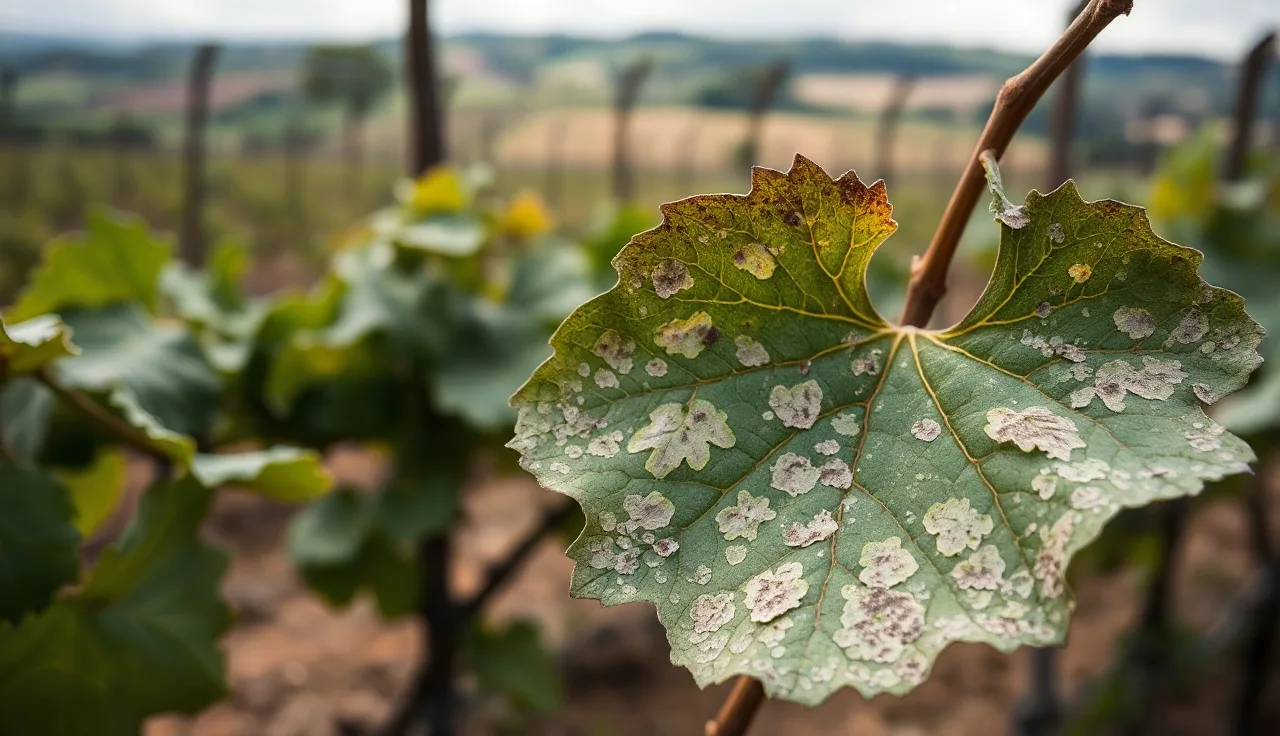
Powdery mildew (Erysiphe necator, called Uncinula necator in older texts) shows as a white or grey powdery coating on the upper surface of young leaves, shoots, and berries. It doesn't need free water to germinate. Conidia can infect at relative humidity as low as roughly 40 percent. The fungus overwinters as chasmothecia (cleistothecia) in bark and as mycelium inside dormant buds, which is why infected buds push distorted, stunted shoots the following spring [2].
In the UK the primary infection period runs from bud break through about four weeks post-bloom, though secondary infections continue all season. The high-risk windows are when shoot tips are growing fast, and again at bunch closure when the tight cluster traps humidity around the berries. Infected berries crack, which opens the door to botrytis.
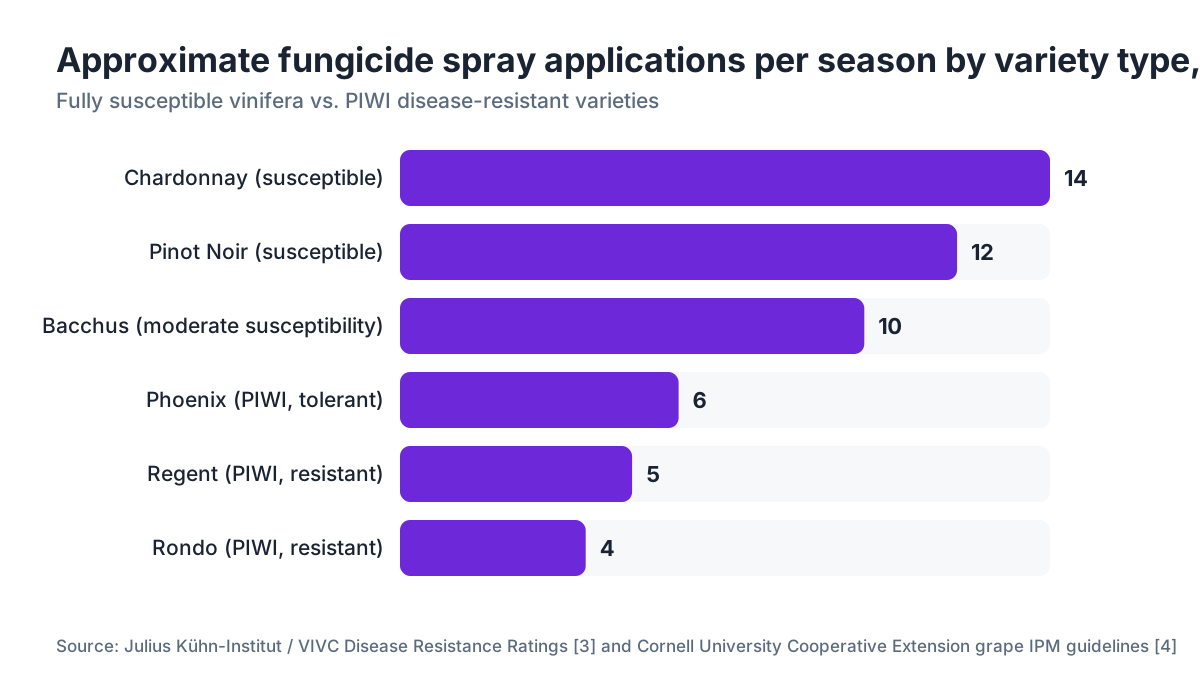
Susceptibility varies a lot by variety. Pinot Noir is moderately susceptible. Chardonnay is worse. Bacchus, one of England's most widely planted whites, sits at moderate susceptibility. Regent and Rondo, two widely grown disease-tolerant varieties, carry partial resistance that genuinely cuts spray frequency, though they're not immune [3].
Timing matters more than product choice here. A protectant program that misses the 10-to-14-day spray window during rapid shoot growth lets the fungus establish mycelium under the leaf cuticle, and at that point many protectants stop working. Sulfur is still the backbone of most UK programs. It's cheap, has no resistance issues, and is approved for organic production.
How does downy mildew spread in UK conditions?
Downy mildew (Plasmopara viticola) needs a specific set of conditions to start its primary infection season: 10 mm or more of rain, temperatures above 10 degrees Celsius for several consecutive hours, and shoots at least 10 cm long. Viticulturalists call this the "10-10-10" rule [4]. In England those conditions often arrive in April or May, earlier than most growers expect.
The pathogen overwinters as oospores in fallen leaf debris and infected shoots on the vineyard floor. When conditions line up, oospores germinate and release zoospores that splash onto lower leaf surfaces and infect through the stomata. Within 5 to 15 days, depending on temperature, you get the yellow "oil spots" on the upper leaf surface and white sporulation underneath. That's the oil-spot phase. Miss it, catch another wet period, and secondary cycles stack up fast.
UK growing seasons carry real risk because spring rain is close to guaranteed. Growers in Kent and Sussex usually start their first downy mildew spray around the 10-cm shoot stage, then hold a protectant interval of 7 to 10 days through wet stretches. Missing even one interval in a wet May has cost some vineyards 30 to 50 percent of their shoot area in bad years.
The practical read on varieties: Seyval Blanc, Madeleine Angevine, and Orion show reasonable tolerance. Classic vinifera like Chardonnay, Pinot Noir, and Pinot Gris are fully susceptible and need a properly timed spray program from early in the season [3].
What is botrytis bunch rot and how do UK growers control it?
Botrytis cinerea is in the environment all the time. The question is whether your bunches give it an entry point. Damaged or cracked berries (from powdery mildew, insects, or rain-induced splitting), tight bunch architecture, and dense canopy foliage set it up. In the UK, August and September rain arriving right around harvest is the most common trigger.
Symptoms start as a brown discolouration of individual berries, then grey fuzzy sporulation spreads across the bunch. In humid conditions a whole cluster can be lost in 48 hours. The economic threshold for botrytis is essentially zero on red varieties. Even light infection carries off-flavours into wine. For whites, some growers deliberately allow Noble Rot (the same fungus, different conditions), but that's a controlled choice, not an accident.
Control relies on three things working together. Canopy management comes first: leaf removal in the fruit zone, usually around flowering and again at veraison, drops the humidity around the bunches and improves spray penetration. Research from University of California Cooperative Extension has shown leaf removal alone cutting botrytis incidence by 30 to 60 percent depending on variety and timing [5]. Variety choice comes second: Pinot Noir with its compact clusters is notoriously vulnerable, and Bacchus is tight-clustered too, while Regent's loose clusters carry much lower risk. Fungicide timing comes third: the key sprays land at flowering, bunch closure, and if warranted at veraison, with the pre-harvest interval respected per label.
Botrytis fungicides carry one of the best-documented resistance problems in viticulture. Repeated use of single-site chemistry (benzimidazoles, dicarboximides, anilinopyrimidines) selects for resistant strains within three to five seasons. Rotating between mode-of-action groups is not optional if you want these products to keep working [6].
What is Phomopsis cane and leaf spot and why is it underdiagnosed in the UK?
Phomopsis viticola causes small, dark brown lesions with a yellow halo on young spring leaves, plus black streaking or bleaching on young internodes. The damaging phase comes later. Infected wood turns brittle, canes die back, and the following year's spurs fail to push. By then most growers have forgotten last spring's wet weather and blame the dead spurs on frost or weak variety vigour.
The fungus infects only during wet periods in spring, when shoots are 2 to 10 cm long. That's an early, narrow window. UK springs being what they are, this disease gets a reliable infection opportunity most years. Copper-based sprays at bud swell (before bud break) and early shoot growth are the traditional control, and copper is one of the few materials cleared for this timing even in organic programs. The UK copper cap is 28 kg per hectare over a 7-year period, an average of 4 kg/ha/year, matching the European limit adopted after the 2018 EU reassessment [7].
Seeing unexplained dead spurs and spur arm dieback? Scrape the bark on the affected wood. Brown discolouration of the inner wood that doesn't reach the main trunk points to Phomopsis rather than Eutypa. That distinction matters, because the two demand different actions.
How serious is Eutypa dieback in British vineyards?
Eutypa lata is a wound pathogen, full stop. It enters through pruning wounds larger than about 1 cm across and colonises the woody tissue over years. The first foliar sign is a cluster of stunted, cupped, chlorotic leaves on one shoot, a syndrome called Eutypa dieback or 'dead arm'. By the time you spot that, the fungus may have colonised 30 to 60 cm of the cordon [1].
In California, Eutypa dieback has been estimated to cost the industry tens of millions of dollars a year in lost production and replanting. UK data is thinner, but the disease is present and confirmed in English vineyards. Vines pruned in wet weather sit at the highest risk, because Eutypa spores release and travel on rain.
Prevention beats everything else. Prune later in winter when wounds heal faster, work in dry weather where you can, and paint a wound protectant (registered botryticide paints or approved copper products) onto cuts larger than 1 cm within a few hours. Once Eutypa sits inside a cordon, the only reliable fix is surgical removal of all infected wood back to clean tissue, confirmed by the absence of internal brown staining. Some growers lose whole arms and retrain from the trunk.
A well-kept spray and operations log is a genuinely useful tool for tracking pruning dates and wound treatment. If you already record pesticide applications for compliance, adding the pruning date, conditions, and wound treatment takes 30 seconds per row. You get a legal record and an agronomic one out of the same note [8].
Is black rot a real threat to UK vineyards now?
Black rot (Guignardia bidwellii) was historically a North American problem, confined to the eastern US wine regions where it can wipe out entire crops in wet years. It's been in parts of continental Europe for decades. In the UK it was rare, but confirmed cases have turned up with rising frequency across the warmer south and southeast since the 2010s.
Symptoms: circular, tan lesions with a dark border on leaves, and shrivelled, black, mummified berries that stay attached to the cluster. Those mummies (pycnidia show as tiny black dots on the surface) are the overwintering inoculum source. Removing and destroying mummified fruit at pruning genuinely helps break the disease cycle.
Black rot responds to the same fungicides used against powdery and downy mildew, including sterol demethylation inhibitors and strobilurins. Run a competent mildew program and you're probably giving yourself reasonable black rot cover by accident. The key infection windows track downy mildew: wet weather from bud break through three to four weeks post-bloom [4]. A warmer UK climate will likely make this disease more economically relevant over the next two decades.
What fungicide products are approved for grapevines in the UK and what are the legal requirements?
Since Brexit, the UK runs its own pesticide registration regime under the Health and Safety Executive (HSE) Chemicals Regulation Division, separate from the EU's EFSA-managed system. Products appear on the UK Pesticide Register (formerly the Chemicals Regulation Division database). Check the current register before you buy anything. Registrations change, and what was approved last year may not be this year [7].
The main approved chemistry groups used in UK vineyards: copper compounds (downy mildew, Phomopsis, Eutypa prevention), sulfur (powdery mildew, organic-approved), sterol biosynthesis inhibitors or DMI fungicides such as myclobutanil and tebuconazole (powdery mildew), strobilurins such as azoxystrobin (both mildews, botrytis), SDH inhibitors, and anilinopyrimidines such as cyprodinil (botrytis). Mancozeb approval in the UK has been under review, so check current status before using it.
Every application needs a written spray record covering the date, product name and registration number, crop, dose rate, volume of water, reason for application, weather conditions, and operator name. This isn't box-ticking. It's a legal requirement under the Food and Environment Protection Act 1985 and the Control of Pesticides Regulations 1986 [9]. Growers selling to supermarkets or wine merchants with LEAF Marque or Red Tractor audits face record-keeping expectations on top of the statutory minimum.
The UK Worker Protection Standard (analogous to the US EPA's WPS [10]) sets re-entry intervals after spraying. These print on every approved product label. The label is the law: spray at a higher rate than the label states and you're operating illegally, whatever the crop pressure.
Organic producers work under the UK Organic Regulations (retained EU Regulation 2018/848 as amended). Copper, sulfur, and certain plant-derived preparations are permitted. Synthetic fungicides are not. The copper cap of 28 kg/ha over 7 years applies to organic and conventional growers alike [7].
How do you build a disease management calendar for a UK vineyard?
A UK vineyard disease calendar runs roughly from bud swell in March through harvest in September or October, with a handful of off-season jobs in winter. Here's a realistic structure built on the biology of the main pathogens:
Dormant to bud swell (February to March): Apply copper to swelling buds for Phomopsis and downy mildew inoculum reduction. Inspect and remove Eutypa-infected wood. Remove mummified berries (black rot inoculum). Paint wound sealant on pruning cuts.
Shoot growth, 5 to 20 cm (April): Begin the powdery mildew program with sulfur or a DMI. Run your first downy mildew risk assessment using the 10-10-10 rule, then apply copper or a systemic at the first risk event. This is your most important spray timing of the year for both mildews.
Pre-bloom to bloom (May to June): Hold 7 to 14-day intervals for both mildews based on weather. First botrytis spray at early bloom on susceptible varieties. Leaf removal in the fruit zone around bloom to cut botrytis risk all season.
Post-bloom to bunch closure (June to July): Maintain the mildew program. Botrytis spray at bunch closure on tight-clustered varieties. Monitor for black rot if it's shown up in your vineyard before.
Veraison to harvest (August to September): Final botrytis spray if warranted, respecting pre-harvest intervals. Reduce or stop mildew sprays based on weather and canopy condition, and stay clear of the pre-harvest interval. Watch bunches closely after any rain.
Post-harvest (October): Apply copper after harvest if downy mildew defoliation was severe, to protect remaining leaf area and support carbohydrate storage. Start planning next year's program from your disease records.
A calendar like this earns its keep when it lives alongside your actual spray records instead of in a separate notebook. Software like VitiScribe ties spray records to growth stage and weather data, which makes end-of-season program review much faster. Keep your records in three spreadsheets and a paper folder and you'll miss the patterns that show up across years.
Which grapevine varieties have the best disease resistance for UK conditions?
This is one of the most practical calls a UK grower makes, and it carries a 30-year horizon given vine lifespan. Fully resistant varieties don't exist. What you get is partial resistance that cuts spray frequency and softens the severity of infection.
The PIWI (Pilzwiderstandsfähig, or fungus-resistant) varieties bred in Germany, Switzerland, and France are showing up more in UK plantings. Regent, Rondo, Solaris, Orion, Phoenix, and Cabernet Blanc carry resistance genes to both powdery and downy mildew, usually rated on the 1-to-9 OIV (International Organisation of Vine and Wine) scale where 1 is fully susceptible and 9 is highly resistant. Most PIWI varieties score 6 to 8 for powdery mildew and 5 to 7 for downy mildew [3].
In practice, a grower planting Regent next to Chardonnay might need 4 to 6 sprays a season on the Regent against 10 to 14 on the Chardonnay. That gap adds up to real money and real time over a career.
The trade-off is wine style. Regent makes a decent red, but it doesn't make Pinot Noir. Phoenix makes a serviceable white, but it won't win a Chardonnay class. If you need to meet market expectations for classic vinifera styles, PIWI varieties are a complement, not a replacement. A pragmatic split for a new planting: 70 percent vinifera on a full spray program, 30 percent PIWI to give yourself lower-input blocks and a hedge against disease years.
The UK Vineyard Association maintains a variety trial register, and NIAB EMR (National Institute of Agricultural Botany, East Malling Research) has published variety trial data relevant to UK conditions [11].
What spray record-keeping is legally required for UK vineyard disease management?
Statutory record-keeping for pesticide use in the UK sits under the Food and Environment Protection Act 1985 and the Control of Pesticides Regulations 1986, with added requirements from the Pesticide Usage Approval Notice (PUAN) and, for professional users, the need to hold a BASIS-registered Certificate of Competence or National Proficiency Tests Council (NPTC) PA1/PA2 qualification [9].
The minimum fields for a legally compliant spray record: operator name, certificate number, date and time of application, product name and MAPP (Ministerial Approval of Pesticide Products) number, crop treated, area treated, dose rate per hectare, total volume applied, water volume, and weather conditions at application (wind speed, temperature, and whether rain fell within the application window). Pre-harvest interval compliance must be demonstrable from the record.
Supermarket supply chains (Waitrose, Marks and Spencer, and others) typically require records held for a minimum of three years and may audit them. LEAF Marque certification wants records that show informed product choice and resistance-management rotation. Red Tractor wine audit standards line up broadly with these.
Here's the honest truth: paper records meet the legal minimum but flunk the practical test. Try to remember what you applied in May two years ago to answer a retailer query, and a searchable digital record is worth a lot. That's the gap purpose-built vineyard record software fills, VitiScribe included, which structures spray logs to the legal field requirements from the start.
Cornell University's integrated pest management program and Washington State University's wine grape pest management resources both publish spray record templates and resistance-management guidance that translate reasonably well to UK conditions once you adjust for approved chemistry [12] [8].
How does the UK climate affect disease pressure compared to other wine regions?
The UK's maritime climate is the variable that shapes disease management here. Average annual rainfall across the main vineyard regions (Kent, Sussex, Hampshire, Dorset) runs 600 to 900 mm, with meaningful rain in every month of the growing season. Compare the Rhône Valley at 600 to 700 mm concentrated in autumn and winter, or Bordeaux at around 900 mm but with reliably drier summers than England gets.
Mean growing-season temperatures in southern England have risen roughly 0.5 degrees Celsius per decade since 1980 [14]. That cuts two ways. It extends the growing season and ripens Chardonnay and Pinot Noir more reliably, but it also stretches the disease pressure season and creates more of the humid, warm spells that certain pathogens want.
The practical upshot: UK growers can't safely borrow spray calendars from German, French, or Australian references without adjusting for the wetter springs and the cooler, wetter autumns. A Burgundy producer might stop the powdery mildew program in early August. In a typical English season you'd reassess against local conditions before making that call.
Disease forecasting models such as UC Davis's UC IPM powdery mildew risk model and the AUDPC-based downy mildew models from French research institutes can be adapted to UK weather data [2] [4]. Some UK agronomists and vineyard consultants do exactly that, pulling weather station data from inside the vineyard to trigger spray decisions instead of following a fixed calendar. It cuts unnecessary sprays in dry years and closes gaps in wet ones.
What should you do when you first spot a disease problem in the vineyard?
Slow down and confirm you're actually looking at what you think you're looking at. Nutrient deficiencies can mimic downy mildew oil spots. Herbicide drift can throw leaf symptoms that look like Phomopsis. Mite damage gets confused with early powdery mildew. Get the diagnosis wrong, spray the wrong chemistry, and you've wasted money, added pesticide load, and left the real problem in place.
Take a sample. A clear photo showing the upper and lower leaf surface, the pattern of spread across the vineyard (random or row-end? shaded or sunny side?), and the growth stage when symptoms appeared all help with diagnosis. NIAB EMR, ADAS, and independent BASIS-qualified agronomists can give you a confirmed diagnosis. The RHS plant health advisory service also covers commercial crops [11].
Once the diagnosis is confirmed: check you have an approved product for that disease and that crop, read the label for dose rate and pre-harvest interval, record the diagnosis in your vineyard log, and apply within the approved parameters. Then set a follow-up date to check whether the application worked.
Seeing a disease you haven't met before, or one spreading unusually fast despite a normal spray program? Call your agronomist before applying more product. Fungicide resistance in powdery mildew and botrytis populations is well documented [6], and hitting a resistant population harder with the same product won't help.
Frequently asked questions
Can UK vineyards get Pierce's disease?
Pierce's disease (caused by Xylella fastidiosa) is not established in the UK and as of 2024 remains a regulated quarantine pest under UK plant health legislation. The vector, the glassy-winged sharpshooter, is not present here either. Xylella is spreading northward in Europe, though, and is subject to strict import restrictions and monitoring. Report any suspected symptoms to the Animal and Plant Health Agency (APHA) immediately.
How often should I spray for powdery mildew in a UK vineyard?
Most UK growers on susceptible vinifera apply powdery mildew fungicides on a 10 to 14-day interval from around the 5-cm shoot stage through to about four weeks after full bloom, then reassess on canopy condition and weather. In dry summers the interval can stretch. In warm, humid spells it should shorten. Growers on PIWI varieties often manage the whole season with 4 to 6 applications.
Is sulfur safe to apply close to harvest on grapes?
Elemental sulfur is generally safe but has a pre-harvest interval that varies by product, typically 14 to 21 days. Check your specific label. More practically, sulfur residues can cause hydrogen sulfide off-flavours in wine if applied too close to harvest or if residues reach the winery. Most winemakers prefer no sulfur after veraison. Agree the cutoff timing with your winemaker before the season starts.
What is the copper limit for UK vineyards and why does it matter?
The UK limit for copper fungicide use on grapevines is 28 kg of copper metal per hectare over any 7-year period, averaging 4 kg/ha/year. This came from the EU reassessment completed in 2018. Copper accumulates in soil and is toxic to earthworms and soil microbiota at elevated levels. Growers leaning heavily on copper, especially organic producers, need to track cumulative applications carefully across years.
Do I need a pesticide certificate to spray fungicides in my UK vineyard?
Yes, if you're a professional user (you use pesticides as part of a business, including your own farm). You need a BASIS-registered Certificate of Competence, typically the NPTC PA1 (foundation) plus the relevant PA2 module for your equipment type. PA1 and PA2 certificates come from Lantra or NPTC and are required before you can buy or apply professional-use pesticides. Domestic garden products are a different category.
What is the difference between downy mildew and powdery mildew on grapevines?
Downy mildew (Plasmopara viticola) needs free moisture to infect. It shows oil spots on the upper leaf surface and white fluffy sporulation underneath. Powdery mildew (Erysiphe necator) needs no free water. It shows as a white powdery coating on the upper surface of leaves, shoots, and berries. They need partially different fungicide chemistries, so correct identification before spraying matters.
Can I use the same fungicide all season to control botrytis?
No, and you shouldn't. Botrytis cinerea has documented resistance to all the major single-site fungicide groups used against it, including benzimidazoles, dicarboximides, and anilinopyrimidines. Using the same product repeatedly within a season or across seasons speeds up resistance selection. The rule: rotate between at least two different FRAC (Fungicide Resistance Action Committee) mode-of-action groups across your botrytis spray timings each season.
How long do I need to keep spray records for my UK vineyard?
The legal minimum under UK pesticide regulations is three years. If you supply supermarket or premium wine merchant accounts, most retailer codes require records available for audit for at least three years, and some specify five. Keeping records for five years as a default is practical. It covers most retailer audit windows and gives you five seasons of comparative data for disease trend analysis.
What diseases are most likely on a new vineyard planting in the UK?
New plantings face the same disease suite as mature vines but sit more vulnerable in the first two to three years, because young vines lack the wood volume to tolerate Eutypa or Phomopsis damage. Downy mildew on young shoot growth can kill entire shoots. Prioritise copper at bud break, start your mildew program early, and seal any significant pruning cuts during establishment. Don't skip the dormant copper spray.
Are PIWI varieties actually worth planting in the UK?
For cutting spray costs and labour, yes. A PIWI block typically needs 40 to 60 percent fewer fungicide applications than a Chardonnay or Pinot Noir block. For wine quality and market positioning at the premium end, it's more complicated. Buyers at high price points still mostly want classic vinifera styles. A mixed planting strategy, with PIWI in higher-risk blocks or as a cost hedge, is what many experienced UK growers are moving toward.
Can grapevine trunk diseases like Eutypa be cured once established?
Not with any currently available fungicide. Eutypa lata in established wood can only be managed by cutting back all infected tissue to clean, healthy wood (identified by the absence of internal brown staining) and retraining from the trunk. Preventive wound protection at pruning time is your only real tool. Some research has explored biological agents applied to wounds, but none are reliably registered or proven effective for UK conditions as of 2024.
What weather conditions should make me spray immediately for downy mildew?
Apply a protectant downy mildew spray when the 10-10-10 rule is met: shoots at least 10 cm long, at least 10 mm of rain, and temperatures above 10 degrees Celsius during the rain period. After that primary infection event, hold a 7 to 10-day spray interval through any following wet, warm weather up to bunch closure. A weather station in or next to the vineyard makes this call far more reliable.
Does leaf removal really reduce botrytis, or is that just received wisdom?
The evidence is real. Research from UC Cooperative Extension and multiple European trials consistently shows early fruit-zone leaf removal (around bloom or just before) reducing botrytis bunch rot incidence by 30 to 60 percent in susceptible varieties. The mechanism is improved airflow, faster drying of berries after rain, and better spray penetration. On tight-clustered varieties like Pinot Noir, fruit-zone leaf removal is arguably more effective than a botrytis spray hitting a dense canopy.
Is black rot spreading in UK vineyards because of climate change?
The data are limited but directionally consistent. Black rot (Guignardia bidwellii) has been confirmed with rising frequency in southern English vineyards over the past decade, and warmer summers create more of the conditions it needs. Nobody has published a rigorous UK-wide survey of black rot incidence yet, as far as current literature shows. The practical advice: remove mummified berries at pruning and maintain your mildew spray program, which gives incidental black rot protection.
Sources
- UC Davis Viticulture and Enology, Eutypa Dieback of Grapevine: Eutypa lata infects through pruning wounds and foliar symptoms may not appear for 3 to 5 years after infection; infected cordons may have 30 to 60 cm of colonised tissue by first symptom appearance
- UC IPM, UC Davis, Grape Powdery Mildew Management Guidelines: Powdery mildew conidia can infect at relative humidity as low as 40 percent; the fungus overwinters as chasmothecia in bark and as mycelium in dormant buds, producing stunted infected shoots the following spring
- Julius Kühn-Institut / VIVC, Vitis International Variety Catalogue, Disease Resistance Ratings: PIWI varieties score 6 to 8 on the OIV 1-to-9 resistance scale for powdery mildew and 5 to 7 for downy mildew; classic vinifera varieties such as Chardonnay and Pinot Noir are rated 1 to 3 (fully susceptible)
- Cornell University Cooperative Extension, Integrated Crop and Pest Management Guidelines for Commercial Grape Production: Primary downy mildew infection requires 10 mm of rain, temperatures above 10 degrees Celsius, and shoots at least 10 cm long (the 10-10-10 rule); black rot infection windows are similar to downy mildew from bud break through 3 to 4 weeks post-bloom
- UC Cooperative Extension, Fruit Zone Leaf Removal Effects on Botrytis Bunch Rot: Early fruit-zone leaf removal around bloom can reduce botrytis bunch rot incidence by 30 to 60 percent depending on variety and timing
- FRAC (Fungicide Resistance Action Committee), Botrytis Resistance Working Group: Botrytis cinerea has documented resistance to benzimidazoles, dicarboximides, and anilinopyrimidines; repeated use of single-site fungicides selects for resistant strains within 3 to 5 seasons
- UK Health and Safety Executive, Chemicals Regulation Division, UK Pesticide Register: The UK copper limit for grapevines is 28 kg per hectare over a 7-year period, averaging 4 kg/ha/year, matching the limit adopted after the EU 2018 reassessment; all approved pesticide products listed on the UK Pesticide Register
- Washington State University Extension, Wine Grape Pest Management: WSU Extension provides spray record templates and resistance management rotation guidance for wine grape producers
- UK Health and Safety Executive, Control of Pesticides Regulations 1986 and FEPA 1985 guidance: UK spray records must include operator name, certificate number, date, product name and MAPP number, crop, area, dose rate, water volume, and weather conditions; records must be retained for at least 3 years
- US EPA, Worker Protection Standard for Agricultural Pesticides: The EPA Worker Protection Standard sets re-entry intervals after pesticide application; the label is the legal document governing application rates and intervals
- NIAB EMR (National Institute of Agricultural Botany, East Malling Research), Grapevine Variety Trials: NIAB EMR publishes variety trial data relevant to UK conditions including disease resistance ratings; the UK Vineyard Association maintains a variety trial register
- Cornell University, New York State Integrated Pest Management Program, Grape IPM: Cornell IPM provides spray record templates and resistance management guidance for grape producers
- UK Met Office, UK Climate Projections (UKCP18): Mean growing season temperatures in southern England have risen approximately 0.5 degrees Celsius per decade since 1980
Last updated 2026-07-09