Grapevine diseases that cause yellow and brown leaves: a field guide
TL;DR
- Yellow and brown grapevine leaves trace back to a short list: downy mildew, powdery mildew, Phomopsis, Eutypa dieback, leafroll virus, fanleaf virus, Pierce's disease, and nutrient problems that fake infection.
- Diagnosis drives everything.
- Spray a fungicide at a virus and you waste money while the real problem spreads through your block.
Why do grapevine leaves turn yellow or brown?
Yellow and brown leaves on grapevines almost never have one cause. The color change is the vine reacting to several unrelated problems: fungal pathogens blocking water movement, viral infections disrupting chlorophyll, bacteria clogging the xylem, or nutrient deficiencies that look identical to disease from twenty feet away. Guess wrong and you pay for it.
The only way to know for sure is to match the symptom pattern to the pathogen. Look at where the color shows up on the leaf, whether it has a clean margin, whether the discoloration follows the veins, whether the fruit is affected, and what week of the season it appeared. A yellow patch between the veins in early summer is a different problem than red-bronze interveinal blotches in August.
Extension plant pathologists at Cornell, UC Davis, and Washington State have published free diagnostic keys that walk through every distinction [1][2][3]. Read those before you open the spray cabinet.
What does downy mildew look like on grapevine leaves?
Downy mildew (Plasmopara viticola) is usually the first disease growers see because it moves fast in cool, wet springs. The classic sign is a pale yellow oil-spot lesion on the upper leaf surface, angular, bounded by small veins. Turn the leaf over and you'll find white cottony sporulation on the underside of those same spots. That white fuzz is the diagnosis. Nothing else on a grape leaf looks like it. [1]
Stay wet and those yellow patches expand, then turn brown as the tissue dies. Heavy infections strip vines bare by late summer, robbing you of photosynthate at the worst possible time. The UC Davis IPM guidelines note that downy mildew needs a period of leaf wetness at moderate temperatures (roughly 13 to 28 C, or 55 to 82 F) to establish infection [1]. That window is what your first protectant spray is chasing.
Primary infection comes from oospores overwintering in leaf litter. Mow and remove the debris. In your spray program, protectants (mancozeb, copper) go on before infection; systemics like fosetyl-Al or phosphorous acid come in once infection is suspected. Cornell's grape guidelines recommend starting protectant applications early in shoot growth in high-pressure regions [2].
Downy mildew does not produce the diffuse interveinal yellowing you'd blame on nutrients. The lesions are angular. That distinction settles most field arguments.
How does powdery mildew cause leaf discoloration in grapes?
Powdery mildew (Erysiphe necator, formerly Uncinula necator) starts as a white or gray powdery coating on the leaf, not a yellow spot. Growers miss the early colony, then wonder why leaves yellow and brown in midsummer.
Here's the sequence. The fungus colonizes epidermal cells, and as it spreads the tissue underneath turns yellow, then chlorotic, then dead. By late season an unmanaged infection leaves big brown patches and a vine in general decline. On red varieties, infected shoot tissue reddens or browns before the coating is obvious. On whites the chlorosis stays subtle until the colony is thick.
Powdery mildew doesn't need free water to germinate. That single fact separates it from downy mildew on your calendar. It runs hot and humid, favoring temperatures around 21 to 30 C (70 to 86 F), high nighttime humidity, and shaded canopies [2]. Dense canopies are powdery mildew factories. Shoot positioning and fruit-zone leaf removal aren't cosmetic. They cut disease pressure directly.
Sulfur has been the backbone of powdery mildew programs for over a century. DMI (sterol inhibitor) and SDHI fungicides give kickback activity. WSU Extension's guidelines lay out resistance management by FRAC code, which matters because DMI resistance is documented in Pacific Northwest vineyards [3].
What is Phomopsis cane and leaf spot and what color are the symptoms?
Phomopsis viticola causes small dark brown to black spots on leaves, usually with a yellow halo around each lesion. The spots show up first on basal leaves early in the season, often around bloom. On canes, Phomopsis leaves bleached, cracked lesions that look nothing like the leaf spots.
The yellow halo is your tell. It separates Phomopsis from angular downy mildew lesions. Small dark centers ringed by a clear yellow band point straight at Phomopsis. Heavy cane infections girdle and kill shoots, which shows up as sudden wilting and browning of whole lateral shoots. [2]
Phomopsis overwinters in infected wood. Protect pruning wounds and clear mummified wood off the vineyard floor to knock down inoculum. The spray window that matters most runs from shoot emergence through 10 to 12 inches of growth, when tissue is most susceptible. Cornell recommends mancozeb or captan through that window in New York vineyards with a Phomopsis history [2].
Does Eutypa dieback cause yellow and brown leaves?
Yes, and it's one of the most misread symptoms in the vineyard. Eutypa dieback (Eutypa lata) produces stunted, chlorotic, crinkled leaves on infected shoots that read like a nutrient problem or a virus to an untrained eye. Leaves are small, cupped, pale yellow to yellow-green. Shoots stay stunted. Fruit set is sparse or fails. [2]
Here's the step that settles it. Cut back the infected cordon or arm and look at the wood cross-section for a wedge-shaped brown stain. That stain is vascular tissue the fungus killed on its way through the wood. Foliar symptoms alone won't confirm Eutypa. The wedge in the wood will.
Eutypa lata enters through pruning wounds and spreads inside the wood. No fungicide cures an established infection. Management is surgical: cut infected wood back to clean tissue, then protect fresh pruning wounds with thiophanate-methyl or a registered Trichoderma-based biocontrol. In California, Eutypa dieback has long been estimated to cost the industry in the tens of millions of dollars a year, though the exact figure shifts by source and season [11]. The UC Davis viticulture and enology group has done the most consistent work on Eutypa epidemiology in California [11].
What do grapevine leafroll viruses look like in the vineyard?
Grapevine leafroll-associated viruses (GLRaV, several strains) throw one of the most recognizable symptoms in the vineyard once you've seen it. Leaves turn red or yellow from the margins inward while the veins stay green into late season. On reds the interveinal reddening is loud, like fall color arriving a month early. On whites those same areas go yellow instead of red. Leaf margins roll down. [4]
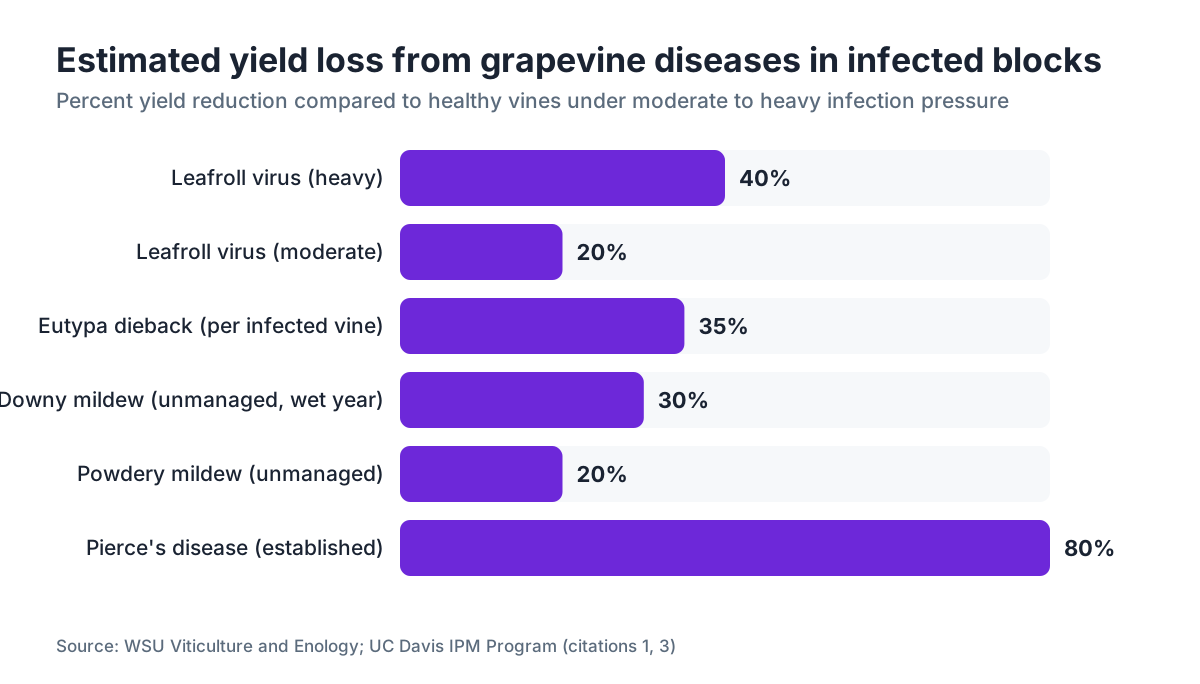
Symptoms creep from the basal leaves toward the shoot tip as the season runs. Fruit on infected vines ripens 1 to 3 weeks late, carries lower Brix, and makes wine that tastes off. A Washington State University study reported yield losses of 20 to 40 percent and Brix drops of 2 to 5 points in heavily infected Cabernet Sauvignon [3].
There's no cure. You rogue infected vines, control mealybug and soft scale vectors, and replant with certified virus-tested material. UC Davis Foundation Plant Services certifies clean planting stock in California [8].
Tracking which vines show early symptoms year over year is exactly the field record that pays off. A vineyard record tool like VitiScribe lets you map symptomatic vines block by block, so rogue-or-replant calls run on data instead of memory.
Can Pierce's disease cause yellowing and browning of grapevine leaves?
Pierce's disease (the bacterium Xylella fastidiosa) is often fatal to wine grapes where it takes hold, and the leaf symptoms start with a pattern called scorching. Irregular brown areas begin at the leaf margin and move inward, leaving a yellow or pale green band between the brown edge and the still-green interior. The brown tissue dries and crumbles. [5]
There's a second tell. The petiole often stays attached to the cane after the leaf blade drops, leaving dried stems standing on the shoot. That matchstick symptom is close to diagnostic for Pierce's disease. On canes you'll see uneven lignification, patches of dark and light bark.
Sharpshooter leafhoppers move Xylella fastidiosa. In California the glassy-winged sharpshooter (Homalodisca vitripennis) is the main vector, and its spread widened the risk zone sharply since the late 1990s. CDFA runs active monitoring and quarantine programs for the glassy-winged sharpshooter in grape counties [5].
No registered treatment cures Pierce's disease in an established vine. Prevention is vector control plus prompt removal of infected vines to cut inoculum. In cool coastal and northern California, vines sometimes shake off early infection when the bacterium can't overwinter at high enough levels, but don't bank on it.
What nutrient deficiencies mimic grapevine disease on leaves?
Several nutrient deficiencies throw yellow and brown leaves that get misread as fungal or viral disease every season. Learn the patterns and you stop wasting money on the wrong spray.
Potassium deficiency shows marginal leaf burn and interveinal yellowing, older basal leaves first. It's common in high-yield blocks and sandy soils with weak cation exchange. Iron deficiency gives interveinal chlorosis on young leaves at the shoot tips, veins staying green. That's textbook iron chlorosis, and it's almost always a soil pH or compaction problem choking iron uptake, not a shortage of iron in the ground.
Magnesium deficiency causes interveinal chlorosis on older leaves, close to potassium but with a different leaf distribution. Boron toxicity burns leaf margins brown in a way that fakes scorch. Zinc deficiency makes small, lopsided leaves with mottled yellow and green.
The only clean way to split nutrient problems from disease is tissue testing. Collect petioles at bloom (opposite the cluster) following UC Davis or Cornell sampling protocols for your variety [1][2]. Pull a soil pH test too. Spraying fungicide on a vine with high-pH iron chlorosis is money in the ditch.
How do you tell the difference between these diseases in the field?
A side-by-side comparison saves diagnostic time.
| Disease / Problem | Symptom color | Location on leaf | Season | Confirms |
|---|---|---|---|---|
| Downy mildew | Yellow oil spots, brown necrosis | Upper surface, angular | Spring-summer | White fuzz on leaf underside |
| Powdery mildew | White coating, yellow then brown | Both surfaces | Late spring-fall | Gray/white powdery colony |
| Phomopsis | Dark spots, yellow halo | Basal leaves first | Early season | Black pycnidia in lesion centers |
| Eutypa dieback | Pale yellow, small crinkled leaves | Whole shoot | Early-mid season | Wedge-shaped brown wood stain |
| Leafroll virus | Red/yellow interveinal, rolled margins | Basal to tip, season-long | Midsummer onward | Veins stay green; late ripening |
| Pierce's disease | Brown scorch, yellow band at margin | Any leaf | Midsummer onward | Petiole retention after leaf drop |
| K deficiency | Marginal burn, interveinal yellow | Older leaves | Midsummer | Petiole test, no pathogen found |
| Fe deficiency | Interveinal yellow, veins green | Young leaves at tip | Spring-early summer | High soil pH; petiole test |
This table gets you close, not to a final call. When a block behaves oddly, send samples to a plant disease diagnostic lab. Cornell and UC Davis both run diagnostic services for growers [1][9].
What are the best fungicide options for grapevine leaf diseases?
Fungicide choice depends entirely on which pathogen you're after and what's already on your spray calendar. A few rules hold across every program.
For downy mildew: copper and mancozeb are protectants that work only if they're on before infection. Phosphonates (fosetyl-Al, phosphorous acid) move systemically. Mandipropamid and dimethomorph are more targeted. FRAC diversity matters because resistance to phenylamides (metalaxyl) is documented worldwide. Rotating FRAC groups isn't optional in an intensive program.
For powdery mildew: sulfur is cheap and effective, but it's phytotoxic above 90 F (32 C) and can't go on within two weeks of an oil spray. DMI fungicides (myclobutanil, tebuconazole) and SDHI fungicides (boscalid, fluxapyroxad) give kickback. FRAC group 3 resistance is documented, so don't lean on one mode of action [12].
For Botrytis bunch rot, which browns berries and leaf tissue in and around clusters, rotate to a different site of action at least once a season. Fenhexamid, cyprodinil, and iprodione are common, and resistance in this pathogen is well documented.
Every application has to be recorded under the EPA Worker Protection Standard (40 CFR Part 170), and many states pile on more [6]. The label is the law. Never exceed labeled rates, no matter how bad the pressure looks. UC Davis and Cornell publish annual pest management guidelines with registered products, rates, and PHIs for their states [1][2].
Managing spray records across several blocks gets messy fast. VitiScribe builds compliant application records from field entries and files them with the block and date they belong to.
When should you pull (rogue) infected vines versus trying to treat them?
This is the question growers dodge because it means facing replant cost. Delay it on viral and bacterial diseases and the math gets worse every season.
Pierce's disease: a vine showing symptoms in year one in a high-vector region should come out. The bacterium won't clear on its own in warm climates, and an infected vine feeds the sharpshooters more inoculum. In cool climates with low sharpshooter pressure, watching one more season is defensible.
Leafroll virus: an infected vine in a mealybug-heavy block seeds virus into its neighbors every year it stays. University of California research points to roguing as the winning play in high-pressure blocks, and the economics tip toward removal fast once spread runs above 5 to 10 percent per year [4].
Eutypa dieback: cut infected wood back to clean tissue. You don't always pull the whole vine if the infection sits in one arm. Cut back, seal the wound, watch it. Take the whole vine when the infection has reached the trunk below the graft union.
Fungal diseases: you never rogue for downy mildew, powdery mildew, or Phomopsis. Those are spray-managed. Roguing is for systemic pathogens and viruses with no spray cure.
What records do you need to keep for disease management and spray applications?
Federal law under the EPA Worker Protection Standard (40 CFR Part 170) requires employers to keep records of each pesticide application for at least 2 years: product name, EPA registration number, active ingredient, amount applied, date, location, and the certified applicator's name [6]. OSHA Hazard Communication adds SDS access obligations on top.
Most states stack more on the federal floor. California's Department of Pesticide Regulation requires a Pesticide Use Report to the county agricultural commissioner within a set window after application for restricted-use pesticides and many general-use products in agriculture [7]. Washington and New York run their own reporting systems.
Good field records are also a disease tool. Knowing downy mildew hit block 4 in week 18 last year tells you to start protectants in week 15 this year. Knowing which vines showed leafroll two seasons back tells you where to scout now and how fast it's moving.
Digital block-by-block records make year-over-year pattern analysis possible. A binder of paper spray logs makes it nearly impossible.
What does grapevine fanleaf virus do to leaves?
Grapevine fanleaf virus (GFLV) is one of the oldest and most widespread grape viruses. It shows up in a few foliar forms depending on the strain: yellow mosaic (bright yellow blotches, sometimes across the whole blade), vein banding (yellow along the veins), and the fanleaf deformation itself (misshapen, asymmetric leaves with irregular lobing and teeth, often on shortened internodes). [4]
The yellow mosaic strain is loud and easy to mistake for a nutrient problem or a different virus. The tell is that the yellow is irregular, often brilliant, and shows on young leaves at the shoot tip more than on basal leaves.
The dagger nematode (Xiphinema index) moves GFLV through the soil. No spray or soil drench reliably clears the nematode once a vineyard is infested. Management runs long: pull infected vines, fallow the block for several years to let nematode populations crash, then replant with certified virus-free material on nematode-resistant rootstock. UC Davis Foundation Plant Services is the main source of certified clean material in California [8].
Long term, the only real answer to fanleaf and leafroll is starting clean and staying clean through vector control.
Frequently asked questions
Can yellow leaves on grapevines just be normal fall color?
Yes. Normal senescence yellows leaves in fall, and that's not disease. The difference: normal yellowing starts late in the season after veraison, spreads evenly across the canopy, and the fruit is already harvested or fully ripe. Disease yellowing shows up earlier, often unevenly, and usually brings other symptoms like spots, powdery coating, or rolled margins.
Is brown leaf scorch on grapes always Pierce's disease?
No. Brown marginal scorch also comes from potassium deficiency, wind damage, herbicide drift, heat stress, or salt injury. Pierce's disease scorch has a diagnostic yellow band between the brown margin and green interior, plus the petiole-retention symptom where dried leaf stems stay on the cane after the blade drops. Miss that pattern and you should look at other causes first, then confirm with a tissue test or lab.
How do I test a vine for grapevine leafroll virus?
ELISA (enzyme-linked immunosorbent assay) on petiole or leaf tissue is the standard method, run by a plant disease diagnostic lab. PCR is more sensitive and catches lower-titer infections. Many state and commercial ag labs offer both. In California, UC Davis Foundation Plant Services and UC Cooperative Extension can point you to certified labs. Sample in late summer when virus titers peak.
What is the white fuzzy growth on the underside of grapevine leaves?
White cottony sporulation on the leaf underside that lines up with yellow or oil-spot lesions on the upper surface is the sporangiophore stage of Plasmopara viticola, the downy mildew pathogen. That's a field-final diagnosis. You don't need a lab to confirm downy mildew when you can see the white sporulation. Get a protectant on the remaining healthy tissue right away.
Can powdery mildew survive without rain?
Yes. Erysiphe necator is one of the few important grape pathogens that doesn't need free water on the leaf to germinate or spread. It runs on moderate temperatures (roughly 21 to 30 C) and high nighttime humidity. That's why powdery mildew stays a serious problem in dry regions like parts of California and eastern Washington despite low rainfall.
How long do I need to keep spray application records for compliance?
The EPA Worker Protection Standard (40 CFR Part 170) sets a minimum of 2 years for pesticide application records. California's Department of Pesticide Regulation requires Pesticide Use Reports after application and keeps those records at the county level. Some lenders and certifiers (organic, SIP, Lodi Rules) want longer or more detailed records. Check your state; 2 years is the federal floor, not a universal answer.
What rootstock helps prevent fanleaf virus spread in replanted blocks?
Rootstocks with Xiphinema index resistance reduce dagger nematode feeding and cut fanleaf transmission. Rootstocks with Vitis rotundifolia parentage (Harmony and Freedom) carry some resistance, though they've had performance limits in some regions. UC Davis Foundation Plant Services publishes current rootstock resistance data. Replanting into infested soil with no fallow period raises reinfection risk regardless of rootstock.
Can I spray copper to manage all grapevine leaf diseases?
No. Copper works as a protectant for downy mildew and has some activity against bacterial diseases. It doesn't control powdery mildew reliably, does nothing to viruses, and has no effect on Eutypa or Pierce's disease. Overuse builds up in soil and turns phytotoxic over time. It's a useful tool in a rotation, not a universal fix.
What is the economic impact of leafroll virus on wine grape yield?
WSU Extension research found yield losses of 20 to 40 percent and Brix reductions of 2 to 5 points in heavily leafroll-infected Cabernet Sauvignon. Fruit from infected vines also shows altered anthocyanin and flavor profiles. The dollar hit per acre depends on your wine price tier, but at typical grape prices the per-vine loss stacks up fast across a block with high infection rates.
How early in the season does Eutypa dieback show symptoms?
Eutypa dieback leaf symptoms appear early to mid-season, usually at shoot emergence in spring. Affected shoots are stunted, and leaves are small, pale yellow-green, and crinkled. The key is that only shoots from infected wood show symptoms; adjacent healthy cordons grow normally. That patchy spatial pattern across the vine is a reliable early field flag before you cut into the wood.
Do cover crops increase disease pressure from fungal grapevine pathogens?
Cover crops don't host Plasmopara viticola or Erysiphe necator themselves. But cover crops that keep the vineyard floor moist and slow air movement raise the humidity and leaf-wetness period that downy mildew loves. Mowing before critical infection windows and picking lower-biomass species in wet seasons helps. In organic programs, cover crop management is one of the few physical levers you have on disease microclimate.
What's the difference between Botrytis bunch rot and leaf diseases?
Botrytis cinerea (gray mold) mostly hits berry clusters, flower clusters, and wounded tissue. On leaves it causes large, irregular tan to brown lesions, usually after physical damage or under very wet conditions. The gray sporulation mass on infected berries is diagnostic. Botrytis is a harvest-timing and canopy problem first; spray management is supplemental. It doesn't cause the interveinal chlorosis you'd tie to viruses or nutrients.
Should I sample leaves for disease diagnosis early or late in the season?
For fungal diseases, sample when symptoms are fresh and active, usually spring through early summer. For viruses including leafroll and fanleaf, late summer (July through September in the Northern Hemisphere) gives the highest virus titer and the most reliable ELISA results. For nutrients, collect petioles at bloom (opposite the basal cluster) following standardized UC Davis or Cornell protocols for your variety and region.
Sources
- UC Davis Integrated Pest Management Program - Grape Pest Management Guidelines: Downy mildew requires a period of leaf wetness at temperatures between 13 and 28 C to establish infection; Eutypa lata enters through pruning wounds; petiole tissue sampling at bloom is the standard nutrient diagnostic.
- Cornell University New York State IPM Program - Grapes: Phomopsis cane and leaf spot produces small dark spots with yellow halos on basal leaves; mancozeb or captan applications during early shoot growth are recommended; Eutypa dieback produces a wedge-shaped brown wood stain.
- Washington State University Viticulture and Enology: Powdery mildew resistance to DMI fungicides is documented in Pacific Northwest vineyards; leafroll-infected Cabernet Sauvignon showed yield losses of 20 to 40 percent and Brix reductions of 2 to 5 points.
- USDA Agricultural Research Service: Grapevine leafroll-associated viruses cause interveinal reddening or yellowing with veins staying green; grapevine fanleaf virus is transmitted by Xiphinema index nematodes in soil.
- California Department of Food and Agriculture - Pierce's Disease Control Program: Xylella fastidiosa causes marginal leaf scorch with a yellow band between brown and green tissue, plus petiole retention after leaf drop; glassy-winged sharpshooter is the primary vector in California.
- US EPA - Agricultural Worker Protection Standard, 40 CFR Part 170: Employers must maintain pesticide application records for at least 2 years including product name, EPA registration number, active ingredient, amount applied, date, location, and certified applicator name.
- California Department of Pesticide Regulation - Pesticide Use Reporting: California requires Pesticide Use Reports submitted to the county agricultural commissioner after application for restricted-use and many general-use pesticides in agricultural settings.
- UC Davis Foundation Plant Services: Foundation Plant Services certifies virus-tested grapevine planting material and is the primary source of clean budwood in California.
- Cornell University Plant Disease Diagnostic Clinic: Cornell runs plant disease diagnostic services for growers including grape disease identification.
- Washington State University Puyallup Plant and Insect Diagnostic Laboratory: WSU operates a diagnostic lab serving Washington State growers for disease identification.
- UC Davis Viticulture and Enology: Eutypa dieback causes annual losses estimated in the tens of millions of dollars in California; no curative fungicide eliminates established infections.
- Fungicide Resistance Action Committee (FRAC): FRAC group diversity in powdery mildew programs is necessary because resistance to sterol inhibitor (DMI) fungicides is documented.
Last updated 2026-07-09