Grapevine fungal diseases: identification, timing, and control
TL;DR
- Grapevine fungal diseases, led by powdery mildew, botrytis bunch rot, downy mildew, and black rot, are the top cause of crop loss and quality damage in most wine regions.
- Control depends on identifying each pathogen correctly, hitting the right growth-stage windows with the right chemistry, and rotating modes of action to slow resistance.
- Skipping early-season sprays is where most losses begin.
Which fungal diseases actually matter in a vineyard?
Four fungi cause most of the economic damage worldwide: powdery mildew (Erysiphe necator), downy mildew (Plasmopara viticola), botrytis bunch rot (Botrytis cinerea), and black rot (Guignardia bidwellii). A fifth, Phomopsis cane and leaf spot (Phomopsis viticola), matters less in dry-summer climates but is serious in humid eastern regions. Dozens of other fungi can colonize grapevines. Most never move the needle on your crop.
Everything else, Eutypa dieback, Botryosphaeria canker, the trunk diseases, is real but fits a different management category because it targets woody tissue on a multi-year cycle rather than this season's crop [1].
Powdery mildew is the broadest threat. It's present in every commercial wine region on earth and thrives in the moderate, dry-summer conditions that most premium Vitis vinifera varieties prefer. Botrytis is second, partly because it causes direct crop loss and partly because even low infection levels can trash wine quality. Downy mildew and black rot are mainly Eastern U.S. and European problems where summer humidity runs higher, though shifting weather patterns are moving those pressure zones.
Step one is knowing which diseases are actually active in your microclimate. A grower in the Willamette Valley has a different priority list than one in Paso Robles or the Finger Lakes. That sounds obvious. But spray programs copied from a neighbor three valleys over, with no local disease monitoring, are common, and they're a waste of money at best and a resistance driver at worst.
How do you identify powdery mildew on grapevines?
Powdery mildew shows up as a white to gray powdery coating on the upper and lower surfaces of young leaves, on shoot tips, and on berries shortly after bloom. It doesn't need free moisture to germinate. Spores of Erysiphe necator can germinate at relative humidity as low as around 40 percent, which is what makes it uniquely dangerous in dry-summer wine country [2]. Infected berries stop expanding, crack as the healthy tissue around them keeps growing, and then become entry points for secondary rots like Botrytis.
The most reliable early indicator is the 'flag shoot', a shoot that overwintered with latent mycelium inside the bud. These shoots emerge already colonized and show white growth before any other symptom appears in the vineyard. Finding flag shoots in the first two to three weeks after bud break tells you the disease overwintered successfully at that site and your early-season program is non-negotiable.
Temperature thresholds matter here. Erysiphe necator grows fastest between 70 and 85 degrees Fahrenheit. Below 50 degrees F growth essentially stops, and temperatures above 95 degrees F for more than a few hours will kill surface mycelium, which is why some coastal and high-altitude sites get natural relief in mid-summer. UC Davis plant pathology work puts the period from 50 percent bloom through four to five weeks post-bloom as the highest-risk window for berry infection [2]. Miss that window and you're managing symptoms instead of preventing them.
Resistance in vinifera varieties is essentially absent. American species (Vitis labrusca, V. rotundifolia) have much better natural tolerance. If you grow French-American hybrids or newer disease-resistant varieties like Marquette or Frontenac, your powdery mildew pressure is genuinely lower, and you may be able to cut spray frequency well below what a Chardonnay or Pinot Noir block needs.
What does botrytis bunch rot look like, and when does infection happen?
Botrytis cinerea is a necrotrophic fungus. It attacks already-damaged or senescing tissue, so you'll almost never see it cause primary infection on healthy, intact berries early in the season. What you see is gray-brown fuzzy sporulation on berries that were already cracked by powdery mildew, mechanical damage, or berry-to-berry pressure in tight clusters. Under humid conditions, a single infected berry can spread mycelium to its neighbors within 48 hours and turn half a cluster gray in under a week [3].
There are three infection windows worth watching. The first is at bloom, when flower parts caught in the cluster (calyptras) become colonized and the fungus sits dormant through berry development. The second is at bunch closure, when humidity inside the cluster spikes and any mechanical damage, from insects, hail, or just berry swell, gives Botrytis its entry. The third is pre-harvest ripening, when sugar climbs and berry skins thin out.
Vineyard practices that reduce bunch rot pressure often do more than fungicides. Shoot positioning that opens the fruiting zone, leaf removal in the cluster zone, and looser-clustered clones all matter. Cornell's viticulture extension has multi-year work showing that leaf removal in the fruiting zone at or before bloom reduces botrytis incidence in humid eastern climates, sometimes enough to skip a fungicide application [3]. That's worth knowing if you're weighing labor costs against chemical costs.
Botrytis in dry conditions, where you get noble rot rather than gray rot, is a different story. But that's a deliberate style choice, not disease management.
How is downy mildew different from powdery mildew, and does it matter in your region?
Downy mildew (Plasmopara viticola) and powdery mildew are unrelated organisms that happen to share a name. Plasmopara viticola is an oomycete, closer to water molds than to true fungi, and it needs free moisture on leaf surfaces to sporulate and infect. That's why it's mainly a problem in regions with summer rain: eastern North America, Europe, and humid parts of New Zealand and Australia [4].
The visual signature is an oily, yellowish 'oil spot' on the upper leaf surface with white cottony sporulation on the underside. Young shoots, tendrils, and cluster stems (rachises) can all be attacked. Infected rachises turn brown and die, which kills portions of the cluster outright, not through rot but through vascular blockage. By the time you see the cottony sporulation on the underside of a leaf, you're already looking at primary infection that happened 5 to 18 days earlier, depending on temperature.
In California's major wine regions, downy mildew is a minor concern most years. In the Finger Lakes, Hudson Valley, or anywhere in France, it's the disease that defines the spray calendar. The Tomaz-Blaeser infection model, widely used in European viticulture, uses temperature and moisture data to predict infection risk. Several commercial weather services now offer downy mildew forecasting, and WSU's decision support tools cover it for Pacific Northwest growers [5].
Fungicide chemistry for downy mildew is completely different from powdery mildew. Phosphonate materials, copper, mancozeb, and more recently mandipropamid (FRAC Group 40) are your tools. The oomycete biology means systemic fungicides effective against true fungi, like the DMI (triazole) group, do nothing against Plasmopara.
What is black rot and why does it hit eastern vineyards so hard?
Black rot, caused by Guignardia bidwellii, is arguably the most destructive disease in the eastern United States when it isn't controlled. Infected berries don't rot softly like botrytis. They shrivel into hard, black, mummified structures called 'mummies' that hang on the vine through winter and release spores the following season. A single uncontrolled cluster can carry enough inoculum to infect hundreds of berries the next year [6].
Infection requires a wetting period, and the temperature-wetness relationship is well documented. At 50 degrees F, it takes about 24 hours of continuous wetness for infection; at 77 degrees F, only 6 hours. Cornell's black rot risk model, available through their viticulture extension, uses these relationships to generate infection period alerts [6]. The most vulnerable window runs from one inch of shoot growth through about four weeks post-bloom. After berries reach about 3 percent sugar (roughly pea-size), they become largely resistant to new infection.
Sanitation is non-negotiable in black rot management. Removing mummies from the canopy and the ground before bud break each spring measurably reduces primary inoculum. In trials, vineyards that combined mummy removal with a standard fungicide program had lower black rot incidence than those relying on fungicides alone. This is one of those cases where the free cultural practice genuinely outperforms spraying more.
For vineyard blocks with a history of black rot, your opening sprays, from 2-inch shoot growth through three to four weeks post-bloom, are where the season is won or lost.
What spray timing windows actually protect the crop?
Fungicide applications tied to grapevine growth stages beat calendar-based programs every time the data gets collected. Disease risk tracks phenology and weather, not the date. Here are the windows that matter, working from bud break to harvest [2][5].
Bud break (Eichhorn-Lorenz [E-L] stage 4-5): First sulfur or mancozeb application targets overwintering powdery mildew inoculum and early flag shoot suppression. A lot of growers skip this one as 'too early'. It's often the one they regret.
6-inch shoot growth (E-L 12): Second powdery mildew application. Consider adding a downy mildew material if you're in a humid region or your forecast shows rain.
Pre-bloom to 50 percent bloom (E-L 17-23): The highest-value spray in the calendar for powdery mildew berry protection. If you use a DMI (triazole) or SDHI anywhere in the season, use it here. This is also the first Botrytis window.
Post-bloom through fruit set (E-L 27-29): Second highest-value window. Berry skins are thin, and infection at this stage causes scarring and cracking that invites secondary rot all season.
Bunch closure (E-L 32): Last realistic Botrytis application before cluster architecture makes spray penetration nearly impossible. After this point, coverage on interior berries is poor no matter what you're applying.
Veraison (E-L 35): Botrytis risk climbs again as sugar rises. Whether you spray here depends on your region, the forecast, and your variety's cluster tightness.
After veraison, pre-harvest intervals (PHIs) for many fungicides become the binding constraint. Check the label. Flutriafol carries a 14-day PHI in most states; tebuconazole is 7 days on some labels but varies by formulation. Running a spray program without knowing PHIs for every product in your rotation is a compliance exposure.
| Growth Stage | E-L Stage | Primary Target | Secondary Target |
|---|---|---|---|
| Bud break | 4-5 | Powdery mildew | - |
| 6-inch shoots | 12 | Powdery mildew | Downy mildew |
| Pre-bloom | 17-19 | Powdery mildew | Botrytis |
| 50% bloom | 23 | Powdery mildew | Botrytis, Black rot |
| Fruit set | 27-29 | Powdery mildew | Black rot |
| Bunch closure | 32 | Botrytis | Powdery mildew |
| Veraison | 35 | Botrytis | - |
How do you manage fungicide resistance in the vineyard?
Resistance is the long-term threat most growers underestimate until it's too late. Powdery mildew populations resistant to the QoI (strobilurin) fungicides, FRAC Group 11, are now documented in every major wine region in the United States. In some California and New York vineyards, resistance frequencies in field populations exceed 80 percent for certain QoI products [7]. That's not hypothetical. Spraying azoxystrobin or trifloxystrobin on a resistant population gives you essentially no control.
The FRAC (Fungicide Resistance Action Committee) system groups fungicides by mode of action, and rotating groups is the main resistance management tool. A simple rule: never apply the same FRAC group more than two times in a row, and cap total applications of single-site fungicides (Groups 3, 7, 11, U6) at no more than four per season. Multi-site products like sulfur (FRAC M2) and copper (FRAC M1) have low resistance risk because they hit multiple biochemical targets at once. They're not glamorous. They work, and rotating them in isn't a step backward.
Sulfur is genuinely underused by growers chasing newer chemistry. At 2 to 3 lb per acre on a 7 to 14-day interval adjusted for conditions, sulfur gives good powdery mildew suppression with no resistance issues. Its limits are real: phytotoxicity above 90 degrees F, no activity on Botrytis, and it washes off in rain. As the backbone of a resistance management program, though, it's hard to beat for cost per application.
Accurate spray records (which product, which FRAC group, application date, rate, and target pest) aren't just a compliance exercise. They're the only way to actually know what you've applied and whether you're staying inside your rotation guidelines. Tools that make spray record-keeping fast and accurate at the point of application, including platforms like VitiScribe, help growers catch resistance-management violations before they become a field problem. A paper log in the truck cab that gets filled in at the end of the week beats nothing, but it misses applications and mixes up dates more than people admit.
What are the EPA Worker Protection Standard requirements for fungicide applications?
The EPA's Worker Protection Standard (WPS), codified at 40 CFR Part 170, covers agricultural workers and pesticide handlers in commercial vineyards and applies to nearly every fungicide application you make, including organically permitted materials like sulfur and copper [8]. The requirements small operations miss most are the posting and notification rules and the restricted-entry interval (REI) documentation.
Every pesticide application in a WPS-covered establishment must be posted with a compliant warning sign at the treated area's entry point during the REI, and the posting must include the product name, EPA registration number, active ingredient, the date and time the REI expires, and the location being treated. Fungicide REIs typically run 4 to 24 hours. Captan carries a 24-hour REI, and some EBDC (ethylenebis-dithiocarbamate) products like mancozeb carry 24 hours as well. Check the label, because the label is the law.
The WPS was revised in 2015 and fully implemented by 2017. Key additions under that revision: mandatory annual pesticide safety training for all agricultural workers (not only handlers), a requirement to give workers access to a central posting area with application information, and a ban on letting untrained, unequipped workers into fields during applications [8].
State rules layer on top of federal WPS. California's Department of Pesticide Regulation (CDPR) adds restricted-materials regulations, county permit requirements for some products, and mandatory spray reporting that goes beyond federal requirements [9]. New York and Washington run their own additional layers. If you're not sure what applies in your county, your county agricultural commissioner's office is the right first call.
WPS record-keeping requires you to keep application records for at least two years. Those records must include the product name, EPA registration number, the crop treated, application date, location, and the name of the certified applicator. Many state pesticide programs require three to five years of retention. Keep the longer period if there's any ambiguity.
How much do fungal diseases cost a vineyard per acre, and is the spray program worth it?
The cost of doing nothing is well documented. Powdery mildew alone, uncontrolled, can destroy 30 to 100 percent of a vinifera crop in high-pressure years [2]. Botrytis can cause 20 to 30 percent crop loss at moderate pressure and can damage wine quality at infection levels too low to see at harvest. Extension work drawing on American Journal of Enology and Viticulture data reports that Botrytis infection at around 5 percent incidence is enough to produce measurable off-flavors in finished wine [3].
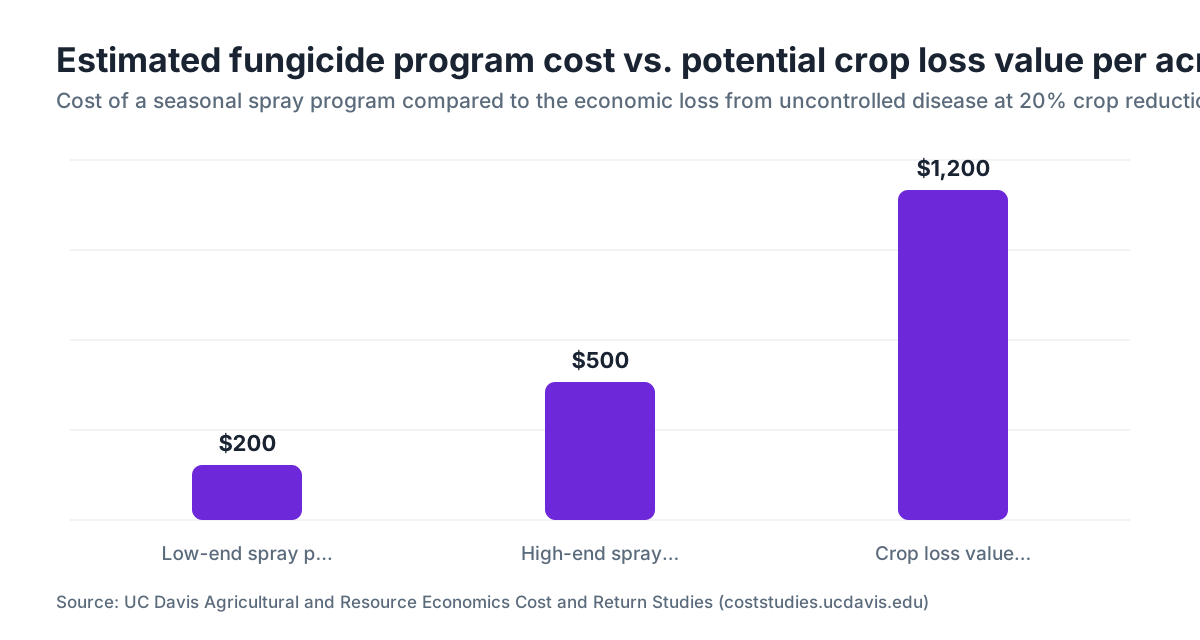
The spray program costs money too. A typical powdery mildew program in California runs 6 to 12 applications per season. At $15 to $40 per acre per application for materials alone (depending heavily on whether you're using sulfur, copper, or premium SDHI/DMI products), plus $20 to $50 per acre per application for custom application or tractor time, a season's fungicide program can easily run $200 to $500 per acre in direct costs. In humid eastern regions where pressure is higher and more active ingredients are needed, costs push higher [10].
That $200 to $500 is almost always worth it on vinifera at any price point above $800 per ton. The math is simple. Losing 20 percent of a 4-ton-per-acre crop at $1,500 per ton is a $1,200-per-acre loss. Preventing it for $300 in spray costs is a 4:1 return. The economics get murkier on lower-value varieties, in drought years with reduced crop load, or on disease-resistant hybrid varieties where baseline pressure is genuinely low.
For vineyard operations weighing the full picture, the most expensive decision is usually the one that happens too late: starting the program after symptoms appear, or running a skeleton program in a bad weather year. Disease doesn't give you a second chance on the current vintage.
What cultural practices reduce fungal disease pressure without more sprays?
Every spray you don't have to make is money and resistance risk you didn't spend. The cultural practices that genuinely move the needle are better understood than they're implemented.
Canopy management is the biggest lever. Dense, poorly positioned canopies create humid microclimates inside the fruit zone, slow drying after rain or morning dew, and make fungicide penetration nearly impossible after bunch closure. VSP (vertical shoot positioning) systems with proper shoot spacing, ideally 3 to 4 inches between shoots in the fruiting zone, produce measurably lower disease incidence than sprawling or hedged systems in multiple WSU and Cornell trials [5][3].
Leaf removal in the fruiting zone, timed to or slightly before bloom, has the best evidence base of any single cultural practice. Cornell fruit-zone leaf removal research shows Botrytis reductions of 30 to 60 percent in humid seasons when leaf removal happens at or before bloom versus removal done post-fruit set [3]. The effect on powdery mildew is real but smaller. Machine leaf removal at pre-bloom has become cost-competitive in most mid-sized operations.
Variety and clone selection is the most powerful long-term tool, though it obviously can't fix a block that's already planted. Tight-clustered Pinot Noir clones like Dijon 115 are far more susceptible to Botrytis than open-clustered clones like Pommard. Choosing looser-clustered selections when replanting in high-Botrytis-risk sites is worth the yield penalty, which is usually small.
Copper accumulation in vineyard soils is a real long-term problem in blocks with decades of copper fungicide use. California and EU rules have both tightened copper application limits for this reason. CDPR guidance restricts copper use in vineyards, and the EU currently allows a maximum of 28 kg of copper per hectare over 7 years (a 4 kg/ha/year average) [9]. If your soil tests show elevated copper, there are reasons beyond efficacy to rotate away from copper materials.
For growers running records across multiple blocks, tracking which blocks had the highest spray frequency in prior seasons, then correlating that with canopy and cultural data, often reveals that a few blocks carry the whole program's cost and resistance risk. Getting that picture takes decent records, which is where organized spray logs, paper or digital, pay for themselves.
Which fungicides are approved for organic viticulture?
Organic certification doesn't mean no fungicides. It means fungicides from approved materials lists, primarily the USDA National Organic Program (NOP) rules under 7 CFR Part 205 [11]. The approved options for fungal disease in organic vineyards are narrower but not trivial.
Sulfur is the workhorse. It's allowed under NOP, it's effective against powdery mildew, and at $3 to $8 per acre per application for the material, it's cheap. Phytotoxicity above 90 degrees F and poor activity on Botrytis are its limits. Wettable sulfur and dusting sulfur formulations are both NOP-compliant.
Copper is approved under NOP for disease control, with the condition that it's used in a way that minimizes soil accumulation. The practical meaning of that condition is contested, and your certifier may set its own guidelines. Copper's activity against Botrytis and powdery mildew is limited; it's more useful against downy mildew.
Kaolin clay (Surround) is NOP-compliant and provides some mechanical exclusion of insects, but its activity against fungal diseases is minimal. Biological fungicides based on Bacillus subtilis (Serenade, Rhapsody) and Bacillus amyloliquefaciens are NOP-compliant and have peer-reviewed data showing activity against Botrytis and powdery mildew, though efficacy is generally lower than synthetic options and more variable under high disease pressure [12].
Potassium bicarbonate (Kaligreen, Armicarb) is NOP-compliant and has reasonable efficacy against powdery mildew, often comparable to sulfur in university trials at equivalent rates. It has no phytotoxicity risk above 90 degrees F, which makes it a useful sulfur substitute in hot weather.
Growers going organic should expect, honestly, to spend more time on cultural management to make up for narrower chemistry. The approved materials are real tools, not placebos, but they need tighter application intervals and better timing than a synthetic DMI or SDHI program.
How do you track and document fungal disease management for compliance?
Spray records sit at the intersection of agronomic discipline and legal compliance, and they matter more than most small operations treat them. At the federal level, WPS requires two-year retention of application records [8]. In California, CDPR requires Pesticide Use Reports (PURs) filed with the county agricultural commissioner within a short window after each application, with records kept for at least two years, and many operations keep three [9]. Washington's Department of Agriculture has its own pesticide application record requirements under WAC 16-228 [13].
A complete fungicide application record captures: date and time of application, location (block ID, acreage), product name and EPA registration number, FRAC group (useful for your own resistance management, not always legally required but worth including), application rate, total amount of product used, target pest, equipment used, applicator name and license number, REI, and the PHI relative to expected harvest date.
The PHI check is easy to forget and genuinely costly to get wrong. Harvesting inside a fungicide's PHI is a label violation and can trigger rejected loads at a custom crush facility or failed residue tests. Some wineries now require growers to provide spray records as a condition of fruit purchase. That trend is growing, not shrinking.
Digital record-keeping platforms built for vineyard operations, VitiScribe being one example designed for this, make data entry faster and generate the compliance reports automatically. Whether you use software or a well-organized paper system, the goal is the same. If a county ag commissioner or a winery buyer asks for your spray records from the previous three seasons tomorrow morning, you can hand them over without a search.
For growers at vineyard operations scaling up, or those selling fruit to regulated markets, getting the record-keeping infrastructure right before a compliance issue arises is far easier than reconstructing records after the fact.
Frequently asked questions
Can powdery mildew overwinter on grapevines and re-infect next season?
Yes, and in two ways. Erysiphe necator overwinters as sexual fruiting bodies called cleistothecia on bark, releasing spores at bud break. It also survives as dormant mycelium inside infected buds, producing flag shoots the following spring. This is why early-season applications, starting at bud break rather than waiting for visible symptoms, matter so much. By the time you see white growth, the infection cycle is already well underway.
What's the difference between FRAC groups and why does it matter for spray rotation?
FRAC (Fungicide Resistance Action Committee) groups classify fungicides by biochemical mode of action. Products in the same group select for resistance the same way, so bouncing between two members of FRAC Group 11 isn't real rotation. True rotation means cycling through different groups across the season, including multi-site products like sulfur (FRAC M2) that carry essentially no resistance risk. Never apply the same single-site group more than twice in a row.
How do I know if my vineyard has QoI-resistant powdery mildew?
Field resistance to QoI (strobilurin) fungicides shows up as continued disease despite on-label applications. You can confirm it through bioassay testing offered by some university plant pathology labs, including UC Davis and Cornell. In regions like California and New York, QoI resistance in powdery mildew populations is now widespread enough that many advisors recommend treating QoI efficacy as compromised by default unless you have recent bioassay data showing otherwise.
Is botrytis worse in some grape varieties than others?
Significantly. Variety and clone drive cluster architecture, and cluster architecture is the biggest biological factor in Botrytis susceptibility. Tight-clustered varieties, Pinot Gris, Gewurztraminer, Riesling, some Pinot Noir clones, and Muscat types, create the interior berry-to-berry contact and humidity that Botrytis needs. Open-clustered varieties like Grenache and Viognier are less susceptible all else being equal. Clonal selection within a variety can shift risk by a meaningful margin.
What pre-harvest interval do I need to observe for common fungicide products?
PHIs vary widely by product and formulation. Common examples: sulfur is typically 0 days (check label), myclobutanil (Rally) is 7 days, tebuconazole varies from 7 to 14 days by formulation, cyprodinil plus fludioxonil (Switch) is 7 days, and captan is 3 days on some labels. These figures come from product labels, which are legal documents. Always verify the specific formulation you're using because the same active ingredient at different manufacturers can carry different PHIs.
Do disease-resistant grape varieties eliminate the need for fungicide programs?
Not eliminate, but they can cut programs substantially. Varieties with multi-gene resistance like Marquette, Frontenac, and newer PIWI varieties from European breeding programs show far lower powdery and downy mildew susceptibility than Vitis vinifera. In practice, most disease-resistant plantings in humid climates still run 2 to 4 fungicide applications per year rather than 8 to 12, which is a real operational and cost difference. The trade-off is usually some compromise on wine style.
When is it too late in the season to apply fungicides effectively?
For berry protection against powdery mildew, the useful window closes around four to five weeks post-bloom when berry skins begin to toughen. After bunch closure, spray penetration into the cluster interior is poor for most equipment, so Botrytis applications after that point give limited protection in tight-clustered varieties. After veraison, PHI constraints eliminate many active ingredients. Late-season applications on already-infected fruit are mostly wasted money.
What records do I need to keep for pesticide applications in a vineyard?
Federal WPS requires retention of application records for two years minimum, including product name, EPA registration number, crop, date, location, and certified applicator. California CDPR requires Pesticide Use Reports filed with the county ag commissioner soon after each application, with records kept for at least two years. Washington and New York have similar state-level requirements. If you sell fruit commercially, many wineries now require spray records as part of fruit purchasing agreements.
Can sulfur-based fungicides damage grapevines?
Yes. Sulfur causes phytotoxicity, mainly leaf burn and fruit russeting, when applied at temperatures above 90 to 95 degrees Fahrenheit, or within two weeks of certain petroleum-based spray oils. Some varieties are more sensitive than others; Concord and some French-American hybrids can show sulfur injury at lower temperatures than most vinifera. The risk is real enough that checking the daily high temperature forecast before any sulfur application is worth doing.
Does Botrytis survive in vineyard soil over winter?
Botrytis cinerea survives primarily as sclerotia on plant debris, especially mummified berries and infected canes left on the vine or the ground. It's not primarily a soil pathogen. Removing mummies from the canopy before bud break each spring reduces primary inoculum meaningfully. This is one of the clearer cases where a cultural practice, taking about an hour per acre in a modestly infected block, delivers measurable disease reduction the following season.
What's the best fungicide program for a small home vineyard or hobby block?
A simple sulfur-based program on a 10 to 14-day interval from bud break through bunch closure handles powdery mildew adequately in most dry-summer climates. Add a DMI or SDHI product at pre-bloom and post-bloom if you've had berry infection in prior years. Skip the strobilurins; QoI resistance is widespread enough that these products often aren't worth their cost. Copper can be added for downy mildew if your site gets summer rain. Total cost under $50 per acre per season is achievable.
How does humidity affect grapevine fungal disease risk?
Each pathogen has a different humidity relationship. Powdery mildew is unusual in that it doesn't need free water, just relative humidity above about 40 percent, and thrives in dry-summer conditions. Downy mildew and black rot require free moisture on leaf surfaces for infection periods measured in hours at a given temperature. Botrytis needs high humidity inside the cluster microclimate rather than broad ambient humidity. This is why canopy management, by improving airflow, cuts Botrytis risk even in humid regions.
Are there biological fungicide options that actually work?
Yes, with caveats. Bacillus subtilis products (Serenade, Rhapsody) and Bacillus amyloliquefaciens strains have peer-reviewed evidence of activity against Botrytis and powdery mildew, and they're NOP-compliant for organic operations. Efficacy under high disease pressure is generally lower than synthetic fungicides, and they need more frequent applications, often 5 to 7-day intervals. They work best inside a rotation that includes sulfur and copper rather than as standalone programs.
Sources
- UC Statewide Integrated Pest Management Program, Grape Pest Management Guidelines (Powdery Mildew): Erysiphe necator spores can germinate at relative humidity as low as 40 percent; the critical berry infection window runs from 50 percent bloom through four to five weeks post-bloom
- Cornell Grapes and Wine, Cornell CALS Viticulture and Enology Extension (Botrytis Bunch Rot): Leaf removal at or before bloom reduces Botrytis incidence significantly in humid eastern climates; low-level Botrytis incidence produces measurable off-flavors in finished wine per AJEV data cited by extension
- Cornell Grapes and Wine, Cornell CALS Viticulture and Enology Extension (Downy Mildew): Plasmopara viticola is an oomycete requiring free moisture on leaf surfaces; primarily a problem in humid climates including eastern North America and Europe
- Washington State University Viticulture and Enology: WSU decision support tools provide downy mildew forecasting for Pacific Northwest growers; VSP canopy systems with 3-4 inch shoot spacing produce measurably lower disease incidence in trials
- Cornell Grapes and Wine, Cornell CALS Viticulture and Enology Extension (Black Rot): At 77 degrees Fahrenheit, black rot infection requires only 6 hours of continuous wetness; the Cornell black rot risk model uses temperature-wetness relationships to generate infection period alerts
- Fungicide Resistance Action Committee (FRAC), FRAC Code List: QoI (strobilurin, FRAC Group 11) resistance in powdery mildew populations is documented in every major U.S. wine region; resistance frequencies exceed 80 percent in some California and New York vineyards
- U.S. EPA, Agricultural Worker Protection Standard, 40 CFR Part 170: WPS requires two-year retention of application records, annual worker training, REI posting requirements, and application notification; 2015 revision fully implemented by 2017
- California Department of Pesticide Regulation: CDPR requires Pesticide Use Reports filed with the county agricultural commissioner after application, multi-year record retention, and copper application limits due to soil accumulation concerns
- UC Davis Agricultural and Resource Economics, Cost and Return Studies: Typical California powdery mildew program runs 6-12 applications per season at $15-40 per acre in materials plus $20-50 per acre application cost; total seasonal disease management costs $200-500 per acre
- USDA National Organic Program, 7 CFR Part 205: Sulfur, copper, potassium bicarbonate, kaolin clay, and Bacillus subtilis products are approved under NOP for organic vineyard fungal disease management
- UC Statewide Integrated Pest Management Program, Grape Pest Management Guidelines: Bacillus subtilis and Bacillus amyloliquefaciens products have peer-reviewed activity against Botrytis and powdery mildew but lower efficacy under high disease pressure compared to synthetic options
- Washington State Department of Agriculture, Pesticides (WAC 16-228): Washington State requires pesticide application records under WAC 16-228 with specific data fields including EPA registration number, certified applicator, and treated location
Last updated 2026-07-09