Grapevine leaf diseases: identification, timing, and control
TL;DR
- Four leaf diseases cost grape growers the most: powdery mildew, downy mildew, black rot, and Phomopsis leaf blight.
- Each has a distinct symptom pattern, a specific infection window, and a fungicide class that works.
- Catching them early, before symptoms spread across the canopy, is the difference between a manageable spray program and a lost crop.
What are the most common grapevine leaf diseases?
Four pathogens cause almost all leaf disease losses in commercial vineyards: powdery mildew (Erysiphe necator, formerly Uncinula necator), downy mildew (Plasmopara viticola), black rot (Guignardia bidwellii), and Phomopsis cane and leaf spot (Diaporthe ampelina). A fifth, Botrytis bunch rot, shows up on leaves in dense canopies but does its real damage on fruit, so it lives in the bunch rot literature.
Powdery mildew is the one you fight every season, everywhere. The pathogen is an obligate biotroph that lives only on living tissue, so it can't overwinter in dead organic matter. It spreads entirely by airborne conidia and needs no free water to germinate. That's why a dry California summer doesn't protect you the way growers sometimes assume [1].
Downy mildew is the opposite in nearly every way. Plasmopara viticola needs liquid water for zoospore release, thrives in cool wet springs, and is an oomycete, not a true fungus. That distinction has teeth. Oomycetes run a different sterol pathway, so standard DMI (sterol demethylation inhibitor) fungicides do nothing against it.
Black rot and Phomopsis both overwinter in infected canes and mummified berries, then release spores during cool wet spring rains. They hit hardest in the eastern U.S. and Pacific Northwest, but they can appear anywhere rainfall passes about 20 inches during the growing season.
Know which pathogen you're looking at before you spray. Applying a downy mildew product to a powdery mildew outbreak wastes money and piles unnecessary pesticide load onto your records.
How do I identify powdery mildew on grapevine leaves?
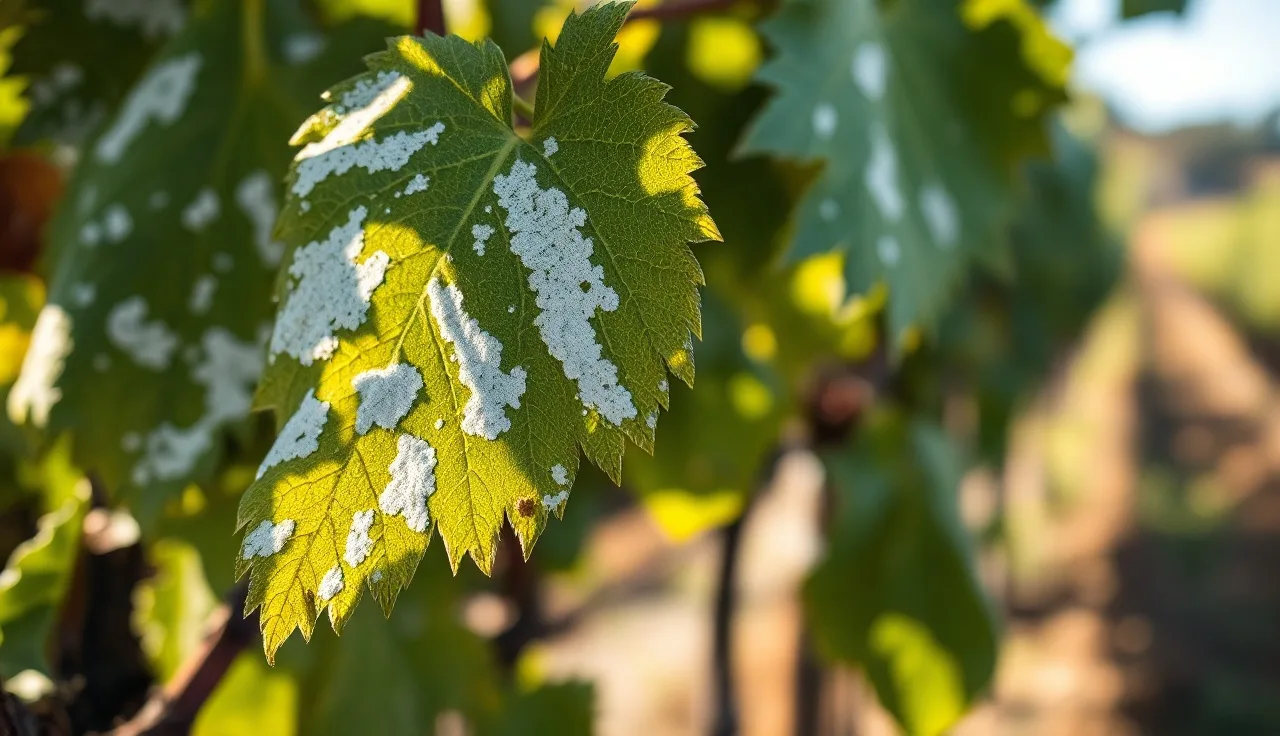
Powdery mildew shows as a white to gray powdery coating on both leaf surfaces. Young leaves curl upward and look stunted. On older leaves the coating sometimes turns brown or rusty. The tissue underneath stays green, which separates it from leaf spots where tissue dies and discolors [1].
On fruit, powdery mildew stops the berry skin from expanding while the pulp keeps growing, so the berry cracks open. That crack is a direct Botrytis entry point. Cluster infections before berry set can cost up to 80% of the crop in a bad year, which is why the two-to-six-week window after bloom gets the most spray attention.
The pathogen overwinters as chasmothecia (formerly called cleistothecia) embedded in bark and as dormant mycelium in infected buds. In spring, chasmothecia release ascospores when bark temperature reaches roughly 50°F and rain or dew wets the surface. That primary release happens once. Everything after that is secondary spread by conidia.
One early detection trick works well. At early shoot growth, pull a few buds and look for a grayish bloom on the inner scales under magnification. If you see it, primary inoculum pressure is high and you start your spray program at bud break, not at bloom.
What does downy mildew look like on grapevines?
The first symptom is an oily, pale yellow-green spot on the upper leaf surface, often called an oil spot. On the underside directly beneath it, you'll see white cottony sporulation under humid conditions, usually early morning. That white fuzz is the tell. Black rot lesions and bacterial angular leaf spots never produce it [2].
As the season runs on, infected tissue turns brown and dies. Heavy infections drop leaves early, which weakens the vine and exposes fruit to sunburn. Infected young berries turn brown and shrivel into a hardened mass. Older berries past the resistant stage (roughly three to four weeks after fruit set) can still get infected on the rachis, and that collapses the whole cluster.
Downy mildew needs specific conditions for primary infection, codified in what viticulture textbooks call the "10-10-10 rule": shoots at least 10 cm long, soil temperature at least 10°C (50°F), and at least 10 mm of rainfall. When those three line up at once, assume spores are moving [2].
In the eastern U.S. and Oregon's Willamette Valley, that threshold usually gets crossed in late April or May. In California's coastal regions it can wait until June. In some dry interior valleys it barely triggers at all in a normal year.
How does black rot spread and what are its symptoms?
Black rot is the most destructive foliar and fruit disease in eastern North American vineyards. Cornell plant pathology extension lays out the cycle plainly: Guignardia bidwellii overwinters in mummified berries and infected canes, then releases ascospores during wet weather from roughly bud break through four to six weeks after bloom [3]. That's your entire high-risk window.
Leaf symptoms start as small, light brown circular spots with a dark brown margin. Within a few days the center shows a ring of tiny black pycnidia (the asexual fruiting bodies) that look like pepper grains under a hand lens. That pepper-grain ring is diagnostic. Nothing else common on a grape leaf looks quite like it.
On shoots and petioles, black rot creates dark elongated lesions. On fruit it turns the berry brown, then black, then shrivels it into a hard, ridged mummy that stays stuck to the cluster. Those mummies are next season's primary inoculum, so pulling them out at pruning cuts disease pressure the following year.
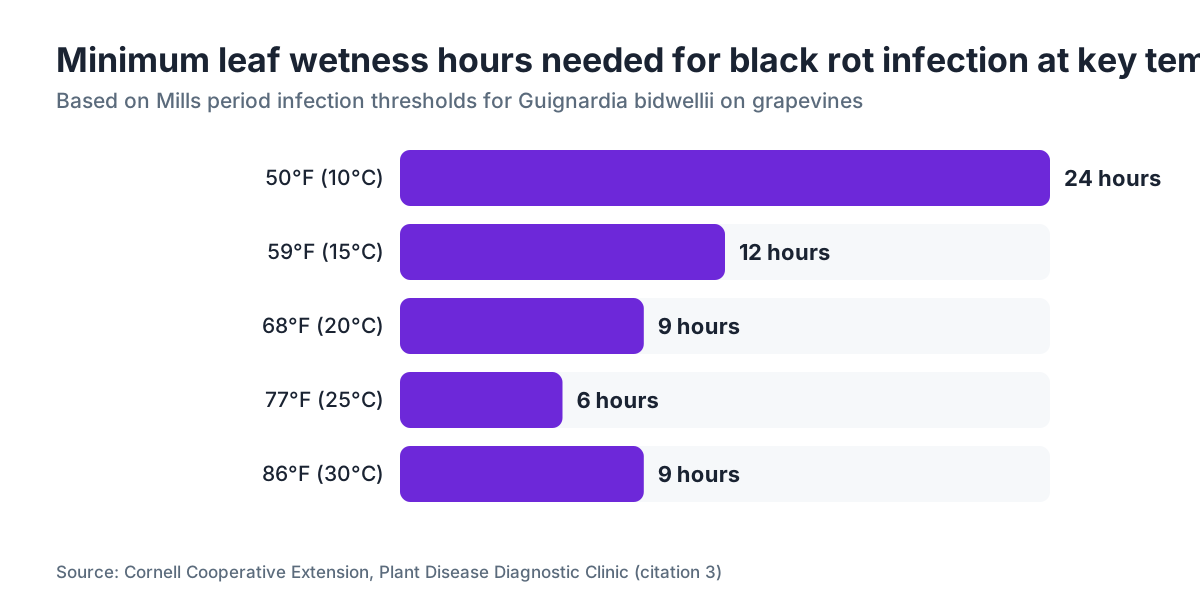
Black rot needs a wet leaf surface to infect. The standard reference is the Mills period table, developed by plant pathologist W.D. Mills in the 1940s and updated since, which gives the minimum leaf wetness hours at each temperature needed for infection. At 77°F (25°C), just 6 hours of wet leaves triggers infection. At 50°F (10°C), it takes about 24 hours [3]. Most disease warning apps, including the ones baked into weather station platforms, run some version of this model.
What is Phomopsis leaf blight and when does it matter?
Phomopsis cane and leaf spot comes from Diaporthe ampelina (formerly Phomopsis viticola). On leaves it shows as small, irregular, yellow-bordered spots near the margins and around major veins. Heavily infected leaves yellow and drop. But the leaf symptoms are rarely the money problem. The real damage lands on the first five or six nodes of new canes, where dark lesions girdle the wood and kill those shoot segments or leave fruit with poor set [4].
Phomopsis overwinters in infected canes as pycnidia that release spores during cool wet weather in early spring. The infection window is tight: the pathogen is most aggressive from bud swell through about five or six inches of shoot growth. After that the new tissue lignifies enough to resist infection. So your spray timing is front-loaded, hard.
Pacific Northwest vineyards, plus the Finger Lakes, Midwest, or Mid-Atlantic sites that get regular spring rain above about 2 inches in April and May, should treat Phomopsis as a first-spray priority. In a dry spring you can often skip dedicated Phomopsis sprays and pick up coverage from broad-spectrum materials used for other diseases.
WSU extension notes that Phomopsis has become a bigger concern as winery demand pushed viticulture into wetter, cooler climates where traditional vinifera wasn't grown [4]. If you farm one of those regions, pull some canes at dormant pruning each year and check the base nodes for the bleached, dotted lesions. That reading tells you how hard to hit it the next spring.
What fungicides work for each grapevine leaf disease?
Matching the chemistry to the pathogen is the single biggest variable in a spray program. The table below covers the major chemical classes, their target pathogens, and their FRAC (Fungicide Resistance Action Committee) group numbers, which you need for resistance management.
| Disease | Effective FRAC Groups | Example Active Ingredients | Notes |
|---|---|---|---|
| Powdery mildew | 3, 7, 11, 13, 50, U6 | Myclobutanil, Tebuconazole, Azoxystrobin, Quinoxyfen, Cyflufenamid | DMIs (Group 3) show resistance in some populations; rotate |
| Downy mildew | 4, 21, 28, 40, 45 | Metalaxyl, Cyazofamid, Dimethomorph, Phosphorous acid | Never use DMIs; different biochemistry |
| Black rot | 3, 7, 11 | Myclobutanil, Boscalid, Azoxystrobin | Protectant timing critical; DMIs have some curative window |
| Phomopsis | M (multi-site), 3 | Mancozeb, Captan, Myclobutanil | Early-season protectants most reliable |
Resistance is real and documented. Powdery mildew populations resistant to QoI fungicides (FRAC Group 11, the strobilurins) have been confirmed in multiple California counties by UC researchers [1]. The practical recommendation from UC Cooperative Extension is to never use a Group 11 material as a solo powdery mildew product and to cap it at two applications per season.
Organic operations have workable options. Sulfur is still the backbone of organic powdery mildew control and has no resistance history. Copper products handle downy mildew and have some activity on black rot. Potassium bicarbonate (OMRI-listed) works against powdery mildew when pressure runs low to moderate. The tradeoff is shorter residual activity and more applications in wet seasons.
Re-entry intervals (REIs) and pre-harvest intervals (PHIs) vary a lot by product. Mancozeb has a 24-hour REI and a 66-day PHI in most registrations, which sets how late in the season you can use it. Under the EPA Worker Protection Standard, you must post REI information at the vineyard entrance and keep it in your spray records [5]. This is exactly where record-keeping errors surface during audits.
When should I start my spray program for leaf diseases?
Timing, not the total number of sprays, decides whether a program works. The most common mistake is waiting until you see disease before spraying. By then the pathogen has infected tissue you can't save, and secondary spread is already running.
For powdery mildew, start at bud break in high-inoculum vineyards, or at 1-inch shoot growth in lower-pressure sites. UC Cooperative Extension recommends that in blocks with a history of severe powdery mildew, applications begin at 1-inch shoot growth and continue on 7-to-14-day intervals through fruit set [1].
Downy mildew programs start at the first rain event that clears the 10-10-10 criteria. In a wet year that might be early May. In a dry year you might not spray at all until June or later.
Black rot timing follows the Mills period model. The highest-risk stretch runs from early bloom through four weeks post-bloom. Cornell extension recommends not skipping applications in this window even when weather looks dry, because one overnight rain is enough to trigger infection [3].
Phomopsis applications live almost entirely in the bud swell through 6-inch shoot growth window. Miss it and the season's chance is gone.
Growing degree day (GDD) models sharpen timing beyond calendar dates. UC IPM tools and the Network for Environment and Weather Applications (NEWA), run through Cornell, both offer grape disease models fed by real-time weather from your nearest station. They're free and genuinely useful, especially for black rot and downy mildew infection period calculations [6].
How much yield loss can leaf diseases cause?
The numbers swing widely by region, variety, disease pressure, and management, so any single figure is a rough guide. Still, the research is consistent enough to give useful ranges.
Powdery mildew on susceptible varieties like Chardonnay, Merlot, and Cabernet Sauvignon can cost 20-80% of the crop in unmanaged vineyards during severe years [1]. UC research has documented yield reductions over 50% in unsprayed trial plots in warm inland California regions [11].
Downy mildew caused heavy losses in the eastern U.S. before copper and synthetic fungicides existed. In modern managed vineyards with a good spray program, losses usually stay under 10%. But in organic or low-input operations during very wet years, defoliation losses of 30-40% have been reported in European vineyards [2].
Black rot is the economic driver across much of the eastern U.S. Cornell plant pathology research cites complete crop loss as possible in unmanaged blocks during wet New York years [3]. Typical managed losses with a spray program run 2-5% in a normal year, spiking to 15-30% when a late-May rain coincides with full bloom and the program falls behind.
The math is stark. At $1,500 per ton for wine grapes (a rough mid-range for many regions), a 10-ton-per-acre block taking a 20% hit from black rot loses $3,000 an acre that season. A spray program running $400-600 per acre pays for itself many times over.
What records do I need to keep for fungicide applications?
Spray records are not optional in any state with a commercial pesticide licensing system, which is all of them. The federal baseline is the EPA Worker Protection Standard (40 CFR Part 170). It requires that pesticide application records be kept for at least two years and be available to agricultural workers and their designated representatives on request [5].
Most states pile their own rules on top. California's Department of Pesticide Regulation (CDPR) requires licensed applicators to submit a Pesticide Use Report (PUR) monthly, listing the county, section, township, range, commodity, product name, EPA registration number, total product used, and total acres treated [7]. That's a real administrative load if you do it by hand.
At minimum, each application record should capture date and time, product name and EPA registration number, rate applied (per acre and total), total acres treated, applicator name and license number where required, target pest, crop growth stage, and REI/PHI information. Some auditors also want wind speed and direction, equipment type, and water volume.
This is where digital record-keeping earns its cost. VitiScribe is built around vineyard spray records and compliance workflows, so if you manage more than 20 acres or fall under CDPR PUR reporting, running records in a spreadsheet creates real audit risk. Spray records tied straight to block maps and weather data are worth the money.
For organic certification, the USDA National Organic Program (NOP) requires that records of all materials applied to organic ground be kept for five years and be available to your certifying agent on request [8]. If you're transitioning blocks, those records document the three-year transition period.
Are some grape varieties more resistant to leaf diseases?
Yes, and by a lot. Vitis vinifera varieties like Chardonnay, Merlot, Cabernet Sauvignon, and Pinot Noir are highly susceptible to both powdery and downy mildew because they have essentially no co-evolutionary history with these pathogens. Erysiphe necator and Plasmopara viticola are both of North American origin, and downy mildew spread from North America to Europe in the 1870s.
American Vitis species, including V. labrusca, V. riparia, and V. rupestris, carry varying levels of natural resistance. That's the genetic base for most hybrid breeding programs. Cornell's grape breeding program has released disease-resistant wine grapes like Marquette, Frontenac, and Traminette that carry resistance genes from V. riparia and other American species [9]. These varieties often grow on two to four fungicide applications a season instead of the 8-12 a vinifera program needs in a wet year.
The German and Swiss programs have produced a run of PIWI varieties (Pilzwiderstandsfähige, meaning fungus-resistant), including Regent, Solaris, and Johanniter. They're gaining commercial traction in the UK, Germany, and parts of Switzerland. Downy mildew resistance in these varieties comes from quantitative trait loci mapped to specific chromosome locations in the Vitis genome.
If you're establishing new blocks in a high-disease-pressure region, the variety choice is the highest-leverage disease decision you'll ever make. No spray program fully covers for planting a highly susceptible variety in a humid climate.
How do canopy management practices affect leaf disease pressure?
Canopy architecture decides how fast a leaf disease spreads once it takes hold. Dense, shaded canopies trap humidity, block spray penetration, and build the microclimate downy mildew and black rot want. This is not subtle. UC research on canopy management in Chardonnay found that shoots positioned and hedged into a single-curtain open canopy had significantly lower powdery mildew incidence than unpruned control vines [11].
Shoot thinning and leaf removal around the fruit zone do two jobs at once. They cut humidity around the clusters and they open the fruit zone to spray coverage. Timing matters. Leaf removal done before bloom (at three to five leaves unfolded) acclimates the berry skin to UV and lowers Botrytis risk more than removal done after fruit set.
Row orientation moves disease pressure too. North-south rows put sun on both sides of the canopy through the day, which shortens morning dew retention. East-west rows shade one side most of the morning, stretching leaf wetness and raising infection risk.
Cover crop and irrigation management count as well. Flood-irrigated vineyards or solid-set sprinklers that wet foliage raise downy mildew and black rot risk sharply compared with drip. If you run overhead cooling for spring frost protection, that's a real disease trigger for Phomopsis and downy mildew.
For the broader picture of how block-level decisions cascade through operations, the vineyard overview covers the ground.
What's the role of weather monitoring in disease forecasting?
Weather data is the base of any disease program that isn't just calendar spraying. You need temperature, relative humidity (or leaf wetness), and rainfall at or very near the vineyard. A weather station 10 miles away in a different valley is not good enough for downy mildew or black rot infection modeling.
In-vineyard stations have dropped in price over the past decade. A basic setup with temperature, humidity, and a rain gauge costs $300-600 at the low end (brands like Davis Instruments and Onset HOBO). Agricultural systems with leaf wetness sensors and cellular data transmission run $800-2,000. The payback from one avoided spray, or one correctly timed spray, covers a multi-year return on that hardware.
NEWA (Network for Environment and Weather Applications), run by Cornell, provides free disease and pest models for grapes across the northeastern U.S. and other growing regions [6]. You enter your station data or pick a nearby partner station, and it runs the Gubler-Thomas powdery mildew risk model, the Mills period black rot model, and the downy mildew primary infection model. The output is an infection risk rating telling you whether the next spray is urgent, routine, or can wait.
UC IPM Online offers similar tools for California growers, including the grape powdery mildew risk model developed by Doug Gubler and colleagues [1]. These resources are free, peer-reviewed, and updated regularly. There's no good reason to skip them.
Tracking your sprays against actual infection events over several seasons builds a site-specific dataset that sharpens decisions over time. That's where software like VitiScribe pays off beyond compliance, because the records turn into an analytical tool.
How do I manage fungicide resistance in my spray program?
Resistance is a selection pressure problem. Every time you apply a single-site fungicide (DMIs, strobilurins, SDHI fungicides), you select for the small fraction of the pathogen population that survives it. Repeat that pressure enough, and the resistant population takes over. In California, QoI-resistant powdery mildew is widespread enough that the Gubler-Thomas risk model has been adjusted for growers who leaned too hard on strobilurins.
The practical tools are plain. Rotate FRAC groups. Don't follow a Group 11 material with another Group 11; alternate with a Group 3 DMI, a Group 7 SDHI, or a Group 50 product. Cap the number of applications per season for high-risk groups. FRAC guidance generally recommends no more than two to three applications a season for Group 3, 7, and 11 materials. Lean on multi-site protectants (FRAC Group M) like sulfur, mancozeb, or captan at least two to three times a season. These broad-spectrum materials have no known resistance history because they attack multiple fungal enzymes at once.
For powdery mildew, UC IPM guidelines recommend mixing or alternating DMIs with multi-site materials through the high-risk bloom period rather than running DMIs alone [1]. Sulfur at 3-5 pounds of elemental sulfur per acre is still a highly effective powdery mildew product on 7-to-10-day intervals in warm, dry conditions. Don't apply sulfur when temperatures will top 95°F (35°C) within 48 hours. It burns the vine at high heat.
Keep your FRAC group data in the spray records. If you don't track which group each product belongs to, you can't manage resistance systematically. The FRAC website publishes a free updated code list each year mapping every registered fungicide to its mode of action group [10].
Frequently asked questions
Can powdery mildew spread to grapevines from other plants?
The grape powdery mildew pathogen (Erysiphe necator) is host-specific to Vitis species and does not spread from other plants or infect them. Roses near your vineyard, sometimes used as sentinel disease indicators, carry a different powdery mildew species that poses no infection risk to your vines. Your inoculum comes only from infected grape tissue that overwintered on-site or blew in from nearby vineyards.
How long does mancozeb residue last on leaves and what's the pre-harvest interval?
Mancozeb is a contact protectant with no systemic activity, so re-apply after rain events over roughly 1.5 inches or after 10-14 days in dry conditions. The labeled pre-harvest interval (PHI) for mancozeb on grapes is 66 days in most registrations. Plan your last application carefully. In regions with short seasons or early harvest, this PHI closes your mancozeb window well before veraison.
Is copper safe to use on all grape varieties for downy mildew?
Copper is generally safe on mature grapevine tissue but can burn young shoots during cool wet springs when the spray dries slowly. Varieties like Concord, Niagara, and some hybrids are more sensitive than vinifera. Keep rates at or below 1-2 pounds of metallic copper equivalent per acre per application. Cumulative copper loading in soil is a long-term concern too, especially in organic operations that lean on it heavily.
What's the difference between Phomopsis and black rot on grape leaves?
Both show small brown spots, but they look different up close. Black rot lesions carry a distinct ring of tiny black pepper-grain pycnidia visible under a hand lens, ringed by a dark brown border. Phomopsis spots are smaller, more irregular, often yellow-margined, and cluster near the veins and leaf margin. Neither has the white sporulation of downy mildew. Timing differs too: Phomopsis peaks in early spring, black rot from bloom through 4 weeks post-bloom.
Do spray records need to include the worker re-entry interval?
Federal Worker Protection Standard rules under 40 CFR Part 170 require the REI be communicated to workers and posted at the establishment. The core application records required under state pesticide use regulations generally need the product name, EPA registration number, rate, acres, and applicator information. California's Pesticide Use Report system and most state equivalents don't require logging the REI in the record itself, but keeping it there is good practice for audits and helps supervisors manage field crew access.
Can I use the same fungicide program for all my grape varieties?
You can use the same products, but timing and frequency should track variety susceptibility. A Pinot Noir block next to a Marquette block needs a different schedule: the Pinot wants 8-12 applications in a wet year, the Marquette might want 2-4. Running a full vinifera program on a resistant hybrid wastes money and adds unnecessary residue risk. Map disease history by variety and adjust your block-level programs each season.
When is it too late in the season to spray for black rot?
Black rot infection risk drops sharply once berries reach about 6-7 weeks after fruit set (roughly when green berries hit 8-10mm diameter), because berry resistance climbs as they mature. After that, rachis infections are still possible but less common. Cornell extension guidance recommends holding your program through 4-6 weeks post-bloom, then judging whether pressure warrants continuing. In a dry season you can often stop by mid-July in northeastern U.S. vineyards.
What's the 10-10-10 rule for downy mildew?
The 10-10-10 rule is a field trigger for downy mildew primary infection risk. It needs three conditions at once: shoots at least 10 cm (roughly 4 inches) long, soil temperature at or above 10°C (50°F), and at least 10 mm (roughly 0.4 inch) of rainfall. When all three align, assume Plasmopara viticola zoospores are being released and moving. This is the standard starting point for downy mildew spray programs across Europe and the wetter parts of the U.S.
How do I know if powdery mildew resistance to strobilurins is a problem in my vineyard?
The clearest sign is poor control despite correctly timed Group 11 applications at labeled rates in appropriate conditions. If you're applying azoxystrobin or trifloxystrobin on schedule and still watching powdery mildew spread fast, resistance is likely. UC and some state diagnostic labs can test populations for QoI resistance mutations. The fix is to stop using Group 11 products as a sole active ingredient and rotate to DMIs, Group 7 SDHIs, and sulfur. Strobilurins can still work in premix products combined with a different FRAC group.
Are disease-resistant grape varieties worth planting for a commercial winery?
It depends on your market. Cornell-bred varieties like Marquette, La Crescent, and Frontenac make serious wine and are gaining acceptance in the eastern U.S. and upper Midwest. European PIWI varieties are finding buyers in the UK and Germany. The catch is consumer recognition: planting Marquette instead of Pinot Noir means marketing an unfamiliar name. For high-pressure regions where a vinifera program costs $600-900 per acre in fungicides alone, the economics increasingly favor resistant varieties in at least part of the portfolio.
What should I do if I see oil spots on my grapevine leaves in spring?
Oil spots on the upper leaf surface with white cottony sporulation underneath are textbook downy mildew. Act now. Downy mildew can spread from a few infected leaves across a big share of the canopy within a week in humid, warm conditions. Apply an oomycete-active product (phosphorous acid, dimethomorph, cyazofamid, or a metalaxyl-class material) within 24-48 hours and re-evaluate your spray interval. Don't reach for a standard DMI fungicide; it does nothing against Plasmopara viticola.
How do I include fungicide applications in an organic certification compliance record?
The USDA National Organic Program under 7 CFR Part 205 requires you to record every input application, including OMRI-listed materials like sulfur, copper, potassium bicarbonate, and Bacillus subtilis-based products, with product name, rate, date, location, and target pest. These records must be kept for five years and made available to your certifying agent. Keep the product label and OMRI listing documentation on file too, since certifying agents often ask for proof the material is approved.
Does leaf removal help control powdery mildew in the fruit zone?
Yes, substantially. Removing leaves in the cluster zone before or just after bloom improves air circulation, cuts humidity in the fruit microclimate, and opens fungicide spray penetration to the clusters. UC canopy management research found lower powdery mildew incidence on fruit in leaf-removed treatments versus unmanaged canopies. Timing matters: pre-bloom removal gives the most benefit and also builds berry skin tolerance to sun. Post-harvest defoliation offers minimal disease benefit.
What minimum weather station data do I need for disease modeling?
At minimum: hourly temperature, relative humidity or leaf wetness duration, and daily rainfall totals. Those three inputs run the Mills period model for black rot, the downy mildew primary infection model, and the Gubler-Thomas powdery mildew risk model. Leaf wetness sensors are more accurate than RH-based estimates but cost more. Where you place the sensor matters as much as its quality: put it at canopy height in a representative block, because a station on a hill or near a building misreads what's happening in the vine row.
Sources
- UC IPM Online, UC Statewide IPM Program, UC Davis: Powdery Mildew on Grapes: Powdery mildew can cause 20-80% crop loss in unmanaged vineyards; QoI resistance documented in California; leaf removal and canopy management reduce incidence; spray timing recommendations from bud break through fruit set.
- UC IPM Online, UC Statewide IPM Program, UC Davis: Downy Mildew on Grapes: Oil spot symptoms on upper leaf surface; white cottony sporulation on underside; 10-10-10 rule for primary infection conditions; oomycete biochemistry means DMI fungicides have no efficacy.
- Cornell Cooperative Extension, Plant Disease Diagnostic Clinic: Black Rot of Grape: Black rot overwinters in mummified berries and infected canes; spore release through 4-6 weeks after bloom; Mills period table infection thresholds; complete crop loss possible in unmanaged eastern U.S. vineyards.
- Washington State University Extension: Phomopsis Cane and Leaf Spot of Grape: Diaporthe ampelina infects first 5-6 nodes of new canes; infection window from bud swell through 6 inches of shoot growth; increasing concern as viticulture moves to wetter, cooler climates.
- EPA: Agricultural Worker Protection Standard (40 CFR Part 170): Pesticide application records must be kept for at least two years and available to agricultural workers; REI information must be posted at the vineyard entrance.
- NEWA (Network for Environment and Weather Applications), Cornell University: Grape Disease Models: NEWA provides free Gubler-Thomas powdery mildew risk model, Mills period black rot model, and downy mildew primary infection models using real-time regional weather station data.
- California Department of Pesticide Regulation: Pesticide Use Reporting: California licensed applicators must submit monthly Pesticide Use Reports including county, section, township, range, commodity, product name, EPA registration number, total product used, and total acres treated.
- USDA National Organic Program: 7 CFR Part 205: NOP requires records of all materials applied to organic ground be kept for five years and available to certifying agent; documents the three-year transition period.
- Cornell University, College of Agriculture and Life Sciences: Grape Breeding and Genetics Program: Cornell has released disease-resistant wine grape varieties including Marquette, Frontenac, and Traminette carrying resistance genes from V. riparia; these can be grown with 2-4 fungicide applications per season versus 8-12 for vinifera in wet years.
- FRAC (Fungicide Resistance Action Committee): FRAC Code List: FRAC publishes an annual updated code list mapping every registered fungicide to its mode of action group; essential reference for resistance management rotation planning.
- UC ANR Publication: Grape Pest Management Guidelines (UC Davis Viticulture and Enology): UC research documented yield reductions over 50% in unsprayed powdery mildew trial plots in warm inland California; canopy management single-curtain system showed significantly lower disease incidence.
- WSU Viticulture and Enology Extension: Pacific Northwest Pest Management Handbooks: Fungicide program costs, variety susceptibility data, and disease pressure in Pacific Northwest viticulture regions.
Last updated 2026-07-09