Grapevine pests and diseases: the complete field guide

TL;DR
- The four biggest threats in most U.S.
- vineyards are powdery mildew, botrytis bunch rot, grape leafhopper, and phylloxera.
- Correct ID drives everything: the wrong spray at the wrong time wastes money and breeds resistance.
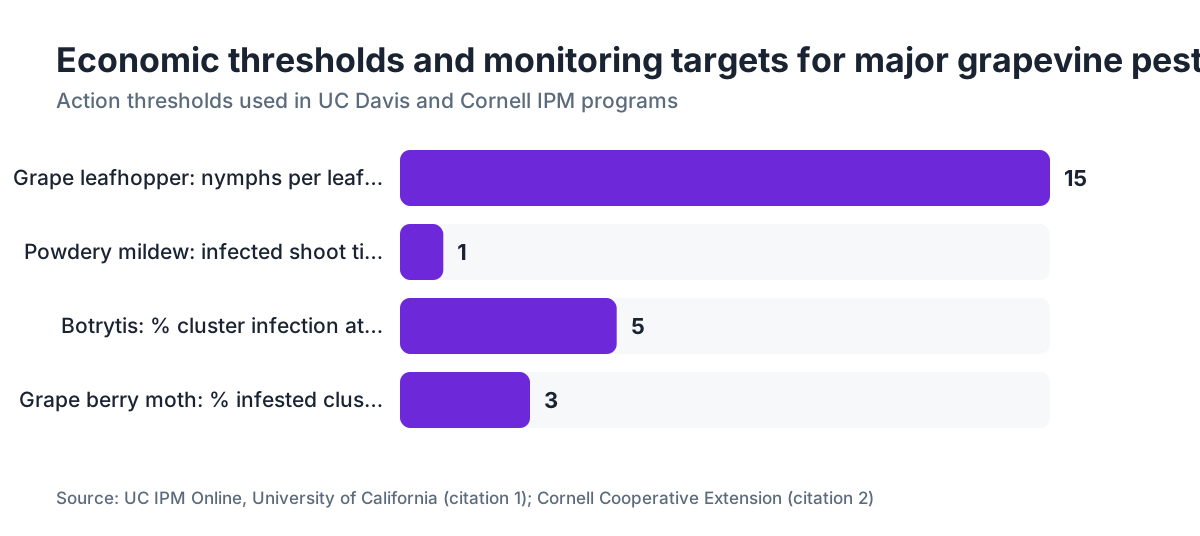
- UC Davis IPM sets a powdery mildew start at 1 inch of shoot growth and a leafhopper threshold of 15 to 20 nymphs per leaf.
- UC Davis, Cornell, and WSU publish the best free diagnostics.
Why do grapevine pests and diseases matter so much for your operation?
A single bad powdery mildew season can cut your yield 30 to 50 percent. Botrytis bunch rot wipes out whole blocks in wet years. Phylloxera collapsed the European wine industry in the 1800s and it still forces expensive replanting today. The stakes are not abstract.
For most vineyard managers and small winery owners, the problem is not noticing that something is wrong. You can see a diseased cluster or a stippled leaf. The hard part is knowing which pathogen or pest you're actually looking at, what threshold justifies a spray, and how to document the intervention so you stay right with EPA Worker Protection Standard rules and state pesticide reporting laws.
This guide covers the fungal diseases, bacterial diseases, viral disorders, and arthropod pests you're likely to meet in U.S. wine grape production. It leans on UC Davis Integrated Pest Management (IPM) guidelines, Cornell Cooperative Extension viticulture resources, and Washington State University Extension, because those are the sources your PCAs and county farm advisors already cite [1][2][3]. Where the data is thin or contested, I say so.
What are the most common grapevine fungal diseases?
Fungal diseases drive most of the pesticide passes in a typical vineyard. These are the ones you genuinely need to know.
Powdery mildew (Erysiphe necator) is the number one fungal disease of grapevines worldwide [1]. It hits all green tissue: leaves, shoots, berries. Infected berries split or scar with russeting, and the fungus lays down that dusty white-gray coating everybody recognizes. It overwinters as chasmothecia in bark and as mycelium in infected buds. The two windows that matter most are when shoots are 1 to 12 inches long and from pre-bloom through 3 to 4 weeks after bloom. UC Davis IPM recommends starting a sulfur or DMI program at 1 inch of shoot growth in high-risk vineyards, on a 7 to 14 day interval depending on weather and material [1].
Botrytis bunch rot (Botrytis cinerea) loves humidity and a dense canopy. It enters through wounds, flower parts, and split berries. Gray fuzzy sporulation on clusters is the tell. Canopy management is the most effective cultural control, plain and simple, because opening the fruit zone drops humidity around the clusters. Fungicide timing counts most at bloom (early inflorescences through fruit set) and again near veraison in wet years [2].
Downy mildew (Plasmopara viticola) is a water mold, not a true fungus, but you manage it much the same way. Look for oily, angular yellow spots on the upper leaf surface with white fluffy growth underneath on humid mornings. It needs free water to germinate. It does the most damage in the eastern U.S. and in cool, wet Pacific Coast valleys. The old European 10-10-10 rule (temperature above 10 C, rainfall over 10 mm, shoots over 10 cm) still works as a field trigger for a protective spray [3].
Eutypa dieback (Eutypa lata) and Botryosphaeria dieback are trunk diseases that bleed yield quietly over years. They enter through pruning wounds. Cut into an infected arm and you'll see a wedge-shaped canker; above ground the shoots come up stunted and chlorotic. Once it's established, your only option is cutting it out and retraining. UC Davis research shows wound protectants applied within 30 minutes of a pruning cut drop infection 50 to 70 percent in high-inoculum vineyards [1].
| Disease | Key symptom | Primary infection window | Management category |
|---|---|---|---|
| Powdery mildew | White dusty coating on berries/leaves | Shoot growth through 4 wks post-bloom | Sulfur, DMI, SDHI fungicides |
| Botrytis bunch rot | Gray fuzzy sporulation on clusters | Bloom, veraison, harvest | Canopy management + fungicides |
| Downy mildew | Yellow oil spots, white sporulation | Rain events, shoot growth | Copper, phosphonate, mancozeb |
| Eutypa dieback | Stunted chlorotic shoots, cankered wood | Pruning wounds | Wound protectants, surgical removal |
| Phomopsis cane/leaf spot | Dark lesions on canes and petioles | Wet conditions at budbreak | Mancozeb, captan at early growth |
What insects and mites are the biggest threats to grapevines?
Arthropod pests run from nuisance to catastrophe. The ones below earn a dedicated scouting protocol.
Grape phylloxera (Daktulosphaira vitifoliae) is the most historically important grape pest there is. The root form feeds on rootlets and raises swollen galls called nodosities and tuberosities that eventually kill the vine. Above ground, the leaf form galls some American species. Nearly every commercial vineyard manages it by planting on resistant rootstock, which is not a cure but a dependable fix. Own-rooted vinifera in infested soil is just waiting to die. There is no economically workable in-season chemical treatment for the root form [1].
Grape leafhopper (Erythroneura elegantula and E. variabilis) and the Virginia creeper leafhopper (Erythroneura ziczac) stipple leaves by piercing cells and sucking out the contents. Heavy infestations shrink photosynthetic area, delay sugar, and foul the harvest with cast skins that end up in the picking bin. UC Davis IPM sets an economic threshold of 15 to 20 nymphs per leaf at the second-generation nymph stage for most table and wine grapes in California [1].
Anagrus epos, a tiny parasitic wasp, hits leafhopper eggs and can hold populations down on its own when French prune trees or other overwintering refuges sit nearby. Preserving beneficials before you reach threshold beats spraying almost every time.
Grape mealybug (Pseudococcus maritimus) and the vine mealybug (Planococcus ficus) keep getting worse in California. The vine mealybug is the newer arrival, more aggressive and harder to control because it feeds on roots as well as canopy. Mealybugs also vector grapevine leafroll-associated viruses. Fuchs and colleagues, writing in the Phytobiomes Journal, tie leafroll spread by mealybug vectors to hundreds of millions of dollars in lost quality and yield across California over a decade [4].
Pacific spider mite (Tetranychus pacificus) and Willamette mite (Eotetranychus willamettei) bronze and desiccate leaves in hot, dry weather. Miticide resistance is real, so rotating modes of action is not optional. Predatory mites like Galendromus occidentalis do good work when you keep broad-spectrum insecticides out of the vineyard.
Grape berry moth (Paralobesia viteana) is the dominant insect pest in the eastern U.S. Larvae tunnel into berries, leaving entry holes that invite botrytis and other rots. Degree-day models tied to local biofix dates beat calendar spraying by a wide margin. Cornell's New York State IPM program publishes degree-day tools built specifically for grape berry moth [2].
What bacterial and viral diseases affect grapevines?
These show up less often than the fungal diseases, but they're usually irreversible once established, which flips the whole management math.
Pierce's Disease (Xylella fastidiosa) is a bacterial pathogen carried by sharpshooters, mainly the glassy-winged sharpshooter (Homalodisca vitripennis) in California. The bacterium plugs the xylem and chokes off water movement. Symptoms include scorched leaf margins (the classic "matchstick" leaf), patchy shoot maturation with green islands on otherwise brown canes, and vine death in 1 to 5 years in Vitis vinifera [1]. There is no cure. You pull infected vines. The California Department of Food and Agriculture has regulated the glassy-winged sharpshooter as a quarantine pest since 2000 [5]. UC Riverside and UC Davis are working on transgenic resistance and biocontrol, but nothing is commercially available as of 2024.
Crown gall (Agrobacterium vitis) throws up tumor-like galls at the graft union or on the trunk, usually after freeze injury opens the door. The bacterium is soil-borne and lives systemically in infected tissue, so there's no treatment for a vine that has it. Biocontrol with strain K-84 or K-1026 helps at the nursery stage but isn't a dependable field fix.
Grapevine leafroll disease isn't one pathogen. It's a complex of at least eight related viruses, the most common being Grapevine leafroll-associated virus 3 (GLRaV-3). Symptoms show up as downward-rolling leaf margins in late summer, red or yellow interveinal color depending on cultivar, and slow or incomplete ripening. Mealybugs move it vine to vine in the field. An infected block can climb from a few percent to over 50 percent in a decade with no intervention [4]. Certified clean planting material is the front-line defense.
Grapevine red blotch disease, caused by Grapevine red blotch virus (GRBV), was first described in 2011 and mimics leafroll: red blotching on leaves and poor ripening. The vector is still under study, though Spissistilus festinus (three-cornered alfalfa hopper) has been implicated [4]. The science here moves fast. Anything you read more than two or three years old may already be out of date.
How do grapevine pests and diseases differ by region?
Geography shapes your disease pressure more than almost any other single factor. A spray program built for the Willamette Valley fails badly in Napa, and the reverse is just as true.
In the eastern United States (New York, Virginia, Pennsylvania, Ohio), downy mildew and botrytis lead the fungal threats, with black rot and anthracnose close behind. Grape berry moth is the dominant insect. Humidity and frequent summer rain push spray intervals to 7 days or shorter during high-pressure stretches. Cornell Cooperative Extension publishes detailed regional guidelines, and its Scaffolding Disease Management framework is widely used across the Northeast [2].
In California, powdery mildew dominates in most wine grape regions, with almost no downy mildew pressure in coastal valleys thanks to the dry-summer Mediterranean climate. Leafhopper, mealybug, and mite pressure all matter. Pierce's Disease is endemic in Southern California and the San Joaquin Valley and limits which varieties you can grow at all. UC Davis has run its VEN 118 course, grapevine pests, diseases, and disorders, for decades, and it has shaped California pest management thinking about as much as any single resource [1][8].
In Washington State, cold winters set off crown gall problems, and the Yakima Valley's irrigated desert breeds heavy spider mite pressure. Downy and powdery mildew both occur, but the dry climate keeps fungal pressure well below East Coast levels. WSU Extension keeps spray guides calibrated to Inland Northwest conditions [3].
In Oregon, botrytis and powdery mildew are the main worries in the Willamette Valley's cool, wet climate, and growers lean hard on canopy architecture as a first line of disease suppression. The southern part of the state runs more California-like.
If your vineyard operates across appellations or you're planning expansion, learn these regional baselines before you finalize a block design. Skipping that step is expensive.
What do UC Davis grapevine pests and diseases resources actually cover?
UC Davis is the most cited university source on this topic in the U.S., and it earned that. The UC IPM Online grape pest management guidelines are free, updated regularly, and cover life cycles, monitoring protocols, economic thresholds, and registered materials for every significant California pest and pathogen [1].
The VEN 118 course (grapevine pests, diseases, and disorders) runs through the UC Davis Department of Viticulture and Enology and covers the same ground at a university level [8]. Its reading list pulls in UC IPM publications, peer-reviewed papers, and UC ANR grape production titles. If you're a self-taught vineyard manager, working through the VEN 118 topics, some of which UC Davis has shared through Continuing and Professional Education, fills real gaps. The UC ANR title "Grape Pest Management" (Publication 3343) is the deepest single reference for California practitioners, though it isn't free and the most recent edition dates to 2013 [11].
Cornell's counterpart is the identification and management guide series from Cornell Cooperative Extension, plus online tools like the Network for Environment and Weather Applications (NEWA) that feed real-time weather into disease models for botrytis, downy mildew, and grape berry moth [2].
WSU Extension's Pacific Northwest Pest Management Handbooks list registered materials and recommendations for Oregon and Washington and get updated every year [3]. They're legally defensible references for label-compliant use in those states.
How do you scout and monitor for grapevine pests and diseases effectively?
Scouting is not walking the rows looking for dead things. It's a protocol with a defined sampling unit, timing, and threshold.
For powdery mildew, the standard UC Davis approach examines 5 shoot tips per vine across at least 10 vines per block during early shoot growth, focused on the first 6 leaves. You want colonies before they sporulate. Flag shoots help: mark 5 to 10 shoots per block and check them every pass. A single cluster with visible mildew after bloom is a problem you should have caught earlier.
For leafhopper, sample 5 leaves per vine from 2 positions (basal and mid-shoot), across at least 20 vines spread through the block, aimed at second-generation nymphs in July. Average more than 15 to 20 nymphs per leaf and you've crossed the economic threshold in most California situations [1].
For vine mealybug, check under bark near the graft union in late winter (February to March in California) and run sticky tape traps on trunks for crawlers. One mealybug per vine isn't automatically a spray trigger, but a climbing trend across two seasons is.
Frequency matters. During the critical windows for powdery mildew and botrytis, weekly is a floor. In hot, dry stretches or right after a good spray interval, you can stretch it out. Never skip scouting in the 2 to 4 weeks after bloom. That's when powdery mildew infections on berries become permanent.
A written scouting log, paper or software, is where compliance meets agronomy. The EPA Worker Protection Standard requires pesticide application records to be kept at least 2 years, and many state rules stretch that to 3 to 5 [6]. A tool like VitiScribe ties scouting notes straight to spray records, so you can show the basis for each application if you're audited or chasing a sustainable winegrowing certification.
What pesticide resistance patterns should vineyard managers know about?
Resistance is not theoretical. It's costing real money in real vineyards right now.
Powdery mildew resistance to DMI (sterol inhibitor) fungicides, especially FRAC Group 3 materials like myclobutanil and tebuconazole, is widespread across California. UC Davis plant pathology surveys have found DMI-resistant Erysiphe necator isolates in a majority of vineyards sampled in Napa, Sonoma, and San Joaquin counties [1]. That doesn't make DMIs useless. It means leaning on them as your primary material is asking for trouble. Rotate among FRAC groups: alternate DMIs with SDHIs (FRAC 7), quinoxyfen (FRAC 13), and non-site-specific materials like sulfur (FRAC M2).
Botrytis resistance to benzimidazole fungicides (FRAC 1) is essentially universal in California and much of the East Coast. FRAC 17 (fenhexamid) resistance is documented too. The FRAC website publishes resistance risk ratings by mode of action, and it's a legitimate reference for building a rotation [7].
For mites, pyrethroid resistance in Pacific spider mite is well documented, and many populations also resist abamectin. Rotating sites of action and protecting predatory mites by keeping carbamates and pyrethroids out are the two things that work long term.
No single chemistry lasts forever. FRAC and IRAC group labels sit on the bag precisely so you can rotate [7][10]. If you don't know your current program's FRAC groups, find out before next season. That's the single cheapest resistance-management move you can make.
What are the EPA Worker Protection Standard requirements for vineyard pesticide applications?
The EPA Worker Protection Standard (WPS), revised in 2015 with amendments through 2017, applies to all agricultural pesticides used in vineyards where workers or handlers are present [6]. Here's what you need to stay on top of.
The WPS requires you to post pesticide application information (product name, EPA registration number, active ingredient, location treated, and restricted-entry interval) at a central location workers can reach, within 24 hours of application. That posting stays up until the REI expires. Electronic posting through a secure, accessible system is allowed under the 2015 revision.
Restricted-Entry Intervals (REIs) for common vineyard fungicides run from 4 hours (many sulfur products) to 24 hours (many DMI and SDHI fungicides) to 48 hours for some organophosphates. The label is law. You cannot shorten the REI on the product label no matter what local practice says.
The WPS also requires an emergency eyewash station within 100 feet of where handlers mix and load (or accessible in under 30 seconds if farther), annual pesticide safety training for all agricultural workers, and decontamination supplies at every application site [6]. The 2015 revision changed training content, which now has to cover topics like heat illness prevention.
States layer their own rules on top. California's DPR requires Pesticide Use Reports (PURs) filed monthly with the county agricultural commissioner, including product, acreage treated, target pest, and application method [5]. Washington and Oregon run similar reporting through their departments of agriculture.
Record-keeping is where most small operations slip, not because they're spraying irresponsibly, but because the paperwork load is heavy. Vineyard operations at places like Gervasi Vineyard or Ponte Winery keep dedicated compliance staff for exactly this reason.
How do you build an integrated pest management (IPM) program for a vineyard?
IPM is not a philosophy. It's a decision framework with defined steps, and it saves money when you run it right.
Four components: prevention and cultural controls, monitoring against economic thresholds, biological controls, and chemical controls as a last resort or when thresholds are crossed. The order matters. Spraying because "it's that time of year" is not IPM.
Start with each site's disease history. If a block has had powdery mildew in 3 of the last 5 years, it needs an aggressive early program no matter what April looks like. If a neighboring block has been clean for 5 years, scout first and spray only when you see something.
Canopy management is the most underrated disease tool you own. Leaf removal in the fruit zone at or just before bloom drops relative humidity around clusters, cuts botrytis infection 30 to 60 percent in some trials, and improves spray penetration [2]. It costs labor, but it saves fungicide passes and lifts wine quality. Real work, real returns.
For chemical controls, match the material to the target and your FRAC/IRAC rotation. A typical California powdery mildew program might run: sulfur at early shoot growth, a DMI at 6 to 8 inches, an SDHI at pre-bloom, back to sulfur post-bloom, and a quinoxyfen pass mid-summer if pressure is high. Your PCA should tune this to your block, variety, and microclimate.
Document everything. UC Davis IPM guidelines explicitly recommend keeping records of scouting results, treatment decisions, and outcomes [1], and that record is what lets you sharpen the program year over year. If you're running multiple blocks or sourcing grapes for a small winery, a centralized system like VitiScribe makes the year-over-year analysis practical instead of theoretical.
What grapevine disorders look like pest or disease damage but aren't?
Abiotic disorders fool experienced growers. Get this wrong and you launch an expensive spray program that does nothing.
Nutrient deficiencies are common. Potassium deficiency causes marginal leaf scorch that looks a lot like Pierce's Disease, but it shows up uniformly across the vine rather than on a few canes. Magnesium deficiency causes interveinal chlorosis you can mistake for downy mildew or virus. A petiole analysis in August, sampled from the blade opposite the cluster at bloom, is the only reliable way to sort deficiency from disease [1].
Herbicide drift throws a distinctive pattern of distorted, cupped, or elongated shoot growth. Clopyralid (common in cereal crops) and picloram are notoriously volatile and drift into vineyards from neighboring fields. The damage is non-infectious and won't spread vine to vine, which is your first clue.
Frost damage leaves shoot tips and young tissue brown and dead, usually in a pattern that follows the vineyard's topography. Growers sometimes confuse it with early downy mildew.
Boron toxicity from irrigation water or over-application burns the tips of older leaves and can mimic leafhopper damage or potassium deficiency.
Heat-driven disorders include sunburn, a flat, papery tan spot on the sun-exposed side of berries, and waterberry (also called shot berry), a failure of berries to set or develop normally, often tied to nutrition or hormones around bloom.
The diagnostic question: is the symptom spreading, what's the pattern across the block, and did it appear suddenly or slowly? Infectious diseases spread from a point or source. Abiotic disorders tend to be uniform across a block or tied to a specific environmental gradient.
How do you keep spray records and stay compliant with grape pest management regulations?
Compliance has two audiences: regulators and yourself. Good records protect you from both.
At minimum, your spray records need the date of application, product name and EPA registration number, active ingredient, formulation, rate per acre, volume per acre, target pest, growth stage at application, REI, total acres treated, and the applicator's name and license number where your state requires a licensed PCA or PQA [5][6]. Some states also want the mix water source and equipment calibration date.
Many states want this information within 30 days at the county level, with the record retained 2 to 3 years. California's use reporting system requires monthly submission by the 10th of the following month [5]. One missed report is a violation and can draw a fine from your county agricultural commissioner.
Beyond the legal floor, good records tell you whether the program works. Correlate scouting results with application timing and weather year over year and patterns surface: which blocks run higher leafhopper pressure, which varieties are your powdery mildew weak points, which spray intervals you actually hit versus what you planned.
The vineyard operations with the least regulatory trouble are the ones that made record-keeping a habit instead of a year-end scramble. Paper is legal and always will be. But in a multi-block operation, digital records with timestamps and automatic PUR-formatted exports are faster and harder to get wrong.
Frequently asked questions
What is the most common disease of grapevines in the United States?
Powdery mildew (Erysiphe necator) is the most common and economically significant grapevine disease in the U.S. It hits all green tissue and shows up in nearly every wine grape region. In California alone, powdery mildew management drives the majority of fungicide passes made in vineyards each season. UC Davis IPM recommends starting a protective program at 1 inch of shoot growth in high-risk blocks.
How do I tell the difference between powdery mildew and downy mildew on grapevines?
Powdery mildew lays a white to gray powdery coating on the upper leaf surface and on berries. Downy mildew causes oily, angular yellow spots on the upper leaf surface with white fluffy growth underneath, visible mainly in humid conditions. Powdery mildew is a true fungus managed with sulfur and DMI fungicides. Downy mildew is a water mold managed with copper, phosphonates, or mancozeb.
What is the economic threshold for grape leafhopper in California?
UC Davis IPM sets the economic threshold at 15 to 20 nymphs per leaf, sampled at the second-generation nymph stage in summer (typically July). Cover at least 20 vines across the block, checking 5 leaves per vine at both basal and mid-shoot positions. Below that threshold, natural enemies and the vine's own tolerance usually make spraying economically unjustifiable.
Can you cure Pierce's Disease in grapevines?
No. There is no commercially available cure for Pierce's Disease (Xylella fastidiosa) in the field. You remove infected vines to keep sharpshooter vectors from moving the bacterium to healthy vines. Management focuses on controlling glassy-winged sharpshooter populations near vineyard borders and choosing tolerant varieties or rootstocks where you can. UC Riverside and UC Davis continue to work on resistance breeding and biocontrol.
What is the UC Davis VEN 118 course and who is it for?
VEN 118 is a university-level course at UC Davis covering grapevine pests, diseases, and disorders in detail. It covers identification, epidemiology, economic thresholds, and management for every major California grape pest and pathogen. It's built for viticulture and enology students but useful to any vineyard manager who wants a systematic, science-based foundation. Some materials are accessible through UC Davis Continuing and Professional Education.
How long do I need to keep pesticide application records for a vineyard?
The EPA Worker Protection Standard requires pesticide application records to be kept at least 2 years. Many states go longer: California requires pesticide use reports filed monthly with the county agricultural commissioner and records retained 3 years. Oregon and Washington run similar requirements. Always check your state's Department of Agriculture for the exact retention period that applies to your operation.
What causes grapevine trunk diseases and how can you prevent them?
Trunk diseases like Eutypa dieback and Botryosphaeria dieback come from fungal pathogens that enter through pruning wounds. Spores release during wet weather and land on fresh cuts. Prevention centers on wound protection: registered protectants (such as thiophanate-methyl or Trichoderma-based products) applied within 30 minutes of pruning cut infection sharply. Pruning in dry weather and delaying it until near budbreak also lowers risk.
What is grapevine leafroll disease and how does it spread?
Grapevine leafroll disease comes from a complex of at least eight related viruses, with Grapevine leafroll-associated virus 3 (GLRaV-3) the most common. Symptoms include downward-rolling leaf margins in late summer, red or yellow interveinal color, and poor ripening. Vine mealybug and grape mealybug move the virus vine to vine. Prevention depends on certified clean planting material and controlling mealybug populations in the vineyard.
How does phylloxera spread and what actually manages it?
Grape phylloxera (Daktulosphaira vitifoliae) spreads through infested plant material, soil moved on equipment, and to a lesser degree crawlers moving across the soil surface. There's no effective in-season chemical treatment for the root form. The only reliable long-term management is planting on resistant rootstock. Own-rooted Vitis vinifera in infested soil declines over years no matter what you spray.
What fungicide resistance issues are most common in vineyards?
DMI (FRAC Group 3) resistance in powdery mildew is widespread in California, with UC Davis finding resistant isolates in a majority of sampled Napa, Sonoma, and San Joaquin vineyards. Botrytis resistance to benzimidazoles (FRAC 1) is essentially universal. Mite resistance to pyrethroids and abamectin shows up in Pacific spider mite populations. Rotating FRAC and IRAC groups every 1 to 2 applications is the standard recommendation to slow resistance.
How do regional climate differences affect grapevine disease pressure?
Eastern U.S. vineyards face heavy pressure from downy mildew, black rot, botrytis, and grape berry moth thanks to humid summers and frequent rain. California's dry-summer Mediterranean climate suppresses downy mildew in most coastal valleys but drives intense powdery mildew pressure. Washington's Yakima Valley runs high spider mite pressure in its irrigated desert. Oregon's Willamette Valley looks Pacific Coast but gets enough summer moisture to sustain botrytis and powdery mildew.
What are the WPS posting requirements for vineyard pesticide applications?
Under the EPA Worker Protection Standard (revised 2015), pesticide application information must be posted at a central location workers can reach within 24 hours of application, and stay posted until the Restricted-Entry Interval expires. Required information includes product name, EPA registration number, active ingredient, location and dates treated, and the REI. Electronic posting is permitted if workers have reasonable access to the system during working hours.
What scouting methods actually work for early powdery mildew detection?
UC Davis recommends examining 5 shoot tips per vine from at least 10 vines per block during early shoot growth, focused on the first 6 leaves from the tip. Marking flag shoots, specific vines or shoots checked every visit, tracks progression over time. Because colonies are visible under magnification before they sporulate, a hand lens helps. The goal is finding colonies in the 1 to 6 inch shoot stage, before berry infection starts.
Sources
- UC IPM Online, University of California, Grape Pest Management Guidelines: UC Davis IPM guidelines for powdery mildew economic thresholds, leafhopper monitoring protocols, phylloxera management, DMI resistance surveys, and trunk disease wound protectant efficacy.
- Cornell Cooperative Extension, Network for Environment and Weather Applications (NEWA), Grape IPM: Cornell extension resources on grape berry moth degree-day models, botrytis management timing, and Scaffolding Disease Management for the northeastern U.S.
- Washington State University Extension, Pacific Northwest Pest Management Handbooks: WSU Extension registered pesticide recommendations and spray guides for Oregon and Washington vineyards, updated annually.
- Fuchs M. et al., Phytobiomes Journal, Grapevine Leafroll Disease and Mealybug Vectors: Grapevine leafroll-associated virus 3 spread by mealybug vectors linked to hundreds of millions in California crop losses over a decade; red blotch virus vector research.
- California Department of Pesticide Regulation, Pesticide Use Reporting: California requires monthly Pesticide Use Reports filed with county agricultural commissioners by the 10th of the following month, and glassy-winged sharpshooter regulated as quarantine pest since 2000.
- U.S. EPA, Agricultural Worker Protection Standard (WPS): EPA Worker Protection Standard (revised 2015) posting, REI, training, decontamination, and record retention requirements for agricultural pesticide use.
- Fungicide Resistance Action Committee (FRAC), FRAC Code List: FRAC codes for fungicide modes of action, resistance risk ratings, and rotation recommendations including botrytis resistance to benzimidazoles and fenhexamid.
- UC Davis Department of Viticulture and Enology, VEN 118 Course Information: UC Davis VEN 118 course covers grapevine pests, diseases, and disorders at the university level, influencing California pest management practice.
- California Department of Food and Agriculture, Pierce's Disease Control Program: CDFA regulates glassy-winged sharpshooter as a quarantine pest and funds Pierce's Disease research and vector control in California.
- Insecticide Resistance Action Committee (IRAC), IRAC Mode of Action Classification: IRAC group classifications for insecticides and miticides used in vineyards, supporting resistance management rotation programs.
- UC ANR, Grape Pest Management, 3rd Edition (Publication 3343): UC ANR Publication 3343 is the most thorough single reference for California grape pest management; most recent edition published 2013.
Last updated 2026-07-09