Grapevine leafroll disease: what every vineyard manager needs to know

TL;DR
- Grapevine leafroll disease is caused by a complex of at least eight related viruses (GLRaV-1 through -9) spread mainly by mealybugs and soft scales.
- It reduces sugar accumulation, delays ripening by 2 to 3 weeks, and can cut yield by 20 to 40%.
- There's no cure.
- Your only tools are certified clean planting material, vector control, and roguing infected vines.
What is grapevine leafroll disease and why does it matter so much?
Grapevine leafroll disease (GLD) is one of the most economically damaging virus diseases of grapevines worldwide. It's not one virus. It's a complex of at least eight Ampelovirus species, designated GLRaV-1 through GLRaV-9 (not all numbers represent distinct confirmed species), with GLRaV-3 the most widespread and destructive member of the group [1]. The pathogens belong to the family Closteroviridae, and they live in the phloem tissue of infected vines.
Why does it matter? Because infected vines can't move sugars efficiently from leaves to fruit. The practical result is delayed ripening, low Brix at harvest, poor color in red varieties, and smaller berries. UC Davis Plant Pathology and the Foundation Plant Services program have documented yield losses of 20 to 40% and reductions in soluble solids (Brix) of 1 to 3 points in infected vines compared to virus-tested clean stock in the same block [1]. In wine terms, losing two Brix in a red variety means you're picking earlier than you planned, chaptalizing where the law allows it, or just accepting a thinner wine.
The disease is present in every major wine region on earth. In California, surveys have found infected vines across Napa, Sonoma, Paso Robles, and the Central Valley. In New York, Cornell researchers have documented GLRaV-3 as the dominant strain in Finger Lakes and North Fork vineyards [2]. Washington State University extension reports the same in the Columbia Valley [3]. Nobody has good aggregate national incidence data. But regional surveys routinely find 10 to 30% infection in established commercial blocks that were never replanted with certified material.
What does leafroll disease look like in the vineyard?
Symptoms are visually distinct, but only in the right season and the right variety. You'll see them clearest from veraison through harvest.
In red varieties, the classic sign is downward rolling of leaf margins plus interveinal reddening that starts at the leaf base and spreads outward. The veins themselves stay green, which creates a sharp green-veins-on-red-leaf pattern that's hard to confuse with anything else once you've seen it a few times [1]. Leaves feel leathery. They don't yellow and drop early. They just sit there looking wrong.
In white varieties, symptoms are much subtler. Leaves roll downward and may show mild chlorosis between veins, but nothing like the dramatic red color of infected Cabernet or Merlot. White-variety infections get missed during visual scouting all the time and only turn up in lab testing. That's a real problem, because a Chardonnay block can carry GLRaV-3 for years without anyone noticing [2].
A few things people misread:
- Potassium deficiency can redden red-variety leaves, but it usually starts at the margins and moves inward, and the veins don't stay green as sharply.
- Leafhopper feeding causes stippling and bronzing, not rolling.
- Water stress causes rolling, but the leaves recover overnight. Leafroll rolling holds through the day.
- Natural autumn color change mimics leafroll, which is why you scout at or just before veraison, not in October.
Fruit symptoms include poor color (red varieties), smaller berries, soft texture, and lower sugar at any given date compared to healthy vines in the same block. Delayed ripening runs 2 to 3 weeks in severe cases [1].
How does leafroll virus spread in a vineyard?
This is where management gets complicated. GLD spreads three ways: through infected planting material, through insect vectors, and (rarely, but it happens) through contaminated tools working fresh green tissue.
Infected planting material is how most vineyards historically acquired GLD. Before certified clean stock programs existed, viruses moved freely through nursery trades. A vine propagated from infected mother blocks carries the virus before it goes in the ground. That's why older blocks planted before about 1990 in California have far higher infection rates than blocks planted with Foundation Plant Services (FPS) certified stock [1].
Insect vectors drive most secondary spread inside an established vineyard. Mealybugs, particularly grape mealybug (Pseudococcus maritimus), obscure mealybug (Pseudococcus viburni), longtailed mealybug (Pseudococcus longispinus), and vine mealybug (Planococcus ficus), transmit GLRaV-3 in a semi-persistent manner [4]. Soft scales, including European fruit lecanium (Parthenolecanium corni) and cottony cushion scale, can also vector GLRaV-1 and GLRaV-3. Vine mealybug is the most efficient vector of GLRaV-3 in California and it's invasive, having spread fast through the San Joaquin Valley and into coastal counties since it was first detected in Coachella Valley in the early 1990s [4].
Semi-persistent transmission means the insect doesn't pick up the virus instantly. It feeds on infected tissue for a while, then feeds on a healthy vine to pass it along. Crawlers (first instars) are the mobile stage that disperses within and between vines. They ride workers' clothing, equipment, and bird feet more than they crawl on their own. Wind dispersal of crawlers is documented too.
Roguing a single infected vine in a high-mealybug block without controlling the vector first is nearly pointless. The mealybugs that fed on that vine are already on the neighbors. You have to hit vector populations and infected sources together.
Which grape varieties are most vulnerable to leafroll?
All Vitis vinifera varieties are susceptible to infection. Vitis labrusca and hybrid varieties can be infected too, but they often show fewer or no symptoms, which makes them silent reservoirs in mixed plantings [2].
Among vinifera, red varieties express symptoms far more clearly than whites. Cabernet Sauvignon, Merlot, Syrah, Pinot Noir, and Zinfandel all show the classic interveinal reddening that makes visual scouting practical. Pinot Noir is sometimes called especially sensitive, with severe yield and quality penalties, though the research comparing cultivar-level economic impact is thin.
Chardonnay, Pinot Grigio, Sauvignon Blanc, and Riesling can all be heavily infected with GLRaV-3 and show only mild leaf rolling with little or no color change. You can walk a Chardonnay block with 30% infected vines and not know it. That's the argument for routine serological or PCR testing in white-variety blocks instead of leaning on visual scouting.
Rootstock susceptibility matters too. Some rootstocks harbor GLRaVs without transmitting them efficiently to the scion, but you can't depend on that as a strategy. The virus lives in the scion in virtually all commercial grafted vine configurations.
How do you test vines for leafroll virus accurately?
Visual scouting gets you partway there in red varieties. It doesn't get you there in whites, and it misses low-titre infections in any variety during the wrong time of year. For a definitive answer, you need laboratory testing.
The two standard methods are enzyme-linked immunosorbent assay (ELISA) and reverse transcription polymerase chain reaction (RT-PCR). ELISA is cheaper and works well for screening large numbers of samples for the major strains (GLRaV-1, GLRaV-3). RT-PCR is more sensitive and detects lower virus levels, which matters for certification programs and for young vines with low titers. Most diagnostic labs recommend RT-PCR to confirm any negative ELISA when infection is suspected [2].
Timing matters. Virus titers run highest in leaves from veraison through harvest, so sample in that window for the most reliable results. Petioles and leaf blades from mature leaves on current-season shoots are the standard tissue. Some labs also accept dormant cane wood, which is handy for winter testing, but sensitivity can be lower [1].
Testing programs for commercial vineyards fall into a few buckets:
- New block establishment: Test mother vines and incoming plant material from nurseries, even when you order certified stock. Certification reduces risk. It doesn't zero it out.
- Existing block survey: Test a grid sample (every fifth or tenth vine in a pattern, plus any symptomatic vines) to estimate block-level incidence before you run the replant economics.
- Post-roguing confirmation: Test neighbors of removed vines to catch adjacent infections you missed by eye.
Cost per ELISA test runs roughly $15 to 35 per sample at commercial plant diagnostic labs, depending on how many viruses you screen for. RT-PCR costs more, typically $30 to 75 per sample. Pricing varies by lab and region. University extension diagnostic labs at Cornell, UC Davis, and WSU all offer testing [1][2][3].
What is the economic impact of leafroll on wine quality and yield?
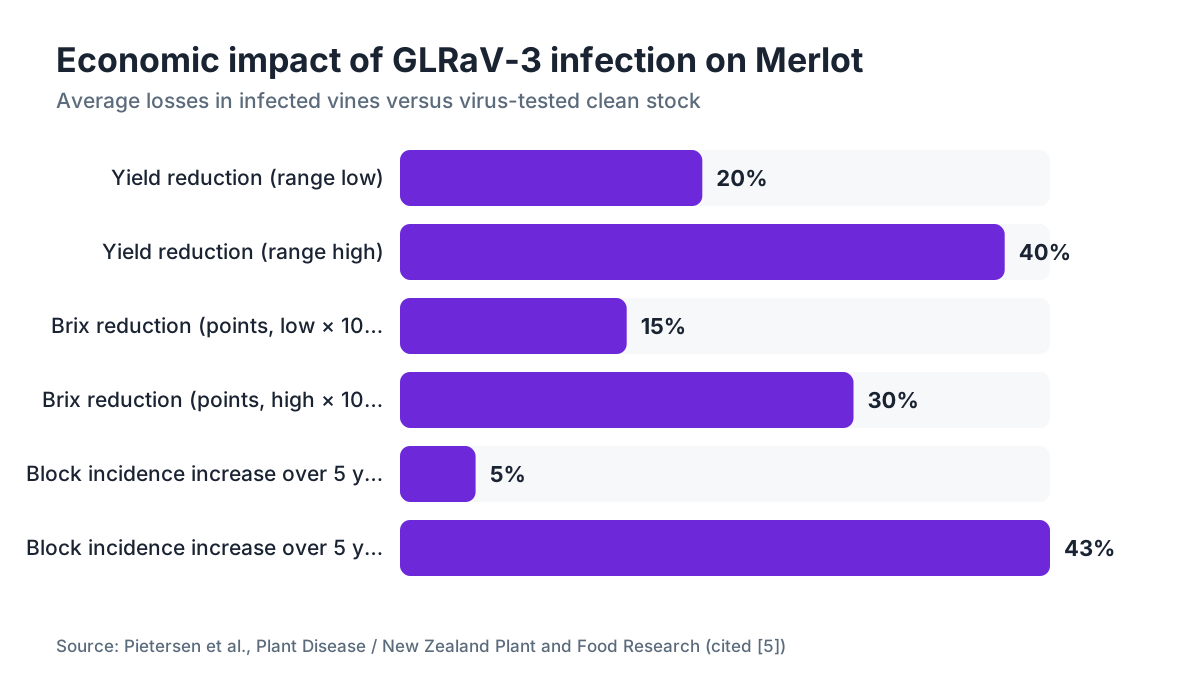
The numbers are real and they're large. A study from New Zealand's Plant and Food Research (one of the most-cited in the field) found GLRaV-3 infection cut yield by an average of 20 to 26% and reduced Brix by 1.5 to 3.0 units in Merlot under the conditions studied [5]. California extension work and the FPS program at UC Davis cite similar ranges: 20 to 40% yield reduction and 1 to 3 Brix reduction depending on variety, climate, rootstock, and timing of infection [1].
Delayed ripening is the quality problem that's hardest to compensate for. In a short-season climate like New York's Finger Lakes or parts of Washington, a vine that needs two extra weeks to reach target Brix may simply not get there before the first frost. You either pick underripe or lose the crop to weather. California's warmer regions give you more margin, but delayed ripening still means elevated malic acid, lower anthocyanin in red varieties, and uneven berry development.
Long term, the damage compounds. An infected vine doesn't just underperform once. It underperforms every year, and it acts as a virus reservoir feeding vector-mediated spread to healthy neighbors. A block that starts at 5% infection can hit 50% within five to eight years under high mealybug pressure, even if you never plant another infected vine [4].
The rogue-versus-replant call hinges on incidence. Cornell extension guidance suggests that once block-level incidence passes roughly 20%, replanting the whole block with certified clean material often makes more economic sense than picking off individual vines over time [2]. That threshold is a rough guide, not a hard rule. Your region, variety value, vine age, and vector pressure all move the math.
What does the research say about leafroll spread rate and timeline?
Spread dynamics of GLRaV-3 in vineyards with active mealybug vectors have been studied in New Zealand, South Africa, and California. The common finding across studies: secondary spread is spatial, radiating outward from initial infection foci, and it runs exponential rather than linear once mealybug populations are established [5][4].
A New Zealand study tracking 16 Merlot blocks over five years found disease incidence could climb from around 5% to over 40% in that span under high vine mealybug pressure and no targeted vector management. Spread was mostly between adjacent vines within rows, not across rows, consistent with how crawlers disperse [5].
In South Africa, long-term surveys showed blocks with initial incidence below 3% and aggressive vector management held incidence roughly stable, while comparable unmanaged blocks grew 5 to 8 percentage points per year [6].
US data is patchier. There's no national longitudinal dataset. Individual vineyard studies from Napa and Sonoma documented spread of 3 to 12% per year depending on mealybug species and density, canopy management (denser canopies favor mealybugs), and how close the block sits to infected neighbors [4].
The honest answer is that spread rate varies enough that no single number fits your situation. What the research shows consistently is that fast response to new infection foci plus vector control are the only tools that demonstrably slow spread.
How do you control leafroll disease? Does roguing actually work?
There's no systemic treatment that cures an infected vine. The toolkit has three parts: prevention through clean plant material, vector control, and roguing.
Prevention and clean plant material
The single most effective step is starting clean. Foundation Plant Services (FPS) at UC Davis maintains nuclear stock and certified grapevine material tested free of known grapevine viruses, including all major GLRaV strains [1]. Cornell's grape program and WSU Extension both point growers to their respective state certification programs for the same assurances [2][3]. Ordering certified material doesn't guarantee zero infection, because post-certification contamination can happen in nurseries, but it's the floor you build everything else on.
Vector control
Controlling mealybug and soft scale populations is the key to slowing secondary spread. The main approaches:
- Systemic insecticides at crawler emergence (spirotetramat, buprofezin, and thiamethoxam or imidacloprid as soil drenches have been evaluated; UC Davis IPM guidelines list current registered options and resistance concerns) [4].
- Biological control, including the introduced parasitic wasp Anagyrus pseudococci, which specifically attacks mealybugs. Augmentative releases show promise in research but haven't performed consistently enough in commercial settings to replace chemical management.
- Cultural practices: pulling ground cover weeds that harbor mealybugs, removing loose bark that gives them overwintering sites, managing ants that tend mealybugs and disrupt parasitoids.
Vector control matters most in the months around bud break and through summer, when crawlers are most active.
Roguing
Roguing (removing and destroying infected vines) works as part of a program. Done alone, without vector control, or once incidence is already high, it barely dents block-level spread. The sequence that makes sense: test to confirm infection, rogue the infected vine and its immediate neighbors (the neighbors are often infected but symptomless), and hit vector populations before and after roguing. Fill gaps with certified clean material only after you've confirmed the surrounding vines are clean.
Roguing eats labor and money. Some managers keep detailed records in a field mapping system, which is where tools like VitiScribe help you track symptomatic vine locations, test dates, and rogue events against a block map so patterns show up over multiple seasons.
For vineyard operations fighting high incidence in older blocks, the honest math often favors full block removal and replanting over years of symptomatic roguing. That's a hard call, because you're pulling revenue forward while deferring the new block's production. But a 40% yield-impaired block rarely pencils better than a clean replacement on a five-year projection.
What are the regulations and certification standards for virus-tested grapevine material?
In the United States, grapevine certification programs run at the state level, with varying stringency. California has the most mature program through Foundation Plant Services (FPS) at UC Davis, which maintains indexed and tested nuclear stock and supplies certified budwood and rooted cuttings to licensed nurseries. California's program is voluntary, not mandatory, but adoption runs high for premium varieties because the quality argument is strong [1].
New York's program is managed in coordination with Cornell and the New York State Department of Agriculture and Markets. Washington State runs through WSU Extension and the state's nursery industry [3].
At the federal level, USDA APHIS regulates importation of grapevine material from other countries under 7 CFR 319 to keep out exotic virus strains. Post-entry quarantine testing is required for imported material, and several GLRaV strains have turned up in material entering through official channels, which is exactly why the import rules exist [7].
The European Union has stricter mandatory certification requirements under Commission Directive 2005/43/EC for vine propagating material, which is why European nursery stock generally carries a stronger baseline of virus testing history. US growers importing legally from European sources still face the APHIS post-entry quarantine requirements.
For spray programs tied to vector management (mealybug control), the EPA Worker Protection Standard (WPS) at 40 CFR Part 170 applies to pesticide applications in vineyards as agricultural establishments. That means restricted-entry intervals, pesticide safety training, and posting requirements when your mealybug program uses restricted-use or WPS-covered products [8]. The California Department of Pesticide Regulation adds reporting requirements for many materials used in mealybug programs, and those spray records are the kind of compliance documentation that needs to be complete and retrievable at inspection.
Should you replant a leafroll-infected block or manage it in place?
This is the hardest practical question in GLD management, and it doesn't have a universal answer. Here's an honest framework for thinking it through.
Factors favoring replanting:
- Block incidence above 20 to 25%. At that level, roguing and managing in place is a running battle you're probably losing.
- High vine mealybug pressure with no realistic way to knock it below the threshold for meaningful spread.
- Older block where the vines already underperform for other reasons (age, rootstock incompatibility, variety obsolescence).
- Premium variety or tier where the Brix and quality penalty is actually costing you in the winery or the market.
Factors favoring continued management:
- Low incidence (under 10%) with stable or slow spread. Aggressive roguing plus vector control can hold this.
- Young block. A five-year-old block hasn't paid back establishment costs, so replanting stings.
- Climate or regional limits on replant timing (soil fumigation windows, water access, vine gap-fill programs).
- Labor and capital not available for establishment and the three to four years of non-revenue production.
Cornell's viticulture team at the New York State Agricultural Experiment Station published a decision framework that weighs incidence, spread rate, and economic return per ton [2]. Worth reading before you make a block-level call. The UC Cooperative Extension has similar economic modeling resources through its Integrated Viticulture program [1].
The replant decision also changes your certification choices. A new planting is your chance to get to zero infection. Don't compromise on certified clean stock to save $0.50 a vine. The gap in vine cost between certified and non-certified material is trivial next to the 20-year difference in block performance.
How does leafroll affect wine quality beyond Brix at harvest?
Lower sugar is the headline number, but the quality cascade runs deeper.
Anthocyanin synthesis in red varieties depends on sugar moving from leaves to berries through the late ripening period. When GLRaV infection impairs phloem function, both sugar transport and the signals that drive anthocyanin accumulation in berry skins get disrupted. The result is pale, poorly colored red wines from infected fruit, even when Brix reads acceptable [10]. That's why winemakers at premium estates can often spot fruit from infected blocks before analysis, just from berry color at sorting.
Total acidity and malic acid stay elevated when ripening drags. Malic acid metabolizes during alcoholic fermentation, but it still affects perceived tartness and mouthfeel, and elevated TA going in means more aggressive MLF management.
Tannin development lags in infected fruit too, though the literature quantifies this less well. The practical effect is thinner structure in the finished wine.
Aroma compound development takes a hit as well. A New Zealand study found GLRaV-3-infected Merlot carried significantly lower concentrations of several key aroma compounds at equivalent dates compared to healthy vines, tied both to the ripening delay and to direct metabolic disruption of phloem-dependent transport [5].
For winemakers buying fruit or running an estate program, the lesson is practical: infected-vine fruit warrants separate lot handling, earlier sensory evaluation, and an honest conversation about whether it clears the quality bar for your top tier.
Where can you get more help with leafroll identification and management?
The best US technical resources for practical vineyard-level guidance on GLD:
UC Davis Foundation Plant Services and UC Cooperative Extension hold the most extensive public resources on virus identification, clean plant programs, and California vector management. Their Integrated Viticulture site and the FPS catalog are first stops [1][4].
Cornell Cooperative Extension and the New York State Agricultural Experiment Station at Geneva have published widely on leafroll in eastern US grape production, including economics of roguing versus replanting and cultivar-specific expression [2].
Washington State University Extension has region-specific guidance for Pacific Northwest conditions and covers the mealybug species present in Washington, which differ somewhat from California's vector complex [3].
USDA ARS runs virus indexing and germplasm programs that support national clean plant networks. Its National Clean Plant Network for Grapes coordinates certification programs across states [7].
For a grower in paso robles wineries country or any other California appellation, your county farm advisor through UC Cooperative Extension is the most direct path to region-specific help. In New York's Finger Lakes or on the south coast winery end of the state, Cornell Extension viticulture specialists serve the same role.
On the record-keeping side of a GLD program, specifically mapping infected vine locations, logging test results by vine or row, and documenting roguing for your spray records and compliance files, VitiScribe handles exactly that kind of structured field data across a season. You can pull up block history and infection maps any time, which turns the replant-versus-manage decision into something less like a guess.
Frequently asked questions
Can leafroll virus be cured once a vine is infected?
No. There is no systemic treatment that eliminates GLRaV viruses from an infected grapevine. Thermotherapy (heat treatment) can reduce virus titers in tissue culture and is used in clean stock production, but it's not practical for field vines. Management is restricted to controlling spread through vector management and removing infected vines. An infected vine stays infected for its life.
How long does it take for leafroll symptoms to appear after infection?
Newly infected vines may not show clear symptoms for one to three seasons, depending on variety, virus strain, vine vigor, and when the infection happened. That latent period means a vine can spread virus through mealybug feeding before anyone flags it on a visual scouting pass. This is why laboratory testing beats visual scouting alone for estimating true block incidence.
Are some rootstocks resistant to leafroll virus?
No commercial rootstock is resistant to infection with GLRaVs. Some rootstocks show weaker symptom expression, but they can still carry the virus and act as a source for vector-mediated spread. Rootstock selection has no meaningful role in a leafroll management strategy. Starting with certified clean budwood and rootstock material is the decision that matters, not chasing a rootstock based on claimed virus tolerance.
What is the difference between GLRaV-1 and GLRaV-3?
Both are Closteroviridae family ampeloviruses. GLRaV-3 is the most economically significant and most widely distributed globally, with vine mealybug as its primary efficient vector. GLRaV-1 tends to be vectored more by soft scales than mealybugs, which shifts the vector management strategy somewhat. In mixed infections, where a vine carries both strains, symptoms and economic damage are generally worse than with either strain alone.
Do ELISA tests detect all strains of leafroll virus?
Standard commercial ELISA panels test for specific GLRaV strains, most commonly GLRaV-1, GLRaV-2, GLRaV-3, GLRaV-4, and GLRaV-7. A negative ELISA doesn't guarantee absence of every possible strain. For broader screening, RT-PCR with strain-specific primers is more sensitive and catches more. If you suspect infection but ELISA reads negative, the next step is RT-PCR at a university extension diagnostic lab.
How do mealybug crawlers spread leafroll within a vineyard?
First-instar mealybug nymphs (crawlers) are the mobile dispersal stage. They hatch in large numbers and move on wind, farm worker clothing, equipment, birds, and their own slow locomotion. They travel within and between vines, acquire the virus feeding on infected phloem tissue, then transmit it when they move to a healthy vine. Managing equipment hygiene and ant populations (which protect and transport mealybugs) is part of a complete vector management program.
Is leafroll disease the same as red blotch disease?
No. They look similar in red varieties, both reddening leaves, but different viruses cause them. Grapevine red blotch disease comes from Grapevine red blotch virus (GRBV), a circular single-stranded DNA virus in the family Geminiviridae. Leafroll comes from RNA viruses in the family Closteroviridae. The vectors differ too. Telling them apart requires laboratory testing; visual diagnosis alone is unreliable.
What is the best time of year to scout for leafroll symptoms?
Scout from veraison through harvest, typically late July through September depending on region and variety. That's when interveinal reddening in red varieties is most pronounced and when white-variety symptoms are at their most visible. Scouting in spring or early summer is largely useless, because virus expression is minimal during active shoot growth. Mark symptomatic vines with flags or GPS coordinates for follow-up testing rather than pulling them right away.
How much does it cost to rogue and replant leafroll-infected vines?
Individual vine removal and replacement in an established block typically costs $15 to 40 per vine in labor and material, not counting the years of lost production from the gap vine while it establishes. Full block replanting, including vine removal, fumigation, new trellis work if needed, certified plant material, and labor, runs $15,000 to 40,000 per acre depending on region and trellising system. Certified vine material itself typically costs $3 to 8 per vine from licensed nurseries.
Can birds or equipment spread leafroll between vineyards?
Yes, indirectly. Mealybug crawlers travel on bird feet and bodies. Equipment moving between infected and healthy blocks can carry crawlers on tires and surfaces. That's why some programs recommend washing tractors and equipment, especially under-vine mowers and harvesters, when moving from high-incidence blocks to clean blocks. It's not foolproof, but it's a reasonable practice under high pressure.
Does leafroll affect organic vineyards differently?
The virus biology is identical in organic and conventional vineyards. The management difference is that organic certification restricts which insecticides you can use for mealybug vector control, so biological and cultural tools carry more of the load. Kaolin clay, mealybug-parasitic wasps (Anagyrus pseudococci), and aggressive loose bark removal matter more in organic programs. Certified clean plant material is just as available and just as important for organic growers.
Are there approved biological controls for grapevine mealybug that vectors leafroll?
Yes. The parasitic wasp Anagyrus pseudococci is commercially available and specifically targets grape mealybug and related species. Results have been variable in commercial vineyards, with efficacy depending heavily on the mealybug species present, ant interference, and augmentative release timing. Ant management (trunk barriers or registered bait stations) is often a prerequisite for biological control to work, since ants actively protect mealybugs from parasitoid attack.
How do I document leafroll testing and roguing for compliance records?
At minimum, record the vine identification (block, row, vine number), the test date and method (ELISA or RT-PCR), the lab and result, and the action taken with date. If roguing, document the removal date and the replacement vine source and certification number. These records sit separate from your pesticide application records but should live in the same retrievable system. Your county agricultural commissioner may request them if you're in a regional virus survey or quarantine program.
Is grapevine leafroll a regulated or quarantine pest in the US?
GLRaVs are not on the federal quarantine pest list as internal pests, so infected vines within the US aren't subject to mandatory state or federal eradication orders in most cases. Importation of grapevine material from outside the US is regulated by USDA APHIS under 7 CFR 319, and post-entry quarantine testing for viruses including GLRaVs is required. Some states run additional notification or survey programs; check with your state department of agriculture.
Sources
- UC Davis Foundation Plant Services, Grapevine Leafroll Disease: GLRaV infection reduces yield 20 to 40% and Brix by 1 to 3 points; FPS maintains certified virus-tested nuclear stock
- Cornell Cooperative Extension, New York State Agricultural Experiment Station, Grapevine Leafroll: GLRaV-3 is dominant strain in New York; block incidence above 20% favors full replanting over roguing
- Washington State University Extension, Viticulture and Enology: GLRaV-3 documented in Columbia Valley vineyards; WSU provides Pacific Northwest-specific vector management guidance
- UC Statewide Integrated Pest Management Program, UC ANR, Mealybugs in Vineyards: Vine mealybug Planococcus ficus is the most efficient vector of GLRaV-3 in California; spread rate of 3 to 12% per year documented in Napa and Sonoma
- Pietersen G. et al., Plant Disease, New Zealand Plant and Food Research, Spread of Grapevine Leafroll-Associated Virus 3: GLRaV-3 infection reduced yield 20 to 26% and Brix 1.5 to 3.0 in Merlot; incidence can rise from 5% to over 40% in five years under high vine mealybug pressure
- Carstens E. et al., South African Journal of Enology and Viticulture, Leafroll spread dynamics: South Africa survey: blocks under aggressive vector management held incidence stable; unmanaged blocks increased 5 to 8 percentage points per year
- USDA ARS National Clean Plant Network for Grapes: USDA ARS coordinates national certified clean plant programs; APHIS 7 CFR 319 requires post-entry quarantine testing for imported grapevine material including GLRaV screening
- US EPA Worker Protection Standard, 40 CFR Part 170: EPA WPS at 40 CFR Part 170 requires pesticide safety training, entry restriction intervals, and posting requirements for pesticide applications in vineyards as agricultural establishments
- Maree H.J. et al., Frontiers in Microbiology, Grapevine leafroll-associated virus 3: Review: GLRaV-3 is most economically destructive member of the leafroll complex; disrupts phloem function leading to reduced anthocyanin and aroma compound development
Last updated 2026-07-09