Grapevine powdery mildew: the complete disease management guide
TL;DR
- Powdery mildew (Erysiphe necator) is the most economically damaging fungal disease in most U.S.
- wine grape vineyards.
- It thrives in warm, dry weather with mild nights, infects all green tissue, and cuts yields 20-50% in bad years.
- Sulfur, DMI fungicides, and canopy work are your main tools.
- Timing the first spray right matters more than anything else.
What exactly is grapevine powdery mildew and what causes it?
Grapevine powdery mildew comes from an obligate fungal pathogen, Erysiphe necator (formerly Uncinula necator). Obligate means it only survives and reproduces on living plant tissue. That's why you can't grow it in a petri dish, and why infected buds and stunted spring shoots called flag shoots are the main overwintering reservoir. The fungus rides out winter inside dormant buds or as chasmothecia (its sexual structures) on the bark. Come spring, infected buds push out as stunted, white-dusted shoots, and chasmothecia release ascospores during early rains. [1]
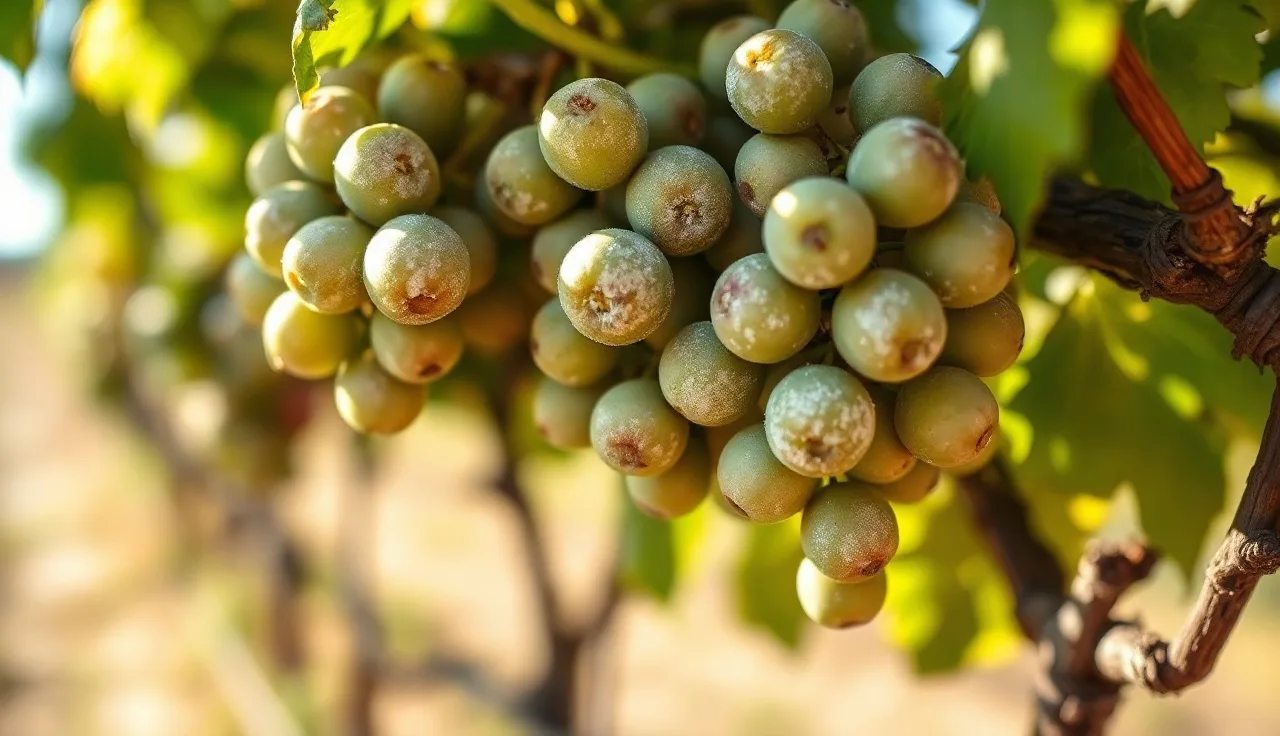
The white powder you see isn't the plant reacting. It's the fungus itself: a mat of mycelium and chains of asexual spores called conidia, sitting right on the surface of the tissue. Powdery mildew is the oddball among fungal pathogens because it doesn't need free water to germinate. High humidity (above roughly 40%) does the job. That's why it hammers warm inland valleys with cool nights, and why it stays quiet in genuinely rainy climates where downy mildew takes over instead. [2]
Conidia move almost entirely on the wind. A single sporulating colony throws off millions of spores a day. Generation time, the span from infection to fresh spore production, runs 5 to 7 days when temperatures sit between 70°F and 85°F. That speed is what makes a missed spray window so expensive.
What does powdery mildew look like on grapevines?
Early infections are easy to miss. On young leaves, look for pale yellow spots on the upper surface with a faint white felt underneath. Within days the white mat shows on both sides. Infected leaves curl, pucker, or take on a crinkled texture. Heavily infected shoot tips look like someone dusted them with flour. [1]
On clusters, timing decides everything. Berries are most susceptible from fruit set through about three to four weeks after, until they reach roughly 8° Brix. Infected young berries show the white coating, and as they grow the skin fails to expand with the pulp. That mismatch cracks or splits the skin. At harvest you can smell infected fruit, a musty, moldy odor that carries straight into the wine and wrecks sensory quality long before any obvious rot. [3]
Flag shoots are the clearest tell in early spring. They're stunted shoots with leaves coated in white powder the moment they emerge from the bud. Find even a few in a block and you know the inoculum was sitting in those dormant buds all winter. Your first-spray timing just got non-negotiable.
When does powdery mildew infection risk peak during the growing season?
Risk tracks vine phenology. The dangerous stretch runs from budbreak through about three to four weeks past fruit set. Once berries pass 8° Brix, their susceptibility drops off a cliff, though leaves and rachises stay open to infection all season. [3]
Temperature drives the whole thing. The fungus grows across a wide band, roughly 50°F to 95°F, but the sweet spot is 68°F to 77°F. Above 95°F, growth stalls and surface spores actually die. Don't read that as permission to skip sprays during a heat wave. Temperatures fall again, and any infection already established inside the tissue keeps marching. [2]
UC Davis gives you a field threshold worth memorizing. When you've stacked up 10 straight days with temperatures between 70°F and 85°F and humidity above 40% for part of each day, you're in a high-infection window. [1] Most commercial forecast systems, including the ones wired into weather station networks across California and Washington, run some version of this model.
Rain suppresses surface conidia because the spores hate free water. But spring rain triggers chasmothecia to discharge ascospores, the primary-season inoculum. So a wet spring followed by warm dry weather is the textbook setup for a bad powdery mildew year.
How much yield and revenue can powdery mildew cost a vineyard?
The numbers swing with variety, region, and control program, but the losses are real and well documented. UC Davis research estimates that uncontrolled powdery mildew cuts yields 20-50% in susceptible varieties, and that's before you count quality. [3] Berry splitting opens the door for Botrytis and other rots, which stack more damage on top.
Quality losses may hurt premium producers more than yield. Off-aromas from infected fruit, often described as mushroom, mold, or earthy, ride through fermentation and don't wash out. For a winery paying $3,000-$5,000 per ton for Napa Cabernet, one mismanaged block can turn into a rejected load or a downgrade that erases a year's margin.
Spray program costs are real too. A high-pressure region might run 8 to 15 applications a season, and at $15 to $60+ per acre per application (material and method dependent) that adds up quick. Sulfur is cheapest. SDHI fungicides and strobilurin combinations sit at the top end. Done right, the spray program almost always costs less than a single bad year. Nobody who's lost a Chardonnay crop to mildew argues otherwise.
Which grapevine varieties are most susceptible to powdery mildew?
Every Vitis vinifera variety is susceptible to some degree. No commercial vinifera is immune. But the spread inside that group is wide. [4]
| Variety | Relative susceptibility |
|---|---|
| Chardonnay | High |
| Cabernet Sauvignon | High |
| Merlot | High |
| Muscat (most types) | Very high |
| Sauvignon Blanc | Moderate-high |
| Zinfandel | High (especially berries) |
| Riesling | Moderate |
| Grenache | Moderate |
| Chambourcin (hybrid) | Low |
| Norton/Cynthiana | Low |
| Marquette | Low |
American species (Vitis labrusca, V. riparia) and most French-American hybrids carry natural resistance from their non-vinifera parents. Cornell's grape breeding program and others have spent decades building vinifera-quality hybrids with real powdery mildew resistance, and a handful are gaining commercial ground. [4]
Clonal variation inside vinifera varieties is real but small. Don't plan to spray less on a 'resistant clone' of Chardonnay. The differences aren't big enough to change your program.
What fungicides work best against powdery mildew, and how do you rotate them?
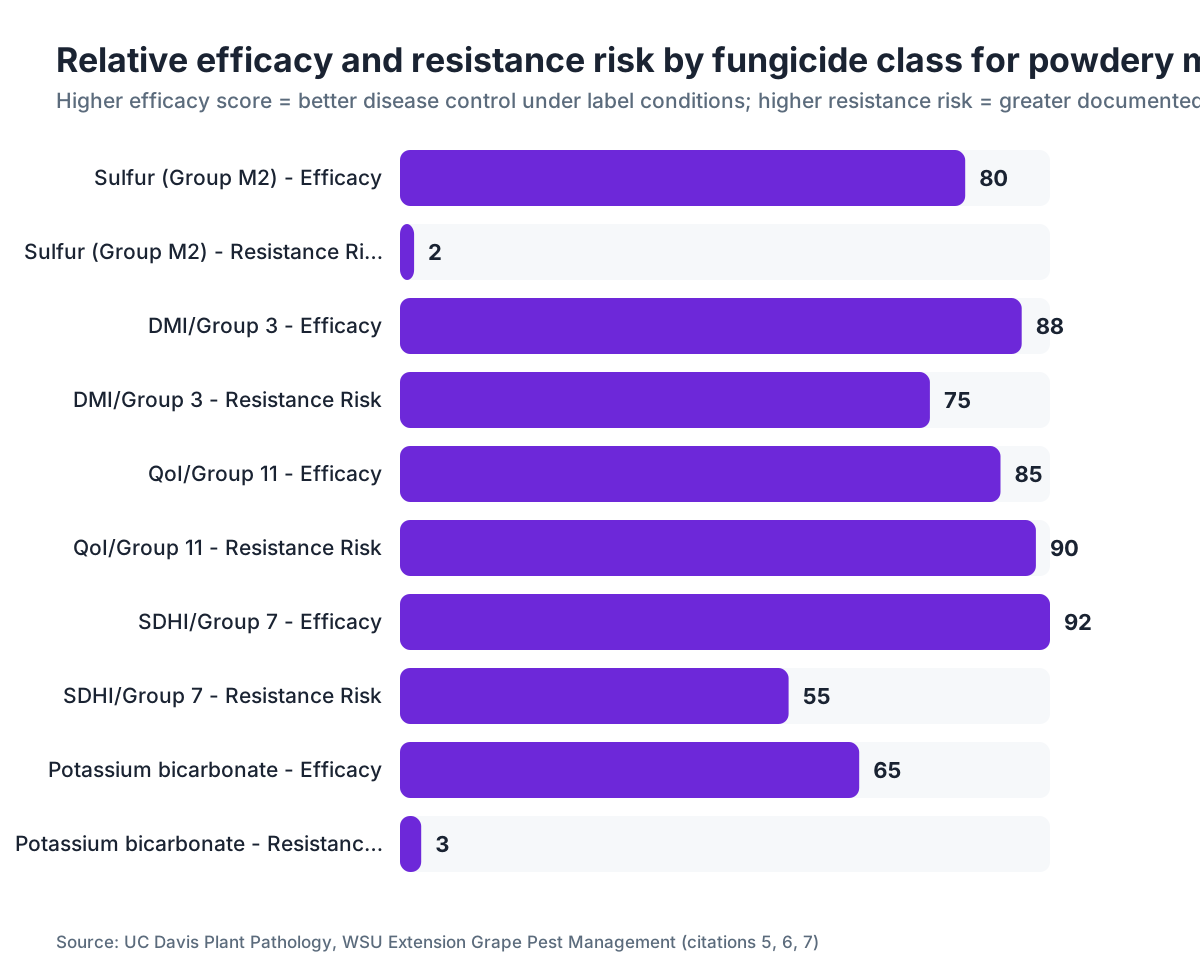
Resistance is the biggest management threat in powdery mildew control. E. necator develops it fast, especially against sterol inhibitors (DMI/Group 3) and strobilurins (Group 11). California and Washington have both documented DMI resistance in field populations. [5] Lean on one chemistry class without rotating and you're breeding a resistant population.
Here's how the main classes break down:
Sulfur (Group M2): Cheapest, no resistance risk (multi-site mode of action), best used preventively at 7-10 day intervals. Phytotoxic above 95°F, so check the forecast before you spray. Still the backbone of most Western programs. [6]
DMI fungicides (Group 3, e.g., myclobutanil, tebuconazole): Good protectant and curative activity up to 3-4 days post-infection. Resistance is widespread. Use at most twice per season in any block, paired with a different class. [5]
QoI/strobilurins (Group 11, e.g., azoxystrobin, trifloxystrobin): High resistance risk, and some populations are fully resistant. WSU treats these as a one-spray-per-season material at most in high-pressure regions. [7]
SDHI fungicides (Group 7, e.g., fluxapyroxad, benzovindiflupyr): Newer, excellent efficacy, but resistance has already emerged in some regions. Same rule: rotate, limit use.
Potassium bicarbonate and oils (e.g., JMS Stylet-Oil): Solid OMRI-listed options. Efficacy is real but residual is short, so stay at 5-7 day intervals. Oils can burn tissue if you mix them with sulfur and spray in heat.
A workable high-pressure rotation: open with sulfur every 7-10 days from budbreak through bloom, switch to a DMI or SDHI around bloom when you need curative activity to cover any missed windows, then swing back to sulfur after fruit set. Never more than two applications of a single FRAC group per season. [5]
Log every application: date, product, rate, timing against growth stage, method. This isn't just tidy record-keeping. Under the EPA Worker Protection Standard, you're required to keep pesticide application records, and many state ag departments require you keep spray records for at least 2 years. [8]
How does canopy management reduce powdery mildew pressure?
Dense canopies are powdery mildew nurseries. Shoots overlap, the cluster zone gets no airflow, humidity stays high, spray can't penetrate, and you've built exactly the microclimate the fungus wants. Canopy work won't replace fungicides under heavy pressure, but it genuinely shifts the disease dynamics. [9]
Early leaf removal in the cluster zone (around fruit set) does three jobs at once. It improves spray coverage where it counts, drops humidity around the fruit, and exposes clusters to enough sun to push surface temperatures past what the fungus tolerates. A UC Davis study found early leaf removal cut cluster powdery mildew severity by 30-60% versus unmanaged vines in some Napa trials, though results move around by variety and vigor. [9]
Shoot positioning and hedging matter too. Vertical shoot positioning at a steady 3-4 inch spacing keeps the canopy open and sprayable. Overly vigorous vines (usually from overcropping, excess nitrogen, or irrigated coarse soils) throw up thick canopies that outgrow your pruning faster than you can keep up.
Run a vineyard in a humid region, or manage blocks with a history of heavy pressure, and canopy work is likely the highest-return non-spray move you can make.
What do disease forecast models tell you and how do you use them?
A spray calendar built on dates alone is a blunt tool. Forecast models hand you a biologically grounded trigger by estimating actual infection risk from weather data. The most widely used in U.S. viticulture are the UC Davis powdery mildew risk model and its variants running through Skybit, CIPM, and regional ag weather networks. [1]
Most models work from accumulated degree days (base 50°F from January 1) and flag windows when temperature and humidity line up with peak fungal growth. The UC Davis model, available through the UC IPM program, uses an index that tracks daily temperature-humidity combinations and sums them. When the index crosses a threshold, the model calls for a spray. [1]
In practice: put a weather station in your highest-risk block, not at a regional airport, log the data, and check the model weekly from budbreak through veraison. Platforms like VitiScribe can pull weather data and flag spray-timing alerts against your existing spray records, so you're not doing the math by hand in July.
Nobody has clean data on how much yield the models save versus a tight calendar program. The value shows up on the edges: cutting pointless sprays in low-risk years, and catching high-risk windows before symptoms appear.
What are the rules for spray records and compliance in U.S. vineyards?
Federal and state rules overlap here. The short version: you need records, and the window for losing them is shorter than most managers assume.
Under the EPA Worker Protection Standard (40 CFR Part 170), any restricted-use pesticide application requires a record with the product name, EPA registration number, active ingredient, location and size of the treated area, date, applicator name and license number, and the rate applied. [8] Keep those records 2 years, and make them available to WPS-covered workers within 15 days of a request.
Most state ag departments pile on their own layer. California's Department of Pesticide Regulation requires that all pesticide applications to agricultural property be reported monthly to the county agricultural commissioner, with records kept 3 years. [10] Washington requires licensed applicators to keep records up to 7 years under some conditions. [7] Oregon, New York, and the other big wine states run similar frameworks.
For USDA Organic certification, your spray records have to document every input and tie it to an approved materials list. A single missing application record during an inspection can cost you certification for that block or that year's crop.
The practical answer is a spray log you actually keep in real time, not one you reconstruct from memory in December. Paper works. A spreadsheet works. A field-operations platform works better because it timestamps entries and can generate the reports your county ag commissioner wants without manual reformatting. VitiScribe was built around this workflow, so spray records, PHIs, and field notes live in one place and compliance reports generate on their own.
How do you manage powdery mildew in certified organic vineyards?
Organic viticulture doesn't mean you can't spray. It means your materials have to be on the National Organic Program approved list or cleared by your certifier. For powdery mildew, the organic toolbox is genuinely good. [11]
Sulfur is your anchor. It's OMRI-listed, cheap, effective, and has been used in vineyards since before anyone coined the word organic. Potassium bicarbonate (Kaligreen, MilStop) is fast-acting on surface mildew, though its residual is shorter than sulfur's. Oils like JMS Stylet-Oil and neem-based products (clear the specific neem with your certifier) give protectant activity. Copper, mostly a downy mildew and bacterial tool, has some foliar activity against powdery mildew.
The hard part in organic programs is interval and rain-fastness. Sulfur washes off. In a season with frequent light rains, you may need to spray every 5-7 days instead of 10-14. That runs up labor and input costs fast. Many organic growers in high-pressure regions find tight canopy management moves from best practice to economic necessity, because cutting disease pressure with cultural tools is what lets them stretch the intervals.
Resistance isn't a worry with sulfur or potassium bicarbonate (both multi-site), which is one real edge organic programs hold over conventional ones that lean on single-site chemistries.
What's the best spray timing strategy if you can only afford a limited program?
Limited to a handful of applications by budget or equipment? Spend them at the highest-value windows. The non-negotiable one: protect the cluster zone from fruit set through three to four weeks post-set. Berries hit maximum susceptibility in that stretch, and infection there does the most economic damage. [3]
Next in line is the pre-bloom and bloom window. Rachises (the cluster stems) are highly susceptible at bloom, and infected rachises weaken cluster architecture for the whole season. A single well-timed sulfur spray at 20-50% bloom covers a lot of ground.
If a bad year forces you down to three sprays total (not a recommendation, just a reality check), hit pre-bloom, just after fruit set, and two weeks post-fruit set. Miss those three and you're in damage control the rest of the season.
One thing to cut if you're trimming the program: late-season foliar sprays after veraison. The leaves get infected, but the economic damage to fruit is mostly done. That money does more good in next year's early-season program.
How do you scout for powdery mildew effectively?
Scouting is how you learn whether your program is working and whether you're breeding a resistance problem. It doesn't have to be fancy.
Starting at budbreak, walk each block weekly and hunt for flag shoots. Mark them with flagging tape when you find them, because their location shows you where inoculum pressure runs highest. Through the season, check 50-100 shoots per block, pulling samples from across the canopy rather than only the edges. Record the percentage of leaves with any sign of mildew and the percentage of clusters affected. Cornell's guidelines put an action threshold around 10% cluster incidence pre-veraison in susceptible varieties, a point where you re-examine spray timing and intervals. [4]
Photograph what you find. A dated, GPS-tagged photo is hard to argue with later, and it helps you see whether pressure is building or holding steady. Some vineyard managers keep those photos next to their spray records so the story reads clean: conditions, response, outcome.
After harvest, take one more walk to note which blocks had the worst flag shoot counts and the heaviest late-season foliar disease. That map tells you where to concentrate next year's early program.
Frequently asked questions
Can powdery mildew kill a grapevine?
Not directly, and rarely fast. Powdery mildew doesn't kill vines the way some pathogens do. But severe, repeated defoliation cuts photosynthesis, and chronically infected vines store less carbohydrate going into winter, which hurts cold hardiness and next-season vigor. Over several bad years with no management, production drops hard. The economic kill happens long before the plant dies.
Does rain stop powdery mildew from spreading?
Rain temporarily knocks surface conidia off tissue and kills them, since the asexual spores hate free water. But spring rains trigger the sexual spores (ascospores) from overwintering chasmothecia to release and infect new tissue. Rain also washes off sulfur and other protectants. So a rainy spring followed by warm dry weather is the classic setup for a high-pressure year, not a low one.
How long does sulfur remain effective after application?
In dry conditions, elemental sulfur at label rates gives roughly 7-14 days of protectant activity. Rain strips it faster. High temperatures (above 90-95°F) volatilize sulfur off the leaf and raise phytotoxicity risk on some varieties. In humid climates with frequent rain, you may need to re-apply every 5-7 days. Wettable sulfur formulations tend to stick better than dusts in most conditions.
What is the pre-harvest interval (PHI) for common powdery mildew fungicides?
PHIs vary by product and appear on the label, which is the legal document. Common examples: elemental sulfur is typically 0 days, myclobutanil (Rally) is 7 days, azoxystrobin (Abound) is 0 days, tebuconazole (Elite) is 14 days, and some SDHI products carry 7-14 day PHIs. Always check the current label before your last pre-harvest application. A PHI violation is a food safety and legal problem, more than paperwork.
Is powdery mildew the same as downy mildew on grapes?
No. Different pathogens, different behavior. Powdery mildew (Erysiphe necator) is a true fungus that thrives in warm, dry conditions and doesn't need free water to infect. Downy mildew (Plasmopara viticola) is an oomycete (water mold) that needs free water and mild temperatures to sporulate. Both attack green tissue but call for different fungicide classes. A strobilurin that controls downy mildew may do little against powdery mildew in a resistant population.
How do I know if my fungicide program is failing due to resistance?
Watch for visible colonies appearing within days of a full-rate application of a previously effective product, colonies still sporulating normally after treatment, and disease progressing despite a tight spray calendar. If you suspect resistance, send samples to a university plant diagnostic lab for screening. Switch your FRAC group immediately and note the change in your spray records. UC Davis and Cornell both offer diagnostic services.
Can you spray for powdery mildew during bloom without damaging pollination?
Yes, with care. Sulfur is generally considered safe during bloom for disease control, though some growers avoid it at peak bloom on the theory it can knock back natural yeast on berry surfaces, which matters if you farm for native fermentations. Most DMI fungicides are fine at bloom from a pollination standpoint. Avoid spraying anything in high heat during bloom; the risk is heat plus certain adjuvants, not the fungicide chemistry itself.
At what growth stage should I apply the first powdery mildew spray?
Most university guidelines call for the first application at or just before budbreak in historically high-pressure blocks, or no later than the 1-inch shoot tip stage. UC Davis extension recommends starting by the 3-5 leaf stage at the latest in susceptible varieties. Flag shoots at emergence tell you inoculum is already in the buds. Wait until you see disease on leaves and you've already lost the best spray window of the year.
Do winemakers reject grapes for powdery mildew, and at what threshold?
Yes. Many wineries write rejection thresholds into grape purchase contracts, typically 1-3% infected berries by weight or visual cluster inspection. Above that they may reject the load, dock the price, or make the grower sort before delivery. Even below visible thresholds, infected fruit can carry off-aroma compounds (notably geraniol and some volatile sulfur compounds) that turn up in finished-wine sensory analysis.
What spray equipment gives best coverage in a dense canopy?
Air-blast sprayers with air volume calibrated to canopy density are the standard. The key variable is canopy leaf wall area (LWA): denser, taller canopies need more air and water volume to get penetration. Many extension guidelines recommend calibrating to LWA rather than a flat per-acre rate. Electrostatic sprayers can improve underside coverage with less water. Hand-gun applications work in small or steep blocks but are slow and labor-heavy.
How do I handle a powdery mildew outbreak mid-season when the program has lapsed?
First, assess actual cluster infection. Leaf infection is bad, but the season isn't lost unless clusters are involved. Switch to a curative product (a DMI gives up to 96 hours post-infection activity in most populations). Tighten the interval to 7 days. Do emergency leaf removal in the cluster zone to improve penetration. Document everything. If cluster infection tops 15-20%, call your buyer about their threshold before harvest; a conversation beats a rejection at the crush pad.
Are there any wine grape varieties with good powdery mildew resistance worth planting?
Among hybrids with reasonable wine quality, Marquette, Frontenac, and Chambourcin show meaningful resistance. Cornell's grape breeding program (which developed Marquette) has published trial data with dramatically lower powdery mildew incidence than vinifera controls. For strictly vinifera plantings, no commercially available variety has true resistance. Some European programs have released partial-resistance PIWI varieties (Souvignier Gris, Muscaris), but they aren't widely planted in the U.S. yet.
How do I train new vineyard workers to identify powdery mildew?
Start with the smell (musty, yeasty) and the look: white powdery coating on young leaves and shoot tips, not on older hardened tissue. Flag shoots in spring make an easy training target because they're dramatic and localized. Use printed photo guides from UC Davis IPM or Cornell's diagnostic program; both publish free extension materials with color photos. On early-season scouting walks, point out the actual colonies. Workers who've seen it once recognize it reliably.
Sources
- UC Davis UC IPM - Powdery Mildew of Grape: UC Davis powdery mildew risk model and the 10/10 rule: 10 consecutive days of 70-85°F with humidity above 40% indicates high infection risk
- UC Davis UC IPM - Grape Pest Management Guidelines: Erysiphe necator grows across 50-95°F, optimum 68-77°F; spores die above 95°F sustained; no free water needed for germination
- UC Davis Viticulture and Enology: Uncontrolled powdery mildew can reduce yields 20-50% in susceptible varieties; berries most susceptible from fruit set until roughly 8° Brix; off-aromas persist through fermentation
- Cornell University - New York State Integrated Pest Management Program, Grape Disease: All V. vinifera varieties are susceptible; action threshold of roughly 10% cluster incidence pre-veraison recommended in susceptible varieties; hybrid varieties including Marquette show substantially lower incidence
- UC Davis Plant Pathology - Fungicide Resistance in Erysiphe necator: DMI fungicide resistance documented in California field populations; FRAC rotation to limit any single group to two applications per season per block recommended
- Washington State University Extension - Pacific Northwest Pest Management Handbooks, Grape: Sulfur fungicides: FRAC group M2, multi-site activity with no known resistance risk; phytotoxicity risk above 95°F; standard backbone of Pacific Northwest powdery mildew programs
- Washington State University Extension - Grape Pest Management, Powdery Mildew: WSU recommends treating strobilurin (Group 11) fungicides as one-spray-per-season materials at most in high-pressure regions due to resistance risk; Washington pesticide records for licensed applicators required up to 7 years
- U.S. EPA - Worker Protection Standard (40 CFR Part 170): Under WPS, restricted-use pesticide application records must include product name, EPA registration number, active ingredient, location, date, applicator name and license, rate applied; records kept 2 years and available to workers within 15 days on request
- UC Davis UC IPM - Grape Pest Management Guidelines, Cultural Controls: Early leaf removal in the cluster zone reduced powdery mildew severity on clusters by 30-60% versus unmanaged vines in Napa trials; canopy management lowers humidity and improves spray coverage
- California Department of Pesticide Regulation - Pesticide Use Reporting: California requires monthly reporting of all pesticide applications to agricultural property to the county agricultural commissioner; records kept 3 years
- USDA National Organic Program - Allowed and Prohibited Substances: Elemental sulfur, potassium bicarbonate, and certain plant-based oils are OMRI-listed and approved under NOP for use in certified organic viticulture for powdery mildew control
- Cornell University College of Agriculture and Life Sciences - Grape Breeding and Genetics Program: Cornell grape breeding program developed hybrid varieties including Marquette with documented lower powdery mildew incidence than vinifera controls in multi-year trials
Last updated 2026-07-09