Grapevine red blotch disease: what every grower needs to know

TL;DR
- Grapevine red blotch disease comes from Grapevine red blotch virus (GRBV), a single-stranded DNA virus first characterized in 2012.
- It reduces sugar, delays ripening, and lowers anthocyanins in red varieties.
- There is no cure.
- You manage it with certified planting material, vector control, and roguing infected vines.
- Survey your block before you replant.
What is grapevine red blotch disease?
Grapevine red blotch disease is an infectious vine disease caused by Grapevine red blotch virus, abbreviated GRBV. The virus belongs to the family Geminiviridae, genus Grablovirus, and carries a circular, single-stranded DNA genome roughly 3.2 kilobases long. UC Davis researchers characterized it formally in 2012 after Napa Valley growers noticed vines with bright red leaves that did not match any known leafroll virus [1].
What makes red blotch so hard is that it mimics leafroll disease almost perfectly in the field. Both turn leaves red in red varieties and yellow in white varieties late in the season. Both slow ripening. Both move through infected planting material. The two even co-infect the same vine often enough that telling them apart by eye is genuinely unreliable.
Red blotch is now confirmed in most major U.S. wine grape regions: California, Oregon, Washington, New York, Virginia, and Texas [2]. Cornell's viticulture program has traced it in New York blocks back to propagation material from the early 2000s [3]. Nobody has good data on total infected acreage nationally. Estimates in the literature run from a few percent to over 60 percent of surveyed blocks in older Napa and Sonoma plantings, but sampling methods vary widely between studies, so treat the high numbers with caution.
What does red blotch look like in the vineyard?
Foliar symptoms start appearing in mid to late summer, usually July through September depending on your climate. In red-berried varieties, leaf margins and interveinal tissue turn a vivid red or reddish-purple while the veins stay green. That green-vein pattern is one of the more useful visual clues, though it is not perfectly reliable. Symptoms show up first and clearest on mature mid-canopy leaves. Young leaves at the shoot tips usually look fine.
White and green-berried varieties yellow instead of reddening, which is where field confusion with leafroll gets ugly. Some infected white-variety vines show almost nothing at all. That makes visual surveys in Chardonnay or Pinot Gris blocks close to useless without lab confirmation.
Beyond the leaves, watch for:
- Delayed and uneven veraison in infected clusters
- Lower Brix at harvest compared to healthy vines nearby
- Reduced anthocyanins in red varieties, so berries look lighter and less saturated
- Little to no yield effect in many studies, though some Washington State University trials found modest yield drops in heavily infected blocks [4]
A field tip from extension literature: walk the block at veraison and flag any vine where clusters lag their row neighbors by two to three weeks. That ripening gap is a red flag worth a PCR test. Symptoms intensify as the season runs on, so scouting before August misses most infected vines.
How much does red blotch reduce fruit quality and wine quality?
This is the question growers care about most. The honest answer: the hit is real, and the size of it swings by site and season.
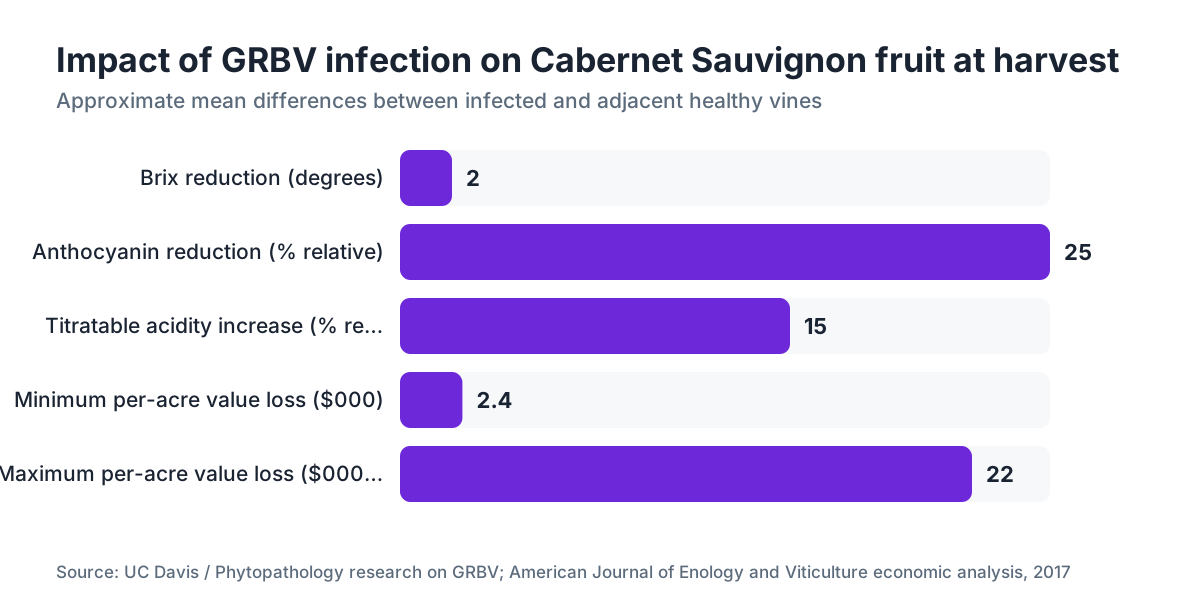
Field work published in Phytopathology and follow-up studies from the UC Davis Department of Viticulture and Enology found infected Cabernet Sauvignon vines ran 1 to 3 degrees Brix lower at commercial harvest than adjacent healthy vines [1][5]. Titratable acidity was higher in the infected fruit and pH was lower, both signs of the delayed ripening. Malic acid, which normally burns off fast after veraison, dropped more slowly in GRBV-infected vines.
On the wine side, sensory panel work out of UC Davis showed wines from GRBV-infected Cabernet Sauvignon had lower color density, lower total anthocyanins, and scored lower on overall quality in blind tastings than wines from healthy vines in the same block [5]. The quality hit tracked with how early the symptoms showed: vines red by late July lost more than vines that turned in September.
Washington State University extension notes that in cooler climates the Brix deficit can drop fruit below commercial ripeness entirely. You either hang the fruit late and eat the botrytis risk, or you pick under-ripe [4]. In warm interior valleys the same infected vine might still hit 23 to 24 Brix, just later than its healthy neighbors.
Nobody has run a controlled, multi-year, multi-region economic study I would call definitive. The closest is a 2017 economic analysis in the American Journal of Enology and Viticulture that put per-acre value losses at roughly $2,400 to $22,000 depending on grape price and how infected the block was [6]. The high end is premium Napa fruit. The low end is commodity-priced regions.
Grapevine red blotch virus reduces Brix by 1 to 3 degrees in infected Cabernet Sauvignon, according to UC Davis research published in Phytopathology [1].
How does red blotch spread from vine to vine?
Two pathways matter: infected planting material and a confirmed insect vector.
Infected budwood and rootstocks move red blotch long distances. Before GRBV was characterized in 2012, propagators were spreading the virus across regions inside nursery material without knowing it. Some researchers think the wide distribution of red blotch in older California blocks traces almost entirely to pre-2012 propagation, not insect spread [2].
The confirmed insect vector is the three-cornered alfalfa hopper, Spissistilus festinus, a treehopper common across the western and southern United States [7]. Cornell and UC Davis researchers showed transmission in controlled experiments: viruliferous hoppers fed on infected vines, moved to healthy vines, and produced symptomatic infections. Transmission efficiency was low compared to aphid-transmitted viruses, but field spread in blocks next to alfalfa or clover cover crops is documented.
A few things about the vector that shape your management:
- S. festinus has multiple generations per year in warm climates, so a single season can bring repeated inoculation events
- Adults and nymphs both feed on vine stems, girdling petioles and small canes; you may spot crescent-shaped cuts
- The hopper's range runs through the Southeast and into the mid-Atlantic, which partly explains why Virginia and North Carolina growers have found the disease
- Other potential vectors have been proposed but not confirmed. WSU tells growers not to assume S. festinus is the only route until more research lands [4]
Grape mealybugs and other leafroll vectors do NOT transmit GRBV. That matters for your spray program, because the chemistries that hammer mealybugs are not your first choice against treehoppers.
How do you test a vine for red blotch virus?
Visual diagnosis is not enough. Period. You need PCR (polymerase chain reaction) confirmation, and for any decision involving replanting, buying vines, or roguing, get that test from an accredited lab.
The standard test is reverse-transcription PCR or quantitative PCR using primers that target the GRBV coat protein or replication-associated protein genes. Most commercial plant diagnostic labs in California, Oregon, and Washington run it. UC Cooperative Extension and Foundation Plant Services (FPS) at UC Davis keep lists of approved testing labs [8]. Turnaround runs 5 to 14 business days depending on the lab and time of year. Submit samples in August or September, when viral titer peaks and a positive is most likely to read clean.
Sampling protocol matters a lot. Collect petioles or leaf tissue (not whole leaves) from mid-canopy, symptomatic-looking tissue, and follow the lab's instructions on sample size and shipping. Pooling samples from several suspect vines to save money is tempting, but it lowers your detection sensitivity. For a block-level survey, a grid approach (every 5th vine in every 3rd row, say) gives you a decent prevalence estimate without testing every vine.
For incoming nursery stock, ask for lot-level PCR documentation before planting. California's Foundation Plant Services runs a vine virus indexing program and keeps GRBV-tested foundation stock for propagation [8]. Clean FPS stock is not a zero-risk guarantee once material is in the field, but it drops the odds of planting infected material sharply.
Multiplex PCR panels that test for GRBV and several leafroll viruses at once are worth the extra cost for any serious workup, since co-infection is common.
What management and treatment options exist for red blotch?
There is no chemical treatment, no approved biological control, and no immune variety. Your toolkit has three real parts: prevention, vector management, and roguing.
Prevention is the highest-leverage move you have. Plant certified, GRBV-tested material from a program like California's FPS or a comparable state-level clean stock program. Cornell's New York State Agricultural Experiment Station at Geneva has published guidelines for sourcing disease-tested planting material in the Northeast [3]. If you farm where S. festinus is established, site selection counts too: a block right next to an alfalfa field faces higher vector pressure.
Vector management against S. festinus fits inside your normal insecticide program, but you may need to adjust timing and chemistry. Pyrethroids and organophosphates have documented activity against treehoppers in alfalfa. Vineyard-specific efficacy data is thinner. WSU extension recommends scouting for adults and nymphs starting in late spring and treating when populations run high, especially in blocks that already carry GRBV-positive vines [4]. Any insecticide application in a vineyard falls under the EPA Worker Protection Standard (WPS), which sets re-entry intervals, hazard communication, and training rules for ag workers [9]. Make your spray records show the product, rate, PHI, and REI for every application. State ag departments can and do audit those records.
Roguing (pulling and destroying infected vines) cuts the inoculum source in the block and lowers the odds of vector-mediated spread to healthy neighbors. Weigh the roguing decision against infection prevalence, vine age, variety value, and whether the block is headed for replant soon anyway. Once 30 percent or more of a block tests positive, replanting the whole thing usually pencils out better than roguing and managing in place.
Records of which vines tested positive, when they were rogued, and what replaced them are exactly the data a state nursery certification inspection or a winery compliance review wants. VitiScribe is built for this kind of vine-level tracking, tying PCR results, rogue dates, and replanting records to individual vine IDs so the data is there when someone asks.
Cover crop management around and inside the vineyard helps knock down S. festinus. The three-cornered alfalfa hopper, as the name says, thrives in legumes. Mow alfalfa or clover strips before hopper populations peak in late spring and early summer. It is cheap and worth doing.
How is red blotch different from grapevine leafroll disease?
This one comes up every season, because the two diseases look nearly identical in the field, especially in red varieties, and because mixing them up costs you real money.
| Feature | Red Blotch (GRBV) | Leafroll (GLRaV-3 most common) |
|---|---|---|
| Pathogen type | Single-stranded circular DNA virus | Single-stranded RNA virus |
| Leaf symptom in red varieties | Red interveinal blotching, green veins remain | Red leaf rolling downward, veins also may redden |
| Leaf symptom in white varieties | Mild yellowing or none | Yellow, may be mottled |
| Primary spread mechanism | Infected planting material; S. festinus vector | Infected planting material; mealybug and soft scale vectors |
| Insect vector | Three-cornered alfalfa hopper (S. festinus) | Grape mealybug, vine mealybug, soft scales |
| Effect on Brix | 1-3° reduction | Similar or slightly greater reduction reported |
| Co-infection possible? | Yes, common | Yes, common |
| Confirmed cure | None | None |
| Detection | PCR required for confirmation | PCR required for confirmation |
The green-vein symptom is the most reliable visual tell, but only on a vine infected with GRBV alone. Co-infected vines can throw a blend of symptoms from both viruses that defies easy sorting. If you need to know which disease you have, test. The vector difference matters in practice too: mealybug programs (often systemic neonicotinoids or spirotetramat) do not reliably suppress treehoppers, so a leafroll spray program is not a red blotch spray program.
Which grape varieties are most susceptible to red blotch?
GRBV infects both Vitis vinifera and some hybrids. No vinifera variety has shown confirmed immunity. Symptom severity and the real impact on fruit quality vary a lot by variety.
Cabernet Sauvignon is the most studied variety, because so much of the early detection work happened in Napa Valley Cab blocks. Red varieties in general show the loudest foliar symptoms, which has skewed detection: growers see the red leaves and send samples. White-berried varieties like Chardonnay and Sauvignon Blanc often show subtle symptoms or none, so infected blocks can hide for years.
Field surveys hint that certain rootstocks may influence symptom expression, but the data is thin and you should not read it as rootstock resistance. The virus infects the scion. Current data does not show the rootstock changing virus accumulation in any meaningful way.
Hybrid varieties like Marquette, Frontenac, and Norton have turned up infected in northeastern surveys, though sample sizes are small [3]. That matters for growers in Virginia, New York, and the Midwest planting cold-hardy hybrids. Do not assume red blotch is a vinifera-only problem.
The varieties that suffer worst are those with a narrow harvest window and high anthocyanin demands. Pinot Noir, with its naturally low anthocyanin potential and a short gap between optimum ripeness and over-ripeness, takes a hard hit from the Brix deficit and lost pigment.
How do you buy certified disease-free grapevine material?
This is where prevention lives, and it pays to be specific about what "certified" actually means versus what nursery marketing implies.
In California, Foundation Plant Services (FPS) at UC Davis is the state's repository for virus-tested foundation stock. FPS keeps nuclear stock tested for GRBV and a panel of other viruses, and releases that material to registered California nurseries for propagation [8]. Buy from a California-licensed nursery using FPS foundation stock and you get material that was clean at the foundation level, though it can pick up contamination during nursery propagation or field increase if biosecurity slips.
In New York, Cornell's NYSAES Geneva runs clean stock testing protocols for northeastern growers [3].
Nationally, the USDA Agricultural Marketing Service coordinates the National Clean Plant Network (NCPN) for grapes, which links foundation stock programs across states and sets minimum testing standards [10]. Ask your nursery for documentation of NCPN compliance or equivalent state program participation. Vague claims of "virus-tested" without saying which viruses and which program are not good enough, given that GRBV was not on most panels before 2012.
A practical checklist when buying vines:
- Ask for written documentation that the scion and rootstock sources were tested for GRBV (more than leafroll and fanleaf)
- Ask whether testing was done on foundation-level or increase-level material
- Inspect incoming plants for S. festinus nymphs and adults before planting near existing blocks
- Keep all nursery documentation. You may need it for insurance claims or regulatory inspections
Small growers planting a few hundred vines tend to skip the paperwork. That is a mistake. One infected vine from a single planting can become the inoculum source for vector-mediated spread across a whole block in a few seasons.
What does current red blotch research say about the future?
Research momentum on GRBV has climbed a lot since 2012, but a few questions stay genuinely open.
On the vector side, UC Davis and Cornell teams keep asking whether insect species besides S. festinus can transmit GRBV in the field. Some researchers suspect other hemipteran insects may spread it in regions where S. festinus is rare, which would change management if confirmed [7]. No second vector has been confirmed in the peer-reviewed work I can point to with confidence.
On the diagnostic side, there is active work on field-deployable rapid tests that skip the lab. Lateral flow assays and loop-mediated isothermal amplification (LAMP) methods exist for other grapevine viruses and are being explored for GRBV. A reliable field test would rewrite the economics of scouting.
Genetic resistance breeding is a long haul. Some wild Vitis species show tolerance or resistance to related geminiviruses in other crops, and USDA-ARS breeding programs are starting to screen Vitis germplasm. A commercially useful resistant vinifera variety is at least a decade out by any honest timeline.
Thermotherapy (heat treating infected vines) and in vitro shoot-tip culture can strip GRBV from infected foundation material in controlled settings. Neither is a practical field treatment. They are how clean stock programs regenerate certified material.
For day-to-day management, the most useful recent development is the 2021 UC Cooperative Extension update on sampling protocols for block-level surveys, which gives growers a statistically defensible sampling plan without testing every vine [2]. That kind of pragmatic guidance is what actually helps in the field.
How should you record and document red blotch management for compliance?
If your state runs a nursery certification program or a mandatory pest reporting requirement, GRBV may already sit on the list of reportable diseases or notifiable pests. California, Oregon, and Washington all have regulatory frameworks around virus disease management in wine grapes. Your county agricultural commissioner is the right first call to figure out your specific obligations.
Good documentation protects you in ways that go past regulation. Winery contracts increasingly carry vineyard health representations. If a buyer later finds your block has high red blotch prevalence and the fruit data backs quality loss, documented PCR results, a roguing log, and a paper trail on your planting material sourcing are your best defense.
For spray records tied to vector management, every insecticide application must comply with the EPA Worker Protection Standard [9]. Under WPS you have to post pesticide safety information at a central location, give workers application-specific information including product name, location treated, REI, and hazard information, and make sure workers had pesticide safety training within the last 12 months. California and Washington add state-level requirements on top of federal WPS.
Tracking vine-level test results, roguing events, and replanting decisions across a multi-acre block gets complicated fast. A spreadsheet works until it does not. A purpose-built record-keeping tool like VitiScribe earns its keep here, tying each vine's history to a map and making it easy to generate the documentation a compliance audit or winery quality review actually asks for.
Keep all nursery purchase records and test documentation for at least three years, or longer if your state or winery contract sets a retention period. If a consultant does your PCR sampling, get their methodology and lab reports in writing, not a verbal summary.
Frequently asked questions
Can red blotch virus be cured in an existing vine?
No. No approved treatment eliminates GRBV from a living vine in the field. Thermotherapy and shoot-tip culture can clean foundation stock in a lab, but neither is practical for production vines. Your choices are to manage around the infection with good nutrition and canopy practices, or to rogue and replant with certified clean material.
How long does it take for red blotch symptoms to appear after infection?
Incubation varies. Vines infected by vector inoculation in controlled experiments showed foliar symptoms within the same growing season, typically 6 to 12 weeks after inoculation. Vines planted with infected material may not show obvious symptoms for one to three seasons, especially young vines with limited leaf area. That latency is why PCR testing of planting material before you plant matters so much.
Is red blotch disease the same as red leaf disease?
Not exactly. Red blotch, leafroll virus diseases, and abiotic disorders like potassium deficiency can all turn leaves red in red-berried varieties. "Red leaf disease" is not a precise technical term. Grapevine red blotch disease specifically means infection by GRBV. PCR testing is the only way to confirm which red-leaf cause you have in a given vine.
How common is red blotch in new nursery plantings?
Since GRBV was added to routine virus panels around 2012 to 2015, infection rates in certified nursery material have dropped a lot. Foundation Plant Services at UC Davis tests foundation stock for GRBV as a standard item. Residual risk still exists during nursery propagation and increase, so asking for lot-level documentation instead of leaning on general nursery certification is still warranted.
Does red blotch affect vine growth and yield, or only fruit quality?
The documented effects hit fruit ripening and quality: lower Brix, higher acid, reduced anthocyanins. Yield effects are inconsistent across studies. Some WSU and UC Davis trials showed little to no yield reduction, while others found modest drops in berry weight or cluster number. Vine vigor and growth rate do not appear much affected in most field observations.
Can cover crops spread red blotch between vines?
Cover crops do not transmit GRBV directly, but leguminous covers like alfalfa and clover support high populations of the three-cornered alfalfa hopper, the confirmed vector. Mow these covers before hopper numbers peak in late spring to cut vector pressure. Avoid alfalfa as a permanent interrow cover in blocks that carry GRBV-positive vines.
What insecticides work against the three-cornered alfalfa hopper?
Pyrethroids and organophosphates have documented activity against Spissistilus festinus in alfalfa. Vineyard-specific efficacy data is thinner. WSU extension recommends scouting first and treating only when populations run high. Any application must follow label directions, comply with EPA Worker Protection Standard re-entry interval requirements, and land in your pesticide application records.
How much does PCR testing for red blotch cost?
Commercial lab pricing for a GRBV-specific PCR test typically runs roughly $20 to $50 per sample in recent years, though prices vary by lab, panel, and volume. Multiplex panels that add several leafroll viruses cost more per sample but give you more diagnostic information for the money. Contact Foundation Plant Services or your state's plant diagnostic lab for current pricing.
Does red blotch spread from an infected vine to adjacent vines quickly?
Vector-mediated spread from infected to healthy vines within a block is documented in field surveys, but it moves slower than mealybug-transmitted leafroll. Some surveyed blocks hold stable prevalence for years before detectable spread; others show measurable increases season to season. Proximity to high-vector-pressure areas like alfalfa fields tracks with faster spread.
Are there any red blotch-resistant rootstocks available?
No rootstock has been shown to give the scion resistance to GRBV infection. Some researchers are checking whether rootstock genotype shifts symptom expression or virus titer, but current data does not support picking a rootstock as a red blotch management strategy. Resistance breeding focused on scion varieties using wild Vitis germplasm is in early stages at USDA-ARS.
What is Foundation Plant Services and how do I access their clean stock?
Foundation Plant Services (FPS) at UC Davis is California's official repository for virus-indexed grapevine foundation stock. Certified California nurseries license foundation material from FPS for propagation. Growers cannot buy directly from FPS. You purchase from a licensed nursery using FPS-sourced material. FPS publishes an online catalog of available varieties and rootstocks tested for GRBV and other major grapevine viruses.
How do I know if my vineyard block needs to be tested for red blotch?
Test any block showing delayed veraison, uneven ripening, or red-leaf symptoms in late summer that nutrient deficiency cannot explain. Test before replanting a struggling block. Test incoming planting material if nursery documentation is incomplete. If your block was planted before 2015 with material whose virus-testing history is unclear, a baseline survey is a reasonable investment before you commit to long-term farming decisions.
Does winemaking technique compensate for red blotch fruit quality losses?
Somewhat, but not fully. Extended maceration and color extraction can partly offset lower anthocyanin levels. Extended hang time to close the Brix gap raises botrytis risk. Adding sugar (chaptalization, legal in some states) fixes the Brix number but not the acid balance or phenolic maturity. Most winemakers describe red blotch fruit as harder to work with regardless of technique.
Sources
- UC Davis / Phytopathology: Krenz et al. and Rowhani et al., GRBV initial characterization and fruit quality impacts: GRBV was formally characterized in 2012; infected Cabernet Sauvignon vines showed 1 to 3 degrees Brix reduction at harvest
- UC Cooperative Extension, GRBV management guidelines and block sampling protocols: Red blotch confirmed in California, Oregon, Washington, New York, Virginia, and Texas; 2021 UC Cooperative Extension sampling protocol update
- Cornell University NYSAES Geneva, grapevine virus disease and clean planting material guidelines: Red blotch documented in New York blocks traced to pre-2012 propagation material; clean stock and hybrid variety infection data
- Washington State University Extension, grapevine virus diseases including red blotch: In cooler climates GRBV infection can push fruit below commercial ripeness; vector scouting and insecticide timing recommendations
- UC Davis Department of Viticulture and Enology, red blotch wine quality study: Wines from GRBV-infected Cabernet Sauvignon vines had lower color density, lower total anthocyanins, and scored lower in blind sensory evaluations
- American Journal of Enology and Viticulture, economic analysis of red blotch disease impacts (2017): Per-acre value losses from GRBV infection estimated at roughly $2,400 to $22,000 depending on grape price tier and infection prevalence
- UC Davis / Phytopathology, Bahder et al. confirmation of Spissistilus festinus as GRBV vector: Three-cornered alfalfa hopper (Spissistilus festinus) confirmed as GRBV vector in controlled transmission experiments
- Foundation Plant Services, UC Davis, grapevine virus testing and foundation stock catalog: FPS maintains nuclear stock tested for GRBV and releases to registered California nurseries; approved testing lab list available
- EPA Worker Protection Standard for Agricultural Pesticides: WPS requires re-entry intervals, hazard communication, central posting of pesticide safety information, and annual worker training for all pesticide applications in agricultural settings
- USDA Agricultural Marketing Service, National Clean Plant Network: The National Clean Plant Network coordinates grapevine foundation stock programs across states and sets minimum testing standards
Last updated 2026-07-09