Grapevine root disease: causes, identification, and field management
TL;DR
- Grapevine root disease comes in three shapes: soil-borne fungal pathogens (Armillaria root rot, Phytophthora crown and root rot), the insect pest phylloxera, and nematode-vectored viruses like fanleaf.
- Each has its own symptoms and spread pattern.
- Almost none can be cured once established.
- Your real tools are early scouting, resistant rootstocks, and soil hygiene.
What diseases attack grapevine roots?
Grapevine roots get hit by at least four separate biological threats, and confusing one for another burns time and money. Getting the diagnosis right first is the whole game.
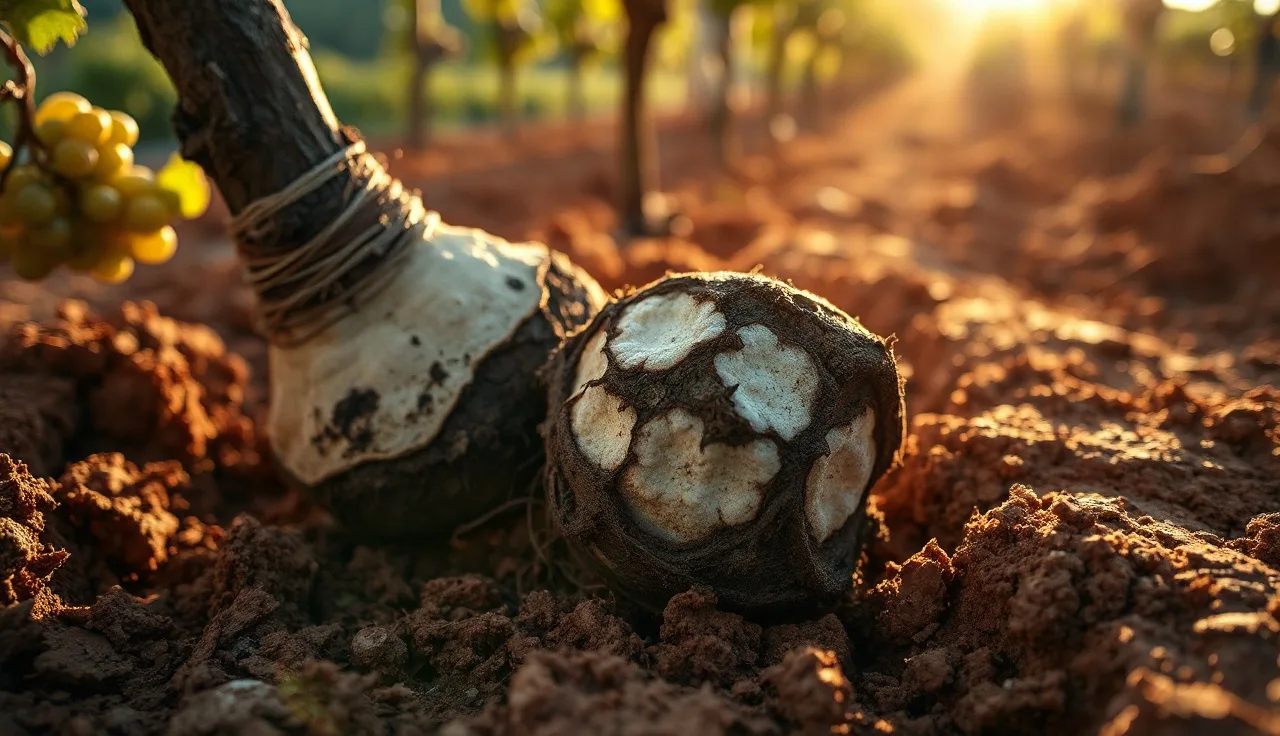
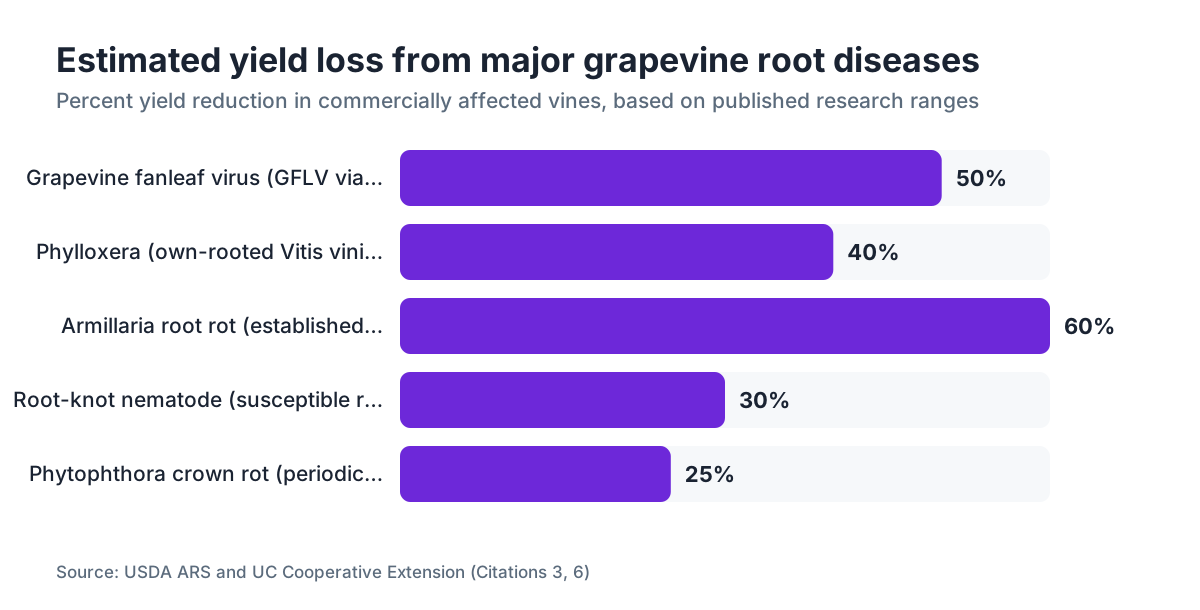
Phylloxera (Daktulosphaira vitifoliae) is the most famous root pest in viticulture history. The insect feeds on root tissue and forms galls that shut down water and nutrient uptake. It wrecked European vineyards from the 1860s through the 1880s, and it still drives rootstock decisions in California, Oregon, and Washington today [1].
Armillaria root rot, caused by Armillaria mellea and related species, is a wood-rotting fungus that travels through soil on old root fragments. You find it most where vineyards went in on former oak woodland or orchard ground. UC plant pathologists estimate Armillaria can survive in soil as infective material for 50 years or more after the host is gone [2].
Phytophthora crown and root rot (mostly Phytophthora cinnamomi and P. parasitica) likes waterlogged, poorly drained soil. It's a water mold, not a true fungus. That distinction matters, because fungicides built for true fungi often do nothing to it.
Nematodes are the fourth category, and they work differently. Root-knot nematodes (Meloidogyne spp.) and dagger nematodes (Xiphinema index) chew roots directly and also carry grapevine fanleaf virus, one of the most damaging grape viruses on earth [3]. A vine can carry the virus a long time before its roots show anything.
A few less common pathogens are worth knowing. Cylindrocarpon (now split partly into Ilyonectria and Dactylonectria) causes black foot disease in young nursery vines, and Rosellinia necatrix causes white root rot in some regions. This article sticks to the big four, because they account for most of the field losses in commercial U.S. vineyards.
How do you identify root disease symptoms above ground?
Root disease rarely shows up in the roots first. You see it in the canopy, which is annoying, because canopy symptoms tell you almost nothing on their own. Slow shoots, small pale leaves, early fall color, dead cordons. All of it points at the roots, and all of it also matches drought stress, trunk disease, and plain old vine age.
The pattern down the row tells you more than the symptom. Phylloxera decline spreads outward from a starting point in a rough circle, creeping over years, usually following equipment traffic [1]. Armillaria does the same thing, only faster, and when you pull a dying vine and smell the roots you'll often catch the mushroom odor of Armillaria mycelium.
Phytophthora shows up first in wet years and in the low spots of the block. A vine that sailed through a dry summer and then collapses after a wet winter is the classic Phytophthora story. Crown rot itself looks like dark, water-soaked tissue at the soil line once you peel back the bark with a knife.
Nematode damage looks like a nutrient deficiency that ignores your fertilizer. The vine simply can't take up what you're feeding it. Fanleaf virus, once Xiphinema index has passed it along, throws distinctive leaf deformation, vein-banding, and double-serrated leaf margins that are close to diagnostic on their own [3].
The only way to confirm any of this is a soil or tissue test. For nematodes, send a composite soil sample from around the root zone to a certified lab. For Phytophthora and Armillaria, bag fresh root and crown tissue and send it to a university diagnostic lab. You'll have an answer in one to two weeks. Cornell's Plant Disease Diagnostic Clinic and UC diagnostic labs both take commercial grower samples [2][4].
Don't skip the lab. Growers have replanted a whole block assuming phylloxera, then lost the replacement vines to Armillaria that nobody ever diagnosed.
What does phylloxera damage look like on roots, and how fast does it spread?
Phylloxera galls look like small lumpy knots on actively growing root tips. On susceptible Vitis vinifera roots, the insect punctures the root with its stylet, injects saliva that scrambles cell growth, and the root reacts by forming a hook-shaped gall. The gall tissue rots, secondary infections move in, and root function drops off. On resistant rootstock, galling stays minimal and the vine heals fast enough to shrug off the insect without real yield loss [1].
Spread is mostly mechanical. Infested soil rides between vineyards on equipment, boots, and nursery stock. Inside a block, the insect moves on its own slowly, maybe a few feet a year on crawlers. An own-rooted block in California's North Coast can go from first detection to near-total collapse in 5 to 10 years. On cooler or drier sites the timeline can stretch toward 20 years, but it never reverses without converting to rootstock [1].
The WSU Viticulture and Enology program treats phylloxera as present in essentially every commercial wine grape region of the Western U.S., and as a baseline assumption for new plantings [5]. Plant own-rooted vines anywhere with a history of V. vinifera and you're taking a real gamble.
California's AXR#1 rootstock failure in the late 1980s and 1990s is the cautionary tale. That rootstock got sold as phylloxera-resistant, wasn't resistant enough against the Biotype B population, and set off a replanting wave across Napa and Sonoma that ran into the billions. UC estimates 25,000 acres or more got replanted in California during that stretch [1].
For how site history and soil type shape establishment decisions, see our vineyard planning fundamentals.
Which rootstocks resist phylloxera and nematodes?
Rootstock is the most durable decision you'll make against root disease. Once it's in the ground, you live with it for 25 to 40 years.
| Rootstock | Phylloxera resistance | Root-knot nematode resistance | Notes |
|---|---|---|---|
| 3309 Couderc | Moderate | Low | Good in cool, shallow soils; avoid in nematode ground |
| 101-14 Mgt | Moderate-high | Low | Widely used in California; moderate vigor |
| 5BB Kober | High | Low | Handles wet soils better than most |
| 1103 Paulsen | High | Moderate | Good drought tolerance; common in hot climates |
| 110 Richter | High | Moderate | Deep-rooted; useful on dry, low-fertility sites |
| 039-16 (Harmony) | High | High | Strong nematode resistance, but moderate vigor issues |
| Freedom | High | High | Solid all-around where nematodes are the main worry |
| Ramsey (Salt Creek) | High | Very high | Very vigorous; that vigor can become a management problem |
Resistance ratings come from UC and WSU research trials [5][6]. No rootstock is immune to every phylloxera biotype or nematode species, and ratings from one region don't always carry to another, because local populations differ. Check current recommendations for your region and your specific nematode species with your farm advisor or extension office before you order.
Nursery certification matters as much as the rootstock. Certified clean material from a Foundation Plant Services (FPS) program cuts the odds of importing nematode-vectored viruses on propagation wood [7]. Planting uncertified material into nematode-infested ground is the fastest way there is to spread fanleaf virus.
How does Armillaria root rot spread and can you stop it?
Armillaria moves underground on rhizomorphs, dark cord-like fungal structures that can travel several feet a year through soil. The fungus lives on large woody root fragments left by earlier trees or vines. Ordinary vineyard tillage doesn't pull out enough of that material to clear the pathogen.
You confirm it when you find the white fan-shaped mycelial mats under the bark of a dying vine's crown and roots, and sometimes honey-colored mushrooms at the base in fall [2]. Decaying root tissue also gives off a fruity, musty smell that's hard to miss once you know it.
There's no cure for an infected vine. Pre-plant fumigation does little against Armillaria, because the pathogen sits deep inside large root pieces the fumigant can't reach. UC recommends that before you replant a known Armillaria site, you dig out as much old root material as you can, wait a fallow period of at least 2 to 3 years if you're able, and go in knowing the risk won't be zero [2].
Some growers get partial results from solarization paired with deep ripping to expose and dry root fragments, especially in the San Joaquin Valley, where summers run hot enough to cook the top soil layer. It's a risk-reducer, not a cure.
Armillaria-resistant rootstocks basically don't exist in viticulture. A few reports hint that certain rootstocks might be a touch more tolerant, but nothing comes close to the resistance we have against phylloxera. You're managing the inoculum load in the soil, not the vine's defenses.
Here's the practical version. Planting on former oak woodland or old orchard ground? Get a real soil pathogen assessment first, budget for far more stump and root removal than you think you need, and plan on a higher vine replacement rate through the first decade.
What causes Phytophthora crown and root rot in vineyards?
Phytophthora is a water mold in the Oomycete class, which means it makes swimming zoospores that move through free water in the soil. Drainage and irrigation are your main levers.
P. cinnamomi and P. parasitica are the two most common species in California vineyards, though P. megasperma and others turn up in wetter regions [8]. The pathogen infects root tips and crown tissue at or just below the soil surface. In bad infections the crown carries a dark brown lesion you can find by peeling bark at the soil line. Vines hit early in the season can collapse suddenly in spring.
The risk factors are plain: heavy clay, low spots in the block, flood irrigation, cover crops holding moisture against the trunk, and any compaction that chokes off drainage. Drip emitters set too close to the trunk have caused crown rot even on otherwise well-drained sites.
Phosphonate fungicides (potassium phosphite, fosetyl-Al) are the main registered tools against Phytophthora in grapes. They don't wipe out the pathogen, but they can hold it back enough for infected vines to recover, as long as you fix the drainage too. EPA label requirements for phosphonate products fall under the Worker Protection Standard for any vineyard application [9].
Mefenoxam (Ridomil Gold) is registered for Phytophthora in grapes in some states, but resistance has shown up in Phytophthora populations in other crops, so leaning on it too hard is a real risk. Rotating modes of action and pairing chemistry with cultural fixes like drainage trenches and berm reshaping holds up better over time.
Cornell's viticulture extension material covers Phytophthora management around Northeast vineyard drainage, which behaves differently from Western U.S. conditions [4].
How do nematodes damage grapevine roots and spread viruses?
Root-knot nematodes (Meloidogyne spp.) are microscopic roundworms that feed inside root tissue and form galls that choke water and nutrient flow. In the canopy the damage mimics Phytophthora or drought. Pull the roots and you'll see swollen galls, sometimes running together into lumpy masses on the feeder system.
Dagger nematodes (Xiphinema index) do more harm than their direct feeding would suggest, because they carry grapevine fanleaf nepovirus (GFLV), the most widely distributed grape virus in the world [3]. X. index can hold the virus for months to years and pass it on every time it feeds on a healthy root. A vineyard with both X. index and GFLV loses 20 to 80% of production depending on cultivar and infection timing, per University of California work [6].
Nematodes travel mainly in infested soil on equipment, in irrigation water carrying soil particles, and in infected nursery stock. On their own they barely move, usually a meter or less per year in undisturbed ground.
Pre-plant fumigation with 1,3-dichloropropene (Telone II) is the most effective nematode treatment before planting. Results swing with soil type, moisture, and application depth. UC recommends soil testing before and after fumigation to check the actual population knockdown [6]. Post-plant options are thin. A few contact nematicides are registered, but getting product down to nematodes in the root zone of an established vine is hard.
Fallow rotation with suppressive cover crops, like sudangrass hybrids, can pull populations down before replanting. But if X. index and GFLV are both present, replanting without fumigation gets you fast reinfection from virus-carrying nematodes that rode out the fallow in root fragments.
Recordkeeping on fumigant-treated fields is required for certain products under state pesticide rules and the EPA Worker Protection Standard [9]. If your operation runs spray records in VitiScribe, the fumigation event and buffer zone documentation sit in the same system as everything else, which keeps the audit paper trail in one place.
What pre-plant soil treatments actually work against root disease?
The honest answer: pre-plant treatments lower your risk, they don't erase it. Knowing what each tool does and doesn't do saves money and keeps you from false confidence.
Methyl bromide was the gold standard for decades. It's now almost entirely phased out for most U.S. agricultural uses under the Montreal Protocol [10]. That leaves 1,3-dichloropropene (Telone II) as the main broad-spectrum soil fumigant for nematodes and some soil pathogens. It needs a trained licensed applicator, a buffer zone calculation, and registration with your state pesticide agency.
Metam sodium and metam potassium (Vapam, K-Pam) are registered for pre-plant vineyard use in some states and reach both nematodes and some fungal pathogens. They're more water-soluble than 1,3-D, so they spread better in heavier soils, but they also demand close attention to soil conditions and label terms.
Against Armillaria, no fumigant gives reliable control inside large root pieces. The pathogen survives treatment tucked in tissue the chemical can't penetrate. Physical removal of big root fragments before treatment improves how well any chemical approach works.
Soil solarization uses clear plastic mulch to heat the top 6 to 12 inches of soil to temperatures lethal to many pathogens. It's practical in hot, sunny climates and shows good results against some Phytophthora species and nematodes near the surface. The limit is depth. Nematodes at 18 to 24 inches survive, and Armillaria in deep root pieces isn't touched.
The WSU viticulture program recommends a multi-year fallow with a non-host cover crop plus fumigation as the most reliable pre-plant protocol when the previous crop was grapes or a susceptible tree fruit [5]. One-year fallows rarely knock X. index down far enough.
Don't skip the pre-plant soil test. A composite sample from multiple depths (0 to 12 inches and 12 to 24 inches) tells you which pathogens are there, at what densities, and whether treatment is even warranted. Fumigation runs $800 to $2,000 or more per acre depending on product and method. Weigh that against the risk your soil test actually shows.
What does a root disease management plan look like for a new block?
A written root disease plan is worth building before you spend a dollar on plants. Here's how experienced growers put one together.
Start with site history. What grew there before? Oak or other hardwood means Armillaria risk. Previous grapes mean phylloxera, nematodes, and fanleaf. Orchard crops open the door to several of the same pathogens. Get it in writing, because it drives rootstock choice and pre-plant treatment.
Then run a pre-plant soil assay: nematode species and population density at multiple depths, plus a bioassay or PCR test of soil from suspect areas if Armillaria or Phytophthora are in play. University extension labs and certified commercial labs both run these. UC Davis Foundation Plant Services offers diagnostic resources for vine pathogens [7].
Choose rootstock off the pathogens actually in that soil and the site's physical traits (water-holding, drainage, vigor potential). Don't let a salesperson pick it for you based on what the nursery has that season.
If nematodes sit above threshold, fumigation before planting pencils out for most commercial operations. Schedule it inside the right soil temperature and moisture window for the product. Off-label conditions cut efficacy hard.
Plan drainage. Fix low spots with tile drains or grading before planting. Doing it after the vines are in costs far more and disrupts far more.
Use certified clean nursery stock. FPS-certified material costs more than uncertified, but the alternative is importing fanleaf virus or other pathogens before the vines are even planted [7].
Once the block goes in, keep records of where early decline shows. A block map with GPS coordinates of symptomatic vines, dated observations, and lab results lets you track spread across years. That field data is what tells you whether an outbreak is growing or holding steady. Keeping those records in a structured system, paper or software, is required anyway for pesticide compliance under most state programs [9].
How do you manage root disease in an existing established vineyard?
Managing root disease in an established block starts with accepting you can't cure most of it. Your moves are slowing the spread, protecting the healthy vines, and deciding when replacement beats carrying declining ones.
For phylloxera in an own-rooted block, the long-term answer is converting to grafted vines on resistant rootstock. Some growers stretch block life with aggressive nutrition and careful irrigation to keep declining vines producing as long as they can. That buys 5 to 10 years in some cases, but it's not a fix [1].
For Armillaria, rogue out affected vines fast, dig out as much infected root tissue as you can, and think twice about replanting in the exact spot of a dead vine on a known Armillaria site. Replanting into a fresh hole with soil brought in from outside the infected area, after a two-year wait, survives better than dropping a new vine straight back into the old hole.
For Phytophthora, the cultural fixes (drainage, moving drip emitters off the trunks, keeping organic matter off the crown) usually do more than fungicides alone. Phosphonate trunk sprays or soil drenches can help protect recently infected vines that still hold living crown tissue.
For nematode pressure in an established block, midsummer nematicide applications to the root zone give partial suppression but rarely drop populations under the economic threshold. Keeping vines healthy through nutrition and irrigation softens the hit from nematode feeding.
So when does replanting beat treating? The rough economic threshold UC Farm Advisors use is when a block falls below about 70% of its potential production for two or more years running, with no upward trend, and the cause is confirmed as a root disease that can't be cured. That threshold shifts with grape price and replanting cost in your operation, but it's a fair place to start the conversation.
What are the compliance and worker safety requirements for root disease treatments?
Root disease treatments that use registered pesticides pull in a stack of federal and state requirements you need to understand before you spray or inject anything.
The EPA Worker Protection Standard (WPS, 40 CFR Part 170) covers any agricultural pesticide application. Under WPS, workers get annual pesticide safety training, access to a pesticide safety information display, and protection from entry during the restricted-entry intervals (REIs) printed on each label [9]. For soil fumigants like 1,3-dichloropropene, REIs can run 5 days or more, and many fumigant jobs require buffer zone notification to nearby workers.
Soil fumigants also fall under Pesticide Management Plans (PMPs) in California through the Department of Pesticide Regulation, which requires a certified pest control adviser (PCA) to write the recommendation and a licensed applicator to apply it [11]. Other states run similar but varying rules.
Fumigant labels for 1,3-dichloropropene (Telone II) set minimum buffer distances, application depth, and the soil temperature and moisture required for legal application. Using a product outside those label conditions is a federal violation under FIFRA, whether or not anything goes wrong [10].
Phosphonate fungicides for Phytophthora carry standard REIs (usually 4 hours for most formulations) and standard PPE per the label. They're far simpler on the compliance side than fumigants, but they still need to land in your spray records with product, EPA registration number, rate, application date, and applicator name.
Every pesticide application in a commercial vineyard should hit your spray log within 24 hours in most states. When a state inspector or USDA audit asks for records and you can't produce them, penalties run from a warning to license suspension. Current records in a purpose-built system cut that risk. Across multiple blocks or regions, like the operations you'll find among Paso Robles wineries, organizing records across sites is worth systematizing.
How much does root disease cost vineyards in lost production and replanting?
Nobody has clean, current numbers on total annual losses from grapevine root disease across the U.S. The closest estimates come from California replanting studies and regional assessments.
The UC farm enterprise budget for North Coast wine grapes puts replanting costs at $20,000 to $45,000 per acre, depending on site prep, trellis replacement, and the establishment period before you see a crop [6]. That range has drifted up with inflation since publication, so real costs in 2024 and 2025 likely sit at the high end or above it.
The Armillaria and phylloxera replanting wave in California from roughly 1990 to 2002 is estimated to have hit over 25,000 acres in Napa and Sonoma counties alone, with total economic impact in the billions [1]. That's a historical figure, not a forecast, but it shows the scale an established outbreak can reach.
For grapevine fanleaf virus, USDA ARS research documents yield losses of 20 to 80% in infected vines, the wide range reflecting cultivar susceptibility and time since infection [3]. A 40% average yield loss across 20 acres of a $2,000-per-ton variety costs $160,000 in a single harvest. At that scale, pre-plant soil treatment looks cheap.
Nematode and pathogen soil assays run $50 to $200 per sample depending on the lab and number of species tested. A thorough pre-plant assay for a 10-acre block might total $300 to $600. That's genuinely small against replanting costs.
The case for early diagnosis and preventive rootstock selection holds up in the data, even where the exact regional loss numbers stay fuzzy.
Frequently asked questions
Can you cure a vine that already has Armillaria root rot?
No. There's no curative treatment for Armillaria in an established vine. Once symptoms show, the vine almost never recovers. Remove it fast, dig out infected root material as thoroughly as you can, and hold off replanting that spot for at least two years. Fungicide applications have not shown reliable results against Armillaria in vineyard settings.
How do I know if my vineyard has phylloxera or a nutrient deficiency?
The pattern in the row is the first clue. Phylloxera decline spreads outward from a starting point in a rough circle. Nutrient deficiency usually affects vines more evenly across a block or tracks soil variation. Confirm phylloxera by pulling a symptomatic vine and checking feeder roots for hook-shaped galls, or by sending root samples to a university diagnostic lab.
What soil temperature is required for 1,3-dichloropropene (Telone II) to work?
Telone II labels call for soil temperature at or above 40 degrees F at application depth, with 50 to 65 degrees F considered optimal for good distribution and efficacy. Applying into cold, wet soil cuts fumigant movement and kills fewer nematodes. Follow the label. Applying outside the specified conditions is a federal FIFRA violation and wastes the product.
Do cover crops help or hurt root disease pressure?
It depends on the disease. Some cover crop species, especially sudangrass hybrids, suppress nematode populations during fallow. But dense cover crops or mulches that trap moisture against vine crowns can raise Phytophthora crown rot risk. Species choice and management matter a lot. Check with your local UC or WSU extension farm advisor before picking a cover crop in a high-risk block.
How long does grapevine fanleaf virus stay in a soil after removing infected vines?
Xiphinema index, the nematode that carries fanleaf virus, can hold the virus for up to 9 months or more without a host vine. The nematodes themselves survive in soil on root fragments for years. That's why replanting without fumigation into a confirmed fanleaf-positive site almost always brings fast reinfection, often within 3 to 5 years of the new planting.
Is Phytophthora a fungus or something else?
Phytophthora is an Oomycete, sometimes called a water mold, not a true fungus. That distinction matters for chemistry, because fungicides aimed at fungal pathogens are often useless against it. Phosphonate materials (potassium phosphite, fosetyl-Al) and mefenoxam are the registered tools with real efficacy against this pathogen class in grapes.
What rootstock should I use if I have both phylloxera and root-knot nematodes in my soil?
Freedom and Harmony (039-16) both resist phylloxera and root-knot nematodes well and see wide use in California where both pests are present. Ramsey (Salt Creek) has very high nematode resistance but is extremely vigorous and can create vine management problems in fertile soils. Get current regional recommendations from your UC or WSU farm advisor before ordering, since resistance ratings are population-dependent.
How often should I scout for root disease symptoms in an established block?
Walk each block at least twice per season: once at budbreak when early deficiency symptoms surface, and once in late summer when stress shows most. Flag symptomatic vines and log GPS coordinates. Pull and inspect roots from at least one symptomatic vine per cluster of dying vines, and send tissue to a diagnostic lab before you assume a cause. Tracking patch size year over year tells you whether a problem is spreading.
Does organic certification affect what root disease treatments I can use?
Yes, a lot. Most soil fumigants, including 1,3-dichloropropene and metam sodium, aren't allowed under USDA National Organic Program standards. Certified organic vineyards lean on resistant rootstocks, clean planting material, biological soil amendments, and cultural practices like cover crops and better drainage. Potassium phosphite for Phytophthora has had uncertain organic status; check current OMRI listings and your certifier before use.
Are there biological controls for grapevine root nematodes?
Commercial biological nematicides, including Bacillus firmus-based products and some mycoparasite products, are registered for grapes in some states. Research results are mixed. Efficacy is generally lower and less consistent than chemical fumigation. They can earn a place in an integrated program, especially where fumigants are restricted, but expect partial suppression rather than the population knockdown a pre-plant fumigation gives you.
What records do I need to keep after applying a soil fumigant in a vineyard?
Federal FIFRA rules and state pesticide regulations require a written application record within 24 hours in most states. Records must show product name, EPA registration number, rate, total amount applied, application date and time, treated field location, applicator name and license number, and any buffer zone notifications made. Some states also require submitting fumigant records to the county agricultural commissioner within a set window.
Can black foot disease kill young vines, and how is it different from Armillaria?
Yes. Black foot disease, caused by Ilyonectria and Dactylonectria species, hits vines in the first 3 to 5 years after planting and shows up most in nursery-propagated material or in replant situations. Infected vines show stunted growth, yellowing, and a black discoloration of the roots and the base of the rootstock. Unlike Armillaria, black foot makes no rhizomorphs or mushrooms, and it doesn't spread in the radial pattern typical of Armillaria.
How do I reduce Phytophthora risk without using fungicides?
Fix drainage first: install tile drains in low spots, reshape row berms to push water away from vine crowns, and drop any irrigation practice that floods the root zone. Move drip emitters at least 12 inches off vine trunks. Keep organic mulch and cover crop residue away from the crown. In clay soils, deep ripping before planting improves drainage and cuts the anaerobic conditions Phytophthora needs to sporulate.
Is there any genetic resistance to Armillaria in commercially available rootstocks?
No commercial grapevine rootstock gives reliable resistance or strong tolerance to Armillaria root rot. Some research has looked at wild Vitis species with possible tolerance, but nothing has become a commercial rootstock with documented field resistance. On known Armillaria sites, the strategy is cutting the inoculum load through physical removal and fallow, not counting on the rootstock.
Sources
- UC Agriculture and Natural Resources, Grape Phylloxera: Phylloxera spread patterns, the AXR#1 rootstock failure, 25,000+ acres replanted in California, and the inability to reverse own-rooted decline without rootstock conversion
- UC IPM, Armillaria Root Rot of Grapevines: Armillaria can survive in soil as infective material for 50 years or more; white mycelial mats and honey mushrooms confirm it; fumigation has limited efficacy and a 2-3 year fallow is recommended before replanting
- USDA ARS, Grapevine Fanleaf Virus Disease: Xiphinema index vectors grapevine fanleaf nepovirus; yield losses of 20-80% documented in infected vines; GFLV is the most widely distributed grapevine virus worldwide
- Cornell University Plant Disease Diagnostic Clinic: Cornell accepts commercial grower tissue samples for root and crown disease diagnosis; Northeast Phytophthora and drainage management guidance
- WSU Viticulture and Enology: Phylloxera present in essentially all Western U.S. commercial wine grape regions; multi-year fallow with non-host cover crop plus fumigation recommended as most reliable pre-plant protocol; rootstock resistance ratings
- UC Cooperative Extension, North Coast Wine Grape Farm Enterprise Budget and Nematode Management: Replanting costs estimated $20,000-$45,000 per acre; pre-plant soil fumigation and rootstock resistance ratings for nematode species; 40% fanleaf yield loss economic example basis
- UC Davis Foundation Plant Services (FPS): Certified clean planting material from FPS reduces introduction of nematode-vectored viruses; diagnostic resources available for vine pathogens
- UC IPM, Phytophthora Crown and Root Rot of Grapevines: P. cinnamomi and P. parasitica are the most common Phytophthora species in California vineyards; phosphonate fungicides suppress but do not eradicate
- EPA, Worker Protection Standard, 40 CFR Part 170: WPS requires annual pesticide safety training, pesticide safety information display, and restricted-entry interval enforcement for all agricultural pesticide applications including fumigants
- EPA, FIFRA and Methyl Bromide Phaseout: Methyl bromide phased out for most agricultural uses under the Montreal Protocol; off-label pesticide application is a federal FIFRA violation
- California Department of Pesticide Regulation, Fumigant Pesticide Management: California requires a licensed PCA recommendation and licensed applicator for soil fumigant applications; Pesticide Management Plans required for certain fumigants
Last updated 2026-07-09