Grapevine trunk disease complex: what every vineyard manager needs to know
TL;DR
- Grapevine trunk diseases (Botryosphaeria dieback, Eutypa dieback, Esca, Phomopsis cane and leaf spot, and black foot) are caused by wood-invading fungi that enter through pruning wounds.
- They cost California growers an estimated $260 million per year in lost production.
- No cure exists once wood is infected, so prevention through wound timing, protectant fungicides, and rigorous record-keeping is everything.
What is grapevine trunk disease complex and why does it matter?
Grapevine trunk disease complex is not a single disease. It's a group of fungal infections that share one ugly trait: they colonize the permanent woody structure of the vine, cut off water and nutrients, and do it quietly for years before you see symptoms in the canopy.
The main diseases in the complex are Eutypa dieback (caused by Eutypa lata), Botryosphaeria dieback (caused by a family of Botryosphaeriaceae fungi including Neofusicoccum parvum and Diplodia seriata), Esca and Petri disease (caused by Phaeomoniella chlamydospora, Phaeoacremonium minimum, and related species), Phomopsis cane and leaf spot (Diaporthe ampelina), and black foot (Dactylonectria and Ilyonectria species). Each one enters through wounds. Pruning cuts are the main entry point, though hail damage, mechanical injury, and infected nursery wood all open doors too.
California's Wine Institute and UC Cooperative Extension put direct economic losses from trunk diseases in California at roughly $260 million per year in reduced yield and vine replacements [1]. That figure is almost certainly an undercount nationally. A study by Trouillas and colleagues published in Phytopathology estimated that Eutypa dieback alone affects between 25 and 80 percent of vines in many California blocks more than ten years old, depending on region and variety [2].
The core problem is irreversibility. Once the wood is infected, you can't spray it out. You can slow spread and remove infected wood, but you cannot cure a vine that has a mature Eutypa canker running through its cordon. That's why the entire management framework centers on prevention.
What are the individual trunk diseases and how do you tell them apart?
Sorting out which disease you're dealing with matters because the infection biology and management windows differ by pathogen. Here's how they break down.
Eutypa dieback is the one most California and Pacific Northwest growers think of first. Cross-section a symptomatic arm and you'll see a characteristic V-shaped or wedge-shaped brown canker in the wood. Aboveground, the shoot emerging from an infected spur is stunted, the leaves are cupped and chlorotic, and clusters may fail entirely. Eutypa lata produces spores during rain events between October and May, which is exactly when most winter pruning happens [2].
Botryosphaeria dieback looks similar in cross-section but tends to move faster under drought stress. The cankers are typically darker (grey-black to dark brown) and can extend several centimeters further from the pruning wound in a single season than Eutypa. WSU Extension notes that water stress amplifies susceptibility significantly [3].
Esca is the one that will make your stomach drop on a hot August afternoon. Healthy-looking shoots suddenly show interveinal leaf scorching (the tiger-stripe pattern), the berries shrivel, and sometimes whole shoots collapse overnight in what's called apoplexy. Inside the wood there's a soft, white spongy rot surrounded by dark staining. Esca is caused by multiple fungi acting together; Petri disease is the early, nursery-phase form affecting young vines.
Phomopsis cane and leaf spot is more familiar as a canopy disease (small dark lesions on leaves and canes early in the season) but it also causes a wood canker that weakens cordons over time. It's more of a wet-climate problem, common in the Finger Lakes of New York, the Willamette Valley, and cool coastal sites.
Black foot hits young vines, usually in the first three to five years. It rots the root crown and basal trunk wood, causing sudden vine death or severe stunting. It typically comes in on infected nursery material or from infested soil.
| Disease | Causal fungi | Primary entry | Symptom speed | Key visual ID |
|---|---|---|---|---|
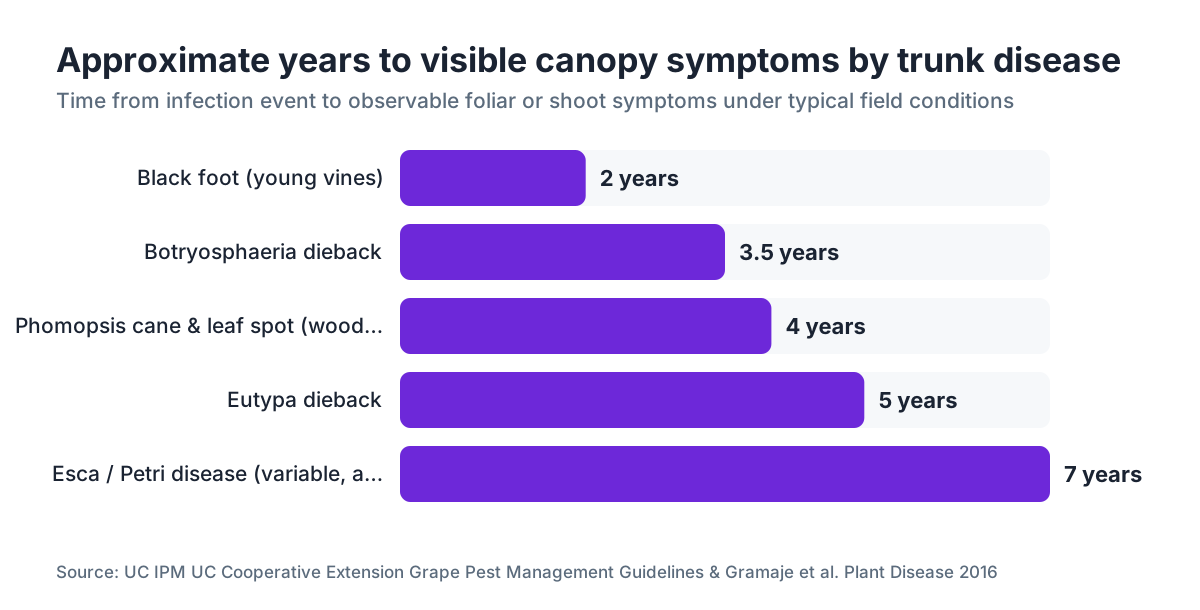
| Eutypa dieback | Eutypa lata | Pruning cuts | Slow (3-7 yrs) | Wedge canker, stunted shoots |
| Botryosphaeria dieback | Neofusicoccum, Diplodia spp. | Pruning cuts | Moderate (2-5 yrs) | Dark canker, accelerates with drought |
| Esca / Petri disease | P. chlamydospora, Pm. minimum | Wounds, nursery wood | Variable (sudden apoplexy) | Tiger-stripe leaves, white rot in wood |
| Phomopsis cane & leaf spot | Diaporthe ampelina | Pruning cuts | Moderate | Cane lesions, wood canker |
| Black foot | Dactylonectria, Ilyonectria spp. | Nursery wood, soil | Fast in young vines | Root crown rot, sudden collapse |
When and how do trunk disease fungi infect pruning wounds?
The infection window is the single most actionable piece of biology in this whole complex. Get this wrong and no amount of record-keeping or spray product will save your vines.
Eutypa lata releases ascospores during rainfall from late fall through early spring, and peak inoculum lines up almost perfectly with dormant pruning season in most wine regions. The spores land on fresh cut surfaces and germinate within hours if moisture is present. Cornell's viticulture program has documented wound susceptibility persisting for up to 16 weeks after a pruning cut is made under some conditions, though the highest-risk window is the first two to three weeks [4].
Botryosphaeria fungi produce both sexual (ascospore) and asexual (pycnidiospore) inoculum and stay active over a wider temperature range, including during warm dry spells after pruning. This is why Botryosphaeria dieback is increasingly severe in drought years and in warmer regions like the San Joaquin Valley and parts of Paso Robles.
The practical upshot: every fresh cut you make in a wet-winter region is a potential infection point. Pruning later in the dormant season, closer to bud swell, shrinks the susceptibility window. UC Davis researchers have shown that late pruning (delaying until 50% bud swell) can cut Eutypa infection rates substantially compared to early pruning in January, though late pruning carries its own production tradeoffs [1].
Inoculum pressure also comes from inside your own vineyard. Old infected wood on the trellis, unpruned mummified canes, and dead vines left standing all produce spores year after year. Removing and destroying infected prunings is not optional if you're trying to manage inoculum.
What fungicides and biological products actually work for trunk disease prevention?
Let's be direct: no registered product cures an existing trunk disease infection. Everything available works only as a protectant applied to fresh pruning wounds before the fungi get in. That distinction matters enormously for setting expectations.
For Eutypa and Botryosphaeria dieback, the most-documented options are thiophanate-methyl-based products (e.g., Topsin M), boscalid (Endura), and tebuconazole. A UC Davis trial summarized by Gubler and colleagues found that wound protectant fungicides reduced Eutypa infection rates by 50 to 90 percent depending on product and timing of application relative to rainfall events [1]. Boscalid showed particularly strong activity against Botryosphaeria in that work.
Biological options have matured enough to take seriously. Products based on Trichoderma atroviride (e.g., Vintec) have shown efficacy against Eutypa lata and some Botryosphaeria species in French and Australian trials, and have EPA registration in the US. Bacillus-based products are also registered but have weaker efficacy data against trunk pathogens specifically. If you're managing organically, Trichoderma products are your main option; they work best when applied immediately after cutting.
The application method matters as much as the product choice. Pruning wound protectants need to physically coat the cut surface. This means:
- Hand-applying paste formulations immediately on large cuts
- Using a spray boom or backpack right after mechanical pruning (within hours, not the next day)
- Re-applying after rain events wash off surface residues
Timing relative to rainfall is key. If rain is forecast within 24 to 48 hours and you haven't protected wounds, you've lost that window for Eutypa. The spores move with rain; the infection happens fast.
EPA's Worker Protection Standard (WPS) applies to fungicide applications in vineyards. Re-entry intervals (REIs) and personal protective equipment requirements under 40 CFR Part 170 must be posted and followed [5]. California's DPR requires that all pesticide applications be recorded in a pesticide use record (PUR) within 24 hours of application, and these records must be submitted to the county agricultural commissioner monthly [6]. If your spray records aren't current, you're more than risking disease, you're risking compliance penalties.
How do you prune to reduce trunk disease risk without wrecking production?
Pruning technique is your first line of defense, and it's free.
The idea of 'pruning to the green' or leaving a protective stub comes from how the vascular tissue at the base of a spur connects to the main trunk. Researchers at UC Davis and at the Institut Français de la Vigne et du Vin have shown that each spur position has a dedicated vascular pathway (a 'sectored' flow system), and infections entering through a dead stub can track back along that pathway into the cordon or trunk wood [1]. Leaving a small protective cane beyond the fruiting spur, then removing it the following year after it has died and desiccated naturally, reduces the connection between dead wood and the live conductive tissue.
Make cuts as smooth as possible. Ragged cuts have more exposed surface area and hold moisture longer. Sharp, clean blades make a real difference. Disinfecting pruning tools between vines with 70% isopropyl alcohol or a 10% bleach solution slows spread of pathogens on tools, though the evidence that tool transmission is a major pathway (versus airborne spore deposition) is mixed. Still, it's low-cost insurance.
Late pruning shrinks the infection window because wounds made closer to bud swell close faster physiologically, and there's less dormant season left for spore deposition. WSU Extension recommends evaluating late pruning in blocks with high Eutypa pressure, weighed against site-specific frost risk from delayed pruning [3].
Double-pruning, a mechanical pre-pruning pass in January that removes bulk cane mass, followed by hand-finishing closer to bud swell, is gaining adoption in larger operations. The mechanical pass creates wounds that get re-cut anyway, so the final finished wounds land in the lower-risk late-dormant window. Labor savings from faster hand pruning can partly offset the added pass cost.
Can you surgically remove trunk disease and save infected vines?
Yes, sometimes. Remedial surgery is the most labor-intensive management tool but also the only one that directly addresses established infections.
For Eutypa and Botryosphaeria dieback, the standard approach is to remove infected wood until you reach clean white wood in cross-section with no brown staining. This often means removing an entire cordon arm, or in bad cases, cutting back to the trunk and retraining a new shoot. The removed wood must leave the vineyard and get burned or buried, not left in the row.
Esca is harder to manage surgically because the white rot can be diffuse and doesn't always show clean boundaries. Some growers are trialing a trunk renewal approach: cutting back to the rootstock union and retraining completely, which resets the clock but loses 2 to 4 years of production.
The economics matter. If you have 15% vine mortality in a mature block worth $40,000 per acre in grapes, surgical intervention plus retraining costs (labor plus lost production during retraining) can easily hit $5,000 to $10,000 per acre across a whole diseased block. That math sometimes favors replanting over remediation, especially if the vineyard is on a short lease or the variety is out of fashion.
Don't skip wound protection after surgery. You've just made multiple large fresh cuts on a stressed vine. Apply wound protectant immediately.
How does nursery material spread trunk disease into a new vineyard?
Growers who focus only on field management miss this one. Nursery-propagated wood is a documented source of Esca, Petri disease, and black foot pathogens. The fungi colonize dormant wood during propagation, hot water treatment, rooting, and storage, and they ride right into your vineyard at planting.
A 2016 review in Plant Disease by Gramaje and colleagues found that Phaeomoniella chlamydospora and Phaeoacremonium minimum (the main Esca/Petri pathogens) were recovered from a significant percentage of commercial nursery material samples in California, Europe, and South Africa [7]. The percentages varied widely by nursery and year, so this isn't a condemnation of any specific source, but it means buying certified clean stock from nurseries with documented sanitation protocols is meaningful due diligence.
Hot water treatment of dormant cuttings before grafting (typically 50 degrees Celsius for 30 minutes) is the most-studied intervention for cleaning propagation material. UC Davis's Foundation Plant Services maintains clean grapevine material and has protocols for hot water treatment [8]. Not all commercial nurseries use it consistently.
Ask your nursery supplier directly: what is their testing protocol for trunk disease pathogens, do they hot-water treat cuttings, and can they provide pathogen test results? If they can't answer that clearly, that's information too.
What does the research community know now, and what are grapevine trunk disease conferences revealing?
The grapevine trunk disease research community is active and moving fast relative to even ten years ago. The International Symposium on Grapevine Trunk Diseases, held roughly every two to three years, is the main venue where new pathogen identification, epidemiology data, and management trials get presented before they land in journals. The 2016 symposium in Stellenbosch, the 2018 symposium in Portugal, and the 2022 meeting in California all produced substantial new findings.
A few things the recent conferences and literature have shifted:
The Botryosphaeriaceae family is far more species-diverse than previously known. What used to be lumped as 'Bot canker' is now understood to be 20-plus distinct species with varying aggressiveness, host range, and geographic distribution. This matters for fungicide selection because species vary in sensitivity.
Esca management is getting renewed attention. The French use of sodium arsenite was banned in the EU, removing the only product that had meaningful curative activity. Researchers are now looking at trunk injection of phosphonate compounds, biocontrol agents, and heat treatment of vines. None of these are yet proven at commercial scale in the US.
There's growing interest in the microbiome of the wood. Some research groups are characterizing the endophytic fungal and bacterial communities in trunk wood and asking whether a diverse, healthy wood microbiome might suppress pathogen establishment. This is early-stage work but conceptually interesting.
The clearest conference takeaway from recent years is blunt: the integrated approach (late or double pruning, wound protectants, diseased wood removal, and clean nursery material) consistently outperforms any single tactic, and the economic data increasingly support the cost of doing all four.
How do you set up a monitoring and record-keeping system for trunk diseases?
Trunk disease management needs sustained, systematic observation. This is not something you eyeball once a season.
A workable monitoring program has four components. First, annual vine health surveys during the growing season, ideally at veraison when Esca symptoms are most visible, noting position and severity of symptomatic vines by block and row. Second, cross-section sampling of removed wood to confirm pathogen identity (or at least rule in or out the major diseases), which a plant pathology lab at a land-grant university can do for modest cost. Third, annual pruning wound protection records that document what product was applied, at what rate, on what date, and by whom. Fourth, tracking vine removal and replacement rates by block over time.
The pruning wound protection records also need to satisfy your county agricultural commissioner's pesticide use reporting requirements if you're using registered fungicides. California's Department of Pesticide Regulation requires the county PUR to include applicator license number, site location, acres treated, product name, EPA registration number, amount used, and application date [6]. This is non-negotiable paperwork.
Some growers are moving to digital field records that capture GPS-tagged vine health data and link to spray records in a single system. VitiScribe was built for this kind of field-to-compliance workflow, connecting block-level scouting notes to the spray records you're required to submit. Whether you use software or a well-organized paper system, the underlying structure is the same: timestamped, located, signed records that would hold up to an inspection.
For larger operations, map disease incidence using your vine spacing and GPS coordinates. Trunk diseases often cluster. A new focus of infection near an old infected vine or a drainage problem area tells you something you can act on.
What are the realistic economics of trunk disease across a vineyard block's life?
Nobody has a perfect, randomized economic dataset on this across all US wine regions. The closest published work is a 2013 study by Trouillas and colleagues at UC Davis, along with analyses by UC Cooperative Extension farm advisors in Napa and Sonoma counties, which put Eutypa-related yield losses at 5 to 20 percent in heavily infected mature blocks [1].
Here's how the math usually works out for a hypothetical mature Cabernet Sauvignon block at Napa pricing:
A 20-acre block producing 3 tons per acre at $4,000 per ton gross generates $240,000 per year. A 15 percent yield loss from trunk disease costs $36,000 per year. Over ten years that's $360,000 in lost revenue, before you count the cost of vine replacements and replanting labor.
Prevention is cheap by comparison. A fungicide wound protectant program for that same 20-acre block (thiophanate-methyl or boscalid applied after pruning) might cost $1,500 to $4,000 per year including product and labor. Even at the high end that's a 10-to-1 return if it prevents half the infection rate.
The tricky part is that you won't see the return on prevention for 5 to 10 years, when the vines that didn't get infected are still producing at full capacity while neighboring unprotected vines in the industry are declining. It's a long game. That's why so many growers underinvest, and why so many vineyards in the 15- to 25-year age range are carrying significant trunk disease burden right now.
For a reference on current California spray costs, UC Cooperative Extension publishes annual cost-of-production studies by crop and county, available through the UC Agriculture and Natural Resources website [9].
What should you do right now if you suspect trunk disease in your vineyard?
Start with confirmation. Don't guess, don't assume. The canopy symptoms of trunk disease (weak shoots, chlorotic leaves, sudden vine death) overlap with nutrient deficiencies, water stress, Pierce's disease, and other problems. Cross-section a few symptomatic arms with a handsaw or pruning saw and look for internal wood discoloration. If you see wedge cankers or dark staining, call your local farm advisor or submit wood samples to a plant pathology diagnostic lab.
UC Davis's Plant Pathology laboratory and Cornell's Plant Disease Diagnostic Clinic both accept samples from growers and can identify the causal organisms by culture or molecular methods [4]. Washington State also has diagnostic resources through WSU Extension [3]. Turnaround is typically one to four weeks depending on the method.
Once you have confirmation, prioritize the infection hot spots on your block map. Remove and destroy symptomatic wood during the current or next dormant season. Do not leave it in the rows. Apply wound protectant to every cut surface made during that remediation work.
Review your pruning crew's timing and technique. If you've been pruning in January during wet weather in a region with high inoculum pressure and not protecting wounds, that's your main problem to fix. Shifting pruning timing and adding a wound protectant program will move the needle more than any other single change.
For young vineyards, or if you're planting a new block, source clean nursery material, ask for pathogen testing documentation, and consider a soil fumigation program for black foot risk in heavily replanted ground, though fumigant options are increasingly restricted and you'll need to work with your PCA on what's registered and appropriate in your county [6].
Tracking what you find, what you do, and what changes is the only way to know if your program is working. A basic spreadsheet by vine ID, block, and observation date gets you started. A platform like VitiScribe can connect those observations to your spray records and compliance filings if you want to cut the manual work of keeping everything in sync.
For growers in the Paso Robles wineries region or similar warm inland valleys where Botryosphaeria pressure is high, the urgency to adopt a wound protection program is especially acute given the combination of high spore pressure and drought stress that speeds up disease progression.
Frequently asked questions
What is the most common trunk disease in California vineyards?
Eutypa dieback and Botryosphaeria dieback are the most prevalent trunk diseases in California. Eutypa dieback caused by Eutypa lata has been documented in 25 to 80 percent of vines in blocks older than ten years in many California wine regions, depending on variety and location. Botryosphaeria dieback has become increasingly common as drought stress has increased vine susceptibility.
Can trunk diseases spread from vine to vine through the soil or tools?
Airborne spore dispersal during rain events is the primary spread mechanism for Eutypa lata, Botryosphaeria species, and Phomopsis. Tool transmission is theoretically possible but the evidence it's a major pathway is limited. Black foot and Petri disease pathogens can persist in soil and on nursery material. Disinfecting pruning tools is low-cost and reasonable practice, but fixing your wound protection program matters more.
How long does it take for grapevine trunk disease symptoms to appear after infection?
Eutypa dieback typically takes 3 to 7 years after infection for clear canopy symptoms to appear, though wood discoloration can be found earlier in cross-section. Botryosphaeria dieback moves somewhat faster, often 2 to 5 years. Esca can cause sudden apoplexy with no prior warning in a vine that appeared healthy. Black foot can kill young vines within one to three years of planting.
What is the best time to prune to avoid trunk disease infection?
Later in the dormant season is consistently better. Pruning closer to bud swell (rather than in early January) shrinks the window during which fresh wounds are exposed to wet conditions and spore dispersal. UC Davis research shows later pruning substantially reduces Eutypa infection rates. The tradeoff is site-specific frost risk and labor scheduling. In high-pressure regions, late pruning combined with wound protectant application is the most protective combination.
Are there any organic-approved treatments for grapevine trunk diseases?
Trichoderma atroviride-based products (such as Vintec) are the main biologically-based option with EPA registration and efficacy data for trunk disease prevention in organic systems. Bacillus-based biocontrols are registered but have weaker data specifically for trunk pathogens. Pruning timing and technique remain your most important organic management levers. No organic product cures an existing infection.
Does grapevine variety affect susceptibility to trunk diseases?
Yes, variety matters. Chardonnay and Cabernet Sauvignon are considered highly susceptible to Eutypa dieback. Some varieties show lower natural susceptibility, though no commercially grown wine grape variety is considered immune. Rootstock choice also matters for black foot and Petri disease, with some rootstocks showing better field tolerance than others. UC Davis and ENTAV-INRAE have variety susceptibility data, though it's imperfect.
How do I read a cross-section of grapevine wood to diagnose trunk disease?
Cut cleanly across the arm or trunk with a pruning saw and look at the wood's color pattern. Healthy wood is cream to white. Eutypa dieback produces a characteristic wedge or V-shaped brown sector that typically points toward the pruning wound origin. Botryosphaeria cankers are usually darker brown to grey-black. Esca shows a soft, white to yellowish spongy rot often surrounded by dark staining. Black foot shows brown to black rot at the root crown and basal trunk.
What records do I need to keep for trunk disease fungicide applications?
In California, pesticide use records must be filed with the county agricultural commissioner monthly and include the applicator's name and license number, site location by legal description, crop and acreage treated, product name and EPA registration number, amount of product used, and date of application, per California DPR requirements. Federal WPS rules under 40 CFR Part 170 also require posting application information and maintaining records of re-entry intervals for employees.
Can I replant a vineyard block that's had severe trunk disease without the disease returning?
Possibly, but replanting into infested soil is a real risk for black foot and Petri disease pathogens, which can persist in roots and organic matter. Full site fumigation, thorough removal of old root material, and a multi-year fallow period all reduce but don't eliminate risk. Sourcing hot-water-treated nursery material from a clean nursery is essential. Eutypa and Botryosphaeria risk after replanting depends more on regional inoculum pressure than soil carry-over.
What is hot water treatment of grapevine nursery material and does it work?
Hot water treatment involves immersing dormant cuttings or dormant grafted vines in water at 50 degrees Celsius for 30 minutes. Studies have shown it can significantly reduce internal populations of Phaeomoniella chlamydospora and Phaeoacremonium minimum, the main Esca/Petri pathogens, in propagation material. UC Davis Foundation Plant Services uses hot water treatment protocols. It's not 100 percent effective but meaningfully reduces the risk of bringing disease into a new planting.
Is there a national or international database or conference for grapevine trunk disease research?
The International Symposium on Grapevine Trunk Diseases is the primary research conference, held every two to three years in different wine-producing countries. Proceedings from past symposia are published in peer-reviewed supplements to journals like Phytopathologia Mediterranea. The American Phytopathological Society annual meeting also regularly features trunk disease sessions. UC Davis, WSU, and Cornell all publish extension-accessible summaries of current research for growers.
How much does a grapevine trunk disease management program cost per acre?
A preventive wound protectant fungicide program typically costs $75 to $200 per acre per year for product alone, depending on product choice, application method, and how many applications you make per season. Adding labor for hand application to large cuts increases that. Double pruning to shift wound timing to late dormant adds roughly a half-day to one day of tractor time per acre for the mechanical pre-prune pass. These costs are small relative to the yield losses a serious disease outbreak causes.
Do cover crops or soil practices affect trunk disease risk?
Directly, no. Trunk disease pathogens enter through aerial wounds, not primarily through the soil (with the exception of black foot). But soil and irrigation management practices that reduce vine water stress indirectly reduce Botryosphaeria dieback severity, since drought-stressed vines are substantially more susceptible to that pathogen. Maintaining good vine nutrition and consistent water supply is a supporting management practice, not a primary control.
What extension resources are available for trunk disease identification and management?
UC Davis Cooperative Extension publishes the 'UC IPM Pest Management Guidelines for Grapes' online, with detailed trunk disease sections. Cornell Cooperative Extension has trunk disease resources through the Lake Erie Regional Grape Program and the Finger Lakes Grape Program. WSU Extension publishes viticulture guides specific to Pacific Northwest conditions. The UC Davis Foundation Plant Services site covers clean nursery material standards. All are freely accessible online.
Sources
- UC IPM, UC Cooperative Extension, Grape Pest Management Guidelines: Trunk Diseases: UC Davis researchers documented that wound protectant fungicides reduced Eutypa infection rates by 50 to 90 percent; Eutypa dieback estimated to cost California growers roughly $260 million per year; late pruning (to 50% bud swell) reduces Eutypa infection rates substantially; vascular sectoring research supporting protective stub pruning method
- Trouillas FP et al., Phytopathology, 2010, Botryosphaeriaceae species in California: Eutypa lata produces ascospores during rainfall October through May; 25 to 80 percent of vines in many California blocks more than ten years old affected by Eutypa dieback depending on region and variety
- Washington State University Extension, Grape Trunk Disease Resources: Water stress amplifies Botryosphaeria susceptibility; WSU recommends evaluating late pruning in blocks with high Eutypa pressure against frost risk; WSU offers Pacific Northwest diagnostic resources
- Cornell University Plant Disease Diagnostic Clinic, Grape Trunk Diseases: Cornell has documented wound susceptibility persisting up to 16 weeks after a pruning cut; Cornell's diagnostic clinic accepts wood samples and identifies causal organisms by culture or molecular methods
- US EPA, Agricultural Worker Protection Standard (40 CFR Part 170): EPA Worker Protection Standard requires posting re-entry intervals and personal protective equipment requirements under 40 CFR Part 170 for vineyard fungicide applications
- California Department of Pesticide Regulation, Pesticide Use Reporting: California DPR requires pesticide use records submitted to county agricultural commissioner monthly, including applicator license, site, acres, product name, EPA registration number, amount used, and application date; soil fumigant options regulated
- Gramaje D et al., Plant Disease, 2016, Grapevine trunk diseases: a review: Phaeomoniella chlamydospora and Phaeoacremonium minimum recovered from a significant percentage of commercial nursery material samples in California, Europe, and South Africa
- UC Davis Foundation Plant Services, Grapevine Certification and Hot Water Treatment: UC Davis Foundation Plant Services maintains clean grapevine material and has protocols for hot water treatment of propagation material
- UC Agriculture and Natural Resources, Cost and Return Studies, Winegrapes: UC Cooperative Extension publishes annual cost-of-production studies for California winegrape regions, including spray program costs
- International Symposium on Grapevine Trunk Diseases, Proceedings, Phytopathologia Mediterranea: Botryosphaeriaceae family now understood to include 20-plus distinct species with varying aggressiveness; integrated approach consistently outperforms any single management tactic per conference summaries
- UC Davis Department of Plant Pathology, Grapevine Trunk Disease Diagnostic Resources: UC Davis Plant Pathology laboratory accepts wood samples from growers and can identify causal organisms by culture or molecular methods
- Úrbez-Torres JR et al., Plant Disease, 2006, Botryosphaeria species in California grapevines: Neofusicoccum parvum and Diplodia seriata among primary Botryosphaeriaceae species causing dieback in California; cankers move faster under drought stress
Last updated 2026-07-09