Grapevine trunk disease pathogens: what they are and how to stop them
TL;DR
- Grapevine trunk diseases come from more than 130 fungal species grouped into five complexes: Botryosphaeria dieback, Eutypa dieback, Esca, Petri disease, and black foot.
- They enter through pruning wounds, colonize woody tissue, and kill mature vines over years.
- No cure exists.
- Wound protection, late pruning, and remedial surgery slow the damage and buy years of productive vine life.
What are grapevine trunk disease pathogens?
Grapevine trunk diseases are woody-tissue infections caused by a loose group of fungi, most of them ascomycetes, that colonize the permanent structure of the vine instead of the canopy. These are not leaf diseases. By the time you spot foliar symptoms, the damage inside the cordon or trunk is often years old.
The species count is genuinely staggering. A 2019 review in Phytopathologia Mediterranea documented more than 130 fungal species linked to these disease complexes worldwide [1]. That number keeps climbing as researchers sequence fungi pulled from symptomatic wood. For field purposes, though, the pathogens sort into five named groups: Botryosphaeria dieback, Eutypa dieback, Esca (including black measles), Petri disease, and black foot.
They share one biology. They're wound pathogens. Pruning cuts, frost cracks, mechanical damage, grafting scars, and trunk injuries are the doors. The fungi move into the vascular cambium and xylem, produce toxins and enzymes, block water movement, and leave the dark internal staining or wedge-shaped cankers you find when you saw through infected wood. Some species crawl. Others colonize a fresh pruning cut within hours.
This is a global problem and it's getting worse. Monoculture planting, the mid-century removal of arsenical fungicides that happened to suppress some of these pathogens, and the shift to larger pruning wounds on high-wire trellis systems have all pushed incidence up over the past 30 years [2].
Which specific fungi cause each trunk disease complex?
Break it down by complex and it gets manageable.
Botryosphaeria dieback comes from species in the family Botryosphaeriaceae, mainly the genera Lasiodiplodia, Diplodia, Neofusicoccum, and Botryosphaeria itself. Lasiodiplodia theobromae is the most aggressive species in warm climates. Neofusicoccum parvum and N. luteum dominate cooler regions. UC Cooperative Extension lists more than 20 Botryosphaeriaceae species from California vineyards alone [3]. These fungi sporulate heavily from dead wood and infected pruning stubs, releasing conidia that germinate on wet pruning wounds within hours of rain.
Eutypa dieback runs mostly on Eutypa lata, though Cryptovalsa ampelina and other Diatrypaceae species show up as co-conspirators. Eutypa lata releases airborne ascospores during rain between autumn and spring, the same window when most pruning happens. The lag between infection and symptoms is notoriously long, often 3 to 10 years, so you may not see the stunted, chlorotic "eutypa arm" until well after the infected cordon has died inside [4].
Esca is the hardest of the group because it's a syndrome, not a single-pathogen disease. The major players are Phaeomoniella chlamydospora, Phaeoacremonium minimum (formerly P. aleophilum), and wood decay basidiomycetes, chiefly Fomitiporia mediterranea and F. punctata. P. chlamydospora and Phaeoacremonium species drive early Esca (called Petri disease in young vines) and the tiger-stripe foliar pattern in mature vines. The basidiomycetes cause the internal white rot and soft spongy wood that eventually hollows the trunk. Acute Esca, where vines collapse and die in a matter of days in mid-summer, seems to involve a toxin response triggered by environmental stress interacting with the fungal colonization, though the mechanism is still argued over [5].
Petri disease is early Esca, driven by the same P. chlamydospora and Phaeoacremonium species that enter at nursery level through infected planting material or grafting wounds. Cornell's plant pathology extension ties Petri disease strongly to contaminated nursery stock and failed hot-water treatment [6].
Black foot comes from Ilyonectria (formerly Cylindrocarpon) species, principally I. liriodendri and I. macrodidyma. These are soilborne, infecting through roots and the trunk base. They're the dominant trunk disease problem in young vines in nurseries and early establishment, killing vines before they ever build a real trunk.
| Disease complex | Primary causal genera/species | Entry route | Symptom lag |
|---|---|---|---|
| Botryosphaeria dieback | Lasiodiplodia, Neofusicoccum, Diplodia | Pruning wounds | 1-3 years |
| Eutypa dieback | Eutypa lata | Pruning wounds (ascospores) | 3-10 years |
| Esca | Phaeomoniella, Phaeoacremonium, Fomitiporia | Pruning wounds, nursery | 5-15 years |
| Petri disease | Phaeomoniella, Phaeoacremonium | Nursery/grafting wounds | 1-3 years |
| Black foot | Ilyonectria spp. | Roots, trunk base | 1-4 years |
How do these pathogens spread in a vineyard?
Spread ties almost entirely to pruning, rain, and infected wood sitting in the block. That's the short version.
For Botryosphaeriaceae and Eutypa lata, the spore release window is the variable that matters. Both sporulate from dead wood and old pruning stubs when rain wets the tissue. Botryosphaeria species release conidia (asexual spores) from pycnidia embedded in bark, and those travel by water splash or on tools. Eutypa lata releases wind-dispersed ascospores that carry real distance, with studies detecting viable spores up to 50 meters from a source [4]. That shapes block layout and pruning timing.
Fresh pruning wounds are most vulnerable in the first few hours after cutting, then susceptibility falls as the wound dries and forms a barrier. WSU extension measured that wounds stay highly susceptible for roughly 2 to 3 days under wet winter conditions and that susceptibility drops by about 50 percent within 24 hours of dry weather [7]. That's why late-winter pruning during dry windows is one of the most evidence-backed tools you have.
Phaeomoniella chlamydospora and Phaeoacremonium species ride in on infected planting material. Nursery vines with internal vascular staining arrive already inoculated. Water splash and contaminated tools can move conidia between vines in the growing season, but that secondary spread is slower and matters far less than the nursery-to-vineyard route.
Ilyonectria (black foot) is soilborne. It builds up in replant situations where old infected roots break down slowly, and it can sit in soil for years. Replanting into old vineyard ground without fumigation or an extended fallow carries real risk.
What symptoms tell you which pathogen is at work?
Internal wood symptoms beat foliar symptoms for diagnosis. You can't always read the killer from the outside, but cutting into cordons and trunks gives you a clearer picture.
Botryosphaeria dieback makes V-shaped or wedge-shaped cankers in cross-section, with dark brown to black discoloration spreading from the wood margin. The pith often stays relatively intact. Symptomatic arms show delayed budbreak, stunted shoots, and dieback from the cordon tip inward. Dead pruning stubs studded with small black pycnidia are a reliable field tell.
Eutypa dieback gives you the classic "eutypa arm": one side of the vine with stunted, chlorotic leaves and tattered margins, a result of eutypine toxin, while the rest of the vine looks fine. Cut the affected cordon and you find a central dark brown canker with a gray-black zone. Old, large pruning wounds, especially those over 2.5 cm across, tie strongly to severe Eutypa infections. The bigger the wound, the longer it takes to dry, and the more time spores have to germinate [4].
Esca's foliar signature is the tiger stripe: interveinal chlorosis and necrosis running parallel to the midrib, giving leaves a striped look. Cross-section the trunk and you see a spongy white-rotten core (the basidiomycete decay) surrounded by dark vascular staining from Phaeomoniella and Phaeoacremonium. Acute Esca is sudden wilting and whole-vine collapse in summer, sometimes inside a single week.
Petri disease in young vines shows internal vascular staining (dark streaks or spots) in cross-sections of trunk and roots, low shoot vigor, and sometimes a dark gummy exudate from cut surfaces. The vine limps along at reduced productivity for years before it dies or gets pulled.
Black foot shows up as stunted growth, poor establishment, chlorosis, and root rot with dark brown to black crown and root lesions. In a nursery or first-year planting, any vine that won't thrive despite good water and nutrition earns an immediate root inspection.
Here's the catch. Mixed infections are common. You can find P. chlamydospora and Lasiodiplodia in the same vine, and sorting out their relative roles in decline takes laboratory isolation, not field eyeballing.
How much economic damage do trunk diseases actually cause?
The numbers are hard to pin down because damage assessment has to account for lost yield, early replanting costs, and dead productive years. The estimates that exist are large.
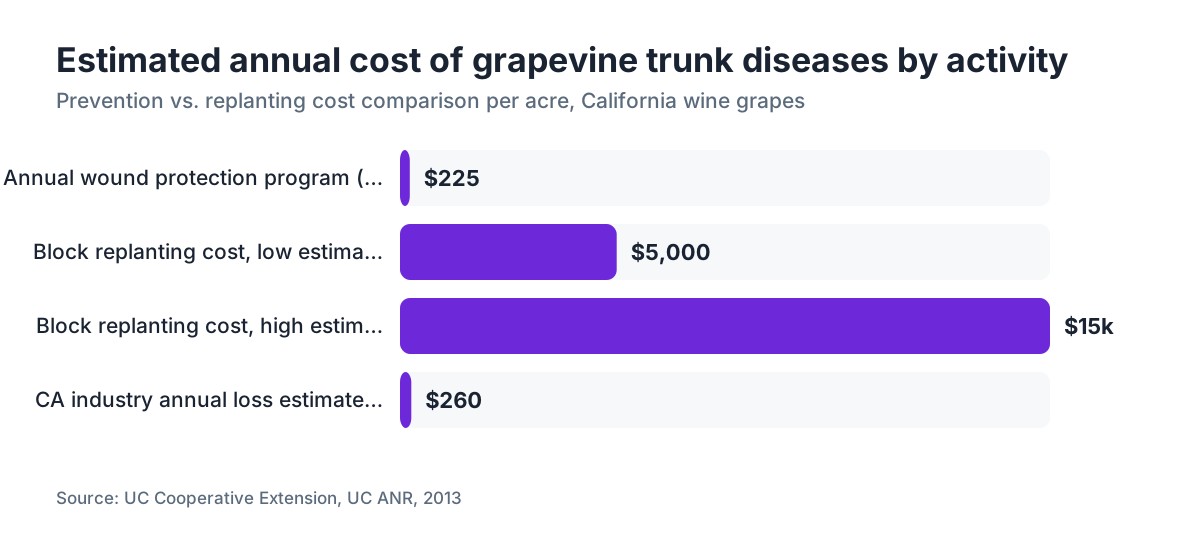
A widely cited 2013 UC Cooperative Extension study put the cost to California's wine grape industry at roughly $260 million a year in lost production and vine replacement [3]. At the time that ran about 12 to 15 percent of the state's wine grape production value. Later assessments in Australia, South Africa, and France found similar proportional losses.
For one grower the math is simple and painful. A mature Cabernet Sauvignon vine in the right spot takes 4 to 6 years to return to full production after retraining. Direct replacement runs $500 to $1,200 per acre (vine, labor, trellis adjustment), and on top of that sit 4 to 6 years of reduced yield. The direct cost per replaced vine easily clears $30 to $60 before you count the fruit you never picked. Multiply that by typical incidence in an unmanaged block and the loss over a 20-year vineyard life gets heavy.
Trunk disease surveys from Spain, France, and California keep finding infection rates above 30 percent in vineyards older than 15 years, and above 50 percent past 25 years, with some hot-climate blocks near universal infection [1]. Nobody has good recent national-scale US data. The California figures are the most rigorously documented, and that's the honest state of it.
What actually prevents trunk disease infections?
Wound protection at pruning is the single most evidence-backed prevention strategy. Everything else is supplemental.
Delaying pruning until late dormancy cuts exposure to peak spore release for both Botryosphaeria and Eutypa. The recommendation across California, WSU, and other regions is to hold final cuts as late as budbreak allows, after most winter rain but before green tissue shows [7]. Double-pruning (long spurs in early winter, then a final cut to position in late winter) gets you there without wrecking crew efficiency.
Topical protectants applied right after cutting measurably drop infection. The most studied options:
- Trichoderma-based biological protectants (Vinevax, Esquive, Trichoseal), which colonize the wound surface and crowd out pathogens. Field trials in France and California show 40 to 70 percent fewer infections versus untreated wounds [8].
- Boric acid plus latex paint, which physically seals the wound and has some fungistatic action. Cheap and practical at scale.
- Topsin-M (thiophanate-methyl) in a wax or latex carrier, with systemic activity against Botryosphaeria and Phaeomoniella. This requires a WPS-compliant application with the right PPE and re-entry intervals under the EPA Worker Protection Standard [9].
Tool sanitation matters less than people think for airborne pathogens like Eutypa, but it's genuinely important for Phaeomoniella and the black foot fungi that move on blades. A 70 percent ethanol or 10 percent bleach dip between vines is the standard call, with bleach being effective but hard on steel.
Hot-water treatment of nursery vines (50 degrees Celsius for 30 minutes) before planting kills the Petri disease and black foot inoculum riding in planting material. The evidence is strong and the cost is low against the risk [6]. Some nurseries offer pre-treated material. Asking whether stock is hot-water treated is basic due diligence that most buyers skip.
For replant ground, an extended fallow of 2 to 3 years or soil fumigation with registered materials cuts Ilyonectria inoculum. Methyl bromide alternatives have variable efficacy, and the USDA AMS keeps updated registration information for fumigants [10].
Can infected vines be cured or is removal the only option?
Surgery works, to a point. Sometimes removal is the smarter money.
Remedial surgery, cutting infected wood back to healthy tissue, is the standard move for Eutypa and Botryosphaeria infections caught before they reach the main trunk. You cut the affected cordon or arm below the canker margin, leave at least 5 to 10 cm of clean wood visible in the cut face (no brown staining), and retrain a new shoot to replace what you took. UC Davis research found remedial surgery added an average of 7 years of productive life to vines with Eutypa-infected arms when done right [3].
Esca doesn't cooperate. The fungal infection spreads through the whole trunk, and there's no practical way to cut it all out. Retraining from a basal sucker or a full trunk renewal can reset things in some cases, because the new trunk starts clean in theory. In practice the basidiomycete rot in the old trunk keeps going and can bridge into the new trunk through root connections, so renewal is not a reliable cure for advanced Esca.
Sodium arsenite was used in France and elsewhere as a trunk injection for Esca and showed real efficacy, but the EU banned it in 2003 over environmental and worker safety concerns. There's no registered chemical substitute with comparable systemic action against the Esca basidiomycete. That's an honest hole in the toolkit.
For black foot in young vines, pull and replant with healthy, hot-water-treated material. Carrying a Petri or black foot infected young vine to maturity rarely pays when you're already staring at 4 to 6 more years of reduced growth.
A rough guide: vines more than 50 percent infected across the trunk cross-section are candidates for removal. Vines with infection stuck in one arm or cordon and a clean trunk are candidates for surgery. It's a guide, not a rule, and variety, rootstock, vine age, and replacement cost all shift the call.
How do you keep spray and pruning records for trunk disease management?
If you're applying fungicide wound protectants or Trichoderma products after pruning, those go in your pesticide application records. In California, Arizona, and most major wine states, any pesticide application in a commercial vineyard requires a record with the product, EPA registration number, application date, rate, acreage, applicator name, and REI compliance [9]. Same rule if you use thiophanate-methyl or any other EPA-registered fungicide as a wound sealant.
For biological products like Trichoderma harzianum protectants, check whether the product carries a 40 CFR Part 180 exemption (many biological fungicides do) or a standard EPA registration. The label is the law. The record should reference the label's registration number either way.
The place where trunk disease work bumps hard into compliance is worker re-entry. Pruning supervisors putting sealant on fresh cuts need to know that even some low-toxicity products carry a 4-hour REI under the EPA Worker Protection Standard. Documenting training, PPE issuance, and REI compliance under 40 CFR Part 170 is not optional in commercial operations [9].
For growers logging this across multiple blocks and multiple pruning dates, a field records platform makes the paperwork practical instead of theoretical. VitiScribe is built for exactly this: log pruning dates by block, tag wound protectant applications, and generate the compliance records a state ag inspector would ask for. A well-organized spreadsheet or paper log works too. The thing that matters is that the record exists and is accurate.
Keep a year-by-year map of trunk disease incidence by vine and block while you're at it. It's not a compliance requirement, but it shows whether your prevention program is working and which blocks are drifting toward economic thresholds. UC Davis and Cornell both publish free disease scouting protocols you can use as a template [3][6].
What does current research say about biological and chemical controls?
Biological controls have the most active research behind them right now, mostly because the chemical options are thin.
Trichoderma atroviride and T. harzianum isolates are the most studied biocontrol agents for pruning wound protection. A 2019 meta-analysis in Biological Control found Trichoderma products cut Botryosphaeria infection rates by 40 to 65 percent across trials when applied within 24 hours of pruning [8]. The mode of action is competitive exclusion (Trichoderma colonizes the wound faster than the pathogen) plus direct mycoparasitism. These products are heat-sensitive and need correct storage and mixing. A lot of field failures trace back to old or badly stored product.
For Eutypa lata specifically, Fusarium lateritium has shown some biocontrol activity as a wound colonizer in trials, but it isn't commercially registered and the risk of that Fusarium causing other trouble keeps it out of production.
On the chemical side, thiophanate-methyl (Topsin-M) is still the most-used fungicide for wound protection, with activity against Botryosphaeria and Phaeomoniella. Flusilazole and tebuconazole showed activity in European trials against some trunk pathogens but carry US registration constraints. Boscalid has some activity against Diaporthe species. The registered US options are narrower than growers often realize, and any new application means checking current California DPR, Oregon ODA, or WSDA registration status, because these change.
UC Davis is also looking at silicon applications and their effect on infection susceptibility, and early data on silicon and wound healing speed looks interesting. It's not at the point where you'd build a program on it.
No systemic fungicide cures an established trunk disease infection. The research consensus is flat on this: chemical management is preventive, not curative [5]. Spraying fungicide to save a vine that's already 40 percent colonized in the trunk is money with no realistic return.
What do UC Davis, Cornell, and WSU extension programs recommend?
These three programs put out the most useful English-language extension material on trunk diseases, and their advice lines up, with some regional nuance.
UC Davis Viticulture and Enology, through UC Cooperative Extension, pushes double-pruning, wound protection with registered products, remedial surgery, and rogueing vines past threshold. Their trunk disease program publishes free field guides and a phone-friendly scouting protocol. UC ANR publication 3491 covers Eutypa dieback specifically, with ID photos and management tables [3].
Cornell's Viticulture and Enology program leans into Petri disease and nursery stock hygiene for the Northeast, where young vine losses from Petri and black foot are a bigger proportional problem than in mature California blocks. Their Plant Pathology extension pages carry hot-water treatment protocols and guidelines for reading nursery certifications [6].
WSU's viticulture extension has done the most work on Botryosphaeria management for Pacific Northwest conditions, including the pruning-timing data on wound susceptibility windows cited earlier. Their program publishes annual spray guides updated for current Washington pesticide registrations [7].
All three make their core trunk disease materials free as PDFs. A search for "grapevine trunk disease pdf" on any of these .edu sites lands you on current, peer-reviewed extension guides. The UC ANR, Cornell CALS, and WSU Extension PDF libraries are among the best free technical resources a grower can get.
One point they all share: prevention costs a fraction of replanting. The UC analysis put a full wound protection program (delayed pruning, wound sealant, staff training) at roughly $150 to $300 per acre per year, against $5,000 to $15,000 per acre to replant a block depending on trellis complexity and variety [3]. The math isn't close.
What are the risks when sourcing nursery vines and planting new blocks?
Planting Petri and black foot pathogens into your dirt is avoidable, but only if you ask the right questions before you buy.
The USDA APHIS Federal Nursery Certification Program does not certify grapevine material for trunk disease freedom, unlike the programs for Phylloxera or some viral diseases. State nursery programs (California's CDFA Grapevine Registration and Certification Program is the most rigorous in the US) test for some viral diseases but not routinely for Phaeomoniella or Ilyonectria [10]. So "certified" is not the same as "trunk disease free," a distinction that catches a lot of growers off guard.
In practice, ask your nursery straight: Do you hot-water treat before shipping? What Phaeomoniella chlamydospora testing, if any, do you run? Is your mother block tested for Petri disease pathogens? A serious nursery has answers. Growers who buy on price alone and skip these questions tend to pay for it in the first 3 years of establishment.
Inspect cut surfaces of incoming material before planting. Cut 10 to 20 trunks at random from a lot and look for vascular staining. Any visible brown to black spotting or streaking in a 1-year vine's cross-section is a red flag for Phaeomoniella or Phaeoacremonium. It isn't diagnostic without a lab, but it tells you whether to plant the lot or ask for a replacement.
For replanting into a block where trunk disease killed the last vines, soil testing for Ilyonectria propagule density is available through several commercial labs, though threshold interpretation isn't well standardized in the literature yet. The general UC recommendation is 2 to 3 years of fallow or a non-host cover crop rotation before replanting where black foot was confirmed [3].
Frequently asked questions
How many fungal species cause grapevine trunk diseases?
More than 130 fungal species have been confirmed as associated with grapevine trunk diseases worldwide, according to a 2019 review in Phytopathologia Mediterranea. For practical management, the key pathogens cluster into five disease complexes: Botryosphaeria dieback, Eutypa dieback, Esca, Petri disease, and black foot, each with a smaller set of primary causal species.
Can you cure a grapevine that already has trunk disease?
For Eutypa and Botryosphaeria infections limited to an arm or cordon, remedial surgery (cutting back to healthy wood) can extend vine life. For advanced Esca with trunk-wide white rot, there is no reliable cure. No registered systemic fungicide can eliminate an established trunk disease infection. The choice is between surgery, vine renewal from a basal shoot, or removal.
When is the best time to prune to avoid trunk disease infections?
Late dormant pruning, as close to budbreak as practical, significantly reduces infection risk because it falls outside the peak spore release window for Eutypa lata and Botryosphaeria species. Double-pruning (rough cut early, final cut late) is the best practical method. WSU research found wounds remain highly susceptible for 2 to 3 days under wet conditions, so pruning during dry weather windows also helps.
What wound protectants actually work for trunk disease prevention?
Trichoderma-based biological protectants (applied within 24 hours of pruning) reduce Botryosphaeria infection rates by 40 to 65 percent in field trials. Thiophanate-methyl in a wax or latex carrier has registered fungicidal activity against several trunk pathogens. Boric acid with latex paint is cheap and offers physical protection. None are 100 percent effective. Layering delayed pruning with a wound sealant gives the best results.
Does hot-water treatment of nursery vines prevent trunk disease?
Yes. Hot-water treatment at 50 degrees Celsius for 30 minutes eliminates Phaeomoniella chlamydospora, Phaeoacremonium species, and Ilyonectria species present in dormant planting material. Cornell and UC Davis both recommend asking nurseries whether their material is hot-water treated before purchasing. It's one of the few trunk disease interventions with consistently strong evidence behind it.
How do you identify Esca disease symptoms in the vineyard?
Esca produces tiger-stripe foliar symptoms: interveinal chlorosis and necrosis running parallel to the leaf midrib in a striped pattern, typically appearing mid-summer. Cutting the trunk reveals white spongy internal rot from basidiomycete decay with surrounding dark vascular staining. Acute Esca causes sudden whole-vine collapse in summer. Mixed infections are common, so lab confirmation is needed for certainty.
What records do I need to keep when applying wound sealants after pruning?
Any EPA-registered pesticide wound sealant application in a commercial vineyard requires a record with the product name, EPA registration number, application date, rate, acreage, applicator, and proof of REI compliance under the EPA Worker Protection Standard (40 CFR Part 170). Biological products with a FIFRA exemption may have lighter requirements. Check the specific product label; it is the legal standard.
Where can I download a free grapevine trunk disease PDF guide?
UC Cooperative Extension publishes free PDF guides including publication 3491 on Eutypa dieback through the UC ANR catalog (anr.ucanr.edu). Cornell's CALS Plant Pathology extension pages and WSU Extension's viticulture publications both provide downloadable trunk disease management guides. Searching 'grapevine trunk disease pdf' on any of these .edu domains returns current, peer-reviewed materials.
How does Eutypa lata spread in a vineyard?
Eutypa lata releases wind-dispersed ascospores from dead wood and infected pruning stubs during rainfall in autumn through spring. Studies have detected viable spores up to 50 meters from a source. Fresh pruning wounds are the infection point, with susceptibility highest in the first few hours after cutting and under wet conditions. Large wounds over 2.5 cm diameter carry higher risk due to slower drying.
What causes black foot disease in young grapevines?
Black foot is caused by Ilyonectria species (principally I. liriodendri and I. macrodidyma), soilborne fungi that infect through roots and the trunk base. The disease is most serious in nurseries and first-year vineyard plantings, causing stunted growth, chlorosis, and root rot. Replanting into old vineyard ground without fallow or soil treatment significantly increases risk due to residual inoculum in decomposing roots.
How much does trunk disease cost California wine grape growers?
A 2013 UC Cooperative Extension study estimated trunk diseases cost California's wine grape industry approximately $260 million annually in lost production and vine replacement. Surveys consistently find infection rates above 30 percent in vineyards older than 15 years and above 50 percent in vineyards over 25 years. A full wound protection program costs roughly $150 to $300 per acre per year versus $5,000 to $15,000 per acre to replant.
Is there a chemical that cures Esca or Eutypa inside the trunk?
No registered systemic fungicide cures an established Esca or Eutypa infection inside the trunk. Sodium arsenite showed efficacy against Esca in France but was banned in the EU in 2003 over environmental and safety concerns, and no comparable substitute has been registered. Chemical management for trunk diseases is strictly preventive, applied to fresh pruning wounds before infection occurs.
How do I evaluate whether to do surgery or remove a diseased vine?
Vines with infection limited to one arm or cordon and a clean trunk cross-section are good surgery candidates, cutting back to healthy wood at least 5 to 10 cm below visible staining. Vines where the main trunk shows more than 50 percent discoloration in cross-section are generally better replaced. Vine age, variety value, replant cost, and remaining productive years all factor into the call.
Do Botryosphaeria and Eutypa infections show the same wood symptoms?
Not exactly. Botryosphaeria dieback causes wedge-shaped cankers with dark brown to black wood at the margin and often dead stubs with black pycnidia on the surface. Eutypa dieback causes a central dark canker with a characteristic gray-black zone and is accompanied by stunted, tattery-leafed shoots on the affected arm. Both can be present in the same vine, and lab isolation is the only definitive way to confirm which species is causing what.
Sources
- USDA Agricultural Research Service, grapevine trunk disease overview: Increasing incidence of trunk diseases linked to monoculture planting, removal of arsenical fungicides, and larger pruning wounds from modern trellis systems
- UC Agriculture and Natural Resources, Viticulture and Enology / UC Cooperative Extension trunk disease program: More than 20 Botryosphaeriaceae species isolated from California vineyards; $260 million annual cost to California wine grape industry; wound protection program costs $150-300 per acre per year vs $5,000-15,000 per acre to replant; remedial surgery increased productive vine life by average 7 years
- Plant Disease journal, Esca disease complex review: Esca is a syndrome involving Phaeomoniella chlamydospora, Phaeoacremonium species, and Fomitiporia basidiomycetes; acute Esca mechanism involving toxin response and environmental stress interaction remains debated; no registered systemic fungicide cures established trunk disease infection
- Cornell University CALS Plant Pathology Extension, Grapevine Trunk Diseases: Petri disease strongly associated with contaminated nursery stock and hot-water treatment failure; hot-water treatment at 50°C for 30 minutes recommended for planting material
- Washington State University Extension, Viticulture and Enology Program: Pruning wounds remain highly susceptible for 2 to 3 days under wet winter conditions; susceptibility drops approximately 50% within 24 hours of dry weather; late dormant pruning recommended to reduce Botryosphaeria infection
- Biological Control journal, meta-analysis of Trichoderma-based wound protectants in viticulture: Trichoderma-based products reduced Botryosphaeria infection rates by 40 to 65 percent across multiple field trials when applied within 24 hours of pruning
- US EPA, Agricultural Worker Protection Standard (40 CFR Part 170): Pesticide applications in commercial vineyards require records including product, EPA registration number, date, rate, acreage, applicator, and REI compliance; some low-toxicity products carry a 4-hour REI
- USDA AMS National Organic Program and state nursery certification programs: USDA APHIS Federal Nursery Certification does not specifically certify grapevine material for trunk disease freedom; California CDFA Grapevine Registration and Certification Program tests for some viral diseases but not routinely for trunk disease pathogens
- European Journal of Plant Pathology, Esca and Eutypa dieback management review: Sodium arsenite banned in EU 2003 due to environmental and worker safety concerns; no registered chemical substitute with comparable systemic efficacy against Esca basidiomycete component
Last updated 2026-07-09