Grapevine wound dressing for trunk disease: what actually works

TL;DR
- Pruning wounds are the main entry point for trunk disease pathogens like Eutypa lata and Botryosphaeriaceae.
- Sealing cuts within 24 hours with a registered fungicide-based wound dressing (products containing thiophanate-methyl or Trichoderma-based biologicals) significantly reduces infection.
- Latex paint and petroleum jelly offer little real protection.
- Timing, product choice, and application method all matter.
Why do pruning wounds invite trunk disease in the first place?
Grapevine trunk diseases are not a single problem. They're a family of fungal infections, including Eutypa dieback caused by Eutypa lata, Botryosphaeria dieback caused by species in the Botryosphaeriaceae family, and Esca, a complex syndrome with multiple fungi involved. What they share is a common entry point: fresh pruning wounds.
When you make a cut, the exposed xylem tissue stays wet and chemically attractive to fungal spores for days. Eutypa lata spores are released during rain events, travel in wind, and land on cuts. UC Davis researchers found that spore loads in California vineyards can be high enough to cause infection within hours of a rain event, even in winter [1]. Botryosphaeriaceae spores, by contrast, are spread both during rain and during dry conditions, which makes their infection window harder to predict [2].
The wound itself doesn't close immediately. Grapevines produce a callus slowly, and the drying of exposed wood that growers sometimes count on for protection only really works in low-humidity, rain-free stretches. In wetter climates, or in any year with wet winters, those conditions rarely hold.
This is why wound protection matters: the infection happens early, often in the first few days after pruning, before any callus forms.
How much economic damage do trunk diseases actually cause?
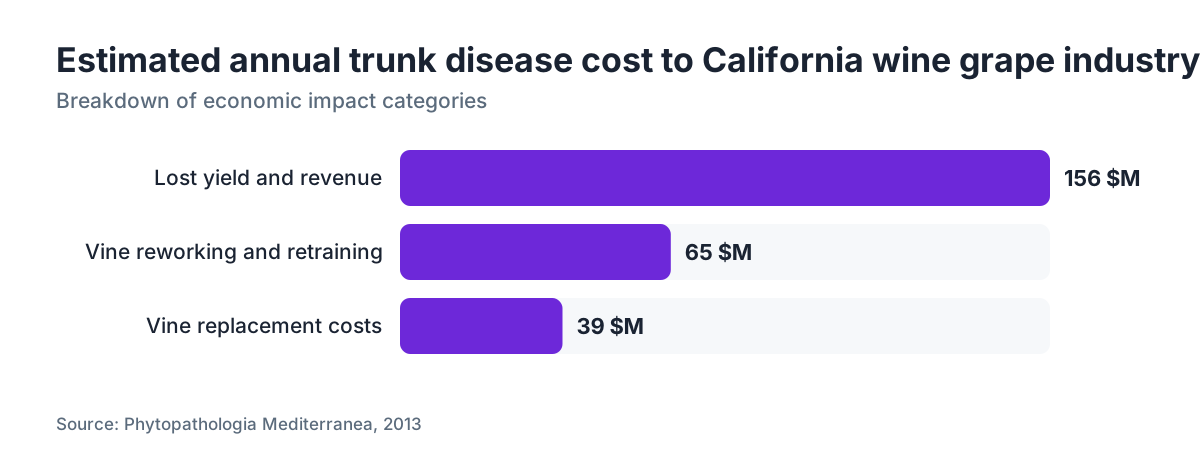
The numbers are genuinely striking. A 2013 study published in Phytopathologia Mediterranea estimated that trunk diseases cost the California wine grape industry approximately $260 million per year in lost production and vine replacement [3]. That figure covers reduced yields, the cost of retraining or reworking affected vines, and outright vine death in severe cases.
Eutypa dieback alone is estimated to reduce yields by 20 to 70 percent in heavily affected blocks, depending on the proportion of vines showing canopy symptoms [1]. Botryosphaeria dieback can kill cordons in a single season under hot, dry stress conditions.
The cost of prevention, meaning registered wound dressings applied at pruning, typically runs between $40 and $120 per acre per year depending on product and application method. Against a $260 million industry loss, that's a straightforward tradeoff.
Nobody has perfect vineyard-level data on return on investment for wound protection specifically, but the closest long-term trials, including work from UC Davis, show statistically significant reductions in wood disease incidence in treated vines compared to untreated controls [1].
Which wound dressings actually protect against trunk disease?
This is where growers get burned by marketing. A lot of products are sold as wound sealants. Very few have replicated field trial data showing they reduce trunk disease infection.
Three categories have meaningful evidence behind them:
Fungicide-based dressings (thiophanate-methyl): Products containing thiophanate-methyl as the active ingredient, applied in a paste or suspension formulation, have the best replicated data. UC Davis trials and Washington State University extension research both support thiophanate-methyl as effective against Eutypa lata and several Botryosphaeriaceae species [2]. Apply as a diluted paste directly to the cut surface immediately after pruning.
Trichoderma-based biological dressings: Products based on Trichoderma atroviride (the strain in products like Esquive WP and similar) have shown real efficacy in European and Australian trials, and some UC Davis work. They work by colonizing the wound with a competitive fungus that blocks pathogen establishment. Efficacy is somewhat more variable than synthetic fungicides, especially in very wet conditions, but they're a legitimate option, particularly for growers managing organic or reduced-chemical programs [4].
Boric acid plus glycerol formulations: Some commercial products use boric acid as an antifungal agent. There's moderate supporting data, mostly from Australian trials. Less commonly registered in the U.S., so check your state label.
What doesn't work well:
- Latex paint: seals the surface cosmetically but has no antifungal activity and doesn't meaningfully slow Eutypa infection in controlled trials [1].
- Petroleum jelly or lanolin: same story. They may reduce desiccation, but they don't stop spore germination.
- Wound sealant sprays without active ingredients: these are essentially decorative.
If you're in California, check the UC Integrated Pest Management guidelines for registered materials and current efficacy ratings before buying [5].
How soon after pruning do you need to apply wound dressing?
Within 24 hours is the practical target. Some extension sources say within a few hours when rain is forecast [2].
The infection risk curve is steep. Eutypa lata spore germination on cut wood can begin within hours of a wet period. Once germination starts, no wound dressing is going to stop an established infection. You're not treating disease, you're preventing it.
WSU extension research on Botryosphaeria dieback found that infection risk remained elevated for at least 14 days after pruning in wet conditions [2]. That's a wide window, and it means a single application may not be enough if the vine gets re-wetted on subsequent days. Some growers in high-pressure situations apply a second coat after the first rain event.
In dry climates, like parts of eastern Washington or the Central Valley, the risk window is narrower because spore dispersal requires free moisture. But even there, a December or January rain can carry enough spores to infect unprotected cuts quickly.
The honest advice: don't prune on the day before a major rain event if you can help it, and always have your wound dressing mixed and ready to apply the same day cuts are made.
What's the best technique for applying wound dressing to grapevines?
Application method matters more than most growers realize. The goal is complete coverage of the entire cut face, including the cambium ring at the edge.
Paint-on application with a small brush or sponge applicator is still the gold standard for individual cuts, especially large ones on the trunk or main cordons. You can see exactly what you've covered. It's slow per vine, but thorough.
Pressurized spray application works well for high-volume operations if you use a targeted wand rather than a boom. The risk with spraying is missing the cut face, applying too thin a coat, or wasting product on bark that doesn't need it. Have someone check coverage at the start of each day.
Dip application, where you dip a spur stub into a container of dressing, is used by some operations for cane pruning with short cuts. It's fast, but contamination of the dip container can be an issue if you're working through diseased blocks.
For Trichoderma-based biologicals, follow the label on water volume carefully. These products need enough moisture to support spore viability, but not so much dilution that concentration drops below effective levels.
Coverage rates matter too. Most product labels recommend enough material that you can see a visible coat on the wood, not a thin translucent film. If it looks dry in 30 seconds, you probably underapplied.
Does wound dressing help on large trunk cuts and surgery wounds?
Yes, and possibly more than on small spur cuts.
When you're doing trunk renewal, cordon replacement, or cutting back to remove diseased wood, the exposed surface is large, wet, and highly vulnerable. These are not routine pruning cuts. They expose a cross-section of the trunk that may already have some internal wood discoloration from past infections.
The same fungicide dressings apply here. But there's an additional consideration: after cutting back to apparently healthy wood, the wound needs even more careful coverage because the surrounding tissue may already be stressed.
Some viticulturists also recommend a second application 7 to 10 days after the initial cut on large wounds, once the first coat has dried and any remaining exposed wood is visible. This is a practical call, not a formally tested protocol in most trials.
Trunk surgery on Esca-affected vines is a separate and more complex situation. The fungal consortium involved in Esca, including Phaeomoniella chlamydospora and Phaeoacremonium species, infects wood over years. Cutting back does not always fully remove the pathogen, and wound dressing on surgical wounds, while still recommended, is not a cure. It reduces reinfection risk on the new cut surface, but the vine's internal wood may remain compromised.
For a grower managing a vineyard with active Esca, wound protection is one piece of a longer management strategy that includes canopy management, irrigation stress reduction, and sometimes replanting.
Are there registered products in the US and what do labels require?
Product registration matters a lot here, for both legal compliance and efficacy. In the U.S., any product claiming to control a plant disease must be registered with the EPA, and state registration is required separately in most states.
Thiophanate-methyl-based wound dressings for grapevines include products like Topsin M 70 WP (with various formulation partners) and some proprietary paste products. Always check the label for use on grapevines specifically, because registration by crop can vary.
EPA registration does not automatically mean the product is registered in your state. California, Oregon, and Washington all require state-level pesticide registration, and not all trunk disease wound dressings are cleared in every state. Check your state Department of Agriculture's pesticide registration database before purchasing in volume [6].
Labels also specify required personal protective equipment (PPE) and re-entry intervals (REIs). Under the EPA Worker Protection Standard, agricultural workers must follow the REI on the label, and early-entry workers performing application need specific PPE, typically chemical-resistant gloves and eye protection at minimum [7]. If you have employees applying wound dressings, this is a compliance area you cannot ignore. The WPS requires that application-specific pesticide safety training be documented and available.
Keeping good spray records on wound dressing applications, including product name, EPA registration number, rate, date, applicator, and field ID, is exactly the kind of documentation that protects you during a state inspection or an organic certification audit. Tools like VitiScribe are built for this: the spray log captures all required fields, ties to field maps, and keeps the audit trail current without extra paperwork.
How does pruning timing reduce trunk disease risk?
Wound dressing is most effective when it works together with smart pruning timing. The dressing is a backup. Timing is the first line of defense.
Late pruning, meaning pruning after bud swell rather than during deep dormancy, reduces Eutypa lata infection risk meaningfully. This is because later in the season, vines callus more quickly, reducing the window of susceptibility. UC Davis trials documented a statistically significant reduction in Eutypa infection in late-pruned vines compared to early-pruned controls [1].
The tradeoff is real: late pruning delays canopy development slightly, and in regions with late frost risk, earlier bud push after late pruning can increase frost exposure. Every region and variety has its own calculus here.
Double pruning, where you leave long canes in the first pass and then cut back to the final spur positions after bud swell, is a practical method that combines the infection-risk benefits of late pruning with operational flexibility. The first pass is fast, leaves long stubs that are eventually discarded, and the final wound is made when callusing is faster. This technique has become fairly widely adopted in California Chardonnay and Cabernet Sauvignon.
Rainy periods are the highest-risk windows. If you can track local spore release data, some UC Davis monitoring stations do publish spore trap counts for Eutypa, and timing pruning around those peaks helps. Practically, most growers just avoid pruning immediately before forecast rain events when they can.
What does the research say about biological versus chemical wound dressings?
This is a genuinely contested area and the honest answer is: both have real supporting evidence, and the best choice depends on your system.
The most thorough independent comparison comes from a multi-year trial at UC Davis (Rolshausen and Gubler, 2005, published in Plant Disease), which tested thiophanate-methyl, Trichoderma viride, and untreated controls on Eutypa lata infection. The thiophanate-methyl treatment reduced disease incidence significantly. Trichoderma viride showed partial efficacy, statistically better than untreated controls but not as strong as thiophanate-methyl [4].
More recent work on Trichoderma atroviride strains (which differ from T. viride) has shown stronger efficacy, with some Australian and European trials showing parity with synthetic fungicides under field conditions. The differences between Trichoderma species and strains matter a lot here: not all Trichoderma products perform equally.
For organic operations, Trichoderma-based products are generally OMRI-listed and allowed, while synthetic fungicides like thiophanate-methyl are not. That's often the deciding factor.
For conventional operations with high disease pressure, the practical recommendation from most extension specialists is thiophanate-methyl as the primary treatment, with Trichoderma as a rotation option or where resistance management is a concern [2].
Nobody in the extension world recommends relying on untreated wound dressings or physical sealants alone in a region with documented Eutypa or Botryosphaeria pressure. The data is clear enough on that point.
What's the right wound dressing program for different pruning systems?
Spur-pruned vines (Cordon systems like VSP with bilateral cordons) produce a large number of small cuts. The practical challenge is throughput: you need to cover hundreds of cuts per acre quickly. Spray wands with a targeted nozzle work better here than brush application for most operations. Products that dry quickly matter because crews move fast.
Cane-pruned vines (Guyot, head-trained cane systems) produce fewer cuts, but some of them, the main cane removal wound on the head, can be quite large. Brush application on those larger wounds, combined with a spray or dip on smaller cuts, is a reasonable split approach.
Head-trained, spur-pruned systems (common in old vine Zinfandel and Grenache) often have complex trunk architecture with many old spur wounds already present. These vines frequently show internal trunk disease even without visible canopy symptoms. In these blocks, wound dressing on current-year cuts is still worth doing, but you're working against a longer history of infection in the wood.
| Pruning system | Primary wound type | Best application method | Volume (per acre) |
|---|---|---|---|
| VSP bilateral cordon, spur | Many small spur cuts | Targeted spray wand | 100-200+ cuts |
| Guyot cane-pruned | Few cane base cuts, larger | Brush on large cuts, spray on small | 20-60 cuts |
| Head-trained spur | Mixed, some old trunk wounds | Brush on large, spray on small | 80-160 cuts |
| Cordon renewal cuts | Large trunk/cordon cuts | Brush, two coats | 10-30 cuts per block |
These are rough ranges. Actual cut counts depend on vine spacing, training history, and pruning severity.
How do you document wound dressing applications for compliance?
Spray record requirements for wound dressings vary by state, but if you're applying a pesticide-labeled product (which any registered fungicide-based wound dressing is), you need a spray record in most states. California's Department of Pesticide Regulation requires a pesticide use report (PUR) for any restricted or agricultural pesticide application [8]. Other states have analogous requirements.
At minimum, a compliant spray record for wound dressing applications needs to capture:
- Date of application
- Product name and EPA registration number
- Active ingredient
- Rate applied (typically oz/acre or fluid oz/100 gallons)
- Acres treated (or number of vines, depending on how you account)
- Applicator name and certification number if applicable
- Block or field identifier
- Pest target (Eutypa dieback, Botryosphaeria dieback, or trunk diseases generally, as stated on the label)
For organic operations, you also need to document that the product is OMRI-listed or otherwise compliant with your certifier's standards. Your organic system plan typically requires pre-approval of any material not on a pre-approved list.
If a state inspector or organic certifier asks for spray records, they want to see this information. A logbook, a spreadsheet, or a purpose-built platform like VitiScribe all satisfy the requirement, as long as the records are complete and retained for the required period (typically three years under California DPR rules, and five years under USDA organic program requirements [9]).
EPA's Worker Protection Standard also requires that pesticide application records be available to workers and their designated representatives for 30 years after application [7]. That's a longer retention requirement than most growers realize.
What are the signs that trunk disease has already established and wound dressing can't fix it?
Wound dressing is prevention, not treatment. Once Eutypa lata or Botryosphaeria species have colonized the wood, no topical treatment is going to eradicate the infection.
The visible symptoms of established trunk disease:
- Stunted, chlorotic shoots with small leaves in a wedge-shaped pattern tracing back to a dead sector of the cordon (classic Eutypa symptom)
- Dead spurs or cordon arms that fail to push in spring
- Cross-sectional wood discoloration: a wedge of brown or gray wood visible when you cut through an affected cordon or trunk
- Cankers on the trunk surface, sometimes with gum exudate
- For Esca: tiger-stripe leaf symptoms (interveinal chlorosis with a dark border) and, in acute cases, apoplexy (sudden vine collapse in summer)
If you see these symptoms, the management is surgical: cut back below the visible discoloration to clean white wood, apply wound dressing to the new cut, and then either retrain a new cordon from a water shoot or plan for trunk renewal over one to three seasons. The diseased wood needs to come out of the vineyard, not left on the ground where it becomes a sporulation source.
Some viticulturists also recommend bench testing: slicing through the removed wood to confirm you've cut back past the brown discoloration before applying wound dressing to the new cut face. That extra step takes a minute per vine and it's worth doing on any surgical cut.
Frequently asked questions
Does latex paint protect grapevine pruning wounds from trunk disease?
No, not meaningfully. Latex paint seals the surface but has no antifungal activity. UC Davis trials found no significant reduction in Eutypa lata infection in wounds treated with latex paint compared to untreated controls. It's a waste of time if your goal is trunk disease prevention. Use a registered fungicide-based wound dressing or a Trichoderma biological product instead.
How long does a wound dressing stay effective on a grapevine cut?
Most products provide meaningful protection for 7 to 14 days under normal field conditions, assuming no heavy rain washes off the coating. If cuts are re-wetted by significant rain within a week of application, a second coat is a reasonable precaution, especially in high-disease-pressure vineyards. Thiophanate-methyl products generally have longer residual activity than Trichoderma biologicals, which can be degraded by UV and high temperatures.
Can you use wound dressing on Esca-infected vines?
Yes, on new cuts made during trunk surgery, wound dressing reduces reinfection risk. But Esca involves a complex of fungi already present inside the wood, and wound dressing can't cure that. After cutting back to clean wood, applying a registered dressing to the new cut face is standard practice. Don't count on it as a standalone solution; Esca management is a multi-year process involving pruning technique, vine stress reduction, and sometimes replanting.
What's the re-entry interval for thiophanate-methyl wound dressings on grapevines?
It depends on the specific product formulation. REIs for thiophanate-methyl products typically range from 12 to 24 hours under the EPA Worker Protection Standard. Always read the specific product label, as REIs are label requirements and vary by formulation. Workers entering treated areas before the REI expires must use the required PPE specified on the label and have completed WPS pesticide safety training.
Is Trichoderma wound dressing approved for organic grapevine production?
Most commercially available Trichoderma-based wound dressings are OMRI-listed and approved for certified organic production, but you should verify each specific product with your certifier before use, since some formulations include inert ingredients that may not be approved. Your organic system plan may also require pre-approval. Check the OMRI Products List (omri.org) and confirm with your certifier in writing.
How does double pruning reduce trunk disease risk?
Double pruning leaves long stubs in the first pass, made during peak spore season. Those stubs are later removed after bud swell, when vines callus faster and spore pressure may be lower. The final wound, made later in the season, is smaller, heals faster, and is exposed for a shorter window before callus formation begins. UC Davis research supports late pruning as a significant risk reduction strategy, especially for Eutypa.
Do wound dressings work for all trunk disease pathogens or just Eutypa?
Fungicide dressings with thiophanate-methyl have demonstrated efficacy against both Eutypa lata and several Botryosphaeriaceae species in WSU and UC Davis trials. Trichoderma-based products also show activity against multiple trunk pathogens, though efficacy varies by Trichoderma strain and target pathogen. No wound dressing has strong evidence against the full Esca complex, where the fungal community is diverse and already established deep in wood tissue.
What do I need to include in a spray record for wound dressing applications?
At minimum: date, product name, EPA registration number, active ingredient, rate, acres or vines treated, field identifier, applicator name and certification number if required, and the pest target. California requires a Pesticide Use Report for agricultural pesticide applications. Records must typically be retained three years under California DPR rules, and five years under USDA organic program regulations. If you have employees applying the product, WPS documentation is also required.
How much does a wound dressing program cost per acre?
Product cost for registered fungicide-based wound dressings typically runs $40 to $120 per acre per year, depending on product, number of applications, and vine density. Labor is often the bigger variable: brush application is slower than spray application and can add significant cost in high-density blocks. Against potential losses from trunk disease, which UC Davis-linked research estimated at $260 million per year for California alone, most cost-benefit analyses favor a consistent protection program.
Which university extension programs have the best resources on trunk disease wound protection?
UC Davis (Kliewer and Gubler legacy work, now continued through the UC Cooperative Extension viticulture specialists) has the most extensive research base. WSU Extension covers Botryosphaeria and winter wound protection specifically for Pacific Northwest conditions. Cornell Cooperative Extension addresses trunk diseases relevant to the Northeast, including Eutypa and winter injury interactions. All three publish free online guides and identification resources.
When is wound dressing not necessary or not worth the cost?
In very dry climates with documented low trunk disease pressure and consistently dry winters after pruning, the risk-reduction value of wound dressing drops. The infection cycle requires free moisture for spore dispersal. That said, nobody has good region-by-region infection pressure maps that make this call simple. The conservative answer is: if you're in a wine grape region with documented Eutypa or Botryosphaeria, use wound dressing. If you've never seen symptoms after 20 years in an arid block, the calculus is different.
Can you apply wound dressing in cold weather?
Yes, but temperature affects product performance. Trichoderma-based biologicals have reduced viability below about 50°F and need time to establish on the wound surface. Thiophanate-methyl chemical dressings work in colder conditions but may be slower to dry and could run off if the cut surface is wet with rain or frost. Apply when the wood is dry, even if air temperatures are low. Avoid applying to frozen wood surfaces.
Should you remove and burn diseased wood removed during trunk surgery?
Yes. Diseased wood left in the vineyard becomes a sporulation source, releasing spores that can infect new wounds on neighboring vines. Remove it from the block and either burn it or chip it for composting offsite. This is standard extension advice from UC Davis, WSU, and Cornell. Leaving pruned material on the vineyard floor under the vine row is a particular risk factor for trunk disease pressure in subsequent years.
Sources
- UC Davis, Department of Plant Pathology - Eutypa Dieback of Grapevine: Eutypa lata spore loads in California vineyards can be high enough to cause infection within hours of a rain event; late pruning significantly reduces infection incidence in replicated trials
- Washington State University Extension - Botryosphaeria Dieback and Eutypa Dieback of Grape: Thiophanate-methyl wound dressings effective against Eutypa lata and Botryosphaeriaceae; infection risk remains elevated for at least 14 days after pruning in wet conditions
- Phytopathologia Mediterranea (2013) - Estimate of economic impact of trunk diseases on California wine grape industry: Trunk diseases cost the California wine grape industry approximately $260 million per year in lost production and vine replacement
- Plant Disease (2005), Rolshausen and Gubler - Efficacy of Trichoderma viride and thiophanate-methyl against Eutypa lata: Thiophanate-methyl significantly reduced Eutypa lata infection; Trichoderma viride showed partial efficacy, statistically better than untreated controls but less effective than thiophanate-methyl
- UC IPM - Grape Pest Management Guidelines: Eutypa Dieback: UC IPM provides registered materials and current efficacy ratings for wound dressings against trunk diseases in California vineyards
- California Department of Pesticide Regulation - Pesticide Registration: State-level pesticide registration is required in California; not all trunk disease wound dressings are registered in every state
- EPA - Worker Protection Standard (40 CFR Part 170): EPA Worker Protection Standard requires workers follow REI on the label, application-specific safety training must be documented, and pesticide application records must be available to workers for 30 years
- California Department of Pesticide Regulation - Pesticide Use Reporting: California DPR requires a Pesticide Use Report for any restricted or agricultural pesticide application
- USDA Agricultural Marketing Service - National Organic Program Regulations: USDA organic program regulations require spray records be retained for five years
- UC Davis, Kliewer Lab / UC Cooperative Extension - Double Pruning Research: Double pruning reduces Eutypa lata infection risk by making the final wound later in the season when callusing is faster
Last updated 2026-07-09