Grapevine trunk disease: causes, costs, and how to stop it
TL;DR
- Grapevine trunk diseases (Eutypa dieback, Botryosphaeria dieback, Esca, Phomopsis) are fungal infections that colonize pruning wounds and slowly rot the vine's vascular system.
- They're the leading cause of premature vineyard replanting worldwide, costing an estimated $1.5 billion annually.
- Prevention centers on wound protection at pruning and delayed pruning timing.
- There is no cure once a vine is heavily infected.
What are grapevine trunk diseases and why do they matter so much?
Grapevine trunk diseases are a group of fungal and oomycete infections that enter the vine through pruning wounds and progressively destroy the vascular wood. They are not one disease. The term covers at least four distinct disease complexes, each caused by a different set of pathogens, but all sharing the same basic story: spores land on a fresh cut, germinate, and start colonizing the woody tissue that the vine needs to move water and carbohydrates. Over years, the wood becomes a rotting mass of dead sectors, blocked vessels, and gum deposits.
Why does this matter financially? A 2014 study published in Phytopathologia Mediterranea estimated the global economic impact of Eutypa dieback and Botryosphaeria dieback alone at roughly $1.5 billion USD per year in lost production and replanting costs [1]. That figure doesn't include Esca or Phomopsis, and it doesn't account for inflation in replanting labor and vine material since then. For a small 20-acre operation, even a 15% infection rate across mature blocks can mean replacing vines that cost $8 to $15 per plant plus trellis work, lost crop years, and the long wait for a new vine to reach full production.
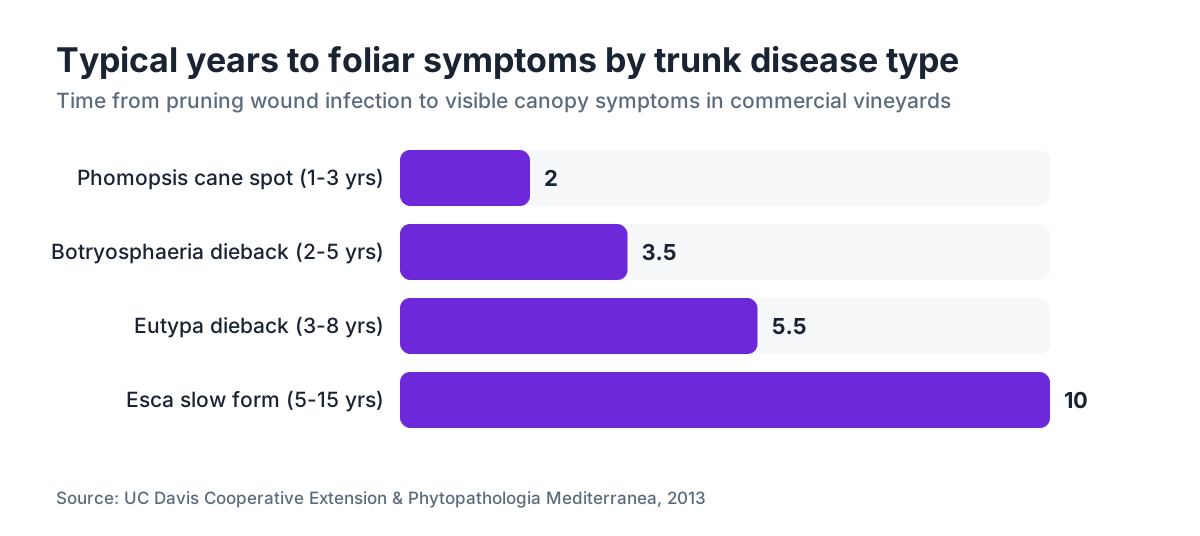
The disease also compounds over time. A vine infected at year three may not show foliar symptoms until year eight or ten, by which point the internal wood damage is already severe. That lag is what makes trunk disease so treacherous for vineyard managers who rely on visual scouting. You can have a block that looks fine and is already halfway to economic failure.
For anyone managing a vineyard long-term, trunk disease management is not optional. It's the background variable that decides whether a planting lasts 30 years or 12.
What are the main types of grapevine trunk disease?
Four major disease complexes account for nearly all trunk disease losses in commercial vineyards.
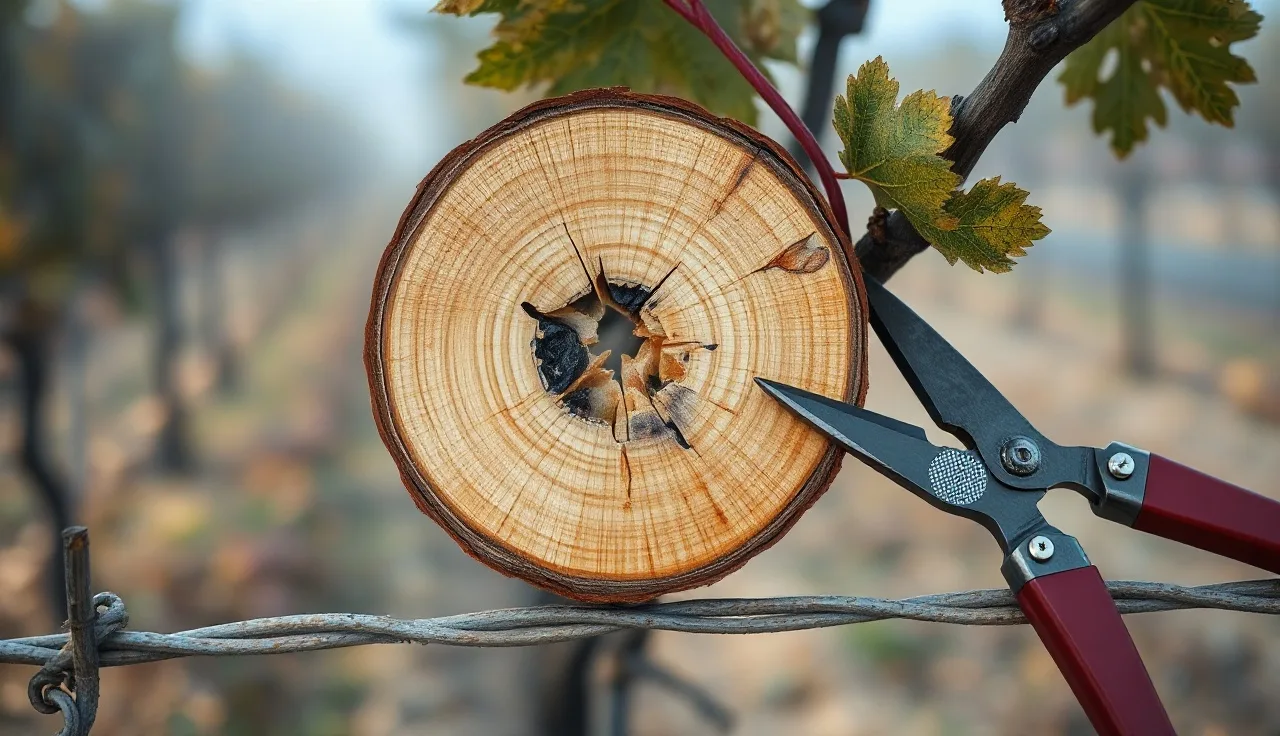
Eutypa dieback is caused primarily by Eutypa lata. Spores release during rain events from fruiting bodies on infected dead wood, land on pruning wounds, and colonize the vascular tissue. Symptoms in the canopy are strikingly specific: short internodes, chlorotic or cupped leaves with necrotic margins on stunted shoots in spring, often called "dead arm" symptoms. The wood shows a distinctive wedge-shaped necrotic sector when you make a cross-section cut through the cordon or trunk. UC Davis extension has documented Eutypa lata infecting wounds up to 3 cm in diameter far more readily than tiny spurs [2].
Botryosphaeria dieback is actually a complex of at least 12 Botryosphaeriaceae species, including Lasiodiplodia theobromae and several Diplodia and Neofusicoccum species [3]. These pathogens are more aggressive in warm and dry climates. Internal symptoms include dark brown to black streaking in cross-sections, sometimes called "black dead arm." Canopy symptoms can look similar to Eutypa but tend to appear faster, sometimes in as few as two years post-infection.
Esca is the most complex of the four. Multiple fungi are involved, including Phaeomoniella chlamydospora, Phaeoacremonium minimum, and Fomitiporia mediterranea. The foliar symptom called "tiger stripe" (interveinal chlorosis with brown necrotic stripes on the leaf blade) is the recognizable field sign, but Esca also causes an apoplexy form: the vine collapses suddenly in summer, often dying within a single season. Cornell's extension resources note that Esca has been found in New York vineyards and that its slow form can persist for years before economic vine death [4].
Phomopsis cane and leaf spot (caused by Diaporthe ampelina, formerly Phomopsis viticola) primarily attacks green tissue early in the season, but the pathogen also infects the woody cordon and trunk through cane wounds. It's the easiest of the four to manage with standard dormant copper sprays. A severe infection can still lead to spur death and canopy loss over time.
| Disease | Primary Pathogen(s) | Key Wood Symptom | Typical Symptom Lag |
|---|---|---|---|
| Eutypa dieback | Eutypa lata | Wedge-shaped necrosis | 3-8 years |
| Botryosphaeria dieback | 12+ Botryosphaeriaceae spp. | Black streaking/dead wood | 2-5 years |
| Esca | P. chlamydospora, Fomitiporia spp. | Internal white rot | 5-15 years |
| Phomopsis cane spot | Diaporthe ampelina | Spur/cane necrosis | 1-3 years |
How do trunk disease fungi actually infect a vine?
Every serious trunk disease infection starts the same way: a fresh wound on wood. Pruning cuts are by far the most common entry point, but mechanical harvest damage, frost cracks, and broken canes also create openings. The window of vulnerability is real and measurable. Research from UC Davis showed that Eutypa lata can colonize a fresh pruning wound within hours of spore deposition, and wound susceptibility stays relatively high for two weeks or more after cutting, depending on temperature and wound diameter [2].
Spore release is tied directly to rainfall. Eutypa lata releases ascospores from perithecia (tiny fruiting bodies embedded in old dead wood on the vine or on nearby hardwood trees like almond, cherry, and elm) during wet weather. Washington State University extension notes that spore release peaks when rainfall exceeds 2.5 mm during dormancy, and infections occur even at temperatures as low as 1°C [5]. Botryosphaeria species behave similarly but also release conidia during summer rain events, which means wound infection risk is not limited to the dormant pruning period.
Once inside, the fungus grows through the xylem vessels and ray cells. It doesn't just kill one spot. It colonizes along the grain of the wood, which is why an infection near a pruning spur can eventually reach the trunk and travel downward toward the graft union. By the time you see foliar symptoms, the fungal mycelium may already extend 30 to 60 cm below the visible dead wood.
The graft union is a particular weak point in young vines. Nursery propagation methods that involve cold storage of dormant cuttings or hot-water treatment protocols affect how early Phaeomoniella chlamydospora (an Esca pathogen) is detectable in planting material. Several studies have found trunk disease fungi in certified nursery stock at rates from 5% to over 50% depending on the study and country of origin. Nobody has perfect data on U.S. nursery infection rates; the most systematic North American survey work comes from Kendra Baumgartner's lab at USDA-ARS Davis [10].
What does trunk disease look like in the field?
Symptoms vary by disease and by vine age, but a few signs are reliable enough to act on.
In spring, look at shoot development across your cordons. Eutypa dieback classically presents as shoots that emerge noticeably shorter and weaker than surrounding shoots, with small cupped or chlorotic leaves that have necrotic brown margins. These stunted shoots often sit directly above a dead or discolored section of the cordon. Cut into the cordon at that point and you'll see a dark wedge or sector of necrotic tissue against the lighter healthy wood. That cross-section cut is the field diagnostic.
For Botryosphaeria, look for sudden dieback of an entire arm or cordon section, often in summer after stress (heat, drought, or a frost event). The wood interior shows dark brown to nearly black streaking, and the bark over the affected area may look sunken or discolored. Wilting without obvious foliar disease is a common presentation.
Esca's tiger-stripe pattern on leaves is distinctive once you know it: interveinal areas turn yellow or red (depending on variety), while the tissue running along the veins stays green, creating the stripe pattern. Red varieties often show red striping; white varieties show yellow. In the apoplexy form, an entire vine can collapse and dry out within a few days in midsummer. That's a hard day in the vineyard.
Phomopsis cane lesions start as small black spots on young green shoots in spring, coalesce into necrotic areas, and can leave whole canes with bleached, brittle wood by the end of the season. On spurs, you'll see dark necrosis at the base that can kill the spur entirely.
None of these symptoms are perfectly exclusive to one disease. Eutypa and Botryosphaeria symptoms in particular overlap substantially. If you need a definitive ID for research purposes or an insurance claim, PCR-based testing from a plant pathology lab is the right call. WSU's Plant Disease Diagnostic Clinic and the UC Davis Plant Pathology lab both take commercial submissions.
When is the best time to prune to reduce trunk disease risk?
Timing is the single most actionable lever most growers have. And the research on it is actually pretty clear.
The core principle: prune late in the dormant season, as close to budbreak as possible, and avoid pruning during or right after rain events. Eutypa lata spore release requires rain. If you prune on a dry day in late February or early March (in California) rather than in December or January, the wounds have less cumulative exposure to spore-laden rain events before budbreak closes and seals them. UC Davis trials found that late-season pruning (March versus December) cut Eutypa infection rates by 50% or more in some blocks [2].
The practical problem is labor logistics. Most operations can't prune 50 acres in two weeks. The standard recommendation from WSU and UC cooperative extension is to use a "delayed pruning" strategy on blocks known to have trunk disease pressure, accepting that lower-value or lower-risk blocks get pruned earlier while high-value old-vine blocks get the late-pruning priority [5].
Double pruning is another approach gaining adoption. You make a rough mechanical pre-prune in December, leaving long canes, then hand-finish to final spur positions in late February or March. The pre-prune wounds are expendable wood that catches any early spore infection while protecting the spur positions that will become the permanent structure. Research at WSU and in Australia has shown this can cut Eutypa infection rates significantly. It does add a labor pass, so the economics have to pencil out for your situation.
Avoid pruning during rain or in the 24 hours right after rain if you can help it. Spore concentrations in the air are highest during and just after a rain event. This sounds simple but takes discipline when you're trying to hit a pruning window with a full crew.
Do pruning wound protectants actually work?
Yes, with important caveats about product choice, application timing, and coverage.
The two most studied options are Topsin-M (thiophanate-methyl) and Trichoderma-based biological products, most notably Vinevax (Trichoderma atroviride strain SC1) in some markets, plus the older standard fluopyram for Botryosphaeria species [6]. In the United States, the most widely registered and used wound protectant for trunk disease is a paste formulation of thiophanate-methyl (sold as Topsin-M WP, mixed with a sticker or commercial wound paste).
Application has to happen on the day of pruning. Research trials that applied wound protectants 24 or 48 hours after cutting showed much lower efficacy than same-day application [2]. With a crew making hundreds of cuts per day, that means either dipping tools in the wound protectant solution as you prune, using a paint-on paste applied behind the pruner, or using a sprayer to hit wound faces shortly after each row is finished.
The term "cut guard" in trunk disease management refers specifically to products and practices designed to protect the pruning wound surface, the cut face and the stub, from spore penetration. A cut guard grapevine trunk disease program usually combines timing (late pruning), product (registered fungicide paste or biological), and method (same-day coverage of every significant cut, meaning anything larger than roughly pencil-width). Smaller wounds seal faster and carry lower infection risk; big cordon cuts warrant more attention.
Biological options like Trichoderma harzianum and T. atroviride products (including RootShield and some formulations sold under different names by region) show real efficacy in European trials [6]. U.S. registration status and availability vary. Check the current California Department of Pesticide Regulation database or your state's pesticide database for what's labeled in your state before buying [11].
What doesn't work as reliably: standard bordeaux mixture or copper alone on pruning wounds. Copper has activity against some pathogens but limited efficacy specifically for Eutypa lata wound protection compared to the benzimidazoles or Trichoderma products.
Any product applied to pruning wounds falls under EPA Worker Protection Standard recordkeeping rules if it's a registered pesticide. Keep your application records, applicator certification, and re-entry interval documentation current [7]. If you're using VitiScribe for your spray records, the wound protectant applications go into the same log as your canopy sprays, with the field, date, product, rate, and applicator name captured in one place.
Can you cure a vine that already has trunk disease?
Not really. Not once the infection is extensive.
The only effective remediation once a vine has significant trunk disease is surgical removal of infected wood, either through trunk renewal (retraining a sucker or low shoot as a new trunk) or through complete vine removal and replanting. There is no systemic fungicide registered for curative use in grapevines in the U.S. that reliably clears an established trunk infection.
Trunk renewal works when the infection is in the cordon or upper trunk and a healthy sucker or low shoot is available or can be stimulated. You cut the vine back below the visible necrosis, confirm by cross-section that the remaining wood is clean and white (no discoloration), and retrain a new trunk from a sucker or a low retained shoot. This sets the vine back two to four years in productivity. The process requires finding a clean training point below the infection, which sometimes means cutting all the way to near the graft union.
The success rate of trunk renewal depends heavily on how early you catch the infection and how clean the remaining wood is. A vine with Esca that has internal white rot in the base of the trunk has nowhere to go. But a vine with Eutypa limited to one cordon arm can sometimes be rebalanced by removing the affected arm and retraining a replacement shoot.
For replanting, the economic math matters. A mature vine removed and replaced with a new plant will typically take 3 to 5 years to reach economic bearing level [8]. If you have a block where 20% or more of vines are significantly infected, a whole-block replant often makes more economic sense than vine-by-vine intervention, especially if the planting is already 20 to 25 years old.
Some growers in regions with heavy Esca pressure use a management approach of simply marking infected vines, accepting some yield loss, and managing vine life expectancy rather than trying to save each vine. That's a pragmatic position when replanting costs are high and the rest of the vine is still functional.
How do trunk diseases spread through a vineyard, and what does an infected block look like?
Spread within a block happens primarily through airborne spores from infected wood already on the property. Dead cordon stubs, mummified canes left on the trellis wire, and old pruning brush left in the row are all inoculum sources. Eutypa lata also infects many hardwood trees, so almond, cherry, walnut, and olive trees near the vineyard are secondary inoculum sources.
Pruning tools are not considered a major infection pathway for most trunk disease fungi. Unlike bacterial diseases such as crown gall, which spread readily on contaminated tools, Eutypa lata and Botryosphaeria species spread primarily through airborne spores rather than tool-to-wound contact. Cross-contamination is biologically possible, and good tool hygiene (cleaning with 70% alcohol between vines, or a 10% bleach solution) costs very little and has no downside.
A block in the early stages of trunk disease looks fine from a distance. Individual vines show the stunted-shoot or dead-arm pattern scattered through the block, often with no obvious spatial clustering early on because infection events are driven by airborne spore deposition, which is somewhat random. Over time, blocks near dead wood accumulate higher infection pressure and you do start to see spatial clustering around old removed vines or near the ends of rows where brush piles concentrated.
In regions like Paso Robles and South Coast California where heat stress is common, Botryosphaeria dieback tends to advance faster than in cooler coastal areas, because heat and water stress predispose vines to infection and the pathogens themselves are more aggressive at higher temperatures. This is worth knowing when you're benchmarking your infection rate against regional averages.
What does a practical trunk disease management program look like year by year?
Most of the work happens at pruning. Here's a practical annual framework built from UC Davis, Cornell, and WSU extension recommendations.
Dormant season (December through early spring): If you're doing single-pass pruning, schedule high-value or high-risk blocks as late as possible, ideally within three to four weeks of budbreak. Apply a registered wound protectant (thiophanate-methyl paste or a labeled Trichoderma product) to all cuts larger than pencil diameter on the same day cuts are made. Dispose of or bury pruning brush rather than leaving it in rows; burning or deep burial removes the inoculum source. Do not leave dead cordon stubs or mummified canes on the trellis.
Budbreak through bloom: Scout for Eutypa dieback symptoms (stunted shoots, cupped chlorotic leaves) and Phomopsis symptoms (black lesions on young green tissue). Apply copper or mancozeb for Phomopsis management if pressure is high, following labeled timing windows. Mark infected vines with flagging tape for surgical assessment after harvest.
Summer: Watch for Esca tiger-stripe foliar symptoms and for sudden Botryosphaeria-related arm dieback, particularly after heat events or water stress periods. Document infected vine locations with GPS or row-by-row notation so you have a reliable map of where the problem is.
Post-harvest: This is the time to perform trunk renewal surgery on marked vines while the vine is still going through senescence and you can trace the infection in the wood. It's also the time to plan replanting decisions for the coming year.
Record-keeping across all of this (spray applications, vine status maps, pruning dates, wound protectant applications) is exactly the kind of compliance and operations documentation that benefits from a digital system. Keeping it on paper across multiple seasons makes it very hard to spot trends. A platform like VitiScribe lets you log wound protectant applications in the same spray record interface you use for canopy sprays, and you can pull a field history when you need to document your IPM program for a third-party audit.
Cornell extension's viticulture program has published a disease risk model for Eutypa dieback that uses weather station data to estimate spore release events [4]. If you're in a region with a network weather station and you want to refine your pruning window decisions, that model is worth looking at.
Are there resistant or tolerant grape varieties, and does rootstock matter?
No commercial Vitis vinifera variety has strong documented resistance to the major trunk disease pathogens. Some varietal differences in susceptibility exist, but they're differences in degree, not kind.
Among V. vinifera varieties, Chardonnay, Cabernet Sauvignon, and Grenache have generally been found more susceptible to Eutypa lata than some other varieties in French and California trials, though susceptibility rankings vary by study. Sauvignon Blanc and Syrah appear somewhat less susceptible to Eutypa in some research, but nobody should count on varietal selection as a primary defense strategy.
Rootstock choice affects vigor and stress tolerance but is not currently a proven tool for trunk disease resistance. There's ongoing research into the role of rootstock in influencing fungal community composition in the wood, but no rootstock is marketed or labeled as trunk-disease resistant for commercial plantings.
Interspecific hybrids (American species and French-American hybrids like Chambourcin or Marquette) tend to have thicker bark and different wood anatomy that may offer some incidental reduction in wound colonization, but the research on trunk disease specifically in hybrid varieties is sparse.
Genetic selection is a long-term research area. Some work on V. vinifera genotype susceptibility is ongoing at UC Davis and at INRAE in France, but no resistant variety is available for commercial planting in the near future based on published work.
What does the EPA Worker Protection Standard require for trunk disease applications?
Any pesticide application, including wound protectants applied to pruning cuts, falls under the EPA Worker Protection Standard (WPS) if the product is a registered pesticide and it's applied in an agricultural setting [7]. This has real compliance implications for vineyard operations that apply thiophanate-methyl paste or other registered fungicides as part of a trunk disease program.
The WPS requires the employer to post pesticide application information (product name, EPA registration number, active ingredient, application date and location, restricted-entry interval) at a central location accessible to workers. The regulation was updated significantly in 2015. The revised rule requires that workers receive WPS safety training before any work in treated areas, that personal protective equipment listed on the product label be provided and used, and that handlers not apply pesticides when workers are in the treated area without specific exemption [7].
For wound protectant paste applications, the handler is typically the pruner or a worker following the pruner with the paste applicator. The label governs what PPE is required. Thiophanate-methyl labels generally require chemical-resistant gloves for handlers and specify a re-entry interval. Read the label for the specific product you're using. Federal law, not the vendor's sales sheet, is what matters: the WPS is built on the principle that "the label is the law."
Keeping complete records for each wound protectant application (date, field block, product, EPA reg number, applicator name, rate, PPE used) is a legal requirement and also your defense in any regulatory inspection. These records need to be retained for two years under federal WPS requirements [7]. Many state agriculture departments require longer retention, so check your state's rules.
How much does trunk disease cost, and how do you assess your vineyard's risk level?
The $1.5 billion annual global estimate from the 2014 Phytopathologia Mediterranea study [1] is the most-cited number, but translating that to your operation takes some thought about vineyard age, region, and varietal mix.
For a 20-acre Cabernet block in Napa Valley, assume mature vine replacement cost of $15,000 to $25,000 per acre (vine cost, installation, trellis repair, and opportunity cost of three to five lost crop years). At a 10% vine loss rate, that's $30,000 to $50,000 in replacement cost per affected acre. A survey published in the American Journal of Enology and Viticulture found infection rates in California commercial vineyards from under 5% in young blocks to over 40% in blocks over 20 years old, with wide variation by region and disease management history [9]. Nobody has a clean national survey; those ranges reflect the available California data.
To assess your own risk level, start with these factors: vine age (infections accumulate over time), region (warmer and drier regions favor Botryosphaeria; cool wet regions favor Eutypa), pruning timing history, wound protection history, and presence of dead wood inoculum in or near the vineyard.
A rough field assessment: walk each block post-budbreak and count symptomatic vines as a percentage of total. Anything above 10% warrants an active management response. Above 20%, you need to be having a replanting conversation alongside a surgical intervention plan. Below 5% in a mature block suggests your management has been working, or you got lucky, or the infection has not yet reached foliar symptom stage.
The honest answer is that most growers underestimate their infection rate because the symptom lag means early colonizations are invisible. Regular cross-section sampling of cordons from representative vines, even asymptomatic ones, in a 15-to-20-year-old block will often reveal internal discoloration that precedes foliar symptoms by years.
Frequently asked questions
What is the most common grapevine trunk disease in California?
Eutypa dieback caused by Eutypa lata has historically been the most commonly reported trunk disease in California, particularly in Napa, Sonoma, and the Central Valley. Botryosphaeria dieback has grown in reported prevalence, especially in warmer inland regions. UC Davis extension considers both economically significant across most California wine regions. The two diseases often co-occur in the same vine.
Can I use a wound sealant instead of a fungicide on pruning cuts?
Wound sealants alone (latex paint, pruning paste without fungicide) offer only physical barrier protection and are much less effective than registered fungicides. Research trials at UC Davis showed that thiophanate-methyl-based wound protectants outperformed untreated controls and non-fungicidal sealants for Eutypa lata infection prevention. Use a labeled fungicide product if your goal is meaningful trunk disease protection rather than aesthetics at the wound face.
How long do pruning wounds stay susceptible to trunk disease infection?
UC Davis research shows that large pruning wounds stay susceptible to Eutypa lata for at least two weeks after cutting under field conditions, with susceptibility highest in the first 24 to 48 hours. Warmer temperatures speed wound callusing and shrink the susceptibility window somewhat. Wounds larger than 1 cm diameter stay open longer than small spur cuts and carry higher infection risk.
Is double pruning worth the extra labor cost for trunk disease control?
For high-value old-vine blocks with documented trunk disease pressure, double pruning has research support from WSU and Australian studies showing meaningful reductions in Eutypa infection rates. The labor cost of a pre-prune pass (often done mechanically) plus a hand-finish pass needs to pencil out against the value of the block. For a young block or a block with low infection history, single-pass late pruning plus wound protectant is probably enough.
Can trunk disease spread on pruning shears?
Tool transmission is not considered a primary spread route for most trunk disease fungi, unlike bacterial pathogens. Eutypa lata and Botryosphaeria species spread mainly via airborne spores. Tool sanitation (70% ethanol or 10% bleach solution between vines) is cheap insurance and good practice regardless. It matters more for diseases like crown gall where tool contamination is a documented spread mechanism.
What does Esca look like versus Eutypa dieback in the vineyard?
Esca produces distinctive tiger-stripe foliar symptoms (interveinal chlorosis with green tissue along the veins) and sometimes a sudden summer vine collapse called apoplexy. Eutypa dieback presents as stunted shoots with small cupped chlorotic leaves with brown margins, typically in spring, and a wedge-shaped necrotic sector in cross-section wood cuts. Both cause internal wood discoloration, but the foliar patterns differ enough to tell apart in most cases.
What wine regions have the worst trunk disease pressure?
Globally, Mediterranean climates (California, southern France, Spain, Australia, South Africa, Chile) have high pressure from both Eutypa and Botryosphaeria species. Cooler, wetter regions like New York and the Pacific Northwest have more Eutypa and Phomopsis pressure. Within California, warmer inland regions like the San Joaquin Valley and parts of Paso Robles show high Botryosphaeria rates. No commercial region is free of trunk disease pressure once vines reach maturity.
How do you dispose of pruning brush to reduce trunk disease inoculum?
Burning is the most effective method for eliminating Eutypa lata and Botryosphaeria inoculum in pruning brush. Where burning is restricted (many California air quality districts limit agricultural burning), mulching the brush finely and incorporating it into the soil can speed decomposition, though some fungal survival on undecomposed fragments is possible. Removing brush from rows and off-site disposal beats leaving it on the vineyard floor. Never leave infected cordons or mummified wood on the trellis.
Are there biological products registered for grapevine trunk disease wound protection in the U.S.?
Trichoderma-based biological fungicides have shown efficacy in European trials against Eutypa and Botryosphaeria species. U.S. registration and availability of specific Trichoderma products for wound protection in grapevines varies by state. Check your state's pesticide registration database for current labeled options. Some RootShield formulations contain Trichoderma harzianum and may apply; verify current label language for pruning wound use before buying.
How do I know if my grapevines came from the nursery already infected with trunk disease fungi?
Several studies have found trunk disease pathogens, particularly Phaeomoniella chlamydospora (an Esca pathogen), in certified nursery stock at rates from 5% to over 50%. There is no standard commercial testing requirement for nursery stock in the U.S. For high-value plantings, you can ask your nursery to document hot-water treatment protocols, which reduce but don't eliminate internal fungal contamination. Starting with the cleanest material available and protecting wounds from day one of planting is your best defense.
What records do I need to keep for trunk disease fungicide applications under the EPA WPS?
For any registered pesticide used as a wound protectant, EPA Worker Protection Standard requirements include: product name, EPA registration number, active ingredient, date and location of application, re-entry interval, and applicator identity. Records must be kept for a minimum of two years federally; some states require longer. Post the application information at a central accessible location before re-entry is allowed. Check your product label for specific handler PPE requirements.
Does pruning in dry weather actually reduce trunk disease infection?
Yes, with good supporting research. Eutypa lata spore release is rain-dependent, so pruning on dry days and avoiding pruning during or right after rain events reduces spore exposure to fresh wounds. WSU research documented that spore release peaks when rainfall exceeds 2.5 mm. This doesn't eliminate risk entirely because spores can persist in the air after rain, but dry-weather pruning combined with late-season timing is meaningfully protective compared to pruning during wet dormant periods.
Can I retrain a trunk-diseased vine, and what is the success rate?
Trunk renewal works when infection is limited to the upper cordon or upper trunk and a healthy sucker or low shoot is available. Cut below the visible necrosis and confirm with cross-section inspection that remaining wood is clean. Success depends on finding a clean training point; if internal rot reaches the graft union area, renewal is not viable. The process typically sets a vine back two to four years in productivity. Success rates are not well quantified in published literature; the best outcome depends on early detection.
Sources
- Phytopathologia Mediterranea, Global economic impact of grapevine trunk diseases (2014): Estimated global economic impact of Eutypa dieback and Botryosphaeria dieback at roughly $1.5 billion USD per year in lost production and replanting costs
- UC Davis Cooperative Extension, Eutypa Dieback of Grapevine: Eutypa lata can colonize fresh pruning wounds within hours; wound susceptibility stays elevated for two weeks or more; late-season pruning reduces infection rates by 50% or more in trials
- UC Davis Plant Pathology, Botryosphaeria Dieback of Grapevine: Botryosphaeria dieback is caused by at least 12 Botryosphaeriaceae species including Lasiodiplodia theobromae, Diplodia spp., and Neofusicoccum spp.
- Cornell Cooperative Extension, Grapevine Trunk Diseases in New York: Esca has been found in New York vineyards; Cornell has developed a weather-based Eutypa risk model using station data
- Washington State University Extension, Grapevine Trunk Diseases Management: Eutypa lata spore release peaks when rainfall exceeds 2.5 mm; infections can occur at temperatures as low as 1°C; double pruning shown to reduce infection rates
- American Phytopathological Society, Compendium of Grape Diseases (trunk disease wound protectants): Thiophanate-methyl, fluopyram, and Trichoderma-based products (including T. atroviride strain SC1) show efficacy as pruning wound protectants
- U.S. EPA, Worker Protection Standard for Agricultural Pesticides (40 CFR Part 170): WPS requires employers to post application information, provide PPE, and retain pesticide application records for a minimum of two years; the label is the law
- USDA National Agricultural Statistics Service, Vineyard establishment and bearing timelines: A newly replanted grapevine typically takes 3 to 5 years to reach economic bearing level
- American Journal of Enology and Viticulture, Trunk disease prevalence survey, California: Survey found infection rates in California commercial vineyards ranging from under 5% in young blocks to over 40% in blocks over 20 years old
- USDA-ARS, Kendra Baumgartner lab, Davis, CA, Nursery stock trunk disease survey: Trunk disease fungi found in certified nursery stock; most systematic North American survey data from USDA-ARS Davis research group
- California Department of Pesticide Regulation, Pesticide Registration Database: State-level pesticide registration status for wound protectant and trunk disease fungicide products
Last updated 2026-07-09