Grapevine trunk disease symptoms: the complete field guide
TL;DR
- Grapevine trunk diseases kill wood slowly, often for years, before you see anything in the canopy.
- The four to know are Botryosphaeria dieback, Eutypa dieback, Esca, and Phomopsis dieback.
- Each leaves its own wood stain or canker.
- Above ground you get stunted shoots, tiger-stripe leaves, and sudden collapse.
- No cure exists once wood is colonized, so pruning-wound protection and accurate diagnosis are your only real tools.
What are grapevine trunk diseases and why do they matter so much?
Grapevine trunk diseases are a group of fungal infections that colonize the permanent woody parts of a vine: the cordon, the trunk, the arms. Not the shoot, not a single leaf. The pathogens work from the inside out, rotting conducting tissue over seasons or decades before anything shows above ground. By the time you spot a dead arm or a cluster of stunted shoots, the wood has usually been dying for years.
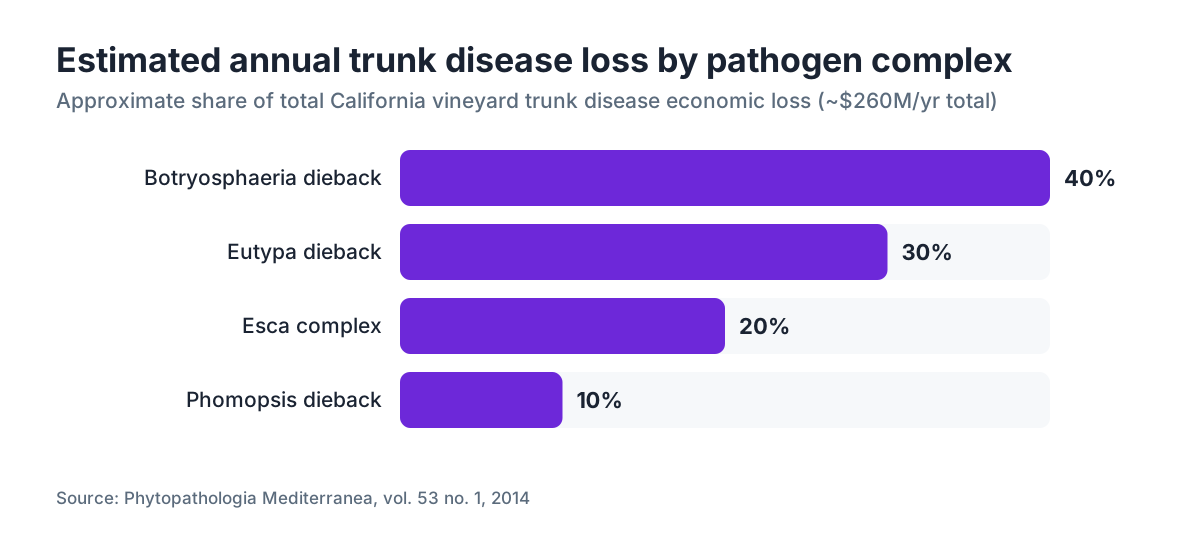
The money at stake is real. A 2014 review in Phytopathologia Mediterranea by Gramaje and Armengol estimated that trunk diseases cost the California wine industry more than $260 million a year in lost production and replanting [1]. Losses run higher in older-vine regions like Spain, France, and Portugal, where vines over 25 years old are common and infection rates of 60 to 80 percent of plants have been documented in some blocks [2].
Four pathogen complexes cause the overwhelming majority of field cases. Botryosphaeria dieback comes from a group of Botryosphaeriaceae species. Eutypa dieback comes from Eutypa lata. Esca is a complex involving Phaeomoniella chlamydospora, Phaeoacremonium minimum, and Fomitiporia mediterranea. Phomopsis dieback comes from Diaporthe ampelina.
Each leaves a signature pattern in wood cross-sections and in the canopy. Learning to read both is the first real skill a vineyard manager needs, and it's the one this guide is built around.
What does Botryosphaeria dieback look like in the wood and canopy?
Botryosphaeria dieback is probably the most widespread trunk disease in warm, dry wine regions: California's Central Valley, South Australia, South Africa's Western Cape, Spain's La Mancha. Heat and water stress favor the fungi, and there are many of them. Neofusicoccum parvum, Diplodia seriata, Lasiodiplodia theobromae, and at least a dozen others show up depending on region [2].
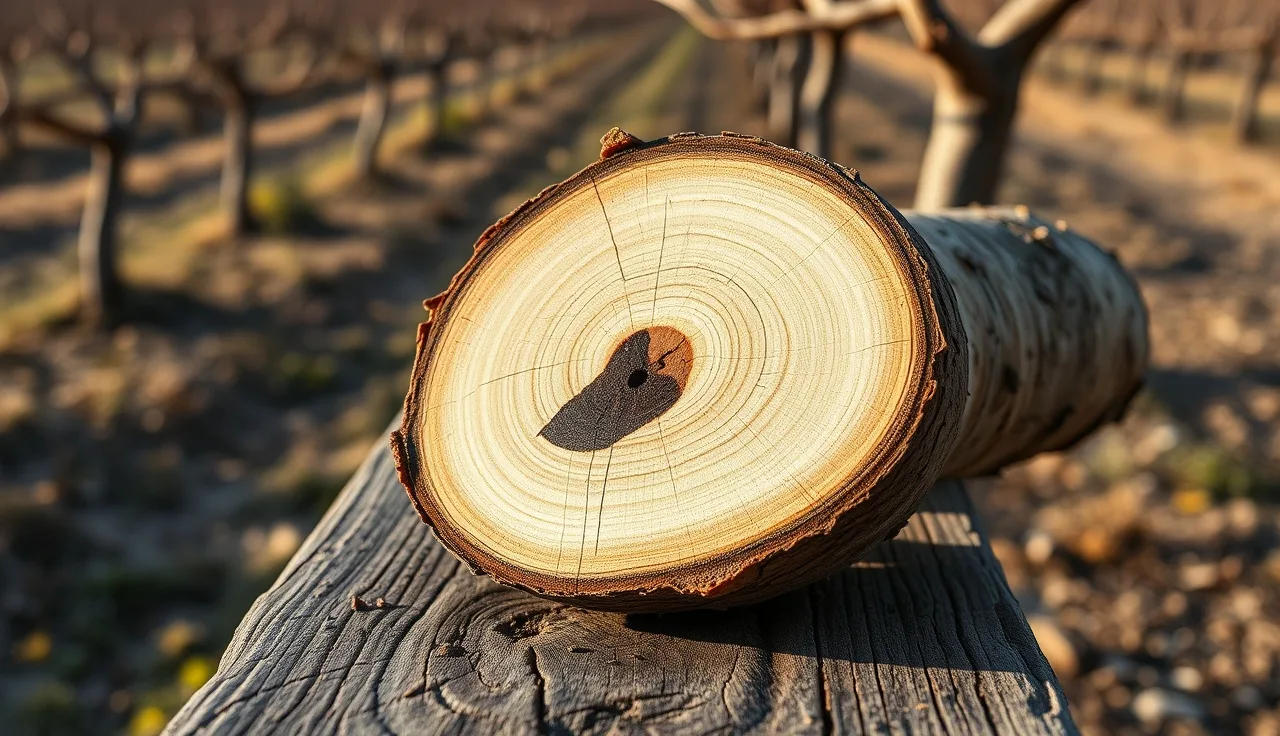
In the wood, the giveaway is a wedge-shaped or V-shaped dark brown to black lesion visible in a clean cross-section. The necrosis starts near the bark and points inward toward the pith. Color runs from light tan in early infections to near-black in advanced cases. Peel back bark on a symptomatic arm and you sometimes find black pycnidia, the fruiting bodies, embedded in the tissue. That's a solid field confirmation.
In the canopy, Botryosphaeria shows up as delayed shoot emergence in spring, worst toward the far end of cordons. Affected shoots stay stunted with shortened internodes. Count the nodes: a symptomatic shoot might carry three to five internodes where its healthy neighbor carries eight or nine. Leaves on stunted shoots yellow and drop early. A whole arm can die within two to three seasons of the first visible canopy symptoms.
One distinction saves you a lot of confusion. Botryosphaeria rarely causes the tiger-stripe leaf pattern that comes with Esca. See those chlorotic leaf bands alongside wood symptoms and you're probably looking at more than one pathogen, which is normal in older vines.
How do you identify Eutypa dieback in your vineyard?
Eutypa lata has been studied for decades by UC Davis Plant Pathology, which keeps one of the better online resources on the disease for California growers [3]. The classic canopy symptom is a stunted shoot carrying small, cupped, distorted leaves. Growers often say the leaves look stitched down at the margins. Clusters on affected shoots develop poorly, with small and sparse berries. This stunting usually appears a few years after the trunk or cordon wood gets infected.
The wood sign is a wedge-shaped necrosis in cross-section, close to what Botryosphaeria produces but often more centrally placed and ringed by a slightly lighter brown halo. The dead sector follows the grain and can run 30 to 60 centimeters above and below the infection point in a mature trunk.
Eutypa spreads mainly through rain-splashed ascospores released from fruiting bodies on dead wood. The infection window is wide. Ascospores come out through the rainy season wherever dead wood sits, including nearby pruned vines, fence posts, and dead wild hosts like almond and apricot. Large pruning wounds on thick wood are the main entry points. A clean cut on a trunk over 5 centimeters across is a real infection risk if you leave it unprotected [3].
Timing matters more here than almost anywhere else. UC Davis work found infection rates at large pruning wounds ran far higher when wounds were open during and right after rain. Painting or spraying wounds within 24 hours of cutting, especially in wet weather, is the most evidence-backed prevention you have.
What are the symptoms of Esca and how does it differ from other trunk diseases?
Esca is the most striking of the trunk diseases and the one most likely to rattle a grower seeing it for the first time. It's a disease complex, meaning several pathogens work together, and the symptoms shift with which species dominate and how old the vine is [4].
In the wood, Esca causes a soft, white, spongy rot of the heartwood. Cut into an infected trunk and it feels like wet cardboard. The outer sapwood may show dark streaking or brown to black staining from the vascular fungi (Phaeomoniella chlamydospora and Phaeoacremonium minimum) that usually arrive ahead of the wood-rotting Fomitiporia. You can find the vascular staining with no white rot at all, especially in younger vines.
The canopy symptoms are the most recognizable in viticulture. The tiger-stripe pattern is what sticks in a grower's memory: interveinal chlorosis that lays down alternating green and yellow bands between the major leaf veins, sometimes with a reddish tinge in red varieties. This is nearly diagnostic for Esca on its own. Berries may show dark spotting and shrivel early. Some vines run a chronic form, leaf symptoms fading in and out for several seasons. Others go into apoplexy.
Apoplexy is the acute form. In summer, often right after a hot spell, an entire vine wilts and collapses fast, sometimes within days. It may partly recover, or it may die outright. Apoplexy rates in a block climb with vine age. In older Iberian and southern French vineyards, annual apoplexy rates of 2 to 5 percent have been documented, which stacks up to severe loss across a decade [4].
Esca favors warm, humid regions. In California it's present but generally less common than Botryosphaeria or Eutypa. Across much of Europe it's the top trunk disease worry.
What does Phomopsis dieback look like, and is it different from Phomopsis cane and leaf spot?
Yes, both come from the same fungus, Diaporthe ampelina (formerly Phomopsis viticola), but they show up differently. Phomopsis cane and leaf spot is the spring foliar and shoot phase. Phomopsis dieback is the perennial wood phase.
The wood symptoms of Phomopsis dieback include dark brown discoloration near the base of the trunk and in the lower spur positions. In cross-section the necrosis sits mostly in the outer sapwood rings and is less wedge-shaped than Botryosphaeria or Eutypa. In bad cases you get a dark, shriveled canker at the base of the trunk or at the graft union.
In the canopy it shows as dead basal shoots and dead spurs, mostly low on the vine. In cool, wet seasons, the bleached, cracked shoots you see in spring with little black pycnidia embedded in them are almost certainly Phomopsis. The jump from annual shoot infection to perennial wood infection happens as the fungus works through persistent infected tissue, especially in vines hit by repeated severe cane infections.
Phomopsis dieback runs hotter as a problem in cool, wet regions: the Pacific Northwest, parts of New York state, cool-climate European regions. WSU Extension keeps practical disease management resources for growers in those places [5].
How do you read a wood cross-section to diagnose trunk disease in the field?
A pruning saw and a good eye handle a field screen. Pick symptomatic arms or trunks, cut cleanly across the wood, and read the exposed face in good light. What you're after is the pattern and color of any dead tissue against the healthy cream-white wood.
Here's a quick-reference for the patterns:
| Disease | Cross-section color | Pattern shape | Location in wood |
|---|---|---|---|
| Botryosphaeria dieback | Dark brown to black | Wedge, V-shaped | Outer sapwood, points inward |
| Eutypa dieback | Brown with paler halo | Wedge, central | Central to mid sapwood |
| Esca (vascular phase) | Dark streaks, then white rot | Irregular, diffuse | Heartwood, central |
| Phomopsis dieback | Dark brown | Irregular, outer ring | Outer sapwood, basal wood |
| Healthy wood | Cream to pale tan | None | Uniform |
A few things to hold onto. These fungi rarely travel alone. Mixed infections in older vines are the rule, not the exception, and a single wood face can show overlapping patterns. A species-level diagnosis needs lab isolation and PCR, which your local plant diagnostic lab runs. UC Davis, the Cornell Plant Disease Diagnostic Clinic, and the WSU Plant Pest Diagnostic Laboratory all offer it [3][5][6].
One more thing. Fresh cuts show truer colors. An oxidized face starts darkening within minutes, which makes healthy wood look diseased. Cut it, then read it fast.
When in the season are trunk disease symptoms most visible and easiest to scout?
Spring is your best window for canopy scouting. The stunting, cupping, and distortion tied to Eutypa and Botryosphaeria stand out clearly as shoots push and early leaves unfold. Walk the rows between budbreak and bloom and symptomatic shoots pop against normal growth.
Midsummer is when Esca tiger-stripe peaks and when apoplexy hits. A July or August walk aimed at tiger-stripe leaves and wilted vines earns its keep in Esca-prone blocks.
Wood symptoms read most accurately during dormant pruning, when you're already cutting. Build a systematic cross-section survey into the pruning routine. Flag vines with internal discoloration, log their location and what you see, and track progression year to year. This is where a digital field records system makes the practice stick across a property running thousands of vines.
VitiScribe's vineyard record-keeping tools let you log scouting observations by block and vine ID, so you build a disease history without paper notes that may not survive the next equipment wash.
The worst time to diagnose from symptoms alone is late fall, after the canopy senesces. Leaf symptoms are gone and tired wood looks rough on its own. You'll rack up false positives and burn pruning hours on vines that were never diseased.
How do trunk diseases spread through a vineyard, and what are the infection windows?
Almost every trunk disease fungus infects through pruning wounds. That's the single most important sentence in this guide. A vine's bark is a decent physical barrier. A fresh pruning cut is not. The window of wound susceptibility shifts by pathogen and weather, but the practical rule holds: any large pruning wound is vulnerable during wet weather until it calluses, which can take weeks [3].
Eutypa and Botryosphaeria both move by spores through different routes. Eutypa releases ascospores from perithecia on dead wood during rain, and those spores travel with rain splash and wind to infect vines tens of meters from the source. Botryosphaeria fungi release conidia from pycnidia in wet weather, and some species also produce ascospores. In warm, irrigated regions, the Botryosphaeria infection season effectively runs from the first pruning cut until callus closure.
Phomopsis infects mainly in cool, wet spring weather. Esca pathogens also come in through wounds, but the road from infection to visible symptom can run decades, which is part of why Esca resists management.
Diseased nursery stock is a documented pathway too. Studies have found Botryosphaeria and Phomopsis DNA in apparently healthy nursery-grown vines at planting [2]. A block can start life carrying a disease load that surfaces only years into production. California's nursery certification program handles part of this, but it isn't fully solved.
What management options actually work for grapevine trunk diseases?
The honest answer: nothing wipes trunk disease out of an established vineyard. What works is slowing spread, protecting new wood, and pulling the worst vines on a timeline that weighs replant cost against lost yield.
Pruning wound protection with a registered fungicide or biological product is the most evidence-backed move. Thiophanate-methyl products, cyproconazole, and the biocontrol Trichoderma atroviride (sold as Esquive in some markets) carry peer-reviewed efficacy data [7]. Application within 24 hours of cutting beats delayed application consistently in field trials. Hand-painting wounds doesn't scale on a large property. Backpack sprayers or pruning machinery that applies product right after the cut is the realistic option.
Delayed pruning helps as a supplement. Pruning later in dormancy, after the main rains, shrinks the overlap between open wounds and peak spore release. It won't eliminate risk, but it can cut new infections meaningfully in Eutypa-prone regions.
For Esca, sodium arsenite was once the most effective trunk injection treatment. The EU banned it in 2003 over toxicity and residue concerns, and nothing has replaced it. Trunk surgery, physically cutting out infected wood and retraining shoots from below the rot, can extend a vine's productive life but needs skilled labor and only pencils out on high-value vines.
Replanting with clean nursery stock into fumigated or rested ground is the reset. UC Davis work on replant protocols and certified clean planting material gives the best guidance on holding down the starting disease load in new blocks [3].
Worker protection runs through all of it. When you apply fungicide wound treatments, EPA Worker Protection Standard rules apply. Applicators need the PPE the label specifies, and restricted-entry intervals must be observed and recorded. For the current requirements, see the EPA's official Worker Protection Standard pages [8].
What happens at a grapevine trunk disease workshop, and are they worth attending?
Grapevine trunk disease workshops run periodically through university extension programs, mainly UC Davis in California, Cornell Cooperative Extension in New York, and WSU Extension in Washington [3][5][6]. They're usually half-day or full-day events at a commercial vineyard or research station, pairing classroom sessions on pathogen biology with hands-on field scouting.
The field component is the real payoff. Reading wood cross-sections from actual infected vines, walking rows with a pathologist, and setting symptomatic shoots next to healthy ones does more for your diagnostic eye than any written description, this one included. If you've never gone, go.
Cornell's grape IPM program and UC Davis Plant Pathology have also put out video materials and online modules that fill in when a workshop isn't within reach [3][6]. The UC IPM Pest Management Guidelines for grape cover all four major trunk disease groups with diagnostic photographs [9].
If you run several blocks or varieties, a workshop helps you learn which diseases hit hardest in your region, so you aim scouting and money where the pressure is instead of chasing every possibility. In the Pacific Northwest, Phomopsis and Eutypa are the priority targets. In California's Central Valley, it's Botryosphaeria. In the Mid-Atlantic, Phomopsis with Botryosphaeria climbing. Local workshops mirror that regional reality in a way generic resources can't.
How do you tell trunk disease apart from other vine disorders with similar symptoms?
Several non-disease conditions copy trunk disease symptoms closely enough to cause misdiagnosis and wasted effort.
Leafroll virus, especially Grapevine Leafroll-associated Virus 3 (GLRaV-3), reddens leaves in red varieties and yellows them in whites, often with downward-rolled margins. From a distance it looks like Esca tiger stripe. The difference: leafroll progresses uniformly across the vine from the bottom of the canopy up, and its interveinal pattern is fuzzier than Esca's sharp banding. Wood cross-sections in leafroll vines show no necrosis at all.
Boron deficiency causes shoot distortion and cupped leaves that read like Eutypa stunting. Pull a petiole tissue analysis. Boron at the low end of normal plus no wood discoloration in cross-section points to nutrition, not Eutypa.
Grapevine fanleaf virus (GFLV) throws malformed, asymmetric leaves and shot berries that can pass for Phomopsis or Eutypa canopy symptoms. GFLV moves by Xiphinema nematodes and needs serological or PCR testing to confirm.
Herbicide damage, especially from growth-regulator herbicides like 2,4-D and dicamba, cups and distorts leaves with a strap-like narrowing of the lamina. Symptoms that show up suddenly across scattered vines after a spray event in a neighboring field point to drift first.
The reliable way to separate all of these from trunk disease is the wood cross-section. No internal discoloration means trunk disease is unlikely, and the hunt moves to viruses, nutrition, or something else.
How do you document and track trunk disease across your vineyard for compliance and management?
Good trunk disease records do two jobs: management tracking and compliance documentation, the second one mattering most once fungicide treatments enter your program.
For management, the minimum useful record per vine or per block covers the observation date, the symptom category (stunted shoots, tiger stripe, apoplexy, cross-section discoloration with color noted), a severity estimate (mild, moderate, severe, or a 1 to 5 scale), and the action taken. If you track replant decisions, add a column for vine age at symptom onset. Patterns in that data tell you whether pressure clusters in a particular variety, rootstock, or block section, which drives better remediation calls.
For spray compliance, every fungicide or biological wound application needs a complete pesticide application record under California's rules and similar rules in other states: applicator name, date and time, product name and EPA registration number, rate, total volume applied, target pest, and field location [10]. This holds even for biological wound treatments like Trichoderma products if they carry a pesticide registration.
Digital record-keeping takes the friction out of staying consistent. VitiScribe is built for vineyard field records, including spray logs that meet state pesticide recordkeeping requirements, so your compliance file grows at the same time as your disease history.
If you're in a state with mandatory pesticide reporting, like California's DPR system, your electronic records have to feed those reports accurately. Paper spray logs transcribed later are where errors pile up. The cost of a compliance violation, fines plus the administrative time to answer it, dwarfs the cost of getting the records right the first time [10].
Frequently asked questions
Can a vine recover from trunk disease once it's infected?
Infected wood doesn't recover. The fungi colonize dead or dying tissue and the damage stays. You can surgically remove infected wood and retrain new shoots from below the infected zone, extending the vine's productive life. For Esca and advanced Botryosphaeria, full removal and replanting is usually more economical once more than 30 to 40 percent of the trunk cross-section shows necrosis.
What does apoplexy look like in a grapevine?
Apoplexy is the acute collapse form of Esca. In midsummer, often within a few days of a heat event, an entire vine wilts suddenly as if severely water-stressed. Leaves dry and curl on the shoot while staying attached. In cross-section the trunk shows advanced white rot of the heartwood. The vine may partly recover in later seasons, but full recovery is rare. Annual apoplexy rates of 2 to 5 percent are documented in old European vineyards.
How do I protect pruning wounds from trunk disease fungi?
Apply a registered fungicide or biological wound sealant within 24 hours of cutting, ideally right away. Products with thiophanate-methyl or the biocontrol Trichoderma atroviride have published efficacy data. Waiting until the next day or a scheduled spray pass cuts your protection sharply. Large wounds, anything over 2 centimeters across, carry the highest risk and should go first. Wound protection matters most during or just after rain.
What's the difference between Eutypa dieback and Botryosphaeria dieback symptoms?
Both cause wedge-shaped wood necrosis in cross-section and stunted canopy growth, but there are useful tells. Eutypa produces small, cupped, distorted leaves with poor cluster development on affected shoots. Botryosphaeria stunts shoots harder and often kills arms faster, though its leaves are less distorted. Eutypa necrosis tends to sit more centrally in the wood; Botryosphaeria necrosis is usually darker, near-black, starting in outer sapwood. Mixed infections are common.
At what vine age do trunk diseases typically become visible?
Canopy symptoms rarely show in vines under three years old, though infection can happen from the first pruning season. Eutypa symptoms usually appear 3 to 8 years after infection because the fungus grows slowly through wood before disrupting enough vascular tissue to hit shoots. Botryosphaeria can produce visible symptoms faster, sometimes within 2 to 3 years. Full-form Esca with white rot is most common in vines over 15 to 20 years old.
Is delayed pruning an effective strategy to reduce trunk disease infection?
Yes, within limits. Pruning later in dormancy, after the main rainy season, shrinks the overlap between fresh wounds and peak spore release for Eutypa. Field studies in California found lower Eutypa infection rates in later-pruned vines. The tradeoff is labor scheduling and, in some regions, the risk of pruning too close to budbreak. Delayed pruning works best as one layer of a multi-tactic program, not the sole control.
Can trunk disease spread from old vine stumps or trellising wood?
Yes. Old stumps and dead wood in or near the vineyard, including fence posts made from susceptible species, can harbor Eutypa and Botryosphaeria fruiting bodies that release spores during rain. Removing dead wood from the vineyard floor and burning or chipping it is standard hygiene. Leaving pruned canes in the row or on trellis wires through winter and spring extends the period of spore production.
How does diseased nursery stock contribute to trunk disease in new plantings?
PCR studies have detected Botryosphaeria, Phomopsis, and Phaeomoniella chlamydospora DNA in symptomless nursery vines at planting. Infections can be present before a vine ever sees its first pruning season in the ground. The pathogen may sit latent for years before canopy symptoms appear. Buying certified clean planting material from reputable nurseries with documented disease testing reduces but doesn't eliminate this risk.
What does tiger-stripe leaf discoloration look like on a grapevine?
Tiger stripe is the Esca leaf symptom. Between the main leaf veins, bands of pale yellow or reddish tissue alternate with green, giving a striped look when you hold the leaf to light. In red varieties the bleached zones often turn red or bronze rather than yellow. Symptoms show in midsummer and intensify through the season. The margins of the chlorotic zones are fairly sharp, which sets it apart from the diffuse yellowing of nutritional deficiencies.
How do I submit a vine sample for laboratory trunk disease diagnosis?
Cut a 20 to 30 centimeter section of symptomatic wood, ideally spanning the junction of healthy and discolored tissue. Wrap it in dry newspaper, not plastic, to keep moisture and mold down in shipping. Include a form with variety, rootstock, vine age, symptom description, and your contact info. UC Davis, Cornell, and WSU all run plant disease diagnostic labs that accept vine wood and provide species-level fungal ID, typically within 1 to 3 weeks.
Are there any resistant rootstocks or varieties that reduce trunk disease risk?
No commercial rootstock or scion variety is fully resistant to trunk disease fungi. Some studies suggest varietal differences in Esca susceptibility, with certain Pinot Noir clones running somewhat higher rates than Chardonnay in side-by-side comparisons, but the data isn't strong enough to drive variety selection on trunk disease risk alone. Rootstock-scion compatibility and wound-healing speed may influence susceptibility indirectly, but this area needs more research.
What EPA Worker Protection Standard requirements apply when treating pruning wounds?
If the wound treatment product carries an EPA pesticide registration, WPS applies. It covers restricted-entry intervals after application, required PPE for handlers (at minimum the label-specified protection), and decontamination supplies at the site. Employers must provide WPS safety training to agricultural workers before first entry into treated areas. Records of application, including product name, EPA registration number, rate, date, and location, must be kept for two years. See EPA's WPS guidance at epa.gov.
How often should I scout for trunk disease symptoms in my vineyard?
At minimum, two focused passes a year: one from early shoot emergence through bloom (for Eutypa and Botryosphaeria canopy symptoms) and one in midsummer (for Esca tiger stripe and apoplexy). Add a systematic cross-section survey during dormant pruning. In blocks with known history, flag and record affected vines individually. Scale scouting intensity with vine age: blocks over 10 years old warrant more attention than young plantings, where trunk diseases rarely reach canopy expression yet.
Sources
- Phytopathologia Mediterranea, vol. 53 no. 1 (2014), Gramaje & Armengol review of trunk disease economic losses: Trunk diseases cost the California wine industry more than $260 million per year in lost production and replanting costs
- Phytopathologia Mediterranea, trunk disease pathogen complex global review: Infection rates of 60 to 80 percent documented in some older-vine blocks; Botryosphaeriaceae species diversity by region; diseased nursery stock as documented infection pathway
- UC Davis Department of Plant Pathology, Eutypa dieback of grapevine resources: Large pruning wounds are the primary infection court for Eutypa; infection rates higher when wounds exposed during rain; wound protection within 24 hours recommended; clean nursery stock and replant protocols
- UC Statewide Integrated Pest Management Program (UC IPM), Grape Esca (Black Measles) guidance: Esca is a complex involving Phaeomoniella chlamydospora, Phaeoacremonium minimum, and Fomitiporia mediterranea; annual apoplexy rates of 2 to 5 percent documented in old Iberian and French vineyards
- WSU Extension, grape disease management resources for Phomopsis and Eutypa: Phomopsis dieback management resources for Pacific Northwest growers; WSU Plant Pest Diagnostic Laboratory accepts vine wood samples
- Cornell College of Agriculture and Life Sciences, Grape IPM and Plant Disease Diagnostic Clinic: Cornell offers species-level fungal diagnostic services and grape trunk disease online training modules; Botryosphaeria a growing concern in Mid-Atlantic
- UC IPM Pest Management Guidelines: Grape, trunk diseases fungicide efficacy: Thiophanate-methyl, cyproconazole, and Trichoderma atroviride products have peer-reviewed efficacy data for pruning wound protection against Eutypa and Botryosphaeria
- EPA Agricultural Worker Protection Standard, handlers and workers: WPS requires PPE per label, restricted-entry intervals, decontamination supplies, safety training before first entry, and two-year recordkeeping of application details
- UC IPM Pest Management Guidelines: Grape, trunk disease groups with diagnostic photographs: UC IPM guidelines cover Botryosphaeria, Eutypa, Esca, and Phomopsis dieback with diagnostic descriptions and photographs
- California Department of Pesticide Regulation, pesticide use reporting: California requires complete pesticide application records including applicator name, date and time, product name, EPA registration number, rate, total volume, target pest, and field location
Last updated 2026-07-10