Grapevine virus diseases: what every vineyard manager needs to know
TL;DR
- More than 80 viruses have been found in grapevines worldwide.
- The three that do the most damage in North America are Grapevine leafroll-associated viruses (GLRaVs), Grapevine fanleaf virus (GFLV), and Grapevine red blotch virus (GRBV).
- None are curable once a vine is infected.
- The only management that works is certified clean planting stock, vector control, and roguing infected vines early.
What are the most common grapevine virus diseases?
More than 80 viruses have been described in Vitis species worldwide, but a handful cause nearly all the money damage in commercial vineyards [1]. In North America, three complexes get the most attention: Grapevine leafroll disease (GLD), caused by one or more Grapevine leafroll-associated viruses (GLRaV-1 through GLRaV-9, with GLRaV-3 the worst offender); Grapevine fanleaf disease, caused by Grapevine fanleaf virus (GFLV); and Grapevine red blotch disease, caused by Grapevine red blotch virus (GRBV), which was only formally characterized in 2012 [2].
There are others worth knowing. Grapevine fleck virus (GFkV), rupestris stem pitting, and various nepoviruses turn up in older plantings and in imported material that dodged serious quarantine. Rugose wood complex covers several distinct viruses, including Rupestris stem pitting-associated virus (RSPaV) and Kober stem grooving-associated virus, and it weakens the graft union and shortens vine life.
Here's the thing every manager should sit with. Grapevines are perennial and propagated by cuttings, so a virus that rides in on one infected budstick can live and spread in a block for decades. The vine doesn't die overnight. It just underperforms, year after year, and the losses stay invisible until a formal survey drags the numbers into the light.
How do I identify grapevine leafroll disease in the vineyard?
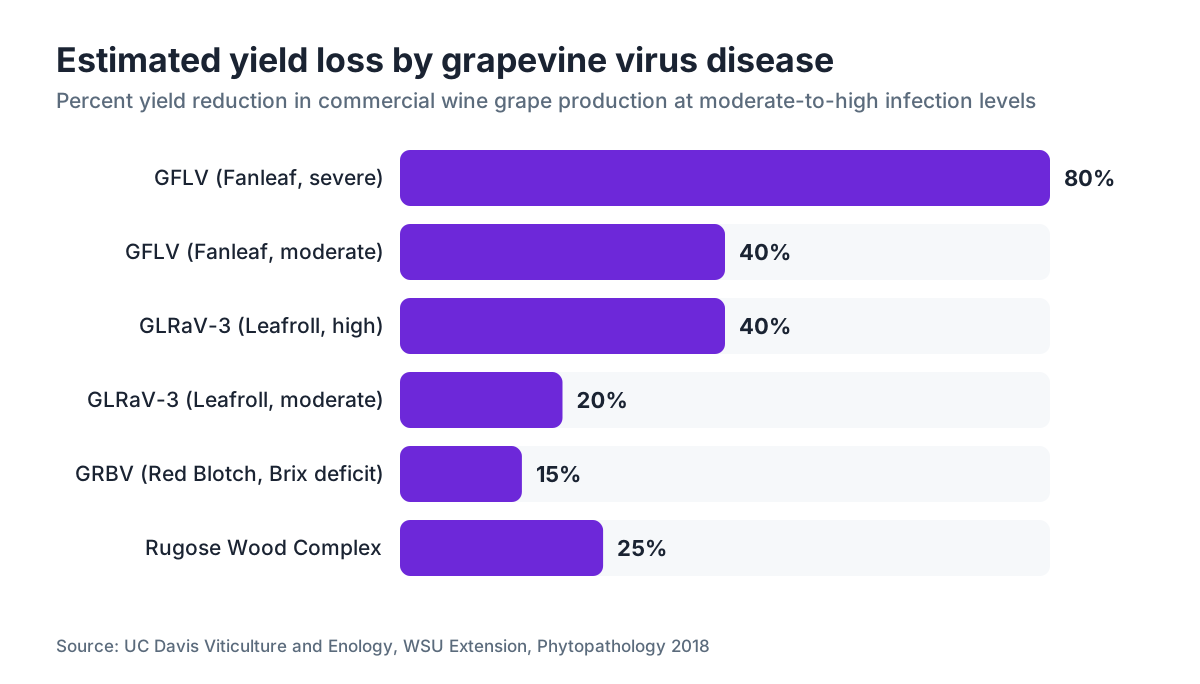
Leafroll is the most economically damaging grapevine virus complex in the world, with yield losses documented at 20 to 40 percent and fruit maturity delayed one to three weeks in infected red varieties [3]. You can spot it in the field, but it fools people constantly.
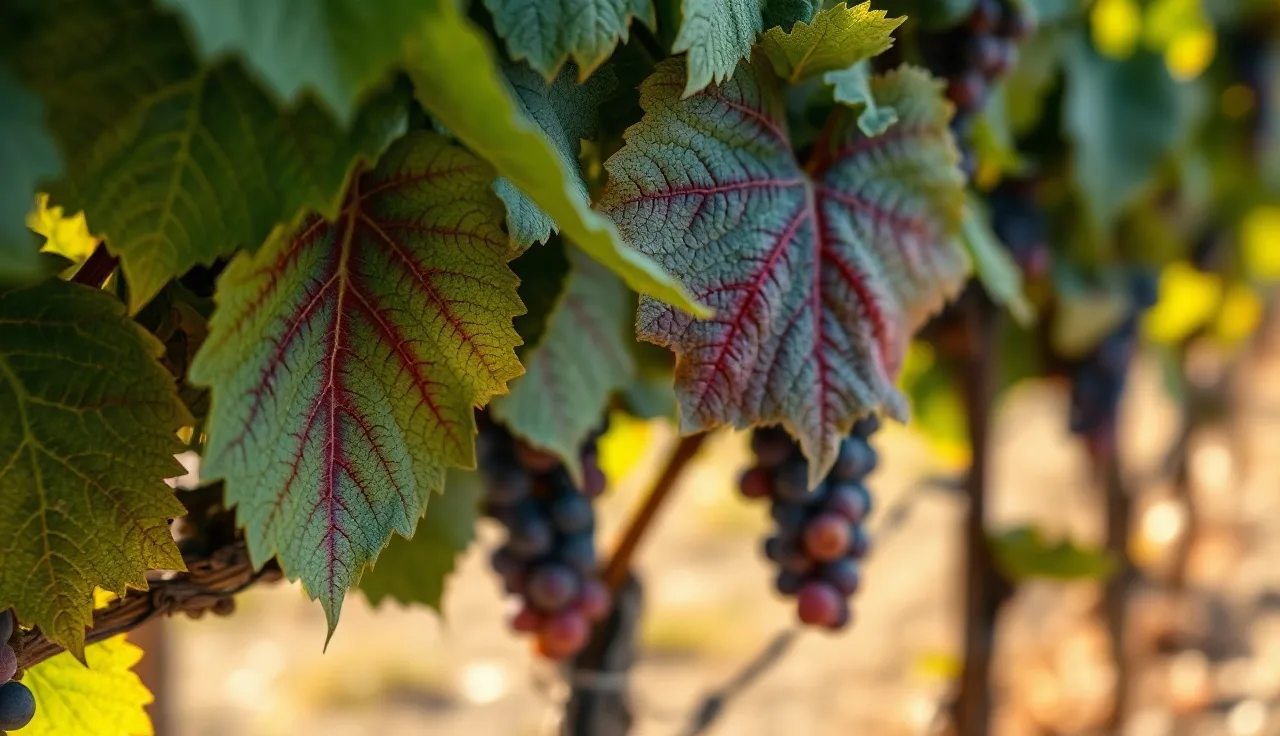
In red-fruited varieties, the classic sign is downward rolling of the leaf margins starting at veraison, with the tissue between the veins turning red while the veins themselves stay green. That contrast is sharp enough to see from a moving ATV late in the season. White varieties roll the same way and yellow between the veins, but the color shift hides against ordinary summer chlorosis. GLRaV-3 in whites gets missed for years.
Symptoms depend on the virus strain, the scion, the rootstock, the season's heat, and the age of the vine. Young vines in their first few leaf years often show nothing at all while carrying the virus. So visual scouting on its own is not detection. Cornell's viticulture team says it flatly: "Symptoms of leafroll may be confused with those caused by nutritional deficiencies, drought stress, or other pathogens" [3]. Confirmation always means a lab test.
Timing your survey matters. Walk the vineyard between veraison and harvest, on a sunny afternoon, working from the outside of the rows in. Flag suspect vines and send petiole or leaf samples to a certified lab for ELISA or RT-PCR. Most state diagnostic labs in California, Washington, Oregon, and New York run these tests for $15 to $40 per sample, though the price moves with the season and how busy the lab is.
What does grapevine red blotch virus look like, and how is it different from leafroll?
Grapevine red blotch virus (GRBV) was first formally described in 2012 and belongs to the family Geminiviridae, which makes it a different animal from the closteroviruses behind leafroll [2]. People mix the two up all the time, and it's understandable, because the leaf symptoms overlap.
Both turn the tissue between the veins red in red varieties. The tells are these: red blotch shows up earlier in the season, sometimes well before veraison; the reddening is patchy and irregular instead of the smooth banding you get with leafroll; and red blotch often skips the strong downward leaf curl that leafroll produces. Infected berries stay high in malic acid, low in sugar, and low in anthocyanins at harvest. That goes straight into the glass as a wine quality problem.
A 2018 study in Phytopathology found GRBV-infected Cabernet Sauvignon vines ran 2 to 4 Brix behind healthy controls under identical management [4]. That's not a rounding error. That's the gap between a harvest you can sell and one that never ripened.
The only way to tell red blotch from leafroll in the field for certain is PCR molecular testing. Some labs now run combination panels that screen GLRaV-1, GLRaV-3, and GRBV in one shot. I'd make that the default in any new planting or when you're scouting a block you don't know.
How do grapevine viruses spread from vine to vine and block to block?
How the virus moves is the whole game in prevention. Two routes matter: propagation material and insect vectors.
Propagation is the bigger historical source. Every grapevine virus can travel through budwood and cuttings. One infected mother vine in a nursery block can throw off thousands of infected planting units before anyone catches it. That's the reason certified clean plant programs exist, and the reason they're worth using.
Insect vectors are the other route, and they change by virus. Leafroll viruses, GLRaV-3 especially, move through soft-scale mealybugs (mainly Planococcus ficus and Pseudococcus longispinus) and some soft scales in the family Coccidae [3]. A mealybug picks up the virus after a short feed on an infected vine, then passes it to healthy neighbors. This is semi-persistent transmission: the insect stays infectious for hours to a few days. Spread runs slow, a few meters a year in a well-run vineyard, but it compounds. A Napa Valley survey found GLRaV-3 incidence in unmanaged blocks climbing roughly 10 percentage points a year once a local mealybug population settled in [5].
Grapevine fanleaf virus (GFLV) spreads almost entirely through its soil-dwelling nematode vector, Xiphinema index. That's what makes GFLV so stubborn. Xiphinema survives in fallow soil for years, holding the virus, so a new planting on old infected ground can get infected within a few seasons even with certified clean stock in the hole. Pre-plant fumigation is standard in GFLV country, though the rules on fumigants keep tightening.
GRBV's vector biology was a mystery for years. Research from roughly 2016 to 2018 pinned the three-cornered alfalfa hopper (Spissistilus festinus) as a confirmed vector, and the full list of insect vectors is still open [4]. GRBV also moves through infected propagation material, so both routes need managing at once.
What does grapevine fanleaf virus do to vines, and why is it so hard to eradicate?
Fanleaf disease is caused by Grapevine fanleaf virus (GFLV), a nepovirus that has probably lived in European vineyards since ancient times. Symptoms split by strain. The degeneration strain twists leaves into that lopsided fanleaf shape, shortens internodes, doubles up nodes, and fasciates shoots. The yellow mosaic strain washes the whole leaf a bright chrome yellow. A chrome-mosaic strain puts yellow spots and rings on the leaves.
Yield losses run brutal. In the worst old, heavily infected vines, losses top 80 percent. Even moderately infected vines drop 30 to 50 percent, with ragged berry set on top. The virus hits cluster size, berry weight, and sugar too.
The eradication problem is Xiphinema index. This nematode lives in the top 60 to 90 cm of soil, feeds on grape roots, and holds the virus for years after you pull the vines. UC Davis's Foundation Plant Services recommends a fallow period of at least two to three years plus pre-plant fumigation before you replant confirmed GFLV ground [6]. Even fumigated, some Xiphinema survive and re-infect. Growers in badly infested spots have run non-host cover crops for four to five years to starve the nematode out before replanting.
There is no cure once a vine is infected. Roguing pulls out the virus reservoir, but it leaves the nematode vector sitting in the soil.
How much do grapevine viruses actually cost per acre?
The cost numbers swing wide depending on variety, virus, regional price per ton, and how long the infection has been around. Here's what the published work actually says.
A 2012 economic analysis from UC Davis put GLRaV-3 infection in Napa Valley Cabernet Sauvignon at roughly $2,500 to $5,000 per acre per year in lost gross revenue, counting both yield loss and the quality discount from delayed ripening [7]. Adjust for today's premium-appellation grape prices and that figure runs higher now.
Washington State University's extension program has documented full vineyard removal and replant at $15,000 to $30,000 per acre once you add land prep, trellis work, and the three-to-four-year establishment stretch with no commercial crop [8]. That's the real price of letting a virus run unchecked until the whole block has to come out.
For red blotch, the 2018 Phytopathology study put lifetime losses at $8,000 to $68,000 per infected acre across a 25-year vineyard life in premium California production, depending on incidence and grape price [4]. The wide band reflects genuine uncertainty about how fast GRBV spreads and how hard buyers discount affected fruit.
Nobody has clean national data on this. The figures above are the best out there from peer-reviewed and extension sources, and they all come from premium-region studies. So use judgment if you're farming a $400-per-ton commodity block.
| Virus | Typical yield loss | Revenue impact (premium regions) | Primary source |
|---|---|---|---|
| GLRaV-3 (leafroll) | 20-40% | $2,500-$5,000/acre/year | UC Davis, 2012 [7] |
| GFLV (fanleaf) | 30-80% | Severe; site often abandoned | UC Davis / FPS [6] |
| GRBV (red blotch) | 2-4 Brix deficit | $8,000-$68,000/acre over 25 yr | Phytopathology, 2018 [4] |
| Rugose wood complex | Long-term decline | Shortened vineyard life | WSU Extension [8] |
How do I test vines for grapevine viruses, and when should I test?
Testing is simple and cheap against the cost of planting sick vines. Two methods do the work: ELISA (enzyme-linked immunosorbent assay) and RT-PCR (reverse transcription polymerase chain reaction). ELISA runs cheaper, around $15 to $25 per virus per sample in most labs, and it handles high-titer viruses like GLRaV-3 well. RT-PCR is more sensitive, catches low-titer infections and newer viruses like GRBV that ELISA can miss, and usually runs $25 to $50 per assay.
For new plantings, test the material before it goes in the ground. Most certified programs (FPS in California, the National Clean Plant Network nationally) have already tested their source blocks, but a random subsample of your incoming nursery stock is cheap insurance. Testing 5 to 10 percent of a planting lot is common.
For established vineyards, the sweet spot for leafroll testing is late summer, six to eight weeks after veraison, when virus titer in the leaf runs highest. Petioles beat leaf blades for ELISA because their titer is more consistent. For GRBV, summer tissue works, and some labs take dormant cane samples during pruning, which is handy.
Buying a vineyard or sourcing budwood from an existing one? Test before you commit. Asking a seller for their disease testing records is plain due diligence. Washington State University's extension publications lay out sampling protocols by virus type and season [8].
On the paperwork side, some managers run field record systems like VitiScribe to track which vines got flagged, tested, and rogued, so there's a clean audit trail for buyer requirements and certification programs.
What certified clean plant programs exist for grapevines?
Foundation Plant Services (FPS) at UC Davis is the primary source of certified clean grapevine planting material in the United States [6]. FPS keeps a repository of tested, indexed mother vines for hundreds of Vitis vinifera varieties and rootstocks, all screened for the main viruses. That material has been thermotherapy-treated and/or meristem-tip cultured to clear viruses before it enters the certified program.
The National Clean Plant Network (NCPN), run through USDA APHIS, ties FPS to regional clean plant centers in Washington, New York, Oregon, and elsewhere so growers get locally adapted certified material [9]. NCPN exists because one national center couldn't serve growers across such different climates.
Using FPS or NCPN material does not buy you a virus-free vineyard forever. It buys you propagation material that tested negative at the time of certification. What happens after that rides on your vector management and the virus pressure around you. Commercial nursery marketing sometimes blurs that line.
For organic or sustainable operations, certified clean plant programs work fine. Plant indexing is a testing and sourcing practice, not a pesticide.
Cornell's viticulture extension tells New York growers to request FPS or NCPN certification documentation from their nursery before accepting any planting material [3]. That's good practice in every state.
Can grapevine viruses be cured or treated once a vine is infected?
No. There is no commercially viable cure once a vine is infected. Full stop.
Thermotherapy (holding infected material at 38°C for several months) paired with meristem-tip culture can clear some viruses in a lab or propagation setting, which is how clean plant programs sanitize infected selections before they enter a certified block. That is not a field treatment. You cannot thermotherapy a planted vineyard.
Antiviral compounds, including ribavirin and several experimental RNA-based approaches, have been studied in controlled settings. None are approved for field use, and none have shown efficacy that would make them practical at commercial scale. A 2020 review in the journal Viruses noted that RNA interference (RNAi) strategies show promise in model systems but sit years away from any field application [10].
What that leaves you is straightforward. Prevent infection, catch it early, and pull infected vines before they become sources for vector spread. Roguing, which means removing infected vines and as much of the root system as you can, is the standard move in most certified wine programs. Some programs want rogued spots replanted with certified clean material within one to two seasons to hold block productivity.
If you're sitting on a block at 30 percent or higher vine incidence with a live mealybug population, the honest answer is usually that replanting the whole block pencils out better than roguing vine by vine while the infection keeps moving.
How do mealybug management and insecticides fit into a leafroll control program?
Mealybug vector control is one of the two main levers for slowing leafroll in an established vineyard. The other is roguing infected vines to shrink the virus reservoir. The goal is not to wipe out every mealybug. It's to hold the population below the level where spread takes off, which means getting ahead of the crawlers before they move from infected to healthy vines in spring and early summer.
Insecticide options include systemic neonicotinoids (imidacloprid, thiamethoxam) applied to soil and taken up through the roots, plus contact and residual products (spirotetramat, buprofezin, chlorpyrifos where it's still registered). Timing and chemistry have to answer to more than efficacy: pollinator protection and pre-harvest intervals under EPA worker protection rules both drive the call [11].
Many of the insecticides used for mealybug in a leafroll program are restricted-use in various states. Spray records must show product name, EPA registration number, rate, timing, applicator name, and target pest. Under the Worker Protection Standard (WPS), workers have to observe restricted-entry intervals (REIs) that vary by product, and records stay on file for two years after application [11].
Biological control, especially parasitic wasps in the genera Anagyrus and Leptomastidea, is a working part of mealybug IPM in California and pairs well with reduced-spray programs. UC Davis and UC Cooperative Extension have published mealybug IPM guidelines aimed squarely at leafroll management [6].
One honest caveat. No insecticide program fully stops leafroll once GLRaV-3 is present above 10 to 15 percent incidence and mealybugs are established. Vector control flattens the epidemic curve. It doesn't reverse it.
What records do I need to keep for grapevine virus testing and spray programs?
Record-keeping for virus management splits into two buckets: diagnostic records and pesticide application records.
On diagnostics, there's no federal rule forcing you to test for viruses. But any premium wine program, certified appellation, or sustainability certification you join will likely want documented testing. California Certified Sustainable (CSWA), LIVE, Salmon-Safe, and various winery sourcing standards increasingly ask for proof of disease status on submitted blocks. Keep the lab reports with the sample date, vine locations (block and row/vine number), virus tested, method used, and result. Hold onto them indefinitely. They're your vineyard's health history.
On pesticides, the rules are federal. The EPA's Worker Protection Standard requires agricultural pesticide records kept for two years, showing product name and EPA registration number, active ingredient, location, total amount applied, date and time, applicator identity, and the applicable restricted-entry interval [11]. If you use a licensed PCA or CCA in California, their written recommendation and signature go in the file too.
State rules stack on top of the federal floor. California's Department of Pesticide Regulation requires county agricultural commissioner reporting for restricted materials, with records held three years. Washington requires pesticide records under RCW 17.21 for commercial applicators [12].
Most managers who've been through a buyer audit end up putting all of this in one digital system, because paper records scatter across office binders, field notebooks, and email threads. VitiScribe is built for exactly this: tagging spray events to specific blocks and generating reports when a buyer comes calling.
For virus-specific records, photograph symptomatic vines, note the GPS coordinates or block/row/vine ID, and link that to the lab result. That paper trail backs your roguing decisions and shows buyers and certifiers you did the work.
How does grapevine virus management differ across California, Washington, and New York?
The biology doesn't change. What shifts by region is which viruses and vectors are present, which varieties you grow, and what the state makes you do on paper.
In California, especially Napa and Sonoma, GLRaV-3 and GRBV run the show. The vine mealybug (Planococcus ficus), an import from Mediterranean regions, is well established and spreads GLRaV-3 fast. FPS at UC Davis is the central certification resource, and the state's DPR oversight of restricted materials is among the strictest in the country. Napa County set up a mandatory vine mealybug control program with its own reporting requirements around 2010 [5].
In Washington, the weight shifts toward leafroll (GLRaV-2 causing a distinct decline in certain rootstocks, alongside GLRaV-3) and rugose wood complex in older Concord and vinifera plantings. WSU Extension publishes regional guidelines built for Columbia Valley and Yakima Valley conditions [8]. The grape mealybug (Pseudococcus maritimus) is the main leafroll vector across most of the state.
In New York, Finger Lakes and Long Island vineyards deal with a mix: GFLV in some older plantings on historically infested ground, leafroll, and tomato ringspot virus (ToRSV), a nepovirus carried by Xiphinema americanum. Cornell's viticulture and extension program has guidelines for northeastern conditions, including hybrid varieties where symptoms show differently from vinifera [3].
All three states run under the federal WPS for pesticide records. California and Washington add state pesticide reporting layers that New York does not. If you farm a vineyard [/articles/vineyard] operation across multiple appellations or states, audit which state's rules hit each property on its own.
Frequently asked questions
Can I visually identify all grapevine viruses in the field without testing?
No. Visual symptoms are good for raising suspicion but they aren't diagnostic. Many viruses cause overlapping symptoms, and some infected vines, especially young ones or low-titer infections, show nothing at all. Leafroll in white varieties is notoriously hard to see. RT-PCR or ELISA testing is required for reliable identification. Always confirm what your eyes tell you with a lab test before you make a management decision.
What is the difference between GLRaV-1, GLRaV-2, and GLRaV-3?
All three are Grapevine leafroll-associated viruses, but they differ in vector, distribution, and severity. GLRaV-3 is the most widespread and economically significant worldwide, spread mainly by mealybugs. GLRaV-1 is also mealybug-transmitted. GLRaV-2 stands out because it can cause graft incompatibility and decline on certain rootstocks, and its biology differs enough that some researchers treat it separately. Combination test panels can tell them apart.
How long does it take after infection for leafroll symptoms to appear?
It varies. In young vines newly infected by mealybugs, visible foliar symptoms can show within one to two growing seasons. With lower-titer strains or vigorous vines, symptoms may hide for two to four years after infection. That lag is a big part of why virus diseases spread undetected before a manager sees the outbreak. Annual late-season scouting plus periodic testing is the only reliable way to catch early infections.
Does removing an infected vine stop the spread of leafroll?
Roguing shrinks the virus reservoir but won't stop spread on its own if mealybugs are active. The right approach pairs roguing with vector control. Timing counts: rogue infected vines in winter or early spring, before mealybug crawlers emerge and can pick up virus from the roots during removal. Pull as much root material as you can to cut down on below-ground virus sources.
Can rootstocks affect how severe grapevine virus symptoms are?
Yes, a lot. Some rootstocks give partial tolerance to certain viruses. Others amplify symptoms or drive a decline you never see on own-rooted vines. GLRaV-2 combined with specific rootstocks, particularly 110R and some SO4 lines, can cause a fast decline that kills vines within a few seasons. That's one reason rootstock virus testing matters as much as scion testing, both at planting and when you buy an established vineyard.
What is the National Clean Plant Network and how do I access certified material?
The National Clean Plant Network (NCPN), coordinated by USDA APHIS, links state clean plant centers that supply tested, virus-free grapevine propagation material [9]. Foundation Plant Services at UC Davis is the primary national repository. To get certified material, contact FPS directly (fps.ucdavis.edu) or your regional NCPN partner center in Washington, New York, or Oregon. Nurseries buying from these programs can hand you certification documentation on request.
Is grapevine red blotch virus present in all wine regions?
GRBV has been detected in every major North American wine grape region, including California, Oregon, Washington, New York, Virginia, and British Columbia. It's also turned up in Europe and South Africa. Its range expanded a lot through infected propagation material before GRBV testing was routine. Surveys published between 2014 and 2020 found incidence from a few percent in newer plantings to over 30 percent in some established California vineyards.
How do I know if a vineyard I'm buying or leasing has virus problems?
Ask the seller or landlord for disease testing records and nursery certification documentation on existing plantings. Walk the vineyard yourself at veraison, looking for leafroll symptoms. Budget for independent testing on a representative sample, at minimum 10 to 15 samples across the block, targeting any vines that look off. Fold potential replant costs into your purchase or lease math. A vineyard at 20 percent leafroll incidence with no vector program carries a calculable liability.
Do organic vineyards have different options for managing grapevine virus vectors?
Organic vineyards can't use synthetic insecticides for mealybug control, which trims the toolbox. Approved options under USDA NOP include kaolin clay, insecticidal soaps, narrow-range horticultural oils, and biological control releases of parasitic wasps. These generally knock back mealybug populations less than systemic neonicotinoids do, so organic vineyards in high-pressure areas lean harder on roguing, clean planting material, and canopy management to cut mealybug habitat.
How often should I test vines in an established, apparently healthy vineyard?
There's no universal answer, but most extension programs suggest testing every five to seven years in low-risk settings and every two to three years where mealybug or GRBV pressure is active. If you supply grapes under a premium contract or certification program, your buyer may set the frequency. For any vineyard where you take scion wood for propagation, test the mother vine block every year.
What spray record information is required under the EPA Worker Protection Standard?
Under EPA's Worker Protection Standard (40 CFR Part 170), agricultural pesticide records must show the crop and location, product name and EPA registration number, active ingredient, amount applied, date and time, and the name of the certified applicator [11]. Records stay on file for two years from the application date and must be available to workers, handlers, and their representatives within 15 days of a request. State rules can add to these minimums.
Can grapevine viruses spread through soil contact or pruning tools?
Most grapevine viruses do not spread through pruning tools or soil contact. The main exception is Grapevine fanleaf virus, which survives in soil through its nematode vector Xiphinema index for years. There's limited evidence of some mechanical transmission through cutting tools for certain viruses in research settings, but that isn't a meaningful field route for the commercially important ones. Tool sanitation between vines isn't a standard virus control recommendation, unlike with bacterial diseases.
What grape varieties are most susceptible to grapevine viruses?
All Vitis vinifera varieties can be infected by the major viruses. What varies is visible symptom expression. Cabernet Sauvignon, Merlot, and Pinot Noir show strong leafroll symptoms and real yield and quality hits. White varieties like Chardonnay and Sauvignon Blanc get infected but show subtler signs. American species and many hybrids can carry viruses with almost no symptoms, which makes them reservoir hosts. Rootstocks differ in their response too, especially to GLRaV-2.
Is there a relationship between grapevine virus incidence and vineyard age?
Yes. Older vineyards, especially those planted before rigorous certification existed (pre-1990s in many regions), tend to carry higher virus incidence because infected mother vine material got propagated unknowingly through several generations. A 2015 Napa Valley survey found significantly higher GLRaV-3 incidence in blocks older than 15 years than in newer plantings from certified stock [5]. Vineyard age is one of the first variables to weigh when you prioritize blocks for a disease survey.
Sources
- University of California Division of Agriculture and Natural Resources, Grape Leafroll Disease publication: More than 80 viruses have been described in Vitis species worldwide
- USDA Agricultural Research Service, Grapevine red blotch virus characterization (formally described 2012): Grapevine red blotch virus was first formally characterized in 2012 and belongs to the family Geminiviridae
- Cornell University Cooperative Extension, Grapevine Leafroll Disease: Leafroll causes 20-40% yield losses and delays fruit maturity 1-3 weeks; symptoms may be confused with nutritional deficiencies or drought stress
- Phytopathology, 2018, Grapevine red blotch virus economic impact study: GRBV-infected Cabernet Sauvignon showed sugar accumulation deficits of 2-4 Brix; lifetime losses estimated $8,000-$68,000 per acre in premium California production
- Napa County Department of Agriculture, Vine Mealybug Program records and UC Cooperative Extension surveys: GLRaV-3 incidence in unmanaged Napa Valley blocks increased approximately 10 percentage points per year once mealybug populations were established; blocks older than 15 years showed significantly higher incidence
- Foundation Plant Services, UC Davis, Grapevine certification and disease information: FPS maintains tested mother vines for hundreds of Vitis varieties; UC Davis recommends 2-3 year fallow plus fumigation before replanting GFLV-affected ground
- UC Davis Viticulture and Enology, Economic analysis of GLRaV-3 in Napa Valley, 2012: GLRaV-3 infection in Cabernet Sauvignon reduced gross revenue by approximately $2,500 to $5,000 per acre per year in Napa Valley
- Washington State University Extension, Grapevine Virus Diseases publications: Total costs of vineyard removal and replant range $15,000-$30,000 per acre including establishment period without commercial yield
- Viruses journal, 2020, RNAi-based antiviral strategies in grapevine review: RNA interference-based strategies show promise in model systems but remain years from any field application; no approved field antiviral treatments exist
- US EPA, Worker Protection Standard for Agricultural Pesticides (40 CFR Part 170): WPS requires pesticide application records including product name, EPA registration number, rate, date, applicator identity, and REI; records retained two years
- Washington State Department of Agriculture, Pesticide Management and Records (RCW 17.21): Washington State requires pesticide records under RCW 17.21 for commercial applicators
Last updated 2026-07-09