Grapevine xylem response to fungi involved in trunk diseases
TL;DR
- When trunk-disease fungi colonize grapevine xylem, the vine responds by forming tyloses, depositing phenolic compounds, and producing traumatic gum in vessel lumens.
- These defenses slow pathogen spread but rarely stop it.
- Infected wood eventually becomes non-conductive.
- Understanding which fungi overwhelm which defenses tells you when to prune, what to cut, and which wounds need protectant fungicide.
What actually happens inside grapevine xylem when trunk fungi arrive?
The xylem is the vine's water and nutrient highway. It's a network of dead, hollow vessel elements linked end to end, running from roots to shoot tips. When a fungal pathogen breaches that system, whether through a pruning wound, a frost crack, or a mechanical injury, it lands in one of the most structurally vulnerable tissues in the plant.
The first thing the fungus encounters is pit membranes, the thin cellulosic barriers connecting adjacent xylem vessels. Healthy pit membranes restrict pathogen spread laterally. The first thing the vine does in response is push living parenchyma cells through those pits into the vessel lumen. These balloon-like outgrowths are tyloses. Tyloses physically block the vessel, cutting off both water flow and fungal advance. [1]
At the same time, adjacent parenchyma cells ramp up synthesis of phenolic compounds, including stilbenes like resveratrol and its oligomers, and other polyphenols with direct antifungal properties. These accumulate in the vessel wall and in surrounding tissue, creating a chemically hostile zone around the infection front. [2]
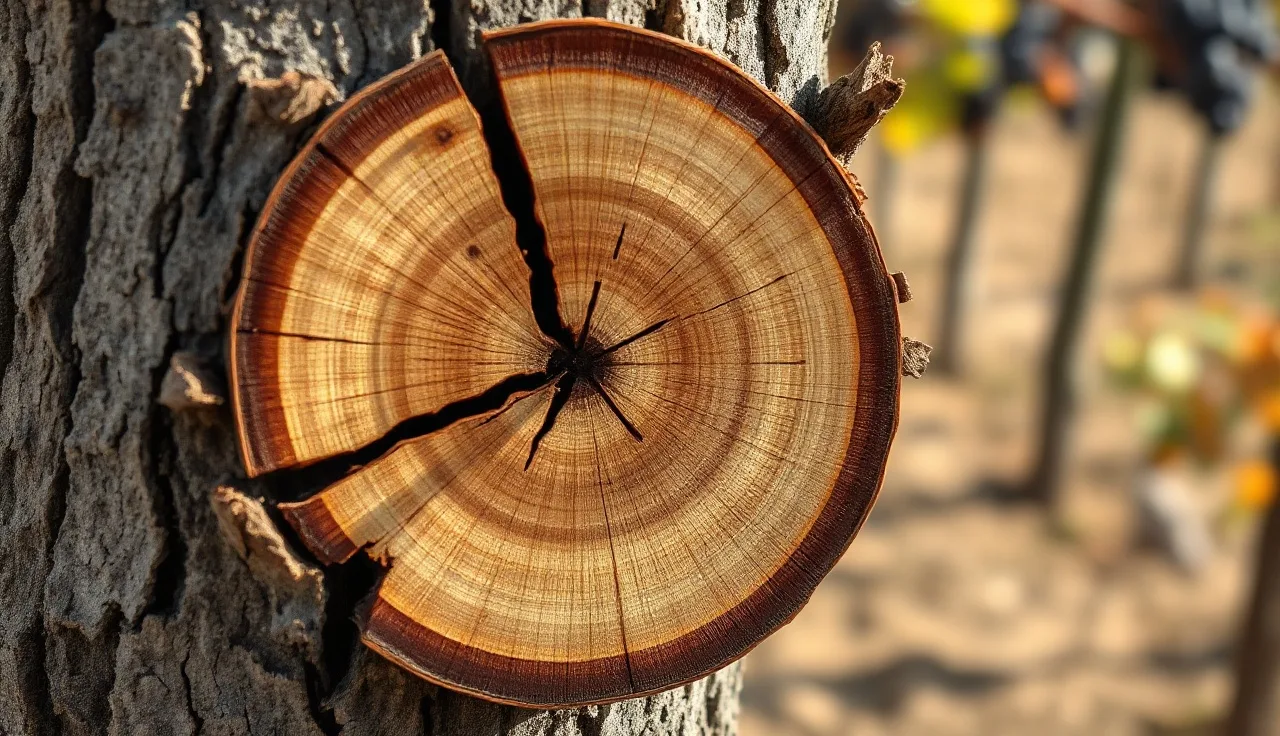
Traumatic gum, a mix of polysaccharides and phenolic materials, also fills vessel lumens in some grape cultivars, adding a physical gel-like plug. The net result is a brownish, discolored zone of non-functional xylem that you can see clearly in a cross-section. That dark stain is more than dead cells. It's the vine's immune response in progress.
Which trunk disease fungi are most aggressive against xylem defenses?
Not all trunk pathogens play the same game. The major groups differ significantly in how they evade or overwhelm xylem defenses.
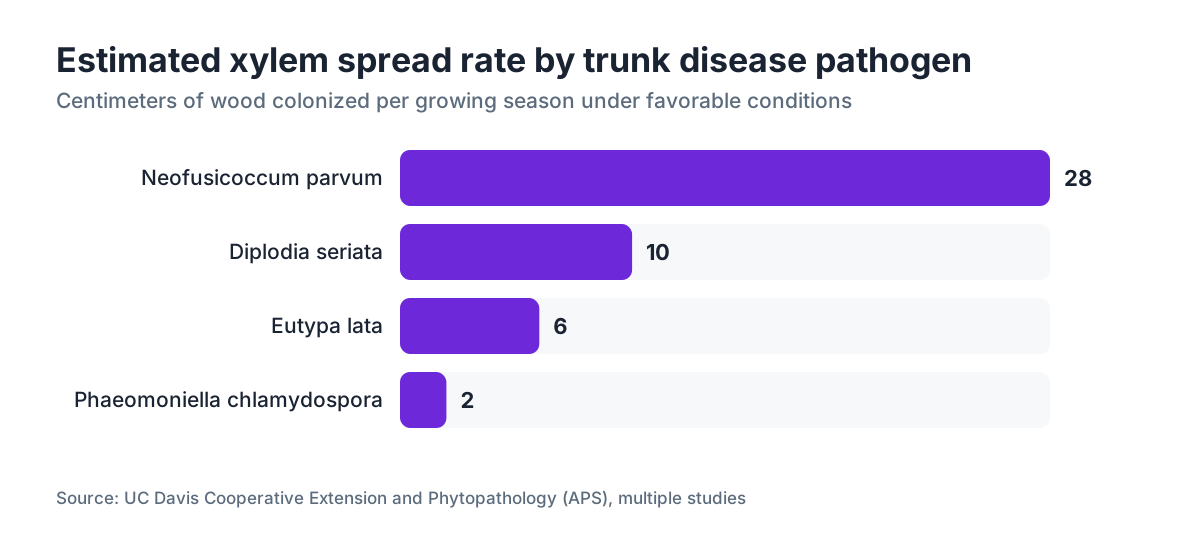
Botryosphaeriaceae (bot cankers), Species like Diplodia seriata, Neofusicoccum parvum, and Lasiodiplodia theobromae are among the most aggressive. N. parvum in particular produces cell-wall-degrading enzymes, including laccase and other oxidases, that break down the phenolic barriers the vine erects. UC Davis research has documented N. parvum colonizing 30 cm or more of cane tissue within a single season under warm conditions, far outpacing the vine's tylosis response. [3] Bot canker fungi also tolerate oxidative stress better than most, so the reactive oxygen species the vine generates around infection sites slow them less.
Eutypa lata (Eutypa dieback), Eutypa lata spreads more slowly than bot canker pathogens but is arguably more insidious. It produces eutypine, a phytotoxic compound that diffuses ahead of the fungal front and disrupts parenchyma cell function before the fungus even arrives. This pre-emptive chemical attack means the vine's defenses are partially disabled in tissue the fungus hasn't yet reached. [4] Cornell's viticulture extension has documented shoot stunting and leaf symptoms in canes 60 cm or more from the visible canker margin, which reflects eutypine's long-range diffusion. [5]
Esca complex (Phaeomoniella chlamydospora, Phaeoacremonium minimum, Fomitiporia mediterranea), The Esca complex is more of a slow siege than a blitz. P. chlamydospora colonizes the xylem early, often entering through propagation material, and disrupts the pit membrane architecture over years. Fomitiporia mediterranea is a white-rot basidiomycete that degrades lignin, literally dismantling the vessel wall rather than just plugging it. [6] The vine's tylosis response is largely ineffective against white-rot degradation because the vessel walls themselves are being consumed.
| Pathogen | Invasion strategy | Typical spread rate | Primary defense overwhelmed |
|---|---|---|---|
| Neofusicoccum parvum | Enzyme-mediated degradation | 20-30+ cm/season [3] | Phenolic barriers |
| Diplodia seriata | Moderate enzyme activity | 5-15 cm/season | Tyloses |
| Eutypa lata | Eutypine pre-toxification | 3-8 cm/season | Parenchyma function |
| P. chlamydospora | Pit membrane disruption | Slow, years to decade | Pit membrane integrity |
| Fomitiporia mediterranea | Lignin degradation | Variable | Vessel wall structure |
What do tyloses and phenolics actually accomplish, and where do they fail?
Tyloses are effective when the infection load is low and the vine is in good physiological condition. A healthy, well-irrigated vine with adequate potassium and boron will form tyloses faster and more completely than a stressed vine. Studies from INRAE and from WSU's viticulture program have both noted that vine water stress, even moderate deficit irrigation, reduces the speed and completeness of tylose formation. [7]
The phenolic response is more nuanced. Stilbenes like resveratrol and viniferins are directly fungitoxic at concentrations found in infected xylem, but they work best against fungi that lack strong detoxification pathways. Eutypa lata and several Botryosphaeriaceae species can oxidize and degrade stilbenes using laccase enzymes, effectively turning the vine's defense into a nutrient source. [2] This is one reason why cultivar resistance to trunk diseases is partial at best: even highly stilbene-producing cultivars can't produce fast enough to neutralize aggressive pathogens.
There's also a hydraulic cost. Every vessel plugged by tyloses is a vessel that no longer conducts water. In young vines with fewer total vessels, a significant infection in the cordon or trunk can remove a meaningful fraction of hydraulic conductance before visible symptoms appear. This explains why infected vines often show water stress symptoms on hot days well before you see dead spurs or cankers. The vine is rationing water through a partially blocked system.
One practical takeaway: the brown stain you see when you cross-section an infected trunk tells you where defenses were deployed, but not where the live fungal front actually is. The fungus can be 10-20 cm beyond the visible discoloration, especially with Eutypa because of eutypine diffusion. [4] Always cut back further than the discoloration when making corrective pruning cuts.
How does cultivar and vine age affect xylem defense capacity?
This is an area where the data is real but incomplete, so honest hedging is warranted.
Cultivar differences in stilbene production are well-documented. Muscadine grapes (Vitis rotundifolia) and some hybrid cultivars produce higher baseline stilbene levels in xylem than Vitis vinifera varieties. Among vinifera cultivars, Sauvignon Blanc has been reported to show relatively higher stilbene induction in response to trunk pathogen inoculation compared to Chardonnay or Cabernet Sauvignon, though the field disease incidence data don't always track neatly with lab stilbene measurements. Nobody has a clean trial showing that higher stilbene production translates to meaningfully lower trunk disease incidence in commercial blocks over a 10-year period. The closest work is from INRAE Bordeaux, which has measured stilbene profiles across cultivars, but controlled field comparisons are confounded by training system, pruning timing, and wood age. [2][9]
Vine age is clearer. Young vines, under 5-7 years old, have smaller diameter trunks with proportionally more sapwood relative to heartwood. They also have less accumulated structural capital. An infection that reaches the trunk in year 2 or 3 can compromise the main trunk in ways that would be merely a cordon setback in a 15-year-old vine. Older vines have more redundancy, more total xylem cross-section, and often more developed wound-response parenchyma. But old vines also accumulate fungal inoculum in old pruning wounds over decades. The oldest blocks in many wine regions, the ones people prize for complexity, are often the most systemically infected. [6]
Scion/rootstock combinations add another layer. There's limited but real evidence that some rootstocks modulate the scion's xylem defense response, possibly through changes in cytokinin signaling that affect parenchyma activity. This is an active research area. Don't make rootstock decisions based on trunk disease resistance claims that aren't backed by replicated trial data.
When are grapevine xylem defenses most vulnerable, and what does that mean for pruning timing?
The vine's wound response is fastest and most effective when it's physiologically active, meaning when shoot growth is happening and cambial activity is high. Pruning during dormancy, which is when most of us prune for operational reasons, leaves wounds open at the time of year when spore release for Eutypa and Botryosphaeriaceae peaks with winter and spring rainfall. The wound dries down and starts forming a callus, but the formal xylem defense response (parenchyma activation, tylosis formation) doesn't fully engage until the following spring. [5]
This timing mismatch is the core reason late pruning reduces trunk disease incidence. WSU extension data from Washington State show that delaying pruning until budbreak reduces Eutypa infection rates substantially compared to December or January pruning in cool, wet climates. [7] The mechanism isn't just wound drying. It's that the vine's defenses are already engaged when infection pressure occurs.
For practical field operations: in wet climates, delay pruning as close to budbreak as labor allows, prioritize leaving a sacrificial cane or spur to draw infection away from the permanent wood, and apply wound protectant fungicides (registered materials include thiophanate-methyl and Bacillus subtilis products) within hours of cutting if you're pruning during rain periods. The EPA Worker Protection Standard applies to any fungicide application in the vineyard. The agricultural use requirements under WPS mean workers present during or shortly after application must be trained and access-restricted provisions followed. [8]
A side note on double pruning: leaving a long cane initially and coming back to make the final cut later is gaining traction as a practical compromise. The final wound, when made closer to budbreak, is shorter-lived before defenses engage. You take the extra labor hit but reduce permanent wood infection. [11]
What does infected xylem look like in cross-section, and how do you read a diagnostic cut?
Cross-sectioning suspect arms and trunks is the fastest diagnostic you have. Here's how to read what you're seeing.
Healthy wood is cream to pale tan in cross-section. Discoloration patterns vary by pathogen:
Bot canker produces a dark brown to black wedge-shaped sector that typically originates at the outside edge of the wood (near the bark) and points inward. The margin is usually fairly sharp. In acute infections, the discoloration can span the entire cross-section in small-diameter arms.
Eutypa produces a central necrosis, often more diffuse and grayish-brown, sometimes with a white mycelial zone visible at the margins of the canker. The discoloration tends to be central rather than sector-shaped because Eutypa spreads through the xylem longitudinally more than radially.
Esca produces the most distinctive pattern: a yellowish to brown central wood decay in older infections, sometimes with a white spongy rot in advanced stages (that's Fomitiporia mediterranea doing lignin degradation). Cross-sections of Esca-infected trunks often show concentric brown rings or irregular brown mottling rather than a clean wedge.
The key diagnostic discipline is to make multiple cross-sections along the limb or trunk, working basipetally (toward the base), and note where the discoloration ends. As noted above, for Eutypa the fungal front is often beyond the visible stain. For Botryosphaeriaceae, the cut margin you use for remediation should be in completely clean, white wood with no streaking. If you're seeing any tan or gray streaking in what you thought was clean wood, go further. A pathogen-free margin of at least 2-3 cm of visually clean wood is the standard recommendation from UC Davis extension for remediation pruning. [3]
Can the vine actually recover once xylem is colonized?
Partial recovery is real. Full systemic clearance is not.
When you make a corrective cut back to clean wood and retrain a new shoot, the new wood that grows from that point is uninfected. The remaining stump may harbor the pathogen for years, but as long as it's sealed off from the growing vine's vascular system, it's not a direct threat to the new wood. The vine essentially walls off the old infected tissue with new callus and xylem. This is the basis for remediation pruning and retraining.
The problem is re-infection. The old infected stub and any old wood left in the trellis continue to produce inoculum. New pruning wounds on the retrained vine are exposed to that inoculum every subsequent season. Blocks that have high trunk disease incidence have high ambient inoculum loads. [5] You can retrain a vine and have the new trunk reinfected within 2-3 seasons if wound management and pruning timing aren't part of the protocol.
For Esca specifically, the situation is harder. Because P. chlamydospora often enters through propagation material, some percentage of vines in commercial blocks may be carrying low-level infections from year one. Trunk renewal doesn't solve a nursery-sourced infection problem. This is why UC Davis and INRAE have both emphasized certified pathogen-tested plant material as a first line of management. [6][10]
For vineyard managers keeping detailed records of which blocks are retrained and which corrective measures were applied, tools like VitiScribe can help track per-vine interventions over multiple seasons, so you actually have the longitudinal record when it's time to evaluate whether retraining a block is worth the capital versus replanting.
How does water stress interact with grapevine xylem defenses against trunk pathogens?
This interaction is underappreciated in field practice and well-documented in the research.
Water stress reduces xylem parenchyma metabolic activity, which directly slows tylosis formation and reduces the output of phenolic defenses. A study measuring stilbene accumulation in water-stressed versus well-watered vines found meaningful reductions in viniferin concentrations in stressed plants following inoculation. [2] The threshold where stress starts to matter appears to be moderate, not severe. Vines at a stem water potential of around -0.8 to -1.0 MPa, which is the lower range of mild regulated deficit irrigation, show reduced wound-response activity compared to well-watered controls.
Hot, dry climates with summer water stress and wet winters with peak Botryosphaeriaceae sporulation (rain after drought events triggers mass conidial release) create a particularly unfavorable cycle. The vines are stressed going into the high-risk infection window, their defenses are partially suppressed, and spore loads are high.
Irrigation management decisions made purely for berry quality (aggressive late-season deficit) may be increasing trunk disease susceptibility. This isn't an argument against deficit irrigation. It's an argument for knowing what you're trading. Nobody has a clean cost-benefit number on this tradeoff because it requires long-term block data with both yield quality records and trunk disease incidence tracking. The best practical advice is: don't add severe water stress on top of wound management failures. If you're in a high-Botryosphaeria-pressure block and pruning timing has been sloppy, that's not the season for aggressive late-season deficit.
What wound protectants actually reduce fungal colonization of xylem?
Several products have real efficacy data behind them, and several are mostly wishful thinking at commercial use rates. Let's separate them.
Registered fungicide wound protectants with real trial data:
Thiophanate-methyl (Topsin-M) is a benzimidazole with documented efficacy against Eutypa lata and Botryosphaeriaceae when applied within hours of cutting. Studies from UC Davis and INRAE put efficacy at 70-90% reduction in infection rates when applied promptly. The timing is non-negotiable. Waiting 24-48 hours after cutting dramatically reduces efficacy because fungal germination can begin within that window. [3]
Boscalid plus pyraclostrobin (Pristine) has shown good efficacy against Botryosphaeriaceae in several California trials. [3]
Bacillus subtilis products (Serenade, Botector) offer a biological option with OMRI-listed status for organic operations. Efficacy is real but lower than the synthetic options, somewhere in the 50-65% range in available trials. Useful for organic programs. Not a substitute for synthetic materials in high-pressure situations.
Pruning paints (non-fungicidal) are largely ineffective at preventing trunk disease infection. The data on this goes back decades and the conclusion is consistent: occlusive paints without a fungicide don't meaningfully reduce infection rates. [5]
All fungicide applications in commercial vineyards fall under the EPA Worker Protection Standard. Under WPS (40 CFR Part 170), workers and handlers must receive training, and restricted-entry intervals must be observed. The Agricultural Handler requirements apply to anyone applying pesticides. [8] State-level licensing requirements (for restricted-use materials) apply on top of federal WPS. Keep your application records, including product name, EPA registration number, rate, date, applicator, and target pest. These records are required for compliance and they're the foundation of any defensible spray record.
What's the relationship between pruning wound size and xylem defense capacity?
Larger wounds are harder to defend. This seems obvious but the mechanism is specific and matters for pruning decisions.
When a pruning cut is made, the vine must callus over the wound surface and simultaneously mount a xylem defense response through the exposed vessel ends. The number of exposed vessels scales with wound surface area. A double-Guyot head with large cuts has far more exposed vessel ends than a minimally-pruned spur system. The vine can't preferentially defend all of them simultaneously.
The concept of minimum wound size is now part of how Sicilian and Spanish researchers are approaching precision pruning, making the smallest cut that achieves the training objective rather than cutting flush with permanent wood. Leaving a stub, even a short one of 1-2 cm, means the exposed vessel ends are in expendable tissue rather than in the permanent arm or trunk. The stub dries down and dies, but the infection in the stub is physically separated from the main xylem by callus and new growth. [1]
There's also a geometric argument: cuts angled so rain doesn't pool on the surface dry faster and are less hospitable for spore germination. This is a minor factor compared to fungicide application and pruning timing, but it costs nothing.
The broader lesson is that every unnecessary cut into permanent wood is a defense liability. Double-pruning systems, where a long cane is left initially and the final cut made near budbreak, reduce permanent-wood wound size while also timing the final wound better. Labor cost is real. Figure roughly 15-25% more pruning labor depending on how your operation runs. [11]
How do you build a trunk disease monitoring and record-keeping protocol?
You can't manage what you don't measure. Trunk disease incidence in commercial blocks is consistently underestimated because symptomatic vines are recorded as dead, replanted, or retrained without the cause being logged.
A practical monitoring protocol has three elements:
First, annual incidence surveys during dormancy. Walk each block and flag vines with visible trunk disease symptoms: dead spurs, dead cordons, foliar symptoms during the season (chlorotic or stunted shoots, tiger-stripe leaf patterns for Esca). Express as percentage of vines per block. A block under 5% incidence is manageable with individual vine remediation. A block at 20%+ incidence is a replanting or block-level retraining decision.
Second, diagnostic cross-sections on removed or remediated wood. When you cut out an infected limb, take a photo of the cross-section. Over three to five seasons you'll build a pattern library of what the discoloration looks like in your blocks and you'll develop a feel for how aggressive the pathogens are in your specific site conditions.
Third, pruning records with wound protectant application dates and timing relative to rain events. This is where a spray and field operations record system matters. Knowing that you applied thiophanate-methyl within 4 hours of pruning in block 7 but had a two-day gap in block 12 gives you a hypothesis to test when you survey incidence the following year.
VitiScribe is built around exactly this kind of per-block longitudinal record, connecting spray records to field observations and compliance documentation.
Cornell's viticulture extension has published a checklist-format IPM guide for trunk diseases that's worth printing and posting in the equipment shed. WSU's extension viticulture program has similar practical materials specific to Pacific Northwest conditions. [5][7] UC Davis's Department of Plant Pathology has the most thorough pathogen-by-pathogen treatment. [3]
What does current research say about breeding or inducing better xylem defenses?
This is an active area with real progress and honest limitations.
The stilbene synthesis pathway in grapevines is relatively well understood at the molecular level. The key enzyme is stilbene synthase (VvSTS), and cultivars with higher baseline expression of stilbene synthase genes generally produce more viniferin in response to pathogen challenge. [2] There are multiple VvSTS gene copies in the Vitis genome and copy number varies across cultivars. [9]
Researchers at INRAE and at various German viticulture institutes have used these molecular markers to screen breeding populations for higher stilbene induction capacity. Some hybrid cultivars (the so-called PIWI varieties, pilzwiderstandsfähig or fungus-resistant) have been bred partly for foliar disease resistance but may carry secondary benefits for trunk disease defense, though this hasn't been tested rigorously in long-term trunk disease trials.
Priming, the process of pre-activating plant defenses using elicitors before the pathogen arrives, is another research avenue. Compounds like beta-aminobutyric acid (BABA) and some biostimulants based on chitosan or laminarin have shown ability to prime stilbene synthesis in grapevines in greenhouse trials. Field performance in reducing trunk disease incidence is less well established. The challenge is that priming is most useful at wound time, and administering an elicitor at every pruning cut across a commercial block is operationally complex.
Nobody has a breeding line of commercial vinifera varieties that demonstrably resists trunk disease colonization under field conditions at commercially meaningful levels. Honest answer: better wound management and pruning timing will do more for your block in the next 10 years than any varietal choice based on xylem defense potential.
Frequently asked questions
What are the first signs that trunk disease fungi have colonized grapevine xylem?
The earliest sign is usually a wedge-shaped or diffuse brown discoloration visible only in cross-section when you cut into wood. Above-ground, infected vines may show delayed budbreak, weak shoot growth, wilting on hot days, or dead spurs. Foliar symptoms like tiger-stripe chlorosis (Esca) or stunted shoots (Eutypa) usually appear years after initial xylem colonization.
How far beyond the visible wood discoloration does the fungus actually extend?
For Eutypa lata, live fungal tissue can be 10-20 cm beyond the edge of visible brown staining because the phytotoxin eutypine diffuses ahead of the fungus. For Botryosphaeriaceae species, the margin is closer but still typically 5-10 cm beyond visible discoloration. Always cut to completely clean, white wood with a 2-3 cm clean margin before considering a remediation cut successful.
Does pruning timing really make a measurable difference to trunk disease infection rates?
Yes, and the data is clear. Delaying pruning to closer to budbreak reduces infection rates because the vine's wound defense response engages faster and the peak spore release period for Eutypa and Botryosphaeriaceae (rain events in winter and early spring) has partly passed. WSU extension data from Washington State show significant reductions in Eutypa infection from delayed versus early dormancy pruning in wet climates.
Are some grape cultivars more resistant to trunk disease xylem colonization than others?
There are documented differences in stilbene production between cultivars, and muscadine grapes and some hybrids produce more stilbenes than Vitis vinifera varieties. But no commercial vinifera variety has demonstrated field-level resistance strong enough to be a primary management strategy. Cultivar choice matters less than pruning timing, wound protectant application, and planting disease-free certified material.
What wound protectant fungicide works best against trunk disease fungi?
Thiophanate-methyl (Topsin-M) applied within hours of pruning has the strongest trial-based efficacy, with 70-90% reduction in infection rates in UC Davis and INRAE trials. Boscalid plus pyraclostrobin (Pristine) is effective against Botryosphaeriaceae. For organic programs, Bacillus subtilis products offer 50-65% efficacy. Pruning paints without fungicide have no meaningful efficacy against trunk disease pathogens.
Can you save a vine that has trunk disease in its main trunk?
Sometimes. If the infection hasn't reached the root system and you can cut back to clean wood, retraining a new shoot from a sucker or a low bud can produce a viable vine. The new trunk will be uninfected. The risk is re-infection from ambient inoculum in the block. Vines with infections in the base of the trunk or cordon junction, or Esca infections from propagation material, have a worse prognosis.
Why does Esca seem to come and go in a vine from year to year?
Esca expression varies with vine water status and climate. In hot, dry years, apoplectic (sudden collapse) Esca is more common; in cooler, wetter years the same vine may show only mild foliar symptoms or none. The fungal complex is still present in the wood regardless of symptom expression. The year-to-year variability reflects how the vine's compromised xylem copes with varying transpiration demand, not actual clearance of infection.
How does the EPA Worker Protection Standard apply to trunk disease fungicide applications?
Any fungicide applied to a commercial vineyard must comply with 40 CFR Part 170 (the WPS). Workers present during or shortly after application must have WPS training, and restricted-entry intervals on the fungicide label must be observed. Handlers applying pesticides need additional handler training. Application records including product, EPA registration number, rate, date, location, and applicator must be kept. State pesticide licensing requirements may also apply.
Is water stress during the growing season making trunk disease worse?
There's solid mechanistic evidence that it does. Water-stressed vines show reduced parenchyma activity, slower tylosis formation, and lower stilbene accumulation at wound sites. Moderate deficit irrigation at stem water potentials of -0.8 to -1.0 MPa has been associated with reduced wound-response activity in lab and greenhouse studies. Aggressive late-season deficit irrigation in high-pressure blocks adds infection risk on top of any wound management gaps.
What does the cross-section of Esca-infected wood look like compared to Eutypa or bot canker?
Esca produces irregular brown mottling or central wood decay, sometimes with white spongy rot in advanced cases from Fomitiporia mediterranea's lignin degradation. Eutypa produces diffuse grayish-brown central necrosis. Bot canker produces a dark brown to black wedge-shaped sector originating at the wood periphery. Making multiple cross-sections from the cut end toward the base helps trace the pathogen and inform how far back to cut.
Should I retrain individual sick vines or replant the whole block?
Under 5% block incidence, individual vine remediation (cutting back to clean wood, retraining) is usually cost-effective. Above 20% incidence, block replanting with certified pathogen-free material is typically more economical over a 15-year horizon. Between those levels, it depends on vine age, variety value, and how well you can reduce ambient inoculum and improve wound management going forward. No clean formula exists; this is a judgment call with your specific economics.
Does double pruning reduce trunk disease infection compared to single-pass pruning?
Yes, for two reasons. The final wound on permanent wood is made closer to budbreak when the vine's defenses engage faster, and the final wound is often smaller because you're cutting from a pre-left stub rather than from the arm directly. The tradeoff is roughly 15-25% more labor for the pruning operation. In high-pressure environments (wet winters, infected blocks), the investment typically pays back in slower disease progression.
Can nursery propagation material carry trunk disease fungi before vines are even planted?
Yes, and this is a major documented pathway for Esca pathogens, particularly Phaeomoniella chlamydospora. The fungus can survive in dormant wood and grafting wounds. INRAE and UC Davis both emphasize using certified pathogen-tested planting material as the first management step. Buying from a nursery with a documented hot-water treatment program (50°C for 30 minutes for dormant wood) meaningfully reduces propagation-source inoculum.
How often should I survey blocks for trunk disease incidence?
Annual dormancy surveys are the minimum. Walk every row, flag symptomatic vines, and record as a percentage per block. A mid-season survey during shoot growth to catch Eutypa shoot stunting and Esca foliar symptoms adds resolution. Tracking year-over-year incidence per block is the only way to know whether your management changes are working or whether a block is progressing toward the replanting threshold.
Sources
- UC Davis Department of Plant Pathology, Grapevine Trunk Diseases overview: Tylosis formation and phenolic accumulation are primary xylem defense responses to trunk pathogen infection in grapevines
- INRAE / Phytobiomes Journal, stilbene response in grapevine xylem to trunk pathogens: Stilbenes including resveratrol and viniferins accumulate in xylem as antifungal defenses and vary by cultivar; Botryosphaeriaceae species can degrade these via laccase
- UC Davis Cooperative Extension, Trunk Diseases of Grapevine: Neofusicoccum parvum can colonize 20-30+ cm of cane tissue per season; thiophanate-methyl applied within hours of pruning achieves 70-90% reduction in infection rates
- Phytopathology (APS), eutypine phytotoxin diffusion in Eutypa dieback: Eutypa lata produces eutypine, which diffuses ahead of the fungal front and disrupts parenchyma function in advance of colonization
- Cornell University Viticulture and Enology Extension, Eutypa Dieback of Grapevine: Shoot stunting symptoms can appear 60+ cm from the visible canker margin due to eutypine diffusion; delaying pruning to budbreak reduces infection rates; pruning paints without fungicide are ineffective
- Plant Disease (APS), Esca complex review, Fomitiporia mediterranea and Phaeomoniella chlamydospora: Fomitiporia mediterranea degrades lignin in vessel walls; P. chlamydospora can enter through propagation material and persists in asymptomatic vines
- Washington State University Extension, Grapevine Trunk Diseases in the Pacific Northwest: Delaying pruning to near budbreak significantly reduces Eutypa lata infection rates in wet climates; water-stressed vines show reduced wound-response activity
- U.S. EPA, Worker Protection Standard 40 CFR Part 170: Agricultural workers and handlers must receive WPS training; restricted-entry intervals and application records are required for all commercial pesticide applications
- European Journal of Plant Pathology, cultivar stilbene production and trunk disease susceptibility: Stilbene synthase gene copy number and expression varies across Vitis cultivars, affecting stilbene induction capacity in xylem following pathogen challenge
- UC Davis Plant Pathology, hot-water treatment of propagation material for trunk pathogens: Hot-water treatment at 50°C for 30 minutes of dormant propagation wood reduces Phaeomoniella chlamydospora and other Esca complex pathogens in planting material
- Phytopathologia Mediterranea, double pruning and trunk disease wound management: Double pruning reduces permanent-wood wound exposure timing and wound size, associated with lower trunk disease progression rates compared to single-pass pruning
Last updated 2026-07-09