OIV grapevine trunk diseases: what vineyard managers need to know

TL;DR
- Grapevine trunk diseases (Botryosphaeria dieback, Esca, Eutypa dieback, Petri disease, and black foot) are recognized by the OIV as the leading cause of premature vineyard decline worldwide.
- There is no cure once wood is infected.
- Prevention through pruning hygiene, wound protection, and replanting decisions is the only effective strategy.
- Losses can reach 20% of annual yield in affected blocks.
What are grapevine trunk diseases and why does the OIV treat them as a global threat?
Grapevine trunk diseases are fungal infections that colonize the permanent woody parts of the vine, the trunk, cordons, arms, and canes, rather than the leaves or fruit. Once the fungi are inside the wood, the vine can't clear them. The infections spread slowly over years, killing vascular tissue and producing toxins that damage the cells around them. The vine declines, crops unevenly, and dies years before its expected productive life ends.
The International Organisation of Vine and Wine (OIV) first addressed trunk diseases formally in Resolution OIV-VITI 564-2016, which called on member states to promote monitoring, research coordination, and prevention strategies [1]. These diseases hit wine grape production on every continent where Vitis vinifera grows commercially. The significance isn't only biological. A vineyard with 15% of its vines infected loses that share of productive wood permanently, and replacement vines need three to five years to reach full production.
The five disease complexes grouped under the trunk disease umbrella are Esca (including black measles and young vine decline), Eutypa dieback, Botryosphaeria dieback, Petri disease, and black foot. Each has its own causal fungi, symptoms, and timing within the vine's life. They share one nasty trait: pruning wounds are the main infection court for most of them [2]. Every dormant pruning season is both a management opportunity and a risk event.
For a small winery owner who also runs estate vineyards, the economic math is not abstract. UC Davis researchers estimated that trunk diseases cost the California wine grape industry over 260 million dollars per year in lost production and replacement costs [3]. That figure is from one state. Multiply it across France, Spain, Italy, South Africa, Australia, Argentina, and Chile, and the OIV's framing of a global crisis makes sense.
What are the five main trunk disease complexes and how do you tell them apart in the field?
Getting the diagnosis right matters because the causal fungi, the management windows, and the replanting math differ between diseases. Here's what you're actually looking at.
Esca is the most visually dramatic. Leaves on infected shoots show interveinal chlorosis and necrosis in a tiger-stripe pattern, often mid-summer when vine stress peaks. Cross-sections of infected canes show brown to black wood. In advanced cases the vine collapses fast, sometimes within a single season, in what's called apoplexy or "young esca" on vines under eight years old. Several fungi cause Esca, mostly Phaeomoniella chlamydospora, Phaeoacremonium minimum, and Fomitiporia mediterranea [2].
Eutypa dieback comes almost entirely from Eutypa lata and produces stunted, chlorotic shoots with small, cupped, or distorted leaves at the base of affected canes. The wood beneath shows a wedge-shaped necrosis in cross-section. Symptoms typically appear four to seven years after infection, which makes early detection hard. Eutypa lata releases ascospores during rain events in winter and early spring, exactly when pruning wounds are fresh and open [4].
Botryosphaeria dieback comes from fungi in the family Botryosphaeriaceae (species like Neofusicoccum parvum and Diplodia seriata are common in California and South Africa). Wood symptoms include brown to black wedge-shaped cankers, sometimes with a cream-colored border. Leaf symptoms look like Eutypa but show up earlier in the season. These fungi are opportunists that colonize stressed vines fastest, which is why drought years often line up with Botryosphaeria flare-ups [3].
Petri disease is the young vine form of Esca. It shows up in vines under five years old and involves the same Phaeomoniella and Phaeoacremonium species found in adult Esca. Infected young vines grow poorly, show abnormal leaf color, and sometimes die back to the graft union. The pathogen often arrives in infected nursery material, one of the biggest transmission vectors the OIV has flagged [1].
Black foot comes from fungi in the genera Cylindrocarpon, Campylocarpon, Dactylonectria, and related groups. It attacks the root system and basal trunk of young vines, causing dark discoloration and decay below the graft union. Affected vines show poor vigor and stunted shoots. Black foot is tied to replant sites where soil pathogens survive from earlier vineyard cycles [5].
The table below sums up the key field differences.
| Disease | Causal Fungi | Primary Symptom | Infection Window | Wood Sign |
|---|---|---|---|---|
| Esca | Phaeomoniella, Phaeoacremonium, Fomitiporia | Tiger-stripe leaf, apoplexy | Pruning wounds, old wood | White rot center |
| Eutypa dieback | Eutypa lata | Stunted, cupped shoots | Pruning wounds, winter rain | Wedge necrosis |
| Botryosphaeria dieback | Neofusicoccum, Diplodia | Wood canker, early leaf die | Pruning wounds, stress events | Dark wedge canker |
| Petri disease | Phaeomoniella, Phaeoacremonium | Young vine decline | Nursery, pruning | Brown streaking in cross-section |
| Black foot | Dactylonectria, Campylocarpon | Root/basal decay, poor vigor | Replant soil, nursery | Black basal rot |
How do these fungi actually spread from vine to vine and site to site?
Prevention only makes sense once you know how the fungi get in. There are four main routes, and pruning wounds top the list.
For most trunk disease pathogens, pruning wounds are the primary entry point [2]. Fungi like Eutypa lata produce spores that ride rain splash and air currents onto fresh cut surfaces. Research at UC Davis showed that Eutypa lata spores can travel 100 meters or more during rain events [4]. A wound is most susceptible in the first hours to days after cutting, before the vine's natural response (a callus and a zone of antimicrobial compounds) can form.
Botryosphaeriaceae spores release in wet weather too, but these fungi also enter through natural bark cracks, hail damage, and any wound that breaks the protective bark. That's why spring hail events often correlate with higher Botryosphaeria pressure in the seasons that follow.
Nursery material is a major but underappreciated vector for Petri disease and black foot. The OIV has called specifically for better certified nursery programs to slow the movement of infected planting material across regions [1]. Surveys of commercial nursery cuttings in several countries have found Petri disease pathogen infection rates from 30% to over 80% in untreated material, depending on source and study. Cornell's viticulture extension points to clean plant programs as the first line of defense for new plantings [6].
Tools are the vector people underestimate. Secateurs and pruning saws carry fungal spores, and there's documented evidence that moving through a block with unsterilized tools spreads pathogens mechanically. WSU's viticulture extension recommends disinfecting pruning tools between vines, or at least between rows, using a 10% bleach solution or quaternary ammonium products [7].
Soil persistence drives black foot and some Petri disease problems. Cylindrocarpon-related fungi survive in soil for years alongside root debris from a previous vineyard. Replant on a site without adequate fumigation or fallow, and you're planting young vines straight into a reservoir of inoculum.
What does the OIV specifically recommend for trunk disease management?
Resolution OIV-VITI 564-2016 is worth reading start to finish if you manage more than a few hectares, because it frames the problem at a systems level instead of just naming spray products [1]. The resolution sets out several priorities.
Preventive cultural practices come before any chemical tool. The OIV names delayed pruning (cutting later in dormancy when wound susceptibility drops), double pruning (a rough cut first, then the final cut closer to bud break), and wound protection as the primary framework.
The resolution asks member states to build and keep national and regional disease monitoring networks so the distribution and severity of trunk diseases can be tracked over time. That's partly a research policy call, but for vineyard managers it means regional surveys and extension data should feed your replanting and rootstock decisions.
The OIV also states plainly that no systemic fungicides registered in most countries can cure established infections. Topical wound protectants applied right after pruning, products based on fungicides like thiophanate-methyl or on Trichoderma biocontrols, are the chemical tools with demonstrated efficacy [3]. The window is narrow. They go on the wound within hours, not days.
Remedial surgery counts as a legitimate and sometimes productive intervention for high-value vines: cut back well below the visible infection margin, or retrain new cordons from suckers. UC Davis extension publishes protocols for this, including cutting at least 10 cm below any visible wood discoloration [3].
Nursery certification is the last policy priority the resolution raises, asking members to build or strengthen clean plant programs. For a vineyard manager the takeaway is simple: source certified disease-tested plant material when you can, and ask nurseries directly about their testing protocols.
When should you prune to minimize trunk disease infection risk?
Timing is the most accessible lever most growers have, and the data on it is cleaner than for almost anything else in trunk disease management. Prune late, prune dry, and you cut infection risk hard.
Wound susceptibility peaks right after pruning and drops as the wound dries and the vine's defenses kick in. Studies measured Eutypa lata infection on wounds made at different points in dormancy and found that wounds made in mid- to late dormancy, closer to bud swell, had much lower infection rates than wounds made right after leaf fall [4]. Fungal spore release also peaks during the wetter, colder stretches of dormancy, which often overlaps early pruning.
Double pruning or delayed pruning attacks this directly. On the first pass you make a rough cut leaving a stub of extra cane. That stub sacrifices itself to any early-season infection. On the final pass, closer to bud swell, you make the permanent cut at the right position. Research at the University of California found this can cut Eutypa infection rates by 50% or more compared to single-pass early pruning [3].
Rain is the operative risk factor, more than the calendar date. A warm, wet December is a higher-risk pruning window than a dry, cold February. Time your final cuts just ahead of a dry stretch and you get both timing advantages at once. In most California and Pacific Northwest regions that means targeting February and early March for final cuts. Wet coastal climates make that harder, which is why wound protectants carry more weight there.
In a dry-winter region like Paso Robles, the timing advantage is easy to hit without elaborate logistics. In the Willamette Valley or coastal Sonoma, plan on wound protectants doing more of the work.
For your spray records, every wound protectant application needs the product name, EPA registration number, date, applicator, rate, and target site. The EPA Worker Protection Standard (WPS) also requires certain information in your records when restricted-entry intervals apply [8].
What wound protection products actually work and which ones are approved?
The honest answer is that the product landscape shifts by country and state, and registration status changes. Here's what the peer-reviewed literature and extension guidance support as of the most recent synthesis.
Topical fungicides on pruning wounds are the most studied chemical approach. In the United States, thiophanate-methyl (usually sold as Topsin-M) is registered for wound protection in vineyards in several states and has shown efficacy against Botryosphaeria and Eutypa in university trials [3]. Boscalid and tebuconazole have also been evaluated. Timing is the whole game: the product has to cover the wound within hours of cutting, which in practice means either an applicator following the pruners or a pruner-mounted spray setup.
Trichoderma-based biologicals (sold under names like Vinevax and Trichoseal in some markets) have shown promising results in Australian and New Zealand trials and are increasingly available in the US. WSU extension has evaluated some of these and found they work, especially paired with delayed pruning [7]. They carry lower re-entry restrictions and fit into some organic programs.
Paints and wound sealants with no active fungicide (petroleum-based wound paints, for example) are not recommended by current extension guidance and can trap moisture. Skip those.
Europe's product list looks different. Several fungicides registered in the US are restricted or unavailable in EU member states, and there's more emphasis on biocontrol and cultural methods. The OIV resolution acknowledges this variation and calls for harmonized efficacy data across member states [1].
For your compliance records, every application has to tie back to the product label. The label is the law under FIFRA in the US, and applying a wound protectant at a rate or to a site not listed on the label is a federal violation. Keep copies of the current label in your spray records, more than the product name [8].
How do you make a replanting or vine surgery decision for an infected block?
This is where vineyard economics get uncomfortable, and there's no formula that fits everyone.
The decision has three branches: leave the vine, do remedial surgery, or remove and replant. The inputs are vine age, infection severity, remaining productive life, replanting cost, and the opportunity cost of the space.
Remedial surgery is worth trying on high-value vines (old-vine blocks, expensive scion and rootstock combinations) when infection is caught early enough to retrain a clean cordon or trunk from a sucker. The protocol requires cutting well below the visible margin of discoloration, typically at least 10 cm, confirming clean wood in the cross-section, and protecting the new cut surface with a wound protectant [3]. Cornell extension notes that success rates depend heavily on how early you act: vines with early wood symptoms that still produce well do much better than vines already in visible apoplexy [6].
When infection rates climb above roughly 20 to 30% of a block, surgery and vine-by-vine management usually lose to replanting. You're spending labor on a losing battle. Replanting California wine grapes runs roughly 15,000 to 30,000 dollars per acre depending on variety, rootstock, trellis system, and region (estimates from UC Cooperative Extension farm budgets; the exact figure varies a lot by county and site) [9]. That's a real number to weigh against projected revenue from a recovering block.
At replanting, several choices lower future risk: rootstocks with better tolerance profiles where data exists, certified pathogen-tested plant material, fumigating or fallowing the soil for at least one season if black foot is in the site history, and drip irrigation to avoid the water stress that speeds up Botryosphaeria.
Detailed records of which rows and vines show symptoms, when they first appeared, and how fast they're progressing turn that replanting call into a data-driven one instead of a gut call. Track this in a spreadsheet and you'll miss the spatial pattern. A field record system that maps vine health by GPS position shows you whether a hotspot is expanding from a point (a tool transmission event or a single source) or spreading diffusely (a systemic nursery or soil problem). VitiScribe's block mapping and spray record module is one way to keep that data organized and audit-ready, especially under a compliance program that requires third-party review.
What do UC Davis, Cornell, and WSU extension programs recommend for trunk disease scouting?
The three major viticulture extension programs overlap but weight things differently based on their regional production contexts.
UC Davis and UC Cooperative Extension have produced some of the most detailed English-language research on Eutypa and Botryosphaeria in California conditions. Their practical advice runs on a systematic scouting protocol: walk blocks during early shoot growth (6 to 12 inch shoots) to catch Eutypa and Botryosphaeria symptoms while they're visible and before later vegetative growth hides them. Flag symptomatic vines and map their location. UC Davis recommends pruning back to check the extent of wood necrosis during dormancy before deciding on surgery versus removal [3].
Cornell's viticulture extension (working largely out of the Cornell Lake Erie Research and Extension Lab and the Finger Lakes) focuses on Eutypa because New York's winters are wet. Their guidance on double pruning and wound protectants is especially detailed, and they've evaluated timing models tied to degree-day accumulation for spore release prediction [6]. For Northeast growers, those models can meaningfully cut product applications by targeting high-risk windows instead of spraying on a calendar.
WSU Extension in the Inland Northwest and Columbia Basin addresses Botryosphaeria and Esca more than Eutypa, because the region's semi-arid summers create the vine stress that favors Botryosphaeria. Their guidance leans on irrigation management (keeping vines watered during heat events) as a trunk disease tool, which a lot of the literature underrates [7]. WSU also publishes tool sterilization protocols with specific product options that meet state pesticide rules.
All three programs agree on the core scouting rhythm: at minimum, a systematic walk during shoot growth and a wood evaluation during dormancy. High-value or previously affected blocks earn monthly checks through the growing season.
How do trunk disease records support compliance and what do inspectors actually look for?
Pesticide application records in the US run under FIFRA and the EPA Worker Protection Standard at the federal level, and under individual state departments of agriculture at the state level. California, Washington, Oregon, and New York all have record-keeping requirements for commercial pesticide applications that go past the federal baseline [8].
For trunk disease management, the records that matter most are wound protectant applications (often restricted-use or general-use pesticides applied to a defined crop stage), any soil fumigation or drip-applied fungicides used for black foot or Petri disease, and the restricted-entry interval (REI) documentation the WPS requires. Under the WPS, the application information has to be posted at a central location workers can reach: product name, location of treated area, application date and time, and the REI [8]. That applies even to a wound protectant if workers enter the block before the REI expires.
Inspectors reviewing your records check the application date against the REI documentation, the applicator's certification number (for restricted-use products), and the retention period. California requires pesticide use reports submitted to the county agricultural commissioner's office monthly, covering every pesticide application whether or not it's restricted-use [10]. A missed submission or a failure to retain records for the required period (three years in most states) is the most common violation found in routine audits.
For GAP or sustainability audits (LIVE, SIP, Lodi Rules, Napa Green, and others), trunk disease records usually surface inside integrated pest management documentation. Auditors want to see decisions driven by scouting data rather than the calendar. Keeping scouting records alongside spray records is what makes that case clean. VitiScribe's record-keeping tools are built to generate the reports sustainability auditors and state inspectors ask for, pulling scouting observations and application records into one timeline.
If you run pruning crews, the WPS also requires that workers can access PPE information and training records specific to the pesticides in use. A wound protectant application right behind the pruners means you have to work out PPE and REI against crew scheduling before the crew shows up.
How much do trunk diseases actually cost, and what's the realistic economic impact on a small vineyard?
The headline number from UC Davis research is 260 million dollars per year in California alone from trunk diseases [3]. That aggregate is hard to turn into block-level decisions, so look at what the research says about per-vine and per-acre impact.
A vine with Eutypa that loses a full cordon arm loses roughly half its fruiting wood. If that vine normally makes 10 to 15 pounds of fruit, one lost cordon is 5 to 7 pounds. Multiply across 400 vines per acre in a standard planting density and even a 15% infection rate produces a per-acre yield loss you measure in tons, not percentages.
Esca is more variable because the disease jumps between seasons. A vine may show apoplexy one year (zero productivity) and look almost normal the next. But over a 10-year window, Esca-affected vines produce well below healthy neighbors, and fruit quality suffers too: partially affected shoots make undersized, uneven clusters.
The replanting math is where the real money lives. Replacing a vine in an established block costs labor for removal, the new vine (typically 3 to 8 dollars for rootstock, depending on variety and whether it's certified clean-plant), and the opportunity cost of three to five years of low productivity from that spot. A 2% annual replacement rate across a 20-acre vineyard adds up fast.
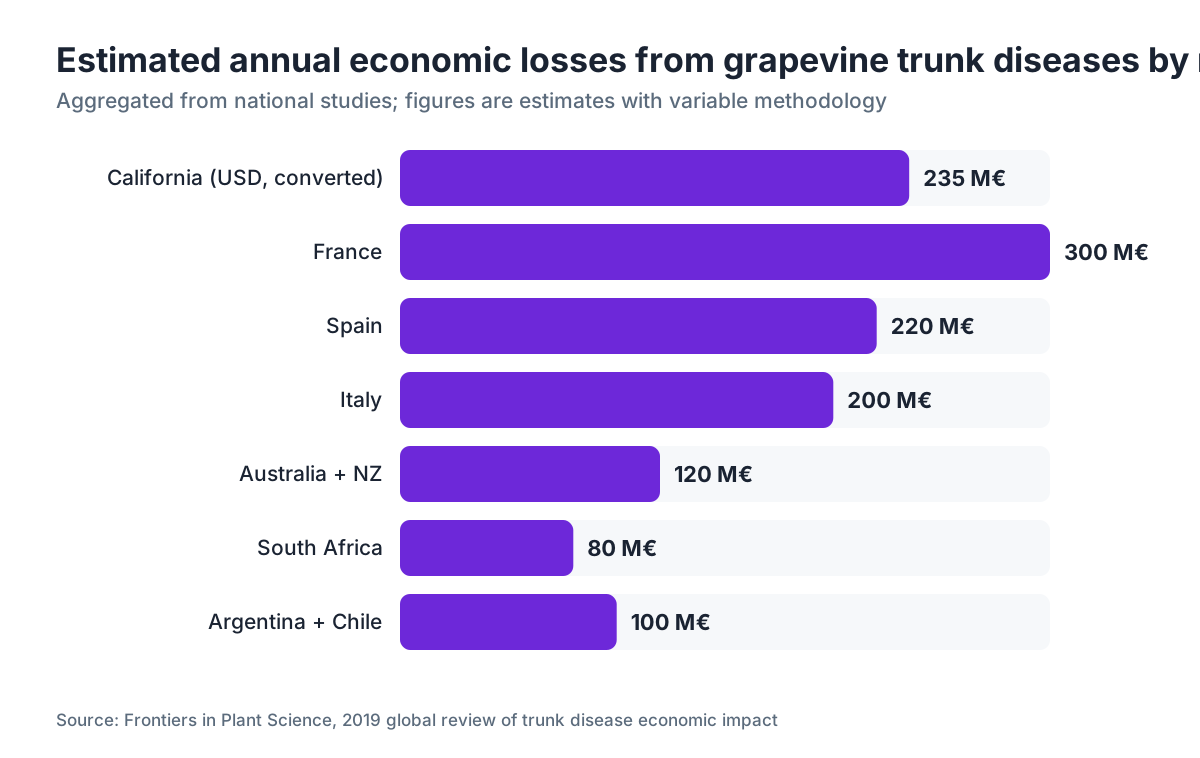
Nobody has great data on the full global cost because reporting is inconsistent across OIV member states. The closest global estimate comes from a 2019 review in Frontiers in Plant Science, which aggregated country-level studies and put annual economic losses above 1.5 billion euros globally, with the caveat that the studies used different methods and the number is an order of magnitude, not a precise figure [2].
The global economic loss from grapevine trunk diseases was estimated at more than 1.5 billion euros annually in a 2019 synthesis published in Frontiers in Plant Science, based on aggregated national studies from major wine-producing countries [2].
Are there resistant or tolerant grape varieties and rootstocks available?
This is an active research area with some early findings and no finished answers.
On the rootstock side, European trials show some rootstocks with lower infection rates or slower symptom progression against Esca-complex pathogens, but the results aren't consistent across regions or causal fungi. Rootstocks get selected for phylloxera resistance, drought tolerance, and vigor management, not trunk disease tolerance, so breeding programs haven't historically chased this trait.
On the scion side, Esca susceptibility varies by variety: Chardonnay, Cabernet Sauvignon, and Grenache rate as relatively susceptible based on field observations and some controlled studies. Carignan and Mourvedre show lower field incidence in Mediterranean regions, but whether that's genetic tolerance or management and site differences is hard to pull apart from field data alone.
The OIV resolution asks member state research programs to study genetic resistance mechanisms, and there are active breeding programs in France, Italy, Spain, and at UC Davis [1]. The payoff from those programs is probably a decade or more from commercial availability.
For now, pick rootstocks on the criteria where the data is solid: nematode tolerance, drought adaptation, vigor management for your site. Treating trunk disease tolerance as a primary selection criterion on current evidence gets ahead of the data.
What should your written trunk disease management plan include?
If you're in a sustainability certification or prepping for a GAP audit, expect to show a written IPM plan that names trunk diseases directly. Here's what the plan needs to cover to satisfy most auditor frameworks.
Start with a disease history for each block: which diseases are confirmed or suspected, when symptoms first showed, and what percentage of vines are affected. This is a living document, updated each season after dormancy and growing-season scouting.
Second, a scouting protocol: who scouts, how often, what they look for, and how results get recorded. Most sustainability programs want this tied to actual field records rather than a stated protocol.
Third, a pruning management protocol: timing targets for your region, whether you use double pruning, and your wound protectant program including product selection, application timing, and equipment.
Fourth, a nursery sourcing policy: where you source plant material and which disease-testing certifications you require from the nursery.
Fifth, a vine removal and replanting trigger: at what infection rate or symptom severity you pull a vine or a block. It doesn't have to be a rigid number, but auditors want a documented, consistent decision process.
For a vineyard that also makes its own wine, the documentation trail connects field decisions to cellar outcomes, and keeping both in one system cuts audit prep time a lot. The blocks at a property like Ponte Winery in Temecula or South Coast Winery in Temecula need the same scouting and record-keeping discipline as any north coast operation.
For growers in Central California wine country, the trunk disease pressure in Paso Robles wineries is real, and Botryosphaeria in particular has been a problem given the region's warm summers and vine stress cycles. Regional extension data from UC Cooperative Extension San Luis Obispo County is the right place to calibrate your local scouting thresholds.
Frequently asked questions
What is the OIV's official position on grapevine trunk diseases?
The OIV addressed trunk diseases formally in Resolution OIV-VITI 564-2016, recognizing them as a global threat to vineyard longevity and calling on member states to implement monitoring programs, support research, promote preventive cultural practices, and improve nursery certification standards. The resolution does not mandate specific products or practices but sets a policy framework that member country regulations then interpret.
Can grapevine trunk diseases be cured once a vine is infected?
No. There are no systemic fungicides registered in any major wine-producing country that can eliminate trunk disease fungi from established wood infections. Management after infection is limited to remedial surgery (cutting back to clean wood below the visible infection margin) or vine removal. Prevention before infection occurs is the only reliable strategy. The OIV resolution specifically acknowledges the absence of curative options.
How long do pruning wounds remain susceptible to trunk disease infection?
Susceptibility is highest in the first 24 to 72 hours after pruning. UC Davis research shows that wounds can remain susceptible for several weeks in cold, wet weather that slows the vine's callus response. Wound protectants need to be applied within hours of cutting to be effective, not days later. This is why delayed and double-pruning strategies reduce risk: the final wound is made when conditions are drier and warmer.
What wound protectant products are registered for use in US vineyards?
Thiophanate-methyl (e.g., Topsin-M) is the most widely registered chemical fungicide for pruning wound protection in US vineyards. Trichoderma-based biologicals (trade names vary by state) are also registered and evaluated in university trials. Registration status varies by state. Always verify current EPA registration and your state label before purchase. The product label is the legal document; apply only to sites and at rates listed on the label.
How do trunk diseases spread through nursery material?
Petri disease and black foot pathogens commonly arrive in infected nursery cuttings. Studies have found Phaeomoniella chlamydospora and Phaeoacremonium minimum in 30% to over 80% of commercial nursery cuttings in various surveys, depending on source and testing protocol. The OIV's 2016 resolution specifically calls for improved nursery certification and pathogen testing. Sourcing from certified clean-plant programs is the primary tool for preventing nursery-origin infections.
What is double pruning and does it actually reduce trunk disease?
Double pruning means making a rough cut first, leaving a longer stub, then returning for the final cut closer to bud swell. The stub sacrifices itself to early-season fungal exposure. UC Davis research found that this approach can reduce Eutypa lata infection rates by 50% or more compared to single-pass early pruning. It takes more labor passes through the block, but for high-value vines or blocks with known disease history it's worth the cost.
How do I scout for trunk diseases during the growing season?
Walk blocks at the 6 to 12 inch shoot stage in spring. Look for stunted, chlorotic, or distorted shoots at the base of canes (Eutypa and Botryosphaeria), and tiger-stripe leaf symptoms in midsummer (Esca). Mark symptomatic vines with flagging tape and record their location. Dormancy is the time to evaluate wood symptoms: make cross-section cuts on marked vines and look for dark wood discoloration or cankers. UC Davis and WSU extension publish scouting guides with photographs.
Does vine stress make trunk diseases worse?
Yes, particularly for Botryosphaeriaceae fungi, which are opportunistic pathogens that colonize water-stressed vines much more aggressively than well-watered ones. WSU Extension recommends maintaining adequate soil moisture during heat events as part of Botryosphaeria management. Drought stress, over-cropping, and nutrient deficiencies all compromise the vine's ability to produce the natural antimicrobial compounds that slow fungal colonization of wood tissue.
What EPA Worker Protection Standard requirements apply to trunk disease pesticide applications?
Under the EPA WPS (40 CFR Part 170), any pesticide application to a vineyard requires that application information be posted for workers: product name, location, application date and time, and restricted-entry interval. Workers must not enter the block before the REI expires unless using appropriate PPE. Applicators must hold valid certification for restricted-use products. California adds county agricultural commissioner reporting requirements on top of the federal baseline.
What's the economic impact of trunk diseases on a small vineyard?
UC Davis researchers estimated California's annual losses from trunk diseases at over 260 million dollars. A 2019 Frontiers in Plant Science review estimated global losses exceed 1.5 billion euros annually. At the block level, a 15% infection rate translates to a roughly equivalent loss of productive wood, plus replacement costs of 15,000 to 30,000 dollars per acre for California wine grapes (UC Cooperative Extension farm budget estimates). The financial case for prevention is straightforward.
How do I decide whether to do remedial surgery or replant infected vines?
Remedial surgery makes sense when vines are high-value, infection is caught early, and a clean cordon or trunk can be retrained from a healthy sucker. Cut at least 10 cm below any visible wood discoloration and confirm clean wood in the cross-section. When infection rates exceed roughly 20 to 30% of a block, replanting is usually more economical than vine-by-vine surgery. Vine age, variety value, and local replanting costs all factor into the decision.
Are some grape varieties more susceptible to trunk diseases than others?
Field observations suggest Chardonnay, Cabernet Sauvignon, and Grenache are relatively susceptible to Esca-complex diseases. Carignan and Mourvedre tend to show lower incidence in Mediterranean regions, though separating genetic tolerance from management and site effects is difficult. The OIV's 2016 resolution calls for research into genetic resistance mechanisms. Currently, no commercial variety can be selected primarily on the basis of trunk disease resistance with high confidence.
What records do I need to keep for trunk disease pesticide applications under California law?
California requires a pesticide use report submitted to the county agricultural commissioner's office each month for every pesticide application, covering product name, EPA registration number, application date, location, total area treated, and total product used. Records must be retained for three years. Under the EPA WPS, application-specific information must also be posted at a central location for workers. Missed submissions are the most common compliance violation found in routine audits.
Can trunk disease fungi survive in the soil and infect replanted vines?
Yes. Black foot pathogens (Dactylonectria and related genera) persist in soil associated with root debris from previous vineyard cycles and can infect young replanted vines directly. Soil fumigation or an extended fallow period before replanting reduces but does not eliminate this risk. Petri disease fungi can also persist in soil and old wood fragments. This is why site preparation protocols matter as much as nursery material quality for replant decisions.
Sources
- OIV, Resolution OIV-VITI 564-2016 on Grapevine Trunk Diseases: OIV formal recognition of trunk diseases as a global threat and policy framework for monitoring, prevention, and nursery certification
- Frontiers in Plant Science, 2019 review: 'Grapevine Trunk Diseases: A Review of the Most Economically Important Diseases': Global annual economic losses from trunk diseases estimated at more than 1.5 billion euros; pruning wounds identified as the primary infection court
- UC Integrated Pest Management Program (UC IPM), Grape Pest Management Guidelines: Trunk Diseases: California trunk disease losses estimated at over 260 million dollars annually; double pruning reduces Eutypa infection rates by 50% or more; thiophanate-methyl registered and effective for wound protection
- UC Agriculture and Natural Resources, Eutypa Dieback research and extension: Eutypa lata ascospores released during rain events travel up to 100 meters or more; infection rates are higher on wounds made early in dormancy vs late dormancy
- UC Cooperative Extension, Black Foot and Petri Disease of Grapevines: Black foot disease caused by Dactylonectria and related genera attacks roots and basal trunk of young vines; strongly associated with replant sites
- Cornell College of Agriculture and Life Sciences, Cornell Cooperative Extension viticulture program, trunk disease resources: Cornell emphasis on clean plant programs for Petri disease prevention; remedial surgery success depends on early intervention; timing models for Eutypa spore release in Northeast conditions
- Washington State University Extension, Viticulture Trunk Disease Management: Tool sterilization between vines recommended; Trichoderma-based biocontrols evaluated; irrigation management to reduce Botryosphaeria pressure identified as a management tool
- US EPA, Worker Protection Standard (40 CFR Part 170): WPS requires posting of application information including product, location, date, time, and REI; workers barred from treated area before REI expires; applicator certification required for restricted-use pesticides
- UC Agricultural and Resource Economics, Sample Costs to Establish a Vineyard and Produce Wine Grapes: Replanting cost for California wine grapes estimated at roughly 15,000 to 30,000 dollars per acre depending on variety, rootstock, and region
- California Department of Pesticide Regulation, Pesticide Use Reporting Program: California requires monthly pesticide use reports submitted to the county agricultural commissioner for every application; records must be retained three years
- UC Integrated Pest Management Program (UC IPM), Botryosphaeria Dieback of Grapevines: Neofusicoccum parvum and Diplodia seriata are common Botryosphaeriaceae species in California; drought years correlate with elevated Botryosphaeria pressure
- UC Agriculture and Natural Resources, Remedial Surgery Protocols for Trunk Diseases: Remedial surgery protocol requires cutting at least 10 cm below visible wood discoloration and protecting new cut surfaces with wound protectant
Last updated 2026-07-09