Grapevine yellows disease: causes, symptoms, and control
TL;DR
- Grapevine yellows is a group of phytoplasma diseases spread by leafhoppers and planthoppers.
- There is no cure.
- Infected vines decline and die within 3-5 years.
- Control means removing infected vines, suppressing insect vectors, and planting certified disease-free material.
- Two strains matter in the U.S.: Bois Noir, which is here, and Flavescence dorée, which is not yet established in North America.
What is grapevine yellows disease?
Grapevine yellows is not one disease. It's a shared name for a group of phytoplasma infections that attack the phloem tissue of grapevines and choke off the flow of sugars and nutrients from leaves to roots and fruit. Phytoplasmas are obligate parasites. They can't survive outside a living host or a living insect vector. They behave somewhere between bacteria and viruses, and they're a nuisance in the lab because you can't grow them on standard culture media.
The diseases in this group look alike, which is why growers and researchers lump them together. But the specific phytoplasma and the insect that carries it change with geography. Getting the diagnosis right matters, because some vectors you can manage and some you basically can't.
In the United States, the phytoplasma that costs growers the most is the Bois Noir strain, caused by 'Candidatus Phytoplasma solani' and carried by the planthopper Hyalesthes obsoletus [1]. Flavescence dorée is a different animal. It's a quarantine pathogen in Europe, caused by 'Ca. Phytoplasma vitis' and spread by the leafhopper Scaphoideus titanus, and it has not established in North America as of this writing. It stays on federal and many state regulated pest lists anyway [2]. Import vine material from Europe and this is the strain that triggers USDA-APHIS inspection.
A third player, the Aster Yellows group (16SrI), shows up now and then in North American vineyards. Its vector is the aster leafhopper, Macrosteles quadrilineatus, which feeds on a long list of weeds and crops. That wide host range makes source control genuinely hard.
What does grapevine yellows look like in the vineyard?
The symptoms are distinctive once you know them, but early on they read like nutrient deficiency or heat stress. That mistake costs you time, and time is the one thing you don't have with a phytoplasma.
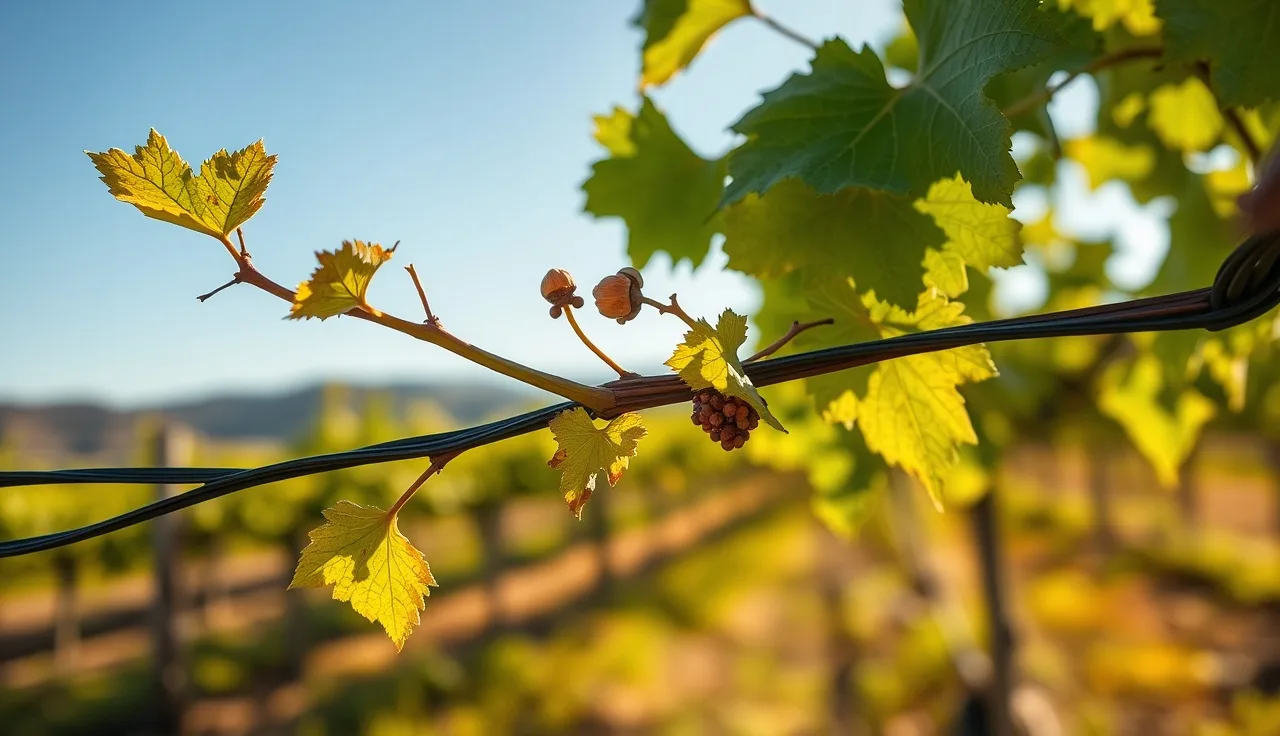
In white and green varieties, the classic sign is a uniform, brilliant yellowing of leaves, worst on the basal part of the shoot. In red varieties the same tissue turns red or purple instead, because the phytoplasma disrupts chlorophyll and anthocyanin differently depending on the cultivar's genetics [3]. This is the presentation growers photograph and carry to their farm advisor.
Other symptoms:
- Shoot tip dieback and failure to lignify (green shoots stay green into fall, never harden off, and die in the first frost)
- Berry shriveling and poor color
- Leaf rolling or downward curling at the margin, easy to confuse with leafroll virus (see below)
- Cluster abortion in bad infections
- Root decline you won't see above ground until the vine is already collapsing
The leaf curl symptom is exactly where grapevine yellows and grapevine leaf curl disease overlap by eye. Grapevine leafroll-associated viruses (GLRaV) cause similar downward curling of mature leaves, often with interveinal reddening in reds. The field tell is timing and shoot tips. Leafroll shows up late in the season and the shoot tips stay normal. Grapevine yellows tends to show mid-season and the shoot tips fail to lignify. A lab PCR test is the only way to be sure [4].
Symptoms come and go. A vine can look nearly clean one season and show full expression the next. That's one of the meaner traits of these diseases. Don't call a vine recovered because it looks better in spring.
How does grapevine yellows spread in a vineyard?
The disease moves two ways: through infected planting material and through insect vectors. Both matter, and most established outbreaks involve both.
Insect transmission drives spread within a block and from neighboring plants. The vector picks up the phytoplasma feeding on an infected plant, then carries it to a healthy vine on a later feed. Both the acquisition feed and the inoculation feed need a minimum time, usually several hours to days, depending on the phytoplasma-vector pairing [1]. Once infective, the insect stays infective for life. That's a big part of why vector numbers matter so much.
For Bois Noir, the vector Hyalesthes obsoletus prefers bindweed (Convolvulus arvensis) and stinging nettle (Urtica dioica) as its main hosts. Vines are a secondary, incidental host. A vineyard bordered by bindweed-choked roadsides or irrigation ditches carries real, ongoing inoculum pressure. Weed control in and around the vineyard is not cosmetic here [12].
Infected planting material is what carries the disease across regions. Dormant cuttings and rootstocks can hide phytoplasma with no symptoms, which is how new areas get seeded. That's exactly why USDA-APHIS requires certification and phytosanitary inspection for vine material crossing borders, and why UC Davis Foundation Plant Services keeps a virus-tested, phytoplasma-tested clean plant repository [5].
Grafting from an infected mother vine spreads it too. If your budwood block has undetected infections, you've distributed the problem across everything you propagate from it.
Which grapevine varieties are most susceptible to yellows?
Every Vitis vinifera variety is susceptible. No commercially planted vinifera is immune. Some varieties express symptoms more severely than others, but symptom severity is not the same as resistance. A variety that shows mild or on-and-off symptoms can still carry and transmit the pathogen.
Some American Vitis species and hybrid rootstocks tolerate infection better than vinifera, meaning they show fewer above-ground symptoms. That cuts both ways. An infected rootstock with no obvious signal is a hidden phytoplasma reservoir.
In European surveys, Chardonnay, Pinot Noir, and Barbera tend to show fast, severe expression with Flavescence dorée. Sangiovese and Garganega respond more variably in Italian data, but that variability probably reflects seasonal timing, vine vigor, and local vector pressure as much as any true varietal tolerance [6].
In California vineyards, where the Aster Yellows group is the main concern, the variety-by-variety pattern is poorly documented. See symptoms in a leafroll-susceptible variety, and confirm with PCR before you treat it as a phytoplasma problem.
How is grapevine yellows diagnosed accurately?
Visual symptoms are enough to put grapevine yellows on the list of suspects. They are not enough to confirm it or tell you which phytoplasma you've got.
The gold standard is PCR testing of leaf midribs or petioles from symptomatic tissue. PCR detects phytoplasma DNA, and sequencing or nested PCR then identifies the specific strain [4]. Your state ag lab or a certified private lab can run it. The Cornell Plant Disease Diagnostic Clinic and UC Davis plant pathology both handle these samples and publish their protocols.
Timing matters. Phytoplasma titer in leaf tissue peaks mid-season, usually July through August in most Northern Hemisphere wine regions. Sample in early spring or late fall and you can get a false negative from a truly infected vine. Pull tissue with clear symptoms, follow the lab's shipping instructions, and get it there fast, because phytoplasma DNA degrades in transit.
Electron microscopy can spot phytoplasma bodies in phloem, but it's expensive, slow, and pointless for routine screening. PCR replaced it in the field years ago.
Serology (ELISA) is used less for phytoplasmas than for viruses. Reliable commercial antibodies for all the relevant strains just aren't available.
If you farm in a state where Flavescence dorée is a regulated quarantine pest, a confirmed positive triggers mandatory reporting to your state department of agriculture. Know your state's reporting rules before you submit a sample, so the regulatory response doesn't blindside you [2].
Is there a cure for grapevine yellows?
No. There is no cure for a phytoplasma-infected vine in commercial production. That's the plain answer.
Tetracycline antibiotics do suppress phytoplasma activity and can bring symptom remission in treated trees and vines. Researchers use them, and some orchards have used them (for pear decline and other phytoplasma diseases). But tetracycline treatment of grapevines is not registered in the United States under EPA pesticide rules, you have to reapply it continuously to hold suppression, and residues in fruit and wine are a regulatory problem. Don't take a commercial vineyard down this road.
Hot water treatment of dormant cuttings at 50°C (122°F) for 45 minutes can eliminate or reduce phytoplasma in planting material [6]. That's a real tool in propagation nurseries and in programs rebuilding certified-clean mother blocks. It does nothing for infected vines already in the ground.
Thermotherapy (heating whole plants) has cleared phytoplasma from potted vines in trials but is impractical at vineyard scale.
Here's the honest calculus. Infected vines decline. Some fast, some slow. Every infected vine you keep in the ground is an inoculum source feeding vector transmission to its healthy neighbors. Roguing, removing and destroying infected vines, is standard practice wherever there's an active management program. The sooner you do it, the more of the block you protect.
How do you manage and prevent grapevine yellows in your vineyard?
Management is a system. No single tactic carries the load alone.
Use certified clean planting material. Prevention starts here. Sourcing vines from a foundation plant program with documented phytoplasma testing is non-negotiable if you're replanting in a region with known infection pressure. In California, UC Davis Foundation Plant Services keeps pathogen-tested nuclear stock [5]. Cornell's grape program provides the same kind of guidance for the East Coast, and WSU Extension covers the Pacific Northwest [9].
Control vectors. Insecticide sprays timed to leafhopper nymph emergence can cut vector numbers and slow spread, but they rarely stop transmission entirely. For Bois Noir, the main hosts of Hyalesthes obsoletus are weeds, so knocking back bindweed and nettle in and around the vineyard shrinks the reservoir of infective insects. Check your local insecticide registrations. The EPA Worker Protection Standard (40 CFR Part 170) sets re-entry intervals, PPE, and training requirements for any pesticide application in agriculture [7]. Make sure every crew member and spray contractor is WPS-trained before you apply anything.
Scout systematically. Walk blocks at least monthly from shoot emergence through veraison. Flag symptomatic vines with GPS coordinates or row and vine markers. A simple spreadsheet or a tool like VitiScribe lets you log flagged vines by block and track year-over-year spread, which is how you learn whether an infection sits isolated or keeps moving.
Rogue infected vines. Remove and destroy symptomatic vines once you've confirmed the diagnosis. In some European programs, roguing is mandatory. Even where it's voluntary, an infected vine left in place is a gift to your vector population.
Watch the neighbors. Phytoplasma ignores property lines. Border a neglected vineyard or a bindweed-heavy roadside and your risk stays live no matter what you do inside your own fence.
Replant with a plan. On rogued sites, use certified material, think about a fallow period to bleed off residual vector pressure, and log the replanting date and source in your records. That paper trail matters for any future regulatory inquiry and for tracking how the block performs over time.
What are the economic losses from grapevine yellows?
The economic hit is real and most vineyard budgets miss it, because the losses build slowly before they get obvious.
In European wine regions where Flavescence dorée is established, heavily affected blocks have shown 50-70% yield reduction in severe years, and some blocks have been abandoned outright [6]. Italy, France, and Slovenia have all reported serious damage in premium regions.
In U.S. vineyards, hard numbers on direct grapevine yellows losses are scarce. The disease is less common here than in Europe, and it often gets misdiagnosed or folded into leafroll virus losses. The University of California estimates leafroll-associated losses (a related but separate pathogen group) at up to $40,000 per acre over a vine's productive life in high-value California wine regions, a figure people sometimes cite as a comparable order of magnitude for phytoplasma risk [8]. That number covers both yield loss and the cost of replanting early.
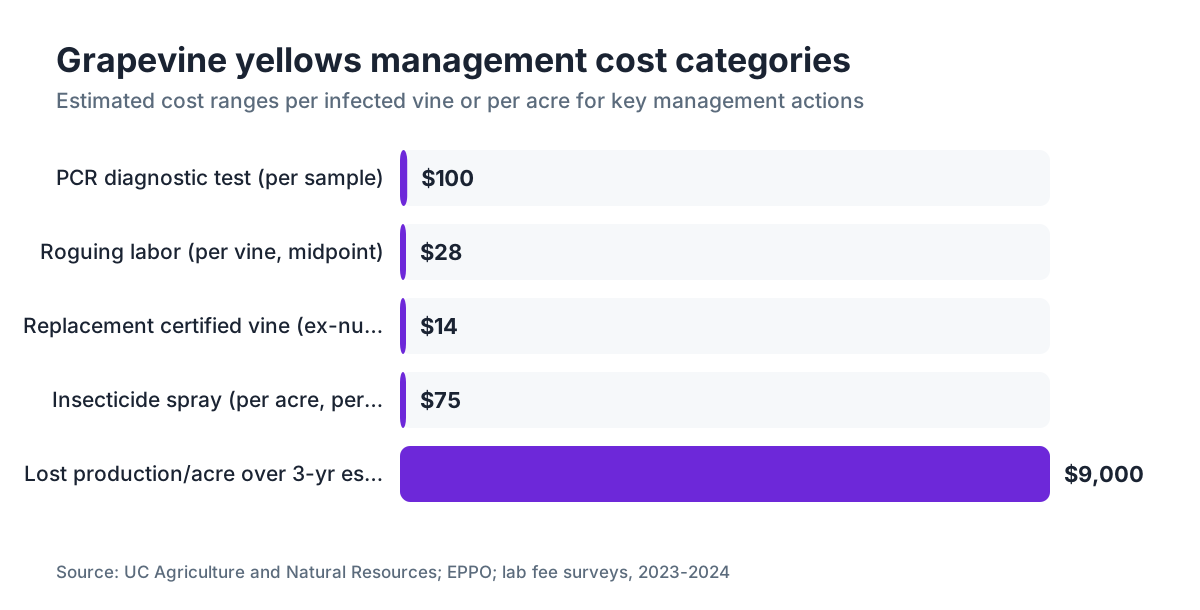
The indirect costs add up too: diagnostic testing ($50-150 per sample depending on lab and panel), roguing and replanting labor, vector sprays, and lost production while replacement vines establish (usually 3-5 years to return to commercial yield).
The table below sketches the cost categories in a mid-scale management program.
How do grapevine yellows differ from grapevine leafroll disease?
Growers mix these two up constantly, and it's an easy mistake. Both discolor leaves and hurt fruit quality. The management differs enough that the confusion costs money.
Grapevine leafroll-associated viruses (GLRaVs, especially GLRaV-3) are spread mainly by mealybugs and soft scale insects, not by leafhoppers or planthoppers [4]. So the control strategy for mealybug-vectored leafroll targets a completely different insect with its own biology, seasonal timing, and insecticide sensitivities.
Symptom timing differs. Leafroll usually shows up in late summer through harvest, starting with older basal leaves and climbing upward. Grapevine yellows often appears earlier and hits shoot tips harder, with the lignification failure that leafroll never causes.
Leafroll is a virus, which means it behaves differently at the cellular level and won't show up on phytoplasma-specific PCR. Labs run separate panels for viruses and phytoplasmas. Submitting samples and want to rule out both? Ask for both.
The two diseases share the clean-planting-material defense. Both move through infected propagation material. Neither has a cure once it's in an established vine. Farm in a high-pressure region for both and the case for certified source material and systematic scouting only gets stronger.
What do extension programs and regulators say growers should do?
The guidance from university extension programs runs pretty consistent across the major grape regions, with some state-specific regulatory add-ons.
UC Davis recommends sourcing planting material only from foundation plant programs with current phytoplasma and virus indexing, monitoring established vineyards systematically, and removing symptomatic vines promptly [5]. Their IPM program covers phytoplasma in the grape disease section with specific advice on sampling and vector management.
Cornell's viticulture program covers grapevine yellows under grape diseases and stresses how weak symptom-based diagnosis is on its own, so lab confirmation should come before any roguing decision [4]. They note that in the northeastern United States, Aster Yellows phytoplasma is the strain you're most likely to meet in grapes, with aster leafhopper as the main vector.
WSU Extension covers phytoplasma diseases for the Pacific Northwest, where cooler climates and different weed flora shift the vector dynamics compared with California [9].
On the regulatory side, USDA-APHIS keeps Flavescence dorée on its regulated pest lists because of what it could do to the U.S. wine grape industry if it establishes [2]. Several states, California included, maintain their own regulated plant pest lists that include Flavescence dorée. A confirmed positive in your vineyard means a mandatory report to your state department of agriculture, likely followed by an official inspection and possibly mandatory roguing of confirmed-positive vines [11].
The EPA Worker Protection Standard (40 CFR Part 170) governs how insecticide applications for vector control get handled on the worker safety side [7]. All agricultural handlers and early-entry workers must have WPS training. Spray records, safety data sheets, and re-entry interval documentation belong in your compliance file whether or not your state layers on extra pesticide record-keeping rules. Keep these records at least two years, the federal minimum. Many state programs require longer.
For growers who want one place to log spray events, flagged vines, scouting notes, and compliance records, a field operations tool like VitiScribe can tie those streams together, so what you find in the vineyard links straight to your spray records and compliance file.
How should you set up a vineyard scouting program for grapevine yellows?
A scouting program for grapevine yellows doesn't need to be fancy. It needs to be consistent and written down.
Start with a base map of your blocks with individual vine positions marked. Skip the expensive GIS. A row-and-vine numbering system on paper or a spreadsheet gets you 90% of the value. What matters is that a symptomatic vine lands at a specific recorded location, more than in your memory.
Scout monthly from shoot emergence through harvest. Peak symptom expression comes mid-summer. In the early weeks, you're mostly hunting for vines that failed to push normally, which can be an early flag for a severe phytoplasma infection carried over from the prior season.
Record what you see: leaf color, leaf roll, lignification status of shoot tips, cluster development. Take photos. With a mobile scouting app, geo-tagged photos become a multi-year timeline of block health, which is genuinely useful when you're trying to tell whether an infection is expanding or holding steady.
For blocks with confirmed or suspected phytoplasma history, tighten scouting to every two weeks in July and August. Flag vines for lab sampling if they show yellowing, reddening, or shoot tip failure you can't pin on another cause. Submit samples promptly.
Track vector pressure too. Yellow sticky traps help you monitor leafhopper and planthopper activity across the season. Match trap counts against symptom timing and you get the information you need to time any insecticide you decide to use.
At season's end, summarize flagged vine locations, lab results, and any roguing you did. That end-of-season record becomes next year's scouting map and feeds straight into your vineyard compliance documentation.
Frequently asked questions
Can grapevine yellows be cured with tetracycline antibiotics?
Tetracycline suppresses phytoplasma activity and causes symptom remission in some hosts, but it's not registered for use on grapevines in the United States, it must be reapplied continuously, and residues in fruit pose a regulatory problem. There is no approved cure for established phytoplasma infections in commercial U.S. vineyards.
How do I tell grapevine yellows apart from nutrient deficiency?
Yellowing from nutrient deficiency (magnesium, nitrogen, potassium) usually follows interveinal patterns or starts at specific leaf positions depending on element mobility. Grapevine yellows produces more uniform yellowing or reddening across the whole leaf blade, plus shoot tip failure to lignify. A soil test rules out deficiency; PCR testing confirms phytoplasma.
Is Flavescence dorée present in U.S. vineyards?
As of this writing, Flavescence dorée is not established in North America. It's a regulated quarantine pest under USDA-APHIS rules. Importing vine material from Europe triggers phytosanitary inspection for exactly this reason. Any suspected detection must be reported to your state department of agriculture immediately.
What insects spread grapevine yellows in California?
In California, the Bois Noir strain is associated with the planthopper Hyalesthes obsoletus, which feeds mostly on bindweed and stinging nettle. The aster leafhopper (Macrosteles quadrilineatus) can transmit Aster Yellows phytoplasma to grapevines. Leafhopper population management and weed control for those primary host plants are both part of the strategy.
How long does it take a vine to die from grapevine yellows?
There's real variability here, and nobody has clean survival-curve data for U.S. conditions across varieties. European observations for severe Flavescence dorée infections suggest vine death within 3-5 years. Bois Noir tends to decline slower in some cases. Vine vigor, rootstock, and annual vector pressure all shift the timeline.
What's the difference between grapevine yellows and grapevine leaf curl disease?
Grapevine leafroll disease is caused by viruses (primarily GLRaV-3) spread by mealybugs and soft scale. Grapevine yellows is caused by phytoplasmas spread by leafhoppers and planthoppers. Both cause leaf curling and discoloration in red varieties, but leafroll doesn't cause shoot tip lignification failure. Separate PCR tests detect each pathogen group.
Do I have to report grapevine yellows to the state?
Mandatory reporting depends on which phytoplasma and which state. Flavescence dorée is a regulated quarantine pest; a confirmed positive requires immediate reporting to your state department of agriculture in most states. Bois Noir and Aster Yellows phytoplasmas generally aren't regulated the same way, but check your state's current regulated pest list because it changes.
What certified clean plant programs exist for grapevines in the U.S.?
UC Davis Foundation Plant Services maintains nuclear stock of grapevines tested for phytoplasmas and viruses and supplies clean budwood to registered California nurseries. Cornell's program serves the East Coast. The National Clean Plant Network coordinates across regions. Buying certified-clean material is the most reliable prevention available.
How much does PCR testing for phytoplasma cost?
Expect roughly $50-150 per sample depending on the lab and whether you run a single phytoplasma panel or a combined virus and phytoplasma screen. University extension diagnostic labs often cost less than private labs. Sample enough vines to characterize the block, more than the one vine that caught your eye.
When is the best time to sample vines for phytoplasma testing?
Mid-season, usually July through August in Northern Hemisphere wine regions. Phytoplasma concentrations in leaf tissue peak during active symptom expression. Samples pulled in early spring or late fall often come back false negative because titer drops when the vine slows its growth. Sample from symptomatic tissue and follow the lab's shipping instructions carefully.
Can I replant immediately after removing an infected vine?
You can, but consider a short fallow period to reduce residual vector pressure, especially if the neighboring vegetation harbors Hyalesthes obsoletus. Handle weed management in the replant site and the surrounding area first. Use certified-clean material for the replacement vine and document its source in your records.
Does hot water treatment work for phytoplasma in dormant cuttings?
Yes, in propagation contexts. Soaking dormant cuttings at 50°C (122°F) for 45 minutes can eliminate or sharply reduce phytoplasma. Nursery programs use it to produce clean planting material. It does nothing for established vines in the field and isn't practical as a field treatment.
Sources
- EPPO Global Database - Hyalesthes obsoletus fact sheet: Hyalesthes obsoletus is the primary vector of Bois Noir phytoplasma ('Ca. Phytoplasma solani'); vector feeds on bindweed and stinging nettle as primary hosts and transmits phytoplasma to grapevines as a secondary host
- UC Davis Statewide IPM Program - Grapevine Disease Management: Red varieties show reddening/purpling of phytoplasma-affected leaves; white/green varieties show yellow discoloration; shoot tip failure to lignify is a key distinguishing symptom from other disorders
- Cornell University Plant Disease Diagnostic Clinic - Grape Disease Resources: PCR testing of leaf midribs is the gold standard for confirming phytoplasma infection and distinguishing it from grapevine leafroll viruses; symptom-based diagnosis alone is insufficient
- UC Davis Foundation Plant Services - Grapevine Program: UC Davis Foundation Plant Services maintains pathogen-tested nuclear stock of grapevines and provides phytoplasma-indexed clean budwood to registered California nurseries
- Bertaccini et al., 2019 - Phytoplasmas and Phytoplasma Diseases in Agriculture, Agronomy Journal: Flavescence dorée has caused 50-70% yield losses in severely affected European vineyard blocks; hot water treatment at 50°C for 45 minutes eliminates phytoplasma in dormant cuttings; Chardonnay, Pinot Noir, and Barbera show particularly severe symptom expression
- EPA Worker Protection Standard - 40 CFR Part 170: The EPA Worker Protection Standard (40 CFR Part 170) requires training, PPE, and re-entry interval compliance for all agricultural pesticide applications including insecticide sprays for leafhopper vector control
- UC Agriculture and Natural Resources - Grape Leafroll Disease Economic Impact: University of California estimates leafroll-associated losses at up to $40,000 per acre over a vine's productive life in high-value California wine regions; used as a comparable order of magnitude for phytoplasma economic risk
- WSU Extension - Grape Pest Management Guide: WSU Extension covers phytoplasma diseases in Pacific Northwest grapes, noting that vector dynamics and weed flora differ from California conditions
- National Clean Plant Network - Grapevine Program: The National Clean Plant Network coordinates clean grapevine foundation programs across U.S. regions to ensure access to phytoplasma- and virus-tested propagation material
- EPPO - Flavescence dorée Pathogen Data Sheet: Flavescence dorée is transmitted by Scaphoideus titanus leafhopper; not established in North America; mandatory roguing is required in countries with active eradication programs
- Maixner, 2011 - Bois Noir epidemiology and vector ecology, Vitis Journal: Bois Noir (Candidatus Phytoplasma solani) has Hyalesthes obsoletus as primary vector; vector's strong preference for Convolvulus arvensis (bindweed) makes weed management central to disease control
Last updated 2026-07-10